
Tag: difficult conversations

07 Apr 2026

Team Performance Review Presentation: The Difficult Conversation Deck

Quick answer: A team performance review presentation becomes a senior leadership concern when individual underperformance has operational consequences the board or executive committee needs to understand. The most effective structure separates context from judgement, uses specific dated evidence rather than impressions, and frames the conversation around forward expectations rather than backward blame — protecting both the individual and the organisation’s credibility.

Henrik had managed the same regional sales team for four years. He knew his people well — knew their habits, their strengths, their reasons for every missed quarter. When his Head of Sales asked him to present to the executive committee on his team’s performance, Henrik assumed it would be a routine briefing: numbers, trends, actions taken.

What he had not anticipated was the level of specificity the committee would demand. The Managing Director wanted to understand why the same two members of the team had missed target for three consecutive quarters, what actions had been taken, what the timeline for resolution looked like, and what the contingency plan was if performance did not improve. Henrik had taken those actions. He had documented conversations, adjusted targets, provided coaching. What he hadn’t done was structure that information in a way that was legible to an executive audience.

His deck, built as a team-wide performance summary, didn’t answer the questions the committee was actually asking. By the third slide, the MD had stopped referring to the deck and was asking Henrik questions directly. The conversation became reactive rather than structured — and the impression Henrik left was of someone who understood the problem but had not thought through the resolution.

Presenting on team performance at executive level requires a different structure from managing team performance at operational level. The audience is asking different questions, with different authority, and different consequences attached to the answers.

Preparing for a leadership presentation on team performance?

The Executive Slide System includes slide templates and scenario playbooks designed for sensitive operational presentations — including performance conversations that need to hold up under board-level scrutiny.

Explore the System →

When a Conversation Becomes a Presentation

Most team performance conversations happen in one-to-ones, performance review meetings, and informal corridor discussions. These are bilateral conversations between a manager and a team member. They require different skills — active listening, empathy calibration, clear boundary-setting — but they don’t typically require a formal presentation structure.

A team performance review becomes a presentation when one of three conditions applies. First, when the performance issue has escalated to the point where senior leadership or the board needs to be informed — either because of operational risk, regulatory exposure, or reputational concern. Second, when an HR or legal process requires a documented record of performance management actions, and a formal presentation constitutes that record. Third, when a restructuring or team change is being proposed and the performance context provides the operational rationale for the structural decision.

In all three cases, the audience is no longer the individual being managed — it is a leadership or governance body that needs to understand the situation, assess the risk, and make a decision. The skills required shift from interpersonal management to executive communication. The structure of your deck needs to match that shift.

When Team Performance Becomes a Senior Leadership Issue

Senior leadership takes an interest in team performance when it ceases to be a management problem and becomes an organisational risk. Understanding the thresholds at which this transition occurs helps you anticipate when a formal presentation will be required — and prepare accordingly rather than reactively.

Revenue or delivery risk. When underperformance in a team threatens a client commitment, a revenue forecast, or a regulatory deadline, it becomes visible at board or executive committee level. The question the board asks is not “what is wrong with this person?” — it is “what is the impact on our commitments and what is the plan to manage it?”

Regulatory or compliance exposure. In regulated industries, individual performance failures can create regulatory risk — particularly if the individual has client-facing, authorised, or sign-off responsibilities. A presentation to the board’s risk or audit committee may be required to demonstrate that the organisation identified the issue, managed it appropriately, and has controls in place to prevent recurrence.

Precedent or culture concern. When a senior or long-serving team member is underperforming and leadership is considering action, the board may be briefed because the decision creates a precedent — particularly in a restructuring context. For guidance on the broader restructuring presentation, see this framework for presenting restructuring decisions while maintaining team trust.

In each scenario, the presentation requirement emerges quickly — often within days of a decision being made to escalate. Having a clear structural template prepared in advance reduces the risk of a poorly composed deck under time pressure.

The Four Components of an Effective Performance Review Deck

The structure below works across the full range of team performance presentation contexts — from board briefings to HR panel reviews to executive committee updates. Each component serves a specific function in the executive’s understanding of the situation.
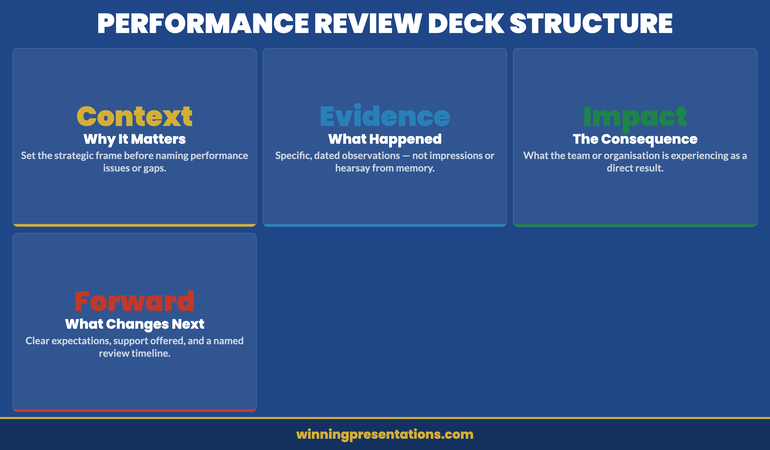
Four-component framework for structuring an executive team performance review presentation

Component one — Context. Before naming the performance issue, establish the strategic frame. What is the team’s role in the organisation? What are their key deliverables? What targets or standards apply? This component ensures that the executive audience has a common reference point before evaluating the performance data. It also signals that your presentation is objective rather than personal — you are presenting against agreed standards, not individual preference.

Component two — Evidence. Present specific, dated observations of the performance concern. The most credible evidence is quantitative — missed targets, delivery failures, client complaints, safety incidents. Where quantitative data is unavailable, use dated written records: meeting notes, email exchanges, formal review documentation. Impressions and recollections carry little weight with an executive audience and invite challenge.

Component three — Impact. Translate the performance data into organisational consequence. What is the team, the client relationship, or the broader organisation experiencing as a result of the underperformance? Impact is the bridge between the individual’s behaviour and the leadership body’s remit. Without a clear impact statement, the board or executive committee has no basis for involvement — the issue remains a line-management matter.

Component four — Forward path. Close with clear expectations for the period ahead, the support being offered, and the review timeline. The forward path demonstrates that you have moved from diagnosis to management — and gives the leadership body something to endorse rather than a problem to resolve for you. A specific timeline with named review points is more credible than a general commitment to improve the situation.

The Executive Slide System

Slide templates and scenario playbooks designed for executive presentations that require precise framing — including sensitive operational and people decisions.

  • Slide templates designed for operational review and leadership briefings
  • AI prompt cards to structure difficult-topic presentations quickly
  • Framework guides for presenting sensitive decisions to executive audiences
  • Scenario playbooks for board updates, HR escalations, and risk briefings

Get the Executive Slide System — £39

Designed for executives presenting operational and people decisions to senior leadership.

Delivering Difficult Messages Without Losing Authority

The most common failure mode in team performance presentations is over-softening. The presenter, uncomfortable with the difficult message, introduces so many qualifications and contextual caveats that the core message becomes unclear. An executive audience that cannot determine whether you are describing a serious performance concern or a temporary dip in a capable team member’s output cannot make the decision they need to make.

Be specific about the standard that was missed. “Performance has been below expectations” tells the board very little. “Sales conversion was 32% against a team target of 55% across Q1 and Q2” gives them something concrete to evaluate. Specific evidence is not harsher than vague evidence — it is more honest, and it protects you from the accusation of subjective judgement.

Separate the person from the position. The most professionally robust performance presentations focus on the role’s requirements and the observed gap — not on the individual’s character, motivation, or attitude. “The role requires X. The observed performance on X has been Y for the following documented period” is more defensible and more persuasive than any formulation that attributes the gap to the individual’s personal qualities.

Present the management actions you have taken. An executive audience needs to understand what you, as the presenting leader, have done to address the performance concern before bringing it to their attention. The implicit question behind every escalated performance presentation is: “Has the manager done everything within their authority to resolve this?” If the answer is yes, the escalation is credible. If the answer is not yet, the board will question why the matter has been escalated prematurely.

The Executive Slide System includes scenario playbooks for operational presentations to senior leadership, including frameworks for structuring sensitive people decisions.

Managing Defensive Reactions in the Room

Performance presentations to a leadership or governance body can generate defensive reactions — not always from the individual being discussed, but from other leaders in the room who have their own stake in the situation. A long-serving team member may have advocates at executive level. A performance concern that reflects on the quality of previous leadership decisions may be met with resistance from those who made those decisions. Being prepared for these dynamics is as important as being prepared for the content.
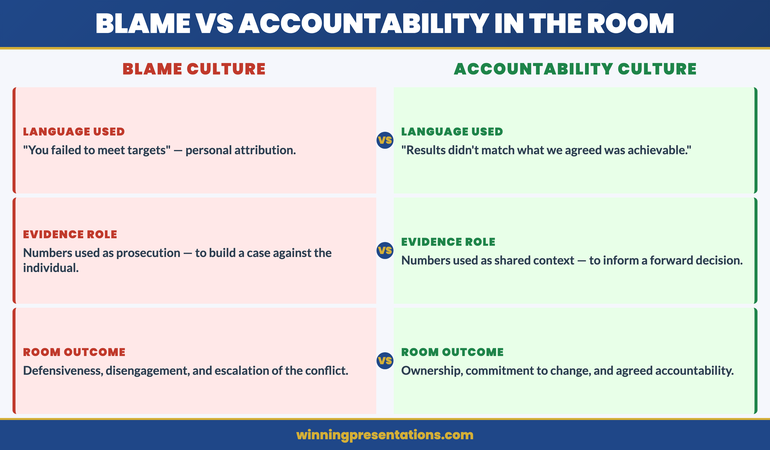
Contrast between blame culture and accountability culture approaches to team performance presentations

Distinguish between a response that seeks information and one that seeks to discredit. A question like “what support has been offered?” is information-seeking — the executive wants to know whether due process has been followed. A question like “isn’t this a management problem rather than a performance problem?” is often an attempt to redirect accountability. The first deserves a direct, detailed answer. The second deserves a measured response that acknowledges the management dimension while maintaining the performance narrative.

Never make commitments in the room that you haven’t modelled. Under social pressure from a defensive executive, the impulse to concede — to agree that more time should be given, or that the targets should be reviewed — can feel like a way to reduce conflict in the moment. It is rarely a sound operational decision. If you need to consider a proposed change to the performance management plan, commit to modelling the impact and returning within a specific timeframe, rather than agreeing on the spot.

Bring the conversation back to organisational impact. When the room becomes focused on the individual’s personal circumstances or on historical decisions, the most effective re-framing is to return to the organisational impact statement. “I understand the context. The question for this committee is what we do about the fact that [named outcome] is at risk.” This shifts the frame from blame to decision — which is where executive committees are most effective. The principles here align with those in the companion piece on presenting redundancy announcements to affected teams.

The Post-Presentation Follow-Up That Makes It Stick

The performance review presentation creates commitments — from you, from the individual concerned (if present), and from the leadership body. The post-presentation follow-up determines whether those commitments are honoured or allowed to fade. There are three elements to an effective follow-up process.

A written record of decisions made. Within 24 hours of the presentation, send a summary of the decisions taken and actions agreed in the meeting. This serves as a contemporaneous record — which matters both for due process and for accountability. The summary should be factual and outcome-focused, not a narrative account of the discussion.

A direct conversation with the individual. If the individual was not present in the executive presentation, they need to be informed of the leadership body’s assessment and decisions as soon as possible — typically within the same working day. The individual should hear the outcome directly from their manager, not through informal channels. The conversation should align precisely with the written record: the same language, the same commitments, the same timeline.

A structured review checkpoint. The performance improvement plan that follows should have a named review date — typically 30, 60, or 90 days, depending on the severity of the concern. This checkpoint should be diarised at the time of the presentation, with the expectation that you will return to the executive body with a progress update at that point. This creates accountability for both the manager and the individual, and demonstrates to the board that the issue is being actively managed rather than filed.

Protecting Yourself Legally and Professionally

Performance presentations at executive level create a paper trail that may become relevant in subsequent employment proceedings. The way you present the information — and the language you use — has implications that extend beyond the meeting. There are four principles that protect your professional and legal position.

Use documented evidence only. Do not include in your presentation any assertion, characterisation, or concern that does not exist in a contemporaneous written record. The moment an executive presentation introduces information that was never documented at the time it occurred, you create credibility risk — and potentially legal risk if the matter escalates to an employment tribunal.

Involve HR before the presentation. HR should be consulted on both the process and the content of any performance presentation to a leadership body. This is not bureaucratic caution — it is risk management. HR will often identify procedural gaps that, if not addressed before the presentation, create grounds for challenge later.

Be consistent in application. An executive audience will assess whether your performance management approach has been applied consistently across the team. If the individual being discussed has been managed more leniently or more harshly than colleagues in comparable situations, this inconsistency will be visible — and will invite questions about whether the performance concern reflects a genuine standard gap or a management preference. The broader context of leadership credibility in high-stakes presentations is covered in the guide to building credibility in your first board presentation in a new role.

Do not speculate about outcome. In the presentation itself, do not reference possible termination, demotion, or other employment outcomes unless these have been agreed in advance with HR and legal as appropriate disclosures. Speculating about employment consequences in an executive presentation — even informally — can prejudice a subsequent process.

Structure Your Next Leadership Briefing

The Executive Slide System includes framework guides for structuring operational presentations — including sensitive situations that need to hold up under board-level and HR scrutiny.

View the Executive Slide System — £39

Designed for executives preparing operational briefings for senior leadership.

Frequently Asked Questions

Should the individual being reviewed be present in an executive-level performance presentation?

This depends on the nature and purpose of the presentation. If the purpose is to brief a leadership body on an operational risk situation, the individual is typically not present — the presentation is a management briefing, not a performance review meeting. If the presentation is part of a formal HR process and the individual has a right to attend or be represented, HR will advise on the appropriate protocol. As a general principle, decisions about individual presence should be made with HR guidance before the presentation, not during it.

How do I present performance concerns without being accused of bias or discrimination?

The most effective protection against bias accusations is a structure that is entirely evidence-based and explicitly linked to agreed standards. When every assertion in your presentation can be traced to a documented record, a named target, or a published standard, the presentation becomes an analysis of a gap rather than a judgement about a person. Consistency is equally important: ensure that the performance management approach you describe has been applied in the same way to comparable situations across the team.

What should I do if the executive committee disagrees with my assessment?

Listen carefully to the basis of their disagreement. If they have information you do not — about the individual’s context, about commitments made at a higher level, about strategic considerations that affect the assessment — that information is relevant and you should factor it in. If the disagreement is about the interpretation of evidence that you and HR are confident in, present the evidence clearly and request that any decision to deviate from the recommended management approach be made explicit and minuted. You are not required to change your assessment in response to social pressure, but you are required to implement whatever decision the governance body makes within its authority.

The Winning Edge — Weekly Newsletter

Executive presentation strategy, delivered every Thursday. Practical frameworks for high-stakes operational and leadership conversations.

Subscribe to The Winning Edge

Free resource: Executive Presentation Checklist — a practical pre-meeting audit for high-stakes leadership presentations.

About the Author

Mary Beth Hazeldine is Owner & Managing Director of Winning Presentations. With 24 years of corporate banking experience at JPMorgan Chase, PwC, Royal Bank of Scotland, and Commerzbank, she advises executives across financial services, healthcare, technology, and government on structuring presentations for high-stakes funding rounds and approvals. Connect at winningpresentations.com.

26 Mar 2026
Executive standing at a podium in a corporate meeting room preparing to deliver a difficult announcement to staff

How to Announce Redundancies With Executive Credibility

When you announce redundancies poorly, trust collapses. Employees hear dismissal instead of strategy. Remaining staff question their own security. Within hours, your credibility has eroded across the entire organisation. The difference between a managed redundancy announcement and a crisis lies in one thing: structure. This article walks you through the slide framework, language choices, and executive positioning that transforms a difficult conversation into a demonstration of leadership integrity.

You’re handling the hardest conversation your organisation will have.

Without a clear framework, redundancy announcements backfire. The Executive Slide System gives you the architecture, language patterns, and credibility cues that demonstrate leadership under pressure.

Get the Framework → £39

A Real Scenario

Margaux leads a financial services team of 18 people. Three months ago, her organisation decided to consolidate two teams due to market conditions. She has two hours to announce the redundancy programme to her department. Her hand shakes as she opens the presentation editor. Without a clear structure, she’s terrified she’ll create panic or appear defensive. She knows that how she frames this—the words she uses, the evidence she presents, the dignity she conveys—will determine whether her team remains functional or fractures. She needs a framework that demonstrates leadership, not just delivery of bad news.

The Three-Part Structure That Maintains Credibility

A redundancy announcement breaks into three distinct parts, and each serves a different purpose. If you skip or collapse any of them, credibility suffers. The first part is context—not excuses, but the business reality that forced this decision. The second is the actual redundancy information: who, when, and support available. The third is organisational clarity: how the remaining structure works and what comes next.

Most executives compress these into one blur. Employees can’t hear the support offer because they’re still processing the shock of redundancy. Remaining staff can’t think about restructuring because they’re anxious about their own jobs. By separating these three movements, you give your audience time to absorb each layer.

Redundancy Announcement roadmap infographic showing four milestones on a winding path: Acknowledge, Explain Why, Detail Support, and Next Steps — each with concise guidance for structuring the announcement

The Executive Slide System for £39

This is exactly what you get:

  • Pre-built slides for difficult conversations (redundancy, restructuring, crisis)
  • AI prompts to draft your specific language and messaging
  • Executive frameworks for maintaining credibility under pressure
  • Delivery checklists and tone guidance
  • Customisable slide templates for your organisation’s data

Used by thousands of executives. 24 years corporate banking experience embedded in every slide.

Get the Executive Slide System → £39

Setting Context Without Fear

The first slide must answer: Why are we here? Not in a defensive way—that reads as justification and triggers defensiveness. Instead, present the business reality with clarity and confidence. Market shift, strategic consolidation, efficiency requirement. Name it directly.

This is where many executives falter. They soften the language: “We’re exploring some structural changes” or “We’re looking at ways to streamline.” Soft language creates anxiety because employees hear euphemism, which they interpret as weakness or deception. Instead, use direct language: “The market environment has shifted, requiring us to restructure our team capacity.”

The context slide should show evidence—market data, financial position, strategic necessity—that demonstrates this decision wasn’t arbitrary. This isn’t about overjustifying; it’s about showing that leadership has done its homework. When employees see evidence, they understand the decision wasn’t personal or reactive. That distinction matters enormously for credibility. For more on how trust forms during restructuring, see our article on restructuring presentations that rebuild team trust.

Language That Demonstrates Respect

This is the section that defines how people remember this conversation. The language you choose here either demonstrates respect or appears callous. Small word choices matter enormously.

Never use: “Unfortunately”, “Regrettably” (these signal pity, not respect), “Let go” (too informal for the gravity), “Transition” (vague), “Affected staff” (dehumanising). Instead use: “Colleagues who are redundant”, “Support package”, “Outplacement services”, “Career transition services”.

When you name people, use full language: “Jane and Marcus in the client services team are redundant as of [date].” Not “Jane and Marcus’s roles are redundant.” This subtle shift—making it about the person’s transition, not just eliminating the role—preserves dignity. The redundancy is a business reality; the individual deserves respect throughout the process.

Support information must be crystal clear. Don’t bury severance details. Present them as a numbered list: notice period, financial package, benefits continuation timeline, outplacement support, reference provision. When people hear the exact details, anxiety drops because there’s clarity instead of ambiguity. You might also review how town hall presentations rebuild trust after layoffs.

Which language choice demonstrates credibility in a redundancy announcement? The Executive Slide System includes word-by-word language patterns that show respect without appearing weak, direct without appearing harsh.

Clear Next Steps and Organisational Clarity

After the redundancy information, remaining staff need to understand what the organisation looks like now. This is where many executives hesitate because the full restructure might not be finalised. But leaving this vague is worse than sharing partial information.

Provide what you know: the new team structure, reporting lines, any immediate role changes. Then be explicit about what’s still being determined and when staff will hear more. “We’re currently finalising the new team structure for the London office. All staff will receive their updated role descriptions by [date].” This creates expectation and prevents rumour-filling.

The final slide must answer: What does success look like, and what’s my role in it? This gives the audience something forward-looking to hold onto. It moves the conversation from loss to clarity about the future state. This is the foundation for maintaining morale and productivity during restructuring.

Crisis Communications Require Structure

When you’re announcing something difficult, the framework is what keeps credibility intact. Redundancy announcements, restructuring communications, even client escalations follow the same principle: clarity, respect, evidence. The system works because it’s built on how senior leadership actually thinks.

Delivering With Authority, Not Defensiveness

The delivery matters as much as the content. Most executives make one critical error: they apologise for the announcement rather than owning it. “I’m really sorry we’re in this position” reads as weakness. “This decision reflects our responsibility to the organisation and its future” reads as leadership.

Your tone should be: steady, matter-of-fact, respectful. This isn’t enthusiasm (which would be inappropriate), but it’s not doom either. You’re speaking as someone who has thought through this decision carefully and is implementing it responsibly.

Pause after delivering key information. Let it land. Don’t fill silence with nervous talking. A three-second pause after you’ve named the redundancies gives people a moment to absorb. Then move to the next point. This rhythm—information, pause, next point—demonstrates control and confidence.

Redundancy Language contrast panels infographic comparing corporate speak (rightsizing, HR will be in touch, we appreciate your understanding) against direct and honest alternatives (naming the number, specific packages, open questions)

Is This Right For You?

Use this framework if you’re:

  • Announcing redundancies to your department or division
  • Leading a restructuring conversation with multiple teams
  • Communicating organisational change to staff or stakeholders
  • Concerned about maintaining credibility during difficult business decisions
  • Wanting to protect team morale whilst delivering tough news

If you’re in HR preparing guidance or comms preparing enterprise-wide messaging, you’ll need additional elements. But if you’re the leader delivering this to your team, this framework is built for exactly your situation.

Lifetime Access to the System

You get slide templates for redundancy announcements, restructuring communications, crisis briefings, and all difficult conversations. Plus AI prompts to customise everything to your organisation’s context. This is the difference between sounding like you’re reading from a template and owning the conversation.

  • Crisis communication frameworks
  • Delivery checklists and tone guidance

Get the Executive Slide System → £39

The Follow-Up Conversation

The group announcement is the foundation, but the work happens after. Redundant colleagues need individual conversations with HR and their manager about their specific package, timeline, and next steps. Remaining staff need clarity about their new roles and how the change affects them.

Many organisations handle this well immediately after the group announcement, then lose momentum. By week two, nobody knows who’s handling what, and credibility begins to erode again. Maintain a communication schedule: day one is the announcement, day two staff get individual letters, day three is one-to-ones, week two is the restructure detail.

This consistency of communication — proving that leadership is managing the change thoughtfully — is what rebuilds trust. It shows that the announcement wasn’t a shock tactic but the beginning of a managed process.

The Executive Slide System includes follow-up communication frameworks alongside the announcement slides — because the presentation is only the first conversation in a series that defines your leadership credibility.

Lead the Hardest Conversation With Confidence

Redundancy announcements define leadership reputations. The difference between a conversation that destroys trust and one that preserves it comes down to structure, language, and delivery. Pre-built frameworks remove the guesswork so you can focus on your people.

  • ✓ Slide templates for crisis and restructuring announcements
  • ✓ AI prompt cards to adapt messaging to your organisation’s context
  • ✓ Framework guides for difficult leadership conversations
  • ✓ Follow-up communication structure for the weeks after announcement

Get the Executive Slide System → £39

Built from real restructuring conversations across financial services and corporate leadership

Frequently Asked Questions

What if staff ask questions I can’t answer during the announcement?

Write down the question and commit to an answer timeline: “That’s a good question. I don’t have that detail today, but I’ll get back to you by Friday.” This is far better than guessing or deflecting. It shows respect for the question and demonstrates you’re managing the process responsibly. Then actually provide the answer on schedule.

How long should the announcement presentation be?

Twenty to thirty minutes for the presentation itself, then allow thirty to forty-five minutes for questions. The presentation should be under ten slides. Longer presentations lose focus and make it seem like you’re overexplaining, which undermines confidence. Say what needs to be said, then open the conversation.

Should I announce redundancies in person or all-hands meeting?

In person, delivered by the leader who has authority over that decision. All-hands meetings work for organizational context, but redundancy information must come from the leader with accountability. This demonstrates respect and ownership. If you’re in a multi-location organisation, deliver the same message in person at each location on the same day, then provide follow-up calls for remote teams.

The Winning Edge Newsletter

Executive communication skills land in your inbox every Friday. Sign-up link: Subscribe to The Winning Edge

Prefer a printed framework? The Executive Presentation Checklist breaks down crisis communication step-by-step. Free download.

For more on difficult conversations that matter to credibility, read our article on how to present compliance changes to regulatory boards.

Your Next Step

You’ve now got the structure. The slides, language patterns, and delivery framework live in the Executive Slide System. Get access today and customise the redundancy announcement for your organisation.

Get the Executive Slide System → £39

About the Author

Mary Beth Hazeldine, Owner & Managing Director of Winning Presentations. 24 years corporate banking experience at JPMorgan Chase, PwC, RBS, and Commerzbank. Has guided thousands of executives through redundancy announcements, restructuring communications, and crisis briefings—building the frameworks that turn difficult conversations into demonstrations of leadership credibility.

06 Dec 2025
Challenge summary slide template - framework for presenting bad news with context and recovery plan

How to Present Bad News Without Killing Your Career

Present bad news the wrong way, and you’ll be remembered as the messenger who deserved to be shot.

Every executive has to present bad news eventually. A missed target. A failed project. A lost client. A budget overrun. The question isn’t whether you’ll face this moment — it’s whether you’ll handle it in a way that maintains trust or destroys your credibility.

After 25 years in corporate banking at JPMorgan Chase, PwC, Royal Bank of Scotland, and Commerzbank, I’ve seen executives present bad news brilliantly and disastrously. The difference isn’t the news itself — it’s the framework. Here’s how to present bad news while protecting your career and keeping leadership’s confidence.

Challenge summary slide template - framework for presenting bad news with context and recovery plan
The framework for presenting bad news while maintaining credibility

Why the Way You Present Bad News Matters More Than the News Itself

Here’s what I’ve learned: executives expect bad news. Markets shift, projects fail, targets get missed. What they don’t expect — and won’t forgive — is being surprised, misled, or left without a path forward.

When you present bad news well, you actually build trust. You demonstrate that you face reality, take ownership, and think proactively about solutions. These are exactly the qualities that get people promoted.

When you present bad news poorly — hiding it, sugar-coating it, or delivering it without a plan — you signal that you can’t be trusted with difficult situations. That reputation follows you.

The framework below ensures you present bad news in a way that builds rather than destroys your credibility.

Presenting bad news to senior leadership?

The structure you use matters as much as the content. The Executive Slide System includes slide templates designed for difficult executive conversations — so the format builds trust rather than eroding it.

Explore the Executive Slide System →

The Framework to Present Bad News Effectively

When you need to present bad news, follow this five-part structure:

Step 1: Present Bad News Early and Directly

Don’t bury it. Don’t build up to it. Don’t hope they figure it out from your data. Present bad news in the first 30 seconds.

Example — Present Bad News Directly:

“I need to share a significant miss on our Q3 targets. We achieved £2.1M against a £3M target — a 30% shortfall. I want to explain what happened, what we’ve learned, and our plan to recover.”

This approach to present bad news accomplishes three things: leadership knows the severity immediately, they know you’re not hiding from it, and they know a plan is coming.

The executives who get destroyed are the ones who make leadership discover the bad news on slide 12. By then, trust is already broken.

Step 2: Present Bad News With Context, Not Excuses

After the headline, provide context. What factors contributed? Be factual, not defensive.

Example — Present Bad News With Context:

Contributing factors:

  • Enterprise deal with [Client A] slipped to Q4 (£400K) — their procurement process took 6 weeks longer than expected
  • Two mid-market deals lost to competitor pricing (£300K combined)
  • New product launch delayed by engineering, impacting £200K pipeline

Notice this doesn’t say “it’s not my fault.” When you present bad news, you explain what happened without shifting blame. Leadership can see the factors — they’ll form their own judgment about accountability.

The moment you start making excuses when you present bad news, you lose credibility. Even if the factors were genuinely outside your control.

Need to present bad news to leadership soon?

The Challenge Summary template in The Executive Slide System has this exact framework built in — structure your difficult message for maximum credibility. Clients have used these to navigate tough conversations while maintaining trust.

Step 3: Present Bad News With What You’ve Learned

This is where you turn bad news into evidence of growth. What did this situation teach you? What would you do differently?

Example — Present Bad News With Lessons:

What we’ve learned:

  • Enterprise procurement cycles are 8-12 weeks, not 4-6 — we need to adjust forecasting
  • Our pricing is vulnerable in competitive situations — need value-based selling training
  • Product dependencies must be flagged earlier — implementing monthly cross-functional reviews

When you present bad news with lessons learned, you demonstrate self-awareness and continuous improvement. Executives know that leaders who learn from failure are more valuable than those who’ve never failed.

Step 4: Present Bad News With a Recovery Plan

Never present bad news without a plan. Leadership needs to know you’re already working on solutions.

Example — Present Bad News With Recovery Plan:

Q4 recovery plan:

  • Enterprise deal with [Client A] verbal commitment secured — contracts in legal review, expect close by Nov 15
  • Added 3 new mid-market opportunities to pipeline (£450K total) — all in negotiation stage
  • Accelerating product launch to Nov 1 — engineering confirmed revised timeline

Revised Q4 forecast: £3.2M (vs. original £2.8M) — we’re aiming to recover the full-year target

When you present bad news this way, you’re not just reporting a problem — you’re demonstrating leadership. The situation is difficult, but you have a credible plan to address it.

10 executive presentation templates - QBR, budget request, board meeting, investor pitch, strategic recommendation slides
Different situations require different structures — presenting bad news has its own framework

Step 5: Present Bad News With a Clear Ask

What do you need from leadership? Support? Resources? Just awareness? Be explicit.

Example — Present Bad News With Clear Ask:

What I need from you:

  • Executive sponsor call with [Client A] CEO to reinforce strategic partnership — would you be available next week?
  • Approval to offer competitive pricing flexibility up to 15% on qualified opportunities
  • Alignment on messaging for the board — I recommend framing as Q3 shortfall with full-year recovery plan

When you present bad news with specific asks, you help leadership help you. Vague asks get vague responses. Specific asks get action.

Need to structure a difficult conversation?

The Executive Slide System includes the Challenge Summary template specifically designed for when you need to present bad news, plus AI prompts to help you frame the message. Clients have used these frameworks to navigate career-defining moments successfully.

Common Mistakes When You Present Bad News

Mistake 1: Burying the bad news.

Hoping leadership won’t notice or will be softened by good news first. They always notice. Present bad news upfront — every time.

Mistake 2: Over-explaining when you present bad news.

A 10-minute explanation of why targets were missed sounds like excuse-making. Present bad news concisely, provide key context, move to solutions.

Mistake 3: Blaming others when you present bad news.

“Engineering’s delay caused this” or “Sales didn’t execute” destroys your credibility even if true. When you present bad news, own what you can control and stay factual about what you can’t.

Mistake 4: Presenting bad news without a plan.

Coming with problems but no solutions signals you’re not ready for leadership. Always present bad news with at least a draft recovery plan.

Mistake 5: Being overly optimistic when you present bad news.

“I’m confident we’ll make it up” without credible evidence damages trust. Be honest about probability when you present bad news. “We have a realistic path to recover 80%” is more credible than false confidence.

Stop Improvising Difficult Conversations

The Executive Slide System (£39, instant access) includes slide templates for the presentations most executives dread — missed targets, recovery plans, budget overruns, and risk updates — structured to maintain credibility and drive decisions.

For executives who need to deliver difficult news with structure and authority, the Executive Slide System includes slide templates and scenario playbooks designed for presenting unwelcome information to senior decision-makers.

  • Templates for 10 executive presentation scenarios, including difficult updates
  • 30 AI prompts to structure your narrative before you build the deck
  • Frameworks that separate fact, context, and next steps clearly

Get the Executive Slide System →

Designed for directors and senior managers who need to present difficult updates at board and leadership level.

The Timing Question: When to Present Bad News

Present bad news as soon as you know it’s real. Not when it’s confirmed beyond all doubt. Not when you have the complete story. Not after you’ve “tried everything.”

The rule: if leadership would want to know, tell them now.

Early bad news can be addressed. Late bad news feels like a cover-up. When you present bad news early, you give leadership time to help. When you wait, you’ve made a unilateral decision that they didn’t deserve to be informed.

I’ve seen careers survive presenting bad news early. I’ve rarely seen careers survive presenting bad news late.

FAQs About How to Present Bad News

What if the bad news is my fault?

Own it directly when you present bad news. “I made a judgment call on X that didn’t work out. Here’s what I learned and how I’ll approach similar situations differently.” Taking ownership when you present bad news builds more credibility than defensiveness ever could.

How do I present bad news in a written format vs. in-person?

Same structure, but present bad news in person whenever possible for significant issues. Written bad news can be misread or forwarded out of context. If you must write, keep it concise and offer to discuss in person.

What if leadership reacts badly when I present bad news?

Stay calm and professional. Don’t get defensive when you present bad news, even if the reaction is unfair. Ask: “What additional information would be helpful?” or “What would you like me to prioritise in the recovery plan?” Redirect to solutions.

How do I present bad news that affects my bonus or review?

The same way. Trying to hide or minimise bad news to protect yourself always backfires. Present bad news honestly, demonstrate accountability, show you’re focused on the business, not self-interest. This actually protects your long-term career better than short-term self-preservation.

The Framework That Turns Bad News Into Strategic Credibility

The Executive Slide System (£39, instant access) gives you the structured slide framework for presenting difficult updates — so you walk in with a framework that builds trust, not just slides that report the problem.

Get the Executive Slide System →

Instant download. 10 templates, 30 AI prompts. 30-day guarantee.

The Career Impact of How You Present Bad News

Here’s the counterintuitive truth: executives who present bad news well often advance faster than those who’ve never had bad news to deliver.

Why? Because handling adversity is a leadership test. Anyone can present good news. The ability to present bad news with clarity, ownership, and a path forward demonstrates executive readiness.

I’ve seen leaders promoted specifically because of how they handled a crisis. Their ability to present bad news honestly while maintaining team morale and driving recovery showed exactly the qualities the organisation needed at higher levels.

Your next difficult moment isn’t just a problem to survive. It’s an opportunity to demonstrate who you are under pressure.

Your Framework to Present Bad News

When you need to present bad news, use this structure:

  1. Lead with the news — State it directly in the first 30 seconds
  2. Provide context — What happened, factually, without excuses
  3. Share lessons learned — What you now know that you didn’t before
  4. Present your recovery plan — Specific actions and realistic outcomes
  5. Make your ask — What you need from leadership to execute

This framework won’t make the bad news good. But it will ensure you present bad news in a way that maintains trust, demonstrates leadership, and positions you to recover — both the situation and your standing.

The Executive Slide System complete package - 10 PowerPoint templates, 30 AI prompts, and quick start guide for executive presentations

Get the Template to Present Bad News Effectively

The Challenge Summary template in The Executive Slide System is built for exactly these moments — when you need to present bad news while protecting your credibility. Plus 9 more executive presentation templates and 30 AI prompts.

Clients have used these frameworks to navigate difficult conversations and emerge with leadership’s trust intact.

GET INSTANT ACCESS → £39

10 templates • 30 AI prompts • Instant download • 30-day guarantee

The Winning Edge

Weekly strategies for executive communication, high-stakes presentations, and building influence in the room. Trusted by senior leaders in financial services, technology, and professional services.

Subscribe to The Winning Edge →

Related: How to Create Executive Presentations That Get Approved in 2025 — the complete guide covering all 10 executive presentation types, including how to present bad news effectively.