

When an executive asks you a question they clearly already know the answer to, they are not seeking information. They are testing your credibility, your composure, and your ability to think on your feet. The response framework in this article will show you exactly how to turn that test into proof of your competence.
Henrik arrived at the quarterly audit committee review with his balance sheet slides prepared to the minute. Three months into his role as finance director, he was about to present the company’s year-end position. Five minutes in, one of the senior audit committee members raised his hand: “Henrik, I notice your cash reserves have declined. What contingency measures do you have in place?” Henrik felt his chest tighten. The questioner was the chair of the audit committee. He would absolutely know about the contingency strategy—it had been discussed at their planning meeting in January. This wasn’t a genuine question. This was a test. Henrik paused. His instinct was to launch into defensive detail, to prove he’d done the work. Instead, he slowed down, met the questioner’s eyes, and gave a response that acknowledged the real question being asked. The room shifted. By the end of the presentation, that same audit committee member stopped him afterwards to say, “That’s exactly the kind of thinking we need in this chair.” Henrik had passed the test—not because he had the right answer, but because he’d recognised what was actually being asked.
Facing difficult questions in executive settings? The Executive Q&A Handling System includes preparation frameworks and response strategies built for exactly this kind of high-stakes Q&A situation.
Quick Navigation
- Why Executives Ask Questions They Already Know the Answer To
- The Three Types of Trick Question in Executive Settings
- The Acknowledge-and-Expand Response Framework
- Reading the Room: Recognising a Test Before You Walk Into It
- What to Do When You Get the Trick Question Wrong
- Building a Pre-Meeting Intelligence Briefing for Q&A
Why Executives Ask Questions They Already Know the Answer To
Before you can respond effectively to a trick question, you need to understand what is actually happening when an executive asks you something they already know the answer to. This is a fundamentally different interaction than a genuine information-seeking question.
In corporate contexts, questions serve multiple purposes beyond information exchange. They are tools for assessment, credibility testing, relationship signalling, and power dynamics. When someone in an executive setting asks you a question they already know the answer to, they are running one of three diagnostics:
- Are you prepared? Can you articulate your thinking clearly, or are you winging it?
- Can you stay composed under pressure? Do you panic, become defensive, or deflect?
- Do you understand the bigger context? Can you see beyond the surface of what’s being asked to the underlying concern?
Most professionals interpret these as genuine questions and respond with either defensive detail (“Let me explain exactly what happened…”) or vague reassurance (“Don’t worry, we’ve got it covered”). Both responses fail the test because they miss what the questioner is actually evaluating. They’re not checking your knowledge of the facts. They’re checking your judgment and your character.
The questioner wants to see whether you will pause, recognise the real question, and respond with clarity and confidence. This is why the executives you see handling difficult Q&A with grace are not necessarily the ones with the most information. They are the ones with the psychological awareness to understand what test they are being given.
The Executive Q&A Handling System
If you are regularly presenting to executive audiences, you are likely facing trick questions—whether you recognise them as such or not. The Executive Q&A Handling System is a preparation framework designed specifically for senior-level presentations where the stakes are credibility and influence.
This system includes:
- A structured approach to pre-meeting preparation that identifies likely questions and the psychology behind them
- Response frameworks for handling questions where the questioner already knows the answer
- Techniques for staying composed when you’re being tested, not informed
- Methods for reading the room to spot credibility challenges before the question is asked
- Recovery strategies for when a response doesn’t land as intended
This is not theoretical. It’s built from the patterns we see in rooms where executives succeed, and where they stumble. You learn the psychology of the questioner’s intent, not just what words to say.
The Three Types of Trick Question in Executive Settings
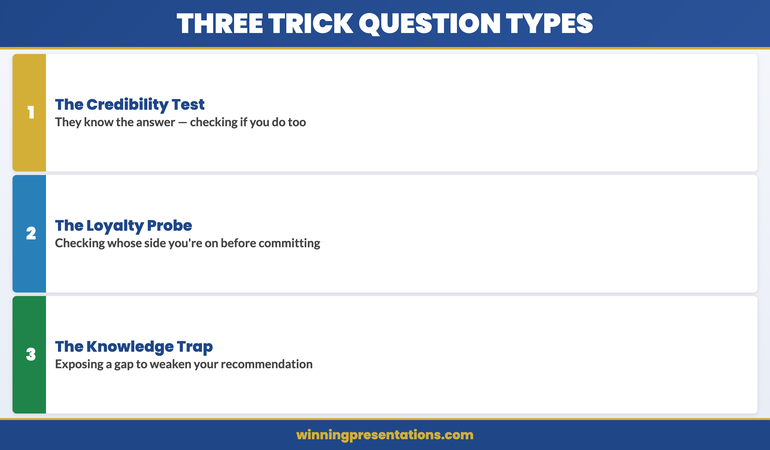
Not all trick questions are created equal. Understanding which category a question falls into will help you diagnose what the questioner is really asking—and respond appropriately. Here are the three patterns that appear repeatedly in executive presentations:
The Consistency Test
The questioner has heard you say something before, or they have read something in your written materials, and they want to hear whether you will say the same thing now, under pressure. This is often phrased as an innocent question (“So how exactly does that process work?”), but the questioner is checking whether you will contradict yourself or suddenly shift your position. The underlying concern is trust. If you tell a different story under pressure, why should they believe anything you say?
The Competence Challenge
The questioner already understands the technical answer, but they want to see whether you can articulate it clearly and confidently. This is most common in highly technical presentations to expert audiences. A board member asks your CFO a detailed question about revenue recognition. The board member is not seeking education—they are checking whether your CFO truly understands the material, or whether they are relying on someone else’s analysis.
The Values Check
The questioner knows what you are going to say, but they want to watch how you say it and what emphasis you place. They are assessing whether your stated values align with your actual priorities. For example: “How are you thinking about risk in this proposal?” The questioner may already know your risk assessment, but they are checking whether risk genuinely matters to you, or whether it is something you pay lip service to while rushing toward a deadline.
Each of these requires a slightly different response strategy. The Consistency Test requires calm clarity. The Competence Challenge requires precision and confidence. The Values Check requires authentic emphasis on what genuinely matters to you. When you misidentify the type of trick question, your response lands wrong—even if your facts are correct.
The Acknowledge-and-Expand Response Framework
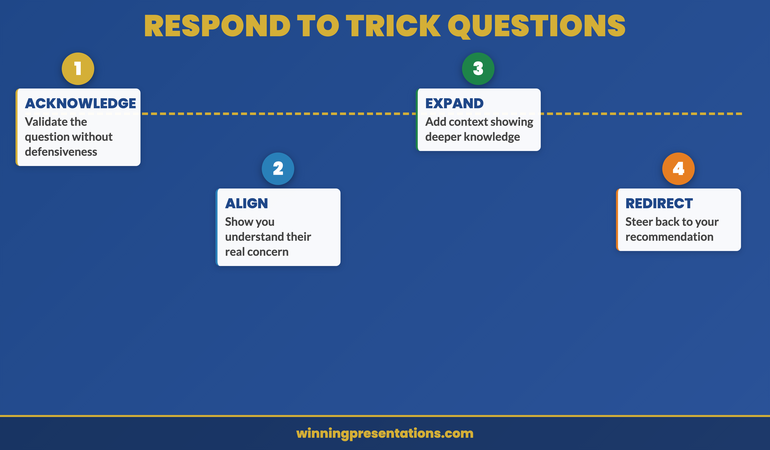
Here is the framework that changes how you respond to trick questions in presentations. It’s built on one simple principle: respond to what is actually being asked, not what is literally being said.
Step 1: Pause and Acknowledge
When you hear the question, resist the urge to answer immediately. Pause. Look at the questioner. Breathe. This pause accomplishes three things: it signals that you are taking the question seriously, it gives your nervous system a moment to settle, and it gives your brain time to diagnose what is really being asked.
Your acknowledgement should be brief and genuine. “That’s a good question. Let me think about what you’re really asking here.” This tells the questioner that you are not going to give a rote answer. You are going to engage with the intent behind the question.
Step 2: Name the Real Question
If you can identify the real question—the test being administered—name it directly. Not aggressively. Not defensively. Simply: “I think you’re asking whether we have genuinely thought through the risk, or whether risk is something we’re paying lip service to.” Or: “You want to know that I can articulate this clearly, without hedging.” This signals that you understand the psychology of the moment. It also disarms the trick, because once it is named, it stops being a trick. It becomes a conversation between two adults.
Step 3: Answer Both the Literal and the Psychological Question
Now provide your answer. Clarity first. Then confidence. Then, if applicable, acknowledgement of the concern beneath the question. For a Competence Challenge, you might say: “The revenue recognition standard for performance obligations requires us to… [clear, precise answer]… and I understand why that matters to you—it’s the difference between someone who can manage the detail and someone who is just executing someone else’s strategy.” You have now answered the literal question (the technical detail) and the psychological question (yes, I understand this and I own it).
Step 4: Close with Confidence
End your response with a statement that acknowledges you have understood and addressed the real concern: “So yes, we have thought this through at that level.” Or: “I hope that demonstrates we understand the nuance here.” Then stop. Do not over-explain. Do not defend further. Let your answer sit.
The Acknowledge-and-Expand framework works because it addresses what executives actually care about in Q&A: seeing that you can think under pressure and respond to the real question, not just the surface words. This is the foundation of handling objections and difficult questions with authority.
Reading the Room: Recognising a Test Before You Walk Into It
The best time to prepare for a trick question is before you walk into the room. If you can identify which questions are likely to be traps, you can rehearse your response and manage your nervous system in advance.
Start with the agenda and the audience list. Which topics on your agenda are most likely to trigger credibility testing? What concerns does this particular group have that they might test you on? Have you presented to any of these people before? How did they question you last time?
Then, think about the psychology of the room. Is someone in this meeting competing with you for influence? Is someone new to the group trying to establish credibility by challenging the presenter? Is there a topic that is historically contentious in this organisation? Trick questions often come from people who are either protecting territory or trying to establish authority. Once you understand the dynamics, you can predict with reasonable accuracy which questions are likely to be tests and which are genuine.
The most predictive factor is this: if a question covers something that was already clearly stated in your written materials or in earlier parts of your presentation, and someone asks it again in the Q&A, it is likely a trick question. They are not seeking information they do not have. They are testing something else. Prepare your response with that in mind.
For more on this preparation work, see our guide to reading the room before you enter.
Preparation Matters More Than Instinct
Many professionals believe that handling trick questions is about quick thinking or natural charisma. It is not. It is about preparation. When you know what questions are likely to come, and you have rehearsed your response framework, you stop relying on instinct (which often leads to defensiveness under pressure) and you start relying on strategy.
The Executive Q&A Handling System includes a pre-meeting briefing template that helps you map out the psychology of the audience, predict likely trick questions, and rehearse responses before you present. This is what separates professionals who remain calm in difficult Q&A from those who freeze or become defensive.
What to Do When You Get the Trick Question Wrong
Even with excellent preparation, there will be times when you misread the situation or give a response that does not land as intended. This happens to experienced presenters. The question is not whether you will ever get it wrong. The question is what you do in the moment when you realise you have.
The instinct, when you have given a wrong answer, is to double down or to apologise excessively. Neither works. Instead, use this recovery sequence:
Pause and Acknowledge the Miss
If you have said something that clearly did not land, or you have heard a follow-up question that tells you your response missed the mark, do not pretend it did not happen. Pause and acknowledge: “I don’t think I answered the question you actually asked.” Or: “Let me come back to that—I think I answered the wrong thing.” This signals that you are paying attention and that you care about being understood.
Reframe and Try Again
Now ask a clarifying question or rephrase what you think the real question is: “Are you asking whether this approach will work in our specific context, or whether the general methodology is sound?” This gives you another chance to identify the real question. Often, the questioner will help you. They will say yes, that is what I was asking. Now you answer the right question.
Move Forward Without Belaboring It
Once you have recovered, move forward. Do not apologise multiple times. Do not spend the next five minutes trying to convince the questioner that your original answer was actually okay. You have acknowledged the miss and answered more accurately. That is enough. The room will respect you more for recovering gracefully than if you had answered perfectly the first time.
This recovery sequence also demonstrates one of the most valuable qualities in executive Q&A: the ability to think and adapt in real time. Sometimes your recovery itself becomes proof of your competence.
Building a Pre-Meeting Intelligence Briefing for Q&A
This is the preparation system that professionals who handle trick questions with confidence use before every executive presentation. It takes about 20 minutes and it is worth ten times that in improved outcomes.
Step 1: Map the Audience Psychology
For each person in the meeting, write down: their primary concern about your topic, their historical relationship to you, and any territory they are protecting. A CFO’s primary concern may be cost control. A head of operations may be concerned about implementation risk. A board member may be concerned about whether the leadership team is aligned. These concerns shape the questions they ask.
Step 2: Identify Trigger Topics
Which parts of your presentation are most likely to trigger testing questions? Usually these are the parts where someone’s interests or priorities could be affected. If you are proposing a change to process, the person who built the current process may ask a trick question to test your thinking. If you are asking for budget, the person holding the budget may test your depth of preparation.
Step 3: Predict the Likely Trick Questions
For each trigger topic, write down the most likely question and what it is really testing. For example: “Likely question: How does this change affect the current team structure? Real question being asked: Are you thinking about the human side of this, or just the process?”
Step 4: Rehearse Your Response Using the Acknowledge-and-Expand Framework
For your top three predicted trick questions, rehearse your response out loud. Use the four-step framework: pause, acknowledge the real question, answer both levels, close with confidence. Do this once. Just once, out loud. You do not need to memorise your response. You just need to know you can deliver it.
This briefing system transforms trick questions from threats into expected elements of the conversation. You walk into the room knowing what to expect, knowing why someone might ask it, and knowing how you will respond. That confidence shows. And that is when trick questions stop being a problem and start being an opportunity to demonstrate your credibility.
If you are presenting to an executive audience in the next few weeks, the Executive Q&A Handling System provides a structured preparation template for exactly this kind of pre-meeting intelligence work.
Frequently Asked Questions
What if I genuinely do not know the answer to the trick question?
If you do not know the answer, the trick question framework still applies. Pause, acknowledge what you are being asked, and say honestly: “That is a fair question and I do not have that level of detail immediately available. Here is what I do know… [answer what you do know clearly] …and I will get you the specific data point you are asking for.” This response demonstrates competence and honesty. It often lands better with executives than someone who tries to bluff their way through an answer they do not have. The credibility test is not about knowing everything. It is about knowing what you know and being clear about what you do not.
How do I know if I am reading the trick question correctly?
You do not need to read it perfectly. The Acknowledge-and-Expand framework is specifically designed to handle uncertainty. By pausing, acknowledging the question, naming what you think is being asked, and inviting the questioner to confirm, you give yourself multiple chances to get it right. If you have misread the situation, the questioner will correct you. “Not quite—what I am actually asking is…” That correction gives you the information you need to answer the right question. The executives who handle this well are not mind-readers. They are good listeners who are willing to check their assumptions.
Can you teach yourself to recognise trick questions, or is this something you either have or you do not?
This is absolutely teachable. It requires three things: understanding the psychology of why executives ask questions they already know the answer to, learning the response framework, and rehearsing your application of it in realistic scenarios. The pattern recognition improves with practice. After you have handled three or four trick questions using the Acknowledge-and-Expand framework, you will start to spot them coming. You will recognise the tone, the timing, the setup. Your nervous system will settle because you will have a strategy. This is not about having a special talent. It is about systematic preparation.
Stay Ahead of Difficult Questions
Every week, The Winning Edge shares practical frameworks for handling executive Q&A, managing audience dynamics, and presenting with authority. Framework-driven. Real-world focused. No theory without application.
Related Reading
If trick questions trigger anxiety, you may find value in our guide to managing presentation anxiety through cognitive restructuring. This article focuses on the psychological patterns that make difficult Q&A feel threatening and how to reframe your relationship to audience testing.
The Real Power of Recognising a Trick Question
Henrik’s story at the beginning of this article was not about having the perfect answer. He had the same facts everyone else in the room had. The difference was that he recognised what was being tested and he responded to the real question. That one moment of psychological awareness—understanding that the audit committee member was not seeking information but testing credibility—changed how he was perceived in that room.
This is what separates the executives you see handling difficult Q&A with grace from those who struggle. They are not necessarily smarter or more prepared in the traditional sense. They are more psychologically aware. They understand that a question is not just words. It is a test. And they have frameworks for responding to the test, not just the words.
When you can do this consistently—when you can pause, recognise what is really being asked, and respond with clarity and confidence—you stop seeing trick questions as threats. They become what they actually are: invitations to demonstrate your competence and your character. And that is when your credibility in the room shifts fundamentally.
About Mary Beth Hazeldine
Mary Beth Hazeldine is the Owner and Managing Director of Winning Presentations. With 24 years of corporate banking experience at JPMorgan Chase, PwC, Royal Bank of Scotland, and Commerzbank, she advises executives across financial services, healthcare, technology, and government on structuring presentations for high-stakes funding rounds and approvals. She is a qualified clinical hypnotherapist and NLP practitioner whose approach integrates psychology-based communication strategy with practical executive presentation technique.