Tag: corporate politics

06 Mar 2026
Executive navigating political dynamics during high-stakes corporate committee presentation with stakeholders around a boardroom table

Political Questions in Presentations: When the Real Agenda Isn’t the Question Being Asked

Everyone said no to the £3M project. Then we discovered the real blocker wasn’t the CFO at all.

Political questions in presentations are questions designed to advance the questioner’s agenda rather than genuinely seek information. They disguise territorial disputes, power struggles, and personal grievances as legitimate inquiry. Recognising political questions requires understanding the difference between surface content (what’s being asked) and underlying intent (why it’s being asked). The framework for handling them involves three steps: identify the real agenda, acknowledge the surface question without being trapped by it, and redirect to the decision the room actually needs to make. Answering the literal question is almost always the wrong move—because the literal question was never the point.

🚨 Presenting to a politically complex room this week?

Quick diagnostic: Do you know which stakeholders in the room have competing interests? Can you name the one person most likely to ask a question that serves their agenda, not yours?

  • Map the room before you enter it—who gains and who loses from your proposal?
  • Prepare for “questions” that are actually statements disguised as inquiry
  • Have a bridge phrase ready: “That’s an important consideration. Here’s how it connects to the decision we’re making today…”

→ Need the complete Q&A preparation system? Get the Executive Q&A Handling System (£39)

The Stakeholder Map That Saved a £3M Project

A project director came to me after her third failed attempt to get a £3M technology investment approved. The steering committee kept rejecting it. She assumed the CFO was the blocker—he asked the toughest questions in every session.

We built a stakeholder map of the committee. Every member. Their stated position. Their likely real position. And crucially—what each person gained or lost if the project went ahead.

The real blocker wasn’t the CFO. He was actually neutral—his tough questions were genuine due diligence, the kind you’d expect from a finance leader evaluating a major investment. The real blocker was a VP of Operations who’d been asking seemingly reasonable questions in every meeting: “Have we considered the impact on the Leeds team?” “What’s the training burden for existing staff?” “Is this the right time given our current workload?”

Every question sounded operational. Every question was actually political. The VP felt bypassed in the project planning. Her team would absorb the implementation burden, but she hadn’t been consulted on the timeline or resource allocation. Her questions weren’t seeking information—they were signalling opposition through the acceptable language of operational concern.

One pre-meeting conversation fixed it. The project director met with the VP, acknowledged the implementation burden, adjusted the timeline to accommodate her team’s capacity, and gave her a formal role in the rollout governance. The VP’s questions in the next steering committee were supportive. The CFO’s due-diligence questions were answered. The £3M was approved.

Three presentations had failed because the project director was answering the literal questions instead of addressing the political dynamics behind them. The questions weren’t the problem. The hidden agendas were.

Walk Into Q&A Knowing the Political Landscape Before the First Question

  • Political Question Recognition: The framework for identifying when a question is serving the questioner’s agenda, not seeking genuine information
  • Stakeholder Mapping for Q&A: How to predict which questions will come from whom—and what they’re really asking—before you enter the room
  • Bridge Response Templates: Tested phrases for acknowledging political questions without being trapped by them
  • Hidden Agenda Playbook: Specific response strategies for territorial disputes, power positioning, and score-settling disguised as inquiry
  • Pre-Meeting Intelligence System: The preparation framework that lets you predict the political questions before they’re asked

Get the Executive Q&A Handling System → £39

Built from hundreds of executive presentations across banking, consulting, and corporate finance—where political Q&A is the norm, not the exception

How to Recognise a Political Question in Real Time

Political questions share characteristics that distinguish them from genuine inquiry. Learning to spot these patterns in real time is the first skill in navigating corporate Q&A:

The Question Contains Its Own Answer

“Don’t you think it’s risky to deploy this before we’ve resolved the integration issues with the Leeds team?” This isn’t a question—it’s a statement (“this is risky and premature”) wrapped in question form. If the questioner already has a position embedded in the question, they’re not seeking information. They’re making a case to the room.

The Question Addresses an Audience, Not the Presenter

Watch where the questioner looks when they ask. If they’re looking at you, they want an answer. If they’re looking at the committee chair, the CEO, or another stakeholder—they’re performing for that audience. The question is political theatre designed to signal their position to the decision maker.

The Question Raises Stakes Disproportionate to the Topic

“What happens to client confidence if this implementation fails?” This question escalates a routine project decision into a client-confidence conversation—a much higher-stakes frame than the actual risk warrants. Disproportionate escalation is a classic political move: it makes the decision feel more dangerous than it is, which benefits anyone who wants to delay or block it.

The Question References a Previous Decision or Conflict

“Is this going to be like the CRM migration that went over budget by 40%?” This isn’t about your project. It’s about a historical wound. The questioner is using your proposal as a vehicle to relitigate an old decision—perhaps one they opposed or were blamed for. The historical reference is the tell: they’re fighting a previous battle, not evaluating your proposal. Understanding the political stakeholder map is essential for predicting when these historical references will surface.

The Five Types of Political Questions

Political questions in presentations cluster into five categories. Recognising the type tells you both the hidden agenda and the correct response strategy:

1. The Territory Question

Surface: “How does this affect my team’s responsibilities?”

Hidden agenda: “Am I losing control, budget, or headcount?” Territory questions come from stakeholders who feel their domain is being encroached upon. The response must explicitly protect their territory or offer something in return.

2. The Credibility Test

Surface: “What’s your experience with implementations of this scale?”

Hidden agenda: “I don’t believe you can deliver this, and I want the room to doubt you too.” Credibility tests are designed to undermine your authority in front of decision makers. The response must demonstrate competence without being defensive. When someone contradicts your data in a presentation, it’s often a credibility test in disguise.

3. The Delay Tactic

Surface: “Shouldn’t we conduct a broader market review before committing?”

Hidden agenda: “I can’t openly oppose this, but I can slow it down until it loses momentum.” Delay tactics use reasonable-sounding process suggestions to kill momentum. They’re effective because saying “let’s do more research” sounds responsible—even when the real intent is obstruction.

4. The Score-Settler

Surface: “Is this similar to the approach that failed in Q3 last year?”

Hidden agenda: “I want to remind the room that your team / department / predecessor failed before.” Score-settlers use your presentation as an opportunity to rehash old grievances. The question isn’t about your proposal—it’s about establishing a narrative of past failure.

5. The Power Play

Surface: “I think we need to step back and consider whether this aligns with our strategic priorities.”

Hidden agenda: “I want to demonstrate that I operate at a higher strategic level than you.” Power plays reframe the conversation to assert the questioner’s seniority or strategic authority. They often come from people one or two levels above the presenter who want to remind the room of the hierarchy.

The Five Types of Political Questions infographic showing Territory Question, Credibility Test, Delay Tactic, Score-Settler, and Power Play—each with surface question and hidden agenda

Facing a politically complex Q&A session?

The Executive Q&A Handling System includes response templates for all five political question types—plus the pre-meeting intelligence framework that predicts them.

Get the Executive Q&A Handling System → £39

The Framework for Responding Without Taking the Bait

The natural response to a political question is to answer it literally. This is almost always wrong. Answering the surface question validates the hidden frame—you’re playing their game on their terms.

The three-step political question response framework:

Step 1: Acknowledge Without Validating

Show you’ve heard the question. Don’t dismiss it. But don’t accept the embedded premise either.

Instead of: “That’s a great question” (which validates the political frame)

Say: “That’s an important consideration” or “That touches on something we’ve built into the plan.”

The word “consideration” is powerful in political Q&A. It acknowledges the topic without agreeing it’s a problem. “Important question” implies the question is good. “Important consideration” implies you’ve already thought about it.

Step 2: Address the Hidden Agenda (Without Naming It)

Respond to what they actually care about, even though they didn’t explicitly state it.

Territory question (“How does this affect my team?”): “Your team’s role becomes more strategic in Phase 2. We’ve specifically designed the implementation to strengthen your team’s capabilities, not replace them.”

Delay tactic (“Shouldn’t we do more research?”): “We’ve completed the market review—findings are in the appendix. The risk of further delay is that [specific competitive or financial consequence]. The recommendation is to proceed with a controlled pilot that gives us real data within 8 weeks.”

Score-settler (“Is this like the CRM failure?”): “The CRM project taught us valuable lessons about phased rollout—which is exactly why this proposal includes built-in review gates at weeks 4, 8, and 12. We’ve incorporated those learnings into the governance structure.”

Step 3: Redirect to the Decision

After addressing the hidden concern, bring the room back to the actual decision. Political questions succeed when they derail the meeting into a tangent. Redirecting prevents this.

“The decision the committee needs to make today is [specific decision]. This proposal addresses [the concern raised] through [specific mechanism]. I’d recommend we focus on [the decision criteria] to make the best use of everyone’s time.”

The redirect isn’t aggressive. It’s professional. And it signals to the room that you understand the dynamics—which builds credibility with every other stakeholder watching. Understanding how executive questions function as trust tests helps you recognise when a question is genuine and when it’s political.

Stop Getting Ambushed by Political Questions You Didn’t See Coming

  • Question Prediction Framework: Anticipate the political dynamics and prepare responses before you enter the room
  • Bridge Response Library: Tested phrases for every type of political question—acknowledge, address, redirect

Get the Executive Q&A Handling System → £39

Walk into Q&A knowing the political questions before they’re asked

Navigating a high-stakes committee presentation?

The Executive Q&A Handling System includes the stakeholder mapping template—so you know who will ask what, and why, before the meeting starts.

Get the Executive Q&A Handling System → £39

Pre-Meeting Intelligence: Predicting Political Questions

The best response to a political question is one you’ve prepared before the meeting. Prediction is more valuable than reaction. Here’s the intelligence framework:

Map Who Gains and Who Loses

For every stakeholder in the room, answer two questions: “What does this person gain if my proposal is approved?” and “What does this person lose?” Anyone who loses—budget, headcount, influence, control, status—is a potential source of political questions.

Identify Historical Grievances

Has there been a failed project in this area before? Does your proposal resemble something that was previously rejected or went wrong? Historical grievances are the fuel for score-settling questions. Know the history and prepare to address it proactively.

Read the Pre-Meeting Signals

Before major presentations, stakeholders often signal their position through informal channels: corridor conversations, email tone, questions raised in pre-reads, last-minute attendee additions. These are intelligence signals. A stakeholder who asks detailed questions in the pre-read is either genuinely engaged or building their case for opposition. The tone and framing of those questions tells you which.

The Pre-Meeting Conversation

The most powerful tool for defusing political questions is a one-to-one conversation before the meeting. Meet with the stakeholder most likely to oppose. Ask directly: “What concerns do you have about this proposal?” In a private setting, most people will tell you the real issue—which they’d never state publicly in the meeting. That gives you the opportunity to address it privately, adjust your proposal, or prepare a specific response.

The £3M project I described earlier was approved not because the presentation got better. It was approved because a single pre-meeting conversation addressed the hidden political objection. The meeting itself became a formality.

Pre-Meeting Intelligence Framework infographic showing four steps: Map Who Gains and Loses, Identify Historical Grievances, Read Pre-Meeting Signals, and Have the Pre-Meeting Conversation

How do you handle a question designed to make you look bad?

Recognise it as a credibility test or score-settling attempt. Don’t become defensive—defensiveness confirms the narrative the questioner is trying to create. Instead, acknowledge the concern (“That’s an important consideration”), demonstrate competence with a specific, measured response, and redirect to the decision at hand. Your composure under the attack builds more credibility with the room than any verbal rebuttal could.

What if a senior stakeholder asks a political question and expects a direct answer?

Seniority doesn’t change the response framework—it changes the tone. With a senior stakeholder, acknowledge with more deference (“That’s exactly the kind of strategic consideration we need to address”), provide a concise response that addresses the hidden concern, and offer to discuss in more detail offline. The offline offer is powerful: it signals respect for their position while preventing the political dynamic from derailing the meeting.

Can you prevent political questions entirely through better preparation?

You can significantly reduce them through pre-meeting stakeholder conversations, but you can’t eliminate them entirely. Corporate politics exist in every organisation. The goal isn’t prevention—it’s preparation. When you’ve mapped the political landscape, predicted the likely questions, and prepared responses for each stakeholder’s concerns, political questions become manageable rather than ambush-like.

Is the Executive Q&A Handling System Right For You?

✓ This is for you if:

  • You present to senior committees where stakeholders have competing interests and political dynamics are significant
  • You’ve experienced Q&A sessions where questions felt designed to undermine your proposal rather than improve it
  • You want a systematic framework for predicting and preparing for political questions before major presentations
  • You’re tired of answering the literal question and realising afterwards that you missed the real agenda

✗ This is NOT for you if:

  • Your Q&A challenges are primarily about knowledge gaps (not knowing the answer) rather than political dynamics
  • You present primarily in collaborative settings where stakeholder alignment already exists

24 Years of Boardroom Q&A. Now a System You Can Use.

  • Political Question Recognition Guide: The five types of political questions with real examples, hidden agendas, and tested response strategies for each
  • Stakeholder Intelligence Template: The pre-meeting mapping tool that predicts who will ask what—and why—before you enter the room
  • Bridge Response Library: Dozens of tested phrases for acknowledging, addressing, and redirecting political questions without taking the bait
  • Pre-Meeting Conversation Scripts: How to have the one-to-one conversation that defuses political opposition before the presentation
  • Q&A Simulation Framework: Practice political Q&A scenarios with your team so nothing in the meeting feels unrehearsed

Get the Executive Q&A Handling System → £39

Built from hundreds of executive presentations at JPMorgan, PwC, RBS, and Commerzbank—where every Q&A is political

Frequently Asked Questions

Q: How do I tell the difference between a genuinely tough question and a political one?

A: Genuine questions seek specific information to improve decision quality. They ask “how” and “what”—”How does the implementation timeline account for Q4 capacity?” Political questions embed a position or agenda—”Don’t you think it’s premature to implement during Q4?” The test: if the question contains an implicit answer or conclusion, it’s political. If it’s genuinely open-ended, it’s authentic due diligence. Watch for embedded assumptions, historical references, and disproportionate escalation.

Q: Should I call out political questions directly?

A: Never publicly. Calling out a political question makes you look combative and embarrasses the questioner—who may have allies in the room. The goal is to address the hidden concern without naming it. “That’s an important consideration. We’ve built safeguards into the plan specifically for that scenario” addresses the concern without accusing anyone of political manoeuvring. If the dynamic is severe and recurring, address it privately after the meeting or through a pre-meeting conversation before the next one.

Q: What if the political question comes from the decision maker themselves?

A: Decision makers ask political questions for different reasons than other stakeholders. They may be testing whether you can navigate political complexity (a leadership competence test), gauging the room’s reaction to a provocative frame, or signalling their own concerns to the committee. The response framework remains the same—acknowledge, address the hidden concern, redirect—but add a closing question: “Would it be helpful if I addressed that in more detail offline, or does the committee have what it needs to proceed?” This gives the decision maker control while moving the meeting forward.

Get Strategic Q&A Insights Every Week

The Winning Edge newsletter shares Q&A frameworks, political navigation strategies, and real boardroom examples for executives who present in high-stakes environments. Subscribe for free.

Subscribe to The Winning Edge

About the Author

Mary Beth Hazeldine is the Owner & Managing Director of Winning Presentations. With 24 years of corporate banking experience at JPMorgan Chase, PwC, Royal Bank of Scotland, and Commerzbank, she has delivered high-stakes presentations in boardrooms across three continents.

A qualified clinical hypnotherapist and NLP practitioner, Mary Beth combines executive communication expertise with evidence-based techniques for managing presentation anxiety. She has trained thousands of executives and supported presentations for high-stakes funding rounds and approvals.

Book a discovery call | View services

Your next committee presentation has political dynamics. Every room does. The question is whether you walk in blind or walk in prepared. Get the Executive Q&A Handling System and know the political questions before they’re asked. Because the presenter who reads the room wins the room.

23 Feb 2026
Executive woman standing with composed expression in boardroom while male colleague sits behind her with arms crossed — corporate presentation sabotage dynamics

The Executive Who Tried to Sabotage My Client’s Presentation (And How the Slides Saved Her)

Quick answer: Presentation sabotage — colleagues feeding contradictory data to decision-makers, lobbying against your recommendation before the meeting, or positioning themselves to benefit from your failure — is a structural problem, not a political one. The defence isn’t better office politics. It’s a slide architecture that makes sabotage irrelevant: decision-first sequencing, self-contained logic, pre-emptive objection handling built into the slide order. When the structure is unchallengeable, the saboteur has nothing to attack.

She Found Out 20 Minutes Before the Meeting. The Room Had Already Been Briefed Against Her.

A colleague had emailed the entire steering committee contradictory data the night before.

Not overtly. Not as an attack. As a “just wanted to flag some concerns about the numbers in tomorrow’s presentation” — the kind of corporate sabotage that looks like diligence but is designed to destroy credibility before you’ve said a word.

My client — a programme director at a global bank — found the email at 8:40am. The meeting was at 9:00. Twenty minutes. No time to address each point individually. No time to rally allies. No time to confront the colleague.

She presented anyway. The committee approved her recommendation in the room. The saboteur’s email was never discussed.

Not because she was politically brilliant. Not because she out-manoeuvred the colleague. Because the slide structure she used made the contradictory data irrelevant. Her architecture led with the decision, surfaced the objections before anyone could raise them, and made the recommendation logically inevitable — regardless of what anyone had been told beforehand.

The sabotage failed because the structure was unchallengeable. That’s not luck. That’s architecture.

Here’s the framework, and why it works when everything else doesn’t.

🚨 Presenting this week in a politically charged environment? Quick check: Does your first slide state the decision you’re asking for — or does it start with background? If it starts with background, any pre-briefed sceptic has 5-10 minutes to build their counter-argument before you’ve even asked for anything. Decision-first sequencing eliminates that window. → Need the exact slide structure? The Executive Slide System (£39) includes the templates that make sabotage structurally irrelevant.

Why Slide Structure — Not Politics — Is Your Only Reliable Defence

When someone sabotages your presentation, the instinctive response is political: confront the saboteur, rally allies, escalate to your manager, or try to discredit their intervention.

Every one of those strategies is unreliable, and here’s why.

Confrontation tips off the saboteur that you know what they’ve done. They adjust. They escalate. A political skirmish becomes a political war, and now the decision-makers are watching two colleagues fight rather than evaluating your recommendation.

Rallying allies requires time you don’t have. In my client’s case, she had twenty minutes. In most cases, you discover the sabotage hours before the meeting — or you don’t discover it at all until you see the sceptical faces. You can’t build a coalition in a corridor conversation.

Escalation makes you look weak. Running to your manager because a colleague sent a challenging email positions you as someone who can’t handle scrutiny. Decision-makers notice. Even if your manager intervenes, you’ve signalled that your recommendation can’t stand on its own.

Structure does something none of these approaches can do: it makes the sabotage irrelevant without addressing it directly. When your decision slide leads with the recommendation, the room evaluates your logic — not the saboteur’s pre-briefing. When your objection handling is built into the slide order, the contradictory data has already been addressed before anyone can raise it. When the evidence follows a self-contained sequence, the committee has no gaps to exploit.

The saboteur needs gaps. A bulletproof structure has none.

Diagram showing why political responses to presentation sabotage fail while structural defences succeed — confrontation, allies, and escalation versus decision-first architecture

The Sabotage-Proof Framework: 4 Slides That Make Attacks Irrelevant

This is the framework my client used. It works because each slide eliminates a specific attack vector that saboteurs rely on.

Slide 1: The Decision Statement. Not background. Not context. Not “Today I’d like to update you on…” The first slide states, in one sentence, exactly what you’re asking the room to approve. “I’m requesting approval to proceed with Option B at a cost of £2.4M, with implementation beginning Q3.” This eliminates the saboteur’s most powerful weapon: the build-up period. In a traditional presentation, the first 5-10 slides are background — and that’s where pre-briefed sceptics build their counter-narrative. By the time you reach your recommendation on slide 15, the room has already decided against you. Decision-first removes the build-up entirely.

Slide 2: The Decision Criteria. Not your evidence yet. The criteria the committee should use to evaluate ANY recommendation — yours or the alternative. “This decision should be evaluated against three factors: implementation risk, 18-month ROI, and team capacity.” This is the architectural masterstroke against sabotage. When you define the decision criteria before presenting your evidence, the saboteur’s contradictory data has to survive YOUR framework. If their “concerns” don’t map to your stated criteria, they’re irrelevant — and the committee sees that without you saying it.

Slide 3: Evidence Against Your Own Criteria. Now — and only now — you present your evidence, mapped directly to the criteria on Slide 2. Each criterion gets a clear data point. No gaps. No hand-waving. No “we’ll come back to that.” The committee can evaluate your recommendation against the framework you’ve already established. The saboteur’s pre-briefing exists in a different framework — one you’ve just made obsolete.

Slide 4: The Ask + Pre-Emptive Objection. Restate the decision. Then address the single most likely objection — proactively, on the slide itself. “The primary risk is implementation timeline. Our mitigation: phased delivery with Stage 1 complete by Week 8.” This removes the saboteur’s final weapon: the “but what about…?” challenge after your presentation. You’ve already answered it. On screen. In front of everyone. The saboteur has to either agree with your mitigation or reveal their objection was personal, not professional.

Four slides. Each one closes an attack vector. Together, they create a structure where sabotage has nowhere to land.

This 4-slide framework is the core architecture inside the Executive Slide System — including the decision-first templates, the criteria slide formula, and the pre-emptive objection structure that makes political attacks structurally irrelevant.

Slide Structure That Survives Corporate Politics

The Executive Slide System gives you the sabotage-proof architecture that makes contradictory pre-briefings, hostile lobbying, and political undermining structurally irrelevant — because the logic is self-contained and unchallengeable.

  • ✓ Decision-first templates that eliminate the build-up window saboteurs exploit
  • ✓ The Criteria Slide formula — force the room to evaluate YOUR framework, not the saboteur’s
  • ✓ Pre-emptive objection slides that close attack vectors before anyone opens them

Get the Executive Slide System → £39

Built from 24 years of executive presentations at JPMorgan, PwC, RBS, and Commerzbank — including high-stakes approvals where the politics were as dangerous as the numbers.

How to Build Pre-Emptive Objection Handling Into Your Slide Order

The difference between a presentation that survives sabotage and one that collapses under it is where the objection handling sits.

Most executives handle objections after the presentation, in Q&A. This is the worst possible position when you’re being sabotaged, because the saboteur has had your entire presentation to refine their challenge. They’ll frame their pre-briefed data as a question — “I noticed some discrepancies in the numbers…” — and now you’re defending yourself instead of advancing your recommendation.

Pre-emptive objection handling reverses this dynamic entirely. Here’s how it works in practice:

Step 1: Map the three most likely challenges to your recommendation. Not your weaknesses — the challenges. What would a reasonable sceptic push back on? What would a saboteur use? In my client’s case: implementation timeline, cost relative to the alternative, and the data discrepancy her colleague had flagged.

Step 2: Address each challenge inside the evidence slides, not after them. When you present your ROI data, include the cost comparison — proactively. When you show the implementation plan, include the risk mitigation — proactively. The saboteur’s ammunition has already been detonated before they can use it.

Step 3: Use Slide 4’s explicit objection statement as the final seal. Name the biggest remaining objection out loud, on the slide, in front of the committee. “The primary concern is timeline risk. Here’s our mitigation.” This signals three things: you’re aware of the risk, you’ve addressed it, and you’re confident enough to name it publicly. A saboteur who raises it now looks like they’re repeating what you’ve already covered.

This is how structure gives you credibility in front of senior leadership — not by avoiding difficult topics, but by owning them before anyone else can weaponise them.

What to Do When Sabotage Happens During the Presentation

Sometimes the sabotage isn’t pre-meeting. Sometimes it’s live: an interruption, a challenge, a “just a quick question” designed to derail your flow at the worst possible moment.

The Sabotage-Proof Framework handles this too, because it changes the room’s expectations about how the presentation should unfold.

When your first slide states the decision, everyone in the room knows what they’re evaluating. A mid-presentation interruption that doesn’t relate to the decision criteria looks like what it is — a distraction. The room self-polices. “Can we let her finish the framework before we go into questions?” happens naturally when the structure is clear.

When your criteria are already established, an off-topic challenge has no anchor. “That’s an interesting point — does it map to one of the three criteria we’re evaluating against?” This isn’t confrontation. It’s a structural redirect. You’re not dismissing the saboteur. You’re applying the framework the room has already accepted.

When your objections are already addressed, a repeated challenge reveals the saboteur’s intent. “As I covered on slide 4, the timeline risk mitigation is phased delivery. Was there an additional concern beyond what’s shown?” The room sees the repetition. The saboteur’s credibility drops.

The framework creates a situation where continued sabotage exposes the saboteur. You don’t need to say a word about the politics. The structure says it for you.

Every template in the Executive Slide System is built with this defensive architecture — the decision-first sequence, criteria-based evaluation, and pre-emptive objection handling that makes political attacks structurally irrelevant, whether they happen before or during the meeting.

The 4-slide Sabotage-Proof Framework showing how each slide eliminates a specific attack vector that corporate saboteurs rely on

Stop Letting Office Politics Decide Whether Your Recommendation Gets Approved

You’ve watched good ideas die because someone lobbied against them before the meeting. You’ve seen colleagues with weaker proposals win because they played the politics better. The Executive Slide System makes the politics irrelevant — your structure does the defending.

  • ✓ Stop losing approvals to colleagues who brief against you — make pre-meeting lobbying irrelevant
  • ✓ Stop scrambling to counter sabotage you discover 20 minutes before the meeting
  • ✓ Stop relying on political alliances to get decisions — let your slide architecture carry the logic

Get the Executive Slide System → £39

The same framework used by my client who got approval 20 minutes after discovering a colleague had briefed the entire committee against her.

Common Questions About Presentation Sabotage

How do you present when someone is actively undermining you?

The counter-intuitive answer: you don’t address the undermining at all. You use a slide structure that makes it irrelevant. Decision-first sequencing eliminates the build-up window where pre-briefed sceptics formulate their challenges. A criteria slide forces the room to evaluate your framework rather than the saboteur’s narrative. Pre-emptive objection handling detonates the saboteur’s ammunition before they can use it. The structure does the defending — you focus on presenting the recommendation clearly and confidently. The executives I’ve worked with across JPMorgan, RBS, and Commerzbank consistently found that structural defence outperformed political manoeuvring, because it doesn’t require you to know what the saboteur has done in advance.

Can slide structure actually protect against corporate politics?

Yes, because corporate sabotage exploits structural weaknesses in traditional presentations. The build-up period (slides 1-10 as background) gives sceptics time to build counter-narratives. Objection handling in Q&A gives saboteurs the last word. Evidence without evaluation criteria lets challengers reframe the decision on their terms. The Sabotage-Proof Framework closes each of these gaps: decision first (no build-up), criteria defined (your framework), evidence mapped to criteria (no gaps), objections addressed proactively (no ammunition left). Politics thrive in ambiguity. Structure eliminates ambiguity.

What do you do when a colleague sabotages your presentation?

If you discover sabotage before the meeting: restructure your opening to lead with the decision and define the evaluation criteria — this makes the saboteur’s pre-briefing compete against your framework rather than your credibility. If sabotage happens during the meeting (interruptions, challenges, “just a quick question” designed to derail): redirect to your criteria slide. “That’s worth discussing — does it map to one of the three criteria we established?” This isn’t confrontation. It’s a structural redirect that the room accepts because the framework was established at the start. The executive presentation framework covers the full architectural approach.

Is the Executive Slide System Right For You?

✓ This is for you if:

  • You present in politically charged environments where colleagues compete for budget, headcount, or strategic priority
  • You’ve had recommendations rejected because someone lobbied against you before the meeting — and you need a structural defence
  • You want slide templates that make your logic unchallengeable regardless of what’s happening behind the scenes
  • You’re tired of winning on evidence and losing on politics

✗ This is NOT for you if:

  • Your presentations are informal team updates with no political stakes (this is built for decision meetings)
  • You’re looking for political strategy or relationship management advice (this is a structural framework)
  • Your presentations don’t involve a specific ask or recommendation (the framework is built around decision-first architecture)

24 Years of High-Stakes Approvals Where the Politics Were as Dangerous as the Numbers. Now Available as Templates.

Every template in the Executive Slide System was built in environments where sabotage, pre-meeting lobbying, and political manoeuvring were standard operating procedure — global banking, consulting, and corporate governance at JPMorgan, PwC, RBS, and Commerzbank.

  • ✓ Decision-first templates tested in steering committees, board meetings, and programme governance
  • ✓ AI prompts to build your sabotage-proof deck in 25 minutes
  • ✓ Before/after examples from real executive presentations where the politics were hostile

Get the Executive Slide System → £39

Used by programme directors, VPs, and department heads presenting in politically charged environments where the structure has to carry the argument — because the politics won’t.

Frequently Asked Questions

What if the saboteur is more senior than me?

Seniority makes the sabotage more dangerous — but the structural defence works identically. In fact, it works better against senior saboteurs, because the decision-first framework shifts the room’s attention from hierarchy to logic. When your first slide states the decision and your second slide defines the evaluation criteria, the committee is evaluating the framework — not the relative seniority of the people in the room. A senior colleague who challenges your data after you’ve already addressed it on Slide 4 looks like they haven’t been paying attention. You don’t need to confront seniority. The structure makes seniority irrelevant to the decision process.

Does this work if decision-makers have already been briefed against me?

Yes — this is the exact scenario the framework is designed for. Pre-briefing creates a counter-narrative in the decision-makers’ minds. Traditional presentations (background first, recommendation last) give that counter-narrative 10-15 minutes to solidify before you’ve even asked for anything. Decision-first sequencing bypasses the counter-narrative entirely. By slide 2, you’ve defined the evaluation criteria — and the pre-briefing has to survive YOUR framework. Most pre-briefed “concerns” don’t map to rigorous evaluation criteria. The committee sees the mismatch without you pointing it out.

What if sabotage happens DURING my presentation — live interruptions and challenges?

The framework handles live sabotage through structural authority. When your criteria are established on Slide 2, every interruption is filtered through that framework. “That’s worth discussing — how does it relate to the criteria we’ve established?” This redirect is powerful because the room has already accepted the criteria. The saboteur has to either map their challenge to your framework (where you’ve already addressed it) or reveal that their objection doesn’t fit the evaluation criteria at all. Continued off-topic challenges expose the saboteur’s intent to the room. You don’t need to call it out. The structure makes it visible.

Get Weekly Presentation Intelligence

Structural frameworks for politically charged environments, plus the slide architecture and communication strategies that make executive presentations unchallengeable — delivered every week.

Join the Newsletter

Related: If the political pressure triggers anxiety about the presentation itself — the fear of being publicly challenged, the dread of walking into a hostile room — that’s a separate problem with a separate fix. Read Glossophobia at the C-Suite: Why Successful Executives Still Struggle for the clinical techniques that break the executive anxiety cycle.

Also today: If the problem isn’t a specific saboteur but a room that has collectively decided against your recommendation before you’ve spoken, the structural approach is different. Read The Presentation You Give When the Room Has Already Decided Against You for the reversal framework.

Your next step: Open the deck for your next steering committee, programme board, or Monday exec meeting. Check: Does Slide 1 state the decision? Does Slide 2 define the evaluation criteria? If not, your structure has gaps — and gaps are where sabotage lands. Fix the architecture before the saboteur makes their next move.

Your next SteerCo, programme board, or leadership meeting has politics. Your slides need to handle it. Build the structure that makes sabotage irrelevant — before the saboteur makes their next move.

Get the Executive Slide System → £39

About the Author

Mary Beth Hazeldine is the Owner & Managing Director of Winning Presentations. With 24 years of corporate banking experience at JPMorgan Chase, PwC, Royal Bank of Scotland, and Commerzbank, she has delivered and supported high-stakes presentations in environments where the politics were as dangerous as the numbers — steering committees, programme boards, and executive governance meetings where sabotage, pre-briefing, and political manoeuvring were part of the operating landscape.

A qualified clinical hypnotherapist and NLP practitioner, Mary Beth has trained thousands of executives and supported high-stakes funding rounds and approvals across banking, consulting, and corporate environments.

Book a discovery call | View services

14 Feb 2026
Executive mapping stakeholder names and influence dynamics on whiteboard before high-stakes presentation

The Political Landscape Map: Who Blocks, Who Enables, Who Decides

The Political Landscape Map: Who Blocks, Who Enables, Who Decides

Quick answer: Most presentations fail because of politics, not content. Before you build a single slide, you need to map three things: who has the power to say yes, who will quietly block you, and who can champion your recommendation when you’re not in the room. This article gives you the framework to identify all three — and a system for navigating each.

The best deck I ever helped a client build got rejected in seven minutes.

It wasn’t the content. The data was solid. The recommendation was clear. The slides were tight — twelve of them, structured exactly right. My client, a Head of Strategy at a mid-cap bank, had rehearsed until the delivery was calm and confident.

The problem was a person he’d never spoken to. A Group Risk Director sitting three chairs from the decision-maker. She had concerns about implementation timelines that nobody had surfaced before the meeting. When the CFO looked at her for a reaction, she shook her head. Meeting over.

Afterwards, my client said: “I prepared for every question. I just didn’t prepare for every person.”

That sentence changed how I teach presentation strategy. In 24 years of corporate banking at JPMorgan Chase, PwC, Royal Bank of Scotland, and Commerzbank, I watched this pattern repeat hundreds of times: brilliant content, devastating political blindspot. The people who consistently got approvals weren’t the best presenters. They were the ones who mapped the room before they entered it.

That mapping process is what I now call the Political Landscape Map.

Why Politics Kills More Presentations Than Bad Slides

Here’s something most presentation training ignores entirely: the decision about your recommendation is rarely made during your presentation.

It’s made before, in conversations you weren’t part of. In hallway exchanges between stakeholders. In the silent risk calculations happening while you’re still on slide two. In the relationship dynamics between people who have history you know nothing about.

When executives decide, they silently ask three questions: What happens if I say yes and it goes wrong? What happens if I say no and miss out? Can I defend this decision to my peers? Your slides can answer the first two. Only political preparation can answer the third.

The uncomfortable truth is that most professionals prepare exclusively for the content challenge — clearer data, better structure, tighter delivery. But in rooms where decisions involve multiple stakeholders, political dynamics determine outcomes more often than presentation quality.

This doesn’t mean content doesn’t matter. It means content is necessary but not sufficient. You need both the right slides and the right relationships with the people evaluating them.

PAA: Why do good presentations still get rejected?
Good presentations get rejected when the presenter addresses the content but not the politics. If a key stakeholder has concerns that weren’t surfaced before the meeting, or if someone in the room feels bypassed or threatened by the recommendation, no amount of data will overcome that resistance. Mapping the political landscape before you present is as important as building the deck itself.

The System for Getting Decisions — Not Just Delivering Presentations

The Executive Buy-In Presentation System teaches you how decisions actually get made in senior rooms — and how to position yourself on the right side of that decision before you open your mouth. 7 modules covering decision psychology, stakeholder mapping, proof strategy, and pressure response.

Includes: Decision Definition Canvas • Stakeholder Landscape Map template • Proof Selector Matrix • Executive Buy-In Blueprint • Pressure Response Playbook with scripts

Get the Executive Buy-In System → £199

Self-study programme with modules released over 4 weeks + live Q&A calls. Currently £199 — price rises to £499 (self-study) / £850 (live cohort) on March 1st.

The Three Roles in Every Decision Room

Every room where a significant decision gets made contains three types of people. Your job is to identify all of them before you present — not during.

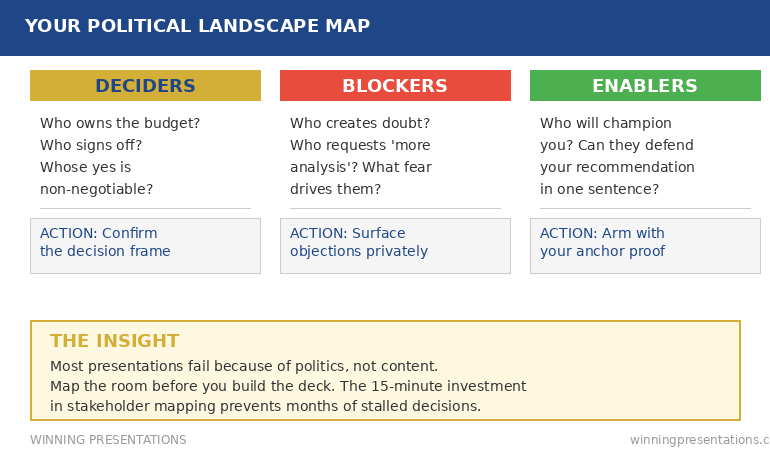
I call this framework the Decider / Blocker / Enabler model — a political landscape map that categorises every stakeholder by their role in the decision, not their title on the org chart. It’s the same approach used in change management and consulting, adapted specifically for high-stakes executive presentations where the politics of the room matter as much as the quality of the slides.

The Decider. This is the person whose “yes” actually matters. In some rooms, it’s obvious — the CEO, the CFO, the Board Chair. In others, it’s not. I once watched a VP present to a room of eight people, addressing his entire pitch to the most senior person present. The actual decision-maker was a Commercial Director two levels below, who controlled the budget line. The VP never made eye contact with her. The proposal died.

The Decider isn’t always the most senior person. They’re the person who owns the budget, the risk, or the political capital required to move forward. Ask yourself: Who actually signs off on this? Whose approval is non-negotiable?

The Blocker. This is the person who can prevent your recommendation from being approved — even if they can’t approve it themselves. Blockers don’t always announce themselves. They ask careful questions. They raise “concerns for consideration.” They request “further analysis.” My client’s Group Risk Director was a classic blocker: she didn’t reject the proposal directly. She simply signalled doubt, and the room followed.

Blockers are motivated by different fears. Some worry about career risk — what if this makes me look bad? Some worry about territorial loss — does this reduce my influence? Some have legitimate technical concerns that haven’t been addressed. The key is understanding which fear is driving the resistance, because each requires a different response.

The Enabler. This is the person who will champion your recommendation when you’re not in the room. Enablers are the most underutilised asset in executive presentations. They’re the colleague who says “I’ve seen the analysis, it’s solid” in the pre-meeting conversation. They’re the board member who turns to the Decider and says “I think this addresses my concern from last quarter.”

You can’t create enablers in the presentation itself. You create them before it — through pre-meeting alignment conversations that give them the information and confidence to support you publicly.

Do this in 60 seconds before your next deck:

Write down the names of everyone in the room. Label each person: D (Decider), B (Blocker), or E (Enabler).

If you can’t label them, you’re not ready to present yet.

Fix it fast: The Executive Buy-In Presentation System (£199 — rises March 1st) includes a ready-to-use Political Landscape Map template + the Decision Definition Canvas so you can do this properly in under 10 minutes.


Executive mapping stakeholder names and influence dynamics on whiteboard before high-stakes presentation

The Executive Buy-In Presentation System includes the Decision Definition Canvas and the Proof Selector Matrix — tools specifically designed to map stakeholder dynamics and match your approach to each person’s concerns. Learn more about the Executive Buy-In System (£199).

Building Your Political Landscape Map

The map itself takes 15 minutes. The intelligence it reveals can save you months of stalled decisions.

For every significant presentation, before you build a single slide, write down every person who will be in the room (or who influences people in the room). Then answer four questions about each:

1. What is their role in this decision? Decider, Blocker, or Enabler. Some people are genuinely neutral — they’ll follow whoever has the strongest signal. Mark them too. They matter because they’re the audience your Enablers are trying to influence.

2. What is their primary fear? Career risk, financial risk, reputation risk, or timing risk. This isn’t about what they’ll say — it’s about what they’re silently calculating. A CFO who asks “What’s the ROI?” is usually asking “What happens to me if this loses money?” Those are different questions requiring different answers.

3. What is their relationship to your recommendation? Does this increase or decrease their influence? Does it create work for their team? Does it solve a problem they’ve been publicly advocating for — or does it contradict something they’ve championed before? People don’t evaluate recommendations in isolation. They evaluate them through the lens of their own position.

4. What would make them feel safe saying yes? This is the critical question. Not “what evidence would convince them?” but “what would reduce their perceived risk enough to support this?” For some, it’s precedent. For others, it’s a guarantee of reversibility. For others, it’s simply being consulted before the meeting so they don’t feel ambushed.

PAA: How do you identify stakeholder dynamics before a presentation?
Start by listing everyone in the room and categorising them as Decider, Blocker, Enabler, or Neutral. Then identify each person’s primary concern — career risk, financial risk, reputation risk, or timing risk. Finally, have one-on-one conversations before the meeting to surface objections and build support. The goal is to know the room’s dynamics before you enter it.

Decisions Happen Before the Meeting. Your Preparation Should Too.

Module 1 of the Executive Buy-In System includes the Decision Definition Canvas — a diagnostic that maps the decision, the decision-maker, the perceived risk, and the success criteria in under 10 minutes. Module 4 teaches you how to match proof to each stakeholder’s specific fear type.

Get the Executive Buy-In System → £199

Study at your own pace with live Q&A calls for support. 7 modules, 36 lessons, built from real boardroom experience where political preparation consistently separated approved proposals from stalled ones.

Presenting this week? Do this in 15 minutes:

1. List every attendee + two influencers who won’t be in the room but shape opinions.
2. Label each: D (Decider) / B (Blocker) / E (Enabler) / N (Neutral).
3. Write each person’s likely fear: career risk, financial risk, reputation risk, or timing risk.
4. Schedule one 10-minute conversation with the most likely Blocker.
5. Add one slide that directly addresses the Blocker’s concern.
6. Confirm the decision question with the Decider’s office.

How to Work the Map Before You Present

The map is useless if you build it and then present as though you haven’t. Here’s how to act on it.

For Deciders: Confirm the decision frame. Before the meeting, have a brief conversation with the Decider (or their gatekeeper) to confirm what decision they’re actually expecting. “I want to make sure I’m structuring this around the right question — is the decision whether to proceed, or which option to proceed with?” This single question has saved my clients more time than any slide redesign. It also signals competence — you’re thinking about their decision, not your content.

For Blockers: Surface the objection privately. This is the most important step, and the one most people skip. Meet the Blocker before the presentation. Not to persuade them — to listen. “I’m presenting the X recommendation next week. I’d value your perspective before I finalise the approach.” Most Blockers don’t want to destroy your proposal. They want their concern acknowledged. When they feel heard in private, they’re far less likely to ambush you in public.

If you discover a concern you can address, build it into your presentation explicitly: “Sarah in Risk flagged the implementation timeline, and I’ve adjusted the phasing to reflect that.” This does two things: it neutralises the objection and it publicly credits the Blocker, which converts them from opponent to contributor.

For Enablers: Arm them with your anchor proof. Your Enabler can only champion your recommendation if they can articulate why it’s the right call — in one sentence, from memory, to sceptics. Give them that sentence. “The anchor proof is [X]. If anyone pushes back on [concern], the response is [Y].” When your champion can defend your recommendation as confidently as you can, the decision doesn’t depend solely on your performance in the room.

For Neutrals: Make the default easy. Neutral stakeholders will follow the strongest signal. If your Enabler speaks first and confidently, Neutrals tend to follow. Structure your presentation so the ask is clear and the next step is simple. People default to “yes” when saying yes is easier than asking more questions.

If you’re interested in the broader stakeholder mapping process for your executive presentations, I’ve written a detailed tactical guide.

The Executive Buy-In System covers this entire process in depth — from the Decision Definition Canvas (Module 1) through pressure response scripts for when Blockers challenge you in the room (Module 6). See the full Executive Buy-In System syllabus (£199).

What to Do When the Politics Are Against You

Sometimes you map the landscape and the picture isn’t good. The Blocker is powerful. Your Enabler is junior. The Decider is risk-averse. What then?

Don’t present until the ground is prepared. The biggest mistake I see is professionals walking into rooms they haven’t prepared politically because “the meeting is already scheduled.” Postponing a meeting to do proper alignment work is almost always a better outcome than presenting into a hostile or uncertain room. You lose a week. You gain a decision.

Reframe the ask to reduce perceived risk. If the political landscape suggests a full “yes” is unlikely, consider presenting a smaller ask: a pilot, a phased approach, a “proceed to next stage” rather than “approve the full programme.” This isn’t weakness — it’s reading the room accurately and adapting. Executives trust people who propose manageable risks over those who push for everything at once.

Use the Blocker’s language in your framing. If you’ve had a pre-meeting conversation with the Blocker, use their exact words in your presentation. “As [Name] rightly pointed out in our earlier conversation, the implementation timeline needs careful sequencing.” This isn’t manipulation — it’s demonstrating that you’ve listened. It’s remarkably difficult for someone to oppose a recommendation that explicitly incorporates their concern.

PAA: What do you do when executives resist your presentation recommendation?
First, diagnose the type of resistance. Is it a content objection (they need more evidence), a risk concern (they need reassurance), a political dynamic (they have competing interests), or a trust issue (they don’t yet believe you can deliver)? Each requires a different response. The psychology of executive buy-in is about addressing the real concern, not just the stated one.

Stop Presenting Into Rooms You Haven’t Read

The Executive Buy-In Presentation System teaches you how senior people actually decide — and how to structure your approach around their psychology, their politics, and their risk calculations. 7 modules: decision clarity, buy-in structure, credibility, proof strategy, AI execution, pressure response, and your personal executive playbook.

Get the Executive Buy-In System → £199

⏰ Launch pricing ends March 1st. The price rises to £499 (self-study) / £850 (live cohort). Lock in £199 before it changes.

Self-study modules + live Q&A calls. Built from 24 years in corporate banking where political preparation consistently separated approved proposals from stalled ones.

Frequently Asked Questions

How far in advance should I map the political landscape?

For high-stakes presentations (board approvals, budget requests, major client pitches), start mapping at least two weeks before. You need time for one-on-one conversations with Blockers and Enablers. For routine updates, a quick mental map the day before is usually sufficient — but even five minutes of stakeholder thinking prevents most political blindspots.

What if I can’t get access to the Blocker before the meeting?

If direct access isn’t possible, find someone who has it. Ask a mutual colleague: “What’s [Name]’s main concern about this area right now?” Even indirect intelligence is better than walking in blind. If you truly can’t get any information, acknowledge the gap in your presentation: build in a slide that explicitly addresses the most likely objection from that person’s position. Showing you’ve anticipated their concern — even without a conversation — signals respect for their perspective.

Is this approach manipulative?

Stakeholder mapping is standard practice in change management, consulting, and programme leadership. It’s not about manipulating anyone — it’s about understanding what different people need in order to feel confident making a decision. The pre-meeting conversations are about listening, not persuading. The goal is to build a presentation that genuinely addresses everyone’s legitimate concerns, not to circumvent them.

How do I handle a situation where two stakeholders have conflicting interests?

This is more common than most people realise. When stakeholders conflict, your job is to name the tension rather than pretend it doesn’t exist. “I’m aware that this recommendation creates different priorities for Operations and Finance, and I’ve tried to structure a phased approach that addresses both.” Naming the conflict demonstrates political awareness. Ignoring it guarantees that one side will surface it — on their terms, not yours.

📬 The Winning Edge Newsletter

Weekly executive presentation strategies, stakeholder navigation techniques, and career-critical communication insights. No fluff.

Subscribe free →

🎯 Free: Executive Presentation Checklist

The pre-presentation checklist I give every executive before a high-stakes meeting. Covers structure, messaging, and audience preparation — including a stakeholder mapping section.

Download free →

Related: If you’ve recently been promoted and you’re presenting to a room where you don’t yet know the political dynamics, read The Presentation You Give After Getting Promoted (Most Get It Wrong) — the listening-led approach is your fastest path to mapping a new political landscape. And if the politics of presenting trigger anxiety, introverted executives often have an advantage in these situations because they observe dynamics rather than performing over them.

The best presentation in the world fails when it’s delivered into a room you haven’t read. Map the Deciders, the Blockers, and the Enablers. Have the conversations before the meeting. Build your slides around their concerns, not just your content.

Start with the Executive Buy-In Presentation System (£199 — launch pricing ends March 1st) — and learn the decision psychology that turns political awareness into consistent approvals.

About the Author

Mary Beth Hazeldine is the Owner & Managing Director of Winning Presentations. With 24 years of corporate banking experience at JPMorgan Chase, PwC, Royal Bank of Scotland, and Commerzbank, she spent over a decade navigating the political dynamics of boardroom decisions before teaching others to do the same.

A qualified clinical hypnotherapist and NLP practitioner, Mary Beth combines executive communication expertise with decision psychology and stakeholder strategy. She has trained thousands of professionals and helps leaders turn political complexity into consistent buy-in.

Book a discovery call | View services