

Hostile questions in board meetings are often about power, not information. The most effective response framework combines tactical pauses, structured bridge statements, and strategic redirection—giving you time to compose your thoughts whilst maintaining board-room authority. When challenged publicly, the goal isn’t to win the argument but to demonstrate calm, credibility, and control.
Quick Navigation
Katrin, a CFO at a mid-cap insurance firm, was presenting quarterly results to her board. Halfway through, Martin—a particularly vocal shareholder director—interrupted with a pointed attack: “These numbers don’t stack up. Either your team can’t count or you’re hiding something. Which is it?” The room went silent. Katrin felt her pulse spike. Her instinct was to defend sharply. Instead, she paused, breathed, and replied: “That’s a fair question, Martin. I appreciate the directness. Let me address both the calculation you’ve flagged and the data we’re seeing.” She took him to the detailed schedule, showed her working, and invited him to identify the specific line that troubled him. By the time Martin had found nothing, Katrin had repositioned the entire moment—she was the professional with answers, and he was the one asking for evidence. The board noticed. Not because she won an argument, but because she stayed composed and showed command.
The Executive Q&A Handling System offers frameworks and response structures designed for handling challenging board room questions.
Understanding Hostile Questions in the Boardroom
Hostile questions are rarely about missing information. They’re about power, distrust, or agenda. A shareholder questions your strategy not because they genuinely don’t understand it, but because they want to undermine it in front of the board. A non-executive director challenges your financial assumptions not to learn, but to position themselves as the critical thinker. Understanding this distinction changes how you respond.
When someone delivers a hostile question, they’re signalling one of three things: they lack confidence in your competence, they disagree with your direction, or they’re trying to build credibility by appearing rigorous. The tone—sarcasm, incredulity, a loaded premise—signals intent before content.
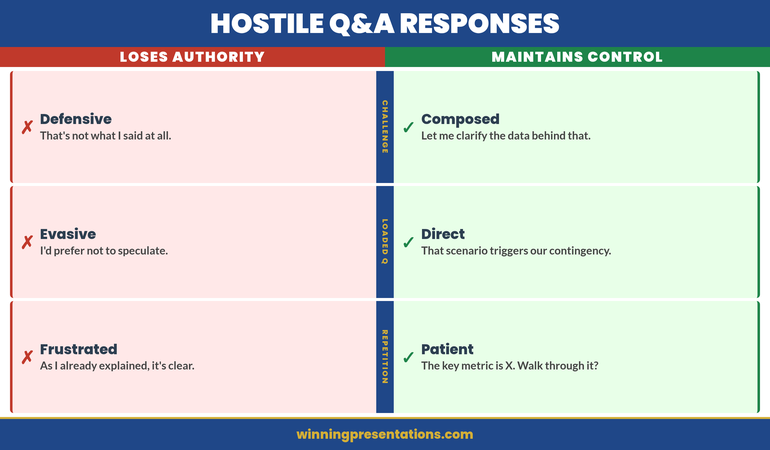
The trap is reacting to the tone rather than addressing the substance. If you become defensive, emotional, or counter-aggressive, you’ve handed control to the questioner. They’ve successfully rattled you. Instead, your job is to separate the emotional content from any legitimate underlying issue, then respond to the legitimate issue with calm authority.
Master Q&A Under Pressure
The Executive Q&A Handling System
Four proven frameworks that work in any boardroom:
- • Response structures that buy you composure time without sounding evasive
- • Bridge statements that redirect loaded questions to your territory
- • Deflection techniques for questions you can’t or shouldn’t answer
- • Question categorisation to separate substance from posturing
The Three-Part Response Framework
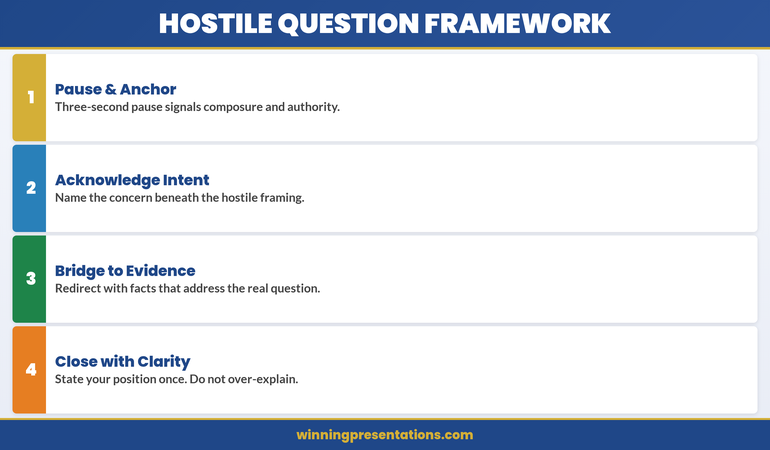
The most effective response to a hostile question has three components: acknowledge, clarify, answer. This isn’t capitulation. It’s tactical.
Part 1: Acknowledge. Before you answer, signal that you’ve heard the question. Not agreeing with the tone—acknowledging the question itself. “That’s a direct question, and I appreciate the challenge” or “I understand why that matters to you.” This does two things: it gives you five seconds of breathing room, and it signals to the board that you’re confident enough to listen without becoming defensive.
Part 2: Clarify. Before answering, reframe. “What I’m hearing is a concern about our cash conversion cycle. Is that right?” This serves three purposes. First, you’re confirming you understand. Second, you’re removing any loaded language and restating it in neutral terms. Third, you’re subtly taking control of the narrative—you’re the one defining what the question is about. If the questioner interrupts and says “No, that’s not what I meant,” you’ve already improved your position.
Part 3: Answer. Now you answer the question you’ve clarified, not the loaded version that was asked. You’re not being evasive—you’re being precise. You’re answering the substantive question, grounded in fact, with evidence if you have it. The tone is assured, not rushed.
This framework works because it buys you time, removes emotional charge, and establishes you as the authority. Learn more about answering from evidence first—it transforms how boards perceive your credibility.
Bridge Statements That Redirect Loaded Questions
Some questions contain a false premise. “Aren’t we overexposed to the Asian market?” might assume a fact not in evidence. The questioner has built an assumption into the question, hoping you’ll defend against it and inadvertently validate the premise.
A bridge statement lets you reject the assumption without sounding evasive. For example: “I’d reframe that. We’re not overexposed—we’re strategically positioned. Here’s the data.” You’ve rejected the premise, offered your framing, and then provided evidence. The board hears that you’re not hiding something; you have a different view based on numbers.
Effective bridges use phrases like: “I’d look at it differently,” “The data shows something different,” “That’s one way to frame it, but the reality is,” or “I appreciate the concern, and here’s what we’re actually seeing.” Each one takes the loaded question and moves it to territory where you can answer with authority.
Before You Answer
1. Genuine information gap or test? Curious questions sound different from challenging ones.
2. What’s the underlying concern? Surface words might not reveal the actual issue.
3. What narrative is this trying to create? Understand the questioner’s intent before answering.
Maintaining Authority When Challenged Publicly
Authority doesn’t come from being right (though that helps). It comes from how you carry yourself when you’re being attacked. The board is watching not your answer, but your composure.
When you respond to a hostile question, use these tactical elements: pause before answering (signals you’re thinking, not reacting), maintain steady eye contact (with the questioner first, then the board), keep your voice level (no rise in pitch, no pace increase), and use declarative statements, not questions (say “The reality is” not “Don’t you think that might mean”). Each one signals control.
If you don’t know the answer, authority means saying so calmly. “That’s a specific number—let me come back to you with the exact figure” sounds stronger than either guessing or becoming evasive. You’ve acknowledged the question, shown you take it seriously, and bought yourself time to deliver accurate information. The board sees competence and integrity, not weakness.
The mistake most executives make is trying to over-answer hostile questions. More words, more detail, more justification. This reads as defensive. Instead, answer what’s asked, provide your evidence, and stop. If they want more, they’ll ask. Your brevity signals confidence. See how to stay composed even when ambushed—these principles apply to any audience size.
When to Stand Firm, When to Concede
Not every challenge deserves the same response. If a questioner has spotted a genuine error or gap in your thinking, the move is to acknowledge it and explain how you’ll address it. This actually builds authority—you’re confident enough to learn in real time.
If a questioner is challenging your decision or strategic direction, your job is not to convince them—it’s to explain your reasoning clearly, acknowledge their concern has been heard, and move on. You don’t need everyone to agree. You need the board to see that you’ve thought it through and you’re not rattled by dissent.
If a question is out of bounds (confidential, speculative, or not your area), you can deflect with: “That’s outside what I can comment on in this forum” or “I’ll address that separately with the appropriate committee.” You’re not being evasive; you’re being responsible. The board respects boundaries.
Frequently Asked Questions
What if the hostile questioner is a majority shareholder or board chair?
Your approach doesn’t change—if anything, it’s more important to stay composed and professional. The power dynamics are already known; demonstrating that you don’t rattle under pressure is actually what builds their confidence in your leadership. Use the same framework: acknowledge, clarify, answer. The only adjustment is your pacing—you might want to be slightly more thorough in your response to show you’re taking their question seriously, but never to the point of over-explaining.
How do I prepare for hostile questions I can’t anticipate?
You prepare for the framework, not specific questions. Know your three-part response structure cold. Practise acknowledging without agreeing, clarifying without defensiveness, and answering with confidence. Anticipate your key vulnerabilities—areas where the board is most likely to push back—and have your evidence organised. Develop contingency answers for your riskiest points—this gives you the confidence to handle almost anything.
What if I lose my composure in the moment?
Pause. Acknowledge it if necessary: “That’s a fair challenge—let me take a breath and answer properly.” This is not weakness. The board will respect your willingness to slow down and think rather than react emotionally. Most of the executives who perform best in hostile Q&A do so because they’ve learned to recognise the moment they’re about to lose composure and they pause. That pause is the skill.
Get Board-Ready Insights Every Week
The Winning Edge newsletter gives you frameworks, case studies, and tactical Q&A prep for executives who present to boards, investors, and high-pressure rooms.
Related Article
Managing Visible Anxiety: Why Trembling Hands Undermine Board Credibility — read how to manage the physical signs of stress during high-stakes presentations.
About the Author
Mary Beth Hazeldine is Owner & Managing Director of Winning Presentations. With 24 years of corporate banking experience at JPMorgan Chase, PwC, Royal Bank of Scotland, and Commerzbank, she advises executives across financial services, healthcare, technology, and government on structuring presentations for high-stakes funding rounds and approvals.