Tag: compensation presentation

26 Apr 2026
Featured image for Remuneration Committee Presentation: How to Brief Non-Executives on Executive Pay Decisions

Remuneration Committee Presentation: How to Brief Non-Executives on Executive Pay Decisions

Quick Answer

A remuneration committee presentation should lead with the governance rationale behind every pay recommendation, not the numbers themselves. Non-executive directors need to understand the decision framework — market positioning, performance conditions, shareholder context, and risk — before they can approve anything. Structure your briefing around those four pillars and you give the committee what it needs to act.

Laurence had been HR Director at a FTSE 350 financial services firm for three years. He knew the compensation landscape inside out. His benchmarking data was impeccable. His spreadsheets ran to fourteen tabs.

The remuneration committee meeting lasted forty-five minutes. His presentation took thirty of them. When the committee chair — a former FTSE 100 CFO — asked, “What’s the single strongest argument for this package if a shareholder challenges it at the AGM?”, Laurence didn’t have an answer ready.

Not because he didn’t know. Because his presentation hadn’t been structured to surface that answer. He’d built a data briefing. The committee needed a governance briefing. The distinction sounds semantic, but it changes everything about how you organise information, which slides come first, and what the committee remembers when they vote.

I’ve seen this pattern repeatedly across financial services, healthcare, and technology organisations. The person presenting to the remuneration committee is typically the most knowledgeable person in the room on compensation. But knowledge alone doesn’t translate into a presentation that helps non-executives make a confident decision.

Already know the pay data but struggling to frame it for non-executives?

The Executive Slide System includes governance briefing frameworks designed for committee and board presentations — the structures that turn complex data into clear decision support for non-executive directors.

Explore the Executive Slide System →

Why most remuneration committee briefings lose the room

The most common failure in a remuneration committee presentation is not poor data. It’s presenting the data as though the committee members are compensation specialists. They are not. They are non-executive directors with fiduciary responsibilities, broad commercial experience, and a governance lens that prioritises risk, fairness, and shareholder defensibility.

When you open with a detailed salary benchmarking analysis, you’re answering a question the committee hasn’t asked yet. They don’t start with “Is this the right number?” They start with “Is this defensible?” Those two questions require entirely different opening structures.

Three patterns consistently undermine remuneration committee briefings:

  • Data-first sequencing: Leading with median market data, percentile positioning, and peer group analysis before establishing the governance rationale. The committee receives numbers without a framework for evaluating them.
  • Excessive granularity: Presenting every element of the pay package — base, bonus, LTIP, benefits, pension — in sequence without connecting them to the overall narrative. The committee loses the thread between slide five and slide twelve.
  • Missing the shareholder voice: Failing to anticipate how the recommendation would appear in the annual report or at the AGM. Non-executive directors are acutely aware of shareholder scrutiny. If your presentation doesn’t address it, they will — and you won’t control the framing.

Each of these problems has the same root cause: the presentation is structured around what the presenter knows rather than what the committee needs to decide.

Give the Committee a Decision Framework, Not a Data Dump

The Executive Slide System — £39, instant access — includes governance briefing structures designed for committee and board-level presentations. Frame executive pay recommendations around defensibility, not just data. Built from 25 years of corporate banking experience.

  • 22 templates covering board, committee, and approval presentations
  • 51 AI prompts for drafting slides, talking points, and briefing notes
  • 15 scenario playbooks including governance and committee briefings

Get the Executive Slide System →

Designed for executives presenting pay, governance, and approval recommendations to non-executive boards.

The four pillars of a strong committee pay briefing

Every effective pay committee briefing rests on four pillars. These are not sections of your slide deck — they’re lenses that every piece of information in your briefing should be viewed through.

1. Market positioning

Where does the proposed package sit relative to the external market? Non-executive directors need to understand whether you’re positioning at median, upper quartile, or somewhere between — and why. The “why” matters more than the number. A package at the 75th percentile is defensible if the role requires a scarce skill set and the retention risk is genuine. It’s indefensible if it’s there because “that’s where we’ve always been.”

Present your benchmarking data as a single summary slide with the comparator group clearly defined. Save the detailed peer analysis for the appendix. The committee needs the conclusion, not the methodology.

2. Performance conditions

How is variable pay linked to outcomes? This is where many presentations lose clarity. The committee needs to see a direct line between the performance conditions in the bonus and LTIP schemes and the strategic objectives of the organisation. If the conditions are financial — revenue growth, return on equity, total shareholder return — show how they align with the published strategy. If they include non-financial metrics (ESG, customer satisfaction, employee engagement), explain why those metrics are material to long-term value.

3. Shareholder context

What would an institutional investor say about this recommendation? Non-executive directors on remuneration committees are acutely conscious of proxy advisory firms — ISS, Glass Lewis — and the governance codes that define best practice. Your presentation should pre-empt the questions those bodies would raise. If the proposed package includes any element that sits outside the Corporate Governance Code’s expectations, address it explicitly rather than hoping the committee doesn’t notice.

4. Risk and proportionality

What happens if this goes wrong? The committee needs to understand downside scenarios. If the executive underperforms, what clawback or malus provisions apply? If the share price falls, how does the LTIP award look in the annual report? If the pay ratio between the CEO and the median employee widens, how will that be communicated? Presenting the upside without acknowledging the downside is a trust-eroding pattern that experienced non-executives recognise immediately.
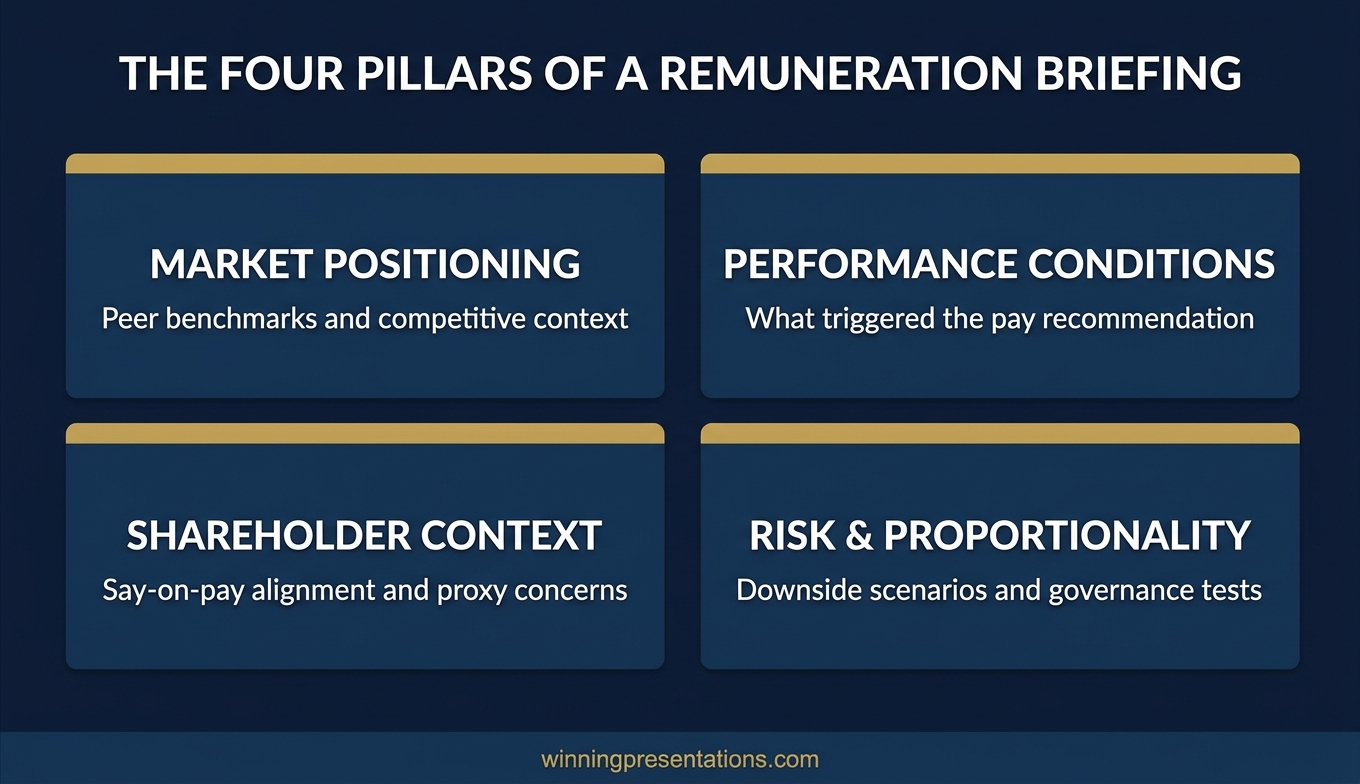
Infographic showing the four pillars of a remuneration committee briefing: market positioning, performance conditions, shareholder context, and risk and proportionality

Structuring the narrative for non-executive scrutiny

The slide order in a committee pay briefing matters more than most presenters realise. Non-executive directors process information through a governance lens, and that lens has a specific sequence: rationale first, then data, then recommendation.

A structure that works consistently:

Slide 1: The governance context. One slide that frames the purpose of the meeting. “The committee is being asked to approve the following pay recommendations for FY2027. These recommendations reflect [strategic priority], are benchmarked against [comparator group], and are designed to [retention/alignment objective].” No data yet — just the frame.

Slides 2–3: Market positioning summary. The benchmarking conclusion (not the raw data). Where the package sits, why it sits there, and what happens if you don’t act.

Slides 4–5: Performance conditions and strategic alignment. The link between pay and performance. What must be achieved for variable elements to vest or pay out. How this connects to the published strategy.

Slide 6: Shareholder and governance lens. Pre-empt the AGM question. Address the pay ratio. Note any departures from the governance code and explain why they’re appropriate.

Slide 7: The recommendation. Clear, specific, and presented as a resolution for the committee to approve. This is not a summary — it’s the decision point. State what you’re asking for and in what form.

This structure aligns with the governance sequence that non-executive directors are trained to follow. It respects their fiduciary role and gives them the information they need in the order they need it. For a detailed framework on structuring any board-level presentation within a tight time constraint, see the guide to the board presentation 15-minute framework.

How to handle sensitive data in a pay briefing

Pay committee briefings contain some of the most sensitive data in any organisation. Individual pay packages, performance ratings, retention risk assessments, and internal comparisons — all of this is material that requires careful handling in terms of both presentation and distribution.

Three principles apply to every sensitive element:

Name individuals only when necessary. In most remuneration committee meetings, the committee will review the pay of the executive team by name. But your slides don’t always need to display individual names prominently. Consider whether a summary table with names in an appendix serves the committee better than a slide-by-slide walkthrough of each executive. The committee chair can direct discussion to specific individuals as needed.

Control the document trail. Every slide you present to the remuneration committee may become discoverable in a legal or regulatory context. Write every slide as though it could appear in a newspaper. This doesn’t mean being evasive — it means being precise and avoiding informal language, subjective assessments without evidence, or commentary that could be misinterpreted.

Separate the paper from the presentation. The committee paper (the pre-read) should contain the full detail. Your presentation should contain the decision-support summary. If you try to put everything in the slides, they become too dense for verbal presentation but too sparse for standalone reading. Neither works. The approach to understanding how board papers and presentations serve different purposes is explored in the article on board agenda presentations.

If you want a structured template for governance-level committee briefings rather than building from blank slides each cycle, the Executive Slide System includes frameworks for exactly this type of presentation.

Stop Building Committee Slides From Scratch Every Quarter

The Executive Slide System — £39, instant access — gives you repeatable slide structures for governance presentations, committee briefings, and board approvals. Frame recommendations around defensibility, not just data. 22 templates, 51 AI prompts, 15 scenario playbooks.

Get the Executive Slide System →

Designed for committee, board, and governance presentations.
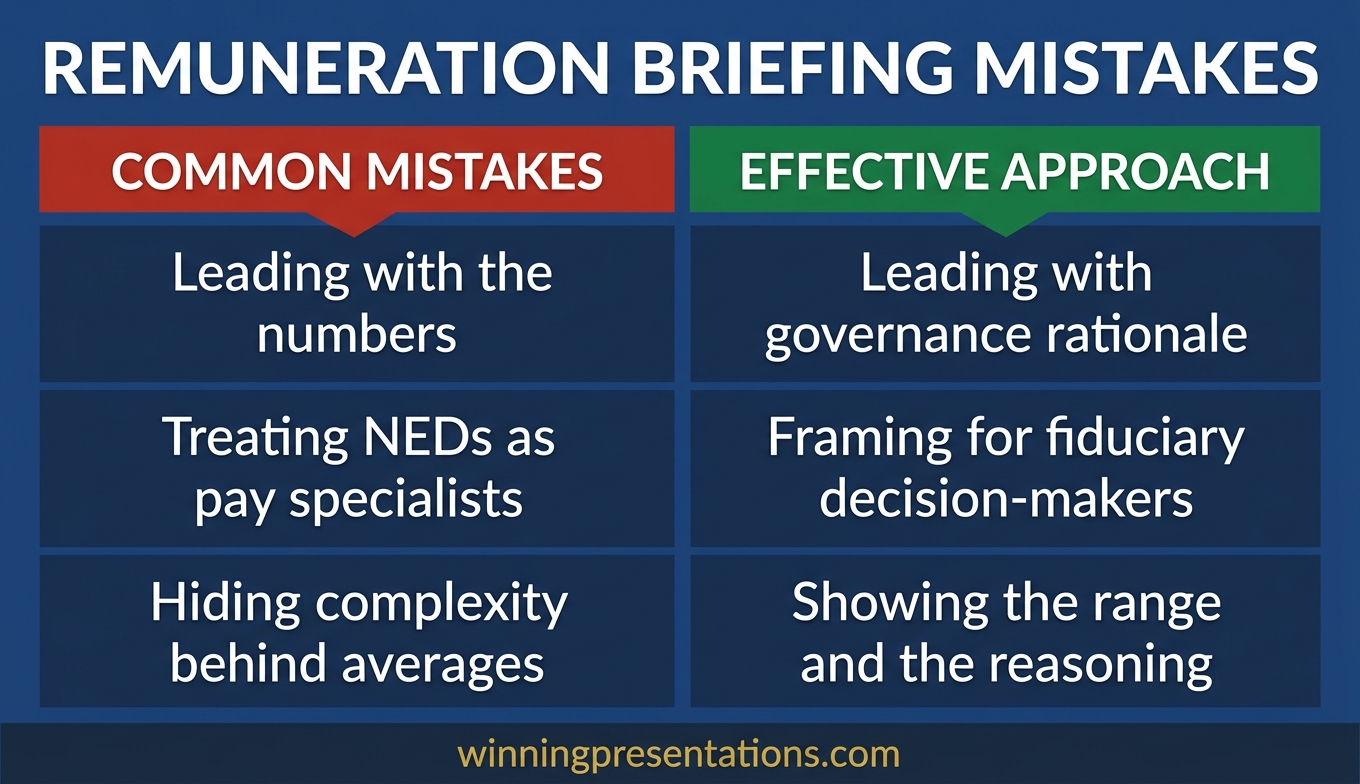
Infographic showing a seven-slide structure for a remuneration committee briefing with governance context, market data, performance conditions, shareholder lens, and recommendation

Building the shareholder lens into your slides

The remuneration committee’s ultimate accountability is to shareholders. Every pay decision they approve will be disclosed in the Directors’ Remuneration Report and potentially challenged at the AGM. If your presentation doesn’t help the committee see the recommendation through that lens, you’re leaving them to construct the shareholder argument themselves — and they shouldn’t have to.

Three shareholder-facing elements belong in every pay governance briefing:

The pay ratio. The UK Corporate Governance Code requires disclosure of the CEO-to-median-employee pay ratio. Your presentation should show this ratio, show the trend, and explain any year-on-year movement. If the ratio has widened, explain why in terms the committee can relay to shareholders: “The increase reflects the vesting of a three-year LTIP award granted during a period of significant strategic transformation.”

The comparator group logic. Institutional investors frequently challenge the choice of comparator companies used for benchmarking. If your comparator group includes organisations significantly larger or more profitable than yours, explain why the comparison is still relevant. If you’ve excluded outliers, say so. Transparency in methodology builds confidence in the conclusion.

The governance code alignment. Where do your proposals sit relative to the UK Corporate Governance Code or your organisation’s specific governance framework? If you’re compliant on every point, say so clearly. If you’re departing from a provision — for example, by using a notice period longer than twelve months — the “explain” part of “comply or explain” should be in your slides, not left to verbal commentary that may not be minuted.

For a broader view on how to tailor your presentation style when addressing non-executive directors specifically, see the guide to non-executive director board presentations.

The principle of audience-first structuring applies equally whether you’re briefing a committee, a full board, or an investor group. The specifics change; the discipline of leading with what the audience needs to decide does not.

Frequently Asked Questions

How long should a remuneration committee presentation be?

Most effective pay committee briefings run between seven and twelve slides, with the verbal briefing taking fifteen to twenty minutes. The remainder of the committee’s time should be reserved for questions and discussion. If your presentation takes longer than twenty minutes, it almost certainly contains detail that belongs in the committee paper rather than the slides. The committee’s role is to scrutinise and approve, not to be educated on every data point. Keep the slides focused on the decision framework and move the supporting analysis to the appendix.

Should I present benchmarking data or just the conclusions?

Present the conclusions in the main body and keep the detailed benchmarking in an appendix or the committee paper. Non-executive directors need to know where the package sits relative to the market and whether the comparator group is appropriate. They do not typically need to see every peer company’s individual data point during the presentation. If a committee member wants the detail, they’ll ask — and having it in the appendix shows you’ve done the work without consuming presentation time on methodology.

How do I address performance conditions that weren’t fully met?

Directly and early. If an executive’s bonus or LTIP award will vest at a reduced level because certain performance targets weren’t achieved, present this as a demonstration that the pay-for-performance link is working as designed. Frame partial vesting as evidence that the scheme is calibrated appropriately, not as a shortfall. The committee will be reassured by a scheme that discriminates between full and partial achievement. What they worry about is a scheme that always pays out in full regardless of performance.

What’s the biggest mistake presenters make in remuneration committee meetings?

Treating the committee as an audience rather than a decision-making body. The difference shapes everything: your slide order, your level of detail, your opening sentence, and how you handle questions. An audience listens and absorbs. A decision-making body evaluates and approves. When you structure your presentation for evaluation rather than absorption, you lead with the governance rationale, provide the evidence efficiently, and make the recommendation explicit. The committee can then do its job rather than spend time searching for the point.

The Winning Edge

Weekly strategies for executives who present at board and committee level. Every Thursday.

Subscribe Free →

Not ready for the full system? Start here instead: download the free Executive Presentation Checklist — a single-page reference for the structure, framing, and decision flow every governance presentation needs.

For executives preparing for internal career progression alongside committee briefings, the dynamics differ but the audience-first principle applies equally. See the related guide on promotion panel presentations.

Your next remuneration committee briefing should give non-executive directors a governance narrative, not a compensation lecture. Lead with the rationale, structure around the four pillars, and make the recommendation explicit. The committee will notice the difference.

About the Author

Mary Beth Hazeldine is the Owner & Managing Director of Winning Presentations. With 25 years of corporate banking experience at JPMorgan Chase, PwC, Royal Bank of Scotland, and Commerzbank, she advises executives across financial services, healthcare, technology, and government on structuring presentations for high-stakes funding rounds, board briefings, and leadership decisions.

20 Feb 2026
Professional woman in navy blazer presenting compensation data on laptop screen to senior male executive in glass-walled boardroom

Presenting to the Person Who Will Decide Your Bonus (What Most Professionals Get Wrong)

Quick answer: Presenting to your boss about compensation is not a negotiation — it’s an executive presentation. The professionals who get better outcomes treat it like a boardroom pitch: lead with impact, not with an ask. Structure your slides using a Value-First framework that positions what you’ve delivered before the compensation question even surfaces. Most people do it backwards — they open with what they want instead of what they’ve earned.

The Compensation Conversation I Almost Ruined at JPMorgan

I walked into my manager’s office with a number in my head and nothing on paper.

This was early in my banking career at JPMorgan Chase. I’d delivered three major client presentations that quarter, each one securing significant renewals. I knew I deserved a better bonus. What I didn’t know was how to make that case without sounding like I was complaining.

So I did what most people do: I started talking about what I wanted. My manager listened politely, said he’d “look into it,” and nothing changed.

Six months later, a colleague in the same team got a significantly better outcome. The difference? She’d walked in with three slides. Not a deck — three slides. One showed her client retention numbers. One showed the revenue she’d influenced. The third showed her next-quarter pipeline. She never mentioned money once. Her manager brought it up.

That was the moment I understood: presenting to the person who decides your compensation isn’t a conversation. It’s a presentation. And the structure matters more than the ask.

After 24 years in corporate banking — across JPMorgan, PwC, Royal Bank of Scotland, and Commerzbank — I’ve seen this pattern play out in every team I’ve worked with. The people who present their value well get rewarded. The people who just “have a chat” get told to wait.

The difference isn’t talent or timing. It’s structure. And the professionals who consistently get recognised for their contributions all do the same thing: they present evidence before they present an ask. They make it easy for their manager to fight for them in the room where compensation decisions actually happen — which is rarely the room you’re sitting in. Here’s the framework I now teach to executives preparing for one of the highest-stakes presentations of their career — and one that most people never think to prepare for at all.

Stop Winging Your Most Important Presentation

The Executive Slide System gives you the exact slide structures that position your value before anyone has to ask. Built from 24 years of boardroom experience.

Get the Executive Slide System → £39

Built from 24 years in banking and consulting environments. Used in board updates, steering committees, and decision meetings.

Why Most Compensation Presentations Fail Before Slide 2

The biggest mistake isn’t asking for too much. It’s starting with the ask.

When you open a compensation conversation with “I’d like to discuss my bonus,” you’ve immediately put your manager in a defensive position. They’re now thinking about budget constraints, team equity, and how to manage your expectations — before you’ve given them a single reason to fight for you.

This is the same pattern I saw repeatedly across my years at PwC and Commerzbank. The professionals who struggled with compensation conversations all made the same structural error: they treated the meeting like a negotiation instead of a presentation.

Here’s what that looks like in practice:

❌ Wrong opening: “Thanks for making time. I wanted to discuss my compensation for this year. I’ve been here three years and I feel like my salary doesn’t reflect my contribution.”

✅ Right opening: “Thanks for making time. I put together a brief overview of what I’ve delivered this quarter and where I see the biggest opportunities next quarter. I’d value your perspective.”

The first version puts your manager on the back foot. The second gives them something to work with — and a reason to listen.

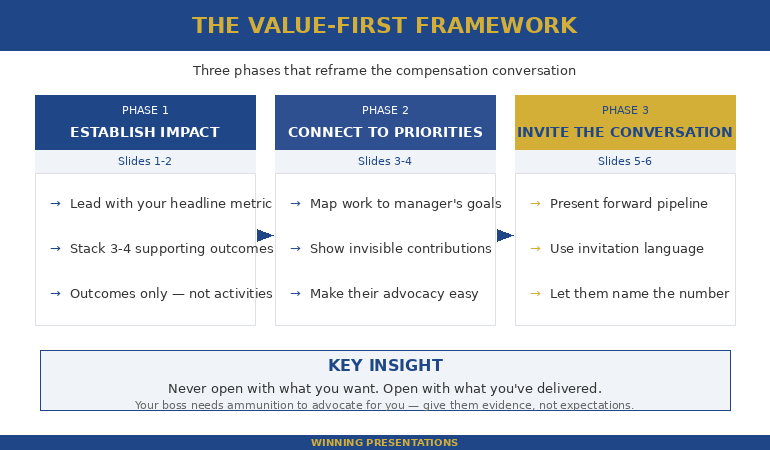
Value-First framework for presenting to boss about compensation showing three phases: establish impact, connect to priorities, then invite the conversation

The Value-First Framework for Presenting to Your Boss About Compensation

The framework that consistently works for compensation presentations has three phases — and none of them start with money.

Phase 1: Establish Impact (slides 1-2). Open with what you’ve delivered in the current period. Not activities — outcomes. Not “I worked on the Q3 client review.” Instead: “Q3 client review retained £1.2M in renewals.” If you don’t have revenue numbers, use time saved, problems prevented, or stakeholders influenced. Your boss thinks in these units.

Watch the difference:

❌ Wrong: “I’ve been really busy this quarter. I worked on the client review, the onboarding project, and helped with the team offsite.”

✅ Right: “Three outcomes this quarter: £1.2M in retained client revenue, 40% faster onboarding cycle, and the new team structure that reduced escalations by half.”

The first is a list of activities. The second is a portfolio of results. Your boss can take the second version into their own review meeting. They can’t do anything with the first.

Phase 2: Connect to Their Priorities (slides 3-4). Show how your work maps directly to what your manager is measured on. Every manager has 3-4 things their boss asks them about. If your contributions connect to those things, you’ve just made it easy for your manager to justify your compensation — not to you, but to the person above them.

This is exactly the kind of structure the Executive Slide System helps you build — slide-by-slide frameworks that make your case before anyone has to ask.

Get the Executive Slide System → £39

Phase 3: Invite the Conversation (slides 5-6). You don’t ask for a number. You present your forward-looking value and let the compensation discussion emerge naturally. “Given the pipeline I’m building for Q2, I’d value your perspective on how my contribution is being recognised.” That’s not an ask — that’s an invitation. It works because your boss has just seen the evidence.

The 6-Slide Structure That Reframes the Entire Conversation

Here’s the exact slide-by-slide breakdown I recommend to executives preparing to present to the person who controls their compensation. Each slide has one job. No more.

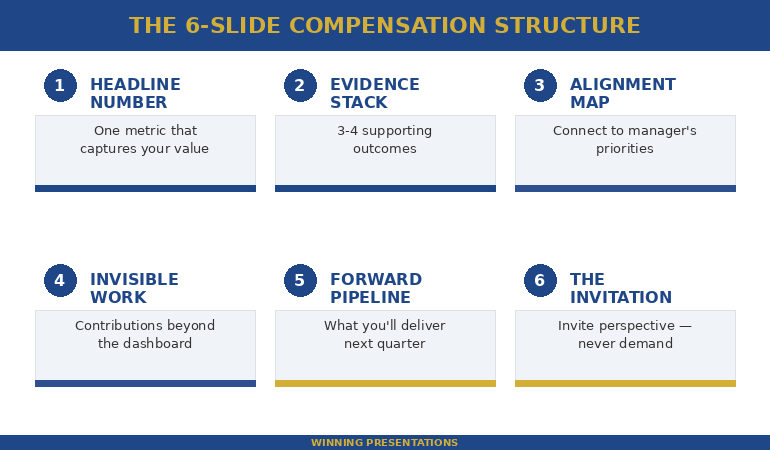
Slide 1 — The Headline Number. One metric that captures your contribution this period. Not a paragraph. One number with context.

❌ Wrong slide 1 title: “Compensation Review Discussion — Q1 2026”

✅ Right slide 1 title: “£1.2M Retained Revenue From Three Client Renewals I Led”

The wrong version announces what you want. The right version announces what you’ve delivered. Your boss reads the second title and immediately thinks: “This person knows their value.” That’s the frame you want before a single word is spoken. This is your executive summary slide — the one that frames everything after it.

Slide 2 — The Evidence Stack. Three to four supporting outcomes that reinforce the headline. Each one should be a single line: metric + context.

❌ Wrong: A bulleted list of everything you worked on — “Participated in the Q3 client review process. Helped onboard new team members. Contributed to the offsite planning.”

✅ Right: Three lines only — “Client retention: 100% renewal rate (£1.2M). Onboarding: cycle reduced from 6 weeks to 3.5. Escalations: down 52% since new structure implemented.”

No explanations. No qualifiers. Your boss doesn’t need you to explain why retaining a client matters.

Slide 3 — The Alignment Map. Show how your outcomes connect to your manager’s stated priorities. If their boss asked them “what’s your team delivering?” — your slide should be the answer they’d give.

❌ Wrong: “My achievements this quarter” — a self-focused list with no connection to departmental goals.

✅ Right: A two-column slide: left column lists your manager’s stated Q1 priorities, right column shows your direct contributions to each one.

This is what separates professionals who get rewarded from those who get “we’ll revisit this next quarter.”

Slide 4 — The Invisible Work. Every professional does work that doesn’t show up in dashboards. Mentoring. Crisis management. Covering for absent colleagues. Political navigation. One slide acknowledging this work — with specifics — tells your boss you understand your full value, not just the measurable parts.

❌ Wrong: “I also do a lot of things that aren’t captured in my KPIs.”

✅ Right: “Three contributions beyond the dashboard: mentored two junior analysts through their first client presentations. Resolved the supply chain escalation before it reached the exec team. Stepped in to cover the Northern region when James was on leave for six weeks.”

Vague claims get nodded at. Specifics get remembered — and repeated upward.

Slide 5 — The Forward Pipeline. What are you set to deliver in the next quarter? This is the slide that changes the conversation from backwards-looking (“what have you done?”) to investment-oriented (“what will you do next?”). Managers who see a strong pipeline are more willing to invest in retaining you.

Slide 6 — The Invitation. No ask. No demand. Just: “I’d appreciate your perspective on how my contribution is being recognised going forward.”

❌ Wrong: “So based on all of this, I think a 15% increase is fair and I’d like to discuss how we make that happen.”

✅ Right: “I’d value your perspective on how this level of contribution is being reflected. I’m also happy to put together a summary you can share with [skip-level name] if that’s useful.”

The wrong version turns you into a negotiator. The right version turns you into a partner — and gives your boss a tool to advocate for you in the room you’re not in.

Six-slide compensation presentation structure showing Headline Number, Evidence Stack, Alignment Map, Invisible Work, Forward Pipeline, and Invitation slides

Build Your Compensation Presentation Tonight

The Executive Slide System includes ready-to-use frameworks for exactly this scenario — including slide structures for value positioning, stakeholder alignment, and decision presentations.

Get the Executive Slide System → £39

Built from 24 years of corporate banking experience and 15 years training executives for high-stakes conversations.

What to Say When Your Boss Says “The Decision Isn’t Mine”

This is the most common deflection — and the most misunderstood. When your boss says the compensation decision isn’t entirely theirs, they’re usually telling the truth. But they’re also telling you something else: they need ammunition.

The correct response is: “I understand it involves multiple stakeholders. Would it help if I put together a brief summary of my contributions this period that you could share?”

You’ve just offered to make their job easier. You’ve also ensured your value gets presented upward — in your words, not a second-hand summary that loses the impact.

This is the same dynamic I saw at Royal Bank of Scotland when working with directors who needed to justify team compensation to the executive committee. The directors who had structured summaries from their team members could advocate effectively. The ones who had to reconstruct contributions from memory couldn’t.

Having the right structure makes this effortless. The Executive Slide System gives you frameworks designed for presenting to senior decision-makers — including the people who control your pay.

Get the Executive Slide System → £39

One timing note: Present your value 4-6 weeks before the compensation cycle starts — not during it. By the time formal reviews begin, budgets are often already allocated informally. And if you’ve just delivered a visible win, don’t wait. Recency bias is real. Your boss’s memory of your value is at its peak right after a result, not three months later during the “proper” review window.

If the anxiety of these high-pressure conversations is what holds you back, you’re not alone — I spent five years terrified of exactly this kind of meeting before I found techniques that worked. Read more about managing high-stakes meeting nerves.

Common Questions About Presenting Your Value in a Pay Review

How do you present your case for a raise to your boss?

Present your case using a Value-First structure: lead with your measurable impact (revenue, savings, client retention), connect your contributions to your manager’s priorities, then invite the compensation conversation rather than making a direct demand. Three to six focused slides work better than a verbal request. Your boss needs evidence they can present upward — give them that evidence in a format they can use.

What should you include in a compensation presentation?

Include one headline metric that captures your contribution, three to four supporting outcomes with numbers, a slide showing how your work connects to your manager’s priorities, acknowledgement of your invisible contributions, your forward pipeline for next quarter, and a soft close that invites discussion. Avoid listing activities — focus on outcomes. Avoid comparing yourself to colleagues — focus on your own value. And keep it to six slides maximum.

How do you talk to your boss about a bonus without sounding entitled?

The key is structure. When you present documented evidence of your impact and then invite your boss’s perspective — rather than making demands — you position yourself as a professional seeking fair recognition, not someone complaining. The phrase “I’d appreciate your perspective on how my contribution is being recognised” works because it’s collaborative, not confrontational. It also gives your boss room to advocate for you rather than defend a position.

Your Next Compensation Conversation Deserves More Than a Chat

The Executive Slide System gives you proven slide frameworks for career-defining moments — including performance reviews, skip-level meetings, and compensation presentations. Built from 24 years of corporate banking experience.

Get the Executive Slide System → £39

Used in board updates, performance reviews, and compensation conversations across banking, consulting, and corporate teams.

Frequently Asked Questions

Can I use this 6-slide structure for a skip-level meeting?

Yes — and you should. Skip-level meetings are often even more important than direct manager conversations because the senior leader may have more influence over compensation decisions. Adjust the Alignment Map (slide 3) to reflect the skip-level leader’s priorities rather than your direct manager’s. Everything else applies exactly the same way. If anything, the structured approach matters more at skip-level because you have less time and need to make a stronger first impression.

What if I don’t have hard revenue numbers to show?

Revenue isn’t the only language bosses speak. Use time saved (“reduced reporting cycle from 3 days to 4 hours”), problems prevented (“identified the compliance gap before the audit”), stakeholders influenced (“aligned three department heads on the integration plan”), or quality improvements (“reduced client escalations by 60%”). The key is specificity. “I contributed to the project” is worthless. “I led the workstream that delivered the client migration two weeks early” is concrete evidence your boss can use.

What if my boss dismisses the presentation entirely?

This happens — and it usually means one of two things. Either the timing was wrong (present earlier in the cycle next time), or your boss genuinely doesn’t control compensation and hasn’t been transparent about it. In either case, the deck you prepared is not wasted. Ask if you can share it with HR or with the person who does influence the decision. Having a structured document of your contributions is always better than relying on memory — yours or theirs.

Should I include specific salary numbers in my slides?

No. Never put a specific number on a slide. The moment you anchor to a number, you’ve turned a value presentation into a negotiation — and you’ve likely anchored lower than what your boss might have offered. Your six slides are designed to build the case so compellingly that your boss initiates the compensation discussion. Let them name the number first. Your job is to make the case so strong that the number reflects your actual value.

📬 Get Weekly Presentation Intelligence

Slide structures, executive communication strategies, and career presentation techniques — delivered every week. No fluff. No spam. Just the frameworks that work in real boardrooms.

Join the Newsletter

📋 Free: Executive Presentation Checklist

A quick-reference checklist for any high-stakes executive presentation — including compensation conversations, board updates, and stakeholder reviews.

Download the Free Checklist

Related: If the anxiety of a salary or bonus conversation is what’s really holding you back, read How I Learned to Present Under Extreme Pressure — the techniques that helped me stay calm in the conversations that mattered most.

Your next step: Open a blank deck tonight. Create six slides using the structure above. You’ll be surprised how much easier the conversation feels when you have evidence on screen instead of nerves in your head.

Want the proven frameworks that make this effortless? Build your salary review presentation in under an hour.

Get the Executive Slide System → £39

About the Author

Mary Beth Hazeldine is the Owner & Managing Director of Winning Presentations. With 24 years of corporate banking experience at JPMorgan Chase, PwC, Royal Bank of Scotland, and Commerzbank, she has delivered high-stakes presentations in boardrooms across the UK and Europe.

A qualified clinical hypnotherapist and NLP practitioner, Mary Beth combines executive communication expertise with evidence-based techniques for managing presentation anxiety. She has spent 15 years training executives and supporting high-stakes board presentations, steering committee updates, and decision meetings.

Book a discovery call | View services