

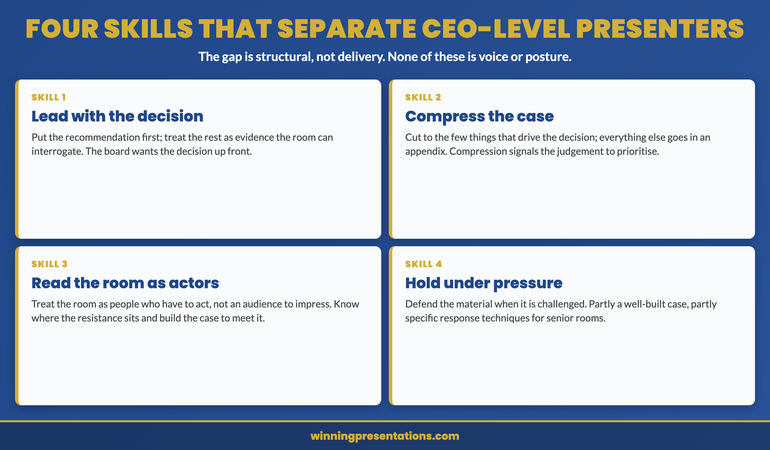
Quick answer: A “presenting like a CEO” course online is worth the money only if it teaches the structural skills that actually separate executive presenters from senior managers — and most of what is sold under that banner teaches delivery polish, which is not the difference. The difference is not voice, posture, or charisma. It is structure: a CEO-level presenter leads with the decision, compresses the case, treats the room as a set of people who have to act rather than an audience to be impressed, and holds their material under pressure. Those are learnable, structural skills, and they are what a serious programme should cover. When you evaluate a course for presenting at CEO level, look for one that teaches case construction and stakeholder analysis over slide-design tips, that is built by someone who has actually presented at board level rather than coached delivery in the abstract, and that fits the way a senior professional’s time actually works — self-paced, no mandatory live attendance, lifetime access to revisit before each high-stakes presentation. This article covers what those skills are and how to tell a substantive programme from a polish-and-confidence one.
JUMP TO:
A few years ago I worked with a newly promoted managing director — a genuinely capable operator who had just stepped up from running a function to sitting on the executive committee of a financial services business. He told me, in our first session, that he had already taken two presentation courses and felt no more like a CEO-level presenter than before. He could feel the gap every time he presented to the committee but could not name it. So I asked him to walk me through the last deck he had presented to them. It was technically excellent — well designed, well delivered, thorough. It was also structured exactly the way he had structured decks as a functional head: context first, analysis in the middle, recommendation at the end. The committee had sat through twenty minutes of build-up to reach a recommendation they had wanted on slide one. The two courses he had taken had improved his delivery and done nothing about his structure, because they were courses about how to present, not about how executives present. The gap he could feel was not polish. It was that he was still presenting like the senior manager he had just stopped being.
I have worked with a large number of senior leaders making exactly this transition, and the pattern is consistent enough that I can usually predict it before I see the deck. The skills that make someone an excellent senior-manager presenter — thoroughness, command of detail, a well-built narrative — are not the skills that make a CEO-level presenter, and in some cases they actively work against the transition. The courses widely marketed as “present like a CEO” or “executive presence” mostly double down on delivery: voice, posture, eye contact, gravitas. Those things are real and they matter at the margin, but they are not the gap. The gap is structural, and a presenter can have perfect delivery and still present like a senior manager if the structure underneath is a senior manager’s structure. The right course teaches the structure. The wrong one teaches you to deliver the wrong structure more confidently.
(This article was created with AI assistance; all stories and insights are based on 35 years of real client work.)
This article is about what a presenting-like-a-CEO course online should actually teach, and how to tell a substantive programme from a polish-and-confidence one before you spend the money. The four structural skills that separate executive presenters from senior managers are: leading with the decision, compressing the case, reading the room as actors rather than an audience, and holding material under pressure. They are all learnable, and they are all structural rather than performative, which is the single most useful thing to know when choosing where to invest. A course that teaches these four is worth it. A course that teaches you to stand straighter and project your voice, however well, is solving a problem you probably do not have.
If you want the structural programme, not the delivery-polish version:
The Executive Buy-In Presentation System is a self-paced course that teaches the structural skills behind presenting at executive level — how to turn reluctant stakeholders into active advocates, how to construct a case a board can act on, and the presentation structures that hold up under senior scrutiny. Seven modules, no deadlines, no mandatory session attendance, with optional live Q&A calls that are fully recorded so you can watch back anytime.
What actually separates a CEO-level presenter from a senior manager
The most visible difference is where the recommendation sits. A senior manager builds toward the recommendation, presenting the analysis that justifies it and arriving at the ask near the end. A CEO-level presenter leads with the recommendation and treats the rest of the presentation as the evidence the room can interrogate. This is not a stylistic preference; it reflects a difference in what the room is for. A functional audience is often there to be walked through the reasoning. An executive committee or board is there to make a decision, and they want the decision in front of them first so they can spend the meeting testing it rather than waiting for it. The managing director I described was building toward a recommendation the committee wanted up front, and the twenty-minute build-up was not thoroughness to them — it was delay.
The second difference is compression. A senior manager is often rewarded for comprehensiveness — covering the ground, anticipating every question, leaving nothing out. At executive level, comprehensiveness reads as an inability to prioritise. A CEO-level presenter compresses the case to the few things that actually drive the decision and puts everything else in an appendix. The compression is itself a signal of seniority, because it demonstrates the judgement to separate what matters from what is merely true. The third and fourth differences — reading the room as a set of people who have to act rather than an audience to be impressed, and holding material under pressure when it is challenged — are the ones that take a presenter from competent to genuinely executive, and they are the ones delivery-focused courses never touch. The structural foundations here are the same ones taught in a serious board presentation course.
The structural skills a course should teach
The first skill a serious course should teach is case construction — how to build a presentation around a decision rather than around a body of information. This is the skill underneath leading with the recommendation, and it is genuinely teachable: there are structures for it, tests for whether a case is decision-led or information-led, and methods for compressing a sprawling analysis into a case a board can act on. A course that teaches case construction is teaching the thing that actually separates executive presenters from senior managers. The second skill is stakeholder analysis — understanding that an executive room is not one audience but several, each reading the presentation through their own lens, and structuring the case so it answers all of them. A presenter who has done the stakeholder analysis walks in knowing where the resistance will come from and has built the case to meet it.
The third skill is handling the pressure that comes with senior rooms — the challenge questions, the pushback on numbers, the moments where a presenter either holds their material or folds. This is partly structural (a well-constructed case is easier to defend) and partly a set of specific response techniques. The fourth is the executive close — how to end a presentation in a way that moves the room to a decision rather than trailing off into questions. A course that covers these four — case construction, stakeholder analysis, pressure handling, and the executive close — is teaching the real curriculum of presenting at CEO level. Notice that none of these is about voice or posture. The delivery-polish courses are not wrong that delivery exists; they are wrong that it is the gap. The gap is here, in the structure, and it is what the broader work on executive presentation training is built around.
A course built by someone who actually presented at board level — not delivery polish.
The Executive Buy-In Presentation System is the self-paced programme that teaches the structural curriculum above: case construction, stakeholder analysis, the structures that hold up under senior scrutiny, and how to turn reluctant stakeholders into active advocates. Seven modules, no deadlines, no mandatory session attendance. Optional live Q&A calls, fully recorded — watch back anytime. Lifetime access to materials. Enrol any time and start with the next cohort. £499.
- 7 modules of self-paced content on the structural skills that separate executive presenters from senior managers
- Case construction and stakeholder analysis — building a presentation around a decision, not a body of information
- Optional live Q&A / coaching calls, fully recorded so you can watch them back whenever you need them
- Lifetime access to revisit the material before each high-stakes presentation — enrol any time, start with the next cohort
How to evaluate a presenting-like-a-CEO course
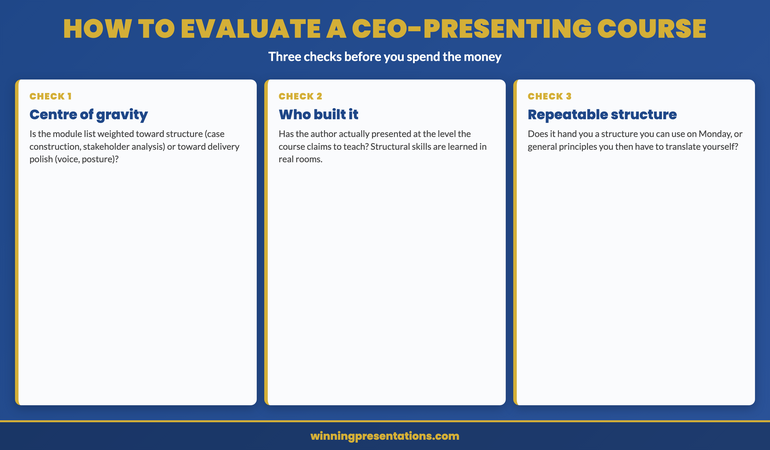
The first thing to check is the curriculum’s centre of gravity. Read the module list and ask whether it is weighted toward structure or toward delivery. A course whose modules are about case construction, stakeholder analysis, and handling challenge is teaching the gap. A course whose modules are about vocal projection, body language, storytelling for charisma, and managing nerves is teaching delivery — useful at the margin, but not the difference between a senior manager and a CEO-level presenter. Most programmes marketed on “executive presence” sit on the delivery side, because delivery is easier to teach and easier to demonstrate in a promotional clip. The structural curriculum is harder to market and more valuable to learn.
The second check is who built it and whether they have actually presented at the level the course claims to teach. There is a meaningful difference between a programme built by a presentation-skills coach who has studied executives and one built by someone who has sat in the executive rooms, built the cases, and faced the challenge questions. The structural skills are hard to teach in the abstract because they are learned in real rooms; a course built by someone who has been in those rooms carries detail that a course built from the outside cannot. The third check is whether the course teaches a repeatable structure you can apply to your own next presentation, or whether it teaches general principles you then have to translate yourself. A course that hands you a structure you can use on Monday is worth more than one that leaves you to derive the structure from inspiration. The same logic underpins a credible board approval training course: repeatable structure over general principle.
If you want the slide-level toolkit alongside the course:
The Executive Slide System gives you the build-level companion to the course thinking — 26 executive templates, 93 AI prompts, and 16 scenario playbooks for the executive scenarios senior leaders meet across the year, including board approval and quarterly review. It is the practical layer: where the course teaches the structural skill, the slide system gives you the templates to execute it. £39, instant download, lifetime access.
Why format matters as much as content for senior professionals
The content can be right and the format can still make a course useless to a senior professional, because the constraint at this level is rarely motivation — it is time, and time that arrives unpredictably. A senior leader cannot reliably commit to a fixed live schedule of weekly sessions, because the diary that would let them attend is the same diary that gets blown up by a deal, a crisis, or a board meeting moved at short notice. A course that requires mandatory live attendance is, for many senior professionals, a course they will start and not finish, not because the content failed but because the format assumed a calendar they do not control. The format question is therefore not secondary; it determines whether the content ever gets absorbed at all.
What works for senior professionals is self-paced learning with optional, recorded live elements. Self-paced means the course bends around the diary rather than the other way around. Recorded live calls mean the value of the live interaction is preserved without the cost of mandatory attendance — if a board meeting collides with a live session, the senior leader watches it back rather than losing it. Lifetime access matters for a related reason: a presenting-at-CEO-level course is not consumed once and finished; it is a reference returned to before each high-stakes presentation, which is when the material is most useful because it is most concrete. When you evaluate a course, weight the format as heavily as the content: a self-paced programme with recorded calls and lifetime access will be finished and re-used; a fixed-schedule live programme, however good, will too often be abandoned at the first diary collision.
Self-paced, recorded calls, lifetime access — built for a senior diary.
The Executive Buy-In Presentation System is self-paced with monthly cohort enrolment, no deadlines and no mandatory session attendance, optional live Q&A calls that are fully recorded, and lifetime access to the materials so you can return to them before each high-stakes presentation. Enrol any time and start with the next cohort. £499.
Frequently asked questions
Is a £499 course worth it when there are cheaper presentation courses and free content online?
It depends on what you are trying to fix. If the gap is delivery polish, cheaper courses and free content cover that well, and you probably do not need to spend £499. If the gap is structural — you present competently but still present like a senior manager rather than a CEO-level executive — then the cheaper and free options mostly will not help, because they teach delivery, which is not your gap. The value of a structural programme is that it teaches the thing the cheaper material skips, and for a senior professional whose progression depends on presenting credibly at board level, closing that gap is worth considerably more than the course costs. The honest test is to look at your last executive presentation and ask whether the problem was how you delivered it or how it was built.
I already present confidently — do I still need this, or is it for nervous presenters?
Confidence and CEO-level structure are different things, and confident presenters are often the ones with the largest structural gap, because their delivery is good enough to mask it. A confident senior manager can deliver an information-led, build-toward-the-recommendation deck very well and still lose an executive committee that wanted the decision up front. The course is not a confidence programme; it is a structure programme, and it is arguably most useful for capable, confident presenters who have plateaued at senior-manager structure without realising that structure is what is holding them at that level. If your delivery is already strong, the structural skills are exactly the high-leverage thing left to add.
How is a self-paced course with optional calls different from a fixed-schedule live programme?
A self-paced course lets you work through the material on your own schedule, with no deadlines and no requirement to attend anything live; the optional Q&A and coaching calls are fully recorded, so you get the benefit of the live interaction whether or not your diary lets you attend in real time. A fixed-schedule live programme, by contrast, typically requires you to be present at set times. For a senior professional whose calendar is regularly disrupted by the demands of the job, the self-paced format is the one that actually gets finished, because it bends around the diary rather than competing with it. The cohort, in this context, simply means the monthly enrolment batch you join — not a fixed live schedule you must keep up with.
What does “presenting like a CEO” look like in practice for someone newly on an executive committee?
In practice it looks like a shorter, decision-led deck that the committee can act on quickly, rather than a thorough, well-built deck they have to sit through to reach the ask. The newly promoted executive’s most common mistake is to bring functional-head thoroughness into an executive room, which reads as an inability to prioritise rather than as diligence. Presenting like a CEO means leading with the recommendation, compressing the case to what drives the decision, anticipating which committee member will push where, and closing in a way that moves the room to decide. It is a smaller, sharper presentation than the one that earned the promotion — which is exactly why the transition catches so many capable people, and why the structural skills are worth learning deliberately rather than absorbing by trial and error in front of the committee.
The Winning Edge — weekly newsletter
The Winning Edge is a weekly newsletter for senior professionals who present at the executive level. One short email a week on the structural moves that separate executive presenters from senior managers. Subscribe to The Winning Edge →
For the wider library of presentation assets senior leaders draw on — slide system, storytelling primer, Q&A taxonomy, delivery references — the complete presenter library (£99) collects them in one place. See the partner article on board approval training and the wider executive resources on the services page.
About the author
Mary Beth Hazeldine is Owner & Managing Director of Winning Presentations Ltd. With 24 years of corporate banking experience at JPMorgan Chase, PwC, Royal Bank of Scotland, and Commerzbank, she advises executives across financial services, healthcare, technology, and government on the structural skills that separate executive presenters from senior managers in high-stakes board and committee settings.
Before you buy a presenting-like-a-CEO course, do three things: read the module list and check whether its centre of gravity is structure or delivery polish, because the gap you are trying to close is structural; check whether it was built by someone who has actually presented at the level it teaches, because the structural skills are learned in real rooms and hard to teach from the outside; and weight the format as heavily as the content, because a self-paced programme with recorded calls and lifetime access gets finished and re-used while a fixed-schedule live programme too often gets abandoned at the first diary collision. The presenter who closes the structural gap stops presenting like the senior manager they were promoted from. The one who takes another delivery course learns to deliver the wrong structure more confidently.