

Why a Reporting-Up Summary Lives or Dies in the First Sixty Seconds
Quick answer: An H1 executive summary presentation — the half-year report a senior leader sends up to a group executive or board — is read in ten slides or not at all, because the person reading it has six other summaries in the same window and gives each one a sixty-second skim before deciding whether to read it properly. The ten-slide format that survives that skim front-loads the verdict: slide one is the half in one sentence and the one decision being asked for, slide two is performance against the H1 plan, slide three is the three things that defined the half, and slides four through ten give one slide each to the dimensions a group executive checks — financials, the forward read into H2, the principal risk, the people picture, and the explicit ask. The senior leader who writes the summary as a chronological narrative of the half loses the reader on the skim because the verdict is buried at the end. The structural move that earns the second read is putting the conclusion on slide one and treating the remaining nine slides as the evidence a busy reader can check, not a story they must follow.
JUMP TO:
In 2003 I worked with a senior leader at one of the institutions where I worked in corporate banking, preparing the half-year executive summary he had to submit to the group executive committee. He had run a strong first half and he wanted the summary to reflect the work. He built a twenty-two-slide narrative that walked through the half in sequence — how the year had started, the early challenges, the turn in the second quarter, the recovery, the strong close. It was, as a story, genuinely well constructed. He sent it up two days before the review. The morning of the review, the group chief operating officer’s assistant forwarded back a single line the COO had written after skimming it on a phone between meetings: “Can someone tell me on one page whether this is good news or bad news and what he wants from us?” The half had been strong. The summary had not said so in a place the reader could find in sixty seconds. The COO had skimmed slide one, found context rather than verdict, and stopped. The senior leader spent the night before the review rebuilding the whole thing into a format that led with the answer.
I have now worked with around thirty-five senior leaders on reporting-up summaries — half-year reviews, board updates, group submissions — across financial services, professional services, and technology. The mistake is almost always the same, and it is the opposite of the mistake people expect. The senior leader writes too good a story. They build a narrative that rewards a careful, sequential read, and they submit it to a reader who does not read sequentially and does not read carefully on the first pass. A group executive with six summaries to get through skims each one for the verdict, decides on the skim whether it earns a proper read, and only then — if it earned it — goes back to the evidence. The summary that buries the verdict in a narrative fails the skim and never gets the read. The summary that front-loads the verdict passes the skim and earns the read it deserves.
(This article was created with AI assistance; all stories and insights are based on 35 years of real client work.)
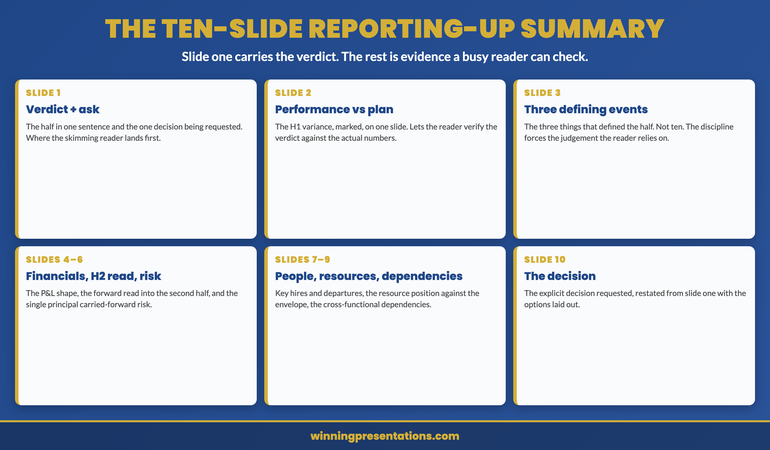
The ten-slide format I want to describe is the structure I now teach every senior leader who reports up to a group executive or board. It is not a storytelling structure. It is a skim-survival structure, built around how a busy senior reader actually consumes a summary: verdict first, evidence on demand. The deck does ten things in a fixed order — the half in one sentence and the ask, performance against plan, the three defining events, the financial picture, the forward read into H2, the principal risk, the people picture, the resource position, the dependencies, and the explicit decision being requested. Slide one carries the conclusion. The remaining nine are the evidence a reader can check in any order. The summary that leads with the answer survives the skim. The summary that leads with the context does not.
If you would rather start from a structure that already leads with the verdict:
The Executive Slide System ships 26 executive templates including an executive-summary structure built for reporting up, plus 93 AI prompts that help you compress a half’s worth of detail into ten slides without losing the evidence a senior reader will want to check. Built for senior leaders who report up on a cycle and cannot afford a summary that fails the skim.
Why a reporting-up summary is read on the skim, not the read
A senior reader at the top of an organisation has a structural problem the senior leader writing up to them does not always picture: volume. At a half-year point, a group executive is receiving summaries from every division, function, and major programme in the same two-week window. They cannot give each one a careful sequential read on the first pass; there is not enough time in the day. So they do what every busy reader does — they skim each summary for the verdict, sort the summaries into “fine,” “needs a proper read,” and “needs a conversation,” and only then go back to the ones in the second and third piles. The first sixty seconds of contact with the summary decide which pile it lands in. A summary that does not surface its verdict in those sixty seconds gets sorted as “fine” by default, which sounds harmless until the senior leader realises that “fine” means “not read,” and that the work they wanted recognised was never actually seen.
This is why a well-constructed narrative is a trap in a reporting-up context. A narrative is designed to be read in sequence; its meaning accumulates toward a conclusion at the end. That is exactly the wrong shape for a reader who starts at slide one, gives it sixty seconds, and stops if the verdict is not there. The narrative’s payoff is on the last slide the skimming reader never reaches. The senior leader experiences this as “they didn’t engage with my report,” when what actually happened is that the report’s structure asked for a kind of reading the reader had no time to give. The fix is not a better narrative. It is the inversion of the narrative: conclusion first, evidence after. The same principle — lead with the decision the reader has to make — sits underneath the work in the executive buy-in masterclass.
There is also a status dimension that senior leaders sometimes miss. A summary that leads with its verdict signals that the writer respects the reader’s time and knows their own conclusion. A summary that makes the reader work through context to find the verdict signals, however unintentionally, that the writer either did not know what their own headline was or expected the reader to do the synthesis. Group executives read the difference. The leader whose summaries consistently lead with a clear verdict and clean evidence gets a reputation as someone who can be trusted with a larger remit, precisely because their reporting does not create work for the people above them. The format is a credibility signal as much as a communication tool.
The ten-slide format that survives the first skim
Slide one is the half in one sentence and the one decision being asked for. “H1 closed ahead of plan on revenue and on plan on cost; the one decision we need from the group is approval to bring forward the H2 hiring plan to capture a channel that opened in Q2.” Verdict and ask, in the first two lines, where the skimming reader lands first. Everything else in the deck is evidence for that sentence. Slide two is performance against the H1 plan — the variance, marked, on one slide, so the reader can verify the verdict in slide one against the actual numbers. Slide three is the three things that defined the half. Not ten. Three. The discipline of three forces the senior leader to make the judgement the reader is relying on them to make.
Slides four through ten give one slide each to the dimensions a group executive routinely checks, in a fixed order so the reader always knows where to look. Slide four is the financial picture — the P&L shape, not the full detail. Slide five is the forward read into H2: what H1 tells you about the second half. Slide six is the principal risk carried into H2 and its mitigation. Slide seven is the people picture — key hires, key departures, the bench. Slide eight is the resource position against the approved envelope. Slide nine is the cross-functional dependencies that could affect delivery. Slide ten is the explicit decision being requested, restated from slide one with the options laid out. A reader who skimmed slide one and decided to read properly can now move through the evidence in any order, because each slide is self-contained and labelled. The fixed order is what makes the deck checkable rather than narrative.
Build the ten-slide reporting-up summary from a template designed to lead with the verdict.
The Executive Slide System ships an executive-summary structure built for reporting up, along with 26 executive templates, 93 AI prompts for compressing a half’s detail into ten checkable slides, 16 scenario playbooks covering board updates and group submissions, plus 7 checklists. Built for senior leaders whose summaries have to survive a sixty-second skim. £39, instant download, lifetime access.
- 26 executive slide templates — including an executive-summary structure for reporting up to group level
- 93 AI prompts — compress a half’s worth of detail into ten slides without losing the evidence
- 16 scenario playbooks — board update, group submission, half-year review, executive reporting
- 7 checklists — including the verdict-on-slide-one check most summaries fail
Why slide one carries the verdict, not the context
The single most common failure in a reporting-up summary is a slide one that opens with context — the market backdrop, the strategic frame, the reminder of what the division does. Context on slide one feels responsible, even courteous; it sets the scene. It is also exactly what loses the skimming reader, because the reader already knows the context — they run the organisation the division sits inside — and what they are skimming for is the one thing they do not yet know, which is the verdict. A slide one that spends its real estate on context the reader already has, and defers the verdict to slide three or the closing slide, fails the skim no matter how strong the underlying half was. The verdict has to be the first thing on the first slide, in a sentence the reader can absorb without effort.
What makes the verdict-first slide hard is that it requires the senior leader to commit to a single headline before they have walked the reader through the supporting case — which feels, to someone trained on persuasive narrative, like giving away the ending. In a reporting-up context, giving away the ending is the point. The reader is not an audience to be taken on a journey; they are a decision-maker who needs the conclusion in order to decide how much of the evidence to engage with. The senior leader who trusts the verdict-first structure finds that the reader engages more deeply with the evidence, not less, because the verdict tells them what the evidence is for. The structural confidence to lead with the conclusion is the same confidence the executive summary slide work is built to develop, and it transfers directly to board and committee settings.
For the deeper framework behind building a verdict-first case for senior readers:
The Executive Buy-In Presentation System is a self-paced programme with 7 modules covering stakeholder analysis, case construction, and the presentation structures that hold up at board and group-executive level. Senior leaders reporting up use the case-construction module to build the verdict-first slide one and the principal-risk slide that a group executive checks on the second read. Optional live Q&A calls, fully recorded. Lifetime access to materials. £499.
What a group executive checks on the second read
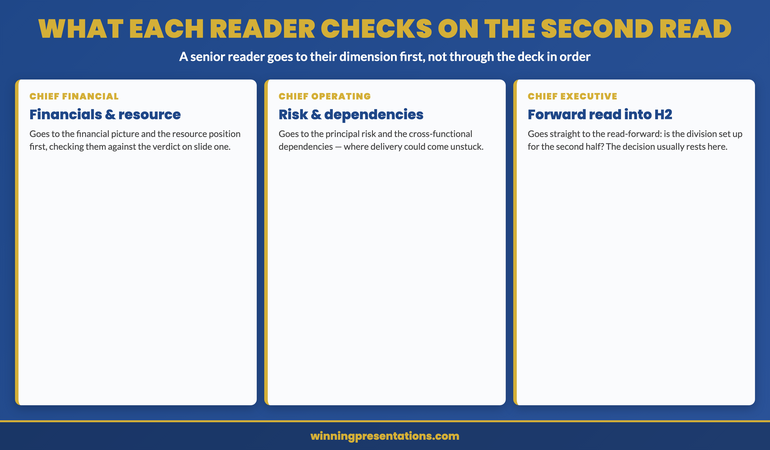
If the summary survives the skim and earns the second read, the group executive does not read it sequentially even then. They go to the dimensions they personally worry about. A chief financial officer goes to slide four and slide eight — the financial picture and the resource position — first. A chief operating officer goes to slide six and slide nine — the principal risk and the dependencies. A chief executive often goes straight to slide five, the forward read into H2, because that is the slide that tells them whether the division is set up for the second half. The fixed-order, one-slide-per-dimension structure is what makes this possible: each reader can find their dimension immediately, check it against the verdict on slide one, and form a view without reading the whole deck. A narrative summary forces every reader through the same sequence and frustrates all of them; the ten-slide format lets each reader take the path their role demands.
The second read is also where the senior leader’s judgement gets evaluated. The three defining events on slide three, the single principal risk on slide six, the choice of what made it onto the people picture on slide seven — these are all judgement calls, and the group executive reads them as evidence of whether the senior leader can tell what matters from what merely happened. A summary that names ten defining events and five principal risks has made no judgement; it has handed the synthesis back to the reader. A summary that names three and one has made the call, and the quality of that call is what the senior leader is actually being assessed on. The format does not just communicate the half; it demonstrates the senior leader’s ability to lead it, which is the thing the group executive most wants to know.
Keep the template. Use it next half. And the half after that.
Instant download, lifetime access to the Executive Slide System — 26 templates, 93 AI prompts, 16 scenario playbooks, 7 checklists. No subscription, no renewal. £39 once. Built for senior leaders who report up twice a year and want a summary that survives the skim every time rather than a blank page each cycle.
Frequently asked questions
Isn’t ten slides too few for a full half-year of activity?
Ten slides is the summary, not the record. The full record — the detailed financials, the programme-by-programme status, the full risk register — lives in an appendix or a supporting pack that you send alongside the ten slides. The ten slides exist to survive the skim and earn the read; the appendix exists for the reader who wants to verify a specific point. Trying to put the full half into ten slides is as much a mistake as putting it into a twenty-two-slide narrative, because it overloads each slide and defeats the skim. Keep the ten slides clean and let the appendix carry the depth. In practice senior readers rarely open the appendix, because the ten slides have already answered the questions that mattered.
What if my organisation’s reporting template is fixed and doesn’t follow this structure?
Use the fixed template for the submission and add a one-page verdict-first cover slide in front of it. Most fixed reporting templates fail the skim precisely because they were designed for completeness rather than for the reader’s first sixty seconds. You usually cannot change the template, but you can almost always add a cover. A single slide that states the half in one sentence, the verdict, and the one decision being asked for — placed before the templated content — gives the skimming reader the landing point the template denies them. Senior leaders who add the verdict cover find their submissions get engaged with more often, even when everything behind the cover is the mandated format.
How is reporting up to a group executive different from presenting to your own board?
The structure is the same; the altitude of the verdict rises. Your own board has more context on your division and can absorb a slightly more detailed verdict. A group executive sits further from the detail and needs the verdict pitched higher — less about the mechanics of the half, more about whether the division is on track and what it needs from the group. When reporting up to a group level, compress slides three, seven, and nine, because the group reader cares less about the internal detail, and give more weight to slide five, the forward read into H2, because the group’s decision is usually about whether to back the division’s second half. Slide one and slide ten stay structurally identical because the verdict and the ask are what every senior reader is looking for first.
How long does it take to build the ten-slide format the first time?
About a day and a half of focused work for a senior leader who has the half’s underlying analysis already done. The slow part is the compression — getting the half into a single verdict sentence on slide one, choosing the three defining events from a dozen candidates, naming the single principal risk. The slides themselves are quick to build once the judgements are made. Senior leaders who start by writing slide one before building any other slide almost always produce a stronger summary, because the verdict sentence forces every later slide to earn its place as evidence for that verdict rather than as another piece of the narrative.
The Winning Edge — weekly newsletter
The Winning Edge is a weekly newsletter for senior professionals who present and report at the executive level. One short email a week on the structural moves that separate summaries that get read from summaries that get sorted into “fine.” Subscribe to The Winning Edge →
For the wider library of presentation assets senior leaders draw on across a reporting cycle — slide system, storytelling primer, Q&A taxonomy, delivery references — the complete presenter library (£99) collects them in one place. See the wider board-readiness resources on the services page, and the partner article on the end-of-quarter board results format.
About the author
Mary Beth Hazeldine is Owner & Managing Director of Winning Presentations Ltd. With 24 years of corporate banking experience at JPMorgan Chase, PwC, Royal Bank of Scotland, and Commerzbank, she advises executives across financial services, healthcare, technology, and government on structuring presentations for high-stakes funding rounds, board approvals, and strategic decisions.
The next time you build an H1 executive summary to send up, do three things instead of writing the half as a story: put the verdict and the one decision being asked for on slide one, in a sentence the reader can absorb in the sixty seconds they will give it; give one slide each, in a fixed order, to the dimensions a senior reader checks, so the deck is evidence they can verify rather than a narrative they must follow; and name three defining events and one principal risk, not ten and five, so the summary demonstrates the judgement the reader is actually assessing. The reader who skims it for a verdict and finds one reads the rest. The reader who skims it for a verdict and finds context sorts it into “fine” and never reads the work you did.