

Why the Best Quarter-Close Board Decks Open With the Next Quarter, Not the Last
Quick answer: An end-of-quarter board presentation is judged less on how thoroughly it reports the quarter that just closed and more on how cleanly it sets up the quarter about to start. The results format senior leaders use puts the headline result and the one number that matters on slide one, the variance against the quarter’s plan on slide two, the two or three things that actually moved the result on slide three, and then pivots — in the same deck — to the Q3 setup: what the closing quarter tells you about the next one, the one risk that carries forward, and the single decision the board needs to make now to protect Q3. The senior leader who spends the whole deck narrating Q2 in detail runs out of room before the board’s real question — “so what does this mean for next quarter?” — gets answered. The structural move that separates a quarter-close deck the board approves from one it merely receives is treating the results as the setup for a forward decision, not as the destination of the meeting.
JUMP TO:
In 2006 I worked with a divisional finance lead at one of the banks where I held a corporate banking role, preparing him for the quarter-close presentation to the divisional board. It was the end of the second quarter, the numbers were genuinely good — the division had come in ahead of plan on revenue and roughly on plan on cost — and he had built a thirty-one-slide pack to do the result justice. Every line of the P&L had its own slide. Every variance had a waterfall. He walked into the room expecting a comfortable meeting because the result was strong. Eleven minutes in, the chair — a non-executive who had run a larger division herself two decades earlier — turned past the slide he was on, found the one slide near the back that mentioned the third quarter, tapped it with the end of a red pen she had been holding the whole time, and said: “This is the only slide I care about. The quarter is closed. Tell me what it means for the next one.” He had given the closed quarter thirty slides and the open quarter one. The board did not doubt the result. They doubted that he had used the result to think forward. The meeting ran another forty minutes, most of it the board doing out loud the Q3 thinking the deck should have done for them.
I have now worked with somewhere around forty senior leaders preparing end-of-quarter and end-of-half board presentations across financial services, professional services, healthcare, and technology. The pattern repeats almost regardless of whether the quarter was good or bad. The senior leader treats the quarter-close as a reporting exercise — a thorough, defensible account of what happened — and builds a deck weighted entirely toward the quarter that has ended. The board treats the same meeting as a forward-planning checkpoint. They have already seen most of the numbers in the monthly reporting. What they want from the live meeting is the synthesis: what the closed quarter changes about the open one. The deck that gives them that lands. The deck that re-reads the closed quarter to them, line by line, gets received politely and then quietly downgraded in the board’s estimation of the presenter.
(This article was created with AI assistance; all stories and insights are based on 35 years of real client work.)
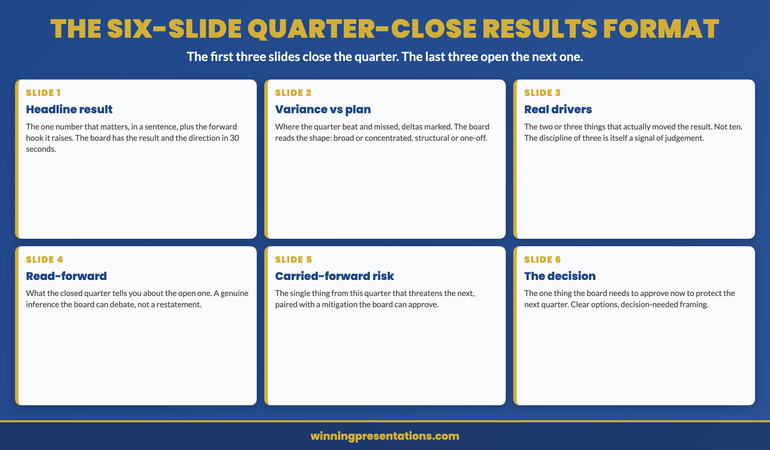
The results format I want to describe here is the structure I now teach every senior leader I work with before a quarter-close or half-year board presentation. It is not a reporting template. It is a forward-decision template that uses the closed quarter as its evidence base. The deck does six things in order: the headline result, the variance against plan, the two or three real drivers, the read-forward into the next quarter, the one carried-forward risk, and the single decision the board needs to make now. The first three slides close the quarter. The last three open the next one. The board approves the deck that completes the pivot. The board merely files the deck that stops at slide three.
If you would rather not rebuild the quarter-close deck from a blank page every cycle:
The Executive Slide System ships 26 executive templates including an 8-slide QBR Deep Dive structure built for exactly this close-and-open shape, plus 8 QBR-specific AI prompts that walk you through populating each slide from your live numbers. Built for senior presenters who run a results cycle every quarter and do not want to start from scratch each time.
Why most end-of-quarter board presentations stall at the results
The reporting instinct is a strong one and it is not irrational. A senior leader who has run a quarter wants the record of that quarter to be complete, accurate, and defensible. There is a real fear underneath the thirty-slide pack: if I leave something out and the board asks about it, I will look as though I did not know my own numbers. So the deck grows to cover every line, every variance, every footnote, on the theory that completeness is safety. At quarter end, completeness is the opposite of safety. A board that is handed thirty slides of closed-quarter detail reads the volume as a presenter who cannot tell the important from the routine, which is a more damaging impression than a single unanswered question would ever have been.
The board has also usually seen the numbers before the meeting. Monthly management reporting, the finance pack, the flash results — by the time the quarter-close board presentation happens, most directors know the headline figures. Re-presenting those figures in detail tells the board nothing they did not have, and it consumes the scarce live time on material that did not need the meeting. The live meeting is the only time the board has the senior leader in the room to interrogate the forward read. Spending that time on backward reporting wastes the one thing the meeting is uniquely for. The senior leaders who understand this arrive having already assumed the board knows the numbers, and build the deck around the question the numbers raise rather than the numbers themselves.
There is a timing dimension as well. A quarter-close presentation lands at the seam between two quarters, when the board’s attention is naturally forward. The board is not nostalgic about the closed quarter; it is anxious about the open one, because the open one is the quarter they can still affect. A deck that holds the board’s attention in the past while their concern is in the future creates a quiet friction in the room that the senior leader often cannot name but can feel — the sense of presenting to people who are mentally already in the next meeting. The results format resolves that friction by meeting the board where their attention already is. The principles behind that forward-read structure are the same ones the executive buy-in masterclass teaches for any board-level case: lead with the decision the room can still make.
The results format that closes one quarter and opens the next
Slide one is the headline result and the single number that matters most, stated at the top in one sentence. Not the full P&L. The one result the board will remember walking out: “Q2 closed at four percent ahead of plan on revenue and on plan on cost, with the full-year forecast now upgraded by two points.” The bottom of the slide carries the one-line implication: “The upgrade is driven by a channel that opened in May and is the central question for Q3.” The board now has the result and the forward hook in the first thirty seconds, which sets the meeting’s direction before any detail arrives.
Slide two is the variance against the quarter’s plan, on one slide, with the deltas marked. Where did the quarter beat plan, where did it miss, and by how much. The board is not reading the detail; they are reading the shape — whether the beat is broad or concentrated, whether the misses are structural or one-off. A concentrated beat and a structural miss tell a very different forward story than a broad beat and a one-off miss, and the variance slide is where the board reads which story they are in. Slide three is the two or three drivers that actually moved the result. Not ten. Two or three. The discipline of naming only the drivers that materially moved the number is itself a signal to the board that the senior leader knows their business well enough to separate signal from noise.
Then the deck pivots. Slide four is the read-forward: what the closed quarter tells you about the open one. If the Q2 beat came from a new channel, slide four is about whether that channel scales into Q3 or was a one-quarter spike. Slide five is the single carried-forward risk — the one thing from the closed quarter that, left unaddressed, threatens the open one. Slide six is the decision: the one thing the board needs to approve now to protect Q3. The senior leader who completes this pivot gives the board a meeting that is worth their time. The structural discipline of closing in three slides and opening in three is what keeps the deck from collapsing back into a report.
Build the quarter-close deck from a template that already does the close-and-open pivot.
The Executive Slide System ships the 8-slide QBR Deep Dive template along with 26 executive templates, 93 AI prompts for populating slides from live numbers, 16 scenario playbooks covering board approval, finance review, and quarterly review scenarios, plus 7 checklists. Built for senior presenters who close a quarter on a deadline every quarter. £39, instant download, lifetime access.
- 26 executive slide templates — including the 8-slide QBR Deep Dive structure for close-and-open results decks
- 93 AI prompts — including 8 QBR-specific prompts that populate each slide from your live numbers
- 16 scenario playbooks — board approval, finance review, quarterly business review, half-year close
- 7 checklists — including the pre-meeting variance check most senior leaders skip under deadline
The pivot slide that turns a report into a decision
Slide four is the structural hinge of the whole deck and it is the slide most quarter-close presentations leave out entirely. Everything before it closes the quarter; everything after it opens the next one; and slide four is where the senior leader makes the explicit connection between the two. The connection has to be a genuine inference, not a restatement. “Revenue was up four percent” is a result. “The four-percent beat came from a channel that did not exist in January, which means our Q3 plan was built on a revenue base that is now understated — we are either re-baselining up or leaving the upside on the table” is an inference. The board can debate an inference. They cannot do anything with a restatement except nod. Slide four earns the rest of the meeting because it gives the board something to decide.
The carried-forward risk on slide five works the same way. Every closed quarter leaves exactly one thing that genuinely threatens the next quarter — not the full risk register, which belongs in an appendix, but the single risk that, if the board does nothing, will show up in the next quarter-close as a miss. Naming that one risk specifically, and pairing it with a mitigation the board can approve, does two things. It demonstrates that the senior leader is thinking past the result they just delivered, which is exactly the forward orientation the board is reading for. And it converts the meeting from a backward-looking review into a forward-looking decision, which is the only version of the meeting that justifies the board’s time. The deeper structure behind this kind of carried-forward case — building a forward decision on the evidence of a closed period — is the core of the work in board presentation structure.
For the deeper framework behind moving a board from results to a decision:
The Executive Buy-In Presentation System is a self-paced programme with 7 modules covering stakeholder analysis, case construction, and the presentation structures that hold up at board and executive committee level. Senior leaders use the case-construction module to build the read-forward and the carried-forward-risk slides that turn a quarter-close from a report into a decision. Optional live Q&A calls, fully recorded — watch back anytime. Lifetime access to materials. £499.
What the board is actually reading at quarter end
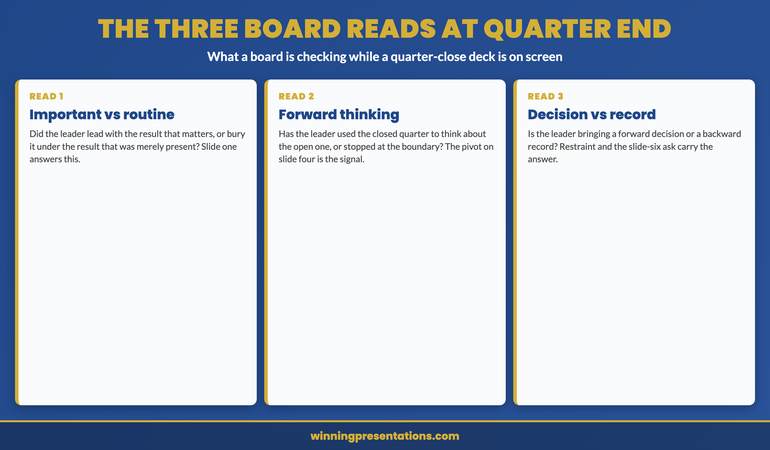
The board at a quarter-close is running three reads in parallel, and none of them is “did the numbers reconcile.” The first read is whether the senior leader can tell the important from the routine — whether, given a quarter of detail, they led with the result that matters or buried it under the result that was merely present. The second read is whether the senior leader has used the closed quarter to think about the open one, or simply stopped at the boundary. The third read is whether the senior leader is bringing the board a decision or bringing them a record. All three reads are happening in the first few slides, which is why the structural choices in slides one through four carry so much weight. A senior leader who leads with the one number, marks the variance cleanly, names two or three drivers, and pivots to the forward read has answered all three reads before the board has formed a contrary impression.
The other thing the board reads at quarter end is restraint. A good quarter tempts the senior leader to dwell — to take the credit the result has earned. The boards that matter read the dwelling as a small failure of judgement, because the result is already known and dwelling on it spends time the board would rather spend on the forward decision. The senior leader who delivers a strong result in three slides and moves immediately to what it means for next quarter reads as someone the board can trust with a bigger remit. The restraint is itself a signal of seniority. None of this requires a different personality; it requires a different deck shape, and the deck shape is learnable.
One template. Every quarter. No rebuild, no renewal.
Instant download, lifetime access to the Executive Slide System — 26 templates, 93 AI prompts, 16 scenario playbooks, 7 checklists. No subscription, no renewal. £39 once. Built for senior presenters who close a quarter four times a year and want a deck that compresses cleanly each time rather than a blank page each cycle.
Frequently asked questions
What if the quarter was poor — doesn’t a bad result need more explanation, not less?
A poor quarter needs more honesty, not more slides. The instinct to explain a bad result at length usually reads to the board as defensiveness, which compounds the problem. The structure holds: state the result plainly on slide one, mark the variance without softening it on slide two, name the two or three real drivers of the miss on slide three, and then spend the forward half of the deck on what you are changing in the next quarter as a result. A board responds far better to a senior leader who delivers a bad result in three clean slides and a credible forward plan than to one who spends thirty slides explaining why the quarter was not really their fault. Restraint reads as control even when the number is poor.
Is this format still right if the board explicitly asks for a detailed results pack?
Provide the detailed pack as a pre-read or an appendix, and keep the live presentation to the six-slide close-and-open structure. The two are not in conflict. A board that asks for detail is usually asking to be able to check the numbers in their own time, not to have them read aloud in the meeting. Send the full pack twenty-four to forty-eight hours ahead, label it clearly as the supporting detail, and open the live meeting with the headline result and the forward read. In practice the board rarely turns to the detailed pack in the room, because the six slides have answered the questions the detail was there to support. The detailed pack reassures; the six slides decide.
How is an end-of-quarter board presentation different from a half-year or year-end one?
The structure is identical; the weight of the forward half increases as the period lengthens. At a single quarter-close, slides four to six can be relatively light because the next quarter is a short horizon. At a half-year close, the forward read carries more weight because the board is calibrating the full second half against the first, so slide four expands to cover the read-forward into the whole of H2 and slide five often becomes two slides to give the principal carried-forward risks room. The headline result, variance, and drivers stay at three slides regardless of period length, because the discipline of closing in three is what protects the time for the forward read.
What is the most common mistake senior leaders make in a quarter-close presentation?
Spending the deck’s scarce attention proving the numbers rather than interpreting them. The numbers are usually already known to the board from the monthly reporting, so re-proving them adds nothing and consumes the time the board wanted for the forward decision. The fix is to assume the board knows the numbers and build the deck around the question the numbers raise: what does this quarter mean for the next one, and what should we decide now because of it. Senior leaders who make this shift find their quarter-close meetings get materially shorter and more decisive, because the deck does the synthesis the board would otherwise have done out loud in the room.
The Winning Edge — weekly newsletter
The Winning Edge is a weekly newsletter for senior professionals who present at the executive level. One short email a week on the structural moves that separate decks boards approve from decks they merely receive. Subscribe to The Winning Edge →
For the wider library of presentation assets senior leaders draw on across a results cycle — slide system, storytelling primer, Q&A taxonomy, delivery references — the complete presenter library (£99) collects them in one place. See the wider set of board-readiness resources on the services page, and the partner article on the H1 executive summary format for reporting up.
About the author
Mary Beth Hazeldine is Owner & Managing Director of Winning Presentations Ltd. With 24 years of corporate banking experience at JPMorgan Chase, PwC, Royal Bank of Scotland, and Commerzbank, she advises executives across financial services, healthcare, technology, and government on structuring presentations for high-stakes funding rounds, board approvals, and strategic decisions.
The next time you build an end-of-quarter board presentation, do three things instead of reporting the quarter line by line: lead slide one with the single result that matters and the forward hook it raises; close the quarter in three slides — result, variance, drivers — and refuse the urge to add a fourth; and spend the back half of the deck on the read-forward, the one carried-forward risk, and the single decision the board needs to make now. The board has already seen the numbers. What they came to the meeting for is what the numbers mean for the quarter they can still affect. The senior leader who gives them that closes one quarter and opens the next in the same deck. The senior leader who narrates the closed quarter in full gets the meeting the board did not need.