Tag: career presentations

19 Apr 2026

Internal Transfer Pitch: The Presentation That Gets You to the Role You Want

Quick Answer

An internal transfer pitch succeeds when it is structured as a business case rather than a personal preference statement. The decision-maker needs to see three things: what the organisation gains by approving the move, what you bring that is directly relevant to the new role, and what the cost or risk of not moving you is. An internal pitch that frames itself around your career goals is a request. One that frames itself around organisational value is a proposal.

Tomás had been in the same division for eight years. When a senior role opened in a part of the business he had been angling towards for two years, he put himself forward, prepared a thorough self-assessment, and requested time with the divisional director to discuss it.

The conversation lasted 11 minutes. The director told him the role would be filled externally.

What went wrong was not Tomás’s track record, which was strong. What went wrong was the structure of what he said. He spent the 11 minutes explaining why he wanted the role. The director spent those same 11 minutes silently calculating what losing Tomás from his existing team would cost him. Neither of them was having the conversation the situation required.

Internal transfer pitches fail in this way constantly. The candidate frames the conversation around their development. The decision-maker evaluates it through the lens of organisational disruption. Those two frames are not compatible, and without a structure that addresses both, the conversation ends in a polite “we’ll let you know” that usually means no.

Need a presentation structure for a high-stakes career conversation?

The Executive Slide System includes proposal templates and framework guides designed for making the business case in internal and external career-stage presentations.

Explore the System →

Why Internal Pitches Fail When External Pitches Would Succeed

The most counterintuitive aspect of an internal transfer pitch is that your existing relationship with the organisation makes the conversation harder, not easier. External candidates start from zero. You start from a set of existing perceptions, existing dependencies, and existing political dynamics that shape how every word you say is received.

Your current manager hears your transfer pitch as a signal that their team is about to lose a high-performer. The hiring manager in the new division may have concerns about whether you can reposition yourself from a known role into an unknown one. The HR function is evaluating whether approving your move sets a precedent they are comfortable with. None of these stakeholders are against you, but none of them are reading your pitch as a neutral observer.

This means the internal pitch requires a more sophisticated structure than an external interview. An external candidate needs to establish credibility, demonstrate capability, and close on the opportunity. An internal candidate needs to do all three of those things and also address the costs and concerns that come with internal movement. The pitch has to make it easy for multiple stakeholders to say yes, not just the hiring manager.

The failure mode for most internal pitches is treating the conversation as if it were a performance review rather than a business proposal. The structure of a performance review is backward-looking: here is what I have done, here is how well I have done it, here is why I deserve the next thing. The structure of a business proposal is forward-looking: here is the problem that needs solving, here is my capability to solve it, here is what the organisation gets by backing this move. The second frame is far more persuasive in a decision setting.
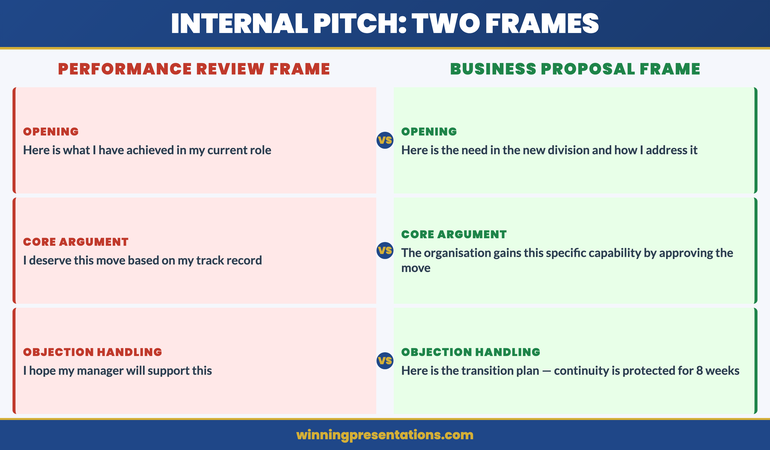
Internal pitch frame comparison: Performance Review frame (backward-looking: what I have done) versus Business Proposal frame (forward-looking: what the organisation gains)

The Three Elements Every Internal Pitch Must Address

An internal transfer pitch that earns approval addresses three questions in sequence. These questions correspond to the concerns of the different stakeholders involved in the decision.

1. What does the organisation gain? This is the organisational value question, and it is the frame that makes an internal pitch a business proposal rather than a personal request. The answer should connect your specific skills and experience to a named need in the target role or division. Not “I have strong analytical capability” but “the new division is building a client-facing data function and I have spent three years building exactly this capability on the service delivery side, which is the experience they currently lack on the team.”

2. What do you bring that is directly relevant? This is not your full CV. It is the two or three pieces of your existing experience that are most directly transferable to the requirements of the new role. Be specific about the capability, and be explicit about the mechanism of transfer — not just “I have done X” but “the X I did on Project Meridian translates directly to the Y challenge I understand the new team is facing.” Internal decision-makers are generally more sceptical about transferability than external ones, because they have a clearer picture of the gap between your current role and the new one.

3. What is the cost or risk of the move not happening? This is the element most often absent from internal pitches, and it is the one that converts a polite conversation into a decision moment. The cost of the move not happening is rarely about you personally — it is about the organisational opportunity that is left unaddressed. “Without someone with this profile in the new team, the risk is that the function is built by people who understand the technology but not the client relationship dynamics. That is a gap that costs significantly more to correct after the fact.” This reframes the decision from “should we approve Tomás’s transfer?” to “what does it cost us not to put the right person in this role?”

How to Frame the Move as a Business Decision

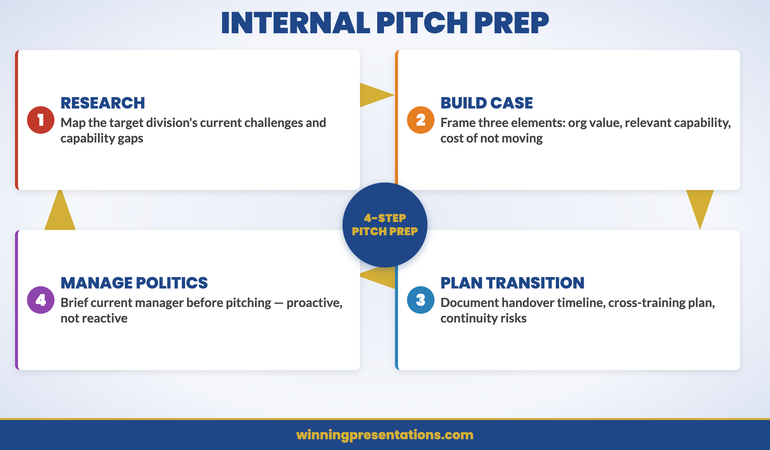
The business case frame for an internal transfer pitch requires you to research the target role with the same rigour you would apply to any significant business proposal. Before the conversation with the decision-maker, you should be able to answer three questions about the division you are moving into: what are the current performance challenges, what capability does the team currently lack, and what is the strategic priority that the role is expected to support?

This information is almost always available if you look for it. Department heads discuss their challenges in all-hands meetings and in conversations with peers. Annual reports and strategy presentations are public. If you have a contact in the division, a single conversation will surface the specific pressure points the team is dealing with. The point is to do this research before the pitch, so your opening framing is not “I would like to move to your team” but “I understand the team is building out its [specific capability] function, and I have direct experience in that area from my current role.”

This opening immediately repositions the conversation. Instead of a candidate asking for a favour, you are a senior professional who has identified a specific organisational need and is presenting a solution. That is the frame in which business proposals are evaluated, and it is far more likely to generate a substantive conversation than a general expression of interest.

The political dimension of an internal transfer pitch is real and ignoring it does not make it disappear. Your current manager will find out about the pitch, if not from you then from the person you are pitching to. Managing that conversation proactively is always better than having it reactively.

The timing of when you inform your current manager is a judgment call that depends on the strength of your relationship and the culture of your organisation. In most settings, informing them before rather than after the pitch is the right move, framed as a professional courtesy rather than a request for permission. “I wanted you to hear this from me directly before I speak with anyone else: I am going to explore the opportunity in [division]. I am not planning to leave the team immediately — this is a longer-term development move — and I want to make sure we handle any transition in a way that does not leave the team exposed.”

This conversation also gives you an opportunity to address the most immediate concern your current manager has: continuity. If you can demonstrate that you have a clear transition plan before the pitch even happens, you remove the most significant source of resistance to an internal move. A manager who knows the handover will be handled well is far less likely to block or slow an internal transfer than one who feels the departure will be disruptive and unplanned.

The broader political landscape also includes relationships with peers who may be affected by the move or who have competing interests in how the new role is filled. It is worth thinking through who the decision influences and ensuring none of them are surprised in a way that creates unnecessary friction.

Presenting Your Transition Plan

Including a transition plan in your internal pitch is one of the most effective ways to signal that you are thinking about this as a business decision rather than a personal one. Most internal candidates do not do this. The ones who do demonstrate a level of organisational maturity that sets them apart from those who present only their own interests.

A transition plan for an internal pitch addresses three things: who takes over your current responsibilities, over what timeline, and what the risk to the current team’s output is during the transition period. It does not need to be detailed. A single slide or a two-paragraph summary is sufficient. The purpose is not to hand over the operational planning to the current manager — it is to demonstrate that you have already considered the disruption your departure causes and have a structured approach to minimising it.

“I would expect a transition of approximately eight weeks. In that time, I would document the [specific process] and cross-train Ngozi, who already has the background to take it on. The two areas of highest continuity risk are [X] and [Y], and I have a plan for both.” That is a transition plan. It takes two minutes to deliver and it removes the primary objection that most internal decision-makers have.

Once the transfer is approved and you are into the new role, the 90-day presentation framework for a new role covers how to structure your first significant update to the new team’s leadership — a presentation that signals you have arrived with a plan and are already making an impact. And for anyone stepping into a board-facing role for the first time, preparing for your first board presentation in a new role addresses the specific challenges of presenting to a board that does not yet have a relationship with you.

Build the Slides for Your Internal Pitch

The Executive Slide System — £39, instant access — includes proposal and initiative templates designed for making the business case in high-stakes internal conversations, including career-stage and role transition presentations.

  • Initiative Proposal slide template adaptable for internal transfer business cases
  • Strategic Recommendation template for framing the organisational value argument
  • AI prompt cards to draft your three-element pitch narrative in under 20 minutes
  • Framework guides for presenting transition plans and capability transfer arguments

Get the Executive Slide System →

Designed for executives making the business case in high-stakes internal conversations.

Handling the Objections That Always Come Up

Three objections appear consistently in internal transfer conversations. Preparing for them before the pitch is not optional.

“We need you where you are.” This is the most common objection and the most straightforward to handle, because the transition plan directly addresses it. “I understand that, and I have thought about the handover carefully. Here is how I would ensure continuity in my current role…” If you have done the transition planning work, this objection collapses on contact. If you have not, it is fatal.

“You don’t have experience in [specific area].” This is a capability gap objection. The response is to acknowledge the gap directly and then reframe it: “You are right that I have not done X in this context. What I have done is Y, which required the same underlying judgment in a different environment. I am confident the learning curve on the technical aspect of X is manageable; the harder part is the [specific judgment or relationship skill], and that is where my existing experience is directly relevant.” Acknowledging the gap first makes you more credible, not less.

“The hiring decision has not been finalised yet.” This is a timing objection, and it requires a specific response: “I understand. I am not asking for a decision today. I am asking for your awareness that I am interested and that I believe I can make a strong business case for the move. Can we schedule 20 minutes when the process is at the right stage for you to discuss it formally?” This keeps the conversation alive without pressuring a decision that has not yet been reached.

For the pitch structure itself, the executive presentation outline framework covers the sequencing principles that make a business case land well with senior decision-makers, whether the pitch is for an internal move, an external role, or a project proposal. And if you are doing this presentation virtually — which is increasingly common for internal conversations across different office locations — the virtual presentation energy guide covers the camera-presence techniques that ensure you read as authoritative and confident even through a screen.

If you are building the supporting slides for your internal pitch, the Executive Slide System includes initiative proposal templates and AI prompt cards for making the business case quickly.
Internal transfer pitch objection handling infographic: three common objections and the response structure for each — We need you where you are, capability gap, and timing

Ready to Build the Slides for Your Business Case?

The Executive Slide System — £39, instant access — includes proposal templates and AI prompt cards you can use to build a structured internal pitch deck in under an hour.

  • Initiative Proposal and Strategic Recommendation templates
  • AI prompt cards for making the capability and business value arguments quickly

Get the Executive Slide System →

Designed for executives making high-stakes internal cases under time pressure.

Frequently Asked Questions

Should I prepare a formal presentation for an internal transfer pitch, or keep it conversational?

It depends on the culture of your organisation and the seniority of the decision-maker. At director level and above, a brief structured document or slide deck signals that you are treating this as a professional business proposal rather than an informal request — which is the right impression to create. At manager level, a well-prepared verbal conversation with a clear structure may be more appropriate. In all cases, the structure of what you say should follow the business case framework: organisational value, relevant capability, cost of not moving. Whether you use slides or not, that is the argument that needs to be made.

How do I pitch for a lateral move when I am already at a senior level?

Lateral moves at senior levels require the most careful framing, because the default assumption is that a senior professional who wants to move sideways is either dissatisfied in their current role or unable to progress vertically. The pitch needs to address this assumption directly. Frame the lateral move in terms of breadth of experience that prepares you for a specific future progression, or in terms of the strategic value to the organisation of having your specific capability in the new function. “I have taken my current division as far as I can in the current structure. Moving to the international team gives me the cross-regional experience that will make me a stronger candidate for the MD role when it becomes available” is a credible lateral pitch for a senior executive.

What if my current manager has already told me they will not support the move?

This is a common and genuinely difficult situation. The first step is understanding the specific objection your current manager has — whether it is genuinely about team continuity, or whether it reflects a different concern (e.g., they do not want to lose you from their headcount, or they have a relationship with the hiring manager that makes this awkward). Once you understand the actual objection, you can address it directly. If the objection is about continuity, a detailed transition plan is the most effective tool. If the objection is more political, you may need to involve HR or a senior sponsor to navigate the decision above the level of the immediate manager.

How long should an internal transfer pitch meeting be?

Twenty to thirty minutes is the appropriate range for an initial pitch conversation. This is long enough to present the business case, address the primary objections, and agree a next step, and short enough to respect the decision-maker’s time and signal that you have prepared efficiently. If the conversation runs beyond 30 minutes, it is usually a good sign — it means the decision-maker is engaged enough to explore the details. The worst outcome is a 10-minute conversation that ends politely, because it means you did not get deep enough into the case for the decision-maker to form a view.

The Winning Edge — Weekly Executive Communication Insights

Each Thursday: one high-stakes communication technique, one real case study, one action you can apply before your next meeting.

Subscribe to The Winning Edge →

Download the free Executive Presentation Checklist — a one-page structure review for any high-stakes meeting.

About the Author

Mary Beth Hazeldine is the Owner & Managing Director of Winning Presentations. With 25 years of corporate banking experience at JPMorgan Chase, PwC, Royal Bank of Scotland, and Commerzbank, she has delivered high-stakes presentations in boardrooms across three continents.

A qualified clinical hypnotherapist and NLP practitioner, Mary Beth advises executives across financial services, healthcare, technology, and government on structuring presentations for high-stakes funding rounds and approvals.

Book a discovery call | View services

20 Feb 2026
Professional woman in navy blazer presenting compensation data on laptop screen to senior male executive in glass-walled boardroom

Presenting to the Person Who Will Decide Your Bonus (What Most Professionals Get Wrong)

Quick answer: Presenting to your boss about compensation is not a negotiation — it’s an executive presentation. The professionals who get better outcomes treat it like a boardroom pitch: lead with impact, not with an ask. Structure your slides using a Value-First framework that positions what you’ve delivered before the compensation question even surfaces. Most people do it backwards — they open with what they want instead of what they’ve earned.

The Compensation Conversation I Almost Ruined at JPMorgan

I walked into my manager’s office with a number in my head and nothing on paper.

This was early in my banking career at JPMorgan Chase. I’d delivered three major client presentations that quarter, each one securing significant renewals. I knew I deserved a better bonus. What I didn’t know was how to make that case without sounding like I was complaining.

So I did what most people do: I started talking about what I wanted. My manager listened politely, said he’d “look into it,” and nothing changed.

Six months later, a colleague in the same team got a significantly better outcome. The difference? She’d walked in with three slides. Not a deck — three slides. One showed her client retention numbers. One showed the revenue she’d influenced. The third showed her next-quarter pipeline. She never mentioned money once. Her manager brought it up.

That was the moment I understood: presenting to the person who decides your compensation isn’t a conversation. It’s a presentation. And the structure matters more than the ask.

After 24 years in corporate banking — across JPMorgan, PwC, Royal Bank of Scotland, and Commerzbank — I’ve seen this pattern play out in every team I’ve worked with. The people who present their value well get rewarded. The people who just “have a chat” get told to wait.

The difference isn’t talent or timing. It’s structure. And the professionals who consistently get recognised for their contributions all do the same thing: they present evidence before they present an ask. They make it easy for their manager to fight for them in the room where compensation decisions actually happen — which is rarely the room you’re sitting in. Here’s the framework I now teach to executives preparing for one of the highest-stakes presentations of their career — and one that most people never think to prepare for at all.

Stop Winging Your Most Important Presentation

The Executive Slide System gives you the exact slide structures that position your value before anyone has to ask. Built from 24 years of boardroom experience.

Get the Executive Slide System → £39

Built from 24 years in banking and consulting environments. Used in board updates, steering committees, and decision meetings.

Why Most Compensation Presentations Fail Before Slide 2

The biggest mistake isn’t asking for too much. It’s starting with the ask.

When you open a compensation conversation with “I’d like to discuss my bonus,” you’ve immediately put your manager in a defensive position. They’re now thinking about budget constraints, team equity, and how to manage your expectations — before you’ve given them a single reason to fight for you.

This is the same pattern I saw repeatedly across my years at PwC and Commerzbank. The professionals who struggled with compensation conversations all made the same structural error: they treated the meeting like a negotiation instead of a presentation.

Here’s what that looks like in practice:

❌ Wrong opening: “Thanks for making time. I wanted to discuss my compensation for this year. I’ve been here three years and I feel like my salary doesn’t reflect my contribution.”

✅ Right opening: “Thanks for making time. I put together a brief overview of what I’ve delivered this quarter and where I see the biggest opportunities next quarter. I’d value your perspective.”

The first version puts your manager on the back foot. The second gives them something to work with — and a reason to listen.

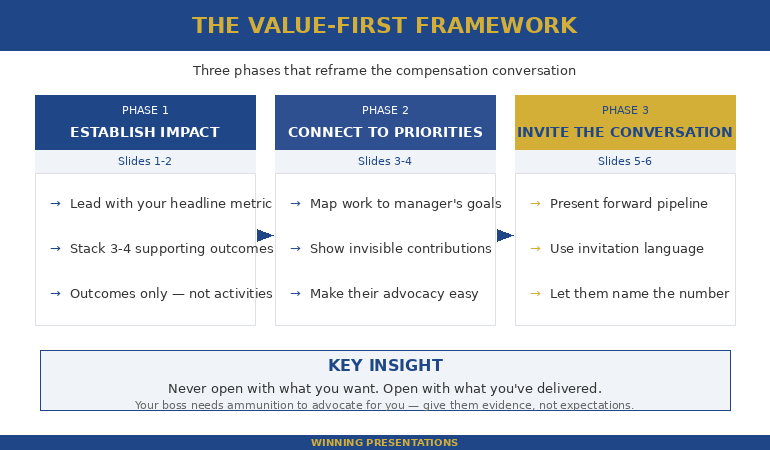
Value-First framework for presenting to boss about compensation showing three phases: establish impact, connect to priorities, then invite the conversation

The Value-First Framework for Presenting to Your Boss About Compensation

The framework that consistently works for compensation presentations has three phases — and none of them start with money.

Phase 1: Establish Impact (slides 1-2). Open with what you’ve delivered in the current period. Not activities — outcomes. Not “I worked on the Q3 client review.” Instead: “Q3 client review retained £1.2M in renewals.” If you don’t have revenue numbers, use time saved, problems prevented, or stakeholders influenced. Your boss thinks in these units.

Watch the difference:

❌ Wrong: “I’ve been really busy this quarter. I worked on the client review, the onboarding project, and helped with the team offsite.”

✅ Right: “Three outcomes this quarter: £1.2M in retained client revenue, 40% faster onboarding cycle, and the new team structure that reduced escalations by half.”

The first is a list of activities. The second is a portfolio of results. Your boss can take the second version into their own review meeting. They can’t do anything with the first.

Phase 2: Connect to Their Priorities (slides 3-4). Show how your work maps directly to what your manager is measured on. Every manager has 3-4 things their boss asks them about. If your contributions connect to those things, you’ve just made it easy for your manager to justify your compensation — not to you, but to the person above them.

This is exactly the kind of structure the Executive Slide System helps you build — slide-by-slide frameworks that make your case before anyone has to ask.

Get the Executive Slide System → £39

Phase 3: Invite the Conversation (slides 5-6). You don’t ask for a number. You present your forward-looking value and let the compensation discussion emerge naturally. “Given the pipeline I’m building for Q2, I’d value your perspective on how my contribution is being recognised.” That’s not an ask — that’s an invitation. It works because your boss has just seen the evidence.

The 6-Slide Structure That Reframes the Entire Conversation

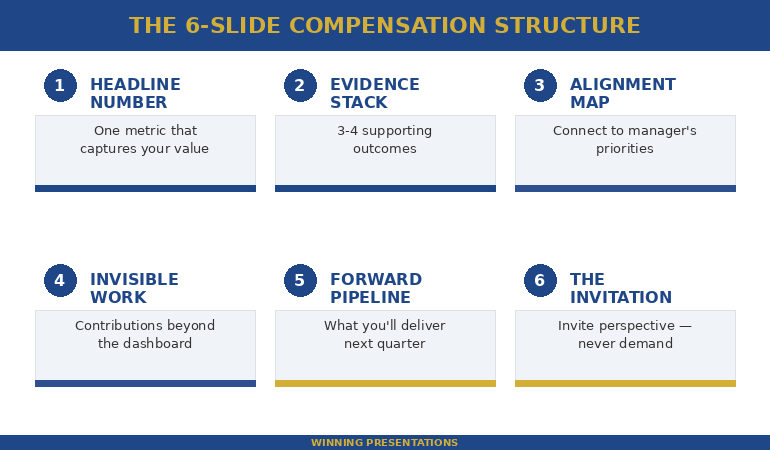
Here’s the exact slide-by-slide breakdown I recommend to executives preparing to present to the person who controls their compensation. Each slide has one job. No more.

Slide 1 — The Headline Number. One metric that captures your contribution this period. Not a paragraph. One number with context.

❌ Wrong slide 1 title: “Compensation Review Discussion — Q1 2026”

✅ Right slide 1 title: “£1.2M Retained Revenue From Three Client Renewals I Led”

The wrong version announces what you want. The right version announces what you’ve delivered. Your boss reads the second title and immediately thinks: “This person knows their value.” That’s the frame you want before a single word is spoken. This is your executive summary slide — the one that frames everything after it.

Slide 2 — The Evidence Stack. Three to four supporting outcomes that reinforce the headline. Each one should be a single line: metric + context.

❌ Wrong: A bulleted list of everything you worked on — “Participated in the Q3 client review process. Helped onboard new team members. Contributed to the offsite planning.”

✅ Right: Three lines only — “Client retention: 100% renewal rate (£1.2M). Onboarding: cycle reduced from 6 weeks to 3.5. Escalations: down 52% since new structure implemented.”

No explanations. No qualifiers. Your boss doesn’t need you to explain why retaining a client matters.

Slide 3 — The Alignment Map. Show how your outcomes connect to your manager’s stated priorities. If their boss asked them “what’s your team delivering?” — your slide should be the answer they’d give.

❌ Wrong: “My achievements this quarter” — a self-focused list with no connection to departmental goals.

✅ Right: A two-column slide: left column lists your manager’s stated Q1 priorities, right column shows your direct contributions to each one.

This is what separates professionals who get rewarded from those who get “we’ll revisit this next quarter.”

Slide 4 — The Invisible Work. Every professional does work that doesn’t show up in dashboards. Mentoring. Crisis management. Covering for absent colleagues. Political navigation. One slide acknowledging this work — with specifics — tells your boss you understand your full value, not just the measurable parts.

❌ Wrong: “I also do a lot of things that aren’t captured in my KPIs.”

✅ Right: “Three contributions beyond the dashboard: mentored two junior analysts through their first client presentations. Resolved the supply chain escalation before it reached the exec team. Stepped in to cover the Northern region when James was on leave for six weeks.”

Vague claims get nodded at. Specifics get remembered — and repeated upward.

Slide 5 — The Forward Pipeline. What are you set to deliver in the next quarter? This is the slide that changes the conversation from backwards-looking (“what have you done?”) to investment-oriented (“what will you do next?”). Managers who see a strong pipeline are more willing to invest in retaining you.

Slide 6 — The Invitation. No ask. No demand. Just: “I’d appreciate your perspective on how my contribution is being recognised going forward.”

❌ Wrong: “So based on all of this, I think a 15% increase is fair and I’d like to discuss how we make that happen.”

✅ Right: “I’d value your perspective on how this level of contribution is being reflected. I’m also happy to put together a summary you can share with [skip-level name] if that’s useful.”

The wrong version turns you into a negotiator. The right version turns you into a partner — and gives your boss a tool to advocate for you in the room you’re not in.

Six-slide compensation presentation structure showing Headline Number, Evidence Stack, Alignment Map, Invisible Work, Forward Pipeline, and Invitation slides

Build Your Compensation Presentation Tonight

The Executive Slide System includes ready-to-use frameworks for exactly this scenario — including slide structures for value positioning, stakeholder alignment, and decision presentations.

Get the Executive Slide System → £39

Built from 24 years of corporate banking experience and 15 years training executives for high-stakes conversations.

What to Say When Your Boss Says “The Decision Isn’t Mine”

This is the most common deflection — and the most misunderstood. When your boss says the compensation decision isn’t entirely theirs, they’re usually telling the truth. But they’re also telling you something else: they need ammunition.

The correct response is: “I understand it involves multiple stakeholders. Would it help if I put together a brief summary of my contributions this period that you could share?”

You’ve just offered to make their job easier. You’ve also ensured your value gets presented upward — in your words, not a second-hand summary that loses the impact.

This is the same dynamic I saw at Royal Bank of Scotland when working with directors who needed to justify team compensation to the executive committee. The directors who had structured summaries from their team members could advocate effectively. The ones who had to reconstruct contributions from memory couldn’t.

Having the right structure makes this effortless. The Executive Slide System gives you frameworks designed for presenting to senior decision-makers — including the people who control your pay.

Get the Executive Slide System → £39

One timing note: Present your value 4-6 weeks before the compensation cycle starts — not during it. By the time formal reviews begin, budgets are often already allocated informally. And if you’ve just delivered a visible win, don’t wait. Recency bias is real. Your boss’s memory of your value is at its peak right after a result, not three months later during the “proper” review window.

If the anxiety of these high-pressure conversations is what holds you back, you’re not alone — I spent five years terrified of exactly this kind of meeting before I found techniques that worked. Read more about managing high-stakes meeting nerves.

Common Questions About Presenting Your Value in a Pay Review

How do you present your case for a raise to your boss?

Present your case using a Value-First structure: lead with your measurable impact (revenue, savings, client retention), connect your contributions to your manager’s priorities, then invite the compensation conversation rather than making a direct demand. Three to six focused slides work better than a verbal request. Your boss needs evidence they can present upward — give them that evidence in a format they can use.

What should you include in a compensation presentation?

Include one headline metric that captures your contribution, three to four supporting outcomes with numbers, a slide showing how your work connects to your manager’s priorities, acknowledgement of your invisible contributions, your forward pipeline for next quarter, and a soft close that invites discussion. Avoid listing activities — focus on outcomes. Avoid comparing yourself to colleagues — focus on your own value. And keep it to six slides maximum.

How do you talk to your boss about a bonus without sounding entitled?

The key is structure. When you present documented evidence of your impact and then invite your boss’s perspective — rather than making demands — you position yourself as a professional seeking fair recognition, not someone complaining. The phrase “I’d appreciate your perspective on how my contribution is being recognised” works because it’s collaborative, not confrontational. It also gives your boss room to advocate for you rather than defend a position.

Your Next Compensation Conversation Deserves More Than a Chat

The Executive Slide System gives you proven slide frameworks for career-defining moments — including performance reviews, skip-level meetings, and compensation presentations. Built from 24 years of corporate banking experience.

Get the Executive Slide System → £39

Used in board updates, performance reviews, and compensation conversations across banking, consulting, and corporate teams.

Frequently Asked Questions

Can I use this 6-slide structure for a skip-level meeting?

Yes — and you should. Skip-level meetings are often even more important than direct manager conversations because the senior leader may have more influence over compensation decisions. Adjust the Alignment Map (slide 3) to reflect the skip-level leader’s priorities rather than your direct manager’s. Everything else applies exactly the same way. If anything, the structured approach matters more at skip-level because you have less time and need to make a stronger first impression.

What if I don’t have hard revenue numbers to show?

Revenue isn’t the only language bosses speak. Use time saved (“reduced reporting cycle from 3 days to 4 hours”), problems prevented (“identified the compliance gap before the audit”), stakeholders influenced (“aligned three department heads on the integration plan”), or quality improvements (“reduced client escalations by 60%”). The key is specificity. “I contributed to the project” is worthless. “I led the workstream that delivered the client migration two weeks early” is concrete evidence your boss can use.

What if my boss dismisses the presentation entirely?

This happens — and it usually means one of two things. Either the timing was wrong (present earlier in the cycle next time), or your boss genuinely doesn’t control compensation and hasn’t been transparent about it. In either case, the deck you prepared is not wasted. Ask if you can share it with HR or with the person who does influence the decision. Having a structured document of your contributions is always better than relying on memory — yours or theirs.

Should I include specific salary numbers in my slides?

No. Never put a specific number on a slide. The moment you anchor to a number, you’ve turned a value presentation into a negotiation — and you’ve likely anchored lower than what your boss might have offered. Your six slides are designed to build the case so compellingly that your boss initiates the compensation discussion. Let them name the number first. Your job is to make the case so strong that the number reflects your actual value.

📬 Get Weekly Presentation Intelligence

Slide structures, executive communication strategies, and career presentation techniques — delivered every week. No fluff. No spam. Just the frameworks that work in real boardrooms.

Join the Newsletter

📋 Free: Executive Presentation Checklist

A quick-reference checklist for any high-stakes executive presentation — including compensation conversations, board updates, and stakeholder reviews.

Download the Free Checklist

Related: If the anxiety of a salary or bonus conversation is what’s really holding you back, read How I Learned to Present Under Extreme Pressure — the techniques that helped me stay calm in the conversations that mattered most.

Your next step: Open a blank deck tonight. Create six slides using the structure above. You’ll be surprised how much easier the conversation feels when you have evidence on screen instead of nerves in your head.

Want the proven frameworks that make this effortless? Build your salary review presentation in under an hour.

Get the Executive Slide System → £39

About the Author

Mary Beth Hazeldine is the Owner & Managing Director of Winning Presentations. With 24 years of corporate banking experience at JPMorgan Chase, PwC, Royal Bank of Scotland, and Commerzbank, she has delivered high-stakes presentations in boardrooms across the UK and Europe.

A qualified clinical hypnotherapist and NLP practitioner, Mary Beth combines executive communication expertise with evidence-based techniques for managing presentation anxiety. She has spent 15 years training executives and supporting high-stakes board presentations, steering committee updates, and decision meetings.

Book a discovery call | View services

24 Jan 2026
The Presentation Mastery Curve: Where Most Professionals Get Stuck (I Was Stuck for 8 Years)

The Presentation Mastery Curve: Where Most Professionals Get Stuck (I Was Stuck for 8 Years)

I gave presentations for eight years without getting meaningfully better. I wasn’t bad. I was stuck at “competent”—and I had no idea why I couldn’t break through.

Quick answer: The presentation mastery curve is a predictable progression with four stages: Survival (just getting through it), Competence (adequate but forgettable), Confidence (good but plateaued), and Mastery (commanding and persuasive). Most professionals get stuck between Competence and Confidence—where presentations are “fine” but not remarkable. The breakthrough requires deliberate structure work, not more practice of the same approach.

In practice, moving from “competent presenter” to “master presenter” requires recognising which stage you’re actually at, understanding why you’re stuck there, and applying the specific intervention that unlocks the next level.

When you break through to the next stage:

  • People stop saying “let me think about it”
  • Your ask becomes easier to say yes to
  • You stop needing 30 slides to feel credible

Written by Mary Beth Hazeldine — executive presentation coach, 24 years corporate banking, trained 5,000+ executives. I’ve coached executives inside global banks, consulting teams, and high-stakes leadership environments—where one presentation can change funding, strategy, or careers. Last updated: January 2026 with new stage diagnostic + “presenting this week” reset.

🚨 Presenting THIS WEEK? Here’s how to break through immediately:

  1. Identify your stage using the diagnostic below (be honest—most overestimate)
  2. Apply the ONE intervention for your stage (don’t skip ahead)
  3. Focus on structure for this presentation, not delivery polish
  4. Get one piece of feedback on whether your argument was clear (not on your style)

One presentation with deliberate structure work beats ten presentations on autopilot.

📅 Want to systematically move through the mastery curve?

The difference between professionals who stay stuck and those who break through is structured progression with the right interventions at each stage. This article maps the curve—and shows you exactly where you are.

When I finally understood the mastery curve, I realised I’d been applying Confidence-stage interventions while stuck at the Competence stage. I was polishing delivery when my structure was broken. No wonder nothing changed.

The executives I train often have the same realisation. They’ve been working on the wrong things—not because they’re not trying, but because they didn’t know which stage they were actually at.

If you’ve ever felt like your presentations should be better than they are—despite years of experience—this article explains exactly why, and what to do about it.

The Four Stages of Presentation Mastery

After training 5,000+ executives, I’ve observed that the presentation mastery curve follows a remarkably consistent pattern. Almost everyone moves through the same four stages—the difference is how long they stay stuck at each one.

Stage 1: Survival (0-2 years presenting)

At this stage, your primary goal is getting through the presentation without disaster. You’re focused on not forgetting your words, not visibly shaking, not running out of things to say.

Markers: Heavy reliance on notes or slides as a script. Significant anxiety before and during. Relief when it’s over. Little memory of what actually happened.

The trap: Some people stay here for years because avoidance feels safer than exposure. They present as little as possible, which prevents them from ever building the reps needed to advance.

Stage 2: Competence (2-5 years presenting)

You can deliver a presentation that’s “fine.” The audience doesn’t notice anything wrong. You hit your points, stay on time, answer questions adequately. But you’re forgettable.

Markers: Lower anxiety, but not excitement. Presentations feel like tasks to complete, not opportunities to influence. You get polite feedback but rarely enthusiastic response.

The trap: This is where most professionals get permanently stuck. “Fine” doesn’t trigger a need for improvement. The pain isn’t acute enough to drive change.

Stage 3: Confidence (5-10+ years… or never)

You’re comfortable presenting. You might even enjoy it. Your delivery is polished. But something’s still missing—you’re not commanding rooms or driving decisions the way you know is possible.

Markers: Good style, but structure might still be weak. You can present well, but can’t necessarily teach others why. Inconsistent results depending on the topic or audience.

The trap: At this stage, the problem is invisible. You look and feel competent. Others might even compliment you. But you’ve hit a ceiling you can’t identify, let alone break through.

Stage 4: Mastery (Rare)

You don’t just present information—you shape how people think. Your presentations create clarity where there was confusion, momentum where there was stagnation, decisions where there was paralysis.

Markers: Presentations feel like conversations, not performances. You adapt in real-time based on the room. The structure serves the argument so seamlessly that it’s invisible. People act differently after hearing you speak.

The truth: Most professionals never reach this stage—not because they can’t, but because they don’t know the specific interventions required to break through from Stage 3.

The four stages of presentation mastery development showing where most professionals get stuck between Competence and Confidence

⭐ A Structured Path Through the Mastery Curve

AI-Enhanced Presentation Mastery is designed for professionals stuck between Competence and Mastery—with the specific interventions that unlock each stage.

What makes it different:

  • Stage-appropriate frameworks (not one-size-fits-all advice)
  • Structure interventions first (the actual breakthrough), delivery polish second
  • Live cohort sessions for real-time feedback on your actual presentations

See the Full Curriculum →

Next cohort starts soon. Limited to 20 participants for hands-on progression.

📦 What You Get (Specifically):

  • 4 executive presentation frameworks — the structure interventions that create breakthrough
  • AI-enhanced creation workflow — cut creation time by 70% so you can focus on mastery, not mechanics
  • Live cohort sessions — practice with feedback at your actual stage
  • Stage-specific exercises — interventions matched to where you are, not generic advice
  • Real presentation application — apply everything to presentations you’re actually building

📌 What this course gives you that experience alone can’t:

  • Diagnosis — honest assessment of your actual stage (most overestimate by one level)
  • Stage-appropriate intervention — the specific work that unlocks YOUR next level
  • Acceleration — compress years of trial-and-error into focused, structured progression

Experience gives you reps. Structure gives you breakthrough.

Where Most Professionals Get Stuck (And Why)

The most common sticking point is between Stage 2 (Competence) and Stage 3 (Confidence). Here’s why:

The “Good Enough” Trap

At Stage 2, presentations work. They’re not embarrassing. They don’t cause problems. This eliminates the urgent need for improvement.

A marketing VP named David described it perfectly: “I’d been presenting for seven years. My presentations were fine. Nobody complained. But I noticed that when I asked for resources or decisions, I’d get ‘let me think about it’ instead of ‘yes.’ I didn’t connect those two things until much later.”

The absence of failure isn’t the same as the presence of success. But it feels like it.

The Wrong Intervention Problem

When professionals at Stage 2 try to improve, they often apply Stage 3 or 4 interventions: vocal variety, body language, storytelling polish, slide design aesthetics.

These are the wrong tools. The breakthrough from Stage 2 to Stage 3 isn’t about delivery—it’s about structure. Your argument needs to be clearer, your ask needs to be sharper, your logic needs to be tighter.

A product director named Jennifer spent a year working with a speaking coach on her delivery. “My voice got better, my posture improved, but my presentations still weren’t landing. Then someone pointed out that my structure was a mess—I was burying my point on slide 15. All that delivery work was polishing a broken argument.”

The Experience Illusion

There’s a dangerous assumption that more presenting automatically means better presenting. It doesn’t.

If you’ve been driving the same way for 20 years, you have 20 years of experience. But you’re not a better driver than you were at year 5. Presentation skills work the same way—repetition without deliberate intervention just reinforces your current level.

I see this constantly: executives with 15+ years of presenting experience who are still firmly at Stage 2. They’ve never been forced to confront the structural weaknesses that are holding them back.

For more on why traditional approaches fail, see why most presentation training fails.

Ready for the structure intervention that creates breakthrough? AI-Enhanced Presentation Mastery focuses on the actual bottleneck—argument structure—not the symptoms. See the Curriculum →

The Honest Diagnostic: Which Stage Are You Really At?

Most professionals overestimate their stage by at least one level. Here’s an honest diagnostic:

You’re at Stage 1 (Survival) if:

  • You avoid presenting when possible
  • You rely heavily on notes or reading from slides
  • Your primary emotion before presenting is dread
  • You can’t remember much of what happened during presentations
  • You measure success by “getting through it”

You’re at Stage 2 (Competence) if:

  • You can present without disaster, but it feels like a task
  • Audience feedback is polite but not enthusiastic
  • You often hear “that was good” but rarely see action result from your presentations
  • You struggle to articulate why some presentations land better than others
  • Your structure varies significantly from presentation to presentation

You’re at Stage 3 (Confidence) if:

  • You’re comfortable presenting, even to senior audiences
  • Your delivery is polished and consistent
  • But you still have presentations that inexplicably fall flat
  • You can’t reliably replicate your best performances
  • You feel like there’s another level you can’t quite reach

You’re at Stage 4 (Mastery) if:

  • You can adapt your presentation in real-time based on the room
  • People consistently act differently after hearing you speak
  • You could teach others exactly why your approach works
  • Your structure is so clear that the audience never feels lost
  • Presenting feels like a conversation, not a performance

Be honest with yourself. The intervention that works depends entirely on an accurate diagnosis.

Related: See the presentation skills gap most professionals don’t see.

Diagnostic checklist for identifying your current stage of presentation mastery development

⭐ If You’ve Been Stuck at “Good Enough” for Years

That’s not a failure of effort—it’s a misdiagnosis of stage. AI-Enhanced Presentation Mastery includes honest assessment and stage-appropriate interventions that actually create movement.

Why it works when experience hasn’t:

  • Diagnoses your actual stage (not the one you think you’re at)
  • Applies the intervention that matches YOUR bottleneck
  • Structure-first approach (the real breakthrough, not delivery polish)

See the Full Curriculum →

Limited to 20 participants • Hands-on feedback • Next cohort starting soon.

The Intervention That Unlocks Each Stage

Each stage has a specific intervention that creates breakthrough. Applying the wrong intervention is why most people stay stuck.

Stage 1 → Stage 2: Exposure + Simple Structure

The intervention: More reps with a basic framework. You need to present enough times that the survival fear diminishes. But you also need a simple structure to follow so each presentation has a foundation.

Specifically: Use the Problem-Solution-Action framework for every presentation. Don’t worry about polish—just hit the structure every time. Volume matters at this stage.

Stage 2 → Stage 3: Structure Mastery

The intervention: Deep work on argument structure. This is where most improvement efforts fail—they focus on delivery when structure is the actual bottleneck.

Specifically: Master the Pyramid Principle (conclusion first, then evidence). Learn to identify and eliminate structural weaknesses: buried leads, unclear asks, logic gaps. Record yourself and analyse structure, not delivery.

A finance director named Marcus described his breakthrough: “I’d been working on my ‘presence’ for years. Then I rewatched a presentation and ignored how I looked—I just mapped the structure. It was a mess. My conclusion came on slide 18. Once I fixed that, everything changed.”

Stage 3 → Stage 4: Adaptive Mastery

The intervention: Real-time adaptation and invisible structure. At this stage, you need to internalise frameworks so deeply that you can deploy them without thinking—and adjust based on audience response.

Specifically: Practice presenting the same content with different structures. Learn to read the room and pivot. Develop the ability to explain your framework choices—if you can teach it, you’ve mastered it.

For more on effective training approaches, see what to look for in presentation skills training.

Want the specific frameworks for each stage transition? AI-Enhanced Presentation Mastery maps the interventions to your actual level—not generic advice for everyone. Learn More →

The Realistic Timeline for Mastery

Here’s what progression along the presentation mastery curve actually looks like with deliberate practice:

Stage 1 → Stage 2: 3-6 months

With consistent exposure (presenting at least weekly) and a simple framework, most professionals can move past survival mode within a few months. The key is volume—you need enough reps for the fear to subside.

Stage 2 → Stage 3: 6-18 months

This is the hardest transition because it requires recognising invisible structural weaknesses. With deliberate structure work, feedback, and focused practice, most professionals can break through within a year. Without intervention, many stay stuck here forever.

Stage 3 → Stage 4: 12-24+ months

Mastery requires deep internalisation of frameworks and real-time adaptation skills. This stage is about refinement, not revolution. Consistent practice with increasingly challenging audiences and situations builds the adaptive capacity that defines mastery.

The Acceleration Factor

These timelines assume deliberate practice with appropriate interventions. With structured guidance—a coach, a programme, a systematic approach—each transition can be compressed significantly. Without it, most professionals never complete the journey.

A senior VP named Robert shared his experience: “I was stuck at Stage 2 for probably ten years. Once I understood the structure intervention, I moved to Stage 3 within four months. Ten years of being stuck, four months to break through—because I finally had the right diagnosis.”

Frequently Asked Questions

Can you skip stages on the presentation mastery curve?

Not really. Each stage builds capabilities that the next stage requires. Trying to work on Stage 4 skills (adaptive mastery) while still struggling with Stage 2 issues (structural clarity) will frustrate you and produce inconsistent results. The progression is sequential for a reason—foundations matter.

How do I know if I’m stuck or just progressing slowly?

If your presentations have felt roughly the same for more than two years, you’re stuck. Normal progression—even slow progression—shows visible improvement over that timeframe. Stuckness feels like running in place: lots of effort, no movement. If colleagues would describe your presentations the same way they would have described them two years ago, that’s stuckness.

Why does focusing on delivery not work at Stage 2?

Because delivery polish can’t compensate for structural weakness. A beautifully delivered presentation with a buried conclusion still fails. The audience might enjoy watching you, but they won’t act on your message because they can’t follow your argument. Structure is the foundation—delivery is the finish. You can’t finish what isn’t built.

Is Stage 4 mastery actually achievable for most people?

Yes, but it requires sustained deliberate practice—and most people don’t maintain that commitment. Stage 4 is rare not because the skills are impossibly difficult, but because the path requires consistent work over years. Most professionals find Stage 3 “good enough” and stop pushing. That’s a valid choice—but it’s a choice, not a limitation.

What’s the biggest mistake people make when trying to improve?

Applying interventions from the wrong stage. Stage 2 presenters working on “executive presence.” Stage 3 presenters taking basic courses designed for Stage 1. The intervention must match the diagnosis. Most improvement efforts fail because they skip honest assessment and jump to generic advice.

How important is feedback in moving through the stages?

Critical at every stage, but the type of feedback changes. Stage 1 needs encouragement and basic correction. Stage 2 needs structural feedback (not style feedback). Stage 3 needs feedback on argument effectiveness and audience impact. Stage 4 needs feedback on adaptation and invisible framework choices. Generic “that was good” feedback doesn’t help at any stage.

Can I diagnose myself accurately?

Somewhat, but most people overestimate by one level. We judge ourselves on intent; audiences judge us on impact. Recording yourself and analysing structure (not watching how you look) helps. But external assessment from someone who understands the stages is more reliable. That’s one reason coaching and structured programmes accelerate progress—they provide accurate diagnosis.

Is This Course Right For You?

✓ This is for you if:

  • You’ve been presenting for years but feel stuck at “good enough”
  • You want stage-appropriate interventions, not generic tips
  • You’re ready for honest assessment of where you actually are
  • You’re willing to do structure work before delivery polish

✗ This is NOT for you if:

  • You’re at Stage 1 and need basic exposure first
  • You want quick fixes rather than systematic progression
  • You’re not currently presenting at work
  • You prefer to work on delivery polish only

⭐ I Was Stuck for 8 Years. Here’s What Finally Worked.

The mastery curve explained everything. I’d been applying wrong-stage interventions for nearly a decade. AI-Enhanced Presentation Mastery is what I wish existed when I was stuck—stage-appropriate frameworks that actually create movement.

What you’ll actually get:

  • Honest stage diagnosis (most overestimate)
  • The specific intervention for YOUR transition
  • Structure frameworks that create breakthrough

See the Full Curriculum →

Next cohort starting soon. Limited to 20 participants.

📧 Optional: Get weekly presentation frameworks in The Winning Edge newsletter (free).

Your Next Step

If you’ve been working on your presentations for years without meaningful improvement, you now understand why: you’ve likely been applying wrong-stage interventions, or not applying any intervention at all.

Presentation mastery development isn’t mysterious. It follows a predictable curve with specific transitions. The breakthrough comes when you accurately diagnose your stage and apply the matching intervention.

Use the diagnostic above. Be honest about where you are. Then focus on the one intervention that unlocks your next level—structure work for most professionals.

For structured progression with expert guidance, see the AI-Enhanced Presentation Mastery curriculum.

P.S. If you’re presenting this week and want to understand what your slides communicate beyond your words, see what your slides actually say about you.

About the Author

Mary Beth Hazeldine is the Owner & Managing Director of Winning Presentations and creator of AI-Enhanced Presentation Mastery. The “8 years stuck” admission that opened this article is real—and understanding the mastery curve was the breakthrough that finally created movement.

With 24 years of corporate experience at JPMorgan Chase, PwC, Royal Bank of Scotland, and Commerzbank, plus having trained 5,000+ executives through the mastery curve, she now teaches the stage-appropriate approach that actually creates progression.

Book a discovery call | View services

07 Jan 2026
Presenting to senior management - what nobody warns you about your first executive presentation

Your First Presentation to Senior Management: What Nobody Warns You About

Quick Answer: Presenting to senior management requires a complete mindset shift. Lead with your recommendation (not context), plan for half your allotted time, expect interruptions, and treat questions as engagement rather than attacks. The executives evaluating you care less about your analysis and more about your judgment. Your first senior presentation is an audition—and most people fail it by over-preparing the wrong things.

My first time presenting to senior management lasted four minutes.

I’d prepared for three weeks. Forty-two slides. Every objection anticipated. Every data point verified.

The Managing Director stopped me on slide two: “What do you recommend?”

My recommendation was on slide 38. I stammered through an explanation of why the context mattered first. He checked his watch. The other executives followed his lead.

I learned more about presenting to senior management in those four minutes than in my entire MBA.

Nobody had warned me that senior executives don’t want your journey—they want your destination. Nobody explained that my carefully constructed narrative would be seen as wasting their time.

Here’s what I wish someone had told me before that first presentation.

The Executive Slide System

Your first presentation to senior management deserves slides that match executive expectations. The Executive Slide System gives you the exact templates, frameworks, and structures that senior leaders expect—so you can focus on delivery, not formatting.

Includes: Executive summary templates, board-ready formats, and the one-page structures that get read.

Get the Executive Slide System →

The 5 Rules for Presenting to Senior Management Nobody Teaches

Rule 1: Lead With Your Recommendation

Everything you learned about building to a conclusion is wrong for senior audiences. Executives don’t have patience for narrative arcs. They want to know what you think—immediately.

Open with: “I recommend X because of Y. Here’s the supporting analysis.”

Not: “Let me walk you through the market conditions, competitive landscape, and historical context that led us to consider…”

When presenting to senior management, your first sentence should contain your recommendation. Everything else is supporting material they may or may not request.

Rule 2: Plan for Half Your Time

If you’re scheduled for 30 minutes, prepare 15 minutes of content. Senior meetings run over. Executives arrive late. Questions derail timelines. The presenter who plans for the full slot always runs out of time before reaching their point.

The presenter who plans for half the time looks polished when they finish early—and prepared when interruptions eat the rest.

Rule 3: Expect Interruptions (And Welcome Them)

Junior presenters interpret interruptions as rudeness. They’re not. When a senior executive interrupts, they’re telling you what matters to them. That’s valuable intelligence.

When interrupted, stop talking. Listen. Answer the question. Then ask: “Should I continue with the presentation, or would you prefer to discuss this further?”

Handing control to the room demonstrates confidence, not weakness.

Rule 4: Answer Questions Like an Executive

The question: “What’s the timeline?”
The junior answer: “Well, it depends on several factors. If we get approval by March, and assuming resources are allocated according to plan, and barring any unforeseen…”
The senior answer: “Six months from approval. I can break that down if helpful.”

When presenting to senior management, answer what was asked. Provide the minimum information needed. Stop talking. If they want more detail, they’ll ask.

Rule 5: Your Slides Are Not Your Presentation

Senior executives can read faster than you can speak. If you’re reading your slides, you’re wasting their time. If everything important is on the slides, why are you there?

Your slides should support your points, not contain them. Speak to the room. Glance at slides for reference. Never, ever read them aloud.

Presenting to senior management - 5 rules nobody teaches for executive presentations

What Senior Executives Are Actually Evaluating

Here’s what nobody tells you about presenting to senior management: they’re barely evaluating your content. They’re evaluating you.

Specifically, they’re asking themselves:

Does this person have judgment? Not just data, but the ability to synthesize information into clear recommendations.

Does this person respect my time? The ability to communicate efficiently signals respect—and readiness for senior roles.

Does this person stay composed under pressure? How you handle tough questions reveals how you’ll handle tough situations.

Would I trust this person in front of clients or the board? Every internal presentation is an audition for external ones.

Your analysis could be perfect, but if you fail these tests, the opportunity doesn’t come again.

For the complete framework on giving presentations that command any room, see my full guide: How to Give a Presentation: The Complete Step-by-Step Guide.

FAQ: Presenting to Senior Management

How is presenting to senior management different from regular presentations?

Senior managers process information differently. They don’t want your journey—they want your destination. Lead with recommendations, not context. Expect interruptions. Answer questions directly without over-explaining. And respect their time obsessively—if you’re scheduled for 30 minutes, plan for 15.

What’s the biggest mistake when presenting to senior management for the first time?

Building to your recommendation instead of leading with it. First-time presenters spend 10 minutes on background before reaching their point. By then, senior managers have already formed opinions—usually negative ones about your communication skills. State your recommendation in the first 60 seconds.

How do I handle tough questions when presenting to senior management?

Pause before answering. Answer only what was asked. Stop talking. Don’t interpret questions as attacks—they’re engagement. If you don’t know something, say “I’ll follow up by end of day” and move on. Executives respect honesty far more than fumbled guesses.

📧 Join 2,000+ professionals getting weekly insights on executive presentations. Subscribe to The Winning Edge →

📋 Free Download: Executive Presentation Checklist

Prepare for presenting to senior management with the same checklist I give clients before high-stakes meetings. Covers the signals executives notice in the first 60 seconds.

Get Your Free Checklist →


About the Author

Mary Beth Hazeldine spent 24 years at JPMorgan, PwC, RBS, and Commerzbank. She’s a clinical hypnotherapist and MD of Winning Presentations.

This article was created with AI assistance; all stories and insights are based on 35 years of real client work.