Tag: buy-in

07 May 2026

Executive Sponsor Buy-In: Why Your Biggest Advocate Goes Quiet

Quick answer: Executive sponsors disappear in steering committees because the presenter gave them nothing to defend. The fix is not a private pep talk. It is giving your sponsor three things in writing before the meeting — the single decision at stake, the two objections you know will surface, and the one sentence you want them to repeat when those objections land. Sponsors who have rehearsed phrases advocate. Sponsors who have absorbed vibes freeze.

Astrid had worked at the bank for eleven years when she finally got a seat at the digital transformation steering committee. The proposal she was presenting — a three-year platform consolidation — had the backing of her executive sponsor, a Group COO with a reputation for moving decisions forward. They had met four times. He had signed off on the scope. He had written her a note the week before saying “I am fully behind this.”

She walked into the committee. She presented for twelve minutes. The CFO raised a concern about the phase-two cost curve. Astrid answered it. The Chief Risk Officer asked about vendor concentration. Astrid answered that too. Then the Head of Operations said something vague about “not being sure the organisation is ready” — and the room went quiet. Astrid looked at her sponsor. He was reading his phone. He said nothing. The committee parked the decision for the next quarter.

Afterwards he pulled her aside. He was apologetic. He said he had been “waiting for the right moment to jump in.” The right moment never came because she had given him nothing to jump in with. The problem was not his commitment. The problem was structural. Sponsors do not advocate in the abstract. They advocate from prepared lines. And Astrid had never given him any.

Looking for a structured way to prepare sponsors and secure senior approval?

The Executive Buy-In Presentation System is a self-paced programme designed for senior professionals who need the structured approach to securing approval for initiatives, budgets, and strategic decisions. Seven modules, monthly cohort enrolment, optional recorded Q&A calls.

Explore the Buy-In System →

Why sponsors go quiet at the worst moment

The pattern is so consistent it deserves a name. Sponsors are confident and vocal in one-to-one meetings. They nod. They commit. They offer to “fight for this one.” Then the steering committee convenes and a strange inversion happens: the sponsor becomes the quietest person in the room on the very decision they said they would champion.

Three forces produce this. The first is political. A sponsor who defends a proposal loudly is visibly staking their own capital on it. If the initiative fails, the failure attaches to them. Quiet advocacy carries less political cost. A nodding sponsor who lets the proposal survive on its own merits can distance themselves later if the execution wobbles.

The second is linguistic. Most sponsors cannot remember the specific phrases you used in your one-to-one briefing. They retained the gist — “cost savings, risk reduction, platform modernisation” — but not the argument architecture. When an objection arrives, they have feelings but no sentences. Feelings do not win meetings. Sentences do.

The third is structural. You did not build the briefing to arm them. You built it to persuade them. Those are different jobs. A persuasion briefing gets the sponsor to say yes. An advocacy briefing gets the sponsor to say the right thing when the room turns hostile. Most presenters stop at the first job.

Infographic showing the three reasons executive sponsors go quiet in steering committees: political exposure, forgotten language, and briefing built for persuasion instead of advocacy

The three things every sponsor needs before the meeting

The advocacy briefing has a surprisingly short list of ingredients. You do not need to rebuild your full presentation for them. You need three items, written down, sent in advance, rehearsed once. That is it.

1. The single decision at stake. Not the topic. Not the theme. The actual decision you need the committee to take in this meeting. Write it as one sentence that begins with a verb: “Approve phase one funding of £2.4m to run from July to December” is a decision. “Discuss the platform strategy” is not. A sponsor who knows the exact decision can steer the conversation back to it when the room drifts. A sponsor who thinks the meeting is about “the platform” has no anchor.

2. The two objections you already know will land. Most decisions get derailed by two predictable concerns, not twenty. You know what they are. You have heard them in corridors, in pre-meetings, in the chair’s personal reservations. Name them explicitly in the sponsor brief. Do not soften them. Do not bury them. Your sponsor needs to see the exact shape of the resistance before they hear it in the room.

3. The one sentence you want them to say. For each objection, write the exact phrase you want your sponsor to use when it surfaces. Not a bullet. A sentence. In quotation marks. Something like: “I have looked at the vendor concentration question in detail with the team, and I am comfortable that the phase-one scope contains the risk.” That is a sentence a sponsor can deliver in twelve seconds without having to compose it live. You are not putting words in their mouth. You are removing the cognitive load of inventing words under pressure.

Writing the sponsor pre-read (two pages, not twenty)

The document that does this work is short. Two pages, sent 48 hours before the meeting, formatted in a way that respects the fact your sponsor will read it once — probably in the back of a car.

Page one carries four sections. The decision sentence at the top. The committee dynamics beneath it — who is in the room, who usually speaks first, who the chair is likely to look to for confirmation. The two objections, each with a three-line summary of why they matter and what has changed since they were raised. And the win condition — what a successful meeting looks like. “Approval granted, subject to a six-month review checkpoint” beats “it goes well.”

Page two carries the sponsor’s advocacy lines. One short paragraph introducing why their voice matters on this specific proposal. Then the objection-response pairs: the objection in their likely phrasing, followed by the sentence you want the sponsor to use. Two or three pairs is plenty. Do not write five. If you need five prepared responses, your proposal has problems the sponsor cannot paper over.

The tone of this document matters. It is not a briefing from you to them — that language positions them as your pupil. It is a shared preparation document, written in the first person plural where possible. “Here is what we expect the committee to press on” reads collaboratively. “Here is what you should say when…” reads transactionally. Committed sponsors respond to the first framing. The second triggers defensiveness.

The 15-minute sponsor rehearsal conversation

Send the pre-read 48 hours ahead. Then request a 15-minute call the day before the meeting. Do not skip this step. Do not replace it with a Teams message. The rehearsal is where the sponsor internalises the language — and where you find out whether they have actually read the document.

Open the rehearsal by asking them to read the decision sentence aloud. This seems unnecessary. It is not. Hearing themselves say the sentence encodes it differently from reading it silently. You will hear stumbles on specific words; those are the words to change before the meeting. If your sponsor trips on “subject to” every time, replace it with “contingent on.” Removing friction from the sponsor’s own mouth is half the battle.

Then run the two objections as a live drill. You voice the objection exactly as you expect the committee member to raise it. Your sponsor responds in their own words. Listen for three failure modes. The first is the sponsor hedging — “well, there are concerns, but…” That is a sponsor who has not yet decided to advocate. Work on the underlying discomfort, not the words. The second is the sponsor over-committing — “this is absolutely the right call and anyone who doesn’t see that is missing the point.” That is a sponsor who will escalate a debate you wanted to keep calm. Soften them. The third is the sponsor forgetting the specific words you supplied. Rewrite those words until they match the sponsor’s natural cadence.

Do not correct. Rewrite. If your sponsor cannot say “we have contained the risk at phase one,” and keeps saying “we have dealt with the risk,” change the document. Your sponsor’s phrasing always wins.

If you are building your case from scratch and want a framework that covers stakeholder analysis, case construction, and the presentation structures that hold up under senior scrutiny, the Executive Buy-In Presentation System walks through each stage with seven self-paced modules.

The sponsor pre-read two-page layout shown as a split infographic: page one with decision, dynamics, objections, and win condition; page two with advocacy lines and objection-response pairs

What to do when the sponsor still goes silent

Even prepared sponsors sometimes freeze. The objection lands in a phrasing you did not predict. The room mood is tenser than expected. Your sponsor is distracted by a separate political fight they are having with one of the committee members. The silence arrives anyway.

You have two moves. The first is a direct invitation. “James, you reviewed this in some detail last week — where did you land on the vendor question?” This is not passive aggression. It is giving your sponsor the verbal cue they need to re-enter the conversation. Most silent sponsors are waiting for permission. Direct invitation grants it. Keep the phrasing neutral — you are not flagging their silence, you are creating an entry point.

The second move is to answer the objection yourself, briefly, and then loop back to them. “On vendor concentration — we have contained phase one to a single provider with a clear exit path at month six. James, that matches the approach you flagged last week, correct?” That formulation gives the sponsor a one-word agreement to deliver, which is the lowest possible cognitive load. Many silent sponsors will nod and then expand: “Correct. And I would add…” You have restarted their advocacy by lowering the entry cost to a single syllable.

Do not default to speaking for them. If you take every objection yourself, the committee learns that the sponsor is not engaged. That perception damages future meetings more than a single awkward silence damages this one. Your job is to keep the sponsor in the conversation, not to replace them.

The complete framework for sponsor-led buy-in

Build the case your stakeholders cannot dismiss. The Executive Buy-In Presentation System is a self-paced framework — 7 modules walking you through the structure, psychology, and delivery that get senior approval. Monthly cohort enrolment, optional recorded Q&A calls. £499, lifetime access to materials.

  • 7 modules of self-paced course content
  • Optional live Q&A sessions, fully recorded — watch back anytime
  • No deadlines, no mandatory session attendance
  • New cohort opens every month — enrol whenever suits you
  • Lifetime access to all course materials

Explore the Executive Buy-In System →

Designed for senior professionals who present decisions to boards, investment committees, and executive sponsors.

The sponsor debrief — the step everyone skips

Within 24 hours of the meeting, book 15 minutes with your sponsor. Not to celebrate. To learn. Three questions only. What surprised them about the room’s reaction. Which of the prepared lines worked and which felt awkward. What they would want in the brief for the next decision. Write the answers down. Those notes become the template for the next sponsor briefing — either for this initiative or a different one. Sponsors who are asked what worked become better sponsors. Sponsors who are only contacted when the presenter needs something become reluctant ones.

This debrief is also where you surface any private feedback the sponsor picked up after the meeting. Often a committee member will make a comment in the corridor that never appears in the formal minutes. Your sponsor heard it. You did not. Capturing that intelligence in a structured debrief — not a passing chat — is the difference between handling the next meeting on data and handling it on guesses.

Need the slide structures that support sponsor advocacy?

The Executive Slide System — £39, instant access — includes 26 slide templates, 93 AI prompts, and 16 scenario playbooks designed for senior presentations. The pre-read document style, decision-framing slides, and objection-handling structures are part of the system.

Get the Executive Slide System →

FAQ

What if my sponsor refuses to meet for a 15-minute rehearsal?

That is a data point worth acting on before the meeting, not after. A sponsor who will not invest 15 minutes in rehearsing their advocacy is telling you their commitment is softer than their verbal commitment suggests. Send the two-page pre-read anyway, and prepare to answer the objections yourself. Consider whether the proposal needs a co-sponsor, and flag to your own manager that the advocacy arrangement is shakier than planned. Do not walk into the meeting pretending the sponsor is fully armed when they are not.

Should the sponsor see my full deck before the meeting?

Usually not. The full deck is for the committee, and showing it to the sponsor in detail distracts them from their advocacy job. The two-page pre-read is calibrated specifically for the sponsor’s role. If the sponsor asks for the full deck, share it — but pair it with the pre-read and a short note that explains the pre-read is the document that matters most for the meeting.

What if my sponsor contradicts my prepared lines in the meeting?

That is a signal the lines were not right, and the sponsor made a live adjustment. Do not correct them in the room. Follow their lead and adapt your subsequent responses to match the framing they have just established. In the debrief, ask what prompted the change. Sometimes the sponsor picked up a signal you missed. Sometimes the prepared phrasing sounded more certain than they were willing to be. Both are useful information for the next brief.

How do I handle a sponsor who is a peer, not a senior executive?

Peer sponsors carry different dynamics. They cannot deliver seniority-based advocacy (“I have reviewed this and I am comfortable”), so build their contribution around subject-matter credibility instead. Prepare lines that draw on their specific expertise — “Having run the procurement process three times, the risk profile here is meaningfully lower than standard vendor engagement” — rather than positional authority. The structure of the pre-read stays the same. The content shifts from seniority-based reassurance to expertise-based reassurance.

The Winning Edge — Thursday newsletter

Every Thursday, The Winning Edge delivers one structural insight for executives presenting to boards, investment committees, and senior stakeholders. No general tips. No motivational framing. One specific technique, one executive scenario, one action. Subscribe to The Winning Edge →

Not ready for the full system? Start here instead: download the free Executive Presentation Checklist — a single-page review your pre-read document has covered the structural basics before you send it to a sponsor.

Next step: take the two-page pre-read template above, apply it to the next steering committee decision you own, and send it to your sponsor 48 hours ahead. Book the 15-minute rehearsal the day before. That is the whole system. It works because sponsors who have rehearsed phrases advocate.

Related reading: Anticipating executive objections before they derail your presentation.

About the author. Mary Beth Hazeldine is Owner & Managing Director of Winning Presentations Ltd, founded in 1990. With 24 years of corporate banking experience at JPMorgan Chase, PwC, Royal Bank of Scotland, and Commerzbank, she advises executives across financial services, healthcare, technology, and government on structuring presentations for high-stakes funding rounds, approvals, and board-level decisions.

06 May 2026
Traditional persuasion training teaches tactics. Senior leaders need something different: a structured framework for moving decisions that actually holds up.

Executive Influence and Persuasion Training: How Senior Leaders Move Decisions

QUICK ANSWER

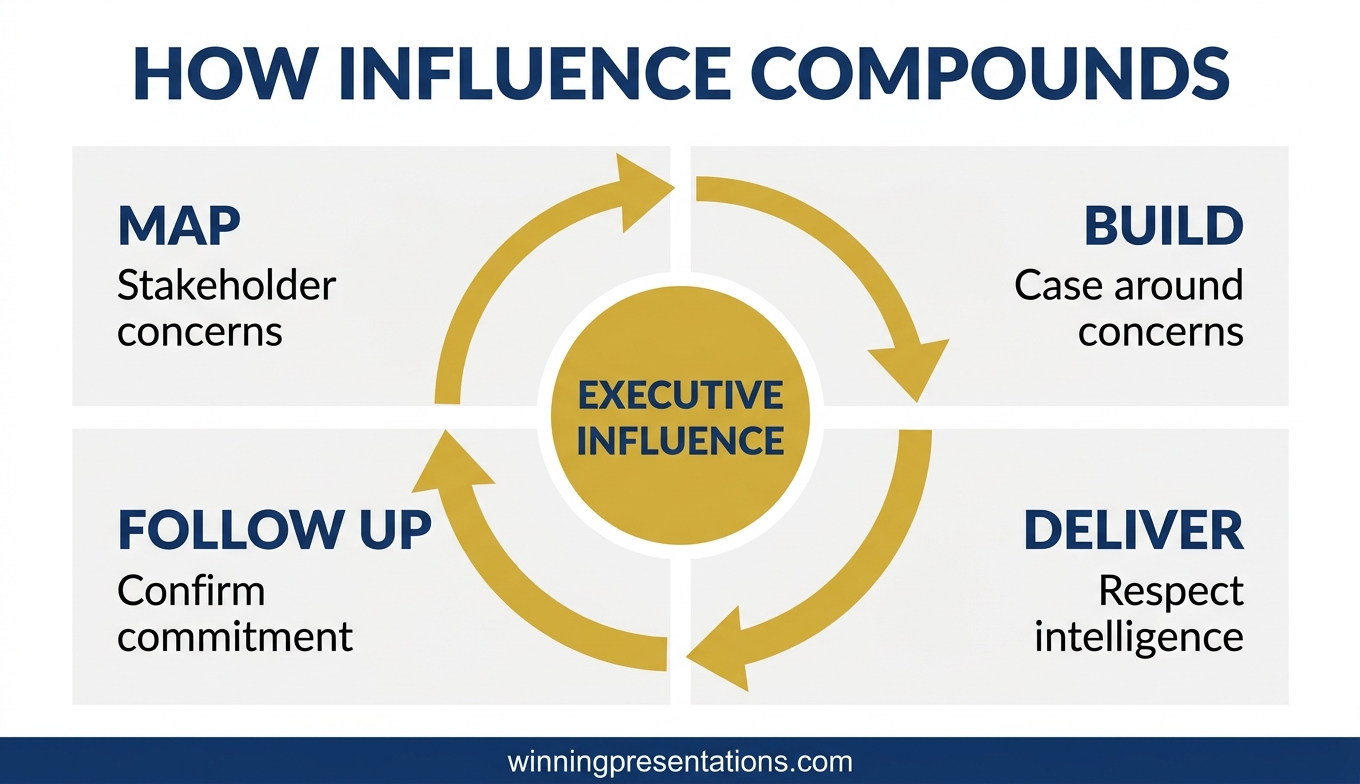
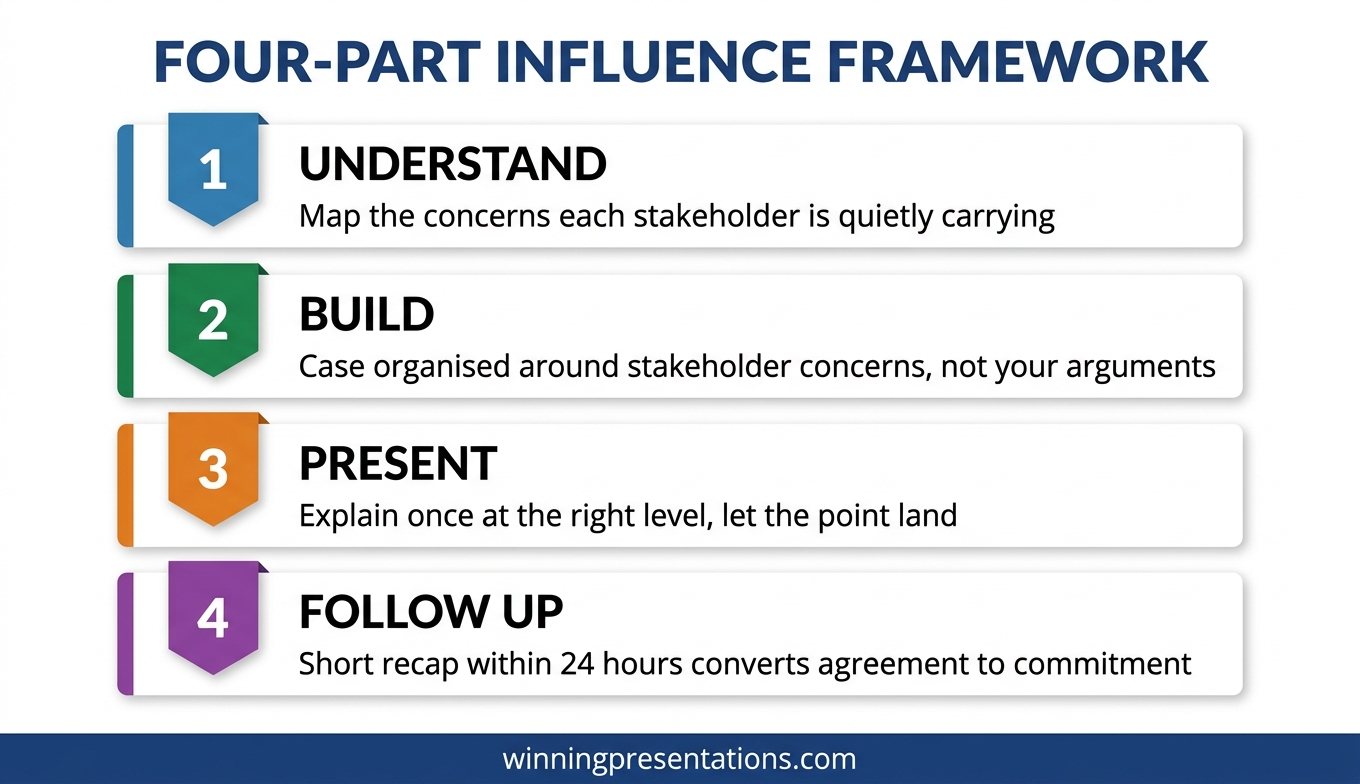
Executive influence and persuasion training for senior leaders is not about charisma, body language, or negotiation tactics. It is about a structured framework for moving decisions among people who have already heard every standard persuasion technique and see through them immediately. The framework has four parts: understanding what your stakeholders actually need to say yes, building a case that addresses their real concerns, presenting it in a way that respects their intelligence, and following up in a way that converts private agreement into public commitment.

The structured framework this article describes

The Executive Buy-In Presentation System is Mary Beth’s self-paced Maven programme covering the complete framework for securing buy-in from senior stakeholders, boards, and executives.

Explore the Programme →

Kenji, a senior director at a global consumer-goods company, walked out of a strategy approval meeting last autumn with a decision he did not expect. His proposal — a £14m restructure of the regional operating model — had been in preparation for six months. Three previous versions had failed. This one passed unanimously. He called me two days later to ask what had actually changed.

The data had not changed. The strategy had not fundamentally shifted. The slides looked similar. What changed was how Kenji had understood the meeting. In the previous three attempts, he had gone in to persuade. This time, he had gone in to address three specific concerns he had privately mapped before the meeting, carried by three specific executives whose support he needed. He had not persuaded anyone. He had made it easy for them to say yes.

Executive influence and persuasion training at senior levels is not about becoming more persuasive. Most senior executives are immune to persuasion tactics because they have seen all of them. What they are not immune to is a well-constructed case that directly addresses the concerns they are already carrying. That is the skill senior leaders need to develop. It looks less like charisma and more like careful, structured preparation.

Why standard persuasion training fails at senior levels

Most persuasion training is designed for sales contexts or early-career leadership, and it teaches tactics: mirroring, framing, storytelling structure, emotional hooks, the use of silence, the “yes ladder”. These tactics work in some contexts. They fail consistently at senior executive level for three reasons.

The first reason is recognition. Senior audiences have seen every tactic. When the tactic is deployed, it registers. A mirrored phrase from a middle manager in an internal meeting reads as coaching. A dramatic storytelling opening in a board update reads as theatrical. The tactics do not land because the audience is fluent in them.

The second reason is asymmetry. Senior stakeholders are evaluating you as much as your proposal. They are asking whether you understand the business well enough to have a defensible view, whether you have anticipated the hard parts, whether your recommendation holds up under pressure. Persuasion tactics signal that you are trying to influence them, which raises their defences rather than lowering them.

The third reason is stakes. Senior decisions are not binary. They carry precedent, political cost, and reputational risk for the people approving them. A persuasive case without a structured answer to those dimensions will not succeed regardless of how well it is delivered. The training needs to address the structure, not just the delivery.

Four-part framework for executive influence and persuasion training covering stakeholder understanding, case construction, presentation, and follow-up

THE STRUCTURED FRAMEWORK FOR EXECUTIVE INFLUENCE

Build the case your stakeholders cannot dismiss

The Executive Buy-In Presentation System is a self-paced Maven programme — 7 modules walking senior professionals through the structure, psychology, and delivery that get executive approval. Bonus Q&A calls (optional, recorded). Monthly cohort enrolment; lifetime access to materials.

  • 7 modules on stakeholder analysis, case construction, and delivery
  • Self-paced — no deadlines, no mandatory live attendance
  • Optional Q&A / coaching calls (fully recorded, watch back anytime)
  • Monthly cohort enrolment — enrol any time
  • Lifetime access to all course materials

£499, lifetime access to all course materials.

Explore the Executive Buy-In Presentation System →

Designed for senior professionals who present decisions to boards, investment committees, and executive sponsors.

Part 1: Understand what stakeholders actually need to say yes

Every senior decision has a set of concerns that live beneath the surface arguments. The surface arguments are the ones people say out loud — budget, timing, strategic fit. The underlying concerns are the ones people do not say out loud because they are political, personal, or uncertain. Senior leaders who influence successfully have learned to map the underlying concerns before the meeting.

The mapping exercise is not complicated. For each stakeholder whose approval you need, write down three things: what the surface argument against your proposal would be if they chose to make one, what the underlying concern probably is (reputation, precedent, control, fear of being seen to change direction), and what specific evidence would make that underlying concern less sharp.

In Kenji’s case, one senior executive had consistently pushed back on previous proposals. On the surface, the pushback was about cost. Underneath, the concern was that the restructure would reduce his remit, which was a status issue rather than a financial one. Kenji spent half a slide on the restructure’s effect on that executive’s remit — not defensively, but transparently. The executive’s objection evaporated because it had been anticipated.

This is the move that standard persuasion training does not teach. It is not about arguing better. It is about understanding what the other person is carrying into the room and addressing it explicitly. For more on the mapping approach, see stakeholder buy-in training.

Part 2: Build a case that addresses real concerns

Once the concerns are mapped, the case has to be built around them, not around the presenter’s own favourite arguments. Most proposals fail because they are organised around what the presenter finds most compelling, which is usually a mixture of the data that supports their view and the strategic logic they have internalised.

A case built around stakeholder concerns is organised differently. It leads with the concern that is most important to the most influential stakeholder, and it addresses that concern with evidence the stakeholder will actually find reassuring — not evidence the presenter finds reassuring. These are often different.

A second move is to surface the strongest counter-argument before the stakeholders do. Naming the strongest argument against your proposal — and then explaining why you have judged it not decisive — is one of the highest-credibility moves in executive communication. It signals that you have thought this through rather than avoiding the hard parts, and it takes the counter-argument off the table in a way a defensive response cannot.

For the slide-structure side of this, the executive presentations buy-in approach maps out how to sequence the case visually so the concerns get addressed in the right order.

Part 3: Present in a way that respects intelligence

Senior audiences do not want to be persuaded. They want to be informed enough to make a good decision. The difference is subtle but it changes every part of delivery.

Presenters who are trying to persuade usually over-explain, over-emphasise, and under-pause. They repeat their key points. They use adjectives like “robust”, “comprehensive”, and “aligned” that signal effort rather than substance. They fill silences. Each of these habits signals anxiety and effort to senior audiences, which reduces credibility.

Presenters who respect the intelligence of the room do the opposite. They explain once, at the right level of detail, and let the point land. They use pauses deliberately. They make their recommendation explicit, defend it in one sentence, and stop. They answer questions directly rather than taking the chance to repeat their case. They let the audience arrive at the conclusion rather than dragging them to it.

This is a delivery style that takes practice to develop because it runs counter to most presentation training. It also requires confidence in the material — if you are uncertain about your own recommendation, the under-explanation will read as evasion rather than authority. The getting executive buy-in presentations framework covers the specific delivery habits that make this tone work.

Cycle diagram showing the four stages of executive influence: map concerns, build case, present, follow up

For the slide structure that carries the case

The Executive Slide System provides 26 templates, 93 AI prompts, and 16 scenario playbooks designed for senior-level presentation work — including buy-in scenarios. £39, instant download.

Get the Executive Slide System →

Part 4: Follow up to convert agreement to commitment

Private agreement in a meeting room is not the same as public commitment. Senior executives will often nod during a presentation and then quietly disengage afterward, especially if the proposal touches something they find politically uncomfortable. The influence work is not finished when the meeting ends.

The follow-up move that converts agreement to commitment is a short, structured recap sent within 24 hours. Not a long document. A three-paragraph note confirming the decision reached, the immediate next step, and the specific commitment you need from each stakeholder to move forward. The note makes the agreement visible to the group, which makes quiet disengagement harder.

A second move is to identify one stakeholder whose support is strongest and ask them to be the visible sponsor of the next step. Sponsorship moves the proposal from the presenter’s proposal to a shared proposal, which changes the politics of any subsequent pushback. This is not manipulative. It is how senior decisions actually move forward in complex organisations.

The influence work is cumulative. Each meeting either strengthens or weakens the overall case, and the follow-up is where most of the cumulative work happens. Senior leaders who treat the meeting as the event and the follow-up as admin usually find their proposals losing momentum between meetings.

Frequently asked questions

How is this different from negotiation training?

Negotiation training assumes an adversarial or bargaining context — you and the other party are trying to reach agreement on terms. Executive influence and persuasion is usually not a negotiation. It is a presentation to decision-makers who have the authority to say yes or no. The skills overlap in some places, but the structure of the conversation is fundamentally different.

Can this be learned through a self-paced course, or do I need in-person coaching?

Most of the structural work — stakeholder mapping, case construction, delivery discipline — can be learned through a self-paced programme and practised in real meetings. The Executive Buy-In Presentation System is designed as a self-paced course with 7 modules, optional recorded Q&A calls, and monthly cohort enrolment. In-person coaching adds value for specific high-stakes moments but is not necessary for building the underlying skill.

How long does it take to see results from this kind of training?

The structural techniques (stakeholder mapping, case building, follow-up) can be applied to the next meeting on your calendar and typically produce a noticeable difference in audience engagement. The delivery discipline takes longer — usually three to four presentations to feel natural. Most senior professionals who work through the full framework see a meaningful shift in their approval rates within two to three months.

Does this work for influencing peers, not just senior stakeholders?

Partly. The stakeholder mapping and case construction translate cleanly to peer influence. The delivery work is slightly different because peer audiences often respond to more conversational framing rather than the formal presentation style that works in board contexts. The core framework still applies.

Is there a risk that this approach comes across as too calculated?

Only if the stakeholder mapping is used manipulatively. Used well, addressing people’s real concerns openly and respectfully reads as thoughtful rather than calculated. The signal you are giving is that you have thought about what they are carrying into the room, which most senior people quietly appreciate. The risk comes from pretending you have not done the work — which reads as false — not from having done it.

The Winning Edge

Weekly thinking for senior professionals on executive influence, stakeholder work, slide structure, and the judgement calls that frameworks do not cover.

Subscribe to The Winning Edge →

Not ready for the full programme? Start here instead: download the free Pyramid Principle Template — the structural scaffold that most persuasive executive cases quietly rely on.

Next step: pick one proposal you have coming up in the next 30 days. Do the stakeholder mapping exercise before you build the deck. Notice how differently the case comes together when the map is done first.

For the AI-assisted side of preparing these cases, see Copilot PowerPoint for board presentations.


About the author

Mary Beth Hazeldine is Owner & Managing Director of Winning Presentations Ltd, a UK company founded in 1990. With 24 years of corporate banking experience at JPMorgan Chase, PwC, Royal Bank of Scotland, and Commerzbank, she advises senior professionals on structuring presentations for board approvals, investment committees, and stakeholder-critical decisions.

02 Dec 2025
10 executive presentation templates - QBR, budget request, board meeting, investor pitch, strategic recommendation slides

What 500+ Executive Presentations Taught Me About Getting Buy-In

I’ve reviewed over 500 executive presentations in my career — and most of them failed to get buy-in.

Not because the ideas were bad. Not because the data was wrong. These executive presentations failed because the presenter didn’t understand how executives actually make decisions.

After 25 years in corporate banking at JPMorgan Chase, PwC, Royal Bank of Scotland, and Commerzbank — followed by 16 years training professionals on executive presentations — I’ve identified the patterns that separate approved proposals from rejected ones.

Here’s what 500+ executive presentations taught me about getting buy-in. These same lessons helped one client secure £2M in funding and another turn a failing quarterly review into a promotion conversation.

10 executive presentation templates - QBR, budget request, board meeting, investor pitch, strategic recommendation slides
Different executive presentations require different approaches — but the principles of buy-in remain constant

Presenting a proposal to leadership in the next 30 days?

The Executive Slide System gives you the slide structures that put these buy-in principles into practice — 10 decision-ready templates with AI prompt cards to build them in under an hour.

Need a Faster Way to Build Executive Slides?

Most executives spend hours on slides that still miss the mark. The Executive Slide System gives you a structured framework for building slides that land with senior audiences — without starting from scratch every time.

Explore the System →

Lesson 1: Executive Presentations Are Decided in the First 2 Minutes

Most presenters build to a conclusion. They set up context, walk through analysis, address objections, and finally — on slide 15 — reveal the recommendation.

By slide 15, the executive has already decided. Usually “no” or “I need to think about it” — which is also “no.”

The executive presentations that get buy-in flip this structure. They open with the recommendation, then provide supporting evidence. The first two minutes tell leadership exactly what you want and why they should approve it.

The pattern for executive presentations: Lead with your ask. If the answer is yes, you’ve succeeded in two minutes. If they have questions, the rest of your presentation answers them. Either way, you’re in control.

What I’ve seen work: “I’m requesting £500K for platform modernisation. Here’s why it’s urgent: our current system fails 3x per quarter, costing us £200K each incident. The investment pays back in 8 months.”

That’s 30 seconds. The executive now knows exactly what’s being asked and has a reason to keep listening to your executive presentation.

Lesson 2: “What If We Do Nothing?” Wins Buy-In in Executive Presentations

Most executive presentations focus on benefits. Here’s what we’ll gain, here’s how great it will be, here’s the ROI.

Benefits are abstract. Risk is concrete.

The executive presentations that consistently get buy-in include the cost of inaction. Not as a scare tactic — as an honest assessment of what happens if leadership says no.

The pattern: Every recommendation in your executive presentations should include a “do nothing” option with explicit consequences. Make it clear that saying no is also a decision with costs.

What I’ve seen work: “If we don’t address this now, we’ll face mandatory compliance remediation in Q3 — estimated at 3x the cost of proactive investment, plus regulatory scrutiny.”

Executives are responsible for risk management. When your executive presentations show them the risk of inaction, you’re speaking their language.

⭐ Maven Flagship — Executive Buy-In System

Turn reluctant stakeholders into active advocates

The Executive Buy-In Presentation System is a self-paced programme with 7 modules. Enrol with this month’s cohort, work through at your own pace — optional live Q&A calls are fully recorded.

£499, lifetime access to materials.

Enrol in the Executive Buy-In System →

Lesson 3: One Decision Per Executive Presentation

I’ve watched presenters ask for budget approval, headcount, timeline extension, and strategic endorsement — all in one meeting. They got none of it.

Multiple asks in executive presentations create multiple opportunities to say no. And when executives face decision fatigue, the default is to defer everything.

The pattern: Identify the single most important decision you need. Build your entire executive presentation around getting that one yes. Everything else is a follow-up meeting.

What I’ve seen work: A director needed both budget and headcount. Instead of asking for both in her executive presentation, she requested budget approval first: “I’m asking for £300K for Phase 1. If approved, I’ll return next month with a staffing plan for Phase 2.”

She got the budget. The headcount conversation was easier because she’d already established momentum with her first executive presentation.

Want executive presentation templates built for buy-in?

I’ve built these lessons into The Executive Slide System — 10 PowerPoint templates with structures designed for approval. Designed for executives who need approval for proposals that matter.

Lesson 4: Executive Presentations Need Patterns, Not Promises

Anyone can promise results. Executive presentations that get buy-in show evidence — specifically, evidence that you’ve delivered before.

This doesn’t mean bragging in your executive presentations. It means referencing past performance as a predictor of future success.

The pattern: Before asking for something new in executive presentations, remind leadership of something you’ve already delivered. Create a pattern of reliability, then position your new request as the next step in that pattern.

What I’ve seen work: “In Q2, we launched the CRM integration on time and 10% under budget. In Q3, we delivered the mobile app ahead of schedule. This request continues that track record — same team, same methodology, higher impact.”

You’re not asking them to take a leap of faith with your executive presentation. You’re asking them to continue backing a winning approach.

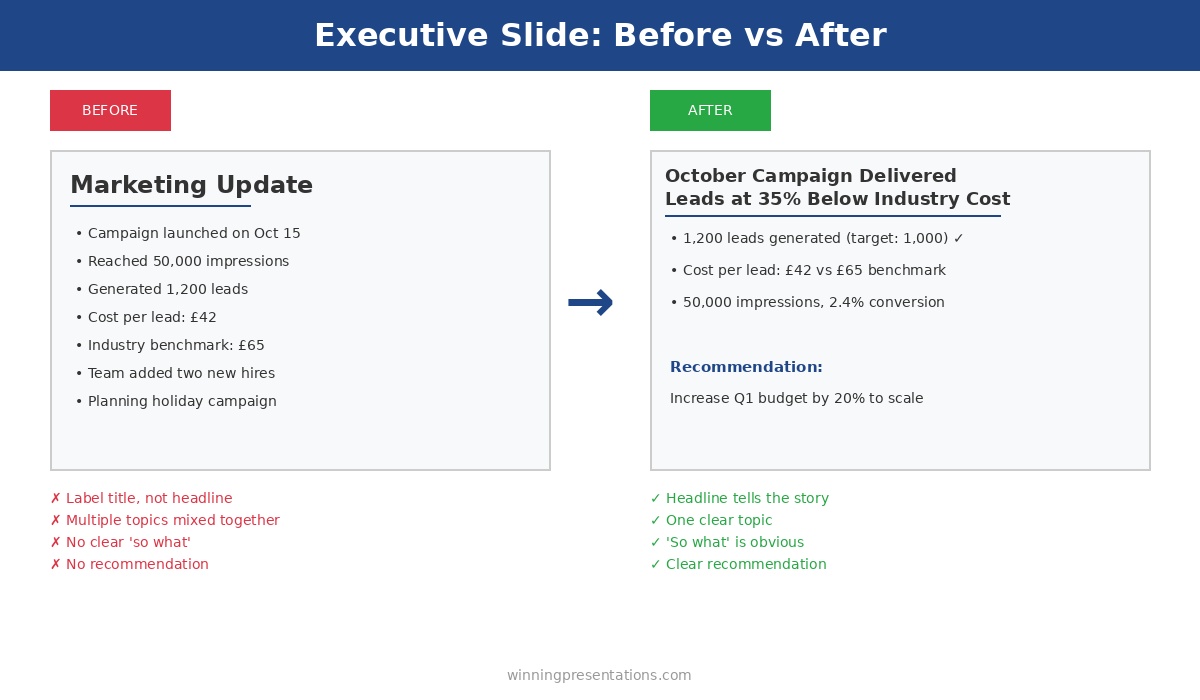
Executive slide before and after example - transforming a weak marketing update into a clear headline with recommendation

The same information, restructured for buy-in: vague labels become clear headlines with recommendations

The structure of a proposal matters as much as its content.

The Executive Slide System gives you 10 decision-first templates — each structured around the buy-in principles above.

Executive Slide System — £39, instant access.

Designed for executives who present where decisions are made.

If you present to senior leadership regularly, the Executive Slide System gives you a structured framework for building slides that land — without starting from scratch each time.

Lesson 5: Address the Elephant in Your Executive Presentations

Every executive presentation has a weakness. A risk you’re downplaying, an assumption that might not hold, a question you’re hoping nobody asks.

Executives always find it. And when they do, your credibility takes a hit.

The executive presentations that get buy-in address the elephant proactively. They name the biggest concern and explain how it’s being managed — before anyone asks.

The pattern: Identify your executive presentation’s weakest point. Address it directly, early, with a clear mitigation plan. Turn a potential objection into evidence of thorough thinking.

What I’ve seen work: “The obvious question is timeline risk — we’re proposing an aggressive 6-month delivery. Here’s why we’re confident: we’ve already completed the architecture design, secured the technical lead, and identified no dependencies on other teams. If we do hit delays, we have a descoped Phase 1 that still delivers 70% of the value.”

Now the executive doesn’t need to probe for weaknesses in your executive presentation. You’ve shown you already know them.

Lesson 6: Make Executive Presentations Easy to Approve

I’ve seen 80-slide executive presentations. I’ve never seen an 80-slide presentation get buy-in.

More information doesn’t build confidence. It builds confusion and delays. Executives want enough information to decide, not all the information available in your executive presentation.

The pattern: For every piece of information in your executive presentations, ask: does this help them decide yes or no? If it’s “interesting background” or “might be useful,” cut it. Save it for the appendix or follow-up questions.

What I’ve seen work: The best executive presentations I’ve reviewed were 6-10 slides. They respected the audience’s time and focused relentlessly on the decision at hand. Executives could say yes in 15 minutes instead of deferring a 60-minute data dump.

The test: If your executive presentation takes more than 20 minutes to deliver, it’s too long. Cut until it hurts, then cut again.

Building an executive presentation this week?

The Executive Slide System includes 10 templates for every executive presentation type — QBRs, budget requests, board openers, strategic recommendations — plus 30 AI prompts to generate content in minutes. One client used the budget request template to secure approval in a single 15-minute meeting.

Lesson 7: Buy-In for Executive Presentations Starts Before the Meeting

This is the lesson that took me longest to learn: executive presentations that get buy-in usually have buy-in before the presentation happens.

The meeting is confirmation, not persuasion.

Experienced presenters socialise their ideas before the formal pitch. They have one-on-ones with key stakeholders, gather input that shapes the proposal, and build alignment so the executive presentation is a formality.

The pattern: Before any high-stakes executive presentation, identify the 2-3 people whose support you need. Meet with them individually. Ask for their input. Incorporate their feedback. When you present, they’re already invested in your success.

What I’ve seen work: A VP preparing a board presentation spent two weeks in pre-meetings. By the time he delivered his executive presentation, every board member had seen an early version and provided feedback. The presentation felt like a collaborative conclusion, not a surprise pitch. Approved unanimously.

The Meta-Lesson About Executive Presentations

Here’s what all 500+ executive presentations taught me: the audience isn’t “executives.” The audience is specific people with specific concerns, priorities, and decision-making styles.

A CFO reviewing executive presentations cares about ROI and risk. A CEO cares about strategy and competitive position. A board cares about governance and shareholder value. A COO cares about execution and resources.

The executive presentations that get buy-in are tailored to the actual people in the room — not a generic “leadership” audience.

The pattern: Before building any executive presentation, answer: Who exactly will be in the room? What do they each care about? What would make each of them say yes? Then build slides that address those specific concerns.

The Executive Presentation Buy-In Checklist

Before your next executive presentation, run through these questions:

Executive Presentation Buy-In Checklist

  1. ☐ Is my recommendation in the first 2 minutes?
  2. ☐ Have I shown the cost of doing nothing?
  3. ☐ Am I asking for ONE decision only?
  4. ☐ Have I referenced past success as evidence?
  5. ☐ Have I addressed the biggest objection proactively?
  6. ☐ Is the executive presentation under 20 minutes?
  7. ☐ Have I socialised this with key stakeholders beforehand?
  8. ☐ Have I tailored content to the specific people in the room?

If you can’t check every box, your executive presentation isn’t ready. Keep working until you can.

Structure That Commands Attention

Structure Your Next Buy-In Presentation in 30 Minutes

The Executive Slide System (£39) gives you 17 tested structures including the buy-in deck template — pre-built to address the objections senior audiences raise before you reach slide three.

Get the Executive Slide System →

FAQs About Getting Buy-In on Executive Presentations

What if I don’t know who’ll be in the room for my executive presentation?

Ask. Email the meeting organiser: “Can you confirm who’ll be attending? I want to make sure I address the right priorities.” This also signals professionalism and preparation for your executive presentation.

How do I get pre-meetings with senior executives?

Position it as seeking input, not pitching: “I’m developing a proposal for [topic] and would value your perspective before the formal executive presentation. Can I have 15 minutes to walk you through the approach?” Most executives appreciate being consulted.

What if my executive presentation genuinely needs 30+ slides?

It doesn’t. You have 30+ slides of content — that’s different. Distill it to 10 slides for your executive presentation, put the rest in an appendix for reference, and offer to send the full deck afterward for anyone who wants detail.

How do I address objections without sounding defensive in executive presentations?

Frame it as thorough thinking, not defensiveness: “The question I’d ask if I were in your seat is [objection]. Here’s how we’re managing that risk…” You’re showing you’ve anticipated concerns in your executive presentation, not responding to criticism.

Your Next Executive Presentation

You probably have an executive presentation coming up. A budget request, a project proposal, a quarterly review, a board update.

Before you build another slide, step back and ask:

  • What’s the one decision I need from this executive presentation?
  • Who specifically will decide?
  • What would make them say yes?
  • What’s the biggest reason they’d say no — and how do I address it?

Answer those questions first. Then build your executive presentation. That order matters.

Executive presentations aren’t about impressing people with your analysis. They’re about making it easy for smart, busy people to say yes.

Make it easy, and they will

The Executive Slide System complete package - 10 PowerPoint templates, 30 AI prompts, and quick start guide for executive presentations

Get Templates for Executive Presentations That Get Buy-In

These lessons are built into The Executive Slide System — 10 PowerPoint templates structured for approval, plus 30 AI prompts to generate your content in minutes.

Designed for executives who present where decisions are made. One client used these to turn a rejected proposal into a funded initiative.

GET INSTANT ACCESS →

Executive Slide System — £39, instant access.
10 templates • 30 AI prompts • Instant download • 30-day guarantee


Related: How to Create Executive Presentations That Get Approved in 2025 — the complete guide covering all 10 executive presentation types with structures and frameworks for buy-in.

📧 The Winning Edge Newsletter

Weekly insights on executive presentations, QBR strategies, and what’s actually working in boardrooms right now.

Subscribe Free →