Tag: buy-in framework

24 Jun 2026
What Senior Leaders Build Inside the Executive Buy-In Presentation System

What Senior Leaders Build Inside the Executive Buy-In Presentation System

Quick answer: The Executive Buy-In Presentation System is a self-paced programme of 7 modules — stakeholder analysis, case construction, opening structure, the recommendation slide, the proof layer, the Q&A taxonomy, and the close. The output is not a polished deck; it is a working set of stakeholder maps, a one-line recommendation that holds under direct questioning, a structured opening, a proof layer that names its own counterevidence, and a rehearsed plan for the four hard questions the leader expects to be asked. A senior leader who works through the modules with one real upcoming board deck typically arrives at the meeting with that deck materially restructured around the buy-in target rather than the content the leader started with. Cohort enrolment is monthly and the materials are lifetime access; optional Q&A calls are fully recorded so attendance is never mandatory.

In early 2019 I was working with a senior commercial director who had been asked to take a major capital-allocation decision to her firm’s investment committee. She came to the session with a thirty-six-slide deck the analyst team had built. The deck was technically excellent, the financials checked out, and the recommendation was sound. She had three weeks. She wanted me to help her tighten the delivery. I asked her one question: “If the chair stops you after slide one and says ‘skip to the recommendation’, what do you say in the next sixty seconds?” She paused for a long time, started, stopped, restarted, and eventually said it depended on which chair. We had identified the problem in about ninety seconds. The deck was beautifully built but had been constructed in the wrong direction — it built up to a recommendation rather than starting from one. Every slide before slide thirty-two was load-bearing for an argument that no buy-in-stage audience was going to wait through.

The three weeks of work that followed were not deck work. They were buy-in work. We mapped the seven people on the committee one by one, sorting them into the ones already on side, the ones leaning against, and the two who would decide the room. We built a one-line recommendation that held under direct questioning. We rewrote the opening to start with the conclusion and the single proof point that pre-empted the strongest objection. We restructured the proof layer so each piece named its own counterevidence rather than waiting for the chair to surface it. And we drilled the four hard questions she was almost certainly going to be asked. The deck that walked into the room three weeks later had ten slides, not thirty-six. The committee approved the recommendation in fifty minutes and the chair said it was the cleanest paper he had seen that quarter. That sequence — stakeholder map, recommendation, opening, proof, Q&A taxonomy — is the structural skeleton of the Executive Buy-In Presentation System. The programme builds out each layer in a module of its own.

(This article was created with AI assistance; all stories and insights are based on 35 years of real client work.)

What people sometimes assume about the programme is that it is a deck-building course. It is not. The Executive Buy-In Presentation System is a course on restructuring the audience-target relationship before the deck is built — or more often, around an existing deck that has been built in the wrong direction. The deck is the artefact; the buy-in is the work. A senior leader who finishes the programme with a polished deck and an unmapped audience has missed the point. A leader who finishes with a slightly rough deck and a fully-mapped audience plus a tested recommendation will outperform the polished-deck version every time.

If you have a board meeting in the next eight weeks and the deck feels off:

The Executive Buy-In Presentation System gives you the 7 modules in a self-paced format — no deadlines, no mandatory live attendance, optional Q&A calls fully recorded. Monthly cohort enrolment, lifetime access to materials. Bring the real deck and rebuild it inside the framework.

See the Executive Buy-In Presentation System →

The shift the programme is built around

Most senior leaders, when asked what they are preparing for a board meeting, describe a deck. They will name the slide count, the structure of the financials, the chart on slide twelve they are not sure about. The deck is the visible artefact and it is what fills the calendar block in the days before the meeting. The work that actually determines whether the recommendation gets approved is something different. It is the analysis of who in the room will support it, who will oppose it, who is undecided, and what each of those groups needs to hear in the first three minutes. That work usually does not happen. When it does, the deck almost always changes shape after it, sometimes dramatically. The Executive Buy-In Presentation System is built around the assumption that the buy-in work has not yet been done, and it walks the leader through doing it.

This is why the first module is not on slide structure. The first module is on stakeholder analysis — the discipline of mapping the room before mapping the deck. Senior leaders who have presented to the same committee many times often think they know the room implicitly and skip this work. They are usually wrong about at least one person, and the person they are wrong about is disproportionately likely to be the one who tips the room one way or the other. The module is not theoretical. The leader maps a real upcoming committee, person by person, and produces a written stakeholder map that lives alongside the deck for the rest of the preparation. That map is the document the leader returns to as the deck takes shape. Without it the deck builds itself around content. With it the deck builds itself around the audience.

Modules 1–3: stakeholder map, recommendation, opening

Module one is stakeholder mapping. The leader produces a one-page map of the committee or board they are about to present to — each member named, sorted by current position (supportive, opposing, undecided), with the one or two factors that will most influence each one. The deliverable looks deceptively simple. The work behind it is what most senior leaders have never been pushed to do: forcing themselves to admit which committee members they actually understand and which ones they have been guessing about. The module is the foundation everything else is built on. A leader who does this module honestly often discovers that two of the seven people in the room are not who they assumed they were, and that the recommendation needs adjusting to address what those two actually need.

Module two is the recommendation. Not the content of the recommendation — the leader brings that — but the form of it. A recommendation that holds under direct questioning at slide one is structurally different from a recommendation that has built up over thirty slides of supporting analysis. The module walks the leader through compressing the recommendation into a single line that survives the chair asking “what are you actually proposing?” forty seconds in. The discipline is harder than it sounds. Most senior leaders, when forced to compress, produce a one-liner that hides important caveats, which then become liabilities under questioning. The module’s job is to teach the leader how to compress without losing structural integrity. The output is a recommendation line that a stakeholder can repeat back to a colleague after the meeting without distorting it.

Module three is the opening. Specifically, the first three minutes — the architecture that gets the recommendation, the stake, and the strongest pre-empted objection into the room before slide three. The module reframes the opening from “context-setting” into “answer-first, evidence-second, implications-third”, which is the pattern senior committees actually scan against. Most leaders open with context because that is how the deck was written. The module rewrites the opening to start where the audience is — with the decision they are being asked to make. By the end of module three the leader has restructured the first three slides of their real deck. The remaining four modules handle the rest.
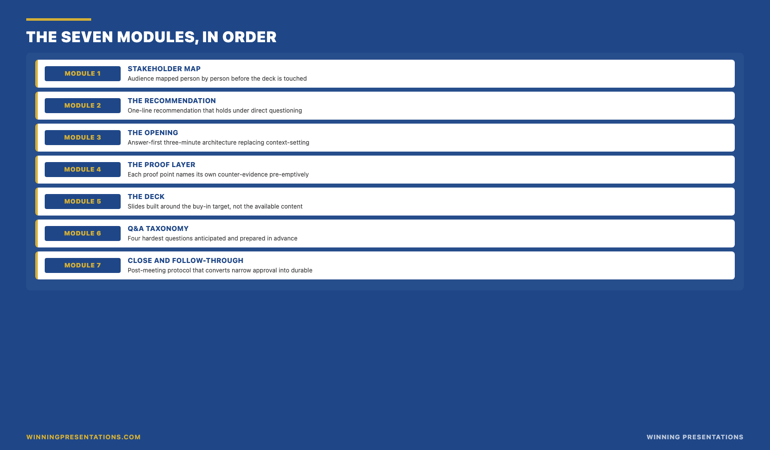
The Executive Buy-In Presentation System modules infographic: Module 1 stakeholder map (audience mapped person by person), Module 2 recommendation (one-line recommendation that holds under questioning), Module 3 opening (answer-first three-minute architecture), Module 4 proof layer (each proof point names its own counterevidence), Module 5 the deck (templates and structure built around the buy-in target), Module 6 Q&A taxonomy (four hard questions prepared), Module 7 close and follow-through (post-meeting protocol that lands the decision).

Modules 4–7: proof, Q&A taxonomy, close, rehearsal

Module four is the proof layer. The shift is from “evidence in support” to “evidence that names its own counterevidence”. A board recommendation that presents only the supporting case looks defensive the moment the first counter-argument lands. A recommendation that names two or three real counter-arguments before the chair raises them looks rigorous and shifts the committee’s posture from challenging to evaluating. The module walks the leader through building this kind of pre-emptive proof structure for the specific recommendation in front of them. It is not a generic technique. It is a structural rebuild of the evidence layer of the deck so that the strongest objections from the stakeholder map are addressed in the proof itself, not deferred to Q&A. Most senior leaders, after this module, find they remove two or three slides from the deck because the content moves into the pre-empted-objection structure rather than living as standalone analysis.

Module five is the deck itself — the slide work that the first four modules have been quietly preparing the leader to do. By this point the stakeholder map exists, the recommendation is compressed, the opening is restructured, and the proof layer is pre-emptive. The deck more or less builds itself around those four pieces. The module covers slide structure, the small number of templates that handle most board-deck scenarios, and the discipline of cutting slides that do not earn their place under the buy-in target. The leader who works through module five with a real deck usually ends with a meaningfully shorter, structurally tighter version of what they came in with. The slide system the module references is available as a standalone product — the Executive Slide System (£39) — for leaders who want the templates and AI prompts the module five work draws on.

Module six is the Q&A taxonomy. The leader works through the eight categories of hard questions senior committees ask — verification, assumption, scope, motive, risk, stakeholder, timing, authority — and prepares a response stance for each. The module’s specific output is a prepared opening line for the four questions the leader expects to be asked, based on the stakeholder map from module one. The four questions are almost never wrong by more than one. Leaders who do this work walk into the meeting with the four hardest questions already absorbed and a response stance for each. Most of the audible composure that committee chairs read as authority comes from this module, because the leader is no longer doing live cognitive work in the room — she is retrieving prepared responses to questions she had correctly anticipated.

Module seven is the close and the follow-through. The close is the last ninety seconds of the presentation — the explicit ask, the decision frame, the implementation outline — structured so the committee can move directly from the close into the vote without ambiguity. The follow-through is the post-meeting protocol: the written summary that goes out within four hours, the captured action items, and the next-step alignment that holds the decision in place between the vote and the implementation. The follow-through is the module most leaders did not know they needed. It is also the one that converts narrow approvals into durable ones, and it is the work that frequently determines whether the recommendation survives the first three weeks after the committee meets.

Turn reluctant stakeholders into active advocates.

The Executive Buy-In Presentation System is a self-paced programme with 7 modules. Enrol with this month’s cohort, work through at your own pace — optional live Q&A calls are fully recorded so attendance is never mandatory. The framework you work through privately; the cohort enrolment puts you alongside other senior leaders working the same modules on different real decks. £499, lifetime access to materials.

  • Module 1: stakeholder map — the audience mapped person by person before the deck is touched
  • Module 2 & 3: one-line recommendation and answer-first opening that hold under direct questioning
  • Module 4 & 5: pre-emptive proof layer and the slide structure that supports it
  • Module 6 & 7: Q&A taxonomy with prepared responses and the post-meeting follow-through protocol

Enrol in the Buy-In System — £499 →

What a senior leader actually walks away with

The artefact-set a leader has at the end of a working pass through the programme is small and concrete. It is one stakeholder map for the upcoming meeting, one written one-line recommendation, one restructured three-slide opening, one rebuilt proof layer with named counter-evidence, one materially shorter deck, four prepared question responses, and one post-meeting follow-through protocol. The whole set fits in a folder and most of it is plain text rather than slide work. That is the point. The leader who walks into a board meeting holding that folder of work is operating from a different structural position than the leader who walks in holding only a deck. The deck supports the meeting; the folder governs it. For a parallel walkthrough focused on the masterclass orientation of the programme, see the Executive Buy-In Masterclass online overview; for the wider context on the kind of training that produces this result, the board approval presentation training reference is the companion piece.
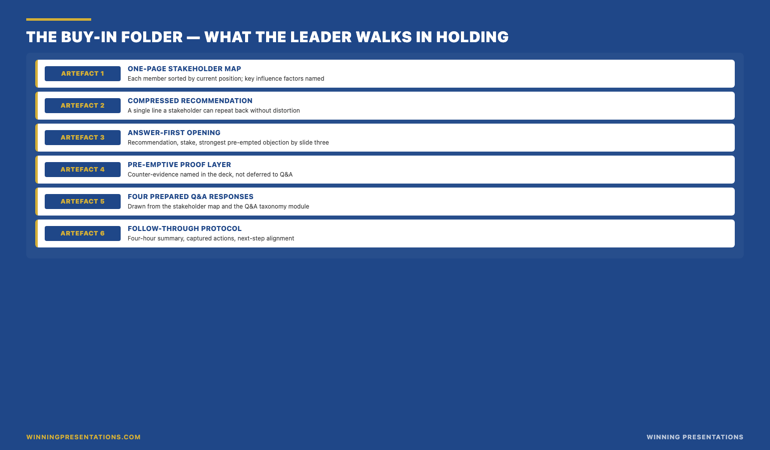
The buy-in folder infographic: one-page stakeholder map (each board member sorted by current position with key influence factors), compressed one-line recommendation that holds under direct questioning, three-slide answer-first opening, restructured proof layer with named counter-evidence, materially shorter deck, four prepared question responses from the Q&A taxonomy, post-meeting follow-through protocol — the artefacts the Executive Buy-In Presentation System produces over its 7 modules.

No deadlines, no mandatory attendance. Lifetime access to all materials.

The Executive Buy-In Presentation System — 7 self-paced modules, monthly cohort enrolment, optional recorded Q&A calls available. Work at your own pace; keep the materials forever. £499.

Join the next cohort — £499 →

Frequently asked questions

Is the Executive Buy-In Presentation System worth it if I already have a strong deck for my next board meeting?

Probably more useful than you would guess. The strongest decks are usually the ones that have been beautifully built in the wrong direction — toward a recommendation that lives on slide thirty rather than slide one. The programme’s first three modules will likely surface a structural rebuild even on a deck that the leader and the analyst team are pleased with, because the rebuild is at the architecture level, not the polish level. Leaders who enrol with a strong deck and an upcoming meeting tend to get the most concrete return from the programme, because the work has a real artefact to attach to.

How does the self-paced format work in practice if I have a hard board meeting deadline?

The 7 modules are designed to be worked in sequence and the most common pattern is one module per week across seven weeks, but the timing is entirely flexible. A leader with a board meeting in three weeks would typically front-load the first four modules in the first ten days and use the remaining time for module five (the deck) and module six (Q&A rehearsal). A leader with eight weeks would space the modules more evenly. Optional Q&A calls happen monthly and are recorded so attendance is never required. The cohort enrolment is the thing that locks you in; the pace is yours.

What does the cohort enrolment actually give me, given the course is self-paced?

The framework you can work through privately. The cohort enrolment puts you alongside other senior leaders working the same modules on different real decks during the same window, which is where the parallel-track learning comes from — watching how someone in a different sector handles module four’s proof-layer rebuild on a deck that is structurally similar but contextually unfamiliar tends to surface insights private study cannot. The optional live Q&A calls are the surface where this happens most often, and the recordings preserve it for anyone who cannot attend live. The structural value of the cohort is the multi-deck exposure to the same framework being applied to different work.

Why is this priced at £499 rather than positioned as a low-cost course?

Because the leaders it is built for are presenting decisions to boards and investment committees where the cost of a deferred decision regularly runs into six or seven figures. A programme that materially improves the structural quality of those presentations earns its £499 on the first board meeting that lands cleaner than it otherwise would have. The pricing is calibrated to the buyer profile, not to the time investment alone. Leaders evaluating it as a generic professional-development purchase often find the framing strange; leaders evaluating it against the specific cost of a single deferred recommendation usually find the maths obvious.

The Winning Edge — weekly newsletter

The Winning Edge is a weekly newsletter for senior professionals who present at the executive level. One short email a week on the structural moves that separate decks committees back from decks they defer. Subscribe to The Winning Edge →

For the wider library of presentation assets that pair with the buy-in framework — the slide system, the Q&A taxonomy, the storytelling primer, and the delivery references — the Complete Presenter bundle (£99) collects them in one place.

About the author

Mary Beth Hazeldine is Owner & Managing Director of Winning Presentations Ltd. With 24 years of corporate banking experience at JPMorgan Chase, PwC, Royal Bank of Scotland, and Commerzbank, she advises executives across financial services, healthcare, technology, and government on structuring presentations for high-stakes funding rounds, board approvals, and strategic decisions.

Walk into your next board meeting with a folder, not just a deck. The folder holds the stakeholder map, the compressed recommendation, the answer-first opening, the proof layer that names its own counter-evidence, and the four prepared question responses. The deck supports the meeting; the folder governs it. The leader who builds the folder gets the decision. The leader who builds only the deck waits to find out.

19 May 2026
Featured image for Buy-In Mastery: Why Executive Approval Is Learnable

Buy-In Mastery: Why Executive Approval Is Learnable

QUICK ANSWER

Executive approval looks like personality, but it is structure. Buy-in mastery is the curriculum senior professionals build over time: stakeholder mapping, case construction, objection pre-handling, and the presentation patterns that hold up to senior scrutiny. People who earn approval consistently are not more charismatic. They are working from a structured framework the rest of the room cannot see.

Annika had been a director at a pan-European insurer for eight years. She had been turned down three times in twelve months on a market expansion proposal she believed in. The fourth time she presented it, the chair of the executive committee said, “This is the version we needed.”

Nothing about Annika’s personality had changed. The market had not become friendlier. Her sponsor had not got more senior. What changed was the way she put the case together. She had stopped trying to convince the room and started preparing the room. She had stopped writing slides that explained her thinking and started writing slides that addressed each committee member’s specific question before they asked it. The proposal had not become better. The buy-in work had become better.

That is the discipline this article is about. Not how to “be more confident” or “tell a better story.” How to learn the work that turns reluctant rooms into approving ones, on a consistent basis, across different audiences and different stakes.

Want a structured approach to buy-in?

If you would rather work through this as a framework than reverse-engineer it across years of approvals and refusals, the Executive Buy-In Presentation System is built around exactly the disciplines below. Self-paced, no deadlines, monthly cohort enrolment.

Explore the system →

The myth: executive approval is about personality

The story most senior professionals are told about buy-in is that it is a function of who you are. The people who get approval are the ones with presence. They are the ones who command rooms. They are the ones who are good at influencing. The implication is that if you are not in that group, you can study the work, polish your slides, and rehearse your delivery as much as you like — and the room will still not lean your way, because the room is not really listening to your slides. It is listening to you.

This story is enormously appealing because it is unfalsifiable. If your proposal is approved, you had presence. If it is declined, you did not. The story dresses up an outcome as a personality trait, then explains every result by pointing back at the trait.

It also happens to be wrong, and the evidence sits in plain view. The senior professionals I have worked with who consistently earn approval are not the most charismatic people in their organisations. They are not the loudest. Several of them are introverts who, if you saw them in the canteen, would not strike you as the people who win the most ground in committee. What they are is people who have learned the work that sits underneath approval, and who run that work to a high standard every time they need a senior decision.

The truth: executive approval is a curriculum

Earning consistent buy-in is a learnable discipline. It can be broken into specific skills. Those skills can be practised. They can be sharpened with feedback. They can be applied across radically different audiences — investment committees, regulators, joint venture boards, government commissioning panels — with the same underlying logic.

That is what makes it a curriculum. A curriculum is not a single technique or a personality. It is an ordered set of disciplines that, taken together, produce a competence. Surgery is a curriculum. So is appellate advocacy. So is structured analytical reasoning at consultancies that take pride in it. Senior buy-in is the same kind of thing.

The reason it does not feel like a curriculum to most senior professionals is that nobody teaches it as one. It is absorbed in fragments — from a sponsor who happened to coach you well, from a mentor who shared three useful patterns, from one client engagement that went well and several that went badly. Most senior professionals are running on a partial version of the curriculum they need, with the gaps showing up most painfully when the stakes are highest.

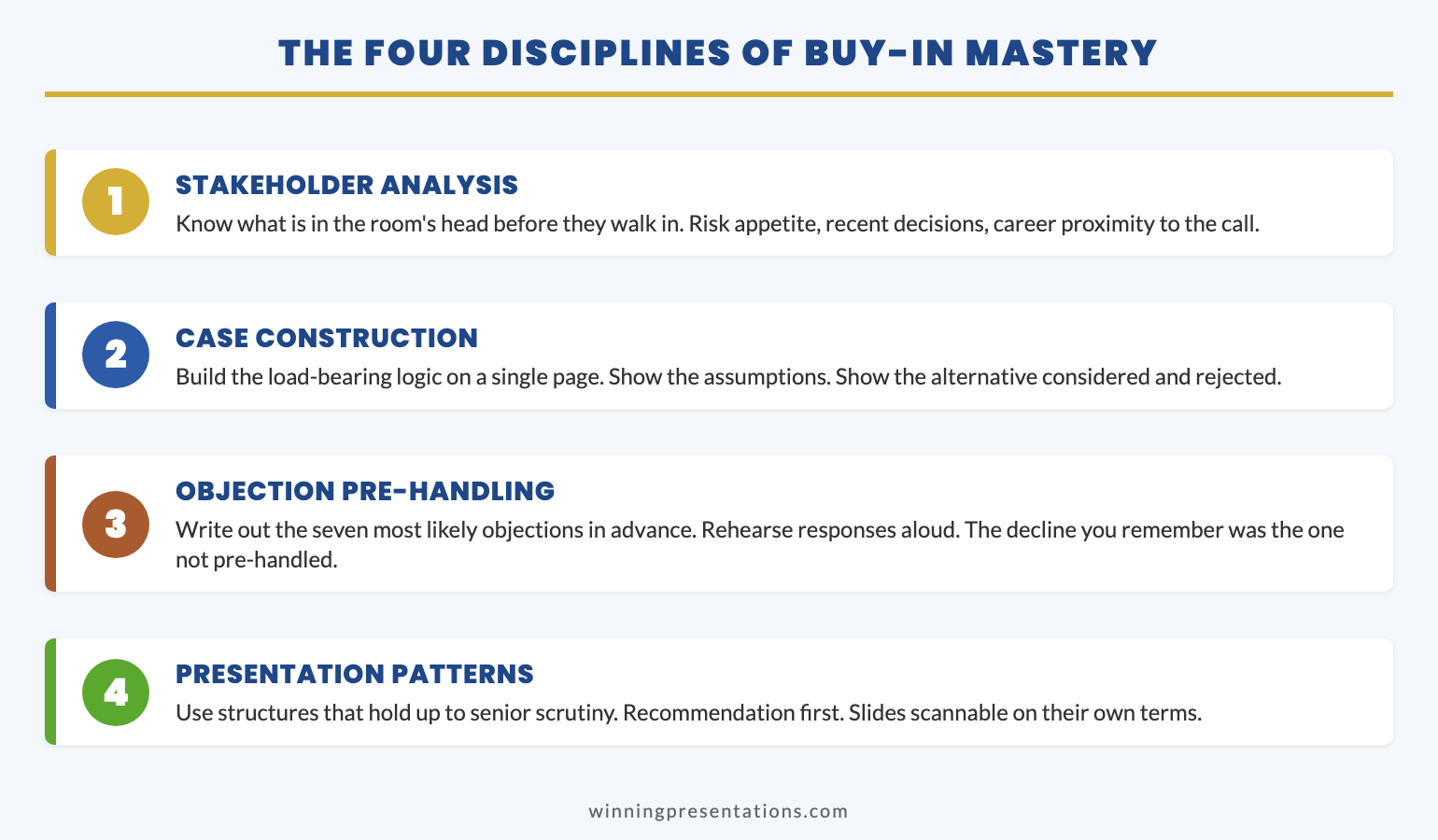
The four disciplines of buy-in mastery infographic showing stakeholder analysis, case construction, objection pre-handling, and structural patterns as ordered components of executive approval

The four disciplines of buy-in mastery

If executive approval is a curriculum, what is in it? In my experience working with senior professionals across financial services, biotech, government, and SaaS, the curriculum reduces to four disciplines. Each is a body of skill in its own right. Each becomes more rigorous as the stakes go up.

Discipline one: stakeholder analysis. Most senior professionals know who is in the room. Buy-in mastery requires knowing what is in their head before they walk in. What is each person’s appetite for risk in the area you are proposing? What did they say “no” to last quarter, and what did they fund? Whose career was nearest to the decision the last time something similar was approved or declined? These are not gossip questions. They are structural inputs into how you frame the case. A proposal that lands well in front of a CFO who has just absorbed a budget overrun reads completely differently from the same proposal in front of a CFO whose unit is over-performing target.

Discipline two: case construction. The case is the underlying logic that takes the audience from “this is the situation we are in” to “this is the decision that follows.” Senior professionals who are strong on case construction can show you the case on a single page. They can show you the load-bearing assumptions. They can show you the alternative they considered and rejected, and why. When the case is structured this rigorously, the slides become almost incidental — they are simply a way of revealing the case at the right pace for the room.

Discipline three: objection pre-handling. Approving rooms are rarely silent rooms. They are rooms where the most predictable objections have already been answered before they are voiced. Buy-in mastery means walking into the meeting with a written list of the seven to ten questions you expect, the order they are likely to surface, and a structured response to each one that you can give without hesitation. The decline you remember is almost always the decline you did not pre-handle.

Discipline four: presentation patterns. The structures that hold up to senior scrutiny are different from the structures that work in working group meetings. Senior approval audiences want the answer first, the evidence second, the implications third — and they want every slide to be defensible on its own terms. The pattern you use is not a stylistic choice. It is part of the reason approvals happen on the first ask.

EXECUTIVE BUY-IN PRESENTATION SYSTEM

Build the case your stakeholders cannot dismiss

The Executive Buy-In Presentation System is a self-paced framework — 7 modules walking you through the structure, psychology, and delivery that earn senior approval.

  • 7 modules of self-paced course content
  • Optional live Q&A / coaching calls (fully recorded — watch back anytime)
  • No deadlines, no mandatory session attendance
  • New cohort opens every month — enrol whenever suits you
  • Lifetime access to all course materials

£499, lifetime access. Self-paced with monthly cohort enrolment — optional recorded Q&A sessions available.

Explore the programme →

Designed for senior professionals who present decisions to boards, investment committees, and executive sponsors.

Patterns that hold up to senior scrutiny

Senior audiences read presentations differently from working audiences. They are scanning for two things: what are you asking me to decide, and what are the load-bearing reasons. Everything else is texture. The patterns that hold up to that kind of reading have specific properties.

The opening slide carries the recommendation, not the agenda. Within the first ninety seconds, senior approvers know what you want them to approve and what the implications are if they do. This is not a stylistic preference. It is what allows them to listen properly to the rest. A presentation that withholds the recommendation until slide twelve forces senior listeners into a guessing posture, which is the opposite of an approving posture.

The body of the presentation walks through the case in load-bearing order, not chronological order. This is one of the hardest pattern shifts for senior professionals trained as analysts or specialists. Analytical thinking moves from inputs to conclusions. Senior decision presentations move from conclusion to the inputs that make it defensible. Both are valid. Only one of them earns approval at speed.

The slides themselves are scannable on their own terms. A senior approver who looks only at the slide titles in sequence should be able to read the spine of your case. A senior approver who lands on any single slide for the first time should be able to understand it without a verbal walkthrough. This is what allows your case to survive a board pre-read where you are not in the room to explain it.

For a deeper walk-through of the slide patterns that earn approval at senior level, see the board approval presentation framework — a sister article that focuses specifically on the structural choices senior approvers respond to.

Need the slide structures to back up the curriculum?

The Executive Slide System is the templates side of the same picture — 26 templates, 93 AI prompts, and 16 scenario playbooks built around the patterns senior approvers respond to. Designed to pair with the Buy-In curriculum, not replace it.

Executive Slide System — £39 →

Pre-handling the objections you can predict

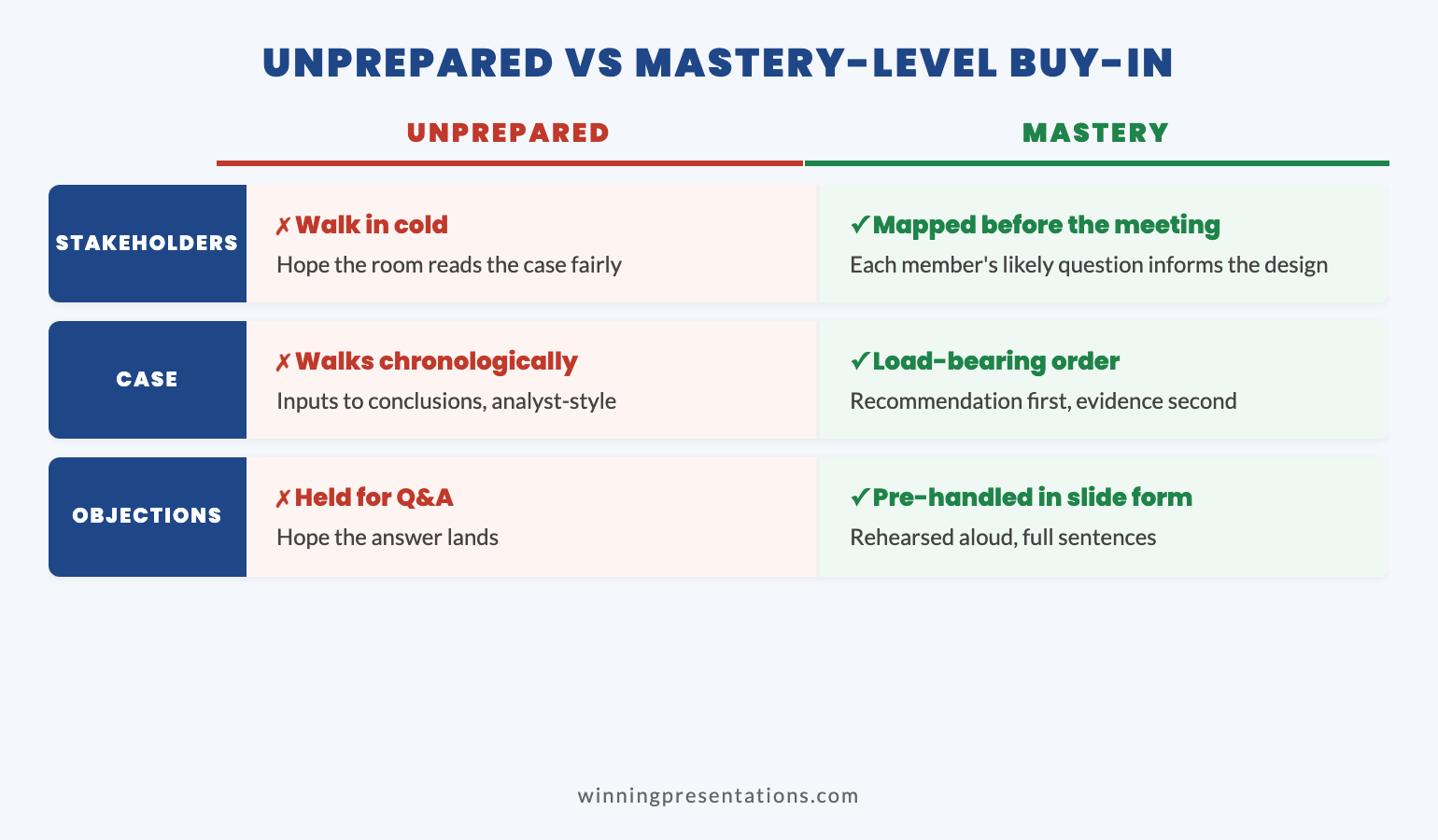
The decline you remember is almost always the decline you did not pre-handle. Senior approval rooms have a finite repertoire of objections. They are not unique to your case. They cluster around five categories — cost, risk, timing, alternatives, and execution — and within each category, the same questions recur with surprising consistency across organisations and sectors.

Two-column comparison infographic contrasting unprepared buy-in approach versus mastery-level buy-in approach across stakeholder analysis, case construction, objection handling, and slide patterns

Buy-in mastery means writing those questions out before the meeting and rehearsing the answers in their likely order. Not bullet points. Not headlines. Full sentences, said aloud, until they come out clean. The senior professional who pre-handles the seven most likely objections has effectively shifted the meeting forward by seven steps before it starts. The room arrives at “what are the implementation milestones” while a less-prepared peer is still defending why the proposal exists at all. Stakeholder management for presentations covers the upstream work that makes pre-handling work properly — you cannot pre-handle objections you have not anticipated.

The pre-handling discipline also has a quiet effect on confidence. When you have rehearsed the responses to the predictable objections, the unpredictable ones become much less destabilising. Senior approvers can tell the difference between a presenter who has thought about a question for the first time in the room and one who has thought about it many times before. The latter earns a different kind of attention.

What it actually takes to learn this

The reason buy-in mastery looks like personality is that it is usually built up over many years, in invisible increments, through a mixture of mentoring, costly mistakes, and rare bits of structured input. By the time it shows up as a competence, the scaffolding is gone. What you see is a senior professional who walks into a room and earns approval — and the explanation that fits that observation most easily is “they are just good at this.”

The shorter route is to treat the curriculum as a curriculum. Work through the disciplines in order, with structured material, in your own time, applying each one to a real proposal you are preparing now. The proposal becomes the practice ground, and the approval — or refusal — becomes the feedback. Two or three iterations of this with conscious attention to which discipline is doing the work and which one is the gap will move you further than another five years of absorbing fragments by accident.

This is, in plain terms, what the Executive Buy-In Presentation System exists to do. It is not the only way to learn the curriculum. Some senior professionals will piece it together through mentoring, reading, and reflection over a decade. The system simply compresses the timeline. Executive presentation skills covers the broader picture for senior professionals who want to understand where buy-in fits inside the wider competence.

JOIN THE NEXT COHORT

Walk into your next approval meeting prepared

The Executive Buy-In Presentation System gives you 7 self-paced modules covering stakeholder analysis, case construction, and the presentation structures that hold up to scrutiny. Monthly cohort enrolment — £499, lifetime access.

Enrol now →

Self-paced with monthly cohort enrolment. No deadlines, no mandatory session attendance.

Why senior professionals turn to a structured framework

The senior professionals who reach for a framework like this tend to share a moment. They have been turned down on something they believed in, and the explanation they were given did not match the work they had done. Or they have watched a peer earn approval on a thinner case and realised the difference was not the case — it was the way the case was put. That moment is usually what makes the curriculum feel worth working through.

Approval is not the only goal. Earning it consistently, across rooms you do not control, is the goal. That requires a body of skill that does not depend on the chemistry of any single meeting. It requires the curriculum.

THE COMPLETE FRAMEWORK

The structured approach senior professionals use to secure approval

Built on 24 years in corporate banking and 16 years coaching senior professionals across financial services, insurance, consulting, and technology. The Executive Buy-In Presentation System — 7 modules, self-paced, monthly cohort enrolment, optional recorded Q&A calls. £499, lifetime access to materials.

Explore the programme →

Designed for senior professionals who need to secure board-level approval.

Frequently asked questions

Is buy-in really learnable, or is some of it just personality?

Personality affects style; structure decides outcomes. Two people with the same buy-in framework can deliver it very differently and both earn approval, because the four disciplines — stakeholder analysis, case construction, objection pre-handling, and presentation patterns — do most of the load-bearing work. Personality decides which version of the framework feels natural to use. It does not decide whether the framework works.

How long does it take to develop buy-in mastery?

Senior professionals who absorb the curriculum in fragments tend to take eight to fifteen years. Those who work through it as a structured discipline can apply the four disciplines to a real proposal within weeks. The constraint is not how long the material takes to learn — it is how many real approval cycles you can apply it to. Two or three live applications, with feedback, builds more competence than another year of theory.

Does buy-in mastery work for non-board audiences?

Yes. The same four disciplines apply to investment committees, regulators, joint venture partners, government commissioning panels, and senior client procurement. The audience changes the inputs to stakeholder analysis. It does not change the structure of the case, the discipline of pre-handling, or the patterns that hold up to scrutiny. Senior professionals who learn the framework typically find it transfers across audiences with minor adaptation.

What separates a presenter who earns approval from one who does not?

The presenter who earns approval has done the work the room never sees. They have mapped the stakeholders, constructed the case to load-bearing order, written out the objections in advance, and chosen a slide pattern that survives scrutiny. The presenter who does not earn approval has often produced a stronger argument, but has not done the structural work that makes the argument land at senior level. The visible part of the meeting is rarely where the difference is made.

The Winning Edge

A weekly newsletter for senior professionals who present at board level. One specific structural idea per issue, drawn from real boardroom and committee work. No filler.

Subscribe to The Winning Edge →

Not ready for the full system? Start here instead: download the free Executive Presentation Checklist — the pre-flight checks that catch the structural mistakes most senior professionals make in the last 24 hours before a high-stakes meeting.

If this article landed for you, From declined to approved is the natural next read. It walks through the same disciplines from the perspective of a senior professional rebuilding a board presentation track record after a sequence of refusals.

Next step: open a real proposal you are working on now and run the four disciplines against it. Where is the curriculum already strong? Which discipline is doing the least work? That is where the next round of approval is being won or lost.

Mary Beth Hazeldine is the Owner & Managing Director of Winning Presentations. With 24 years of corporate banking experience at JPMorgan Chase, PwC, Royal Bank of Scotland, and Commerzbank, she advises senior professionals across financial services, healthcare, technology, and government on structuring presentations for high-stakes funding rounds and approvals. She speaks German and works extensively with the German-speaking financial markets.