

Box breathing is a physiological reset button—a four-step technique that brings your nervous system back into balance within minutes. Navy SEALs use it before covert operations. Emergency room surgeons use it before complex procedures. And senior executives use it before board meetings, earnings calls, and regulatory hearings where composure determines the outcome. The technique is simple, evidence-backed, and discreet enough to use in a conference room lavatory or in the five minutes before you walk into a shareholder meeting.
In this article:
The Story: Henrik’s Regulatory Hearing
Henrik sat in the corridor of the regulatory office with nine minutes to spare before presenting a critical approval hearing. As Chief Financial Officer of a pharmaceutical company, he’d presented to boards and regulators dozens of times—but this was different. A competitor’s recent failure in a similar category had made the regulator more scrutinising. His hands were cold. His jaw was tight. His voice, when he’d rehearsed it an hour earlier, had sounded thin and uncertain.
He’d tried everything: positive affirmations (felt hollow), visualisation (his mind wandered), pacing (made him more anxious). Then a former Navy officer on his executive advisory board had mentioned something in passing at a networking event: box breathing. Not meditation. Not mindfulness. Just a structured breathing pattern that resets the autonomic nervous system in under five minutes.
Henrik pulled up a quiet side room and spent four minutes doing exactly that. Four counts in. Four counts hold. Four counts out. Four counts hold. Repeat. When he walked into the hearing room, something had shifted. His voice was steady. His thoughts were clear. He moved through the presentation with the kind of composed authority the regulators needed to see. The approval came through three weeks later.
The reality of presentation anxiety
Anxiety before high-stakes presentations isn’t a personal failing—it’s a physiological response to perceived threat. Your body doesn’t distinguish between physical danger and reputational risk. When you’re about to present to a board or speak at a regulatory hearing, your sympathetic nervous system activates, flooding your system with cortisol and adrenaline. Box breathing counteracts this directly by engaging your parasympathetic nervous system. It’s not about feeling confident. It’s about getting your physiology out of the way so your competence can show.
The Neuroscience Behind Box Breathing
Your autonomic nervous system has two branches: the sympathetic (fight-or-flight) and the parasympathetic (rest-and-digest). When you’re facing a high-stakes moment, your sympathetic system dominates. Your breathing becomes shallow and rapid. Your heart rate climbs. Blood pools in your muscles instead of your prefrontal cortex. This is useful if you’re facing a predator. It’s catastrophic if you’re trying to communicate complex information clearly.
Box breathing works because extended exhalation—particularly the pause at the end of the breath—directly activates the vagus nerve, which controls parasympathetic activation. The equal counting pattern (four in, four hold, four out, four hold) creates a rhythm that your nervous system recognises and responds to. Within minutes, your heart rate variability improves, your cortisol begins to drop, and your prefrontal cortex—the part of your brain responsible for rational thought, composure, and articulation—comes back online.
This isn’t speculation or wellness theory. The physiological mechanisms have been studied in military contexts, clinical psychology, and sports performance for decades. The technique appears in trauma protocols, anxiety management programmes, and athlete preparation routines because it works at a biochemical level that doesn’t require belief or motivation. Your body simply responds.
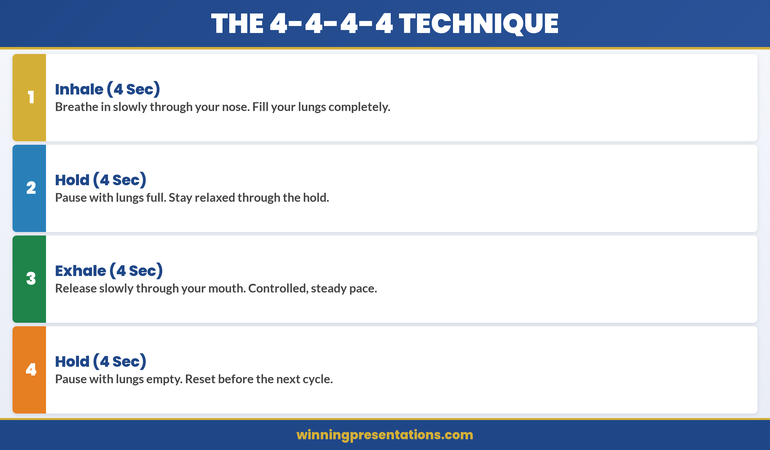
The 4-4-4-4 Technique: Step by Step
Box breathing for executives is deliberately straightforward. There’s nothing to remember beyond counting. Here’s the method:
Step 1: Exhale completely
Before you begin the pattern, expel all the air in your lungs with a slow, deliberate exhale. This triggers an immediate parasympathetic response and signals to your body that you’re intentionally shifting your state.
Step 2: Inhale for four counts
Close your mouth if you’re in a shared space and breathe slowly through your nose. Count steadily: one, two, three, four. Inhale with intention but without strain.
Step 3: Hold for four counts
Once you’ve inhaled, pause without forcing. One, two, three, four. This pause is crucial—it allows your body to absorb the oxygen and signals a return to equilibrium.
Step 4: Exhale for four counts
Slowly release the breath over four counts through your mouth or nose. This is the longest part of your breathing cycle in terms of nervous system effect. Extended exhalation is where the parasympathetic activation happens.
Step 5: Hold for four counts
Pause again for four counts. You’ve completed one cycle of box breathing.
Repeat this cycle five to ten times. Three to five minutes is typically enough to restore composure before a presentation. Some executives do it for longer before particularly high-stakes moments, but diminishing returns set in after ten cycles.
The count can be adjusted if four feels uncomfortable. Some people use five or six counts per phase. The critical variables are that all four phases are equal in duration and that you’re breathing slowly and deliberately—roughly one full cycle every 20 seconds.
Ready to master your nervous system before high-stakes presentations?
Conquer Speaking Fear gives you box breathing, grounding techniques, and frameworks to manage anxiety when your reputation is on the line.
Why Executives Resist Box Breathing
The most capable executives often resist breathing techniques, and it’s worth understanding why. There are three consistent objections.
First, it feels too simple. After years of building complex financial models and navigating geopolitical market dynamics, a four-count breathing pattern can feel trivial. The executive brain interprets simple as ineffective. But physiology doesn’t care about complexity. Your vagus nerve doesn’t require intellectual sophistication. It responds to the pattern regardless of whether you believe in it.
Second, there’s a perception problem. Some worry that using a breathing technique signals weakness or that they need external props to manage their state. The reality is inverted: controlling your physiology before a high-stakes moment is a mark of professionalism and preparation. Navy SEALs, emergency surgeons, and Olympic athletes aren’t weak. They’re disciplined about managing the variables they can control.
Third, they haven’t learned it during low-stakes moments. Attempting box breathing for the first time ten minutes before a regulatory hearing adds cognitive load when you can least afford it. The technique works best when it’s already familiar, when your body recognises the pattern and responds automatically. This is why rehearsal matters.
When to Use Box Breathing: Timing and Context
Box breathing isn’t a tool you pull out only in crisis. The executives who benefit most from it integrate it into routine preparation. Here are the most effective moments:
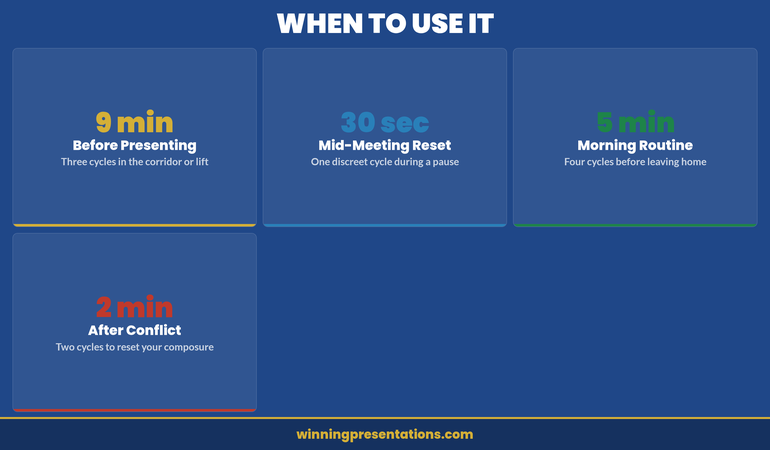
Fifteen to thirty minutes beforehand. This is the optimal window. Your nervous system has time to absorb the reset, but you’re close enough to the event that the effect persists. If you practise earlier, arousal will begin to climb again as you move closer. If you try it two minutes before, you might not have enough time to feel the shift.
During breaks in longer presentations or meetings. If you’re presenting for an hour with a break halfway through, use that break to do one or two cycles of box breathing. It resets your energy and brings you back into a composed state for the second half.
As part of your morning routine on presentation days. Starting the day with three to five minutes of box breathing sets your baseline lower. When the presentation happens later that day, you’re starting from a calmer physiological state, which means you don’t have as far to climb in terms of arousal.
In the moment, if you feel anxiety climbing during the presentation itself. If you’re mid-presentation and notice your heart rate rising or your thoughts becoming scattered, you can excuse yourself for 90 seconds, find a private space, do one or two cycles of box breathing, and return. The reset is noticeable even in such a compressed timeframe.
Adapting Box Breathing for Corporate Settings
The advantage of box breathing for executives is that it’s invisible. You’re not lighting scented candles. You’re not chanting. You’re not wearing any special equipment. You’re simply breathing in a particular pattern, which you can do anywhere without drawing attention.
In a conference room waiting for a board meeting to start, you can do two cycles of box breathing while reviewing your notes. In a client dinner before a major pitch, you can excuse yourself to the restroom for a discreet reset. Before stepping into a shareholder meeting, you can use the elevator ride as your practice window. The technique adapts to the environment because it requires nothing but your breath and your attention.
Some executives integrate it into their pre-presentation routine as casually as they’d check their slides or review their opening line—a standard part of preparation, not a special intervention. This normalisation is precisely what makes it sustainable over time.
If you’re concerned about appearing unusual, remember: most people are too focused on themselves to notice your breathing pattern. And if anyone does notice you taking slow, deliberate breaths before a presentation, the only conclusion they’ll draw is that you’re composed and in control.
Struggling with the structural side of your presentation?
Conquer Speaking Fear combines breathing techniques with frameworks for clarity and confidence under pressure.
Advanced Variations and Adaptations
Once you’re comfortable with the basic 4-4-4-4 pattern, several variations can be useful depending on your situation and what your nervous system needs in the moment.
Extended exhale. If you’re particularly activated, lengthen the exhale phase: 4 counts in, 4 counts hold, 6 counts out, 4 counts hold. The extended exhale amplifies parasympathetic activation. This is particularly useful if you’re feeling panic or very high arousal.
Variable pacing. You can adjust the base count from four to six or even eight, depending on your lung capacity and what feels natural. A 6-6-6-6 pattern gives you a longer cycle, which some people find more meditative. The absolute values matter less than the consistency—equal pacing across all four phases.
Layered breathing in the morning. Some executives combine box breathing with other techniques as part of their morning routine. Five minutes of box breathing, followed by a three-minute visualisation of the day’s presentations going well, followed by a grounding exercise (feet on the floor, five senses awareness). This layered approach creates a robust baseline of composure that persists throughout the day.
Real-time use during the presentation. As you become more practised, you can integrate subtle breathing patterns into your speaking without pausing. Between major points or while your audience is digesting information, you can use shortened versions of the pattern—2-2-2-2 or 3-3-3-3—to maintain a calm, centred state throughout the entire presentation.
Build your complete presentation confidence toolkit
Beyond breathing techniques, you need frameworks for handling objections, managing complex narratives, and staying composed under pressure. That’s what Conquer Speaking Fear covers.
Frequently Asked Questions
How quickly does box breathing work?
Most people notice a physiological shift within 60–90 seconds of starting the technique. Heart rate decreases, breathing slows, and the subjective sense of calm increases. The speed of effect depends on your baseline arousal level and how practised you are. Regular practitioners report faster onset—sometimes within 30 seconds.
Can you do box breathing too much?
In practical terms, no. Box breathing is a self-regulating technique: once your nervous system reaches a calm baseline, the technique simply maintains that state. There’s no risk of over-calming yourself into lethargy before a presentation. If anything, regular practice trains your autonomic nervous system to return to baseline faster, which is a performance advantage.
What if I feel lightheaded during box breathing?
Lightheadedness usually means you’re breathing too deeply or holding too long. Reduce the count from 4 to 3 seconds, and ensure you’re breathing into your diaphragm rather than your chest. If lightheadedness persists, stop the technique and breathe normally. You may also be hyperventilating slightly—focus on the exhale being complete before starting the next inhale.
Does box breathing work if you don’t believe in it?
Yes. Box breathing works through direct physiological mechanisms—specifically, vagus nerve activation and CO2 regulation—not through placebo or belief. Your autonomic nervous system responds to the breathing pattern regardless of your cognitive stance. Sceptical executives often report being surprised by how quickly it works precisely because they didn’t expect it to.
Stay Composed Under Pressure
Box breathing is a tool for executives who want to control the variables they can influence. You can’t control whether the board will approve your proposal. You can’t control market conditions or regulatory decisions. But you can control your physiology in the minutes before you walk into the room. You can control whether your voice is steady, whether your thinking is clear, and whether your audience perceives you as composed and in command of the situation.
Those who integrate breathing techniques into their preparation routine aren’t less capable than those who don’t. They’re more disciplined. They treat their physiology the same way they treat their slides and messaging—as a critical component that requires planning and rehearsal.
Join The Winning Edge newsletter for weekly strategies on presentation structure, executive communication, and managing high-stakes moments.
Need to structure the presentation itself? The Executive Slide System gives you slide templates and frameworks for high-stakes executive scenarios.
See also from today:
- Board Paper vs. Board Presentation: Which Format Wins Authority
- Product Recall Presentation: How to Lead When Costs are High
- Year-End Review Presentation: From Rehearsal to Delivery
Further reading on presentation anxiety:
- Self-Compassion and Presentation Anxiety: A Different Approach
- Presentation Anxiety Relapse: Why You Backslide and How to Prevent It
- Pre-Presentation Rituals: What Olympic Athletes Can Teach Executives
About the Author
Mary Beth Hazeldine is the Owner & Managing Director of Winning Presentations. With 24 years of corporate banking experience at JPMorgan Chase, PwC, Royal Bank of Scotland, and Commerzbank, she advises executives across financial services, healthcare, technology, and government on structuring presentations for high-stakes funding rounds and approvals.