

Quick Answer: Steering committees have different political dynamics than boards. When someone asks a tough question and you say “We’ll take that offline,” you’ve just signalled: “I don’t have a clear answer” or “I’m avoiding this in front of the group.” The steering committee reads that as weakness. The answer is to handle the question in the room—specifically, with one of four tactical approaches: clarify the question, narrow the scope, acknowledge the tension, or state the decision boundary. These techniques work because they demonstrate confidence and command.
Rescue Block: The steering committee is asking questions that feel hostile. Budget constraints. Scope questions. Political landmines. Your instinct is to defer: “We’ll take that offline and come back to you.” But the moment those words leave your mouth, the room sees you as avoiding, not confident. Steering committees are politically charged. Questions are tests. The executives want to see if you can think clearly under pressure. The Executive Q&A Handling System teaches you how to answer steering committee questions in the room with clarity and command.
Jump to section:
- Why Steering Committee Q&A Is Different
- The “Offline” Red Flag and What It Signals
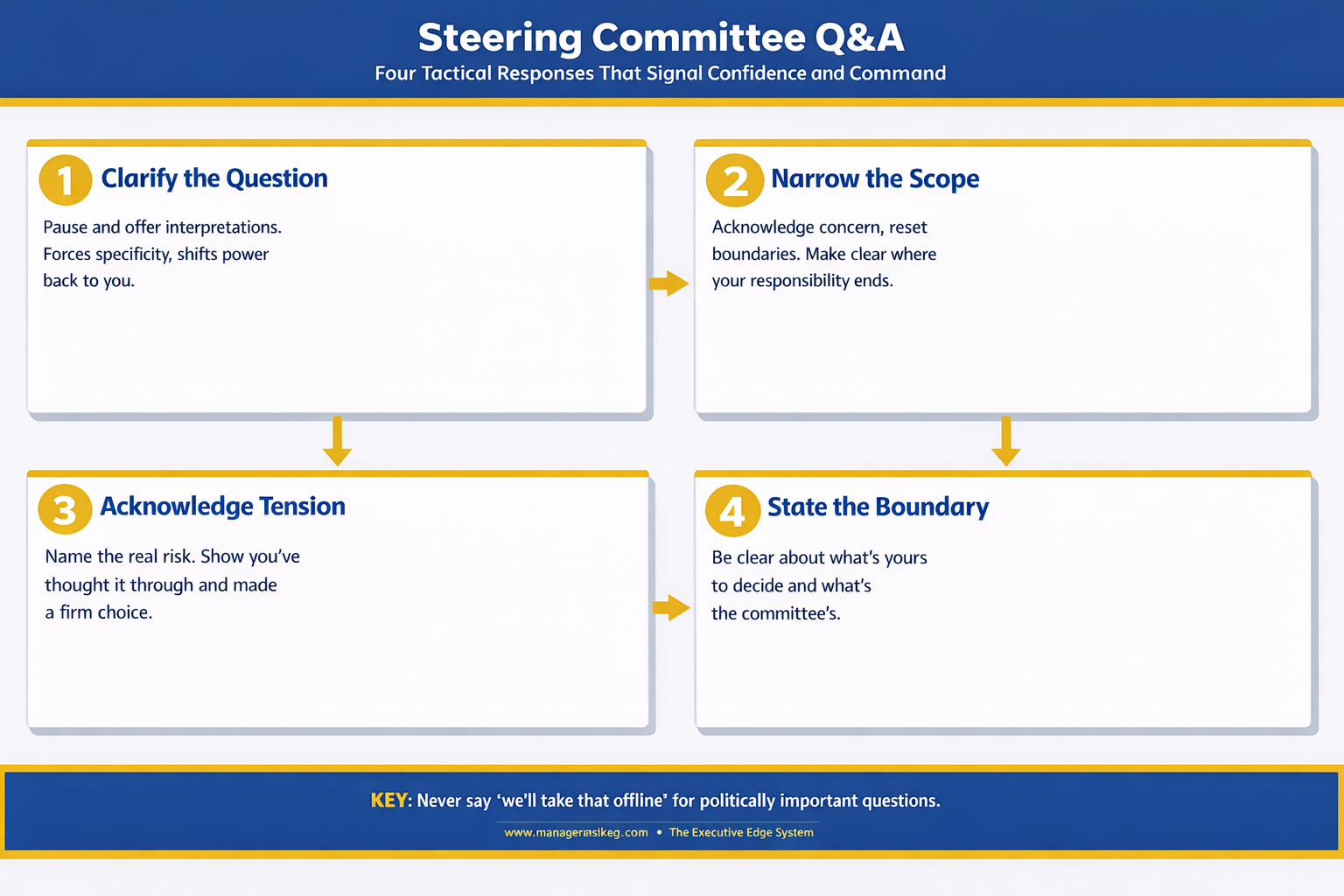
- Four Tactical Responses for Steering Committee Questions
- Tactic 1: Clarify the Question (Tactical Pause)
- Tactic 2: Narrow the Scope (Reset Boundaries)
- Tactic 3: Acknowledge the Tension (Show You’ve Thought It Through)
- Tactic 4: State the Decision Boundary (Signal Authority)
- How to Predict Steering Committee Questions Before They’re Asked
It was Thursday. The steering committee for a major transformation initiative had 12 people in the room. Three were executives from the CFO’s office. Two were operational heads from different business units. The rest were middle managers and programme leads.
Sarah, the programme director, had presented the three-year implementation roadmap. Solid timeline. Clear milestones. Realistic budget.
Then the CFO’s deputy asked: “The timeline assumes we’ll maintain headcount through Year Two. What happens to the budget if the headcount freezes? Which workstreams get cut?”
It was a trap question disguised as a scenario. Behind it: political concern about a possible cost reduction that the CFO hadn’t publicly committed to. Sarah’s answer would signal whether she understood the political risk.
Sarah’s instinct was to defer: “We’ll take that offline and model the scenarios.”
But she’d been trained differently. She paused. She said: “That’s a critical assumption. Let me clarify what you’re asking: are you testing whether we’re exposed to a headcount freeze, or are you asking about the sequencing if a freeze happens?”
The CFO’s deputy leaned back. Slight nod. She’d asked a political test question, and Sarah had recognized it immediately. Sarah wasn’t avoiding. She was clarifying what was really being asked.
Sarah continued: “If it’s the exposure question, the answer is we’re exposed in Year Two onwards. If it’s the sequencing question, we’ve prioritised the client-facing work. But I want to be clear: that’s our view. This committee needs to decide whether that prioritisation aligns with the strategic direction.”
The CFO’s deputy nodded again. The room moved on. Sarah had answered the question not with data, but with political clarity. She’d shown: “I understand what you’re really asking. I’m not avoiding it. I’m making clear decisions about what’s yours to decide and what’s mine.”
That’s steering committee Q&A. It’s not about the answer to the literal question. It’s about reading the political intent and responding with clarity.
Why Steering Committee Q&A Is Different
A board of directors asks questions about governance, risk, and approval.
A steering committee asks questions about survival, territory, and resource competition.
These are different animals. Steering committees include people from multiple business units or functional areas. They all have resource interests. They all have competing priorities. They all have organizational power that overlaps with your project.
A question in a steering committee is never just a question. It’s always a statement of concern, a territory claim, or a political test.
“Does this affect my budget?” = I’m worried you’re taking my headcount or my spend.
“Have we talked to IT about this?” = I need to know if my friends in IT are aligned or if you’re going rogue.
“What happens if the business changes the strategy?” = I want to see if you’ll blow up if your plan changes, or if you’re flexible (and thus less of a threat).
Board questions test governance. Steering committee questions test political savvy and clarity.
Handling questions you don’t know the answer to is one skill. Handling steering committee questions where you DO know the answer but the question is politically loaded is a different skill entirely. You need to read the intent and respond to the intent, not just the words.
The “Offline” Red Flag and What It Signals
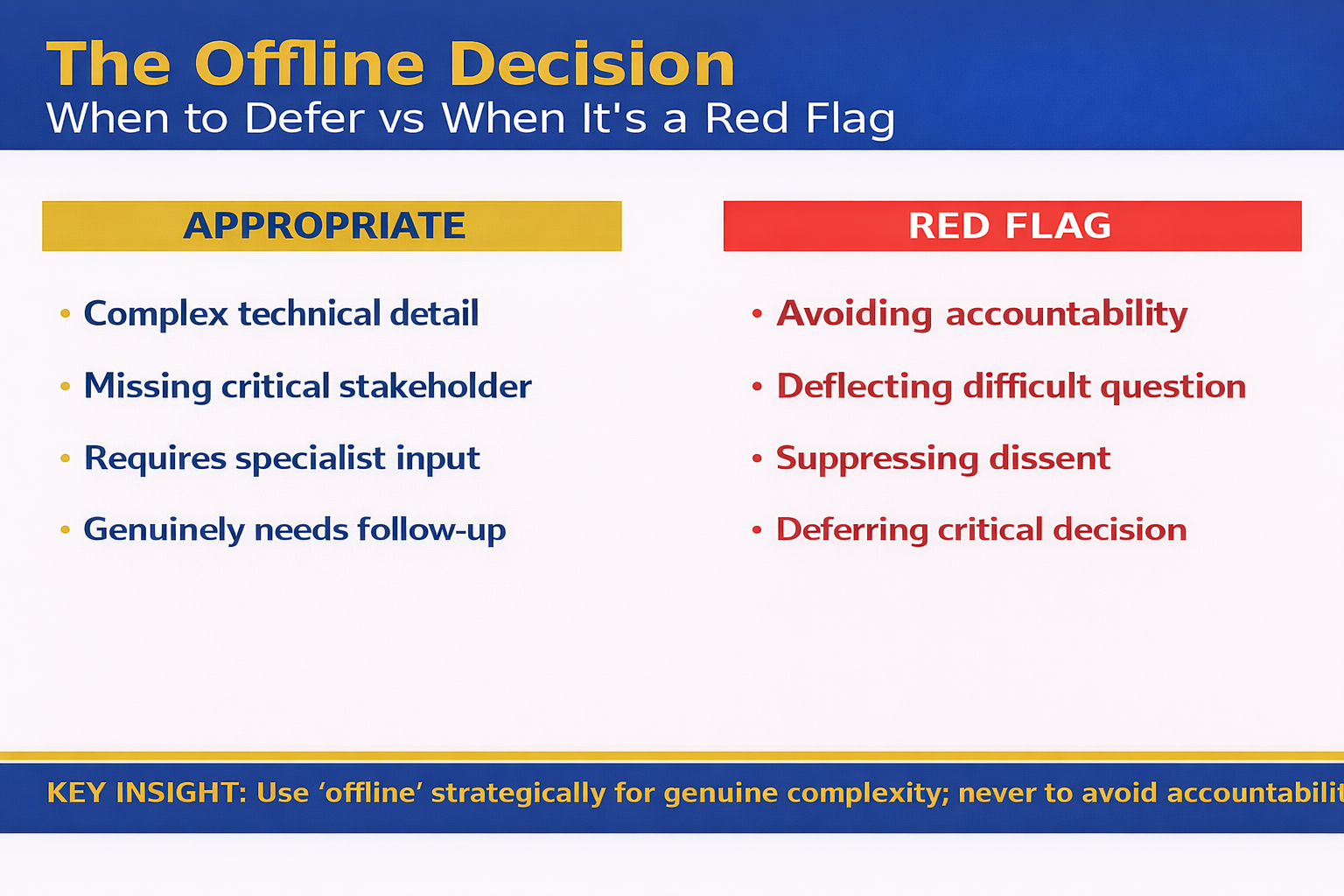
“We’ll take that offline” is a reasonable phrase in some contexts. If someone asks for a specific data point you don’t have at hand, deferring is fine.
But in a steering committee, when someone asks a question that’s politically important (about budget, scope, timeline, resource competition, strategic alignment), saying “We’ll take that offline” signals:
Signal 1: You’re avoiding. You don’t have a clear answer, or you’re uncomfortable giving it in front of the group. The committee reads this as: “You’re not as confident as you appeared.”
Signal 2: You don’t understand the political intent. If you did, you’d know that answering the question in the room matters. The person asking wants the room to hear that you’ve thought through this concern. Deferring suggests you don’t understand the political stakes.
Signal 3: You’re ceding authority. When you defer the answer, you’re saying: “This is something we’ll sort out separately, not something I’m committing to now.” The committee recognizes this as weak leadership.
Signal 4: You’re unreliable. Steering committees see deferred answers as commitments you’re backing away from. Even if you fully intend to follow up, the committee has already registered: “Not ready to commit.”
The best steering committee members never say “We’ll take that offline” in response to a politically important question. They answer the question in the room with clarity—either with a direct answer, or with a clear statement of the decision boundary.
Four Tactical Responses for Steering Committee Questions
Instead of deferring, you have four tactical moves that signal confidence and command.
Not every tactic works for every question. You learn to recognize which situation calls for which tactic. But each one keeps you in authority while addressing the actual concern underneath the question.
Tactic 1: Clarify the Question (Tactical Pause)
Use this when a question feels loaded but you’re not quite sure what’s really being asked.
The move: Pause. Say: “Let me clarify what you’re asking, because I want to make sure I’m answering the right thing.”
Then offer two or three possible interpretations of the question, and ask which one is the real concern.
Example: CFO’s deputy: “What happens to this timeline if we need to implement in two phases instead of three?”
You: “Are you asking whether we could compress the timeline? Or whether we’ve already planned for a phased approach? Or whether the budget changes if we phase it?”
What’s happening: you’re not avoiding the question. You’re showing that you’re thoughtful enough to know that different concerns might be hidden under the same words. You’re also forcing the questioner to be more specific, which shifts the power dynamic back to you.
The steering committee sees this as confidence, not deflection.
When to use: When the question feels politically charged but ambiguous. When you suspect the literal question isn’t the real concern. When you want to demonstrate that you’ve thought through multiple scenarios.
Tactic 2: Narrow the Scope (Reset Boundaries)
Use this when the question is trying to pull you into territory that’s not your responsibility.
The move: Acknowledge the question, but explicitly narrow the scope of what you’re answering for.
Example: Head of another business unit: “How are we going to manage the change impact on my team’s productivity during Year One?”
You: “That’s important. What we’re committing to is the implementation timeline and the resource plan on our side. How your team absorbs the change is something your leadership will need to decide. But we can absolutely provide you with the impact assessment so your team can plan for it.”
What’s happening: you’re not dismissing the concern. You’re making crystal clear where responsibility ends and theirs begins. You’re saying: “I own this part. You own that part. We’ll work together, but I’m not taking accountability for decisions that aren’t mine.”
This is power. The steering committee respects clarity about responsibility.
When to use: When someone is trying to make you responsible for outcomes that aren’t in your control. When the question reveals a territory battle. When you need to establish clear decision boundaries.
Tactic 3: Acknowledge the Tension (Show You’ve Thought It Through)
Use this when the question raises a real tension or risk that you’ve already considered.
The move: Don’t deny or minimize the concern. Acknowledge it directly. Then show that you’ve already thought through the implications and made a deliberate choice.
Example: Operations lead: “We’re taking on a lot of change concurrently. Won’t this distract from the quarterly close process?”
You: “Yes. You’ve identified a real tension. The concurrent timeline means we do have a distraction risk in Q2. We’ve made a deliberate choice to front-load the heavy work in Q1 and sequence the Q2 activities around your peak close period. That’s why the timeline is structured the way it is. We’ve weighed the distraction risk against the timeline pressure, and this is our answer.”
What’s happening: you’re not hand-waving away a legitimate concern. You’re showing: “I’ve thought about this. I’ve considered the risk. I’ve made an intentional choice. This is defensible.”
The steering committee sees this as credibility.
When to use: When the question raises a legitimate risk or tension. When you want to demonstrate that your proposal is thought-through, not naive. When you want to show that you’ve considered trade-offs and made intentional choices.
Tactic 4: State the Decision Boundary (Signal Authority)
Use this when the question is asking you to make a decision or commitment that isn’t yours to make.
The move: Be explicit about what decision is yours and what’s the committee’s. Don’t try to bridge that gap.
Example: CFO’s deputy: “If we get budget pressure, what will you cut?”
You: “That’s not my decision to make unilaterally. If budget pressure comes, we’d recommend to this committee what we’d cut first, based on risk and timeline impact. But the decision about what’s acceptable risk is yours. I can tell you what our recommendation would be, but I’m not going to make that trade-off call without this group.”
What’s happening: you’re not avoiding responsibility. You’re being explicit about where authority sits. You’re saying: “I’m competent in my area. You’re competent in yours. This question belongs to you.”
This is the clearest signal of authority. You’re comfortable not deciding things that aren’t yours to decide.
When to use: When the question is asking you to commit to something that requires board-level or steering committee approval. When you want to demonstrate that you understand governance and decision boundaries. When you want to avoid the trap of making promises that the committee will later challenge.
Master the Political Dynamics of Steering Committee Q&A
Steering committees are different beasts than boards. The questions are political. The answers are leadership signals. The Executive Q&A Handling System teaches you how to read the political intent beneath steering committee questions and respond with four tactical moves that signal confidence and command.
- Why “We’ll take that offline” signals weakness in steering committee settings
- Four tactical responses that keep you in authority while addressing the real concern
- How to read the political intent beneath loaded questions
- How to clarify ambiguous questions without appearing defensive
- How to state decision boundaries that respect authority without avoiding responsibility
Get the Executive Q&A System → £39
Used by programme directors, transformation leads, and business case owners facing steering committees. The tactical responses work because they work with committee psychology, not against it.
Stop deferring to “offline.” Answer with authority.
How to Predict Steering Committee Questions Before They’re Asked
The best steering committee performers don’t wait for questions. They predict them.
Every person on a steering committee has interests. Budget interests. Scope interests. Territory interests. Timeline interests. Risk concerns. The questions that get asked almost always relate to those interests.
Step 1: Map the committee members. Who are they? What business units do they represent? What would their concerns be if they were evaluating your proposal?
Step 2: List the likely concerns. Not about your proposal’s merit. About their interests. Budget pressure? Timeline risk? Scope creep that affects their area? Dependency on another team? Change management impact?
Step 3: Predict the questions. What question would each committee member ask if they wanted to surface their concern?
Step 4: Prepare your answer using one of the four tactics. Not a robotic answer. A tactical response that acknowledges the concern while maintaining your authority.
Step 5: Listen for the actual question. When someone asks a question you predicted, you’re not surprised. You’re ready with a response that signals confidence.
This preparation doesn’t mean you’re scripting responses. It means you’ve already thought through the political landscape. You know what concerns you’re going to face. You know which tactic fits which concern. When the question comes, you respond with authority because you’re not thinking for the first time in the moment.
The Difference Between Steering Committee Q&A and Board Q&A
A board asks: “Is this governed well? Are risks managed? Can we approve this?”
A steering committee asks: “Does this threaten my interests? Can I influence this? Do I understand what I’m committing to?”
Board Q&A is about reassurance. You’re proving that governance is sound.
Steering committee Q&A is about clarity. You’re proving that you understand the political terrain and you’re making intentional choices.
Board meeting Q&A techniques focus on explaining risk mitigation. Steering committee Q&A techniques focus on demonstrating political awareness.
This is why “We’ll take that offline” fails in steering committees. It signals: “I haven’t thought about the political dynamics of this question.” A board might accept that answer. A steering committee recognizes it as weakness.
Never Default to “Offline” Again
Steering committee members are evaluating you as a leader, not just your proposal. Every question is a test of your political awareness and your confidence. The Executive Q&A Handling System teaches you the four tactical moves that keep you in authority while addressing the real concern underneath loaded questions.
- How to read the political intent beneath steering committee questions
- The four tactical responses (clarify, narrow, acknowledge, boundary) and when to use each
- How to predict steering committee questions before they’re asked
- How to prepare answers that demonstrate confidence and command
- Real examples from transformation initiatives, business cases, and strategic programmes
Get the Executive Q&A System → £39
Includes a question prediction worksheet and the four-tactic response framework with real boardroom examples.
Your next steering committee is your chance to show you understand the game.
Three Critical Questions About Steering Committee Q&A
What if I genuinely don’t know the answer to a steering committee question? Don’t pretend you know. Instead, say: “That’s a fair question. I don’t have that analysis right now, but I can see why it matters. Here’s what I’ll commit to: I’ll get you the answer, and I’ll bring it back to the steering committee so we can decide as a group.” You’re not deferring the question; you’re committing to a specific follow-up and a specific forum for the decision. The committee respects this more than “We’ll take it offline.”
What if my steering committee is very political and adversarial? The four tactics become even more important. Clarifying, narrowing, acknowledging, and stating decision boundaries are your protection against being tripped up. The more political the committee, the more important it is to be explicit about what you’re answering for and what you’re not. This prevents you from being pulled into territory that isn’t yours.
Can I use these tactics on a board, or are they strictly for steering committees? The tactics work on any committee, but the emphasis changes. Boards care more about governance and risk reassurance. Steering committees care more about political clarity and decision boundaries. You’d emphasise different aspects of the response depending on the audience, but the core technique is the same.
Is This Right For You?
✓ This is for you if: You present regularly to steering committees, you’ve noticed that some of your answers don’t land the way you expected, you want to improve your credibility in politically complex meetings, you’re often defending a proposal or a programme, you want to understand the political dynamics beneath the questions being asked.
✗ Not for you if: Your presentations are primarily to non-political audiences, you don’t face challenging Q&A, you’re comfortable with your current steering committee performance, you present only to supportive audiences.
The Signature Q&A System: Used by Steering Committee Leaders and Programme Directors
This is the Q&A architecture that works when the stakes are high and the committee is political. You’ll learn the four tactical responses, how to read political intent, how to predict questions before they’re asked, and how to maintain authority while addressing the real concerns beneath the questions.
- Why steering committee Q&A is fundamentally different from board Q&A
- The four tactical responses: clarify, narrow, acknowledge, decide boundary
- How to read the political intent beneath loaded questions
- Question prediction framework (map members, list concerns, predict questions)
- How to prepare answers that signal confidence and command
- Real examples from transformation initiatives, business cases, and strategic programmes
- How to handle follow-up questions and maintain your position
Get the Executive Q&A System → £39
Programme directors, transformation leads, and business case owners use this system before every steering committee. The political dynamics get clearer every time you use it.
Frequently Asked Questions
How do I know if a question is really political or just a genuine inquiry?
Ask yourself: does this question reveal an interest or concern that affects the questioner directly? If yes, it’s political. The question might be framed as a general inquiry, but the person asking has something at stake. That stake is what you’re responding to. The four tactics work whether the question is purely political or genuinely interested, so you’re safe using them in either case.
What if I use one of these tactics and the questioner seems offended?
They’re not actually offended. They’re registering that you’ve recognized their political intent. That’s uncomfortable for people who don’t expect to be read so directly. But it’s also respectful—you’re taking their concern seriously enough to address it directly rather than deflecting. The discomfort passes quickly, and the respect remains.
Can I combine multiple tactics in a single answer?
Yes. You might clarify the question, acknowledge the tension, and state a decision boundary all in one response. As you get more comfortable with the tactics, you’ll develop a style that flows naturally and incorporates multiple moves. Start by mastering one tactic. Then combine them as your comfort grows.
Your Steering Committee Needs Your Clarity Now
Steering committees form to provide governance on strategic initiatives, transformation programmes, and business cases that span multiple functional areas. The political dynamics are real. The questions are tests. Your answers are leadership signals.
You have a steering committee coming up. Maybe next week. Maybe next month. When you walk into that room, you’ll either defer difficult questions with “We’ll take that offline,” or you’ll answer them with one of the four tactical moves.
The committee will recognise the difference immediately. And so will your credibility.
About the Author
Mary Beth Hazeldine is the Owner & Managing Director of Winning Presentations. With 24 years of corporate banking experience at JPMorgan Chase, PwC, Royal Bank of Scotland, and Commerzbank, she has delivered high-stakes presentations in boardrooms across three continents.
A qualified clinical hypnotherapist and NLP practitioner, Mary Beth combines executive communication expertise with evidence-based techniques for managing presentation anxiety. She has trained thousands of executives and supported high-stakes funding rounds and approvals.
Resources From Winning Presentations
Subscribe to The Winning Edge, our weekly newsletter where we share Q&A strategies, real committee stories, and executive communication frameworks. Delivered every Monday.
Stop deferring questions to offline conversations. Start answering them in the room with clarity and command. Your next steering committee will show you what a difference the right tactical response makes.
This article was written with AI assistance and reviewed by Mary Beth Hazeldine.


