

Quick Answer
A product recall presentation must lead with the problem, not the solution. Most executives bury the severity in slide 3 and spend 20 minutes on mitigation. Instead, structure transparency-first: what happened, who it affects, timeline to resolution, and what you’re doing next. This approach preserves stakeholder trust because it treats the board as partners in crisis response, not an audience to manage.
Table of Contents
- Why Most Recall Presentations Fail
- The Transparency-First Structure
- What to Include on Each Slide
- Managing Hostile Questions and Pressure
- The Follow-Up Communication Plan
- Frequently Asked Questions
The Moment Everything Changed
Adaeze had been Head of Operations at a mid-sized medical devices company for seven years. The Friday morning email from Quality Assurance landed at 6:47 a.m.: a batch of 4,200 cardiac monitoring devices carried a firmware fault that could delay alarm notifications by up to 18 seconds. The risk was real, albeit rare—but in cardiac care, 18 seconds matters.
She had 72 hours to present to the board. Not to request permission to issue a recall. To explain the recall that was happening whether the board liked it or not, and to demonstrate that management had a plan the board could trust. Adaeze’s instinct was to minimize the language—”isolated issue,” “proactive measure,” “limited scope.” But she knew that approach would backfire. The board would ask harder questions. Regulators would later find evidence of soft language in board materials. And customers would learn the truth from someone else first.
Instead, she flipped the structure. She led with the problem. She named the risk. She showed the board her remediation plan not as a defence, but as evidence that management had already thought six moves ahead. By the time she finished, the board wasn’t managing crisis. They were supporting a leadership team that had already started managing it.
A product recall is your moment to demonstrate that leadership means accountability, not spin. The executives who survive crises aren’t the ones who minimise the problem—they’re the ones who own it completely and show the board a credible path forward. This article walks you through the structure that turns a crisis presentation from defensive to authoritative.
Why Most Recall Presentations Fail
The pattern is predictable. An executive stands up to brief the board on a product recall. Slide 1 is a cheerful title slide. Slide 2 frames it as “an abundance of caution.” Slide 3 finally names the issue—buried in the third bullet point. Slide 4 launches into mitigation strategy. Slide 5 shows the timeline. Slide 6 introduces the communications plan.
Meanwhile, the board is thinking: You waited until slide 3 to tell me what actually happened? Why should I trust your judgment on what happens next?
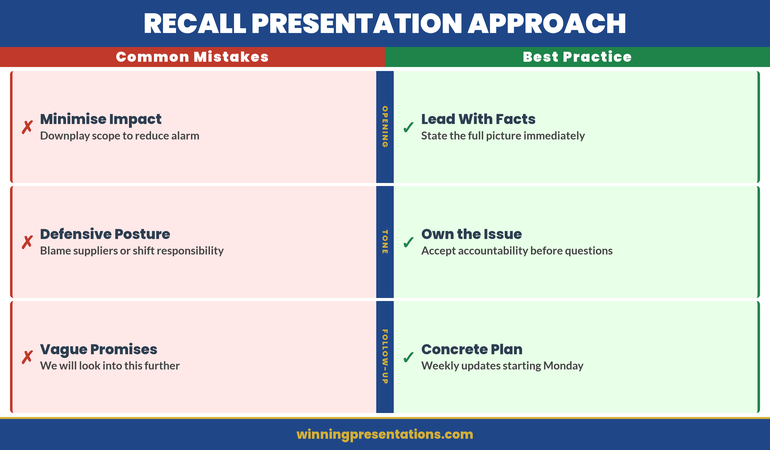
Most recall presentations fail because they prioritise soft-pedalling over clarity. They front-load context and caution language. They bury the severity. They spend 60% of the time on mitigation and 10% on what actually happened. And because the board can smell that sequencing choice, they lose confidence in the presenter’s judgment before the substantive slides begin.
The board doesn’t need you to make the recall sound better. They need you to make the recall understandable, and to show that you’ve thought through the consequences. That requires leading with the problem, not the solution.
Master the Structure for Every Crisis Moment
Whether it’s a recall, a data breach, or a restructuring announcement, the structure that works is transparency first, then solutions. The Executive Slide System gives you the frameworks for framing crisis moments with authority—so your board hears leadership, not damage control.
Build presentations that preserve stakeholder trust and communicate with clarity under pressure.
The Transparency-First Structure
Here’s the reframe: a product recall presentation is not a crisis update. It’s a situation briefing where you, the executive, are already three steps ahead. You’ve already decided the recall is necessary. You’ve already mapped the consequences. You’ve already drafted the plan. The board’s role is to understand the decision and support the execution.
That mindset changes everything. It changes what you lead with. It changes the language you use. It changes the board’s perception of your judgment.
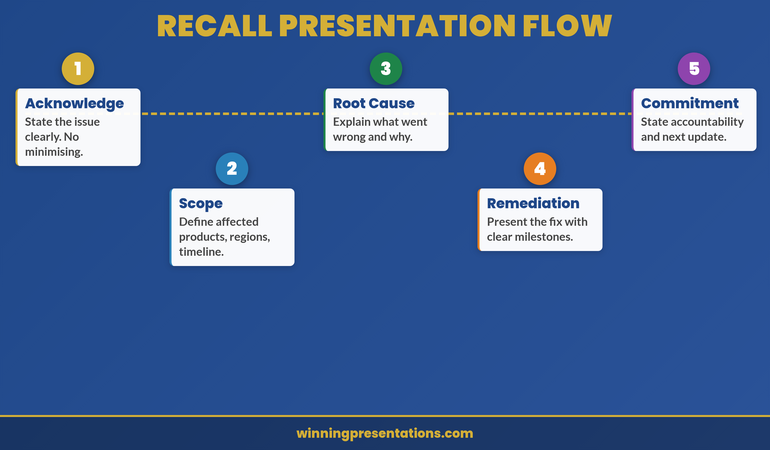
The transparency-first structure works like this:
- Situation: What happened, when, how many units, who it affects. State it plainly. No understatement.
- Risk Assessment: What’s the actual hazard? Is there a reported incident? What’s the severity window? (72 hours, 30 days, ongoing?)
- Regulatory Landscape: What agencies are involved? What are we required to do? What are we choosing to do beyond requirement?
- Our Response Plan: What happens next, in sequence, with owners and timelines.
- Stakeholder Communication: Who else knows? Who do we tell, and in what order?
- Financial Impact & Recovery: What’s the cost? What’s the insurance position? What’s the timeline to normalcy?
Notice what’s absent from this structure: the soft language, the hedging, the “we believe there is a low probability” phrasing. You’re not downplaying. You’re owning. And paradoxically, that ownership builds more trust than any amount of minimisation language ever could.
What to Include on Each Slide
Slide 1: The Situation (Full context)
This is not a title slide. This is your opening move. Use a stark, direct headline: “Batch X4420 Cardiac Monitoring Devices—4,200 Units Affected—Immediate Action Required.” Include the discovery date, the affected customer base (by geography, by customer type), and the nature of the defect in plain language. One visual: a map or a simple count showing distribution. The board should grasp the scope in 90 seconds.
Slide 2: Risk Profile
What is the actual risk to patients or users? Don’t say “low risk”—define it. “Firmware delay of up to 18 seconds in alarm notification. No reported incidents to date. Estimated probability of adverse event: 0.02% per device per annum, based on comparable defects.” This is where you show you’ve done the analysis. Include any reported incidents (be honest if there are none, be serious if there are any).
Slide 3: Regulatory Requirement vs. Our Choice
What does the FDA (or equivalent) require? Class I recall? Notification? What are we doing that goes beyond requirement? This is where you show judgment. Most companies do the minimum. You’re doing the recall because it’s right, not because you’re forced to. Frame it that way.
Slide 4: Response Plan Timeline
This is a Gantt chart or a simple sequencing: Day 1 (today), notify Key Opinion Leaders and major customers. Day 2, regulatory submission. Day 3, public announcement. Week 1, field replacement programme begins. Week 4, 80% replacement target. Week 8, full resolution. Own the timeline. Show who’s accountable for each phase.
Slide 5: Communications Cascade
Who are we telling, in order of priority? Customers (direct contact), key stakeholders, regulators, public (press release), internal teams. What’s the message for each audience? Show the board that you’ve already drafted the customer-facing letter, the investor call script, the internal memo. This prevents panic and shows preparation.
Slide 6: Financial Impact
Be precise. Replacement cost: £X. Logistics: £Y. Customer compensation (if applicable): £Z. Insurance recovery: £A. Net impact: £(X+Y+Z-A). Timeline to resolution (and profitability recovery). This is not a forecast—it’s the plan. The board respects precision more than optimism.
Designing Your Slides for Authority
The visual design of a recall presentation signals either panic or control. Use a clean, minimal template. Navy and white. One accent colour (gold, if you want to match Winning Presentations brand). No animations. No stock photos of smiling people. Use actual data, actual timelines, actual photographs of the affected product if it helps clarity.
One tactical point: if you have 4,200 units affected, show 4,200 on the slide. Don’t round to “approximately 4,000.” The precision signals that you’ve counted them, that you know exactly what you’re dealing with. When the board sees that precision, they believe you.
Quick recommendation: Before you build your slides, draft the customer notification letter. Get it approved by legal and communications. Then build your presentation around the facts you’ve committed to in writing. This forces rigorous thinking and ensures your presentation can’t later be accused of overstating or understating the problem.
Managing Hostile Questions and Pressure
Some board members will be angry. They’ll ask why this wasn’t caught sooner. They’ll worry about liability. They’ll question the cost. They’ll ask what happens if the recall doesn’t solve the problem. This is inevitable. Plan for it.
The principle: answer the hostile question by affirming what you’ve already decided. “You’re right to ask why this wasn’t caught sooner. That’s exactly why we’ve already commissioned a root-cause analysis with an external auditor. That report is due in four weeks, and we’ll present findings and corrective actions to this board in May.” Don’t defend the past. Own the investigation. Move to the future.
Similarly, if a board member questions the financial impact, don’t negotiate. Restate the figure. “The gross cost is £2.4 million. Insurance is covering 70% of that. We’re absorbing £720,000. And we’re recovering that through operational efficiencies on three other projects we’re pausing.” You’ve already done the math. You’re not discovering it in real time.
The most dangerous questions are the ones that betray lack of confidence in your strategy: “What if more defects emerge?” “What if customers sue?” “What if the regulator disagrees with our timeline?” For each, you should have a contingency prepared. “If additional defects emerge in the analysis phase, we’ll expand the recall scope and accelerate the timeline. We’ve already identified suppliers for a 50% acceleration if required. If customers sue, we have product liability coverage up to £15 million. If the regulator challenges our timeline, we’ve built a seven-day buffer into every phase so we can accelerate without affecting quality of replacement.”
Contingencies signal that you’re not naive. You’ve war-gamed the worst case. That’s what a board wants to hear.
Crisis Presentations Demand Speed and Structure
You don’t have time to start from scratch. The Executive Slide System includes pre-built frameworks for product recalls, data breaches, layoffs, and other crisis moments. Customize in minutes. Present with confidence.
The Follow-Up Communication Plan
Your board presentation is the beginning, not the end. Within 24 hours of board approval, every relevant stakeholder group needs the same core message—delivered via their preferred channel.
For customers: a direct email or phone call from someone with authority. Not “We’re issuing a recall.” But “We discovered a potential firmware issue in your batch. Here’s what we’re doing, here’s how we’re replacing it, here’s what you need to do in the next seven days.”
For investors: a calm, factual update in your next investor call or quarterly filing. “We’ve initiated a product recall affecting 4,200 units. The financial impact is £720,000 net. This does not materially affect FY2026 guidance.” The calm tone matters as much as the fact.
For regulators: proactive submission of your corrective action plan. Don’t wait for them to ask questions. Show them you’ve thought three moves ahead.
For employees: an internal memo that explains the recall in the context of your company values. “We discovered this issue. We’re fixing it comprehensively. This is what we stand for.” Employees will hear the news from outside sources if you don’t tell them first.
Frequently Asked Questions
How much detail should I include on each slide if the board only has 45 minutes?
Aim for 6–8 slides maximum, with 3–4 minutes per slide. The detail should live in your speaker notes and in the appendix. The board needs the architecture of your thinking on the main slides, not every number. That said, don’t shy away from the key figures: unit count, financial impact, timeline, and contingency plan. Those four things should be crystal clear on the main deck.
Should I acknowledge my team’s role in missing this defect?
Briefly, yes. Not as a defensive gesture, but as an acknowledgement that you’re investigating. “Our quality team did not flag this issue in our standard testing protocol. As part of this recall, we’re conducting a comprehensive root-cause analysis to understand why, and we’ll present those findings and our remediation plan to the board in May.” This shows accountability without dwelling on blame. The board wants forward motion, not a guilt spiral.
How do I handle the board if they want to delay the recall announcement?
You can’t. From a regulatory and ethical standpoint, once a defect is identified that poses a risk, the clock starts. Delaying actually increases your liability, not decreases it. If the board pushes back, reframe: “I understand the instinct to manage the announcement. But the faster we act, the more control we retain. If regulators find out we delayed, that’s a much bigger story. If customers discover the defect from a third party before we tell them, that’s reputational damage we can’t recover from. Speed is our advantage here.”
What if the recall is bigger than initially estimated?
You’ll discover this during or after your board presentation. Have a protocol ready: “If we find that this affects a larger batch than initially identified, we notify the board within 24 hours with an updated presentation. We’ve built flexibility into our remediation plan so we can scale the response without delay.” Again, the board respects preparation. If you’ve already thought about how to handle expansion, they’ll trust the escalation when it happens.
Get executive presentation strategies delivered to your inbox weekly.
The Winning Edge newsletter covers frameworks for high-stakes presentations, board meetings, and crisis communication. Strategic, practical, no filler.
Download the Executive Presentation Checklist to validate your crisis presentation before you present to the board.
Related Articles
Read next: Board Paper vs Board Presentation: When to Use Each
For other crisis communication frameworks, see:
- Data Breach Presentation to the Board: Protecting Reputation and Trust
- Redundancy Announcement Presentation: Leading Through Difficult Decisions
- Town Hall Presentation After Layoffs: Rebuilding Trust and Team Confidence
What to Do Next
If you’re facing a crisis in the next week or month, start with the customer notification letter. Get it approved by legal and communications first. Then structure your communications around the facts in that letter. This forces clarity and ensures consistency across all stakeholders.
The transparency-first approach isn’t soft. It’s the hardest thing you can do as an executive—because it means owning the problem completely, not managing how others perceive it. But it’s also the approach that preserves trust, accelerates resolution, and positions your leadership as credible when the crisis passes.
Mary Beth Hazeldine is the Owner & Managing Director of Winning Presentations. With 24 years of corporate banking experience at JPMorgan Chase, PwC, Royal Bank of Scotland, and Commerzbank, she advises executives across financial services, healthcare, technology, and government on structuring presentations for high-stakes funding rounds and approvals.