

I felt the heat start at my chest. By the time it reached my cheeks, I knew everyone could see it.
Quick answer: Your face turns red when presenting because your sympathetic nervous system triggers vasodilation—blood vessels near your skin’s surface expand as part of the fight-or-flight response. The more you try to stop it, the worse it gets. The fix isn’t fighting the flush; it’s a 60-second reset that works with your nervous system instead of against it.
Last updated: January 2026 — with the latest research on presentation anxiety and nervous system regulation.
I spent five years trying to hide the blushing. Turtlenecks in summer. Strategic positioning away from windows. Foundation that promised “colour correction.” None of it worked—because I was treating the symptom, not the cause.
What finally worked wasn’t a breathing trick or a confidence hack. It was understanding why my face was doing this, and then using that knowledge to calm my nervous system before it escalated.
If your face betrays you every time you present, you’re not broken. Your nervous system is doing exactly what it’s designed to do—and you can learn to work with it.
In this article:
Why Your Face Turns Red (The Real Reason)
Here’s what’s actually happening when your face flushes during a presentation:
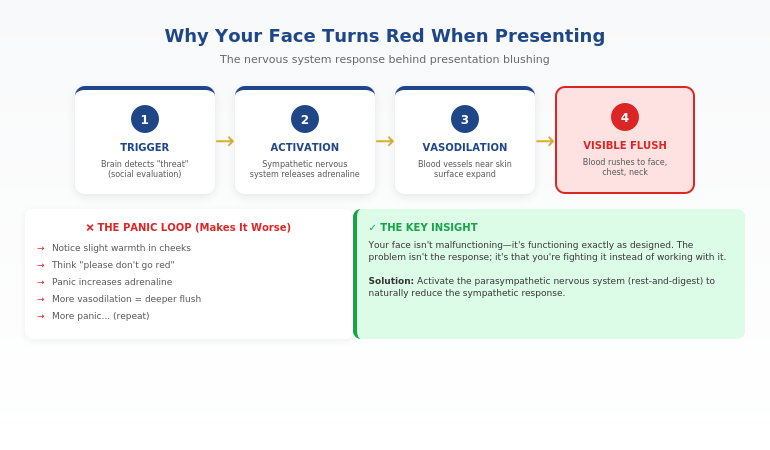
Your brain detects a threat—in this case, social evaluation. It doesn’t matter that no one is physically dangerous; your nervous system can’t tell the difference between a lion and a boardroom full of executives watching you.
The moment your brain registers “threat,” it activates your sympathetic nervous system. Adrenaline floods your body. Your blood vessels dilate, especially the ones near your skin’s surface. Blood rushes to your face, chest, and neck.
This is vasodilation. It’s completely automatic. And here’s the cruel part: the more you think about it, the more blood flows to your face.
I see this pattern constantly: someone notices a slight warmth in their cheeks, panics about it, and the panic itself triggers a deeper flush. It’s a feedback loop that feels impossible to escape.
A client of mine—a finance director named Sarah—described it perfectly: “It’s like my face has a mind of its own. The second I think ‘please don’t go red,’ I can feel the heat spreading. It’s like my body is betraying me in front of everyone.”
She wasn’t wrong about the betrayal feeling. But she was wrong about why it was happening.
Her face wasn’t malfunctioning. It was functioning exactly as designed—protecting her from a perceived threat by preparing her body for action. The problem was that the “action” her nervous system wanted (run away) wasn’t available in a conference room.
⭐ Stop the Flush Before It Starts
Calm Under Pressure gives you the exact protocols for managing physical anxiety symptoms—including the 60-second reset that works with your nervous system, not against it.
Includes:
- The pre-presentation nervous system calm-down sequence
- Mid-presentation reset (when you’re already flushing)
- Long-term desensitisation techniques
Get Calm Under Pressure (£19.99) →
Created by a qualified clinical hypnotherapist who spent 5 years overcoming presentation anxiety. Instant download.
Why “Just Relax” Makes It Worse
The worst advice you can give someone whose face is turning red: “Just relax.”
Here’s why that backfires:
When you tell yourself to relax, you’re using your conscious mind to fight an unconscious response. Your sympathetic nervous system doesn’t take orders from your thoughts. It responds to signals—and “trying to relax” often sends the signal that something is wrong.
Think about it: you only tell yourself to relax when you’re not relaxed. The instruction itself confirms the threat. Your nervous system hears “relax” and thinks: “Why would I need to relax unless something dangerous is happening?”
More adrenaline. More vasodilation. Redder face.
⏱️ Quick self-check: Think about the last time your face turned red during a presentation. Did you try to suppress it? Think “don’t blush”? That thought alone probably made it worse. The solution isn’t suppression—it’s redirection.
I learned this the hard way. For years, I would stand in front of audiences mentally chanting “stay calm, stay calm, stay calm.” My face would flush deeper with every repetition.
It wasn’t until I trained as a clinical hypnotherapist that I understood what I was doing wrong. I was fighting my nervous system instead of working with it.
The same pattern appears in almost everyone I work with. A marketing VP named Mark told me he’d developed an elaborate system of “distraction techniques”—counting ceiling tiles, focusing on one friendly face, reciting song lyrics in his head. None of it worked because none of it addressed the actual nervous system response.
“I thought I could trick my brain into not noticing,” he said. “But my face noticed anyway.”
The 60-Second Reset That Actually Works
The technique that finally worked for me—and that I now teach to clients—doesn’t fight the flush. It redirects the nervous system’s attention.
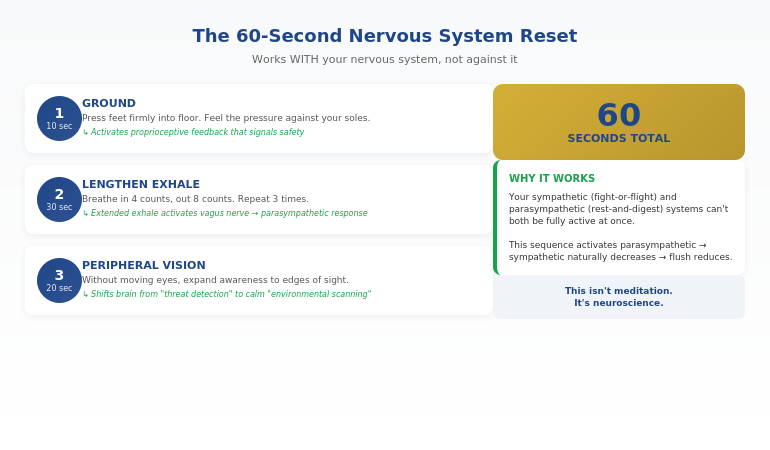
Here’s the science: your sympathetic nervous system (fight-or-flight) and parasympathetic nervous system (rest-and-digest) can’t both be fully active at the same time. If you can activate the parasympathetic response, the sympathetic response naturally decreases.
The trick is doing this in a way that doesn’t signal “emergency.”
The 60-Second Nervous System Reset:
Step 1: Ground (10 seconds)
Press your feet firmly into the floor. Feel the pressure. This activates proprioceptive feedback that signals safety to your brain.
Step 2: Lengthen the exhale (30 seconds)
Breathe in for 4 counts, out for 8 counts. The extended exhale activates the vagus nerve and triggers parasympathetic response. Do this 3 times.
Step 3: Peripheral vision (20 seconds)
Without moving your eyes, expand your awareness to include your peripheral vision. Notice what’s at the edges of your sight. This shifts your brain from “focused threat detection” to “environmental scanning”—a calmer state.
This isn’t meditation. It’s neuroscience. Each step sends a specific signal to your nervous system that reduces the threat response.
Sarah—the finance director—was sceptical when I first taught her this. “It seems too simple,” she said. “I’ve tried breathing exercises before.”
I explained that this wasn’t about the breathing alone. It was about the sequence—grounding first, then the extended exhale, then the peripheral vision shift. Each step builds on the previous one.
She tried it before her next board meeting. “I felt the warmth start,” she told me afterward, “and instead of panicking, I pressed my feet down, did three long exhales, and softened my vision. The heat stopped spreading. It actually stopped.”
For the first time in years, she finished a presentation without her face giving her away.
Want the complete protocol? Calm Under Pressure includes the full 60-second reset plus pre-meeting preparation sequences and recovery techniques for when you’re already flushing. Get the Full Protocol →
How to Prevent the Flush Before It Starts
The 60-second reset works in the moment. But the real goal is preventing the flush from starting in the first place.
This requires working with your nervous system before you walk into the room.
The 10-minute pre-presentation protocol:
- Physical discharge (3 minutes): Your body has adrenaline that needs somewhere to go. Before your presentation, find a private space and do 30 seconds of vigorous movement—jumping jacks, wall push-ups, or even just shaking your hands vigorously. This burns off excess adrenaline before it can trigger flushing.
- Temperature management (2 minutes): Run cold water over your wrists. The blood vessels there are close to the surface, and cooling them slightly can reduce overall flush response. Some people also hold a cold water bottle.
- Nervous system priming (5 minutes): Do the 60-second reset three times in a row, slowly. This pre-activates your parasympathetic system so it’s already engaged when you walk into the room.
I did this protocol before every presentation for about six months. Eventually, my nervous system learned that presentations weren’t emergencies. The flushing became less frequent, then rare, then almost non-existent.
For more on calming techniques, see how to calm nerves before a presentation and presentation breathing techniques.
⭐ Your Complete Physical Anxiety Toolkit
Calm Under Pressure covers every physical symptom—blushing, shaking, sweating, racing heart—with specific protocols that work with your nervous system.
What’s inside:
- The 60-second reset (step-by-step walkthrough)
- 10-minute pre-presentation protocol
- Mid-presentation recovery techniques
- Long-term nervous system training
Instant download. Start using these techniques before your next presentation.
What to Do If You’re Already Red
Sometimes you don’t catch it in time. You’re mid-sentence and you feel the heat rising. What then?
First: don’t acknowledge it out loud unless you want to. There’s advice out there that says “just name it—say ‘excuse me, I’m blushing.'” For some people, that helps. For many others, it makes the flush worse because it draws attention to it.
Instead, try this mid-presentation recovery:
- Take a deliberate pause. Say “Let me check my notes” or “I want to make sure I’m being clear here.” This gives you 10-15 seconds without seeming nervous.
- During the pause, press your feet into the floor hard. Really feel the ground. This activates the grounding response.
- Take one long exhale through your mouth. Make it look like you’re just collecting your thoughts.
- Resume speaking slightly slower than before. Slower speech signals confidence to your audience and to your nervous system.
A client named James used this exact sequence during a presentation to investors. “I felt my face go hot on slide three,” he told me. “I said ‘let me make sure I’m explaining this correctly,’ did the feet-press thing, took a breath, and kept going. By slide five, the heat had faded. No one mentioned anything afterward.”
The flush didn’t disappear instantly—it rarely does. But it stopped escalating, and that made all the difference.
Related: If you’re also worried about the content of your presentation, see the executive slide mistake that costs decisions. Sometimes fixing your slides reduces your anxiety about presenting them.
Need the complete recovery toolkit? Calm Under Pressure includes specific techniques for when you’re already flushing—plus how to train your nervous system so it happens less often. Get the Recovery Techniques →
Face Turns Red When Presenting: Common Questions
Why does my face turn red when presenting?
Your face turns red when presenting because your sympathetic nervous system detects social evaluation as a threat and triggers vasodilation—the expansion of blood vessels near your skin’s surface. This is the same fight-or-flight response that would prepare you to flee a predator. The blood rushing to your face is your body preparing for action. It’s automatic and unconscious, which is why you can’t simply “decide” not to blush.
How do I stop blushing during presentations?
You can’t stop blushing through willpower—trying to suppress it makes it worse. Instead, use techniques that activate your parasympathetic nervous system: ground your feet firmly, extend your exhales (4 counts in, 8 counts out), and expand your peripheral vision. This 60-second reset redirects your nervous system away from the threat response. With practice, your body learns that presentations aren’t emergencies.
Is blushing a sign of anxiety?
Blushing is a sign that your nervous system has detected a perceived threat—which in presentations usually means social evaluation. It’s a physical response, not a character flaw. Many confident people blush; many anxious people don’t. The visibility of your nervous system response doesn’t determine your competence. That said, if blushing bothers you, it’s worth addressing the underlying nervous system patterns rather than trying to hide the symptom.
⭐ Work With Your Nervous System, Not Against It
Stop fighting the flush. Calm Under Pressure teaches you to redirect your nervous system so blushing becomes rare—not something you have to hide.
Includes:
- The 60-second reset (immediate relief)
- Pre-presentation protocol (prevention)
- Mid-presentation recovery (when you’re already red)
- Long-term nervous system retraining
Get Calm Under Pressure (£19.99) →
Created by a clinical hypnotherapist who overcame 5 years of presentation anxiety. Built from 24 years in corporate banking + hypnotherapy training.
FAQ
Can I actually prevent blushing or just hide it?
You can significantly reduce how often and how intensely you blush by training your nervous system over time. The 10-minute pre-presentation protocol, done consistently, teaches your body that presentations aren’t emergencies. Most clients see noticeable improvement within 4-6 presentations. Complete prevention is rare, but reduction from “every time, very visibly” to “occasionally, mildly” is realistic and achievable.
What if I’m already red—can I recover mid-presentation?
Yes. The mid-presentation recovery technique (deliberate pause, feet grounding, long exhale, slower speech) won’t make the redness disappear instantly, but it stops the escalation. The flush typically starts to fade within 1-2 minutes if you don’t panic about it. The key is having a plan so you don’t spiral into “I’m blushing, everyone can see, this is terrible”—that spiral is what makes it worse.
Does this get better with experience?
Often, but not always automatically. Some people blush less as they become more experienced presenters; others continue blushing for decades because they never addressed the underlying nervous system pattern. The difference is whether you’re just “getting through” presentations or actively retraining your nervous system’s response. With deliberate practice using the techniques above, most people see significant improvement within 3-6 months.
Should I acknowledge the blushing or ignore it?
This depends on you. Some people find that saying “excuse me, I always flush when I’m passionate about a topic” defuses their anxiety and actually reduces the blushing. Others find that acknowledging it out loud makes them more self-conscious and intensifies the response. Try both approaches and see which works for your nervous system. There’s no universal right answer—only what works for you.
📧 The Winning Edge Newsletter
Weekly insights on managing presentation anxiety, nervous system techniques, and the psychology of confident speaking. From someone who spent 5 years overcoming presentation terror.
Your Next Step
The next time you feel that familiar warmth starting in your chest, you have a choice.
You can do what you’ve always done—try to suppress it, panic about it, make it worse.
Or you can press your feet into the floor, take three long exhales, soften your vision to the periphery, and let your nervous system calm itself.
Your face turns red when presenting because your body is trying to protect you. Once you understand that—and once you know how to work with that response instead of against it—the power shifts back to you.
For the complete nervous system toolkit, including pre-presentation protocols and mid-presentation recovery techniques, get Calm Under Pressure.
About the Author
Mary Beth Hazeldine is a qualified clinical hypnotherapist and the Owner & Managing Director of Winning Presentations. She spent five years experiencing intense presentation anxiety—including visible blushing—before training in hypnotherapy and NLP to understand and overcome it.
With 24 years of corporate experience at JPMorgan Chase, PwC, Royal Bank of Scotland, and Commerzbank, she has trained thousands of executives on managing physical anxiety symptoms and presenting with confidence.