

Quick answer: Bridging and blocking are the two question-handling techniques every executive presenter should have in muscle memory. Bridging acknowledges the question, then moves the conversation to the message you need to deliver. Blocking declines to answer the question on its terms, with a structured reason. They are not interchangeable. Bridging fails when the room wants the actual answer. Blocking fails when the question is a fair one. Knowing which to use, and when, is what separates fluent senior presenters from technically correct ones.
Jump to:
Henrik watched the technique work in real time. The chief financial officer had asked his colleague Astrid a pointed question about the assumed revenue growth rate. Astrid acknowledged the question in one sentence, named the rate, and then said: “What I think is more important to discuss in the next ten minutes is the structural risk we have not yet covered.” The CFO nodded. The conversation moved. The proposal was approved.
Three weeks later Henrik tried the same technique with his own steering committee. A senior peer asked him directly: “What is your confidence interval on those numbers?” Henrik acknowledged the question and pivoted to a different topic. The senior peer paused, leaned forward, and said: “You have not answered the question. What is your confidence interval?” Henrik had used a bridging move where the room wanted a blocking move. The proposal was deferred for a fortnight while the analysis was redone. Two of the deferral conditions were preventable.
The two techniques are not interchangeable. Bridging is the move that politicians, spokespeople, and senior executives use when they need to acknowledge a question without letting the question dictate the conversation. Blocking is the move that lawyers, scientists, and senior peers use when the question itself needs to be handled before any answer can be given. Both have a place. Mistaking one for the other is one of the most common ways senior presenters lose rooms.
If you face senior peer Q&A regularly
The Executive Q&A Handling System covers bridging, blocking, and the combined move with the rules for choosing between them. Three files, instant access. Designed for senior professionals who present to boards, investment committees, and executive panels.
What bridging actually is
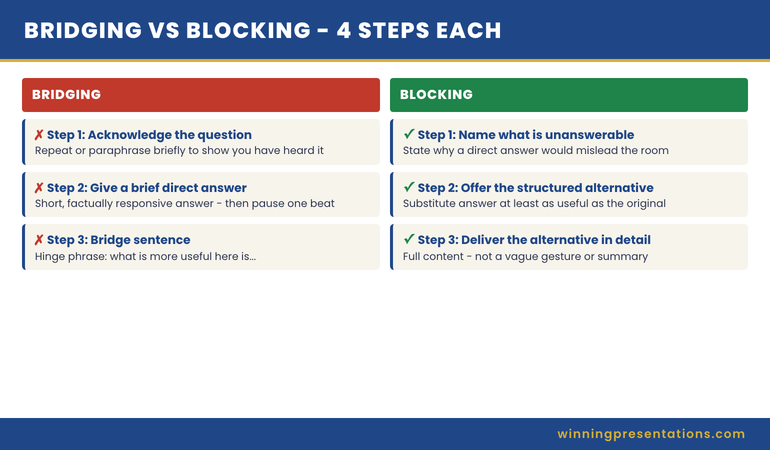
Bridging is a four-step move that acknowledges a question on its own terms and then moves the conversation to a different topic the presenter wants to address. Done well, it feels collaborative. Done badly, it feels evasive. The difference is in the mechanics, which most senior presenters have never been taught explicitly.
Step one is to repeat or paraphrase the question briefly. This signals to the asker that you have heard them and are taking the question seriously. Skipping this step is the most common bridging failure: it makes the pivot feel like a dismissal.
Step two is to give a short, honest answer to the actual question. Not the full answer. A short, accurate, factually responsive answer. If the question was about the revenue growth rate, name the rate. Then pause for one beat.
Step three is the bridge itself. The phrase that does the work. “What I think is more useful to focus on right now…” or “The thing I would draw your attention to in this conversation…” or “Where this connects to the bigger question is…” The bridge is a hinge sentence. It does not deny the original question. It signals that you are about to add value beyond the answer.
Step four is the destination. The point you wanted to make in the conversation. The bridge is only useful if the destination is genuinely more valuable than the original question would have produced. If the destination is just deflection, the room will read the bridge as evasion regardless of how smoothly you executed the mechanics.
What blocking actually is
Blocking is a different move. It declines to answer the question on the asker’s terms, gives a structured reason, and offers an alternative response. Blocking is not the same as refusing to answer. A refusal closes the conversation. A block redirects it productively.
Step one of blocking is to name what is unanswerable about the question as asked. “I cannot give you a single number for that because the answer depends on which scenario you are asking about.” Or “I am not going to commit to a date in this room because the dependency on legal review is real.” This signals respect for the question and clarity about why you are not answering it directly.
Step two is to offer the structured alternative. “What I can give you is a range, with a confidence interval, and the assumption I would change my view on.” Or “What I can commit to is a date for the legal review to complete, after which we can give a credible delivery date.” The alternative has to be substantive. A block followed by a vague gesture reads as evasion.
Step three is to deliver the alternative immediately, in detail. The block only works if the substitute answer is at least as useful as the answer to the original question. If the substitute is thinner, the block reads as a disguised refusal.
Step four is to invite the asker back into the conversation on the new terms. “Does that get at what you needed to know?” This is the move that converts a block from a one-way redirect into a collaborative reframe. It also gives the asker a chance to clarify if the substitute does not address their actual concern.
For senior presenters who handle hostile Q&A
Bridging, blocking, and the rules for choosing — in one structured library
The Executive Q&A Handling System gives you the bridging and blocking mechanics, the decision rule for choosing between them, and the question pattern library that tells you which questions need which technique. Designed for senior professionals presenting to boards, investment committees, and executive sponsors.
- Bridging mechanics with phrasing options for the hinge sentence
- Blocking mechanics with the structured-alternative rule for credibility
- Decision rule for choosing the right technique under pressure
- Three files, instant access, designed for repeat use before high-stakes meetings
£39 · Instant access · Designed for executive Q&A scenarios
Choosing between them in real time
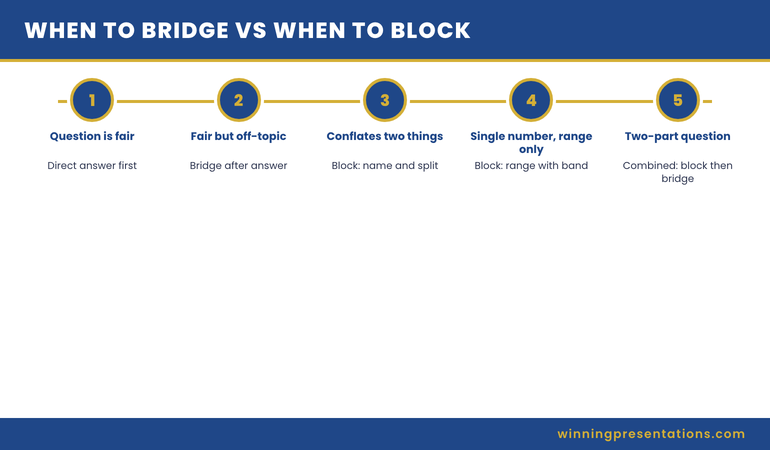
The decision rule is simple in principle and harder in practice. Bridging is the right move when the question is fair but the conversation is not where you need it to be. Blocking is the right move when the question itself is the problem.
A “fair” question, in this sense, is a question that has an answer you could give without misleading the room. The question may be off-topic. It may be a distraction. It may be coming from a peer who is trying to score points rather than understand. None of that makes it unfair. If you can answer it accurately and concisely, bridging is available.
A “problem” question is one where any direct answer would mislead the room. Either the question conflates two things that need to be separated. Or it asks for a single number where a range is the only honest response. Or it presumes a fact that is not yet established. In all three cases, blocking is the right move because answering directly would damage the integrity of the conversation.
The fast diagnostic in the room is one sentence: “Can I answer this accurately in twenty seconds?” If yes, bridge. Give the answer, then move. If no, block. Name what makes the question unanswerable, give the structured alternative, and bring the room back in.
When bridging fails
Bridging fails when the room wants the actual answer. The most common scenario: a senior peer or board member has asked a specific factual question, and they want the specific factual answer before any commentary or context. The bridging move reads as evasion because the asker has signalled — through the form of the question — that the conversation cannot proceed without the answer.
A second failure mode is bridging on a question of integrity. If a board member asks “did you know about this risk before the launch?”, any bridge will be heard as evasion. The question is binary. The room expects a binary answer, possibly with explanation, but with the binary answer first. Bridging here is a serious credibility hit and is rarely recovered in the same meeting.
A third failure mode is bridging too often. The bridging mechanics are well known. Senior peers recognise them. If you bridge twice in a single Q&A session, the room will be alert to the technique. By the third bridge, the technique is the topic. Senior presenters who have only learned bridging — and not blocking, or direct answering — tend to over-rely on it and lose credibility over time.
A fourth failure mode is bridging without the actual answer. The two-step short answer in step two of the bridging move is non-negotiable. Skipping it makes the bridge a redirect, not a bridge. Most senior peers will notice the omission within the first three seconds and the bridge will fail.
When blocking fails
Blocking fails when the question is a fair one. If a senior peer asks for a specific number and the number is knowable, blocking with “I cannot give you a single number” reads as evasion. The block itself is a structurally legitimate move, but it does not have legitimacy on a question that has a clean answer.
A second failure mode is blocking without the structured alternative. The four-step blocking move is sequential. Naming what is unanswerable is step one, but it is not the move. The move is the alternative. Stopping at step one feels like a refusal regardless of how technically correct the reasoning is.
A third failure mode is blocking on a question that is uncomfortable rather than unanswerable. There is a difference between a question you cannot answer accurately and a question you would rather not answer. Blocking the second category is a credibility risk because the room knows the difference. The honest move on uncomfortable-but-answerable questions is to answer them directly and accept the consequences.
A fourth failure mode is blocking too often, particularly with the same structural language. Repeating “I cannot give you a single number for that because…” three times in one Q&A turns the technique into a tic. Senior presenters who rely on blocking as a default tend to develop a habit of phrase that becomes recognisable across meetings, which slowly erodes credibility.
Companion piece: hostile question patterns
The eleven board question patterns that decide which technique to use
Bridging and blocking work better when you can recognise the question pattern in the first two seconds. The companion article on the hostile question playbook covers the eleven patterns most often seen at board level, with response shapes for each.
The combined move
Some questions need both moves at once. The most common case is a board question that contains a fair sub-question and a problem sub-question. “Why did this slip, and when will it land?” The first half is fair — the slip happened, the reason can be named. The second half is a problem — committing to a date in the room, with the dependency on legal review unresolved, would mislead.
The combined move handles this in one structured response. Block the unanswerable half. Answer the fair half. Bridge to the message you need to deliver, if there is one. The order matters: block first, then answer, then bridge. Reversing the order makes the block feel reactive rather than structural.
An example of the combined move: “I am not going to commit to a date in this room because the legal review timeline is the binding constraint and I do not have it in front of me. The reason for the slip is that we changed the scope at the procurement stage, which added two integrations that were not in the original specification. What I think is more important to settle in the next ten minutes is whether the scope change was the right call, because that is the question we will face again on the next project.”
That is one paragraph. Roughly thirty seconds of speaking time. Three structural moves. The room hears one coherent answer rather than three separate techniques. Most senior presenters who can deliver this fluently have practised the move on three or four scenarios in advance.
If you face frequent hostile questions in executive presentations, the combined move is the highest-value technique to put into muscle memory. It handles the questions that single techniques cannot.
Frequently asked questions
Is bridging the same as deflection?
No. Deflection avoids the question. Bridging answers the question briefly, acknowledges it on its own terms, and then moves the conversation. The difference is the short answer in step two. If the answer is missing, the move is deflection, regardless of how smooth the pivot.
When is direct answering better than bridging or blocking?
Most of the time. Both techniques are useful in specific scenarios. The default move at board level should be a direct, structured answer to the question as asked. Bridging and blocking are tools for the cases where direct answering is not available or not productive. Senior presenters who lead with technique tend to over-use it; senior presenters who lead with direct answers tend to use technique exactly when it matters.
How do I rehearse these techniques without sounding wooden?
Rehearse the four-step shape, not specific phrases. The mechanics need to be in muscle memory; the words form in the room. The most common reason the techniques sound wooden is over-rehearsal of the bridge sentence itself. The bridge should sound like the next thing you happened to say. If it sounds prepared, it has been over-prepared.
Will senior peers notice the technique?
Sophisticated senior peers will recognise both moves. That is not a problem if you use them sparingly and in the right scenarios. Recognition only becomes a credibility issue when the technique is used reflexively or repeatedly within a short window. Used well, the techniques signal that you are a structured thinker, which is a credibility benefit, not a cost.
If senior peer Q&A is part of your job
Stop running on instinct in the part of the meeting that decides everything
The Executive Q&A Handling System is the structured library senior presenters use to prepare for hostile Q&A in board meetings, investor panels, and executive committees. Bridging, blocking, the combined move, the question pattern library, and the response shapes — all in one place. Designed for repeat use across meetings.
- Bridging and blocking mechanics with worked examples
- The decision rule for choosing the right technique under pressure
- Question pattern library and 45-second response shapes
- Three files, instant access, designed for senior peer rooms
£39 · Instant access · Designed for executive Q&A scenarios
The Winning Edge — weekly
One short note each Thursday on Q&A techniques, response shapes under pressure, and the moves senior presenters use in board rooms. Written for professionals who do not have time for newsletters that read like newsletters.
Want a starting point first? The free Executive Presentation Checklist covers the structural fundamentals before you commit to a paid system.
For a wider view of how senior-level Q&A handling is taught, see the companion piece on Q&A handling training for presentations.
Next step: For your next high-stakes meeting, write down two questions you are afraid of. For each one, decide whether bridging or blocking is the right move. Rehearse the four-step shape on each one out loud. That is your preparation.
Mary Beth Hazeldine is the Owner & Managing Director of Winning Presentations. With 24 years of corporate banking experience at JPMorgan Chase, PwC, Royal Bank of Scotland, and Commerzbank, she advises senior professionals across financial services, healthcare, technology, and government on structuring presentations and Q&A for high-stakes board meetings, investment committees, and executive sessions. She speaks German and works extensively with the German-speaking financial markets.