

It’s 2:47am. You have to present to the board in six hours. And you’re staring at the ceiling.
Your mind won’t stop rehearsing. Not the presentation itself — the disaster scenarios. The CFO’s sceptical face. The question you can’t answer. The moment your voice cracks and everyone notices.
I know this ceiling. I stared at it for five years.
Before I learned what actually helps the night before a big presentation — and what makes things worse — I tried everything. Warm milk. Meditation apps. Reviewing my slides one more time (always a mistake). Alcohol (definitely a mistake).
Now, as a clinical hypnotherapist who specialises in presentation anxiety, I understand why nothing worked. And I’ve developed a protocol that does.
This isn’t about eliminating nerves. It’s about getting enough rest that you can function tomorrow — and managing the anxiety spiral that keeps you awake.
In this article:
Quick answer: The night before a big presentation, your nervous system is in threat-detection mode — which is why you can’t sleep no matter how tired you are. The solution isn’t forcing sleep; it’s calming your nervous system enough that sleep becomes possible. Stop rehearsing by 8pm, write your fears on paper to externalize them, use physiological sighs (double inhale, long exhale) to activate your parasympathetic system, and accept that imperfect sleep won’t ruin your presentation.
⚡ Presenting in a few hours and can’t sleep?
Do these three things right now:
- Stop trying to sleep. The pressure to sleep makes it impossible. Get up, sit somewhere comfortable, and accept you might not sleep much tonight.
- Do 5 physiological sighs. Double inhale through nose (short, then long), slow exhale through mouth. This is the fastest way to calm your nervous system.
- Write down your three worst fears. On paper, not a screen. Getting them out of your head and onto paper reduces their power.
You can deliver a strong presentation on imperfect sleep. I’ve done it dozens of times. Your body has reserves you don’t know about.
📋 Tomorrow Morning Script (copy this now)
Three lines to keep in your pocket:
Opener: “Before I begin, I want to acknowledge that this topic matters — which is why I’m here to give you the full picture.”
If you blank: “Let me pause for a moment to make sure I’m giving you the most important point here…”
Reset line: “The key thing I want you to take away is this…”
Screenshot this. Having these lines ready reduces anxiety more than any amount of rehearsal.
Why You Can’t Sleep (It’s Not What You Think)
When you can’t sleep before a big presentation, the problem isn’t your mind — it’s your nervous system.
Your brain has identified tomorrow’s presentation as a threat. Not a physical threat, but your amygdala doesn’t know the difference between a predator and a CFO. As far as your nervous system is concerned, something dangerous is coming, and sleeping would be a very bad survival strategy.
This is why telling yourself to “just relax” doesn’t work. You’re fighting millions of years of evolution designed to keep you awake when danger is near.
The anxiety loop works like this:
You think about the presentation → Your body produces stress hormones → You feel more alert → You notice you’re not sleeping → You worry about being tired tomorrow → You think more about the presentation → More stress hormones
Each cycle makes sleep less likely. And the clock keeps ticking.
Here’s what’s actually happening in your body:
- Cortisol stays elevated. Normally it drops at night. Before a big presentation, it doesn’t.
- Your heart rate stays up. Even lying still, your cardiovascular system is ready for action.
- Your mind scans for threats. This is why you keep imagining worst-case scenarios — your brain is trying to prepare you for danger.
- Temperature regulation shifts. You might feel too hot or too cold. This is stress response, not your bedroom temperature.
Understanding this is step one. You’re not broken. You’re not uniquely anxious. Your nervous system is doing exactly what it evolved to do.
The question is: how do you convince it that you’re safe enough to sleep?
For more on the physiological symptoms of presentation anxiety, see my guide on presentation breathing techniques.
Break the Anxiety Cycle Before Your Next Presentation
Conquer Speaking Fear (£39, instant access) combines clinical hypnotherapy techniques with practical exercises you can use the night before — and the morning of — any high-stakes presentation. Stop the spiral before it starts.
Get Conquer Speaking Fear → £39
From a clinical hypnotherapist who spent 5 years staring at that ceiling.
The Night-Before Protocol
This is the exact sequence I use with clients — and used on myself during my banking career. It’s not about forcing sleep. It’s about creating the conditions where sleep becomes possible.
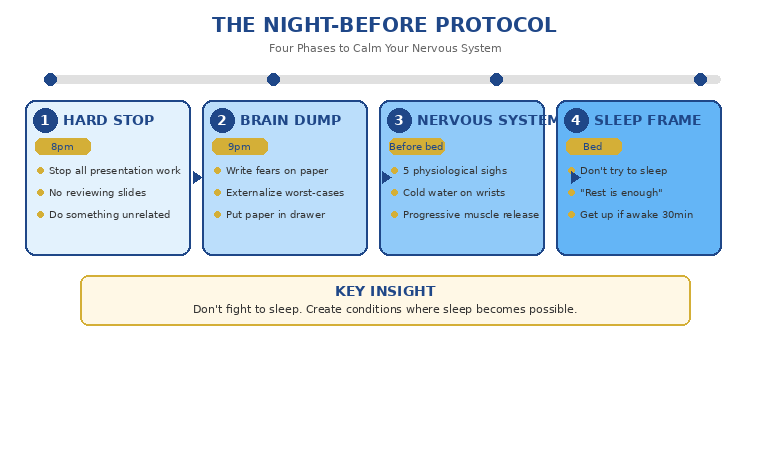
Phase 1: The Hard Stop (8pm)
Stop all presentation work by 8pm. No reviewing slides. No rehearsing. No “just one more look.”
Here’s why this matters: every time you review your presentation, you’re telling your nervous system “this is important and potentially dangerous.” Your brain doesn’t distinguish between preparation and worry. To your amygdala, thinking about the presentation IS the threat.
If you’re not ready by 8pm, you’re not going to become ready between 8pm and midnight. You’ll just make yourself more anxious.
Instead, do something completely unrelated. Watch something light (not the news). Read fiction. Take a bath. The goal is to give your brain something else to process.
Phase 2: The Brain Dump (9pm)
Before you try to sleep, externalize your anxiety. Get a piece of paper — not your phone, paper — and write down:
- Every fear you have about tomorrow
- Every worst-case scenario your mind keeps generating
- Every “what if” question that won’t leave you alone
Don’t censor yourself. Don’t try to be rational. Just dump it all onto the page.
This works because anxiety lives in loops. Your brain keeps cycling through fears because it’s trying to “solve” them. Writing them down tells your brain “I’ve captured this — you don’t need to keep reminding me.”
Then put the paper in a drawer. Physically separating from it matters.
Phase 3: The Nervous System Reset (Before Bed)
Now you need to shift your body from sympathetic (fight/flight) to parasympathetic (rest/digest) activation. These techniques work directly on your vagus nerve:
Physiological sighs (5 repetitions):
- Double inhale through your nose: one short breath, then one longer breath on top of it (filling your lungs completely)
- Long, slow exhale through your mouth
- The extended exhale is what activates the parasympathetic response
Cold water on wrists and face:
- Run cold water over the insides of your wrists for 30 seconds
- Splash cold water on your face
- This triggers the “dive reflex” which slows heart rate
Progressive muscle release:
- Lying down, tense your feet for 5 seconds, then release
- Move up through calves, thighs, stomach, chest, arms, face
- Tension followed by release teaches your body what relaxation feels like
Phase 4: The Sleep Frame
When you get into bed, do not try to sleep. Instead, tell yourself: “I’m going to rest my body. Sleep would be nice, but rest is enough.”
This removes the pressure that makes sleep impossible. The irony of insomnia is that trying to sleep prevents sleep. Accepting rest — even wakeful rest — allows sleep to happen.
If you’re still awake after 30 minutes, get up. Sit somewhere comfortable. Do another round of physiological sighs. Don’t check your phone. Don’t review your slides. Just sit until you feel drowsy, then return to bed.
For more techniques on calming nerves, see my guide on how to calm nerves before a presentation.
What NOT to Do (Common Mistakes)
Some things that feel like good ideas actually make night-before anxiety worse:
Don’t review your slides “one more time.”
This is the most common mistake. It feels productive but does two harmful things: it signals to your brain that you’re not prepared (or why would you need to review again?), and it keeps the presentation front-of-mind when you need to let it go.
Don’t drink alcohol to help you sleep.
Alcohol might help you fall asleep, but it destroys sleep quality. You’ll wake up more often, spend less time in restorative sleep phases, and feel worse in the morning than if you’d slept less but alcohol-free.
Don’t use your phone in bed.
Blue light suppresses melatonin. But more importantly, your phone is a portal to email, to your slides, to everything that triggers anxiety. Keep it in another room.
Don’t catastrophize about not sleeping.
Here’s the truth: you can deliver a solid presentation on four hours of sleep. You can deliver one on two hours. Your body has adrenaline reserves that will kick in when you need them. Worrying about the effects of no sleep causes more damage than the actual sleep loss.
Don’t rehearse in bed.
Running through your presentation in bed feels like preparation, but it’s actually rumination in disguise. Your brain can’t distinguish between helpful rehearsal and anxious repetition when you’re trying to sleep.
Don’t take sleeping pills for the first time.
If you don’t know how a medication affects you, the night before a big presentation is not the time to find out. Some people feel groggy for hours after sleeping pills. Others have strange dreams that are worse than the insomnia.
The Morning Of: First 30 Minutes
How you spend the first 30 minutes after waking sets the tone for your entire presentation day.
Don’t check email first.
Email is other people’s priorities. On presentation day, you need to protect your mental state. Email can wait until after you’ve centred yourself.
Do move your body.
Even 10 minutes of movement — walking, stretching, light exercise — metabolizes the stress hormones that built up overnight. You’ll feel physically lighter and mentally clearer.
Do eat protein.
Skip the sugary breakfast. You need stable blood sugar for the next few hours. Eggs, yogurt, nuts — something that will sustain you without a crash.
Do one final physiological reset.
Five physiological sighs, plus cold water on face and wrists. This pre-sets your nervous system to a calmer baseline before you even leave for the presentation.
Don’t over-caffeinate.
If you slept poorly, the temptation is to drink extra coffee. Resist it. Caffeine amplifies anxiety symptoms — racing heart, jittery hands, rapid thoughts. One normal coffee is fine. Three espressos will make you worse.
If you’re worried about a panic attack, see my guide on what to do if you have a panic attack before a presentation.
Stop Dreading the Night Before
Conquer Speaking Fear (£39, instant access) gives you the complete system for managing presentation anxiety — not just coping techniques, but the deep reprogramming that changes how your nervous system responds to high-stakes moments. Clinical hypnotherapy meets practical business reality.
Get Conquer Speaking Fear → £39
Developed from 5 years of personal struggle and clinical hypnotherapy training.
Frequently Asked Questions
What if I literally can’t sleep at all?
It happens. And here’s the counterintuitive truth: lying in a dark room with your eyes closed, even without sleeping, provides about 70% of the restorative benefit of actual sleep. Your body is still resting, even if your mind isn’t. You will have enough fuel to get through tomorrow. I’ve delivered major presentations on zero sleep. It wasn’t fun, but it was fine.
Should I take melatonin the night before a presentation?
If you’ve used melatonin before and know how it affects you, a low dose (0.5-1mg) an hour before bed can help. But if you’ve never tried it, don’t experiment the night before something important. Some people feel groggy in the morning; others get vivid dreams. Know your response before using it strategically.
What if I wake up at 3am and can’t get back to sleep?
Don’t fight it. Get up, go somewhere comfortable (not your presentation space), and do a brain dump of whatever woke you up. Do five physiological sighs. Read something light for 20 minutes. Then return to bed without any expectation of sleep. Paradoxically, removing the pressure often allows sleep to return.
Is it better to wake up early or sleep as long as possible?
Wake at your normal time, or slightly earlier. Sleeping in disrupts your circadian rhythm and often leaves you feeling groggier than less sleep at the right time. Give yourself at least 90 minutes between waking and presenting to let your brain fully come online.
Your Next Step
The night before a big presentation is never going to be comfortable. Your nervous system is doing its job — preparing you for something that matters.
But you can work with your biology instead of against it. Stop rehearsing by 8pm. Dump your fears onto paper. Reset your nervous system with physiological sighs. And accept that imperfect sleep doesn’t mean a failed presentation.
If you want the complete nervous-system protocol — not just for tomorrow night, but for every future presentation — Conquer Speaking Fear covers the full programme.
Tomorrow, you’ll have reserves you don’t know about. Trust them.
📧 Get the Winning Edge Newsletter
Weekly insights on presentation confidence, anxiety management, and high-stakes communication — from a clinical hypnotherapist and former banking executive.
Related reading: If you’re facing one of the most difficult presentation types tomorrow — a restructuring announcement — read Restructuring Announcement Presentation: What HR Won’t Tell You for the structure that preserves trust when delivering hard news.
About the Author
Mary Beth Hazeldine is the Owner & Managing Director of Winning Presentations. A qualified clinical hypnotherapist and NLP practitioner, she spent five years struggling with severe presentation anxiety during her corporate banking career at JPMorgan Chase, PwC, Royal Bank of Scotland, and Commerzbank.
That personal experience — combined with her clinical training — now helps executives across financial services, healthcare, technology, and government transform their relationship with high-stakes communication. She combines evidence-based anxiety management techniques with practical business reality.