
Tag: anxiety techniques

30 Mar 2026
Quiet moment of reflection before a high-stakes presentation showing a calm professional environment

Self-Compassion for Presentation Anxiety: The Research-Backed Technique Sceptical Executives Trust

Self-compassion quiets the inner critic that drives presentation anxiety. Rather than pushing harder through fear, this evidence-based technique teaches you to respond to mistakes and pressure the way you’d support a trusted colleague. For executives who’ve resisted breathing exercises and affirmations, self-compassion offers something different: a research-backed permission structure to be human during high-stakes moments.

Linh’s Turning Point: From Perfectionist Sabotage to Measured Presence

Linh, a finance director at a multinational bank, had mastered every technical skill. She prepared meticulously. Yet every presentation triggered a spiral: one stumbled phrase, and her internal voice became ruthless. That was sloppy. You should know this cold. Everyone’s thinking you’re not qualified. The harder she pushed to be perfect, the more anxious she became. By her third major presentation in two months, she was considering stepping back from client-facing work altogether—a career-limiting decision she wasn’t ready to make. During a coaching conversation, Linh learned that her perfectionism wasn’t a strength; it was fuel for anxiety. When she began practising self-compassion—acknowledging her nerves as normal, treating herself with the same grace she’d extend to her team—her presentation quality actually improved. The permission to be imperfect freed her from the paralysis of perfectionism.

Rescue Block: You Don’t Have to Be Perfect to Perform Well

Presentation anxiety often masquerades as a motivation problem. In reality, it’s your nervous system perceiving a threat. Self-compassion interrupts that threat signal by validating your experience and reminding you that struggle is part of being human. This isn’t about lowering standards—it’s about building psychological safety so you can access your best thinking under pressure.

What Self-Compassion Actually Means for Presenters

Self-compassion isn’t self-pity or weakness. Kristin Neff, the leading researcher in this field, defines it as three interlocking elements: mindfulness of your difficulty (noticing anxiety without exaggerating it), common humanity (recognising that struggle is universal, not a personal failing), and self-kindness (responding to yourself with the same dignity you’d offer a colleague).

For presentation anxiety, this translates into a specific mental shift. Instead of I’m panicking, I must be terrible at this, the self-compassionate response is: My nervous system is activated. This is what anxiety feels like. I can move forward anyway. That distinction might seem subtle, but the neurological impact is measurable. The inner critic—which intensifies the fight-or-flight response—quiets. Your prefrontal cortex, the rational planning centre, can remain engaged.

Ready to Stop Fighting Your Anxiety?

Conquer Speaking Fear teaches you how. In six modules, you’ll learn the neuroscience of anxiety, practical de-escalation techniques, and the mindset shifts research shows actually work for executives who’ve tried everything else.

Conquer Speaking Fear — £39

Six modules. Lifetime access. No assumptions about your comfort level.

Why Research Backs This Approach

The evidence for self-compassion in anxiety management is robust. Longitudinal studies show that individuals who practise self-compassion report lower trait anxiety, reduced avoidance behaviour, and faster recovery from setbacks. Neuroscience explains why: when you respond to yourself with kindness, you activate the parasympathetic nervous system—your rest-and-digest state—which directly counteracts the arousal of anxiety.

What makes this particularly relevant for presentation anxiety is the mechanism. Traditional anxiety management (grounding techniques, breathing exercises) works by managing the physical symptoms. Self-compassion works by changing your relationship to those symptoms. You’re not trying to eliminate the nervousness; you’re teaching your brain that nervousness doesn’t mean failure. For sceptical executives, this distinction matters. You’re not engaging in sentiment or positive thinking. You’re applying a neurologically sound response to psychological distress.

Research also shows that self-compassion buffers against perfectionism—the cognitive pattern that magnifies presentation anxiety in high-achieving professionals. When you can acknowledge a mistake without catastrophising, you remain calmer and more focused. Your audience doesn’t experience your anxiety; they experience your stability.

The Three Pillars in Practice

Mindfulness: Notice Without Narration

Before a presentation, you’ll likely experience physical sensations: elevated heart rate, tension in your chest, a tightness in your throat. Mindfulness means noticing these without the story. Instead of My heart is racing—I’m going to panic, try: I notice my heart is beating faster. That’s what my body does when it’s preparing. You’re describing the sensation, not interpreting it as catastrophe.

Common Humanity: You’re Not Alone in This

Anxiety thrives on the belief that your experience is abnormal or unique. In reality, every presenter experiences nervousness. Even seasoned executives, award-winning speakers, and confident performers report pre-presentation anxiety. The difference is they’ve learned not to treat it as evidence of inadequacy. When you remind yourself—This is what anxiety feels like for humans. I’m not broken—you reduce the secondary anxiety (anxiety about being anxious) that compounds the original fear.

Self-Kindness: The Internal Tone That Matters

This is where most executives get stuck. Self-kindness can sound soft or indulgent. In practice, it’s rigorous. It means asking: What would I need right now if I were a colleague I valued? The answer might be a pause, a glass of water, a reminder of your competence, or permission to feel uncertain. You’re not rewarding yourself for being anxious; you’re treating anxiety as a problem that warrants care, not punishment.

You can practise these three elements together in a simple structured exercise, which brings us to your practical toolkit.
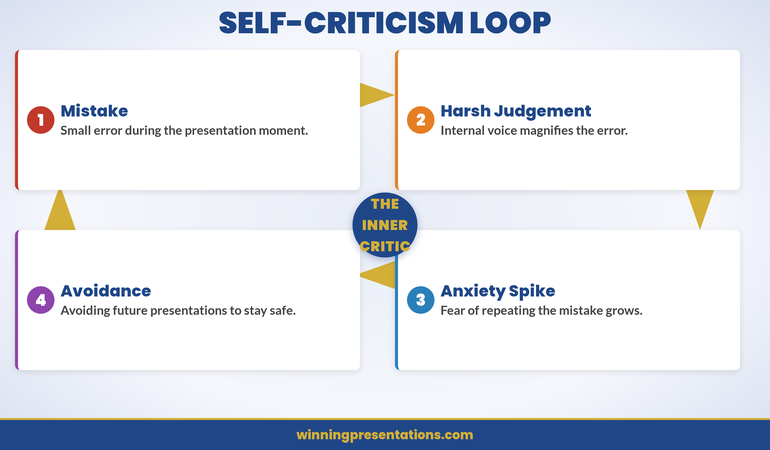
The self-criticism cycle showing four stages: mistake, harsh judgement, anxiety spike, and avoidance

Your 90-Second Exercise Routine

The most effective self-compassion practice for presentation anxiety is the pause-name-soothe sequence. You can do this in 90 seconds, anywhere—in the car park before you present, in the bathroom at the conference, even during a difficult Q&A moment.

Step 1: Pause (20 seconds)
Stop what you’re doing. Notice your breath without changing it. Count the exhales: one, two, three. This brief pause activates your awareness and signals to your nervous system that you’re choosing a response, not being hijacked by panic.

Step 2: Name (30 seconds)
Silently or aloud, name what you’re experiencing. Use simple, non-dramatic language: I’m feeling anxious. My chest is tight. I’m having the thought that I might forget what I’m saying. By naming, you’re engaging your language centres and creating distance from the raw emotion. You’re no longer the anxiety; you’re observing it.

Step 3: Soothe (40 seconds)
Place your hand on your heart or cross your arms over your chest in a gentle self-hug. Speak to yourself as you would a nervous colleague: This is hard right now. That’s okay. I’ve prepared well. I can move forward even with these feelings. The physical touch activates the soothing system; the words reinforce kindness. Research shows this combination is more effective than either element alone.

You can practise this routine during low-stress moments so it’s available when you need it. Many executives practise once daily for a week before a high-stakes presentation, then on-demand before the actual event.

Level Up Your Preparation

Conquer Speaking Fear walks you through this routine with video guidance, then shows you how to integrate it with your broader presentation strategy. You’ll also learn why your anxiety has a particular pattern—and how to interrupt it.
Conquer Speaking Fear — £39

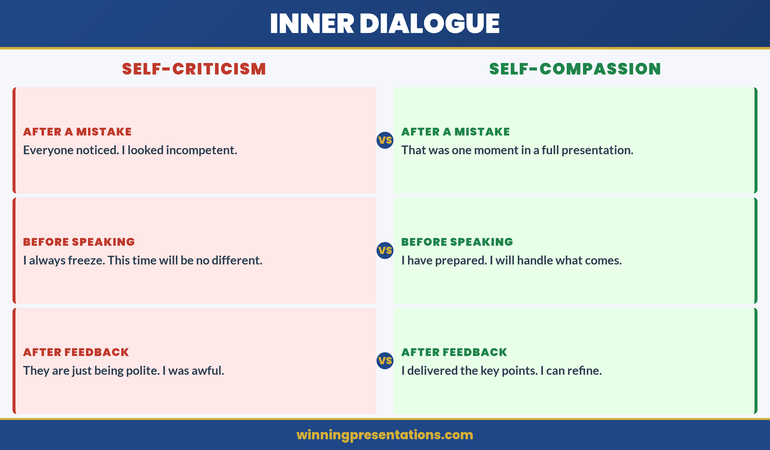
Contrast between self-criticism and self-compassion responses after mistakes, before speaking, and after feedback

Why Sceptical Executives Resist (And How to Overcome It)

You might be thinking: This sounds nice, but will it actually work for me? Won’t I just feel silly talking to myself?

That resistance is predictable. High-achieving professionals have often built their identity on rational problem-solving and self-reliance. Self-compassion can feel like emotional indulgence. Here’s what the research shows: the executives who resist self-compassion are often the same ones whose perfectionism is driving their anxiety. The resistance itself is part of the pattern.

The reframe: self-compassion is strategic, not sentimental. When you reduce the internal criticism that amplifies anxiety, you access clearer thinking. Your prefrontal cortex isn’t hijacked by the threat-detection system. You make better decisions during presentations, field difficult questions more calmly, and recover more quickly from mistakes. This is performance optimisation through psychological stability.

Second concern: Won’t this make me complacent about improving? In fact, self-compassion strengthens motivation for improvement. When you’re not berating yourself for mistakes, you can examine them objectively. What went wrong? What can I adjust? This is the mindset that drives learning. Harsh self-criticism, by contrast, often leads to avoidance (you stop doing presentations) or defensive rigidity (you ignore feedback).

A practical starting point: try the 90-second routine once. Notice what happens. Most executives report a measurable shift in their nervous system activation within three or four practises. That’s not placebo; that’s neurobiology.

For guided video walkthroughs of the 90-second routine and integration strategies, see the full training in Conquer Speaking Fear.

Integrating Self-Compassion Into Your Prep

Self-compassion works best when it’s woven into your broader preparation strategy. Here’s how:

During Content Development
If you notice perfectionist thinking (This section isn’t excellent yet), pause and apply self-compassion. I’m working through this. Draft work is supposed to feel rough. I can refine it. This keeps perfectionism from sabotaging your creative process.

During Practice Sessions
If you stumble during a run-through, notice the urge to self-criticise. Instead, treat the mistake as data: I found something to improve. That’s valuable. You’re building the neural pathways that support learning.

Immediately Before Presenting
Use the 90-second routine. Pair it with a pre-presentation ritual (a specific phrase, a particular movement) so your nervous system learns to associate the ritual with calm focus.

After the Presentation
This is crucial. Instead of replaying every imperfection, practise self-compassion. I did difficult work today. I handled some parts well and some parts less well. That’s the nature of live performance. I learned something. This prevents the post-presentation anxiety spiral that can make future presentations feel higher-stakes.

Build Your Slides with Confidence

Preparation reduces anxiety. The Executive Slide System (£39) includes slide templates and frameworks specifically designed to minimise preparation stress and build presenter confidence.

The Bottom Line: Permission to Perform

Self-compassion for presentation anxiety isn’t about becoming comfortable with nervousness. It’s about building a relationship with your anxiety that doesn’t amplify it. When you stop treating nervousness as evidence of inadequacy, your nervous system downregulates. You become more present, more flexible, and more effective.

For executives, this is particularly valuable because you’re operating in high-stakes environments where stakes feel personal. A misspoken phrase in a board presentation isn’t just a communication hiccup; your mind frames it as a threat to your professional standing. Self-compassion interrupts that narrative. It tells your nervous system: You’re safe. You can think clearly. You can keep going.

That’s not motivational poster sentiment. That’s applied neuroscience.

Frequently Asked Questions

Q: If I practise self-compassion, won’t I lower my standards?
A: No. Research shows the opposite: self-compassion is associated with higher intrinsic motivation and better long-term performance. When you’re not distracted by self-criticism, you can focus on what actually matters—clear communication and audience connection.

Q: How long before I notice a difference?
A: Most people report a noticeable shift in their nervous system activation within three to four practises of the 90-second routine. Deeper integration into your presentation anxiety pattern usually takes two to four weeks of consistent practise.

Q: Can I do this alongside other anxiety management techniques?
A: Yes. Self-compassion complements breathing exercises, preparation, and other evidence-based approaches. Think of it as a complementary layer: it changes how you relate to anxiety, whilst other techniques manage the physical symptoms.

Stay Ahead of Presentation Anxiety

New techniques, research insights, and executive-focused strategies delivered to your inbox. Join The Winning Edge newsletter.


Related Articles
How to Run a Project Kickoff Presentation That Gets Buy-In
The Contract Renewal Presentation: Authority, Nuance, and Closing Power
Buying Time in Q&A: Three Techniques That Sound Natural

Self-compassion isn’t a luxury for presenters—it’s a strategy for sustained performance under pressure.


About the Author

Mary Beth Hazeldine is Owner & Managing Director of Winning Presentations. A qualified clinical hypnotherapist and NLP practitioner who overcame five years of severe presentation anxiety, she combines 24 years of corporate banking experience at JPMorgan Chase, PwC, Royal Bank of Scotland, and Commerzbank with evidence-based techniques for managing presentation fear.

10 Feb 2026
Professional taking a calming breath before high-stakes presentation, moment of composure

The Fight or Flight Hack I Learned From Hypnotherapy (It Works in 90 Seconds)

My heart was pounding so hard I could hear it in my ears.

I was standing outside a boardroom at JPMorgan, about to present a restructuring proposal to twelve senior executives. I’d done this a hundred times. I knew the content cold. But my body didn’t care about my experience. It had decided I was about to be eaten by a predator.

My hands were shaking. My mouth was dry. My brain was screaming at me to run — literally run — out of the building and never come back.

That was the day I realised something had to change. Not my preparation. Not my slides. Not my “mindset.” Something deeper. Something neurological.

I spent the next three years training as a clinical hypnotherapist, specifically to understand why intelligent, experienced professionals lose control of their bodies before presentations — and what actually works to stop it.

Here’s what I learned.

Quick answer: Presentation panic is an amygdala hijack — your brain’s threat detection system firing when there’s no actual threat. You can’t think your way out of it because the amygdala bypasses your rational brain. But you can interrupt it with a 90-second nervous system reset: ground your feet, slow your exhale, activate a physical anchor, and engage your peripheral vision. This shifts you from sympathetic (fight/flight) to parasympathetic (calm/focused) dominance before you enter the room.

For five years, I had a secret. I was a senior banking executive who delivered high-stakes presentations regularly — and I was terrified every single time.

Not nervous. Not “a bit anxious.” Terrified. The kind of fear where your vision narrows, your thoughts scatter, and your body feels like it belongs to someone else.

I tried everything the corporate world suggests: more preparation, more practice, more positive thinking. I visualised success. I told myself I was “excited, not nervous.” I did power poses in the bathroom.

None of it worked. Because none of it addressed the actual problem.

The problem wasn’t psychological. It was physiological. My nervous system was hijacking my body, and no amount of positive thinking could override 200,000 years of human evolution.

When I trained as a hypnotherapist, I finally understood why — and more importantly, what to do about it. (If you want the full story of how I overcame my fear of public speaking, I’ve written about that separately.)

Why Your Body Betrays You (The Neuroscience)

Here’s what’s actually happening when you feel presentation panic:

Your amygdala — the brain’s threat detection centre — has identified a potential danger: you’re about to be evaluated by a group of people. For our ancestors, group rejection meant death. Being cast out of the tribe was a survival threat.

Your amygdala doesn’t know the difference between a boardroom and a savannah. It just knows: evaluation by group = potential rejection = danger.

So it does what it’s designed to do: trigger the sympathetic nervous system. Flood your body with adrenaline and cortisol. Prepare you to fight or run.

This is the amygdala hijack. And here’s the crucial part: it happens before your rational brain gets involved.

The threat signal reaches your amygdala faster than it reaches your prefrontal cortex — the thinking brain. By the time you’re consciously aware of the fear, your body is already in full fight-or-flight mode. (This “low road” threat response was first described by neuroscientist Joseph LeDoux in his research on fear processing.)

This is why you can’t think your way out of it. By the time you’re thinking, the hijack has already happened.

You need to interrupt the nervous system directly.

The 90-Second Nervous System Reset

This technique works because it targets the vagus nerve — the main communication line between your body and your parasympathetic nervous system (the “rest and digest” system that calms you down).

Do this 2-3 minutes before you need to present:

Step 1: Ground (15 seconds)

Stand with both feet flat on the floor, hip-width apart. Press your feet down firmly — feel the floor pushing back up against you.

This isn’t metaphorical “grounding.” It’s neurological. Pressure receptors in your feet send signals to your brain that say “stable, safe, solid ground.” This interrupts the “run away” signal.

Mentally scan from the soles of your feet up through your ankles. Notice the connection to the earth. Your body is supported.

Step 2: Breathe (30 seconds)

Here’s the key most people get wrong: it’s not about breathing deeply. It’s about breathing out slowly.

Your exhale activates the parasympathetic nervous system. Your inhale activates the sympathetic (stress) system. Most anxious breathing is short inhale, short exhale — which keeps you stuck in stress mode.

The 4-7-8 pattern:

  • Inhale through your nose for 4 counts
  • Hold for 7 counts
  • Exhale slowly through your mouth for 8 counts

The extended exhale is what shifts your nervous system. Do this 3-4 times.

⚡ Presenting in the next 24 hours? Do this now (2 minutes):

  • Run the 90-second reset once (Ground → Breathe → Anchor → Peripheral)
  • Write the first sentence you’ll say when you start — just 9 words
  • Fire your anchor the moment you stand up tomorrow

If you want the guided audio version + the full calm protocol for tonight and tomorrow morning:

🎧 Emergency Relief: Guided Audio You Can Use Tonight

Conquer Speaking Fear includes a guided audio walkthrough of the 90-second reset — so you can practise with my voice in your ears instead of trying to remember each step. Use it tonight, use it tomorrow morning, use it 5 minutes before you present.

Get Conquer Speaking Fear → £39

Instant download. 30-day money-back guarantee. Printable protocol card included.

Step 3: Anchor (30 seconds)

This is the technique that changed everything for me. It’s called “anchoring” in NLP, and it gives you a physical switch to access calm on demand.

While you’re in that calm state from the breathing:

  • Press your thumb and middle finger together firmly
  • Hold for 10 seconds
  • Associate this pressure with the feeling of calm

The more you practise this (outside of stressful situations), the stronger the anchor becomes. Eventually, pressing those fingers together triggers the calm state automatically.

I’ve used this anchor in boardrooms, on stages, in TV interviews. It works because you’re not trying to create calm in the moment — you’re accessing calm you’ve already stored.

Step 4: Engage Peripheral Vision (15 seconds)

When we’re anxious, our vision narrows — literally. This is called “tunnel vision” and it’s part of the fight-or-flight response. Your brain focuses on the threat and ignores everything else.

You can reverse this deliberately:

  • Pick a spot on the wall in front of you
  • While keeping your eyes on that spot, expand your awareness to include what’s in your peripheral vision
  • Notice objects on the far left and far right without moving your eyes

This simple technique shifts your brain from “focused threat detection” to “relaxed awareness.” It’s impossible to maintain full fight-or-flight while in peripheral vision mode.

The Conquer Speaking Fear programme includes guided audio for each step of this protocol, plus advanced techniques for building permanent calm anchors.

90-second nervous system reset technique showing 4 steps: Ground, Breathe, Anchor, Engage

Why “Just Breathe” Doesn’t Work Alone

You’ve probably been told to “just breathe” before presentations. And you’ve probably found it doesn’t help much.

Here’s why: breathing alone, without the other elements, often makes anxiety worse.

When you focus intensely on your breathing while anxious, you’re focusing on a body that feels out of control. You notice how fast your heart is beating. You notice how shallow your breath is. You notice how uncomfortable you feel.

This increases anxiety, not decreases it.

The 90-second reset works because it combines multiple interventions:

  • Grounding interrupts the “run” signal
  • Extended exhale activates the parasympathetic system
  • Anchoring accesses pre-stored calm
  • Peripheral vision shifts brain state

Each element alone has some effect. Together, they’re transformative.

Physical Anchors: The Technique Nobody Teaches

Anchoring is the most powerful technique I learned in hypnotherapy training, and it’s almost never taught in corporate presentation skills courses.

The concept is simple: your brain naturally associates physical sensations with emotional states. Think of a song that instantly transports you to a specific memory and feeling. That’s an anchor — the song triggers the emotional state.

You can create these deliberately.

How to Install a Calm Anchor

Step 1: Create a genuine calm state

Do this when you’re actually relaxed — after a bath, during meditation, while listening to calming music. Don’t try to do it when you’re already anxious.

Step 2: Intensify the calm

Once you feel relaxed, focus on the feeling. Notice where you feel it in your body. Make it stronger in your imagination. Give it a colour if that helps.

Step 3: Set the anchor

At the peak of the calm feeling, press your thumb and middle finger together (or any unique physical gesture you can do discreetly). Hold for 10-15 seconds while maintaining the calm feeling.

Step 4: Release and repeat

Release the fingers, break the state (stand up, shake it off), then repeat 3-5 times in the same session.

Step 5: Test and strengthen

Later, in a neutral state, fire the anchor (press the fingers). Notice if you feel a shift toward calm. The more you repeat steps 1-4 over days and weeks, the stronger the anchor becomes.

This isn’t magic. It’s classical conditioning — the same mechanism Pavlov discovered with his dogs. You’re conditioning your nervous system to produce calm on demand.

🎯 Build a Permanent Calm Switch

The anchor installation protocol in Conquer Speaking Fear goes deeper than what I can cover here — including how to “stack” multiple calm memories into one anchor, how to test anchor strength, and how to rebuild an anchor if it weakens over time. This is the skill that transforms occasional relief into permanent confidence.

Get Conquer Speaking Fear → £39

Includes guided audio for anchor installation + stacking technique.

Before, During, and After: A Complete Protocol

The 90-second reset is for immediate pre-presentation use. But if you’re dealing with significant presentation anxiety, you need a complete protocol.

The Night Before

Do NOT review your slides obsessively. This increases anxiety by keeping the presentation front-of-mind.

Instead:

  • Do one final review in the early evening, then stop
  • Spend 10 minutes with your calm anchor (install or strengthen it)
  • Avoid alcohol (it disrupts sleep and increases next-day anxiety)
  • Go to bed at your normal time

The Morning Of

Your nervous system is most suggestible in the first 20 minutes after waking.

  • Don’t check email or news immediately — this triggers stress hormones
  • Do 5 minutes of the breathing protocol while still in bed
  • Visualise yourself calm and in control (not the presentation content — just the feeling of confidence)
  • Move your body — even a 10-minute walk shifts your nervous system state

The full morning protocol in Conquer Speaking Fear includes a specific sequence designed to set your nervous system baseline before high-stakes days.

2-3 Minutes Before

This is when you use the 90-second reset: Ground → Breathe → Anchor → Peripheral Vision.

Do this in a private space if possible — a bathroom, an empty corridor, even a stairwell. You need 90 seconds where no one will interrupt you. (For more techniques to calm your nerves before a presentation, see my dedicated guide.)

During the Presentation

If you feel anxiety rising mid-presentation:

  • Fire your anchor discreetly (press thumb and finger under the table or behind your back)
  • Slow your speaking pace deliberately — anxiety makes us rush
  • Engage peripheral vision while speaking — it’s easier than you think
  • Ground through your feet if you’re standing

Nobody will notice you doing these things. They’re invisible interventions.

After

Your nervous system doesn’t know the “threat” is over just because the presentation ended. You may feel residual anxiety for hours.

  • Don’t immediately debrief or replay what happened
  • Take 5 minutes for physical movement — walk around, stretch
  • Do 3-4 extended exhales to signal safety to your nervous system
  • Later that day, acknowledge what went well (your brain needs positive data to update its threat assessment)

What Changed for Me

That day at JPMorgan, standing outside the boardroom with my heart pounding, I didn’t have these techniques. I went in anxious, stayed anxious throughout, and delivered a presentation that was technically acceptable but emotionally flat.

Now, fifteen years and hundreds of presentations later, I still get the initial spike of adrenaline. That’s normal — it’s your body preparing for a performance. The difference is I know exactly how to channel it.

The 90-second reset isn’t about eliminating all nervousness. It’s about moving from panic (sympathetic dominance) to focused energy (balanced nervous system). The goal isn’t to feel nothing. It’s to feel ready.

You can learn to do this too. Your nervous system isn’t broken — it’s just running outdated threat detection software. You can update it.

🧠 The Complete Nervous System Control System

Everything in Conquer Speaking Fear:

  • The 90-second reset (guided audio + printable card)
  • Anchor installation protocol with memory stacking
  • Night-before and morning-of routines
  • Mid-presentation recovery techniques
  • Post-presentation nervous system reset

Get Conquer Speaking Fear → £39

Instant download. 30-day money-back guarantee. Used by hundreds of executives.

For physical symptoms specifically (shaking hands, racing heart, sweating): Calm Under Pressure (£19.99) provides targeted techniques for the body-level symptoms of presentation anxiety.

Frequently Asked Questions

How long does it take for anchoring to work?

Most people notice some effect after 3-5 installation sessions spread over a week or two. The anchor strengthens with repetition — the more you install it during genuinely calm states, the more reliable it becomes. Some of my clients have anchors they’ve been using for years that fire instantly.

What if I don’t have 90 seconds before the presentation?

If you only have 30 seconds, prioritise the extended exhale (3-4 breaths with long exhale) and fire your anchor. These two elements give you the most nervous system shift in the least time. Even one proper exhale helps.

Can this work for people with severe presentation anxiety?

Yes, but severe anxiety may need additional support. These techniques are the foundation I use with all my clients, including those with diagnosed anxiety disorders. For severe cases, I recommend combining these techniques with professional support from a therapist who understands performance anxiety specifically.

Note: These techniques are performance tools, not medical treatment. If you experience panic attacks, severe anxiety symptoms, or symptoms that significantly impact your daily life, please consult a qualified healthcare professional alongside using performance techniques.

Why does peripheral vision help with anxiety?

Tunnel vision is part of the fight-or-flight response — your brain narrows focus to the perceived threat. By deliberately engaging peripheral vision, you signal to your brain that you’re not in immediate danger (you wouldn’t be scanning the horizon if a predator were attacking). This shifts you out of the high-alert stress state.

📬 The Winning Edge Newsletter

Weekly techniques for presentation confidence and executive communication. Evidence-based strategies from a clinical hypnotherapist who’s been in the boardroom.

Subscribe free →

Related: Once your nervous system is under control, you need a presentation that’s worth delivering. Read The M&A Integration Update That Stops Panic for a framework that keeps 500 people calm when the stakes are high.

Your body’s fear response isn’t your enemy. It’s an ancient protection system that kept your ancestors alive. The problem is it can’t distinguish between a sabre-toothed tiger and a quarterly business review.

You don’t need to eliminate fear. You need to regulate it. Ground your feet. Extend your exhale. Fire your anchor. Engage your peripheral vision.

Ninety seconds. That’s all it takes to shift from panic to ready.

About the Author

Mary Beth Hazeldine is the Owner & Managing Director of Winning Presentations. A qualified clinical hypnotherapist and NLP practitioner, she spent 24 years in corporate banking at JPMorgan Chase, PwC, Royal Bank of Scotland, and Commerzbank before specialising in presentation anxiety.

Mary Beth combines evidence-based nervous system techniques with real-world executive experience. She has trained thousands of professionals in managing presentation fear and high-stakes communication pressure.