

A presentation question bank is a personal system of recurring Q&A patterns with tested answers you’ve refined through real meetings. It prevents inconsistent responses, saves preparation time, and dramatically improves your closing rate. This guide shows you how to build, categorise, maintain, and use one.
Jump to Section
The Problem That Started It All
A sales VP at a SaaS firm was closing just three out of every forty-seven client demos—a 6% close rate. When we dug into what was happening, the issue became clear: he was being asked essentially the same fifteen questions in every single demo. “How does this integrate with our legacy system?” “What’s your migration process?” “What happens if your company gets acquired?”
The problem wasn’t that he couldn’t answer these questions. The problem was that he was answering them from scratch every single time. In Demo 1, he’d emphasise technical integration. In Demo 7, he’d focus on risk mitigation. In Demo 23, he’d suddenly mention a customer story he’d forgotten about in earlier demos. The prospects could feel the inconsistency. More importantly, some answers came across as stronger and more credible than others—and he had no system for knowing which version worked best.
The moment he built a personal question bank with tested answers refined through real feedback, everything shifted. He structured each recurring question with a core narrative, supporting data, and a customer example. He practised the answers until they sounded natural. His close rate climbed from 3 out of 47 to 9 out of 23 in the next four months. That’s a jump from 6% to 39%.
This wasn’t luck. It was systematic preparation.
Quick Diagnostic: Are You Losing Deals to Inconsistency?
Consider these questions about your own presentation Q&A:
- Are you answering the same questions in every presentation but explaining them differently each time?
- Do you sometimes wish you’d answered a question differently after the meeting ended?
- Are your best answers happening by accident rather than by design?
- Do you spend energy crafting answers in the moment instead of drawing on tested responses?
If you recognised yourself in more than one of those, you’re ready for this approach. The Executive Q&A Handling System gives you the exact framework to build and maintain a question bank that works. It’s £39 and designed specifically for this challenge.
What a Question Bank Actually Is
A question bank is not a FAQ. It’s not a script. It’s not something you memorise.
A question bank is a curated personal library of questions you know will come up in your presentations—organised by category, each with a framework for answering that you’ve tested in real meetings. It captures the structure of your best answers, the specific data points that resonate, the customer stories that illustrate your point, and the natural language you use when you’re at your most confident.
Think of it like a jazz musician’s practice framework. A jazz musician doesn’t memorise every solo. Instead, she knows the underlying patterns, the chord progressions, the scales that work, and the techniques that create impact. When she plays, she improvises within that structure. That’s what a question bank does for your Q&A.
The core benefit isn’t that you’ll remember the answer. It’s that you’ll deliver it consistently, confidently, and with the specific elements that have proven to work. You’re no longer inventing responses on the spot. You’re drawing on a tested system.
Building a question bank takes about four to six weeks if you’re deliberate about it. Maintaining it takes roughly thirty minutes per month. The return—in consistency, confidence, and closing rates—is immediate and measurable.
How to Categorise Your Questions
Not all questions are created equal, and grouping them correctly saves you time during preparation and helps you spot gaps in your thinking.
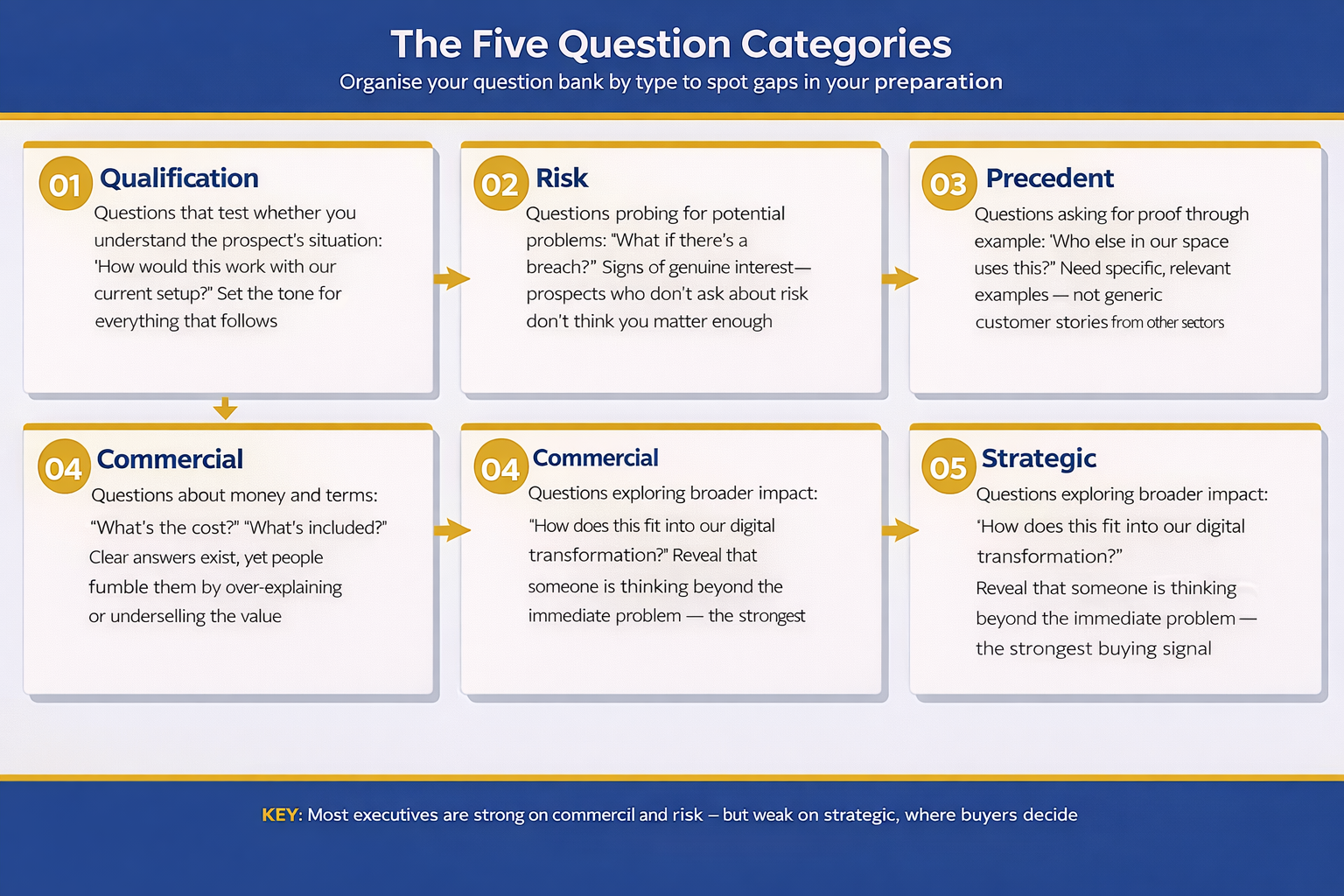
Most presentation questions fall into five natural categories:
Category 1: The Qualification Questions. These test whether you understand the prospect’s situation. “How would this work with our current setup?” “What’s the typical timeline?” “Has anyone in our industry implemented this?” These questions come early and set the tone for everything that follows.
Category 2: The Risk Questions. These probe for potential problems. “What if there’s a data breach?” “What happens if you go out of business?” “How do we ensure this doesn’t disrupt our operations?” Risk questions often feel aggressive, but they’re actually signs of genuine interest. A prospect who doesn’t ask about risk doesn’t believe you matter enough to worry about.
Category 3: The Precedent Questions. These ask for proof through example. “Who else in our space uses this?” “Can you share a case study?” “What did you do when a client had this exact problem?” Precedent questions need specific, relevant examples—not generic customer stories.
Category 4: The Commercial Questions. These focus on money and terms. “What’s the cost?” “How do you price this?” “What’s included in the base package?” These questions have clear answers, yet people often fumble them by over-explaining or underselling.
Category 5: The Strategic Questions. These explore broader implications. “How does this fit into our digital transformation?” “What’s your vision for where this goes?” “How will this change the way we work?” Strategic questions reveal that someone is thinking beyond the immediate problem and imagining long-term outcomes.
When you’re building your question bank, categorise each recurring question into one of these five types. This immediately shows you where your preparation is strongest and where you need to do more work. Most executives have strong answers for commercial and risk questions but weaker answers for strategic questions—precisely the questions that buyers ask when they’re seriously considering you.
The Answer Framework for Each Entry
Once you’ve identified a recurring question and categorised it, the next step is to build a framework for your answer. This isn’t a word-for-word script. It’s the architecture of your response—the elements that make the answer work.
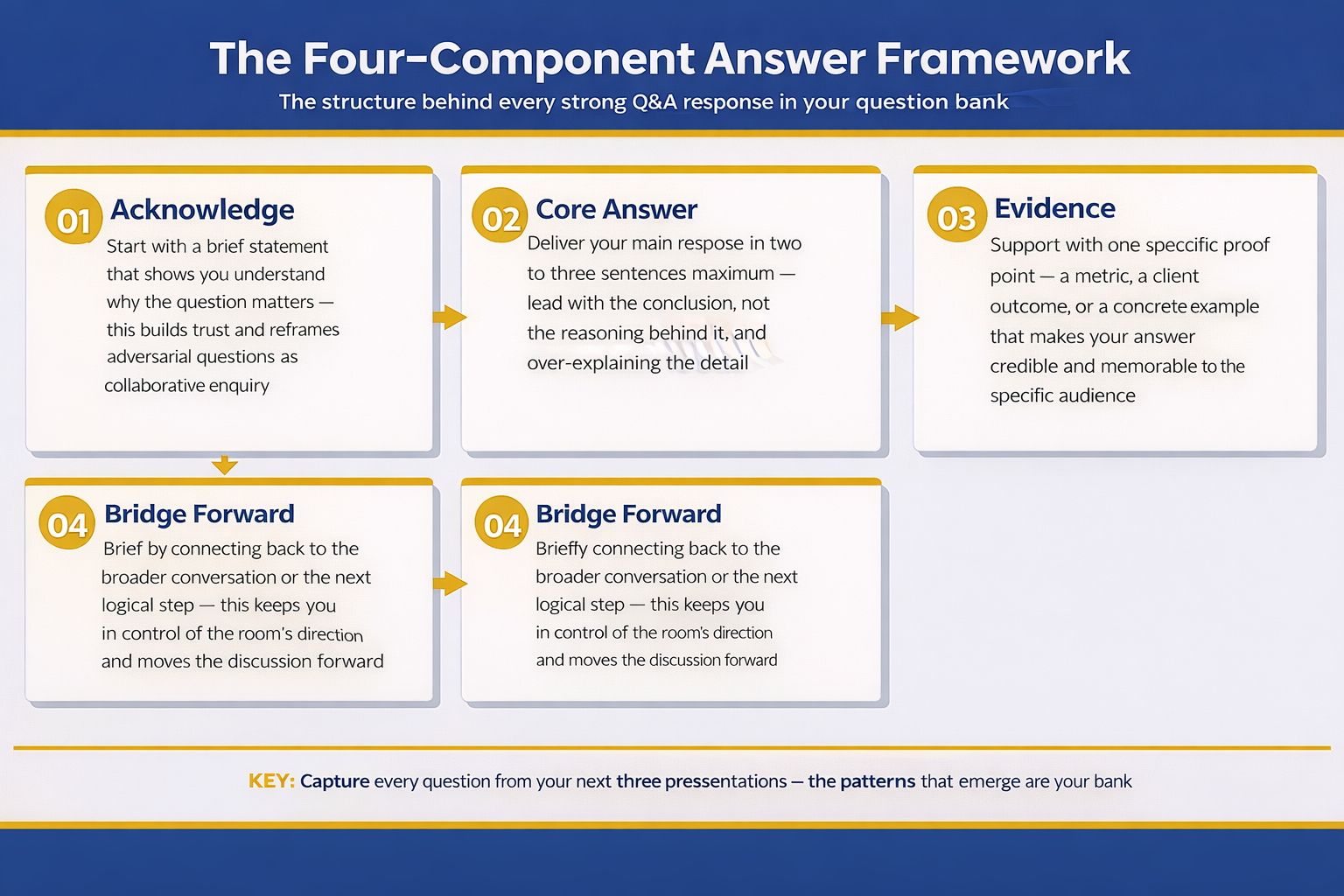
Every strong answer has four components. Master this framework, and you’ll never be caught flat-footed by a question again.
Component 1: The Acknowledgement. Start by acknowledging what the question reveals about the prospect’s concern. If someone asks “What happens if there’s a data breach?” they’re signalling that security and trust matter to them. Your first words should reflect that you understand the seriousness of the concern. “That’s a critical question—it shows you’re thinking about operational resilience, and you’re right to ask.” This takes five seconds and immediately builds trust. It also reframes the question from adversarial to collaborative.
Component 2: The Core Answer. This is the substance. It’s one to three sentences that directly address the question without hedging or over-explaining. For the data breach question, your core answer might be: “We use AES-256 encryption at rest and in transit, maintain SOC 2 Type II certification, and carry cyber liability insurance of £X million. We’ve been audited by [recognised auditor] annually for the past five years.” Notice what’s missing: you’re not explaining what encryption is, apologising for industry-wide security challenges, or offering unnecessary qualifications. You’re stating the fact with confidence.
Component 3: The Proof. This is where you provide evidence through example, data, or case study. For the data breach question: “Across our customer base, we’ve had zero breaches in our platform in [number] years. We’ve had clients in regulated industries like [sector] choose us specifically because of our security posture.” The proof component answers the unspoken follow-up: “How do I know you’re telling me the truth?” A strong proof component uses specific, verifiable evidence, not generic reassurance.
Component 4: The Bridge Forward. This brings the conversation back to the prospect’s situation and moves the discussion forward. “The reason I mention our security approach is that we know it’s non-negotiable in your industry. Once we’ve confirmed the technical architecture meets your requirements, we can move to discussing implementation and timeline.” The bridge acknowledges their concern has been addressed and introduces the next logical conversation.
Apply this framework to every recurring question in your bank. You’ll notice two things: first, you have to really understand your answer to structure it this way. You can’t fake this framework. Second, when you deliver a response using this structure, people perceive you as more competent and more trustworthy. The structure itself is persuasive.
Building Your Bank from Real Meetings
The strongest question banks are built from real presentations, not from theoretical guessing. Here’s how to build yours without waiting for a perfect moment.
Step 1: Listen and Record. In your next five presentations, bring a notebook or use your phone to jot down every question that comes up. Don’t overthink it—just write the question as it was asked. You’re looking for patterns. After five presentations, you’ll likely see that the same eight to twelve questions appeared across multiple meetings, even if they were phrased slightly differently.
Step 2: Cluster and Name. Take your list of questions and group the similar ones together. “How do you handle integrations?” and “Does this connect with Salesforce?” are essentially the same question asked different ways. Name the cluster with a clear, single question that captures the essence. “How does the platform integrate with existing systems?” becomes your bank entry.
Step 3: Rate Your Current Answers. For each clustered question, honestly rate how confident you felt answering it in recent presentations. Use a simple scale: Strong (I answered this with confidence and clarity), Moderate (I answered it adequately but felt there was something missing), Weak (I stumbled through this or changed my answer between presentations).
Step 4: Build the Framework. Start with your “Strong” answers. Write them up using the four-component framework: acknowledgement, core answer, proof, bridge forward. Don’t overthink this. If the answer worked in a real presentation, capture what made it work. Then move to your “Moderate” answers and refine them using the framework. Finally, tackle your “Weak” answers, which usually means researching a bit more and finding a better proof point.
Step 5: Test and Refine. The next time someone asks one of your banked questions, deliver the framed answer. Pay attention to their reaction. Did they seem satisfied? Did they ask a follow-up? Did you spot a better way to phrase something? Make notes after the presentation. Your question bank isn’t static—it evolves based on what works in real conversations.
This approach takes the guesswork out of preparation. You’re not trying to imagine what questions might come up. You’re capturing what actually comes up and building a tested response system around it.
Maintaining and Updating Your Bank
A question bank is only valuable if it stays current. The moment your market, your product, or your competitive situation shifts, your answers need to shift too.
Monthly Review. Set a calendar reminder for the first Monday of each month. Spend thirty minutes reviewing your question bank. Go through each entry and ask: Have I answered this question in the past month? If yes, how did it land? Do I need to adjust anything? If no, is this still a question that comes up, or can I retire this entry? This monthly discipline keeps your bank aligned with what’s actually happening in your presentations.
Seasonal Updates. Quarterly, do a deeper review. Look for new questions that have emerged. In Q1, prospects might focus on budget cycles and board-approved initiatives. In Q4, they might focus on year-end commitments and next-year planning. Your question bank should reflect these seasonal variations. Add new questions that surfaced in recent presentations. Remove questions that haven’t appeared in three months. This keeps your bank lean and relevant.
Competitive Shifts. If a competitor launches a new feature, releases new pricing, or makes a market announcement, review your bank immediately. You’ll almost certainly be asked about it. Develop your four-component answer before the next presentation, not during it. This is where the value of a maintained bank becomes obvious. Everyone will be asked the same competitive question. Your question bank means you’ll be ready. Your competitors will be improvising.
Proof Point Rotation. Every six months, look at the proof points (case studies, customer examples, data points) in your answers. Have they aged? Do they still feel current and relevant? Replace older examples with newer ones. A prospect is more impressed by “We helped a customer in your sector solve this in the past two months” than “We’ve been solving this for years.” Rotating proof points keeps your answers feeling fresh and recent.
The Q&A Preparation Checklist for Executives can help you structure this monthly and seasonal review process.
Using Your Bank for Live Preparation
A question bank is only useful if you actually use it before presentations. Here’s how to make it part of your real preparation workflow.
Seven Days Before. Pull your presentation attendee list. Based on titles, industries, and company type, identify which questions from your bank are most likely to come up. If you’re pitching to CFOs, your commercial and risk questions matter most. If you’re pitching to operations leaders, your implementation and integration questions matter most. Prioritise your review based on the specific audience.
Three Days Before. Review the five to seven questions most likely for this specific presentation. Read through each four-component answer. Don’t memorise it. Just let the framework settle into your mind. Read it once, let it sit, read it again. This is different from studying. You’re activating knowledge you already have, not cramming new information.
Day Before. Do a final read of your top three questions. If there’s a new development you should mention (new customer, new feature, new market announcement), update your proof point accordingly. Spend five minutes visualising how you’ll answer each question. See yourself staying calm, delivering the answer with the four components in order, and moving the conversation forward. This mental rehearsal is remarkably effective.
During the Presentation. When a question lands, take a breath. You know the framework for this question because you’ve practiced it. You know the acknowledgement that shows you understand their concern. You know your core answer with confidence. You know the proof point that builds credibility. You know the bridge that moves the conversation forward. You’re not thinking on your feet. You’re executing a framework you’ve already internalised.
This is where most people realise the actual value of a question bank. It doesn’t reduce spontaneity. It enables spontaneity. You can fully listen to the questioner, respond authentically, and draw on a structure that you know works—all at the same time.
If you want to accelerate this process and integrate Q&A preparation into a complete system, the Executive Q&A Handling System walks you through the entire build-and-maintain process with templates, frameworks, and strategic guidance.
Stop Leaving Your Best Answers to Chance
A well-built question bank eliminates inconsistency, saves preparation time, and directly improves your close rate. The difference between answering questions from memory and drawing on a tested framework is measurable—often the difference between 6% and 39% conversion.
- Capture every recurring question in one place, organised by type
- Build tested answers using the four-component framework that works
- Maintain your bank monthly to stay current with your market
Get the Executive Q&A Handling System → £39
Used by executives across finance, technology, and professional services.
The Three Questions Every Presenter Faces
Most of the questions that appear in your bank will fall into three recurring themes, regardless of your industry or product. Understanding these meta-questions will help you anticipate and prepare for the questions you haven’t yet heard.
Theme 1: “Will this actually work for us?” This is the core doubt underneath qualification and risk questions. The prospect is asking whether your solution is credible, viable, and suitable for their specific situation. Your answer needs to acknowledge their specific constraints and show that you’ve solved similar challenges before. This is where precedent questions are so valuable. Prospects don’t want generic reassurance. They want evidence from situations that look like theirs.
Theme 2: “Can we afford this and what are the trade-offs?” This surfaces in commercial questions, but it goes deeper than just price. Prospects are asking whether the value justifies the cost, whether it will create other expenses they haven’t anticipated, and whether they’re getting a good deal compared to alternatives. Your answer needs to separate total cost of ownership from upfront price, and anticipate the trade-offs they’re worried about before they ask.
Theme 3: “What does this change about how we work?” This is the strategic question that separates buyers who are seriously considering you from those who are just gathering information. They’re asking about implementation, timeline, change management, and the implications for their team and operations. Your answer needs to be honest about what will change (they know something will) and clear about how you’ll guide them through it.
As you build your question bank, notice how your recurring questions connect to these three meta-themes. Your bank answers should directly address these underlying concerns, not just answer the surface question.
Use your question map to visually organise these three meta-themes across your five question categories. This gives you a complete strategic view of your Q&A landscape and helps you spot gaps in your preparation.
Master the Framework That Changes Everything
The difference between a scattered Q&A approach and a systematic question bank is the difference between hoping you answer well and knowing you’ll answer well.
- Apply the four-component answer framework to every recurring question
- Build answers that are tested, credible, and naturally delivered
Get the Executive Q&A Handling System → £39
The framework used by top sales leaders and business development executives.
Moving from Scattered Q&A to Systematic Preparation
The mistake most executives make is waiting for perfection before they start capturing their questions. They think they’ll build a complete, exhaustive question bank all at once. That’s backwards. Start with your top five questions. Build the four-component answer for each. Test them. Refine them. Then add five more.
A question bank isn’t built in a day. It’s built in conversations—in presentations, in follow-ups, in moments where you realise a question worked better when you answered it differently.
The system is simple. Capture it. Test it. Refine it. Repeat. After four weeks, you’ll have a bank that covers 80% of your presentations. After eight weeks, you’ll realise you’ve stopped answering questions inconsistently. After twelve weeks, you’ll notice your close rate has shifted.
This isn’t about memorising scripts or sounding robotic. It’s about building confidence through systematic preparation. When you know you have a tested answer for the most important questions, you can be fully present in the conversation. You can listen deeply. You can respond authentically. You can move deals forward.
The Complete Q&A Preparation System for Executives
A question bank is just the foundation. A complete Q&A handling system includes question prediction, tactical frameworks, and maintenance protocols. The result is that you walk into every presentation knowing you can handle whatever comes your way.
- Identify your core recurring questions using the clustering method
- Build tested answers using the four-component framework
- Integrate Q&A preparation into your pre-presentation workflow
- Maintain your bank monthly to stay competitive and current
- Use your bank to improve consistency, confidence, and close rates
Get the Executive Q&A Handling System → £39
Complete system including question capture templates, answer frameworks, maintenance checklists, and strategic Q&A mapping.
Is This Right For You?
- ✓ Answer the same questions repeatedly but sometimes give different versions of the answer
- ✓ Want to reduce your Q&A preparation time without reducing quality
- ✓ Know your best answers work but haven’t systematised them
- ✓ Want to close more deals by being more consistent and confident in Q&A
- ✓ Are responsible for multiple presentations or team preparation
- ✗ Face entirely new questions in every presentation (you need question mapping, not banking)
- ✗ Are not currently presenting regularly (build your bank once you have recurring presentations)
- ✗ Prefer to improvise all answers without frameworks
Frequently Asked Questions
Related Strategies From Today
We’ve published three articles today exploring different angles of executive presentation mastery:
- The Competitive Displacement Pitch: Replacing an Incumbent Vendor When They’re in the Room — How to position yourself when a competitor is already entrenched, with tactical Q&A approaches for displacement scenarios.
- NLP Anchoring for Presenters: The Technique That Changed My Career (Step-by-Step) — How to use anchoring to create powerful recall and emotional resonance in your presentations.
Your Next Step
A question bank isn’t complex. It’s just systematic. You’ve probably already built most of it in your head through dozens of presentations. What’s missing is the discipline to capture it, structure it, and maintain it.
Start this week. In your next presentation, capture every question that comes up. Don’t overthink it. Just write them down. After your third presentation, you’ll see patterns. Those patterns are the beginning of your question bank. From there, apply the four-component framework we’ve discussed, test your answers, and maintain them monthly. Within a month, you’ll notice the difference in your preparation time and your confidence. Within three months, you’ll notice the difference in your close rate.
The Executive Q&A Handling System gives you templates and frameworks to accelerate this process, but the work itself—the listening, the refining, the maintenance—is worth doing regardless. This is foundational to executive presence.