Category: Speaking Anxiety, Fear & Confidence

16 Apr 2026
Female manager presenting a business case to senior leadership team, composed and authoritative, navy blazer, corporate boardroom

Presentation Skills Training for Managers

Presenting to your own team and presenting upward to senior leadership are different disciplines. Most managers discover this the hard way — they prepare thoroughly, they know their material, and then something goes wrong in the room. The director asks a question they were not expecting. The CFO challenges the numbers before slide five. A non-executive cuts across the argument with a concern that derails the structure. Generic presentation skills training does not prepare managers for any of this. It teaches confidence and delivery. It does not teach the structural decisions that determine whether a senior audience accepts or defers your recommendation.

Priya had been presenting internally for six years by the time she was asked to bring a business case to the executive leadership team. She was confident in front of groups. She had done presentation training as a new manager and had put it into practice. She could hold a room, manage nerves, and take questions. What she had not done was present to people whose job is to interrogate recommendations, not receive them. Her slide deck covered the case logically, building from context through evidence to conclusion over fourteen slides. Forty seconds into slide three, the Operations Director interrupted: “Just tell me what you’re asking for and why it’s better than doing nothing.” The room fell silent. Priya had prepared thoroughly for a presentation. She had not prepared for that question — because she had placed the recommendation on slide twelve, and no executive committee has ever waited that long. She found the slide, gave the ask, and recovered well. But she had lost the room’s confidence in the architecture of her thinking before the case was made. What she needed was not more confidence. She needed a different structure.

Preparing to present to senior leadership? The Executive Slide System gives managers the slide templates, AI prompt cards, and structure guides for presenting upward with authority. Explore the System →

Why Generic Presentation Training Does Not Prepare Managers for Senior Audiences

Most presentation skills training for managers focuses on delivery: voice projection, eye contact, posture, managing nerves, using pauses effectively. These are useful skills. They are not the skills that determine whether a senior leadership presentation succeeds or fails.

Senior leaders do not typically evaluate presentations on delivery quality. They evaluate them on the quality of the thinking. Is the recommendation clear? Is the evidence logically structured? Has the presenter anticipated the objections? Is there a credible path forward? A manager who delivers with polished confidence but buries the recommendation on slide nine will lose a senior audience before the middle of the deck. A manager who presents with visible nerves but opens with a clear recommendation, supports it with organised evidence, and closes with a specific next step will hold that audience’s attention and respect.

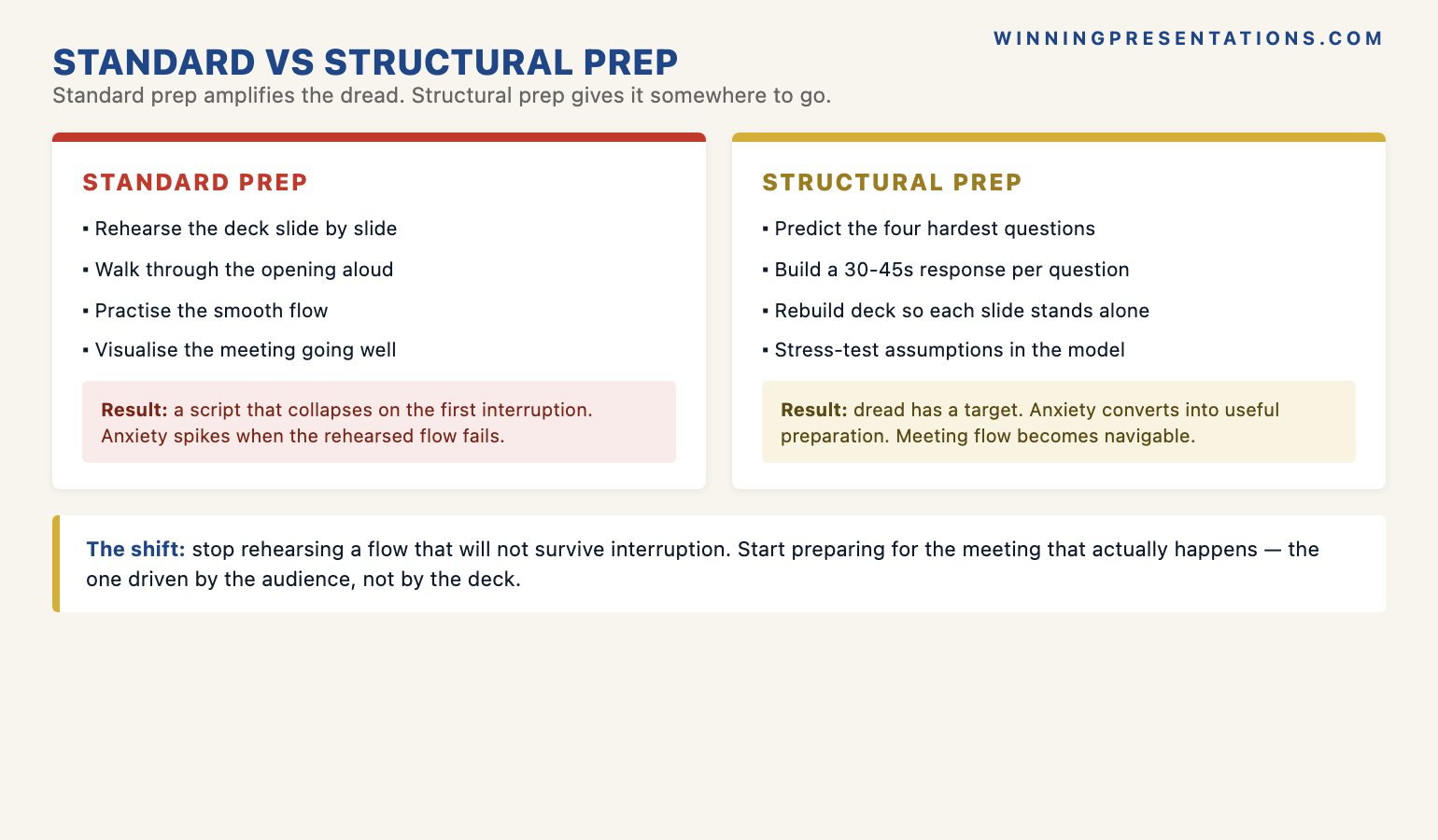
The other thing generic presentation training does not cover is the dynamics specific to presenting upward. In a standard presentation, the presenter controls the floor. In a senior leadership presentation, the audience frequently interrupts — not to be difficult, but because that is how executive committees work. They identify their priority question early and ask it, often before the presenter has reached the slide that addresses it. A manager who has not prepared for this dynamic — who experiences the interruption as a derailment rather than as a normal feature of senior stakeholder engagement — can lose composure at exactly the moment when composure matters most.

Effective presentation skills training for managers must therefore cover three things that generic training omits: presentation architecture for senior decision-makers, objection anticipation and pre-emption, and composure strategies for live challenge. Without these, even a well-delivered presentation may fail to secure the outcome the manager needs.

The Structure Managers Need for Senior Presentations

The Executive Slide System gives managers scenario-specific slide templates, AI prompt cards, and framework guides — built for presenting upward to senior leadership, not for general team communication. £39, instant download.

  • ✓ Slide templates for high-stakes upward presentations
  • ✓ AI prompt cards to build decision-ready decks faster
  • ✓ Framework guides covering structure, evidence, and risk
  • ✓ Instant download — use immediately for your next presentation

Get the Executive Slide System → £39

Designed for managers and executives preparing high-stakes upward presentations

The Structure Gap: How Managers Need to Present Differently Upward

The most consequential structural difference between presenting to peers and presenting to senior leadership is the position of the recommendation. When presenting to a team or a peer group, building context before the conclusion is natural — you establish shared understanding before making the ask. When presenting upward, this approach works against you.

Senior leaders are time-constrained and operate under high cognitive load. They process information more efficiently when they know the conclusion first and evaluate the evidence in light of it, rather than receiving the evidence and forming a view independently. A presentation that opens with context and builds toward a recommendation asks the senior audience to hold all the evidence in working memory until the conclusion arrives — which is not how executive committees read or listen.

The recommendation-first structure that works for senior audiences looks like this: a brief context statement (one to two slides establishing why this is being presented now), the recommendation itself (stated plainly — what you are asking for, or what you recommend doing), the evidence that supports it (organised logically, not chronologically), a risk acknowledgement (the two or three most likely objections, each with a specific response), and a clear next step. This is the structure that allows a senior leader to engage with your recommendation from slide two, rather than suspending judgement for twelve slides.

For new managers presenting upward for the first time, the hardest part of this structural shift is placing the recommendation before they feel they have earned the right to make it. The impulse is to build the case first. But senior audiences are not waiting to be persuaded before hearing the ask — they want the ask upfront so they can evaluate the case with the recommendation in mind. The structure that feels presumptuous in practice is the one that works.

The five-part executive presentation outline maps this structure in full — covering the exact sequencing decisions that allow a manager’s recommendation to land before the room has had time to form a counter-position.

Handling Scrutiny: When Senior Leaders Challenge Your Case

The moment that separates managers who build a reputation in senior presentations from those who do not is usually not the quality of their slides. It is how they respond when a director challenges their numbers, their logic, or their assumptions.

Senior leaders challenge presentations not primarily to undermine them but to test them. A challenge is, in most cases, a signal of interest: the director is engaging with the proposal seriously enough to probe it. A manager who receives a challenge as an attack and becomes defensive has misread the dynamic. A manager who receives a challenge as a question and responds with specific, calm, well-organised information has demonstrated exactly the credibility that senior presentations are designed to establish.

Preparing for scrutiny requires identifying the three to five objections most likely to be raised before you present, and building your response to each into the deck. Not buried in an appendix — in the main body, as a risk acknowledgement section that addresses the objection before it is raised. This has two effects: it pre-empts the objection, which removes one source of challenge from the room, and it demonstrates that you have engaged with the downside, which builds credibility for the recommendation.

When challenges come in real time during the presentation, three composure practices matter most. First, pause before responding — two or three seconds is not a long silence, but it signals that you are considering the question rather than reacting to it. Second, name the question before answering it: “That’s a question about the timeline — let me address that directly.” This gives you a moment to organise your response and signals to the questioner that you have understood what they are asking. Third, answer specifically and move on — do not over-explain or qualify excessively. A direct, specific response followed by a return to the structure of your presentation is more authoritative than a detailed elaboration that leads the room further from the decision.

For managers whose primary concern about senior presentations is the challenge dynamic rather than the structural one, the framework for presenting to resistant or hostile audiences covers the specific techniques for managing a room where the challenge level is sustained rather than occasional.

The Executive Slide System includes framework guides covering how to structure the risk acknowledgement section that pre-empts the objections most likely to arise in management presentations to senior leadership.

Presenting Resource Requests and Business Cases to Senior Leadership

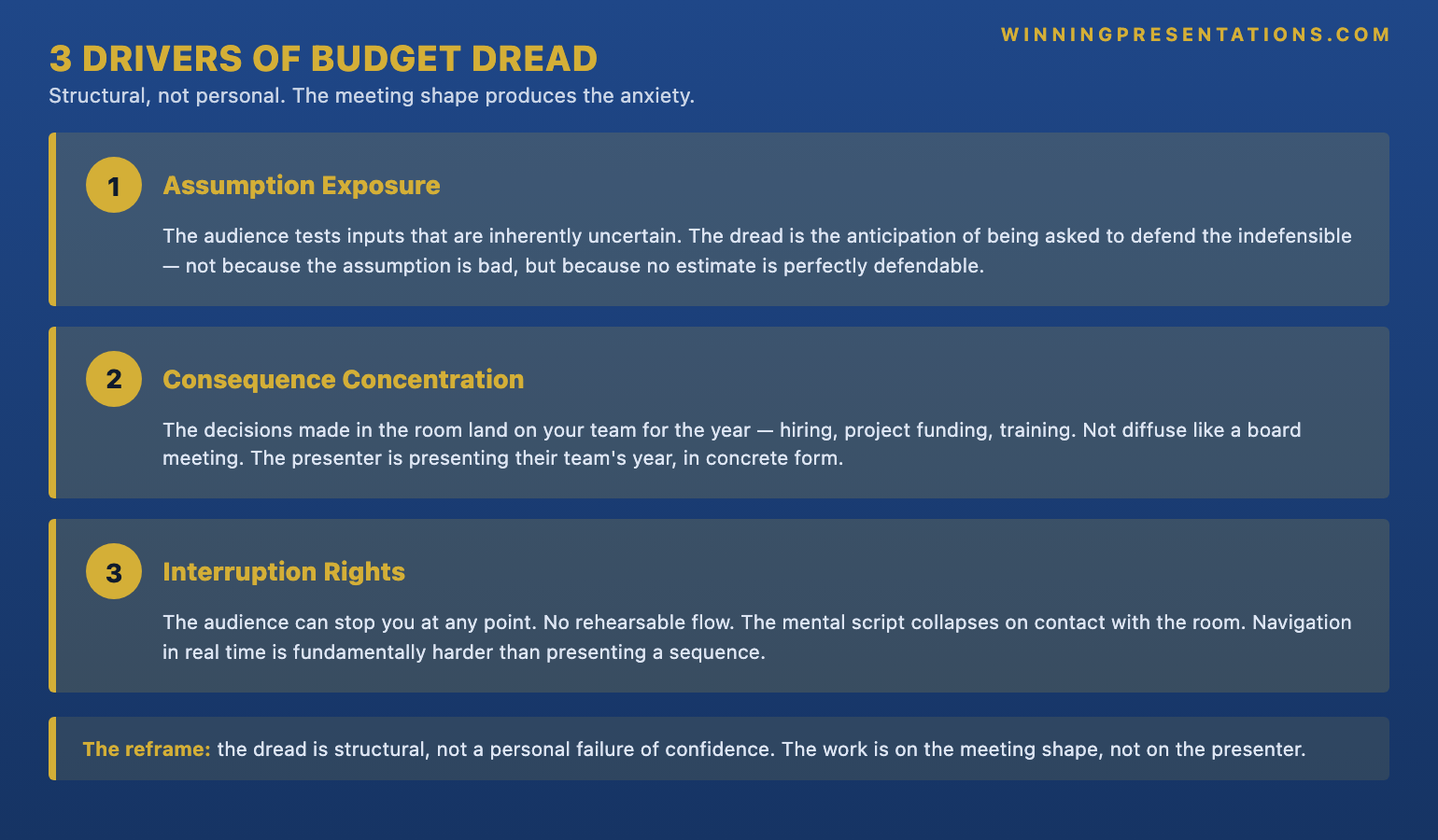
The presentation type that causes managers the most difficulty is the resource request: a budget ask, a headcount case, a capital investment proposal. These are presentations where the manager needs something from the senior audience and the senior audience is simultaneously under pressure to limit or reduce what it gives. The structural and psychological challenge is significant.

The most common failure mode in resource request presentations is what might be called the apologist structure: the manager spends the first half of the deck establishing how much they have achieved with existing resources, implying that they should not need more before eventually making the ask. This structure undermines the request before it is made. It signals awareness that the ask may not be welcome and pre-emptively hedges against it. Senior leaders read this defensiveness and it reduces their confidence in the manager’s conviction about the proposal.

An effective resource request presentation starts from a different premise: the ask is not a favour, it is an investment decision. Framing the request as an investment decision shifts the conversation from “please give us more” to “here is what the organisation gets if it commits this resource.” The financial logic is the same either way, but the framing is entirely different — and framing is what determines whether a senior audience evaluates a resource request as a cost or as an opportunity.

The evidence section of a resource request also needs specific elements that general business presentations omit. The cost of not approving the request — the operational impact, the missed opportunity, the accumulated risk of deferral — is as important as the case for approval. Senior leaders who are undecided between approving and deferring a resource request will often make their decision based on their assessment of what happens if they do nothing. Making that case explicitly, rather than leaving the senior audience to infer it, is one of the structural choices that separates resource requests that are approved from those that are deferred for further consideration.

The framework for presenting difficult information to senior leadership is directly relevant here — resource requests where the current situation is unsustainable require the same credibility-preserving structure as formal difficult-results presentations.

Building Credibility Through Repeated Senior Presentations

Credibility with senior leadership is built presentation by presentation, over time. Each presentation is an opportunity to demonstrate a specific set of qualities: clear thinking, organised evidence, sound judgement about risk, and a realistic understanding of what the organisation can and cannot do. Managers who consistently demonstrate these qualities in their presentations build reputations that precede them — which changes how senior leaders engage with their proposals.

The most important credibility signal in any senior presentation is specificity. Vague language — “we need more resource,” “the timeline might be challenging,” “there are some risks to consider” — signals that the presenter has not done the analytical work to support a recommendation. Specific language — “we need two additional analysts by the end of Q2,” “the implementation timeline has a four-week dependency on the vendor contract review,” “the primary risk is budget overrun in the infrastructure phase, which we have mitigated by capping the vendor commitment until Phase 1 completion” — signals that the presenter has thought the problem through. Senior leaders recognise the difference immediately.

The second credibility signal is the ability to stay on structure when the room becomes difficult. A manager who loses their thread under challenge or who abandons their prepared structure and begins improvising will leave senior leaders with a residual impression of unpreparedness, regardless of how strong the content was. Managers who can acknowledge a challenge, address it specifically, and return cleanly to the structure of their argument demonstrate exactly the composure under pressure that senior leadership values.

Over time, the managers who build the strongest track records in senior presentations are those who treat each presentation as a structured communication exercise, not a performance. The goal is not to impress the room with delivery quality. The goal is to make the decision the room needs to take as easy as possible to take — by providing the right information, in the right order, with the right level of specificity. Managers who do this consistently find that their presentations become shorter, more direct, and more effective with each iteration, because they have learned what senior audiences actually need from them.

Slide Templates and Frameworks for Presenting Upward

The Executive Slide System gives managers scenario-specific slide templates, AI prompt cards, and framework guides for business cases, resource requests, and senior leadership presentations. £39, instant download.

Get the System Now → £39

Frequently Asked Questions

What presentation training do managers actually need?

Managers presenting upward need training in three specific areas that generic public speaking courses do not cover: structuring a recommendation for senior decision-makers, handling the scrutiny that comes with resource requests and business cases, and managing composure when a director challenges their numbers or their logic. Generic presentation skills training teaches eye contact and vocal variety. Effective management presentation training teaches how to structure a case, anticipate objections, and hold your position under pressure.

How do I improve my presentation skills for presenting to senior leadership?

The most important improvement for managers presenting upward is structural — moving the recommendation to the beginning of the presentation rather than building to it at the end. Senior leaders evaluate evidence more effectively when they know what they are being asked to approve. Beyond structure, the specific skills that make the most difference are: concise evidence sequencing (supporting the recommendation without overwhelming it), a risk acknowledgement that shows you have thought through the downside, and a clear next step that defines what you are asking the senior audience to do.

Is there presentation skills training for managers in the UK?

Yes. Winning Presentations offers the Executive Slide System — a self-paced resource covering slide structure, AI prompt cards, and framework guides for managers presenting to senior leadership in UK organisations. It is designed for managers who are preparing a specific high-stakes presentation and need structured guidance rather than a generic training course. It covers the structural and language decisions that matter most when presenting upward in a UK business environment.

How long does it take to improve presentation skills for senior-level presentations?

Structural improvements — particularly recommendation-first framing, concise evidence sequencing, and risk acknowledgement — can be applied to any presentation within a single preparation session once you understand the principles. The Executive Slide System is designed for this: it provides the framework and templates to apply immediately to your next presentation, not a multi-week course before you see results. Sustained improvement in composure under scrutiny takes longer, but the structural improvements that make the biggest difference to senior audience reception can be implemented straight away.

The Winning Edge

Weekly insights on executive presentations, slide strategy, and boardroom communication.

Subscribe Free

About the author

Mary Beth Hazeldine, Owner & Managing Director, Winning Presentations. With 25 years of corporate banking experience at JPMorgan Chase, PwC, Royal Bank of Scotland, and Commerzbank, and 16 years training managers and executives across financial services, healthcare, technology, and government, she works with leaders preparing high-stakes presentations to senior decision-makers.

16 Apr 2026
Female executive presenting to a senior team in a large open meeting room, standing with composed grounded posture, audience visible and engaged, professional corporate setting

Movement During Presentations: How to Use Physical Space Without Losing Authority

Quick answer: Movement during presentations affects how authority is perceived — but the nature of that movement determines whether it increases or undermines credibility. Purposeful movement that connects to a specific point, transitions between content sections, or closes the physical distance with a key audience member builds presence. Anxious movement — pacing, rocking, shifting weight repeatedly — signals discomfort and draws the audience’s attention away from what is being said. Managing movement under pressure is a physical discipline, not simply a matter of awareness.

Valentina knew her material. She had spent three evenings preparing the numbers and had rehearsed the key points twice the night before. Walking into the steering committee room, she felt reasonably prepared — until she reached the front of the room and realised there was no lectern, no table to stand behind, and sixteen people seated in a horseshoe facing her directly.

She started well. But by the third slide, she noticed she had moved to the left side of the room and was unconsciously pacing — small, repetitive steps that she could feel herself making but could not seem to stop. The movement was not covering any ground purposefully. It was simply the physical expression of the discomfort she was managing internally. A colleague told her afterwards that one of the committee members had whispered something to the person beside him around slide four. She spent the drive home convinced it was about her movement.

What Valentina experienced was not unusual. The physical symptoms of presentation anxiety — the activated nervous system, the heightened muscle tension, the excess energy that has no natural outlet in a formal presentation setting — often manifest as movement. The movement feels like it is helping, because it is releasing physical tension. But to the audience watching, particularly a senior one, it reads as something else entirely.

If physical symptoms — including nervous movement, tension, and restlessness — are affecting how you come across in high-stakes presentations, Calm Under Pressure provides a structured approach to managing those physical responses in the room.

Explore the Approach →

Why Nervous Movement Signals Uncertainty to Senior Audiences

Senior audiences read physical signals faster than most presenters realise. Before the first sentence has been completed, the room has already formed an impression based on how the presenter entered the space, where they stood, and what their body was communicating before they spoke. Nervous movement is one of the clearest physical signals that an audience receives and interprets — often without consciously registering that they are doing so.

The reason nervous movement reads as uncertainty is grounded in how people interpret physical behaviour in high-stakes contexts. A presenter who is comfortable with the material and comfortable in the room typically uses their body deliberately — they move to make a point, to shift the audience’s attention, or to manage the physical space of the room. When movement is random, repetitive, and disconnected from the content, it signals that the body is reacting to internal discomfort rather than engaging with the external environment.

For senior audiences — particularly boards, investment committees, and executive leadership teams who have spent years assessing presentations — this interpretation happens quickly and often with limited generosity. They are not wrong to notice it. Movement under pressure is genuinely informative about a presenter’s internal state. The question is not whether the audience will read it, but what you are giving them to read.

Understanding the relationship between movement and perceived authority is part of the broader discipline of executive physical presence. For related reading on how hand and arm positioning affects credibility, the article on presentation gestures and executive authority covers how deliberate gesture use reinforces rather than contradicts what is being said.

Calm Under Pressure — £19.99, instant access

Manage the Physical Symptoms of Presentation Anxiety — In the Room, in Real Time

Calm Under Pressure is a practical resource for executives who experience physical symptoms of anxiety in high-stakes presentations — shaking, sweating, voice changes, restlessness, and the kind of nervous energy that shows up in your body before the room has had a chance to form an opinion. It provides in-the-moment physical management techniques designed for professional settings where you cannot pause and regroup.

  • In-the-moment techniques for managing physical symptoms under pressure
  • Methods for grounding restless movement and nervous energy before you speak
  • Physical reset protocols for use between slides and during Q&A
  • Frameworks for maintaining composed physical presence through challenging moments

Get Calm Under Pressure →

Designed for executives and professionals who present under pressure and need practical in-the-moment physical management.

The Difference Between Purposeful Movement and Anxious Pacing

Not all movement during a presentation signals anxiety. Skilled presenters move deliberately and purposefully — and that movement enhances rather than undermines their authority. The distinction between purposeful movement and anxious pacing is not primarily a matter of how much you move, but whether the movement has an intentional relationship to the content and the audience.

Purposeful movement serves a communicative function. Walking toward a specific audience member while making a key point closes the physical distance and increases the sense of direct communication. Moving to a different part of the room when transitioning between sections of content signals to the audience that something has shifted — it provides a physical marker for a structural change in the presentation. Pausing in stillness to allow a significant point to land is a form of deliberate non-movement that communicates confidence and control.

Anxious pacing is characterised by repetitiveness and disconnection from the content. The pacing presenter moves because the internal discomfort demands a physical outlet — not because the movement serves any communicative purpose. The steps are often small, often rhythmic, and often cover the same patch of floor. The audience recognises this pattern not because they have analysed it consciously, but because it lacks the intentionality that deliberate movement carries.

A useful internal test during rehearsal: if you ask yourself why you moved just then and the honest answer is “I don’t know” or “I needed to,” the movement was anxious. If the answer is “I moved to emphasise that point” or “I moved to shift the audience’s attention to the screen,” the movement was purposeful. This distinction, practised in low-stakes rehearsals, builds the habit of intentional physical communication before you enter a room where the stakes are high.


Contrast showing purposeful movement versus anxious pacing in presentations: deliberate movement toward audience, transitional movement between sections, versus repetitive pacing disconnected from content

How Anxiety Produces Unhelpful Physical Patterns

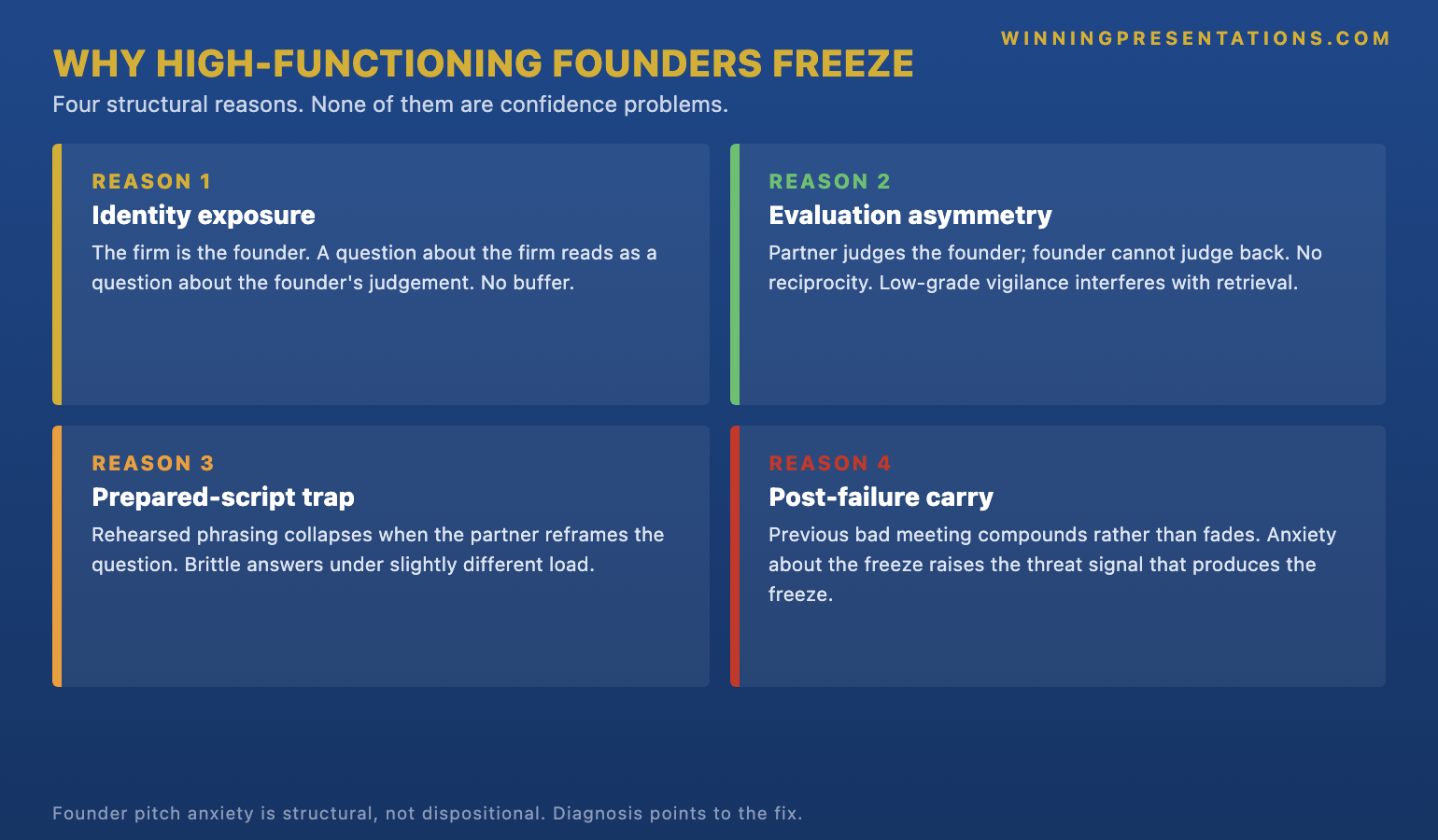
Presentation anxiety produces two distinct physical responses that affect how you occupy space in a room. The first is excess activation — the kind of nervous energy that manifests as pacing, hand movements, weight shifting, and restlessness. The second is physical freezing — a paradoxical stiffness that can set in when the anxiety is high enough that the nervous system pulls the body into a contracted, protective posture.

Both patterns — the overactive and the frozen — communicate anxiety to observers, but they do so in different ways. The overactive presenter reads as unsettled, unfocused, or uncertain about whether they should be in the room. The frozen presenter reads as stiff, disconnected, or under-prepared. Neither pattern is neutral in the way that a presenter might hope when they are simply trying to manage an internal physical state that they cannot directly control.

The anxiety-movement link is physiological. When the body perceives a threat — and a high-stakes presentation to a senior audience is interpreted by many nervous systems as a form of threat — it activates the sympathetic nervous system. Adrenaline and cortisol are released. Muscles are tensed in preparation for physical action that never comes. The body’s physical tension has nowhere to go in a boardroom, so it emerges as movement or as rigidity.

Understanding this mechanism is the first step toward managing it. You are not choosing to pace or to freeze — you are experiencing a physiological response to a perceived threat. The management strategies that work address the physiological state directly, not just the surface behaviour. Telling yourself to stop moving is rarely effective because the underlying activation has not changed. Physical grounding — through breath, through intentional muscle tension and release, through deliberate postural choices — works at the level of the nervous system, not just the conscious instruction.

For executives who experience the pre-presentation activation period as particularly difficult to manage, the article on morning presentation protocols covers how to structure the hours before a high-stakes presentation to reduce the peak of that activation before you enter the room. Managing your physical state ahead of time is more effective than trying to manage it in the moment.

Three Movement Patterns That Undermine Your Credibility

Most presenters have one or two default physical habits that they cannot easily observe in themselves during a presentation. These habits tend to be more visible in video recordings than in live self-assessment — which is one reason that rehearsing on camera, even informally, is such a reliable diagnostic tool. Three patterns appear most commonly in senior executive presentations where movement is unmanaged.

The first is the retreat pattern — moving backwards or sideways away from the audience when making a significant point. This pattern appears when the presenter is unconsciously protecting themselves from the perceived exposure of making a strong claim. The body retreats even as the words advance. The audience reads this as ambivalence — a presenter who is not fully behind what they are saying. Moving forward, toward the audience, on significant points is the correction.

The second is the weight-shift pattern — rhythmically transferring weight from foot to foot while standing in place. This is one of the most common physical habits in presentations and one of the most distracting to observe. It creates a visual rhythm that draws the eye and that reads as restlessness even when the presenter feels relatively calm. The corrective posture is feet shoulder-width apart with weight distributed evenly — a stance that feels slightly over-deliberate in rehearsal but reads as grounded to the audience.

The third is the back-turn pattern — consistently turning toward the screen or slide deck rather than maintaining eye contact with the audience. This pattern often emerges when a presenter is anxious about their content and uses the slides as a prompt. The act of turning away from the audience reduces the physical engagement with the room and signals that the presenter is not fully present with the people in front of them. Managing slides from a position that maintains forward facing — whether through memorisation, a presenter view on a laptop, or deliberate practice — removes the need for the back-turn entirely.

For practical techniques for maintaining eye contact and physical engagement with senior audiences, the article on eye contact techniques in executive presentations covers the specific disciplines for distributing attention across a room of senior decision-makers without triggering the anxiety response that makes sustained eye contact difficult.

If physical symptoms — including these movement patterns — are a persistent challenge in high-pressure presentations, Calm Under Pressure provides in-the-moment physical management techniques designed specifically for professional presentation contexts where the standard approach of taking a break or regrouping is not available.


Three movement patterns that undermine presentation credibility: the retreat pattern, the weight-shift pattern, and the back-turn pattern — with corrections for each

Building Physical Confidence for High-Stakes Presentations

Physical confidence in presentations is not a personality trait — it is a practised competence. Presenters who appear naturally composed in high-stakes rooms have typically developed that composure through deliberate rehearsal, feedback, and the accumulated experience of managing their physical state under pressure. The composure looks natural because it has become habitual; it was not natural at the start.

Building physical confidence begins with establishing a default physical position that feels stable under pressure. For most presenters, this means a grounded stance — feet approximately shoulder-width apart, weight evenly distributed, hands in a neutral position either clasped lightly in front or resting at the sides. This position may feel unnatural at first, particularly if the body’s default response to pressure is to contract or to move. Practising it in low-stakes contexts until it feels comfortable is the only way to make it available when the stakes are genuinely high.

Physical confidence also develops through deliberate movement practice. Rather than waiting for high-stakes presentations to discover your physical habits, rehearsing in a space that mimics the presentation environment — a similar-sized room, a similar physical arrangement — allows you to map out your movement choices before they become reactive. Where will you stand for the opening? Where will you move to on the first key point? Where will you position yourself for the Q&A? Making these decisions in rehearsal means you are not making them for the first time in the room.

The link between physical confidence and voice quality is also worth noting here. When the body is tense and movement is anxious, breath becomes shallow, and the voice loses both depth and steadiness. A grounded physical position supports fuller breathing, which in turn supports a more controlled and authoritative vocal delivery. Physical confidence and vocal confidence are not independent qualities — they reinforce each other in both directions. For related reading on this connection, the companion article on voice control during executive Q&A covers how physical grounding and breath management combine to maintain vocal authority under questioning.

Practising Movement Control Before You Enter the Room

The most effective physical preparation for a high-stakes presentation happens in the minutes immediately before the session, not only in the days of rehearsal leading up to it. The body’s activation state in those final minutes — the cortisol and adrenaline already circulating, the muscles already tensed — will shape how you move and stand once you enter the room. Working with that state deliberately, rather than hoping it will settle on its own, makes a measurable difference to how you present.

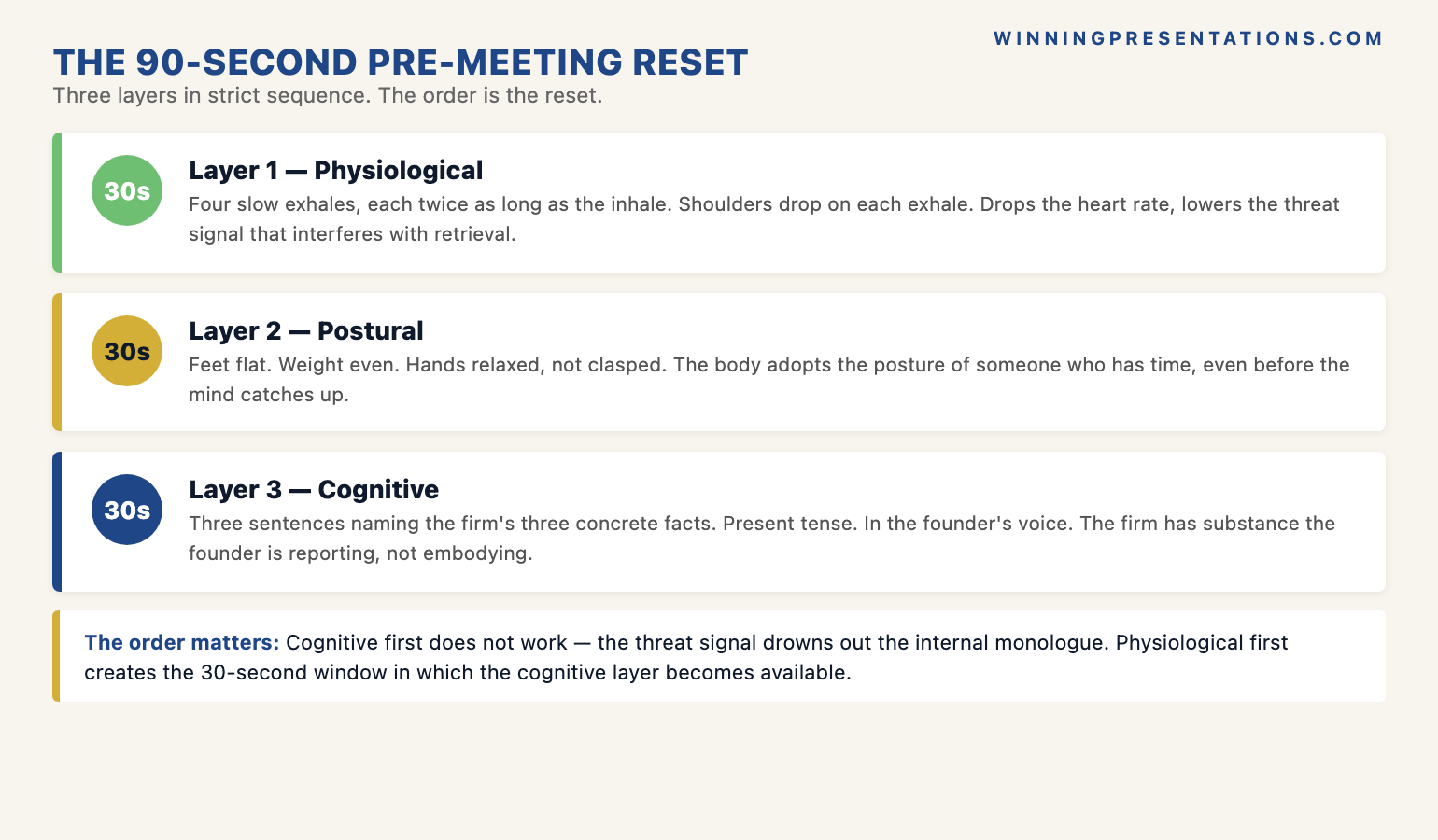
One of the most reliable pre-entry practices is deliberate physical grounding. Before entering the presentation room, find a private space — a corridor, an empty office, a bathroom — and spend ninety seconds in the default grounded stance described earlier. Feel the weight distributed evenly through both feet. Relax the muscle tension in the shoulders and jaw, which are typically the first places anxiety concentrates. Take three slow, extended exhales. The purpose is not to eliminate the activation — that would be neither possible nor desirable. It is to establish a physical baseline that is closer to composed than to reactive.

Entering the room early, when it is still empty or occupied only by support staff, also allows you to establish your physical relationship with the space before the audience arrives. Stand where you plan to stand. Walk the movement path you have rehearsed. Make the space familiar to your body before it is occupied by the people whose judgement you are managing your anxiety about. Familiarity with the physical environment reduces the additional activation that comes from encountering an unfamiliar space while simultaneously managing the presentation itself.

The pre-room preparation window is also the right time to set your physical intention. Not your content objective — your physical one. A simple internal instruction — “I will stand still unless I am moving with a purpose” — functions as a behavioural anchor that can interrupt habitual anxious movement patterns before they take hold. The instruction does not need to be complex. It needs to be specific enough that you will remember it in the room when the activation is high and the habits are pulling in a familiar direction.

Calm Under Pressure — £19.99, instant access

Manage Physical Symptoms and Nervous Energy in High-Stakes Presentations

Calm Under Pressure provides in-the-moment physical management techniques for executives who experience shaking, nervous movement, voice changes, or physical tension during presentations. It is designed for professional settings where you cannot pause, retreat, or visibly manage your anxiety.

Get Calm Under Pressure →

Designed for executives and senior professionals who need to present with composure under genuine pressure.

Frequently Asked Questions

Is it better to move around the room or stay in one place during a presentation?

Neither is inherently better — the quality of the movement determines whether it helps or hinders. Purposeful movement that connects to specific moments in the content — walking toward an audience member when making a key point, shifting position to signal a transition between sections — enhances presence. Staying in one place with genuine composure and intentional stillness also communicates authority. What undermines credibility is not the presence or absence of movement, but the repetitive, disconnected movement that signals physical restlessness rather than deliberate engagement with the room.

What should I do with my hands if I am not gesturing?

The two most neutral hand positions for a standing presentation are a light clasp in front of the body — hands lightly held at roughly waist height — or hands resting naturally at your sides. Both feel more self-conscious than they look to the audience. Hands in pockets, arms crossed, or hands gripping a lectern all carry stronger negative signals than either neutral position. If you tend to fidget with rings, pens, or clothing during high-stress moments, removing the prop before entering the room removes the fidgeting opportunity.

How do I stop pacing when I cannot tell I am doing it in the moment?

The most reliable method is to use a physical anchor — a specific spot in the room that you return to as your default position after any deliberate movement. If you have established this anchor in rehearsal, returning to it becomes a habit that interrupts the pacing pattern without requiring you to consciously monitor your movement during the presentation itself. Video review of rehearsal recordings is also valuable: most people are surprised by their movement habits when they see them on screen, and that visual feedback is more effective at building awareness than verbal feedback from observers.

The Winning Edge — Weekly Newsletter

One Insight Per Week on Executive Communication

Each week, The Winning Edge delivers one focused insight on executive communication — structure, delivery, influence, and the mechanics of getting senior audiences to yes. Straightforward, applicable, and written for people who present under pressure.

Subscribe to The Winning Edge →

About the Author

Mary Beth Hazeldine — Owner & Managing Director, Winning Presentations

With 25 years of corporate banking experience at JPMorgan Chase, PwC, Royal Bank of Scotland, and Commerzbank, and 16 years training executives in high-stakes communication, Mary Beth advises professionals across financial services, healthcare, technology, and government on presenting with authority and composure under genuine pressure. Winning Presentations is her specialist advisory practice.

15 Apr 2026
Male executive presenting via Microsoft Teams, confident expression, professional home office setting

Microsoft Teams Presentation: The Features That Build Confidence and Authority in Virtual Meetings

Quick Answer
Most executives use Microsoft Teams at a fraction of its presentation capability. The features that genuinely change how you come across — Presenter Mode, Spotlight, Background Blur precision, live reactions view — are rarely activated in senior executive meetings. More importantly, technology confidence directly reduces presentation anxiety: knowing exactly what your audience sees eliminates a significant source of pre-meeting dread. When you stop worrying about whether your slides are displaying correctly, you free up cognitive and emotional resources for the actual conversation.

Tomás had been presenting quarterly finance updates to the executive committee via Teams for two years. He was good at the numbers. He understood the story behind them. But every session carried the same low-grade dread from the moment he clicked “Join.”

He never quite knew whether his slides were displaying correctly, or whether the tiny black-and-white thumbnail versions he could see in the corner represented what the CFO and three regional directors were actually looking at. He couldn’t read facial reactions — just names in boxes. His camera sat too low, pointing slightly upward, and he’d never found the right moment to fix it. So he carried on. Dry mouth before every meeting. A tightness in his chest that didn’t fully release until the call was over. He’d assumed that was just what virtual presenting felt like. He was wrong.

If the anxiety of virtual presentations is affecting how you perform in Teams meetings, Calm Under Pressure gives you specific techniques for managing the physical symptoms of presentation stress in the moment — dry mouth, racing pulse, voice shake, and the chest tightness that can make it hard to think clearly mid-presentation.

Explore the Approach →

Why Teams Presentations Trigger a Different Kind of Anxiety

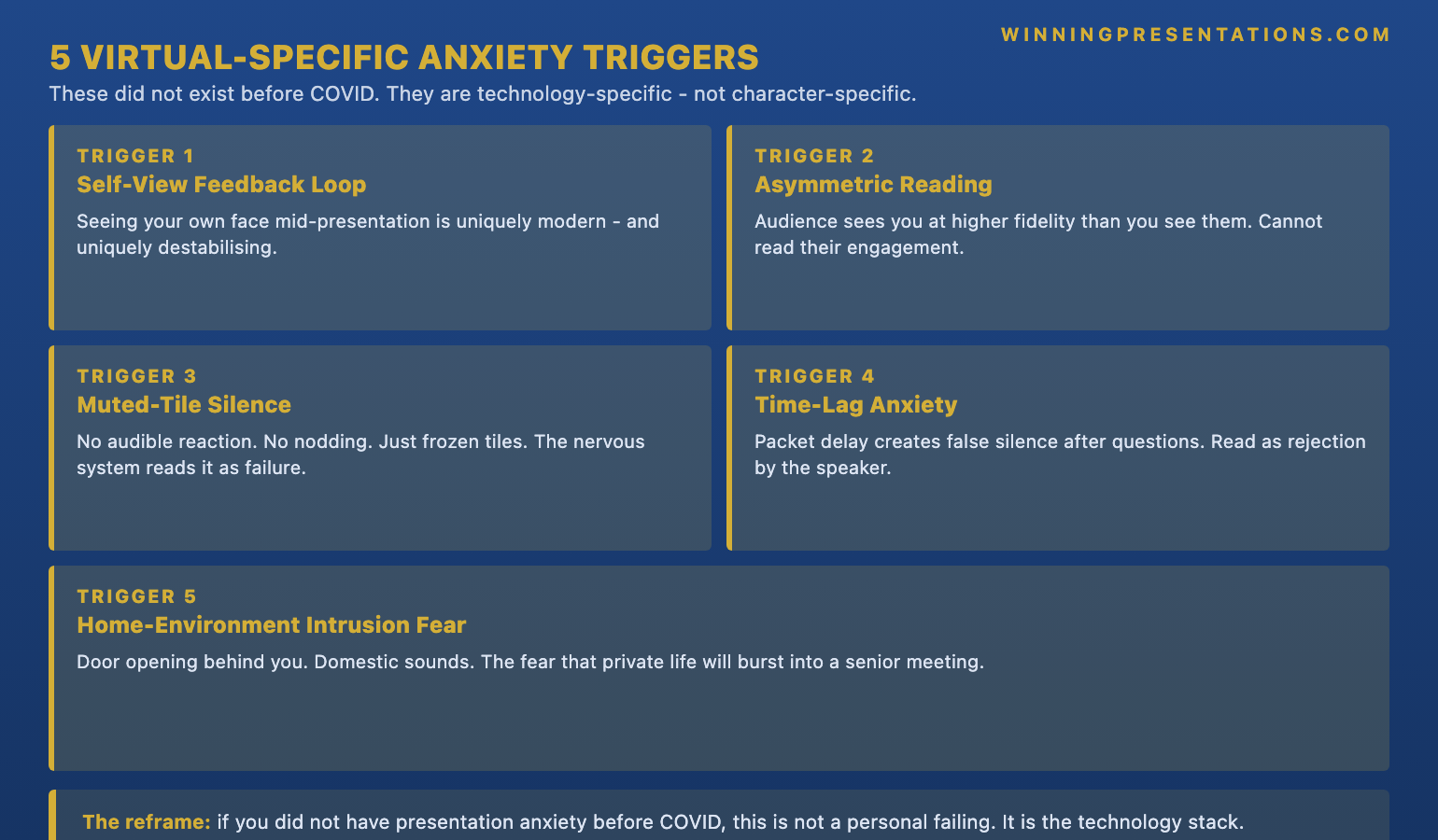
In-person presentations have their own pressures, but they give you something virtual meetings almost never do: immediate, readable feedback. You can see when someone leans in. You notice when the room goes quiet in the right way. You get to sense the energy before you even open your mouth. Virtual presentations strip most of that away, and the brain registers that absence as threat.

The anxiety that builds around Teams presentations is often less about the content and more about uncertainty. Are the slides showing? Did that last point land or did three people mute themselves because they’re checking email? Is the camera making you look unprepared? These questions run in the background like an open application you can’t quite close, consuming mental resource that should be directed at your message.

There is also a specific kind of pressure that comes from presenting to senior stakeholders in a format that feels inherently casual. The video call box places you beside everyone else regardless of seniority. The meeting recording banner is always visible. The chat panel scrolls with messages you may or may not be aware of. It is a format designed for conversation, pressed into service for high-stakes communication — and that tension is real.

Mastering your Teams environment does not remove all of that uncertainty. But it removes enough of it that the anxiety starts to reduce to a manageable level. When you know exactly what your audience sees, you stop generating catastrophic interpretations of their silence. That is a significant shift.

Calm Under Pressure — £19.99, instant access

Manage the Physical Symptoms of Presentation Anxiety — Before, During, and After Your Next Teams Meeting

Most advice about presentation nerves focuses on preparation and mindset. Calm Under Pressure takes a different approach: it addresses the physical symptoms that hit you in the moment — the symptoms that no amount of preparation has managed to prevent. Shaking hands. Sweating. Voice that won’t hold steady. The nausea that arrives as you click “Join.” These are real physiological responses, and there are specific techniques for managing them.

  • In-the-moment techniques for stopping visible shaking and steadying your hands
  • Breathing protocols that activate the parasympathetic nervous system within 60 seconds
  • Voice steadying methods for when your throat tightens before you start speaking
  • Approaches for managing sweating and the physical heat response that comes with adrenaline
  • A pre-meeting reset sequence for the 5 minutes before you join a high-stakes Teams call
  • Recovery techniques for when anxiety spikes mid-presentation and you need to regroup quickly

Get Calm Under Pressure →

Designed for executives who need to manage presentation symptoms in the moment — not weeks of practice.

The Features Most Executives Never Activate

Microsoft Teams is used daily by hundreds of millions of people, and the vast majority of them are using it at roughly 20% of its presentation capability. The default experience — share your screen, speak, hope everyone is following — misses several features that meaningfully change how you are perceived.

Spotlight is one of the most underused. It pins your video as the dominant view for all participants regardless of who else is speaking. In a standard Teams call, the active speaker tile shifts constantly — which means if someone coughs, their face takes over the screen. When you Spotlight yourself at the start of a presentation, you hold the visual frame for the room. It is a small action with a disproportionate effect on perceived authority.

Background Blur is often treated as a binary switch — on or off. What many executives miss is the difference between standard blur and portrait blur, and how each of these interacts with their specific camera, lighting, and background. Portrait mode, which uses AI to distinguish your face from the background, can create a cleaner edge effect but it also sometimes creates an unsettling halo if your lighting is inconsistent. Testing this in advance — not five minutes before a board call — removes one more variable from the anxiety equation.

The reactions panel — which shows real-time emoji responses from participants — is often left closed. But during a presentation, monitoring it briefly gives you something that in-person presenting offers freely: a signal that the room is engaged. Even a thumbs up from a senior stakeholder mid-presentation is information. It tells you the point landed. That kind of feedback, however small, reduces the catastrophising that drives virtual presentation anxiety.


Microsoft Teams presentation features checklist showing Spotlight, Presenter Mode, Background Blur and reactions panel settings for executive meetings

Presenter Mode: What Your Audience Sees and Why It Matters

Presenter Mode is one of the most significant features in the Teams presentation toolkit, and it is routinely ignored. Rather than simply sharing your screen as a flat image, Presenter Mode overlays your camera feed into the slide view — so your audience sees your face and your slides simultaneously, without switching between tiles.

There are three Presenter Mode layouts. Standout places your video over the slides (useful when content detail matters but you still want presence). Reporter shows you below your slides, as though presenting them on a news programme. Side-by-side splits the view. Each creates a materially different impression, and the right choice depends on your slide density and meeting context.

What Presenter Mode does functionally is remove the cognitive dissonance that comes from watching someone share a full-screen deck while their camera disappears. When the audience can see your face while engaging with content, they are more likely to stay with you. And when you know your face is visible alongside your slides — rather than hidden behind them — you present differently. The awareness that you are being seen tends to focus delivery, not unsettle it.

If you want to understand more about how your slides interact with delivery in a virtual context, this guide to screen sharing presentations covers the mechanics of what your audience actually receives when you share your screen — and how to structure slides specifically for that format.

One important note on Presenter Mode: it requires your camera to be on. If you habitually present on Teams with your camera off, you are removing the primary tool that builds trust in a virtual room. Senior audiences read the camera-off choice as disengagement, avoidance, or poor preparation — even when the reason is benign. Turning your camera on, consistently, is a decision that carries more professional weight than most executives realise.

Camera, Lighting, and the Confidence That Comes From Control

The single most impactful physical change most executives can make to their virtual presence costs nothing: raise the camera to eye level. A laptop camera sitting on a desk is typically positioned at chest height or lower. The angle it creates is unflattering and, more importantly, it signals something unintended — you appear to be looking down at your audience, or not quite at them at all.

Eye-level camera placement is achieved by raising the laptop on a stand, a stack of books, or an external monitor. The camera lens should sit at or just above the midpoint of your face. Once this is correct, the impression shifts noticeably. You appear to be addressing the room directly rather than glancing up from paperwork. For presentations to the board or senior leadership, this adjustment is worth making before every call.

Lighting follows the same principle of control reducing anxiety. When you cannot see your own image clearly — when you are backlit by a window or underlit in a dim room — you do not know what the senior stakeholders on the call are looking at. That uncertainty feeds the same low-grade dread that makes virtual presenting exhausting. A ring light or a simple desk lamp positioned in front of you, slightly to one side, is sufficient. It removes the variable.

The connection between physical control and psychological confidence here is direct. It is not about vanity. It is about certainty. When you know your setup is correct — camera at the right height, face well lit, background clean — you have one fewer source of uncertainty running in the background during the meeting. That cognitive space becomes available for the presentation itself.

If physical symptoms of anxiety are affecting your ability to present confidently in virtual meetings — dry mouth, a voice that tightens under pressure, the physical tension that builds as you click “Join” — Calm Under Pressure addresses those symptoms specifically, with techniques you can apply in the moment.

Managing Presentation Anxiety in Virtual High-Stakes Meetings

The Teams features covered in this article are tools for reducing situational uncertainty. But for some executives, the anxiety that surrounds virtual presentations is not primarily about technology at all. It is physiological: a genuine stress response that produces real physical symptoms regardless of how well prepared you are or how smoothly the meeting runs.

These two types of anxiety often run together, which is why both need to be addressed. Controlling your Teams environment removes one layer of pressure. Managing the physical response that persists beneath that requires different techniques — specifically, approaches that work on the nervous system in real time.

One of the reasons virtual presentations feel particularly exposing is the absence of movement. In an in-person meeting, you can walk to a screen, adjust a pointer, pour water. Small physical actions regulate the adrenaline response. On a Teams call, you are largely static. The energy has nowhere to go, and physical symptoms become more noticeable to you — even when they are entirely invisible to your audience.

Your voice is particularly sensitive to this. When adrenaline rises, the vocal cords tighten. The result is a voice that sounds higher, thinner, or less certain than your normal delivery — and because you can hear yourself clearly through your own speakers or headphones on a Teams call, you become acutely aware of any deviation from your usual tone. That awareness feeds the anxiety rather than reducing it.

Understanding your own voice and how to keep it steady under pressure is addressed in detail in this guide to voice control in presentations. For the virtual context specifically, where your voice carries the full weight of your authority, it is worth reading before any high-stakes Teams meeting.


Five-step anxiety management protocol for virtual Teams presentations showing pre-meeting setup, breathing technique, camera check, slide share and post-meeting reset

Calm Under Pressure — £19.99, instant access

Your Next Senior Teams Call Does Not Have to Feel Like This

The pre-meeting dread. The voice that won’t settle. The dry mouth and racing pulse that arrive five minutes before you click Join. Calm Under Pressure gives you specific, evidence-based techniques for managing the physical symptoms of presentation stress — so they stop running the show. These are not mindset reframes. They are physiological interventions that work in the moment, developed for executives who present under genuine pressure.

Get Calm Under Pressure →

The 15-Minute Teams Setup Protocol Before Any Senior Meeting

One of the most effective things you can do to reduce virtual presentation anxiety is to remove all variables before you need to present. A 15-minute setup check — completed well before the meeting starts — converts uncertainty into confirmed readiness. Here is a practical sequence.

Check your camera view. Open Teams, go to Settings, then Devices, and view your camera preview. Verify the angle — eye level, face well lit, background clean. Make any adjustments now, not at 8:58 for a 9:00 call.

Test your audio. In the same Devices panel, run the microphone and speaker test. This is not about paranoia — it is about eliminating the single most common source of opening-minute disruption in virtual presentations. The person who spends the first two minutes of a senior call being told “we can’t hear you” starts from a deficit.

Open your slides before joining. Have your presentation file open, in presentation mode, and tested on screen share. If you use Presenter Mode, activate it in a test meeting or with a colleague the day before. Do not discover its quirks five minutes before a board presentation.

Prepare for a screen-share failure. Have your slides saved to a location you can access in seconds — SharePoint, OneDrive, or a local desktop shortcut. Know in advance that you will say “Let me reshare that” calmly and do so without apology. Using a deliberate pause technique in these moments is more effective than rushing to fill the silence.

Close everything else. Browser notifications, email client, messaging apps. On a laptop with limited processing power, background applications slow Teams. They also provide a distraction if a notification banner appears mid-presentation. A clean desktop is a professional signal that most people overlook.

When you have moved through this sequence and everything is confirmed, the cognitive load of the upcoming presentation drops. You are no longer managing open questions about the technology. You can direct your attention to the opening of your presentation and the points you most need to land.

If you are preparing a presentation that involves difficult content or sensitive messages — financial results that carry bad news, restructuring updates, or performance reviews — the particular pressures of that scenario sit alongside these teams presentation tips. There is specific guidance on presenting bad news to senior leadership that addresses both the structure and the emotional management of those conversations.

Frequently Asked Questions

Why do Teams presentations feel more stressful than in-person presentations?

Teams presentations remove most of the real-time feedback that helps presenters self-regulate in person — visible audience reactions, body language, the energy of the room. Without those signals, the brain defaults to uncertainty, and uncertainty triggers a low-grade threat response. Additionally, virtual presenting requires you to manage technology, monitor the chat, and maintain eye contact with a camera lens simultaneously, which creates a higher cognitive load than in-person presenting. The result is that anxiety symptoms can surface more noticeably even when you are entirely comfortable with your content.

What should I do if my screen share fails mid-presentation?

Stop sharing, pause for two to three seconds without apologising, then reshare. Say something brief and direct: “Let me get that back up for you.” Do not over-explain or fill the silence with reassurances. The deliberate pause signals composure rather than panic. If resharing fails, send the deck link via the Teams chat immediately — have the shareable link ready in a browser tab before the meeting starts. Participants can follow along while you re-establish the share. Preparation for this specific scenario is what separates executives who recover smoothly from those who lose authority in the moment.

How do I maintain audience engagement in a Microsoft Teams presentation?

Engagement in virtual presentations is sustained through shorter structured segments rather than long uninterrupted blocks of content. Plan a check-in or question moment every five to seven minutes — not rhetorical questions, but direct ones: “Helena, does that align with what you’re seeing in the EMEA data?” Use the Teams reactions panel to monitor participation in real time. Ask participants to use the raise hand feature rather than interrupting. Vary your pace and use deliberate silence to signal transitions between points. Audiences on virtual calls disengage when the format is purely passive — build in moments that require a response, however small, and attention levels hold significantly better.

The Winning Edge — Weekly Presentation Insights

Every Thursday, The Winning Edge delivers one practical insight on executive presenting — virtual delivery, high-stakes meetings, managing nerves, slide structure. No fluff, no padding. Written for executives who present under real pressure.

Subscribe to The Winning Edge →

About the Author

With 25 years of corporate banking experience at JPMorgan Chase, PwC, Royal Bank of Scotland, and Commerzbank, Mary Beth Hazeldine has presented to boards, investment committees, and senior leadership teams across four continents. She now works with executives, finance directors, and senior professionals to help them present with authority — in the room and on screen. Her work focuses on the real challenges of high-stakes communication: managing anxiety, commanding virtual meetings, and translating complex information into decisions.

Winning Presentations — winningpresentations.com

14 Apr 2026

Power Posing Before Presentations: What the Research Actually Shows

Quick Answer
Power posing before presentations — standing in an expansive posture for two minutes — does not reliably produce the hormonal changes Amy Cuddy’s original 2010 study claimed. Independent replications have not reproduced the cortisol and testosterone findings. What the research does support is that open, upright posture affects your own psychological state — not through hormone changes, but through proprioceptive feedback. For executive presenters, the most reliable pre-presentation confidence tools are deliberate preparation, controlled breathing, and an explicit intent statement — not a pose. Understanding why power posing became so popular reveals what presenters actually need.

Marcus had read the book. He had watched the TED Talk three times. Two minutes before every high-stakes presentation, he disappeared into a bathroom cubicle, stood with his hands on his hips and his feet apart, and held the pose for exactly 120 seconds. He had been doing it for four years. He believed it worked — and he believed it so completely that when his L&D director mentioned the replication research at a team meeting, he felt something close to personal offence.

The L&D director was not wrong. The research Marcus had built his pre-presentation ritual around had not replicated. But the L&D director missed something important too: Marcus’s ritual was not entirely without value. The two minutes of stillness, the deliberate separation from the pre-presentation noise, the act of doing something purposeful rather than scrolling his phone in a corridor — all of that had genuine psychological value. The pose itself was irrelevant. The ritual was not.

This distinction — between a specific technique and the category of behaviour it represents — is where most of the power posing debate loses its usefulness. The question is not really “does power posing work?” The question is: what does an executive presenter actually need in the two minutes before they walk into a high-stakes room, and how do they get it reliably?

If presentation anxiety goes deeper than pre-presentation rituals can reach — if the fear is significant enough to affect your performance, your sleep, or your career decisions — Conquer Speaking Fear is a structured 30-day programme that addresses the underlying anxiety pattern, not just the surface symptoms.

Explore the System →

What Power Posing Originally Claimed

Amy Cuddy and her colleagues published a study in 2010 — later expanded into a widely shared TED Talk and a bestselling book — claiming that standing in an expansive, dominant posture for two minutes produced measurable physiological changes: increased testosterone and decreased cortisol. The conclusion was striking: a brief physical intervention could change your hormonal profile and, consequently, your psychological readiness for a high-stakes situation.

The research attracted enormous popular attention because it offered a simple, accessible, cost-free intervention for one of the most common professional problems: feeling underprepared or inadequate before an important presentation. The idea that two minutes of deliberate posture could level the physiological playing field was intuitively appealing and practically convenient. It required no equipment, no prior training, and no significant time investment.

The TED Talk became one of the most viewed in the platform’s history. It entered corporate learning programmes, coaching curricula, and pre-presentation advice from well-meaning managers worldwide. By the mid-2010s, power posing had achieved the status of established science in most professional training contexts, despite the fact that its scientific foundations were already being actively questioned by researchers in the field.

Myth versus reality of power posing: original hormonal claims versus what replications actually found, and what works instead

What the Replication Research Found

Independent attempts to replicate the hormonal findings of the original power posing study have not produced consistent results. A large pre-registered replication by Ranehill and colleagues in 2015 — involving a significantly larger sample than the original study — found that expansive postures did produce self-reported feelings of power, but did not produce the hormone changes that were central to Cuddy’s original claim. The cortisol and testosterone results did not hold.

Subsequent meta-analyses have generally confirmed this pattern: the psychological effects of posture — feeling more confident, more in control, more ready — are real and replicable. The hormonal effects are not. This distinction matters because the original claim was that power posing worked by changing your biology, which would then change your behaviour. The revised understanding is that power posing, if it has any effect at all, works through cognitive and attentional channels — it shifts what you are thinking about and how you are evaluating your own readiness, not what your hormones are doing.

Cuddy herself has refined her position over time, arguing that the self-reported psychological effects are the meaningful outcome, even in the absence of the hormonal findings. This is a legitimate scientific position, but it represents a significant narrowing of the original claim. The mechanism is different. The magnitude of effect may be different. And the implication for practice is different: if power posing produces a modest self-perception shift rather than a physiological transformation, then it competes directly with other cognitive techniques that may produce comparable or larger effects.

Conquer Speaking Fear — £39

Address the Anxiety Pattern That Rituals Can’t Reach

Pre-presentation rituals help. But if your anxiety is significant — if it follows you into the days before a presentation, affects your sleep, or causes you to avoid high-profile opportunities — it needs more than a posture adjustment. Conquer Speaking Fear is a structured 30-day programme that uses nervous system regulation and clinical hypnotherapy techniques to address the underlying anxiety pattern, not just manage its symptoms.

  • 30-day structured programme for presentation anxiety and public speaking fear
  • Nervous system regulation techniques grounded in clinical practice
  • Clinical hypnotherapy methods adapted for professional presenters
  • Designed for executives whose anxiety pattern affects their career and performance

Get Conquer Speaking Fear →

Designed for professionals whose presentation anxiety is affecting their performance and opportunities.

What Posture Actually Does to Confidence

The research on embodied cognition — the relationship between physical posture and psychological state — is broader than the power posing debate and considerably more robust. Several consistent findings emerge from this literature that are directly relevant to presenters.

First, contracted, closed posture — shoulders rounded, chest caved, head down — has consistent negative effects on self-perception and cognitive performance. The research on this is more reliable than the research on expansive posture effects, possibly because the contrast between collapsed and upright posture is more physiologically significant than the contrast between neutral and expansive posture. If you are anxious before a presentation and your body has collapsed into itself, deliberately correcting your posture to upright — not superhero stance, just neutral upright — will have a measurable positive effect on how you feel.

Second, the relationship between posture and self-perception runs in both directions. Feeling confident tends to produce upright posture; upright posture tends to increase felt confidence. This is proprioceptive feedback — your body’s own sensory system reporting on its physical state and influencing your psychological state in return. This mechanism is real and supported by a substantial body of research. It is why slumping over your phone in a corridor before a presentation is a worse preparation strategy than standing or walking.

Third, the effect of posture on confidence is almost entirely self-directed, not audience-directed. Your posture in the two minutes before a presentation changes how you feel about yourself — it does not reliably change how your audience perceives you from the moment you walk in. Audience perception is shaped by how you carry yourself in the room, how you speak, and how you engage with questions — not by what you were doing in the corridor beforehand.

This reframes the useful question. Rather than asking whether expansive posture changes your hormones, ask: what physical and cognitive state do you want to be in when you walk through the door, and what is the most reliable way to get there in the time available? For most presenters, Conquer Speaking Fear addresses the systematic anxiety pattern that no pre-presentation ritual can fully manage on its own.

For specific physical techniques that reliably reduce anxiety state before a presentation, see the companion article on box breathing for executive presenters — a method with considerably stronger physiological support than power posing.

A Pre-Presentation Confidence Sequence That Works

If the goal is to be in the optimal psychological state when the presentation begins, a structured pre-presentation sequence is more reliable than any single technique. The sequence below is designed for the 24 hours preceding a high-stakes presentation and can be adapted based on individual preference and available time.

24 hours before: Preparation lock-in. Make a deliberate decision to stop adding material to your preparation. Late additions to a presentation script or slide deck — made under the time pressure of the night before — consistently increase anxiety without improving presentation quality. The preparation phase should have ended by 24 hours before delivery. If you are still making significant changes at this point, note them as a learning for next time, but stop making them now. What you know is what you will present with.

60 minutes before: Environment scan. If possible, visit the presentation room before the audience arrives. Sit in the chair you will present from or stand at the front of the room. This familiarisation exercise reduces the novelty of the environment, which is one of the primary anxiety triggers for executive presenters. An unfamiliar room activates threat-assessment responses. A familiar room does not. This is why a structured pre-presentation ritual that includes environmental familiarisation is worth the time.

10 minutes before: Breath and posture reset. Find a quiet space and do four to six cycles of box breathing — four counts in, four counts hold, four counts out, four counts hold. Simultaneously check your posture: feet flat, shoulders back and relaxed, spine upright. This is not power posing. It is a deliberate physiological reset that reduces sympathetic nervous system activation and restores a baseline of physical composure. The effect is immediate and measurable.

2 minutes before: Intent statement. State — silently or aloud — your intention for the presentation. Not a prediction (“this will go well”) and not a hope (“I want them to like it”). An intent statement is about process: “I am going to be clear, I am going to be direct, and I am going to listen carefully to their questions.” This cognitive anchor replaces rumination about outcome — the most common source of pre-presentation anxiety escalation — with a focus on behaviour that is entirely within your control.

Pre-presentation confidence sequence: 24 hours before, 60 minutes before, 10 minutes before, and 2 minutes before the presentation

When Anxiety Is Deeper Than a Posture Problem

Pre-presentation techniques — power posing, box breathing, visualisation, intent statements — address the surface experience of presentation anxiety: the activation, the racing thoughts, the physical symptoms in the moments before walking in. For many executives, these techniques are sufficient. The anxiety is situational, manageable, and does not significantly affect performance or career decisions.

For others, the anxiety pattern is more persistent. It begins days before the presentation. It involves anticipatory catastrophising — elaborate internal narratives about what might go wrong. It affects sleep. It leads to over-preparation as an anxiety-management strategy rather than a quality-improvement strategy. In some cases, it affects which opportunities executives accept: declining high-profile presentations, deferring to colleagues in senior meetings, avoiding situations that would otherwise advance their careers.

This pattern is not addressable through posture. No two-minute ritual touches the underlying anxiety architecture that is generating it. Addressing it requires working at the level of the nervous system’s threat-assessment — the learned associations and conditioned responses that activate the anxiety cycle in the first place. This is the work that clinical approaches, including the nervous system regulation and hypnotherapy techniques in the cognitive restructuring approach covered in a separate article, are specifically designed to do.

For the Q&A dimension of presentation anxiety — particularly the fear of being caught off-guard by difficult questions — see today’s companion piece on handling repeated questions in presentations. Repeated questions are a particularly common anxiety trigger for executives who interpret them as a signal of inadequacy rather than a routine communication dynamic.

Conquer Speaking Fear — £39

A 30-Day Programme for Persistent Presentation Anxiety

When pre-presentation rituals are not enough — because the anxiety starts earlier, runs deeper, or affects your professional decisions — Conquer Speaking Fear gives you a structured 30-day approach to addressing the underlying pattern, not just managing the moment.

Get Conquer Speaking Fear →

Designed for professionals whose presentation anxiety is persistent and affecting their performance.

Frequently Asked Questions

Is power posing harmful?

There is no evidence that power posing is harmful, and some evidence that it produces modest self-perception benefits in specific contexts. The concern is not that the technique is damaging — it is that over-reliance on a ritual whose effects are poorly understood may crowd out more effective interventions. If standing in a bathroom cubicle for two minutes helps you feel more settled before a presentation, there is no reason to stop. But if persistent presentation anxiety is affecting your performance and you are treating power posing as the solution, you may be underestimating the problem and its available remedies.

Does body language matter during the actual presentation?

Yes — but the effect operates differently than most presenters assume. Research on body language in presentations consistently finds that audiences respond primarily to energy and engagement, not to specific posture configurations. An executive who is genuinely engaged with the material and the audience will carry themselves authentically and read as confident. An executive who is performing a posture they believe signals confidence but do not feel will read as incongruent. The best preparation for confident body language during a presentation is thorough preparation that reduces anxiety, not a specific pose adopted beforehand.

What should I actually do in the two minutes before a high-stakes presentation?

Find a quiet space away from the pre-presentation conversation and noise. Stand or sit with upright posture — not expansive, just neutral and open. Do three to four rounds of box breathing to reduce physiological activation. State your intent for the presentation — one sentence about how you intend to show up, not what outcome you want. Then walk in. This sequence takes less than two minutes and draws on techniques with substantially stronger evidence than power posing. The goal is a calm, focused, ready state — not a peak adrenaline state, which is what some presenters are trying to produce and which tends to interfere with measured, authoritative delivery.

Subscribe to The Winning Edge — Mary Beth’s weekly briefing for executives on presentation confidence, anxiety management, and high-stakes communication.

Subscribe to The Winning Edge →

About the Author

Mary Beth Hazeldine is Owner & Managing Director of Winning Presentations. With 25 years of corporate banking experience at JPMorgan Chase, PwC, Royal Bank of Scotland, and Commerzbank, she advises executives across financial services, healthcare, technology, and government on presentation confidence, communication strategy, and high-stakes delivery.

13 Apr 2026
Female executive Director presenting to the leadership team — deliberate, grounded gesture visible, open palm facing audience, corporate boardroom, authoritative confident posture, editorial photography style

Presentation Gestures: The Body Language Signals That Build Executive Credibility

Quick Answer

Presentation gestures undermine executive credibility when they are unconscious and driven by anxiety — self-touching, repetitive movements, or hands hidden below the table. They build credibility when they are intentional and match the pace of speech: open palms to signal transparency, contained gestures to signal precision, and deliberate pauses that give the body time to settle. The goal is not to choreograph movement — it is to stop nervous movement from speaking louder than your words.

Priya had been promoted to Director six months earlier and had presented to the executive leadership team twice since then. Both times, the feedback from her line manager was the same: technically excellent, but something feels slightly off in the room. People aren’t quite as convinced as they should be given the quality of the content.

The third time, her line manager sat in and watched. Afterwards, he asked her to watch a recording of the presentation — just the first three minutes, with the sound off.

What Priya saw startled her. She had no idea her hands were doing what they were doing. Throughout the opening — the part where she was most confident in her content — her left hand was touching her collar repeatedly, then her right hand was gripping the edge of the table, then both hands were clasped together in front of her. Her upper body was also subtly angled away from the most senior person in the room. She looked, she said afterwards, “like someone who was waiting to be told off.”

The content of those three minutes was strong. The body language was reading a completely different story — one of self-protection, uncertainty, and low status. And the people in that room, all of them experienced at reading people under pressure, were responding to the story they could see, not the one they could hear.

Gesture is not decoration. In executive presentations, it is a primary communication channel — and unlike the words you choose, it operates largely below conscious awareness. Understanding how to manage your own gesture patterns is one of the most direct routes to building the kind of credibility your content deserves.

Is anxiety affecting how you present physically?

If nerves are showing up in your body language — tight gestures, gripping, self-touching — Conquer Speaking Fear addresses the underlying anxiety that drives these physical patterns, not just the surface symptoms. Explore the Programme →

Why gesture matters more than words in executive settings

The research on non-verbal communication in high-stakes professional contexts is consistent: when verbal content and non-verbal signals are misaligned, audiences prioritise the non-verbal signal. They may not be able to articulate why they are unconvinced — “something felt off” is the most common description — but the misalignment registers and creates a vague but persistent sense of doubt.

In executive settings, this effect is amplified by the seniority of the audience. Senior leaders are experienced at reading people under pressure. They have spent careers in rooms where people present optimistic forecasts, defend difficult decisions, and ask for resources they may not be confident about. They have learned to use non-verbal cues as a reliability signal — not consciously, but through accumulated pattern recognition. When your gesture patterns signal anxiety, they read it as uncertainty about your content, whether or not that is what the anxiety is actually about.

The practical implication is that gesture management is not about performance. It is about alignment — ensuring that the credibility signals your body is sending are consistent with the quality of the case you are making. An executive with a genuinely strong case who presents with high-anxiety body language loses credibility they did not need to lose. An executive with a moderate case who presents with calm, grounded body language buys the room’s patience and attention.

For a related dimension of executive physical presence, see eye contact technique for presentations: how to hold the room without staring anyone down.

The four gesture zones every executive presenter needs to understand

Gesture research identifies four distinct spatial zones that matter for executive presenters. Understanding which zone your habitual gestures occupy — and what each zone communicates — is the starting point for deliberate gesture management.

The four gesture zones for executive presenters infographic: the power zone, the credibility zone, the anxiety zone, and the withdrawal zone — showing what each communicates to the audience

The power zone. This is the space between your waist and your sternum, directly in front of your body. Gestures made in this zone — open, visible, with palms facing up or facing the audience — signal confidence and transparency. Leaders who gesture naturally in this zone tend to be perceived as authoritative without being aggressive. This is the zone you want most of your visible gestures to occupy.

The credibility zone. Slightly higher than the power zone, between your sternum and your collarbone. Gestures here — particularly precision gestures, where fingers and thumb touch — signal analytical confidence and attention to detail. Finance directors and technical specialists instinctively use this zone when discussing numbers or complex systems. It reads as competence.

The anxiety zone. This is the space at or above shoulder height. Gestures that drift into this zone — touching your face, hair, or collar — are the clearest non-verbal signal of anxiety available to an audience. They are almost always involuntary and almost always noticed. If you know you have a habit of touching your face or neck when you are under pressure, this is the single most important thing to address.

The withdrawal zone. This is everything below the table or behind your back. Hands that disappear from view — clasped behind you, hidden below the desk line, shoved into pockets — signal that you are managing yourself rather than engaging with the room. The audience may not consciously notice, but the engagement deficit is real.

Conquer Speaking Fear

Address the Anxiety That’s Showing Up in Your Body

Anxiety-driven gestures are a symptom, not the problem. Conquer Speaking Fear — £39, instant access — is a 30-day programme built on nervous system regulation and clinical hypnotherapy techniques, designed for executives whose anxiety is showing up physically in high-stakes presentation settings.

  • 30-day structured programme for presentation anxiety
  • Nervous system regulation techniques for the days and hours before presenting
  • Clinical hypnotherapy-based approaches for deep-rooted speaking fear
  • In-the-moment composure strategies for when nerves spike unexpectedly

Get Conquer Speaking Fear →

Designed for executives whose anxiety is limiting their professional presence and credibility.

Grounding gestures vs distancing gestures

Within the power and credibility zones, there is a further distinction that matters for executive presentations: the difference between grounding gestures and distancing gestures. Both types occur in the visible zone and neither is inherently anxious — but they communicate very different things about your relationship with your content and your audience.

Grounding gestures are gestures that move towards the audience or that are centred and contained. Open palms facing upward or toward the audience, a gesture that physically moves in the direction of a screen or a person, a deliberate downward motion that emphasises a point — these all create a sense of connection and presence. They say, in non-verbal terms: “I am here, I am engaged with you, and I want you to receive what I am saying.”

Distancing gestures are gestures that move away from the audience or that are turned inward. Palms facing down in a pressing motion (which can read as dismissive when overused), hands folded in front of the body (which creates a physical barrier), arms crossed (ditto), or gestures that stay close to the body’s centreline without extending outward — these all create a sense of separation. The speaker appears to be presenting from behind a physical boundary.

The practical intervention is to notice, before you begin any high-stakes presentation, what your default gesture pattern is when you are under moderate stress. Most people have one. If you tend toward contained, inward gestures, practise a single grounding gesture — an open, slow sweep toward the screen when referring to a slide, or an open palm toward the audience when making a key point. You do not need to overhaul your natural style. One intentional, grounded gesture per major content section is enough to shift how the room reads you.

For a broader framework on building executive presence before you walk into the room, see executive presence in presentations: the components that signal authority before you speak.

How the boardroom table works for and against you

A significant proportion of high-stakes executive presentations happen seated — board meetings, steering committees, investor briefings. The boardroom table changes the gesture landscape in ways that most presenters do not fully account for.

The table creates a natural boundary that can easily slide into the withdrawal zone. When you are seated, the temptation is to keep your hands below the table line — particularly if you are feeling anxious or uncertain. This removes your most important credibility signal from view entirely. The audience sees a talking head and infers, correctly, that the rest of the body is doing something it does not want observed.

The single most effective intervention in a seated executive presentation is to keep both hands visible above the table line at all times — resting lightly on the table or gesturing in the power zone above it. This alone shifts the impression from guarded to open, without requiring any additional gesture changes.

The table also creates opportunities. A deliberate, palm-down press on the table surface when making a firm point registers as decisive. A single fingertip placed on the table to enumerate a list point draws the audience’s eye and creates emphasis without the largeness of a standing gesture. Seated presenters who learn to use the table surface as part of their gesture repertoire typically find that their perceived authority increases significantly.

If anxiety is causing you to physically close down in presentations — hands hidden, gestures contracted, body angled away — Conquer Speaking Fear addresses the underlying nervous system response that drives those physical patterns, rather than treating the symptoms in isolation.

Common gesture mistakes that undermine authority

Five gesture patterns appear consistently across executives whose body language is undermining their credibility. These are not personality flaws — they are learned responses to the specific stress of presenting to senior audiences, and they can be addressed with awareness and practice.

Common presentation gesture mistakes vs credibility-building alternatives: contrast panels showing anxious gestures (face touching, hidden hands, crossed arms) against grounded executive alternatives

The self-touch. Touching the face, neck, collar, hair, or ear during a presentation is the most visible anxiety signal available to an audience. It happens when the nervous system is trying to self-soothe under pressure. Awareness is the first step — if you know you do this, you can create a simple circuit-breaker: when you feel the impulse, redirect the hand to a deliberate gesture in the power zone instead.

The grip. Gripping the edge of a table, a pen, a pointer, or your own hands together conveys tension directly. The knuckles whiten, the forearm tightens, and the audience reads physical effort where you intend conviction. If you need something to hold, use a pen lightly — not gripped. Better still, keep your hands free and resting lightly on the table.

The fig leaf. Hands clasped together below the waist (standing) or in the lap (seated) create a closed, self-protective posture. This is one of the most common default positions for presenters under stress, and one of the most damaging in terms of perceived authority. The fix is to simply part the hands — resting them separately on the table or thighs — which immediately creates a more open and settled impression.

The repetitive movement. Swaying, rocking, pen-clicking, tapping, or any other repeated physical action draws attention from the content and signals restlessness or anxiety. These behaviours are almost always invisible to the presenter and very visible to the audience. A recording of your last presentation, watched with the sound off for two minutes, will tell you definitively whether you have a repetitive movement pattern.

The turned body. Presenting with your body or torso angled away from the most senior person in the room — usually the person you find most intimidating — creates a subtle but consistent impression of avoidance. The most effective correction is deliberate: before you begin, physically orient your body toward the decision-maker rather than toward the screen or the room in general.

For morning routine techniques that help you arrive at presentations in a calmer physical state, see the morning presentation protocol that elite executives use to manage pre-presentation nerves.

When nerves take over: recovering composure mid-presentation

Even experienced executive presenters encounter moments mid-presentation when the nervous system spikes unexpectedly — an aggressive question, an unexpected technical failure, a silence that lasts too long. In these moments, the body tends to revert to its anxious default, and the gesture patterns described above will all try to activate at once.

The most effective in-the-moment recovery technique is what performance coaches call the reset breath — a single, deliberate, slow exhale before you respond. The exhale activates the parasympathetic nervous system, which moderates the acute stress response. It takes less than three seconds. To the audience it looks like a considered pause before a thoughtful response. To your nervous system, it is a circuit breaker.

Pair the reset breath with a deliberate physical reset: both hands visible and flat on the table, shoulders dropped rather than raised, body facing toward the questioner. This physical posture tells your nervous system that you are in a position of stability rather than threat — which further moderates the anxiety response.

The longer-term solution is not performance management but the underlying anxiety itself. Gesture problems in executive presentations are almost always a symptom of a presenting anxiety that has not been fully addressed at its root — the belief, often below conscious awareness, that this presentation is dangerous, that failure here will be catastrophic, that the audience is looking for reasons to dismiss you. Addressing that belief — rather than managing its physical expressions — is what creates lasting change.

Conquer Speaking Fear — £39

From Managed Symptoms to Genuine Confidence

Conquer Speaking Fear — £39, instant access — is a structured 30-day programme using nervous system regulation and clinical hypnotherapy techniques. Designed for executives whose anxiety is showing up physically — in gestures, posture, or in-the-moment composure — and who want lasting change, not coping strategies.

Get Conquer Speaking Fear →

Designed for executives whose presentation anxiety is limiting their professional credibility.

Frequently Asked Questions

Should I rehearse specific gestures before a presentation?

Rehearsing specific gestures tends to make them look choreographed rather than natural — which creates a different kind of credibility problem. What is worth rehearsing is the absence of anxious gestures: recording yourself on your phone for five minutes while you walk through the opening of your presentation, then watching it back with the sound off to identify which anxiety patterns are active. Once you know what your default anxious gestures are, you can practise redirecting them rather than scripting replacements. The goal is not controlled performance — it is the physical calm that comes from a nervous system that is not in high alert.

Does gesture style need to change depending on the audience’s culture?

Cultural context does affect gesture norms, and this matters most in international or cross-cultural executive presentations. In general, contained gestures that stay in the power zone are culturally neutral — they read as professional and deliberate across most Western and Asian corporate cultures. What varies is the degree of expressiveness that is expected: some cultures read low gesture volume as composure, others as coldness or disengagement. If you are presenting to an audience from a culture significantly different from your own, the safest approach is to observe how your most respected counterparts in that culture gesture during presentations, and calibrate accordingly.

How long does it take to change habitual gesture patterns?

For most executives, awareness alone produces a noticeable change within three to five presentations. The anxious gesture pattern is habitual, not instinctive — which means it can be interrupted with conscious attention. What takes longer is the underlying anxiety that drives the pattern. If you find that the gestures return under high-pressure conditions even when you have worked hard to address them in lower-stakes settings, that is a signal that the anxiety itself needs to be addressed rather than just managed at the surface level.

The Winning Edge

Weekly executive communication insight — every Thursday

Practical, evidence-based analysis of presentation confidence, delivery, and body language for executives who present in high-stakes settings.

Subscribe to The Winning Edge →

About the Author

Mary Beth Hazeldine — Owner & Managing Director, Winning Presentations

With 25 years of corporate banking experience at JPMorgan Chase, PwC, Royal Bank of Scotland, and Commerzbank, Mary Beth advises executives across financial services, healthcare, technology, and government on structuring presentations and managing the anxiety that limits their professional impact. Her approach draws on neuroscience, performance psychology, and 16 years of executive presentation training.

13 Apr 2026
Senior female director in online coaching session, laptop open on video call, composed expression, home office with navy bookshelf

Executive Presentation Coaching Online: What to Look For

Quick answer: Executive presentation coaching online ranges from solo video courses to live 1:1 sessions to structured group cohort programmes. Each serves a different need. If you are a senior professional who presents to boards, committees, or investors — and you want to improve the strategic architecture of your presentations as well as your delivery — a structured cohort programme typically offers more than unstructured 1:1 coaching alone: peer challenge, a repeatable framework, and guided practice with real-world scenarios. The Executive Buy-In Presentation System is a self-paced programme designed for exactly that context — building and delivering presentations that move decision-makers to a clear yes.

Valentina had been presenting to boards for six years. She was competent — she knew her brief, handled questions reasonably well, and had never had a presentation go badly wrong. But she had also never had one go memorably right. Her proposals were approved, often after a second meeting. Her updates were noted, then forgotten. When she finally asked for feedback from a non-exec she trusted, his answer surprised her: “Your content is sound. But I never feel like you believe your own case.” She had not thought of it that way. She booked onto a coaching programme and, three sessions in, realised she had been presenting information when her audience needed a decision-path. The coaching did not change her knowledge. It changed her architecture — how she built the case, where she placed the key ask, and how she handled the silence after she had said what she needed to say. Her next board presentation resulted in same-meeting approval. Not because she had become a different presenter. Because she had become a clearer one.

Looking for executive presentation coaching online? The Executive Buy-In Presentation System is a self-paced programme for senior professionals presenting at board and committee level. New cohorts open monthly. Explore the programme →

Coaching vs Training: A Useful Distinction

The words “coaching” and “training” are often used interchangeably in the context of executive presentations, but they describe meaningfully different things. Understanding the distinction helps you choose the right type of support for where you are now.

Training is typically structured around a curriculum. It delivers a set of frameworks, principles, or techniques that the participant learns and applies. The content is consistent — the same frameworks are taught to every participant. Training works well when you need to build capability from a defined starting point: you do not know how to structure an executive summary slide, so you learn the principles. You have not thought about Q&A strategy, so you acquire the method.

Coaching is more contextual. A coach works with what you are already doing and helps you understand why it is or is not working — and what to change. The content is personal rather than curriculum-led. Coaching works well when the gap is not knowledge but application: you know what an executive summary should contain, but your current version does not land. You have a framework, but you are not using it fluently.

In practice, the most effective executive presentation coaching online programmes combine both: a structured framework (so every participant learns a rigorous method) with personalised application (so you work on your actual presentations, not hypothetical scenarios). This is what distinguishes a good cohort programme from a self-study course on one hand and unstructured 1:1 sessions on the other.

Comparison infographic showing three executive presentation coaching formats: 1-to-1 coaching, cohort programmes, and self-study — with price tiers, best use cases, and what each delivers

What Executive Presentation Coaching Online Actually Delivers

The quality of online executive presentation coaching varies considerably. At one end, you have pre-recorded video courses with no live interaction: these are training products, not coaching, regardless of what the sales page says. At the other end, you have bespoke 1:1 sessions with a coach who watches you present live and gives feedback — these are closer to genuine coaching but depend heavily on the individual coach’s methodology.

Between those extremes sits a category that has become more viable as remote collaboration tools have matured: live cohort programmes with a structured curriculum and expert facilitation. These combine the repeatability of training (everyone works through the same framework) with the personalisation of coaching (sessions involve live practice, peer feedback, and real-scenario work).

What you should expect from a credible online executive presentation coaching programme, regardless of format:

  • A clear structural framework for building executive presentations — not just delivery advice but the logic of how to sequence information for a board or committee audience
  • Live practice with real feedback — you should be presenting, not just watching or reading about presenting
  • Q&A handling — how to respond to challenging, politically motivated, or technically complex questions without losing authority
  • Confidence and composure — managing nerves and reading the room are as important as slide structure at senior level
  • Tangible outputs — at the end, you should have improved a real presentation, not just understood a theory

Understanding the pre-decision conversations that shape executive approval is one component that separates genuinely senior-level coaching from generic public speaking advice. Coaching that stops at slide design misses the political and interpersonal layer that determines whether a board presentation moves to a decision or defers for another cycle.

Build the Case. Win the Room. Secure the Decision.

The Executive Buy-In Presentation System teaches senior professionals how to structure and deliver presentations that move boards and committees to a clear yes. Self-paced, £499, new cohorts open monthly.

Explore the Programme →

1:1 Coaching vs Cohort Programmes: Which Serves You Better?

This is not a binary choice — both formats have genuine value — but understanding what each does well helps you make a more informed decision about where to invest your time.

One-to-one coaching offers maximum personalisation. Every session is built around your specific situation: your upcoming presentation, your particular board, your current gap. If you have a specific high-stakes moment coming up in the next two weeks and need focused help, 1:1 coaching is often the right call. It is also the right format when the issue is highly individual — a specific pattern of anxiety, a particular stakeholder dynamic, a communication style mismatch with a specific audience.

The limitation of 1:1 coaching is that it is entirely dependent on the coach’s methodology. If the coach has a strong structural framework, you will get one. If they operate more intuitively, you may get excellent feedback on individual presentations without ever building a transferable method. You are also working in isolation — there is no peer dimension, no exposure to how other senior professionals structure their presentations or handle challenge.

A structured cohort programme changes that. In a small group, you see how your peers approach the same challenges — and their approaches reveal assumptions in your own thinking that you would not notice in 1:1 work. Peer challenge, when the group is appropriately senior, is often more penetrating than coach feedback. Your cohort peers know what your audience sounds like because they are the same kind of audience.

The principles behind high-stakes executive slide decisions apply in both formats — but a cohort programme allows you to stress-test your application of those principles against the perspectives of other senior professionals in real time.

The Executive Buy-In Presentation System is a self-paced programme with a defined curriculum — so you get the framework discipline of training with the structured approach and feedback of a cohort format. It is designed for the senior professional who wants a systematic method, not a one-off coaching session.

What to Look For When Choosing Executive Presentation Coaching Online

Not all executive presentation coaching online is designed for the same level of seniority. Much of what is marketed as “executive” coaching is, in practice, content aimed at early-career professionals or people presenting in lower-stakes internal meetings. Before committing time or budget, look for these indicators that a programme is genuinely built for senior-level work.

Board-and-above specificity. Does the curriculum address the particular dynamics of presenting to non-executive directors, investment committees, or senior leadership teams? These audiences behave differently from internal management audiences — they are time-constrained, politically aware, and evaluation-focused. A programme that does not address this specifically is not designed for your context.

Q&A and challenge handling. At director level and above, the Q&A session is often more consequential than the presentation itself. A coaching programme that does not include substantive work on how to handle hostile, loaded, or politically motivated questions is missing a significant portion of what actually determines whether a board presentation succeeds.

Structural framework, not just delivery tips. Delivery coaching — eye contact, pace, gesture — is available everywhere. What is harder to find is coaching on the logic of how to sequence an executive argument: how to build a case that moves from data to recommendation to decision without losing a board that has fifteen other agenda items. Look for programmes that address structure explicitly.

Facilitator credibility. The person running the programme should have direct experience of the environments they are coaching for. This does not mean they must have been a board director themselves — but they should have substantive exposure to the contexts their participants navigate. It is worth asking specifically about the facilitator’s background before booking.

Four criteria for evaluating executive presentation coaching online: board-level specificity, Q&A handling, structural framework, and facilitator credibility — shown as stacked criteria cards in navy and gold

Who Benefits Most From Executive Presentation Coaching Online

The professionals who get the most from executive presentation coaching online tend to share a common profile: they are technically credible, they know their brief, and they have been presenting for several years. They are not new to presenting. What they are encountering is a ceiling — a level of seniority where the rules of what makes a presentation effective have changed, and their existing approach is no longer adequate.

This ceiling shows up in predictable ways. Proposals go to a second meeting instead of being approved in the first. Boards ask for more information when the information was already in the deck. Key messages are misunderstood or not remembered. The presenter leaves a meeting unsure whether the audience was persuaded or merely polite.

These are structural problems, not delivery problems. They tend to improve with coaching that addresses the architecture of the presentation — the sequencing, the ask, the handling of likely objections — rather than with delivery coaching focused on vocal projection or slide aesthetics.

The profile of a participant who is likely to find the Executive Buy-In Presentation System genuinely useful: a director, head of function, or senior leader who presents to board or committee audiences at least several times a year, and who wants a systematic approach to building and delivering presentations that move decision-makers to a clear yes.

Related: if you are working on how to manage the approval process after your board presentation, that post addresses what happens once you leave the room — the follow-through that turns a promising presentation into a confirmed decision.

The Executive Buy-In Presentation System

A self-paced programme for senior professionals who present to boards, committees, and decision-making groups. Stop informing. Start deciding. £499 — new cohorts open monthly.

Explore the Programme →

Frequently Asked Questions

What is an executive presentation coach online?

An executive presentation coach online is a specialist who works with senior professionals — typically directors, heads of function, or C-suite executives — to improve the structure, delivery, and strategic effectiveness of their presentations to high-stakes audiences. Online delivery means sessions happen via video call rather than in person; the work itself is the same. Quality varies significantly: the best coaches and cohort facilitators have substantive direct experience of the environments their clients present in, and they work on structure and strategy as well as delivery technique.

What does online coaching for executive presentations cover?

Good executive presentation coaching online covers both strategy and delivery. Strategy includes: how to sequence information for a board or committee audience, how to build a case that moves a room towards a decision, and how to anticipate and prepare for likely objections. Delivery includes: composure under pressure, handling Q&A, managing the room when the conversation goes off-script, and the physical signals (pace, pause, gesture) that communicate confidence or uncertainty. A programme that addresses only delivery — without the structural and strategic layer — will not move the needle at board level.

What is presentation coaching for directors specifically?

Presentation coaching for directors addresses the specific challenges that arise when presenting to board-level or near-board audiences: non-executive directors with scrutiny responsibilities, investment committees evaluating capital allocation decisions, or executive leadership teams with authority to approve or reject major proposals. These audiences are time-constrained, politically aware, and experienced at identifying gaps in reasoning. Coaching for this context goes beyond general presentation skills — it works on how to build a case that earns decision, how to handle politically motivated questions, and how to maintain authority when challenged.

Is a presentation coach worth it at director level?

For senior professionals who present regularly to high-stakes audiences, good presentation coaching typically delivers a return that is difficult to achieve through self-study alone. The value is not in the information — most directors know the theory of executive communication. The value is in the external perspective: someone who can see the gaps in your current approach that you cannot see because you are inside it, and who can give you a structured method for closing those gaps. Whether 1:1 coaching or a cohort programme is the right format depends on your specific needs, timeline, and how much you would benefit from peer challenge alongside expert facilitation.

The Winning Edge

Weekly insights on executive presentations, board communication, and high-stakes delivery — for senior professionals.

Subscribe Free

About the author

Mary Beth Hazeldine, Owner & Managing Director, Winning Presentations. With 25 years of corporate banking experience at JPMorgan Chase, PwC, Royal Bank of Scotland, and Commerzbank, she has spent 16 years training senior professionals to present with greater clarity and confidence at board and executive committee level.

12 Apr 2026
Professional executive presenting calmly and confidently to boardroom colleagues

Overcome Presentation Anxiety: Online Course for Professionals

If you are looking for an online course to overcome presentation anxiety, Conquer Speaking Fear is a 30-day programme designed specifically for professionals who present regularly and need a structured, evidence-informed approach to managing their response to high-stakes speaking. Unlike generic mindfulness apps or public speaking tips, Conquer Speaking Fear combines nervous system regulation techniques with clinical hypnotherapy sessions built around the presentation context — not just speaking in the abstract. It is available now at £39, instant access. This page explains what the programme includes, who it is designed for, and how to decide whether it is right for your situation.

The Problem: Presentation Anxiety Is Not Just Nerves

For many professionals, the difficulty with presentations goes beyond the pre-meeting nerves that most people describe. It shows up differently depending on the person — a voice that tightens in the first few minutes, a mind that empties of everything it rehearsed the moment a difficult question arrives, or a pattern of quietly declining to present in high-stakes meetings when alternatives are available. Over time, avoidance becomes its own problem: the fewer high-stakes presentations you do, the more charged each one becomes.

Senior professionals often experience this acutely precisely because the stakes are higher. When you have been promoted to a level where your presentations carry real weight — where decisions get made or blocked based on how you communicate — the pressure compounds. Anxiety at this level is not about lacking experience. It is about a nervous system that has learned to treat the presenting environment as a threat, and that responds accordingly regardless of how well you know the material.

This is a physiological pattern, not a character flaw. The voice tightening, the mind going blank under pressure, the dread in the days before a presentation — these are normal nervous system responses that have been calibrated to the wrong stimulus. They are also, with the right structured approach, genuinely workable.

If you have tried general confidence-building approaches and found that they help in lower-stakes situations but do not reliably hold under real pressure, the reason is usually that those approaches do not address the nervous system response directly. Understanding the full range of what treatment-resistant presentation anxiety looks like can help clarify whether what you are experiencing falls into that category.

The Solution: Conquer Speaking Fear

Conquer Speaking Fear is a 30-day structured online programme that addresses presentation anxiety at the level where most approaches stop short: the nervous system. The programme does not ask you to think your way out of anxiety or to simply push through it with willpower. It gives you a set of practical, evidence-informed techniques — drawn from nervous system regulation and clinical hypnotherapy — that change how your body and mind respond to the presentation environment over time.

The programme is built around consistency over intensity. Thirty days of structured practice, with each module building on the previous, creates lasting change in a way that a single intensive workshop rarely does. The techniques are designed to be used in real professional life — not just in quiet practice sessions, but in the moments before you enter a room and during a presentation when you need them most.

Clinical hypnotherapy is one component that often raises questions. In this context, it refers to audio-guided sessions designed to work at the level of the subconscious associations that drive the anxiety response — the part of the brain that decides presentations are threatening before the rational mind has a chance to evaluate the situation. This is not stage hypnosis. It is a well-established technique used in clinical practice for anxiety management, adapted here specifically for the professional presenting context.

The programme also includes a dedicated module for professionals who have had a presenting experience that went badly — a major stumble, a hostile Q&A, or a presentation that resulted in significant professional consequences. For some people, that kind of experience creates a specific pattern that general anxiety work does not touch. The exposure ladder approach to presentation anxiety covers the gradual re-engagement strategy that complements this module well.

What You Get

  • 30-day structured programme — daily modules that build systematically, designed to fit around a working professional’s schedule
  • Nervous system regulation techniques — practical methods for managing the physiological response before, during, and after presentations
  • Clinical hypnotherapy audio sessions — guided sessions designed specifically for the professional presentation context, addressing subconscious anxiety patterns
  • Module for presenting after a difficult experience — dedicated support for professionals recovering from a presentation that went significantly wrong
  • In-the-moment symptom management techniques — tools you can use during a live presentation, not just in preparation
  • Instant access — start today, work at your own pace within the 30-day structure

Price: £39 — instant access, no subscription.

Build a Presenting Practice That Does Not Depend on the Day You Are Having

Conquer Speaking Fear gives you the structured, 30-day programme to shift your relationship with high-stakes presenting — using nervous system regulation and clinical hypnotherapy techniques developed for professionals, not for general public speaking anxiety. £39, instant access.

  • ✓ 30-day programme with daily structured modules
  • ✓ Clinical hypnotherapy audio sessions for presentations
  • ✓ Nervous system techniques for before and during presentations
  • ✓ Module for recovering from a difficult presenting experience

Get Conquer Speaking Fear → £39

Instant access · £39 · No subscription

Is This Right for You?

Conquer Speaking Fear is designed for professionals who present regularly as part of their role and who experience a consistent anxiety pattern that affects their performance or their willingness to take on high-visibility presentations. It is particularly suited to people who have already tried general confidence-building approaches — workshops, affirmations, breathing techniques — and found that those approaches do not hold reliably under real pressure.

It is right for you if: you experience physical symptoms (voice tightening, mind going blank) under presentation pressure; you find that dread in the days before a presentation affects your preparation; you avoid certain high-stakes speaking opportunities; or you have had a difficult presenting experience that has affected your confidence since.

It is not designed for people who are simply looking to improve their slide design or delivery technique without an anxiety component — for those needs, a slide structure resource or presentation skills training would be more appropriate. It is also not a replacement for clinical support if you are experiencing significant anxiety across multiple areas of your life — if that is your situation, working alongside a qualified therapist while using this programme is entirely appropriate.

For professionals with specific questions about how cognitive restructuring for presentation anxiety works as a complementary approach, that guide covers the thinking-level techniques that sit alongside the nervous system work in this programme.

Frequently Asked Questions

Is this the same as meditation or mindfulness?

No. Mindfulness and meditation are valuable practices, but they work primarily at the level of conscious awareness. Conquer Speaking Fear includes nervous system regulation techniques that address the physiological response to presentation pressure — the physical symptoms that occur before and during presenting — and clinical hypnotherapy sessions that work at the level of subconscious association patterns. If you have tried mindfulness and found it helpful in daily life but unreliable under presentation pressure, this programme addresses a different mechanism.

Does this work if my anxiety is severe?

The programme is designed for professionals who experience meaningful anxiety in presenting contexts — ranging from persistent pre-presentation dread to physical symptoms that affect delivery. If your anxiety is severe enough that it is affecting your broader daily functioning, working alongside qualified clinical support is advisable, and this programme can complement that work. If your anxiety is specifically and primarily triggered by presenting situations — which is the case for many professionals — this programme is directly designed for your pattern.

How long until I see results?

Most participants notice a shift in their physical response to presentation preparation within the first two weeks of consistent practice. The nervous system regulation techniques in particular can produce noticeable results relatively quickly, because they address the physiological response directly rather than trying to change it through thought alone. Full integration — where the techniques hold reliably under significant pressure — typically develops over the 30-day programme period. The programme is structured to build progressively, so results deepen as you continue.

Can I do this alongside other anxiety support?

Yes. Conquer Speaking Fear is designed to work as a standalone programme, and it is also compatible with other anxiety support — including therapy, coaching, or medication prescribed by a clinical professional. If you are currently working with a therapist on anxiety, it is worth mentioning that you are using a presentation-specific programme so they can be aware of the techniques you are practising. The approaches in this programme do not conflict with standard evidence-based anxiety treatments.

Is this suitable for C-suite executives?

Yes — and the programme is particularly relevant at C-suite level, where the stakes of each presentation are highest and the expectation to appear composed under pressure is most acute. Senior executives often find that general public speaking courses feel too basic for their experience level. Conquer Speaking Fear does not address presentation skills or delivery technique — it addresses the anxiety pattern itself, which operates independently of seniority or experience. The more visibility your presentations carry, the more disruptive an unchecked anxiety pattern becomes.

The Winning Edge

Weekly insights on executive presentations, speaking confidence, and high-stakes communication — delivered every Thursday.

Subscribe Free

About the author

Mary Beth Hazeldine, Owner & Managing Director, Winning Presentations. With 25 years of corporate banking experience at JPMorgan Chase, PwC, Royal Bank of Scotland, and Commerzbank, and 16 years working with executives on high-stakes presentations, she advises senior professionals across financial services, healthcare, technology, and government on structuring and delivering presentations under pressure.

12 Apr 2026
Female executive facilitating a hybrid meeting with colleagues on a large video screen and in-person attendees at the table, corporate boardroom setting

Hybrid Meeting Facilitation: How to Include Remote Participants Without Losing Control

Quick Answer

Hybrid meeting facilitation works when you design the room dynamics deliberately rather than hoping in-person and remote participants will self-equalise. The anxiety many facilitators feel in hybrid rooms comes from the loss of unified attention — which is a structural problem, not a personal one, and it has practical solutions.

Valentina had facilitated hundreds of meetings in her career as an operations director. In-person rooms she could read in seconds — the body language, the energy shift when someone disengaged, the moment when the room was ready to decide. She was good at it, and she knew it.

Then her organisation moved to hybrid working and the nature of her meetings changed. Half the team in the room, half on screen. And something she hadn’t anticipated happened: she felt nervous in a way she hadn’t felt since the early years of her career.

“I couldn’t read the room any more,” she told me. “The people on screen — I could see their faces but I couldn’t tell whether they were engaged or had muted themselves and gone to make coffee. And the people in the room were talking to each other instead of the camera. I came out of one meeting and thought: I have no idea whether that was useful for anyone.”

What Valentina was experiencing is one of the more common and underacknowledged confidence challenges in modern workplace presenting. It isn’t glossophobia — the fear of speaking in front of groups. It’s a specific disorientation that comes from losing the unified attention that in-person rooms provide. When you can’t read all the signals, the uncertainty triggers an anxiety response that experienced presenters often find more unsettling than the more familiar nerves of a high-stakes speech.

The good news is that this specific form of hybrid anxiety is almost entirely addressable through structure and technique — not through years of practice or therapeutic intervention, but through deliberate design of the meeting environment before you start.

Is presentation or facilitation anxiety affecting your confidence?

If the anxiety you feel in hybrid or virtual rooms is part of a broader pattern of speaking nerves, the Conquer Speaking Fear programme gives you a structured approach to addressing the nervous system response at its source — not just managing the symptoms. Explore the Programme →

Why hybrid meeting facilitation feels so difficult

Hybrid meeting facilitation is genuinely more demanding than either in-person or fully virtual facilitation — not because it combines both, but because it combines both badly unless you actively prevent that from happening. The default hybrid room dynamic, left unmanaged, creates two separate and unequal experiences: in-person participants get a richer, more connected meeting; remote participants get a window into someone else’s meeting.

This inequality is not primarily a technology problem. It is a facilitation problem. The room audio favours in-person participants — their side conversations are audible; the remote participants’ contributions require deliberate acknowledgement to be heard. The visual default is the in-person room — the camera faces the room rather than each individual participant, so remote participants see a collection of backs and profiles rather than faces. And the social dynamics of in-person groups mean that in-person participants naturally gravitate towards each other — which unconsciously de-prioritises the remote contributions.

The facilitator in this environment is managing two rooms simultaneously, with different sensory feedback from each. In the physical room, you can see engagement, restlessness, confusion, and readiness. On screen, you see a grid of faces — some attentive, some in shadow, some clearly multitasking. The bandwidth for social cues is dramatically reduced, and for a facilitator whose instincts have been trained on in-person rooms, the loss of that signal creates a specific kind of anxiety: the feeling that you are not really in control of what’s happening.

Understanding that this is a structural feature of hybrid rooms — rather than evidence of a personal shortcoming — is the first and most important step in addressing the anxiety it generates.

Conquer Speaking Fear

Address the Anxiety at Its Source

If the anxiety you experience in hybrid rooms is part of a broader pattern of presentation nerves, Conquer Speaking Fear — £39, instant access — gives you a structured 30-day programme designed to address the nervous system response that underlies speaking anxiety in any format.

  • 30-day structured programme for executive speaking confidence
  • Nervous system regulation techniques that work before and during meetings
  • Clinical hypnotherapy-based approaches for deep-seated speaking anxiety
  • Practical strategies for high-stakes and unfamiliar presenting environments

Get Conquer Speaking Fear →

Designed for executives experiencing speaking anxiety in any context — in-person, virtual, or hybrid.

The anxiety response in hybrid rooms — and why it’s not your fault

The anxiety that hybrid facilitation produces in experienced presenters is rooted in a specific neurological dynamic: uncertainty. The human nervous system is significantly more reactive to ambiguous threat signals than to clear ones. When you can read a room — when you know who is engaged, who is sceptical, who is ready to contribute — your nervous system has enough information to regulate. When the signals are partial or unclear, the nervous system tends to assume the worst and increases its arousal level accordingly.

In a hybrid meeting, the remote participants represent a zone of reduced signal clarity. You can see their faces, but you can’t read their body language with the same accuracy as in-person participants. You can hear them when they speak, but you can’t hear the small sounds of engagement — the murmured agreements, the shifted attention — that in-person facilitators rely on. This reduced signal creates a low-level but persistent uncertainty that, for many experienced presenters, triggers an anxiety response disproportionate to the actual difficulty of the situation.

The key insight is that this response is adaptive — it is your nervous system correctly identifying that it has less information than it’s used to having — but it is not a reflection of your capability as a facilitator. The solution is not to try harder to read the remote room with the same instincts you use for in-person rooms. Those instincts were calibrated for an environment with more information. The solution is to build a different set of deliberate facilitation practices that compensate for the reduced signal — and to reduce the uncertainty through structure rather than trying to perceive your way through it.

For a broader discussion of how the nervous system response to presenting environments can be regulated, the article on managing presentation anxiety in remote and camera settings covers the physiological basis of camera-related speaking anxiety and the techniques that address it.

Designing the room before the meeting starts

The single most effective thing a hybrid meeting facilitator can do is spend ten minutes before the meeting designing the environment — not the content, the environment. This includes the physical setup, the technology configuration, and the explicit agreement with participants about how the session will run.

Hybrid meeting facilitation setup checklist infographic showing five pre-meeting design decisions: camera positioning, audio configuration, participant roles, engagement protocol, and turn-taking method

Camera positioning. The default camera position in most meeting rooms points at the in-person group — which means remote participants see a wide-angle view of several people rather than clear faces. Where possible, position cameras so that individual in-person participants are visible to the remote group. If the room has a single camera, position the in-person group in a tight arc that fits the camera frame rather than spread across a large table.

Audio configuration. Test the microphone pickup before the meeting starts, specifically for the participants furthest from the primary microphone. Side conversations and quieter voices are the most common source of remote participant exclusion — not because people are excluding them deliberately, but because the room’s acoustic default isn’t configured for remote pickup.

Explicit participation protocol. Open the meeting by naming the facilitation approach: “I’m going to actively bring the remote participants into the discussion by name — please don’t feel I’m putting you on the spot, I want to make sure we’re hearing from both rooms.” This sets expectations, reduces the anxiety of remote participants who don’t know when to contribute, and gives you a facilitation tool you can use without it feeling like an intervention.

Remote participant roles. For meetings with a strong facilitation component, consider giving remote participants an active role beyond contribution — for example, one remote participant as the designated note-taker, one as the time-keeper, or one as the summariser. Active roles reduce the passive observation dynamic that makes remote participation feel marginal.

Facilitation techniques that work across both rooms

Once the room is set up appropriately, the facilitation techniques that work best in hybrid meetings share a common characteristic: they are explicit rather than implicit. Where in-person facilitation can rely on eye contact, gesture, and spatial movement to direct the conversation, hybrid facilitation requires verbalising the things that would otherwise be communicated non-verbally.

Named contribution. Rather than opening the floor generally (“does anyone have thoughts on this?”), direct contributions by name: “Kwame, you’ve worked on this in your region — what’s your read?” This works for in-person participants but is particularly valuable for remote ones, who are more likely to hold back when the floor is open than when they’re directly invited. It also reduces the awkward dynamic where multiple people try to speak at once.

Regular remote checks. At natural breakpoints in the discussion — after a key point has been made, before moving to a new agenda item — explicitly check with the remote group: “Before we move on, is there anything from the remote side that hasn’t had a chance to come in?” This normalises the check rather than making it feel like an afterthought, and it creates a rhythm that remote participants can rely on.

The Conquer Speaking Fear programme includes techniques for managing the specific nervous system response that hybrid and virtual environments trigger — approaches that work immediately, not after months of practice — see what’s included.

Visible shared document. For meetings that involve collective decision-making or problem-solving, a shared document or digital whiteboard that both in-person and remote participants can see simultaneously equalises the visual experience. In-person participants who can see a physical whiteboard have an advantage over remote participants who cannot — a shared digital workspace removes that asymmetry.

For a complete set of techniques for virtual and hybrid presentations, the article on virtual presentation tips for executive meetings covers the full range of engagement strategies that transfer from in-person to screen environments.

Building your confidence as a hybrid facilitator

Confidence in hybrid facilitation — like confidence in any presenting context — comes from accumulated experience of it going well. The challenge is that hybrid meetings are still relatively new as a format, and many experienced presenters don’t yet have the same bank of successful hybrid experiences that they have for in-person facilitation. The default is to rely on in-person instincts in a format where those instincts are less reliable — which creates exactly the uncertainty and anxiety described earlier.

Building hybrid facilitation confidence — roadmap infographic showing five stages from first hybrid session to fluent facilitation, with key skills to develop at each stage

The most direct route to building hybrid facilitation confidence is deliberate low-stakes practice. If your high-stakes hybrid meetings are board presentations or executive committee sessions, the confidence you need for those environments should be built in lower-stakes hybrid meetings first — team calls, project updates, internal workshops. Treating these as practice sessions for the specific techniques of hybrid facilitation — named contribution, remote checks, shared documents — builds the instincts that the higher-stakes sessions require.

Post-meeting reflection is also valuable in a way that it often isn’t for experienced in-person facilitators who already have well-developed instincts. After each hybrid meeting, spend two minutes noting: what worked for the remote participants, what didn’t, and what one thing you would change next time. This systematic reflection accelerates the development of hybrid-specific facilitation instincts significantly faster than simply accumulating experiences without analysing them.

For a broader discussion of how speaking confidence develops in unfamiliar presenting environments, the article on managing hybrid presentations when half the audience is remote covers the specific confidence dynamics of split-room audiences.

Conquer Speaking Fear — £39

Build the Confidence That Works in Any Room

Conquer Speaking Fear — £39, instant access — gives you a 30-day structured programme for building the kind of deep nervous system confidence that holds in hybrid rooms, virtual sessions, and high-stakes in-person environments alike.

Explore the Programme →

Designed for executives who want lasting speaking confidence rather than short-term coping strategies.

When the hybrid room goes wrong — recovery techniques

Even well-prepared hybrid facilitation encounters moments where the split-room dynamic creates a visible problem: a remote participant has clearly been excluded from a discussion, a technology failure has made part of the group inaccessible, or the energy in the room has fragmented between the in-person and remote groups.

In these moments, the worst response is to ignore the problem and hope the room self-corrects. The best response is to name it directly and briefly: “I’m aware we’ve lost the thread with the remote group — let me bring them back in before we go further.” This kind of direct acknowledgement, without excessive apology or disruption to the meeting’s momentum, is what participants on both sides of the split appreciate. It signals that the facilitator is aware of both rooms, which is itself a source of psychological safety for remote participants.

When technology fails entirely — audio drops, video freezes, a remote participant is cut off — pause the meeting, address the problem, and restart with a brief summary of where the discussion had reached. Trying to continue a hybrid meeting without a functioning connection to remote participants is almost always counter-productive: the in-person room makes progress, the remote group returns to a decision they weren’t part of, and the fragmentation of experience that hybrid meetings are supposed to avoid has occurred anyway.

The anxiety that facilitators often feel in these moments — the sense that a visible problem reflects badly on their competence — is worth addressing directly. Technical failures and hybrid room dynamics are partly outside the facilitator’s control. The measure of a skilled hybrid facilitator is not that problems never arise, but that when they do, the response is calm, direct, and effective.

Frequently Asked Questions

How do you stop in-person participants from dominating hybrid meetings?

The most effective technique is a structural one: before the meeting begins, explain that you will be actively managing contributions across both rooms, and that you will call on people by name to ensure both groups are heard equally. This sets the expectation that in-person participants shouldn’t fill the space by default, and it gives you a facilitation tool you can use without it seeming like an intervention. In practice, most in-person participants will self-regulate once they understand that the facilitation approach is actively managing the balance — they don’t need to fill every silence because they know the facilitator will bring the remote group in.

Is it better to have everyone on separate screens in a hybrid meeting?

For meetings of up to eight or ten people, having every participant on their own screen — even those physically in the same building — can produce a more equitable experience than a hybrid setup where some participants share a room camera. It removes the in-person/remote distinction entirely and gives every participant the same visual and audio experience. The obvious drawback is the loss of in-person collaboration dynamics for co-located teams. For high-stakes decision-making meetings or workshops where collaboration quality matters, a well-set-up hybrid room is generally preferable to full individual screens. For information-sharing or feedback sessions, full individual screens often work better.

How do you handle a remote participant who is clearly disengaged in a hybrid meeting?

Address it directly but lightly: “Ngozi, I want to make sure we’re getting your perspective on this — what’s your read?” This brings a disengaged remote participant back into the conversation without singling them out for the disengagement itself. If a remote participant is consistently difficult to engage, consider whether the meeting format is actually serving them well — some meeting types benefit significantly from being fully in-person rather than hybrid, and if a key decision-maker cannot meaningfully participate in the hybrid format, it may be worth rescheduling for a format where they can.

The Winning Edge — Weekly Insights for Executive Presenters

Every Thursday: one practical insight to sharpen your executive communication. No generic tips — only what works in real high-stakes rooms.

Join The Winning Edge →

About the Author

Mary Beth Hazeldine — Owner & Managing Director, Winning Presentations

With 25 years of corporate banking experience at JPMorgan Chase, PwC, Royal Bank of Scotland, and Commerzbank, Mary Beth advises executives across financial services, healthcare, technology, and government on structuring presentations for high-stakes funding rounds and approvals. She is the creator of the Executive Slide System and the Conquer Speaking Fear programme.

11 Apr 2026
Professional speaking confidently to an executive audience — visible calm, open posture, boardroom setting, editorial photography style

Exposure Ladder for Presentation Anxiety: A Systematic Approach to Building Speaking Confidence

Quick Answer

An exposure ladder for presentation anxiety works by building a hierarchy of speaking situations from low-anxiety to high-anxiety, then moving through them deliberately and repeatedly until each step becomes manageable. Unlike willpower-based approaches, systematic desensitisation changes the nervous system’s threat response — not just your attitude toward presenting.

Ngozi had presented at every level of her organisation for eleven years. She had closed deals, led strategy reviews, and presented to the board. By any external measure she was an accomplished presenter. But for the past three years, the week before any significant presentation had become a period of progressive dread — poor sleep, a constant low-level nausea, and an inability to concentrate on anything else. The presenting itself was manageable. The anticipation had become unbearable.

She had tried all the standard advice. She had recorded herself presenting. She had meditated. She had told herself the anxiety was excitement. None of it made a lasting difference. What changed, eventually, was working through a structured exposure hierarchy — not to presentations she was already doing, but to a deliberate sequence of lower-stakes speaking situations she had quietly been avoiding for years. Speaking in a meeting when she did not need to. Offering opinions without being asked. Presenting informally to three people without slides.

The exposure ladder did not make Ngozi comfortable with presenting because she practised presenting more. It worked because it systematically reduced her nervous system’s baseline threat response to being observed and evaluated — the underlying mechanism that was driving the dread. Once that baseline came down, the anticipatory anxiety reduced with it.

This article explains how to build and use an exposure ladder for presentation anxiety — and why the clinical logic behind it is the most reliable route out of a pattern that willpower alone rarely shifts.

Is presentation anxiety limiting your career progression?

Conquer Speaking Fear is a 30-day programme that combines nervous system regulation and clinical hypnotherapy techniques, designed specifically for professionals whose anxiety is persistent despite years of presenting experience.

Explore the Programme →

Why Exposure Works When Everything Else Doesn’t

Presentation anxiety is not fundamentally a confidence problem. It is a threat response. The amygdala — the part of the brain responsible for threat detection — has learned, through repeated association, that being observed and evaluated in front of an audience is dangerous. It responds to that stimulus the same way it would respond to a physical threat: elevated cortisol, accelerated heart rate, restricted breathing, heightened vigilance. The cognitive experience of this response is dread, self-consciousness, and the urge to avoid.

This is why approaches that work at the cognitive level — reframing your thoughts, replacing negative self-talk, visualising success — produce limited results for people with persistent anxiety. The threat response is not cognitive in origin. It does not respond reliably to cognitive correction. You can tell yourself rationally that the presentation is not dangerous, while your nervous system continues to respond as though it is. The rational argument and the threat response operate in different systems.

Exposure therapy works at the level of the nervous system itself. By repeatedly experiencing the feared stimulus — in a controlled, gradual way — without the catastrophic outcome the nervous system anticipates, the amygdala progressively updates its threat assessment. The technical term is habituation: the response to a stimulus decreases with repeated, non-catastrophic exposure. This is not a motivational insight. It is a neurobiological process. It works whether or not you believe in it, and it works for people whose anxiety has been resistant to every cognitive approach they have tried.

The critical requirement is gradation. Throwing yourself into high-stakes presentations does not produce habituation — it can reinforce the threat response if the experience is sufficiently distressing. The ladder structure exists to ensure that each step is challenging enough to activate the anxiety response, but manageable enough that repeated exposure produces habituation rather than reinforcement. This is the clinical insight that makes the difference between an exposure programme that works and one that makes anxiety worse.

For professionals whose anxiety has been resistant to standard approaches, the exposure ladder is often the first intervention that produces a measurable, sustained change — because it is the first intervention that works at the level where the anxiety actually lives.

How to Build Your Personal Exposure Ladder

An exposure ladder is a personally constructed hierarchy of speaking situations, ordered from least to most anxiety-provoking. It is not a generic list — it is built from your specific pattern of avoidance and your specific anxiety triggers. Two people with presentation anxiety will often have completely different ladders, because the situations they find most threatening are different.

Begin by listing every type of speaking or being-observed situation that produces anxiety for you — not just formal presentations. Include meetings where you speak up, phone calls with people you find intimidating, informal updates in team settings, social situations where you are introduced to groups, and any other context where you experience the same anticipatory or in-the-moment anxiety response. This list is your raw material.

Next, rate each situation on a scale of 0–10 for the anxiety it produces, where 0 is no anxiety and 10 is the highest anxiety you can imagine. These ratings are subjective and they will not be consistent — a situation that feels like a 7 one week may feel like a 5 a month later. That variability is normal and expected. For now, use your current honest rating.

Organise your list from lowest to highest anxiety rating. This is your exposure ladder. You will work from the bottom up — beginning with situations rated 2–3, working toward situations rated 8–9. The principle is that you do not move to the next rung until the current rung no longer consistently produces a significant anxiety response. For most people this means repeating a situation three to five times, over days or weeks, until the anxiety rating for that situation drops to 2 or below.

The ladder should have enough rungs that the gaps between adjacent steps are small — typically no more than one to two points on the anxiety rating scale. If you find a large gap between two adjacent items, insert an intermediate situation. The goal is a gradual gradient, not a series of large jumps.

How to build a personal exposure ladder for presentation anxiety: listing situations, rating anxiety, ordering from low to high

The First Rungs: Low-Stakes Practice That Actually Counts

The most common mistake people make when starting an exposure programme is skipping the lower rungs because they seem too easy or too unrelated to presentations. This is a significant error. The lower rungs are where the neurobiological work of reducing baseline threat response happens — and that baseline reduction is what makes the higher rungs easier when you reach them.

For many professionals with presentation anxiety, typical first-rung situations include: asking a question in a meeting with three or four people present; making a comment in a small team discussion when you did not feel obligated to; speaking to a stranger in a professional context; introducing yourself in a group of five to eight people. These may feel trivially low-anxiety, or they may feel more significant than that — either way, they belong at the bottom of your ladder if they are situations you have been avoiding or find uncomfortable.

The discipline of the first rungs is repeatability. You are not trying to have one good experience — you are trying to accumulate repeated, non-catastrophic experiences until the situation loses its anxiety charge. A first rung situation should be practised multiple times per week, in naturally occurring opportunities, until the anxiety rating consistently stays at 2 or below. Only then should you move up.

It is also worth noting that the situations that belong on the lower rungs are often the situations that high-functioning professionals with presentation anxiety have been unconsciously managing around for years. They contribute to meetings in writing but not verbally. They send emails rather than picking up the phone. They arrive early and leave before social conversation starts. These avoidance patterns maintain the anxiety — each avoidance confirms to the nervous system that the situation is dangerous. The first rungs of the exposure ladder directly address this maintenance cycle.

Conquer Speaking Fear includes structured exercises for this phase of the work — specifically the progression from daily low-stakes vocal presence to deliberate speaking situations in professional environments. If the lower rungs are where you need the most support, the 30-day programme provides a week-by-week structure for this exact progression.

A 30-Day Programme for Persistent Presentation Anxiety

Conquer Speaking Fear is a structured 30-day programme combining nervous system regulation and clinical hypnotherapy techniques. Designed for professionals whose anxiety persists despite years of presenting experience — not a confidence course, but a clinical-grade approach to changing your nervous system’s response to speaking situations.

  • 30-day programme with progressive nervous system regulation exercises
  • Clinical hypnotherapy techniques for acute and anticipatory anxiety
  • Structured exposure progression for professional speaking contexts
  • Framework for managing anxiety during high-stakes presentations

Get Conquer Speaking Fear →

Designed for executives and professionals whose presentation anxiety has been resistant to standard techniques.

The Middle Rungs: Structured Escalation in Professional Settings

The middle section of the ladder — typically situations rated 4–6 — is where the most practically significant progress happens for professionals. This is the range that includes the everyday speaking situations that presentation anxiety is quietly limiting: contributing substantively in larger meetings, presenting updates informally to senior colleagues, volunteering to lead a section of a team discussion, speaking at a workshop or professional event.

The principle remains the same: deliberate, repeated exposure to each situation until the anxiety rating drops consistently to 2 or below. But the middle rungs require more intentional engineering of opportunities, because the situations do not occur as frequently as lower-rung situations, and because the stakes involved mean that avoidance is more tempting when the anxiety is present.

One effective strategy for the middle rungs is to create low-consequence versions of higher-stakes situations. Before presenting to a senior leadership team, present the same material to a trusted peer or a small team. Before speaking at an industry event, present informally at an internal team meeting. Before delivering a board update, walk through your slides in a small pre-meeting. These are not rehearsals — they are genuine exposure steps, because the anxiety they produce and the habituation that follows are both real, even when the stakes are modest.

The middle rungs also surface the cognitive distortions that accompany anxiety — the conviction that your voice will shake visibly, that people will notice your anxiety, that you will lose your thread and be unable to recover. Repeated middle-rung experiences provide direct evidence against these predictions, which is why cognitive restructuring approaches are most effective when combined with exposure rather than used in isolation. The exposure creates the evidence; the cognitive work makes that evidence legible to a mind that has been filtering it out.

People also ask: How long does it take for exposure therapy to work for public speaking? The timeline varies considerably by individual, by the severity of the anxiety, and by the consistency of practice. For professionals with moderate presentation anxiety, consistent work through an exposure ladder typically produces noticeable reduction in lower-rung anxiety within four to eight weeks. Progress to high-stakes situations often takes three to six months of sustained practice. The programme is not linear — anxiety will be higher on some days than others, and there will be setbacks. The measure of progress is the trend over time, not any individual session.

Approaching High-Stakes Presentations Without Regression

The upper rungs of the exposure ladder — board presentations, large conference speeches, high-visibility client pitches — are the situations that professionals with presentation anxiety most want to resolve. They are also the situations where the work of the lower and middle rungs pays the largest dividend, because the baseline threat response that drove the dread has been systematically reduced.

The risk at the upper rungs is regression — returning to high anxiety after a difficult experience. A presentation that goes poorly, a tough question you struggled to answer, or an audience that appeared unresponsive can temporarily reset anxiety ratings upward. This is normal and does not signal that the exposure programme has failed. What matters is returning to the practice rather than returning to avoidance. Avoidance after a difficult experience is the single most reliable way to maintain and deepen anxiety. Re-exposure, at a slightly lower rung if necessary, is the path through.

High-stakes presentations also benefit from two specific preparation approaches that work in conjunction with the lower anxiety baseline the exposure ladder creates. Physiological regulation — box breathing, slow exhalation, deliberate postural adjustment — directly modulates the acute threat response in the minutes before a presentation. And cognitive decoupling — separating your evaluation of the presentation’s quality from your evaluation of yourself — reduces the self-referential threat response that drives much of the anticipatory anxiety in high-performing professionals.

The pattern of recovery from anxiety relapse is also predictable. If a difficult high-stakes presentation temporarily reactivates anxiety that had reduced, the recovery through the ladder typically happens faster than the original progression — because the nervous system retains habituation more efficiently than it retains threat learning. This is a useful frame for understanding presentation anxiety relapse: the setback is real, but the recovery is faster than the original work.

Exposure ladder progression from low-stakes daily situations through middle rungs to high-stakes board and conference presentations

Common Mistakes That Stall Progress Up the Ladder

Three patterns reliably stall progress through an exposure ladder, and all three are driven by the same underlying mechanism: avoiding the anxiety response rather than experiencing it.

Safety behaviours. A safety behaviour is anything you do during an exposure to reduce or manage the anxiety rather than experiencing it. Reading from notes rather than speaking from memory. Focusing entirely on the screen rather than making eye contact. Presenting standing behind a lectern when you could present without one. Safety behaviours prevent habituation because they prevent the full anxiety response — and therefore prevent the nervous system from learning that the full response is survivable. Identifying and gradually removing safety behaviours is as important as adding new rungs to the ladder.

Moving up too quickly. Impatience is the most common structural mistake. Moving to the next rung before the current rung has habituated means you are working at anxiety levels that are too high to produce reliable habituation. The discomfort of repeated middle-rung exposure is the work — shortcutting it by jumping to higher rungs creates distress rather than habituation, and can make the upper rungs feel harder rather than easier.

Treating single positive experiences as evidence that the anxiety is resolved. Anxiety is variable. One good presentation does not reset the pattern — and the next difficult one does not undo the progress. The consistency of the practice, not the quality of any individual experience, is what produces lasting change. People who stop their exposure practice after a run of good presentations often find that the anxiety returns when the stakes rise again, because the nervous system has not been habituated fully to the highest-anxiety situations on the ladder.

For a structured approach to maintaining progress and avoiding these stall patterns, the Conquer Speaking Fear programme includes week-by-week guidance on pacing, safety behaviour removal, and recovery from setbacks.

A Structured Path Through Persistent Presentation Anxiety

Conquer Speaking Fear — £39 — is a 30-day programme combining nervous system regulation and clinical hypnotherapy techniques for professionals whose anxiety persists despite years of presenting. If you have tried reframing and positive thinking and found them insufficient, this programme works at the level where the anxiety actually lives.

Get Conquer Speaking Fear →

Designed for executives and professionals with persistent, anxiety that has resisted standard confidence-building approaches.

Frequently Asked Questions

Can I build an exposure ladder on my own, or do I need a therapist?

For presentation anxiety that is persistent but does not significantly impair daily functioning, a self-directed exposure ladder is a reasonable starting point. The principles are straightforward, and many professionals make meaningful progress through structured self-practice. The challenges of self-directed work are consistency, pacing, and identifying safety behaviours — these are easier to monitor with an external guide. If your anxiety is severe, accompanied by panic attacks, or has been present for many years without any period of reduction, working with a therapist trained in exposure-based approaches is worth pursuing alongside or instead of a self-directed programme.

Is systematic desensitisation the same as exposure therapy?

Systematic desensitisation and exposure therapy are closely related but not identical. Systematic desensitisation, developed by Joseph Wolpe in the 1950s, combines a hierarchy of feared situations with progressive muscle relaxation — the original clinical model involved practising relaxation responses while imagining feared situations in order. Modern exposure therapy typically focuses on live (in-vivo) exposure without requiring a specific relaxation component, and the evidence base for live exposure is stronger than for imaginal exposure alone. The exposure ladder approach described in this article draws primarily on the in-vivo exposure model — deliberate, graduated exposure to real situations rather than imagined ones.

What if my anxiety is worse than usual during an exposure practice?

Variable anxiety during exposure practice is entirely normal and does not signal that the approach is failing. Anxiety tends to be higher when you are tired, stressed, or facing other pressures — and exposure sessions that happen to fall on high-stress days may feel harder than usual. The principle is to continue the practice rather than avoid it, even on difficult days — but to reduce the step if necessary rather than forcing an exposure that is significantly beyond your current capacity. If a situation that was previously a 3 on your anxiety scale suddenly feels like a 7, drop back one rung on your ladder and repeat from there. Progress is measured over weeks and months, not individual sessions.

Get weekly insight on presentation confidence in your inbox

Every Thursday, The Winning Edge delivers one actionable insight for professionals working to build sustainable presentation confidence — including practical techniques drawn from clinical anxiety research.

Subscribe to The Winning Edge →

About the Author

Mary Beth Hazeldine is Owner & Managing Director of Winning Presentations. With 25 years of corporate banking experience at JPMorgan Chase, PwC, Royal Bank of Scotland, and Commerzbank, she advises executives across financial services, healthcare, technology, and government on overcoming presentation anxiety and structuring high-stakes presentations for board and executive audiences.

10 Apr 2026
Executive presenter holding a deliberate pause mid-presentation, commanding the room with composed silence, boardroom setting, navy and gold tones, editorial photography style

Presentation Pause Technique: Why Most Executives Rush Past Their Most Powerful Moment

Quick Answer: The presentation pause technique is the deliberate use of silence at key moments in a presentation — after a major point, before a slide transition, or when a question is asked — to control pacing, emphasise meaning, and project authority. Most executives rush through these moments. Learning to hold a pause is one of the fastest delivery improvements available to senior presenters, and it costs nothing except the willingness to tolerate temporary silence.

Ngozi had been a partner at a management consultancy for six years when a colleague watching her present for the first time pulled her aside afterwards. “You know what your problem is?” he said. “You don’t let anything land.” She had delivered a forty-minute session to a senior client team, hit every point on her notes, and received polite but muted engagement. The content was strong. The delivery was relentless.

Her colleague pointed out what she hadn’t noticed: she was filling every gap between her sentences. When she moved from one point to the next, she was speaking before the previous thought had settled. When she clicked to a new slide, she was already halfway through the first sentence before anyone in the room had read the title. When she made her key recommendation, she immediately started qualifying it rather than allowing it to sit.

The fix was simple but uncomfortable. He asked her to pause for a full three seconds after every major point before continuing. “It’s going to feel like thirty seconds,” he said. “It’s three. Do it anyway.” In her next presentation two weeks later, Ngozi did it. The room was noticeably different. People leaned forward. The same content landed with an authority she hadn’t experienced before. The only thing that had changed was the silence.

Working on your presentation delivery?

Conquer Speaking Fear is a structured 30-day programme addressing the nervous system patterns that make confident delivery difficult — including the anxiety that drives rushing, over-talking, and avoidance of the pause.

Explore the Programme →

Why Executives Rush — and What It Costs Them

The most common delivery failure among experienced executives is not losing their thread, forgetting their content, or stumbling over words. It is pace. Specifically: speaking faster than the room can absorb, and filling every available silence before it has any chance to work.

This pattern almost always has the same origin: discomfort with silence. When a presenter is anxious — even mildly, in the way that almost everyone is before a high-stakes presentation — the nervous system interprets silence as danger. The urge is to fill it, because filling it creates the sensation of forward momentum. The problem is that this sensation is a private experience. What the audience experiences is a stream of content delivered at a pace that prevents any individual point from registering before the next one arrives.

The cost of this pattern is considerable and largely invisible. Presenters who rush consistently report feedback like “it was a lot to take in” or “you covered a lot of ground” — diplomatic ways of saying the content didn’t land. They also tend to receive lower ratings on questions like “was the presenter authoritative?” and “did the presentation feel controlled?” Authority and control are not content qualities. They are delivery qualities, and they depend substantially on pace — specifically on the willingness to slow down and hold silence at the right moments.

The relationship between anxiety and rushing is worth understanding clearly, because for many presenters the solution isn’t simply to slow down — it’s to address the underlying discomfort that creates the rush in the first place. See the morning presentation protocol for a practical pre-presentation routine that reduces baseline anxiety before you step in front of the room.

Four Types of Strategic Pause and When to Use Each

Not all pauses serve the same function. Experienced presenters use different types of silence at different moments, each with a distinct purpose. Understanding the four main types gives you a practical toolkit rather than a single technique applied indiscriminately.

Presentation Pause Technique contrast panels infographic comparing Rushed Delivery (filling every silence, speaking over slide transitions, qualifying immediately) against Strategic Delivery (pause after key points, transition silence, hold the recommendation)

The Emphasis Pause. This is the pause that comes immediately after a significant statement — a key recommendation, a critical data point, a decision you’re asking the room to make. Its function is to separate the point from everything that follows it. Without this pause, the most important sentence in your presentation dissolves into the subsequent explanation. With it, the sentence stands alone long enough for the room to receive it. Duration: two to four seconds.

The Transition Pause. This is the pause between sections or when moving from one slide to the next. Its function is to signal to the audience that the context is changing. When presenters eliminate transition pauses, the audience has no sensory signal that one section has ended and another has begun — the structure of the presentation becomes invisible. The transition pause gives the room a moment to process the previous section before absorbing the next one. Duration: two to three seconds. During this pause, make no sound and do not look at your notes.

The Question Pause. This is the pause that follows a question from the audience, before you respond. Its function is twofold: it signals that you are thinking before speaking (a marker of deliberate rather than reactive engagement), and it gives you time to formulate a more considered answer. Most presenters who struggle with audience questions are responding before they’ve finished listening. The question pause creates a physical intervention in that pattern. Duration: three to five seconds. It will feel like ten. Do it anyway.

The Holding Pause. This is the pause you use when you need the room to settle — when people are talking amongst themselves, when a comment has created a reaction you want to allow before continuing, or when you’ve asked a rhetorical question and genuinely want the room to consider it. Its function is control. The presenter who can stand in silence without anxiety is the presenter who commands the room. Duration: as long as it takes. This is the hardest pause to execute and the most powerful when done well.

Address the Anxiety That Drives Rushing

Conquer Speaking Fear is a structured 30-day programme that works with the nervous system patterns underlying difficult presentation delivery. It covers the clinical hypnotherapy and nervous system regulation techniques that address the discomfort driving rushed pacing, over-talking, and avoidance of silence.

  • 30-day structured programme with daily practice sessions
  • Nervous system regulation techniques for pre-presentation anxiety
  • Clinical hypnotherapy approaches for deep pattern change
  • Specific protocols for delivery-related anxiety triggers

Get Conquer Speaking Fear — £39

Designed for professionals whose presentation anxiety is affecting their delivery, career progression, or confidence in high-stakes contexts.

The Physiology of the Pause: Why Silence Feels Longer Than It Is

One of the most consistent obstacles to developing the presentation pause technique is the experience of time distortion. When a presenter pauses for three seconds, it feels to them like eight to ten seconds. This is not an exaggeration or a subjective impression — it is a well-documented effect of heightened nervous system arousal. When adrenaline is present, time perception accelerates for the individual experiencing it. The three-second pause that feels interminable to the presenter is registering as a natural, comfortable beat to the audience.

This knowledge is practically useful because it allows you to recalibrate your internal pause timer. If you are holding a two-second pause and it feels like five seconds, the correct response is to hold it for two more seconds — not to end it because it has already felt “too long.” The felt sense of time during a presentation is reliably inaccurate on the short end. Trust the clock, not your nervous system’s report of the clock.

There is also a social effect at work. Audiences perceive silence from a presenter as a signal of comfort and control, not as a signal of confusion or forgetting. The presenter who pauses after a significant point reads as deliberate and confident. The presenter who rushes on immediately after reads as nervous, even if the content is strong. Silence, in a presentation context, functions as a display of authority rather than a gap in performance. This reframe is useful to hold when the urge to fill silence becomes strong.

The relationship between pace and the nervous system is explored in the pre-presentation ritual framework — the same principles that high-performance athletes use to manage activation levels before competition apply directly to the physiological experience of presenting under pressure. The voice command in presentations article covers the related skill of controlling pace through breath and vocal register.

How to Practise the Pause Until It Feels Natural

The presentation pause technique is a physical skill as much as a mental one. It requires practice to make it automatic, and that practice needs to be deliberate rather than aspirational. Deciding to pause more in your next presentation without rehearsing the pause beforehand is unlikely to produce a different result from what you’ve always done. The nervous system reverts to its default pattern under pressure, and the default pattern, for most presenters, is to fill silence.

The most effective practice method is to record yourself presenting. Not with an audience — alone, with a laptop or phone, running through five to ten minutes of material you know well. After the recording, watch it back specifically looking for the moments where you rushed a transition, spoke over a key point, or began qualifying a recommendation before it had settled. These are your practice targets.

Then run the same section again, this time building in deliberate pauses at each of those moments. A practical technique is to set physical markers — a hand on the table, a breath — that trigger the pause before you continue. The physical anchor interrupts the automated rush pattern more reliably than a mental instruction alone.

Running this practice cycle four to five times before a significant presentation is typically enough to shift the habit noticeably. The first time you hold a three-second pause in front of a live audience and feel the room settle, the discomfort of the technique disappears almost entirely. It is the anticipation of silence, not the silence itself, that creates the avoidance.

If the anxiety driving rushed delivery feels like more than a habit — if it’s affecting your preparation, your confidence, or your willingness to take on visible presenting opportunities — Conquer Speaking Fear addresses the underlying nervous system patterns directly.

Using the Pause Under Pressure: Questions and Challenges

The presentation pause technique is most difficult to execute — and most valuable — during the question and answer phase of a presentation. This is the moment when anxiety peaks for most presenters, and the moment when the urge to fill silence is strongest. It is also the moment when a well-timed pause communicates the most about your credibility.

Mastering the Strategic Pause cycle infographic showing four stages: Read the Room (identify the moment), Hold (three to five seconds of silence), Anchor (state the point clearly), Build (continue from a position of control)

The question pause serves a specific function in the Q&A context: it signals that you are choosing your response rather than producing a reflexive one. When a board member or senior executive asks a challenging question and the presenter pauses before responding, the room reads that pause as considered judgment. When the presenter responds immediately, the room often reads the speed as either defensiveness or insufficient depth of thinking. Neither is the impression you want to create.

A common variation is the clarifying pause — used when a question is ambiguous or when you suspect the questioner means something different from what they’ve asked. Rather than answering a question that may not have been the actual question, pause, and then ask for a brief clarification: “Before I respond — can you tell me what’s driving the question?” This is a form of executive confidence that most presenters never develop because it requires the willingness to slow the interaction down rather than rush to demonstrate competence.

The pause also functions as a defensive tool during hostile or loaded questions. A presenter who pauses before responding to a challenge creates the impression of composure regardless of their internal state. The pause breaks the adversarial rhythm that hostile questions are often designed to create. It returns control of the pace to the presenter. For a more structured approach to handling the specific types of difficult questions that arise in executive presentations, the personal attack disguised as a question framework covers the response structure in detail.

A Structured Programme for Presentation Anxiety

Conquer Speaking Fear uses clinical hypnotherapy and nervous system regulation techniques to address the anxiety patterns that make delivery skills — including the pause — difficult to execute under pressure.

Explore Conquer Speaking Fear

Designed for professionals experiencing presentation anxiety that affects delivery, confidence, or career opportunities.

Frequently Asked Questions

How long should a presentation pause be?

For most strategic pauses — after a key point, at a slide transition — two to four seconds is the right duration. For the question pause before responding to an audience question, three to five seconds. For the holding pause used to settle a room or allow a rhetorical question to land, as long as necessary. The reliable guide is that whatever duration feels comfortable to you in practice is probably too short. Add two seconds to your instinct and see how the room responds.

Will the audience think I’ve forgotten what I’m saying if I pause?

No — provided your body language is composed during the pause. A presenter who pauses while looking at the ceiling or shuffling notes reads as having lost their thread. A presenter who pauses while looking calmly at the audience, or glancing briefly down before looking back up, reads as deliberate. The difference is in what you do during the pause, not the pause itself. Practise holding a pause while maintaining eye contact and relaxed posture — it changes the audience’s read entirely.

Why do I rush even when I know I shouldn’t?

Rushing under pressure is primarily a nervous system response rather than a conscious choice. When adrenaline is present, the urge to fill silence is automatic — it is the same fight-or-flight activation that drives other anxiety responses. Knowing you shouldn’t rush doesn’t override the physiological drive to do so. What does override it is practice that specifically targets the pause — making it a rehearsed behaviour rather than a deliberate in-the-moment decision. For persistent rushing that doesn’t respond to practice alone, the underlying anxiety pattern may benefit from a more structured approach.

The Winning Edge Newsletter

Weekly insights on executive presentation delivery, anxiety management, and the psychological skills behind confident presenting. No generic advice — just what actually works.

Subscribe Free →

About Mary Beth Hazeldine

With 25 years of corporate banking experience at JPMorgan Chase, PwC, Royal Bank of Scotland, and Commerzbank, Mary Beth Hazeldine is Owner and Managing Director of Winning Presentations. She advises executives across financial services, healthcare, technology, and government on the delivery skills and anxiety management strategies that support high-stakes presenting. View services | Book a discovery call