Category: Q&A Handling & Difficult Questions

20 Mar 2026
Executive standing at podium in large corporate auditorium with hundreds of seats and professional lighting creating dramatic atmosphere for all-hands meeting

All-Hands Q&A: When 200 People Watch You Get Ambushed (The Format That Protects You)

Quick Answer

Large-audience Q&A is fundamentally different from boardroom dialogue. When 50–500 people are watching, questions become performative, hostile questioners play to the crowd, and silence reads as weakness. The format that protects you involves curating questions in advance, sequencing them strategically, and controlling the narrative before anyone stands up to challenge you.

Feeling Exposed Before Your Next All-Hands?

You’ve prepared your slides. But you haven’t prepared for the executive from operations who’s been silent all week—the one about to ask a loaded question in front of 150 people.

The Executive Q&A Handling System walks you through the three-step framework that lets you predict 80% of questions before they’re asked—so you’re never ambushed again.

Get the Executive Q&A Handling System → £39

Used by thousands of executives in high-stakes funding rounds and approvals across banking, SaaS, and venture capital.

A senior executive froze for 47 seconds during a board presentation. But this wasn’t a board of eight—it was an all-hands of 200. The recovery technique she’d practised worked. But afterwards she said something that changed how we think about Q&A at scale:

“The boardroom is chess. The all-hands is a stadium. You need different rules.”

She was right. The techniques that work in a boardroom become liabilities in a stadium. This article is about the different rules.

The Boardroom Is Chess. The All-Hands Is a Stadium.

In a boardroom of eight, a question is a conversation. The questioner is looking for information. You can push back, ask for clarification, admit uncertainty. The conversation stays private, stays at the table, shapes only the opinions of those eight people.

In an all-hands of 200, a question is a performance. The questioner isn’t primarily asking you—they’re communicating to the 199 other people in the room. They’re establishing credibility, testing your resolve, signalling to their peers. And silence, hesitation, or an answer that doesn’t land reads to the entire room as weakness.

This is why boardroom Q&A strategy fails catastrophically at scale. You can’t engage in real-time dialogue with 200 people. You can’t afford genuine pauses. You can’t admit uncertainty without 199 people watching your stock price drop.

The all-hands requires a completely different architecture: one built on curation, sequence, and narrative control.

Why Large-Audience Q&A Is So Different

Four psychological forces change how Q&A functions at scale.

Performative Dynamics — The questioner is performing for their peers, not seeking information from you. A hostile question in a boardroom is a challenge. A hostile question in an all-hands is a bid for status. The audience becomes part of the conversation whether you acknowledge it or not.

Audience Inference — 200 people will interpret your answer not in isolation but against a narrative being written live. If you answer one question confidently and hesitate on the next, the hesitation is read as exposure. If you answer the same type of question differently when posed by different people, that inconsistency echoes through the room.

The Silence Problem — In a smaller room, a thoughtful pause signals reflection. In a stadium, a pause is dead air. It’s anxiety. It’s been-caught. Even three seconds of silence before an answer can shift the room’s perception from “she’s thinking” to “she doesn’t know.”

The Contagion Effect — One strong question can trigger others. If someone asks a loaded question and the room responds (even non-verbally—a nod, a shift forward), other questioners become emboldened. What begins as one hostile line can cascade into a perceived ambush within 60 seconds.

Understanding these forces is the first step to protecting yourself against them.

The Framework That Stops Ambush Before It Starts

You can’t prevent someone from raising their hand. But you can prevent ambush. The executive Q&A system teaches you the exact three-step framework that lets you predict the difficult questions before they’re asked—so when they come, you’re already composed, already prepared, and already ahead of the room.

  • Identify the hidden agendas—what questions are really being asked beneath the surface
  • Map the question vectors—who will ask, from which angle, and why
  • Build your pre-composed, flexible responses that work across variations

Get the Executive Q&A Handling System → £39

Thousands of executives have walked into Q&A knowing 80% of the questions before they were asked.

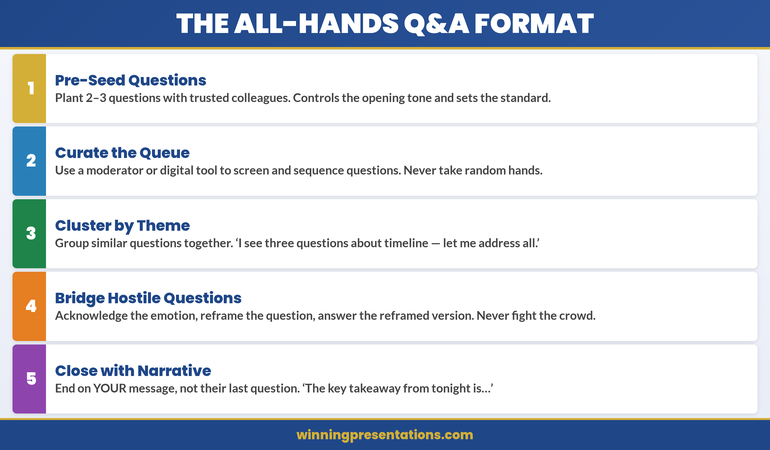
Five-step infographic showing the all-hands Q&A protection format: pre-seed questions, curate the queue, cluster by theme, bridge hostile questions, close with narrative

The Three Dangerous Dynamics You’re Up Against

Before you design a Q&A strategy, you need to understand what you’re actually defending against.

1. The Ambush Through Sequence

A hostile questioner will often wait until later in the Q&A, after you’ve built confidence and credibility, to drop a loaded question. By then, you’re thinking faster, checking less of your internal logic, more likely to contradict something you said earlier. The sequence of questions matters far more than the individual questions themselves. If hostile questions arrive early, you’re locked into caution for the entire session. If they arrive late, they can unpick everything you’ve already built.

2. The Echo and Amplification

One person asks a critical question. Someone else nods. A third person leans forward. Within 30 seconds, the room has decided this is a serious issue, whether or not it actually is. This is the contagion effect at work. A single poorly answered question doesn’t just affect that one interaction—it becomes the permission structure for the next questioner to press harder.

3. The Trap Through Specificity

An experienced hostile questioner will ask for specific data you don’t have in your head at that moment—revenue from a specific customer, headcount in a specific region, a specific decision date that hasn’t been finalised. They’re not asking because they don’t know the answer. They’re asking to force you to either admit you don’t know (weakness in front of 200 people) or guess (and potentially say something contradicted by documents the room has already seen).

Understanding these dynamics lets you build defences before the Q&A even begins.

Curating Questions Before They Become Weapons

The most sophisticated executives don’t leave Q&A to chance. They curate it.

This doesn’t mean scripting the room or planting friendly questions. It means actively managing which questions surface and when. In a large all-hands, you have several legitimate levers:

The Pre-Submission Window — Many large all-hands now invite questions via email or Slack in advance of the session. This gives you 24–48 hours to think through the difficult questions before you’re on stage. You can also use this to shape the types of questions that will be asked: if you explicitly invite “strategic challenges and alternative perspectives,” you set the frame differently than if you say “we welcome all questions.”

The Moderator’s Discretion — If there’s a moderator or chair (often there is, in all-hands at companies over 100 people), the moderator has genuine discretion about question order. You can brief your moderator in advance: “If anyone asks about the acquisition timeline, I’d prefer that comes later in the session when I’ve had time to establish context.” This is legitimate curation, not suppression.

The Format Choice — A written Q&A (submitted via chat) gives you seconds to read each question before it’s asked. A live hand-raising Q&A gives you no warning. A hybrid format—written questions with live follow-ups—gives you the advantages of both. If you have any control over format, this is where it starts.

The Pre-Briefing of Allies — You don’t need to plant questions. But you can ensure that people who are informed and genuinely supportive of your strategy are ready to ask clarifying questions if needed. A well-placed question from someone respected in the room—not a softball, but a genuine question your ally already knows the answer to—can shift narrative momentum at a critical moment.

Curation is not manipulation. It’s architecture. You’re building a structure where truth can surface more effectively.

Ready to walk into your next all-hands knowing 80% of the questions before they’re asked?

Get the Executive Q&A Handling System → £39

Sequencing Strategy: Order Determines Narrative

If curation is about which questions surface, sequencing is about when they surface. This is where most executives lose control.

A hostile questioner wants to ask their loaded question when you’re off balance. An unprepared executive let’s questions come in whatever order they naturally arise. An experienced executive controls the sequence.

The architecture looks like this:

Open with Softballs, Establish Credibility — The first two to three questions should be ones you’re ready for, that you can answer with absolute clarity and confidence. This isn’t dodging. These questions genuinely exist. But you’re choosing to answer them first. The room watches you nail the opening questions. Your body language settles. Your pacing stabilises. By question three, you’ve established that you know what you’re talking about.

Sequence Difficulty in a Staircase, Not a Cliff — If the first three questions are softball and the fourth is “Why did you fail to deliver the acquisition?” you’ve created a cliff. The room notices the shift. You appear less confident. Instead, gradually escalate: first straightforward strategic questions, then deeper strategic questions, then the hardest questions. A staircase climbed looks like progress. A cliff-jump looks like you’ve lost control.

Place Your Hardest Question Second-to-Last — Not last. If you answer your hardest question at the end, the session ends on ambiguity. Place it second-to-last, then deliberately choose an easier final question. You take the hit on the hard question, recover visibly on the final one, and the room leaves remembering your composure on the recovery, not your struggle with the hard one.

Never Let Questions Cluster by Theme — If three questions in a row are about revenue projections, you’re locked into one lane of conversation for three straight minutes. The room stops hearing your answers and starts hearing repetition. Vary the themes: a question about strategy, then culture, then operations, then long-term vision. Each theme-shift keeps the audience’s attention and prevents any single challenge from building momentum.

Sequencing isn’t about softballing the audience. It’s about intelligent narrative design. You’re the executor of that design.

Want to see the exact question-mapping framework used by executives at JPMorgan, PwC, and RBS?

Get the Executive Q&A Handling System → £39

Managing the Hostile Questioner in the Room

Sometimes curation and sequencing aren’t enough. Someone raises their hand with a genuinely hostile question. How do you handle that in front of 200 people?

The principle is this: never respond to the emotion in the question. Respond to the legitimate underlying concern.

A hostile question often contains two layers: the surface aggression and the real question underneath. An example:

Hostile surface: “How can you claim we’re on track when the data clearly shows we’ve missed the last three milestones?”

Real question: Am I right to be concerned about execution?

If you respond to the hostility (“I think we’ve been very clear about this” or “The data actually shows…”), you’re now in an argument with one person in front of 199 others. Instead, acknowledge the concern and reframe the narrative:

“You’re asking whether we’re actually on track—whether the gap between plan and reality is something we’re managing or something that’s managing us. That’s the right question. Here’s what’s happened: we’ve missed three milestones, and we’ve recovered on two of them. Here’s the third one and our plan to close it.”

You’ve stripped away the hostility, validated the underlying concern, and answered the real question. The room watches someone raise a challenge, watch you take it seriously, and watch you respond not with defensiveness but with clarity. That’s not weakness. That’s leadership.

The five-step protocol for hostile questions:

  1. Pause for one full breath (not three seconds—one breath). Longer pauses read as defeat in a stadium. One breath reads as composure.
  2. Thank the questioner for raising a legitimate concern (and make clear it is legitimate, even if the delivery was hostile).
  3. Rephrase the real question underneath the aggression in neutral language.
  4. Answer the real question with data, context, or clear reasoning.
  5. Invite follow-up in a way that signals you’re not threatened—”Does that address your concern?” or “What’s the specific data point that would help here?”

This protocol works because it moves the frame from “executive vs. hostile questioner” to “executive and audience, jointly looking for truth.” That’s a frame you always win in.

Predict 80% of Questions Before They’re Asked

The system that thousands of executives have used to walk into high-stakes Q&A with absolute confidence. Learn how to map question vectors, predict hostile challenges, and build responses that work across variations—so you’re never caught off guard.

Get the Executive Q&A Handling System → £39

Used in funding rounds, board approvals, and company all-hands across three continents.

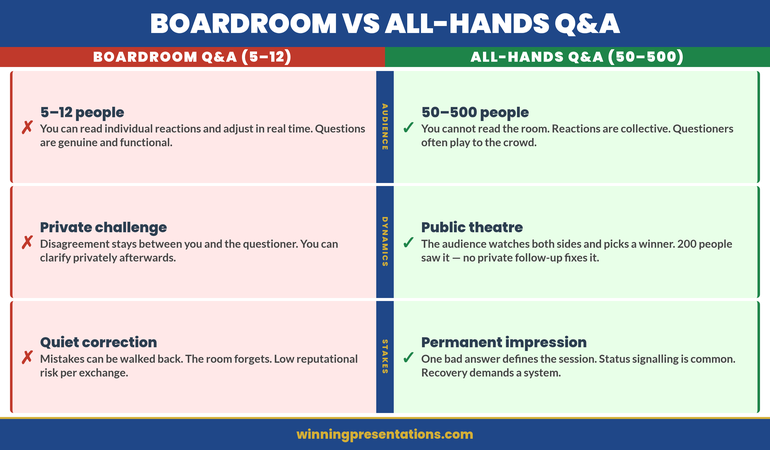
Comparison infographic showing boardroom Q&A versus all-hands Q&A differences across audience size, question motive, hostile dynamics, and recovery from mistakes

The Recovery Protocol When It Goes Wrong

Sometimes despite your preparation, despite curation and sequencing, you’ll stumble. You’ll give an answer that doesn’t land. You’ll be asked something you genuinely don’t know. You’ll get tangled in language. And 200 people will watch it happen.

The recovery is more important than the stumble.

The protocol: acknowledge, clarify, commit, move forward.

Acknowledge: “I didn’t explain that clearly.” Or “That’s a good point and I didn’t address it well.” Or “I don’t have the specific data on that and I should.” Be explicit. The room already knows something didn’t work. Naming it directly proves you’re aware and in control.

Clarify: Give a shorter, clearer version of what you meant to say. Or, if you don’t have the answer, say so: “That’s the right question. I don’t have the headcount breakdown by region off the top of my head, but I’ll send it to you after this.” Specificity here matters enormously. “I don’t know” is worse than “I don’t have that data with me, but here’s who to ask and when you’ll get it.”

Commit: If you’ve committed to follow up (send data, circle back with an answer, investigate something), state it again. “So I’m committing to send you that breakdown within 24 hours.” The room needs to see that you’ve made a commitment and that you’re tracking it.

Move forward: Don’t dwell. Don’t over-apologise. Don’t loop back to the same question three turns later. The quickest way to make a stumble memorable is to keep referencing it. Instead, move to the next question with the same composure you started with.

The senior executive who froze for 47 seconds used this exact protocol. She said: “I lost my train of thought—apologies. Let me restart that answer.” She restarted. She nailed it. And after the all-hands, most people didn’t even remember the freeze. They remembered the recovery.

Three Questions About All-Hands Q&A You’re Probably Asking

Should you ever admit you don’t know the answer in front of 200 people?

Yes—but only if you commit to finding it. “I don’t know, and here’s who has the answer and when you’ll get it” is strength. “I don’t know” without the commit is weakness. The room isn’t judging whether you know everything. They’re judging whether you’re in control and competent. An honest “I don’t know” with a clear path to the answer proves competence. An evasive “we’re looking at that” proves the opposite.

What if someone asks a question that’s actually a political move against you?

It happens. Someone uses the all-hands to signal to their allies or to undermine you publicly. Don’t take the bait. Treat it as a legitimate question (even if it’s not), answer it with data and reason, and move on. Responding to the political subtext (“I know what you’re doing”) only amplifies it. Responding to the surface question denies them the conflict they’re after and proves your focus is on substance, not politics.

How do you handle a question you’ve specifically asked your moderator to avoid?

The moderator was supposed to keep it off the table, but it came anyway. Don’t blame the moderator or show frustration. You asked for curation, curation failed, now you adapt. This is exactly what composure looks like in real time. Answer the question you didn’t prepare to answer—and do it well enough that the room never knows you wanted to avoid it.

Want the three-step framework that lets you predict 80% of questions before they’re asked?

Get the Executive Q&A Handling System → £39

Don’t let 200 people watch you get ambushed. Master the techniques that protect you.

Get the Executive Q&A Handling System → £39

Master Large-Audience Q&A With Absolute Confidence

The difference between an executive who gets ambushed and one who doesn’t isn’t luck or natural talent. It’s preparation. The Executive Q&A Handling System teaches you the exact framework that lets you walk into any Q&A—board meeting, all-hands, investor presentation—knowing you’ve predicted the questions, prepared your responses, and designed a narrative that protects you.

  • Predict difficult questions before they’re asked using the question-mapping system
  • Build flexible, pre-composed responses that work across question variations
  • Control the narrative through strategic curation and sequencing
  • Recover with composure when things don’t go to plan

Get the Executive Q&A Handling System → £39

Thousands of executives at JPMorgan, PwC, RBS, and leading SaaS companies have used this system in high-stakes funding rounds and approvals.

People Also Ask: How do you handle hostile questions in front of a large audience?

Acknowledge the emotion behind the question without validating the hostility. Say “I can see this is important to you” or “That’s a fair concern.” Then reframe: restate the question in neutral terms that you can answer constructively. Answer the reframed version. The audience hears you being respectful and substantive. The hostile questioner gets heard without controlling the narrative. Never argue with someone in front of 200 people — the crowd always sides with the person who stays composed.

People Also Ask: Should I use a moderator for all-hands Q&A?

Yes, whenever possible. A moderator serves three functions: they screen questions for relevance and tone, they sequence questions so hostile or emotional ones don’t cluster together, and they give you a natural pause between questions (which your nervous system needs). Even an informal moderator — “Sarah will be collecting questions” — changes the dynamic. You’re no longer fielding random hands from a crowd. You’re responding to a curated, sequenced list.

People Also Ask: What if nobody asks questions at an all-hands meeting?

Silence after “Any questions?” in a room of 200 people is common and not necessarily a bad sign. Large audiences are reluctant to be the first person to speak. Pre-seed two or three questions with trusted colleagues. After those are asked and answered, the room usually opens up. If it doesn’t, close with your narrative: “The key thing I want you to take away from today is…” Silence isn’t failure. It’s often a sign that your presentation answered the questions before they were asked.

Is This Right For You?

The Executive Q&A Handling System is designed for executives and leaders who regularly face Q&A in high-stakes environments:

  • You present to company all-hands of 50+ people regularly
  • You’ve had the experience of being asked something hostile and wishing you’d been better prepared
  • You know some questions are coming but you’re not quite sure how to respond
  • You want to move from anxious about Q&A to completely composed
  • You’re leading through change, restructure, or challenges and expect scrutiny
  • You’re preparing for funding pitches or investor presentations
  • You want to shift from “hoping it goes well” to “knowing exactly what will happen”

If most of these resonate, this system will change how you approach every Q&A you do from now on.

Frequently Asked Questions

How much time does the system take to learn?

The core framework takes about 30 minutes to understand. The real work—applying it to your specific upcoming Q&A—takes one to two hours. Most executives do this prep 24–48 hours before a big all-hands or presentation. You’re not adding complexity to your process; you’re structuring the prep you should be doing anyway.

What if I work in a culture where Q&A is very open and unstructured?

Curation and sequencing still apply. You can’t control which questions get asked, but you can brief your moderator on preferred sequencing, you can influence what gets submitted in advance, and you can absolutely apply the response protocols in this system. The system works whether your Q&A is hyper-structured or completely free-form.

Does this system teach me how to dodge difficult questions?

No. The opposite. This system teaches you how to answer difficult questions in a way that’s honest, clear, and maintains your credibility. Questions you can’t answer get an honest “I don’t know, here’s the path to the answer.” Questions you can answer but were worried about get a structured response that lands with confidence. The goal is never to dodge. The goal is to protect yourself while being truthful.

Can I use this before my all-hands next week?

Yes. You get access immediately. Many executives use this as a just-in-time prep tool: buy it Wednesday, use it to prepare for Thursday’s presentation. It’s designed to be actionable in hours, not weeks.

Stay Sharp: The Winning Edge Newsletter

Join thousands of executives who get practical Q&A and presentation techniques delivered every week

Each week, The Winning Edge covers real situations: how to handle hostile questions in front of investors, how to recover when something goes wrong, how to read a room and adjust in real time. Subscribe and get patterns that work in the boardroom, the all-hands, and the high-stakes conversation.

Subscribe to The Winning Edge

Free resource: Download the Executive Presentation Checklist (PDF) — the pre-presentation validation that ensures nothing gets overlooked before you present.

About the Author

Mary Beth Hazeldine is the Owner & Managing Director of Winning Presentations. With 24 years of corporate banking experience at JPMorgan Chase, PwC, Royal Bank of Scotland, and Commerzbank, she has delivered high-stakes presentations in boardrooms across three continents.

A qualified clinical hypnotherapist and NLP practitioner, Mary Beth combines executive communication expertise with evidence-based techniques for managing presentation anxiety. She has trained thousands of executives and supported high-stakes funding rounds and approvals.

Book a discovery call | View services

15 Mar 2026
Female executive presenting risk assessment to a serious risk committee in a modern boardroom, showing risk matrix slide on screen, navy and gold corporate aesthetic

Risk Committee Q&A: The 5 Questions That Silence Even the Most Prepared Executives

I once watched a VP of Operations present a £3 million risk mitigation plan to her company’s risk committee. She had 47 metrics on her dashboard. She knew every number. But when the Chief Risk Officer asked, “What’s the one thing in your plan you’re least confident about?” she froze.

She couldn’t answer because she’d prepared for every question except the ones about her own uncertainty. The risk committee wasn’t testing her confidence. They were testing whether she understood the limits of her own knowledge. She failed that test in seven seconds of silence.

The vote to approve her plan got deferred. Not because her mitigation approach was weak. But because her Q&A revealed that she hadn’t mapped her own blind spots — and a risk committee’s job is precisely to find blind spots before they become losses.

Risk committee Q&A is a distinct discipline. The questions are sharper, the scepticism is structural, and the threshold for credibility is higher. This isn’t steering committee Q&A or board update Q&A. Risk committees exist to challenge assumptions and surface exposure. Your preparation must reflect that.

This article gives you the exact taxonomy of risk committee questions and the preparation framework that turns hostile Q&A into a credibility moment.

Preparing for a risk committee in the next 30 days?

Most executives prepare for capability questions. Risk committees test something different: whether you understand your own blind spots. The Executive Q&A Handling System includes a Question Map framework specifically structured for risk, audit, and governance committee Q&A.

Why Risk Committee Q&A Exposes Blind Spots Other Committees Miss

Most executives prepare for executive Q&A the same way regardless of the audience. They prepare for capability questions, financial impact questions, timeline questions. Standard executive fare. This approach will fail in front of a risk committee.

Risk committees operate from a different agenda entirely. While a steering committee is asking “will this work?” and “what does it cost?”, a risk committee is asking “what could go wrong that we haven’t considered?” and “how do you know that?” The psychology is adversarial by design. Risk committee members are professional sceptics. Their job depends on finding the gaps in your thinking.

The gap that most presenters miss is the distinction between demonstrating competence and demonstrating risk awareness. You can walk into a risk committee meeting thoroughly prepared to defend your strategy, but if you haven’t prepared for questions about what you don’t know, the committee will expose that gap within the first four minutes of Q&A. And once credibility is damaged, no amount of capability data recovers it.

Risk committees are also heterogeneous in their expertise. Your audience typically includes an internal Chief Risk Officer (highly technical, familiar with risk frameworks and ISO standards), an external risk or compliance specialist (often with a regulatory lens), and business leaders who sit on the committee for governance rather than technical depth. This means your Q&A must navigate different levels of sophistication simultaneously — you can’t assume the group shares the same risk literacy.

The questions that expose blind spots fall into five categories. Each category tests a different kind of credibility: your understanding of exposure, your confidence in your assumptions, your awareness of gaps, your execution track record, and your alignment with the board’s risk appetite. Most executives prepare for one or two of these. Risk committees test all five.

The Five Question Types That Dominate Risk Committee Q&A

Understanding the taxonomy of risk committee questions is half the preparation battle. Once you know what type of question is coming, you can prepare a scenario-specific answer rather than hoping for a question you’ve rehearsed.

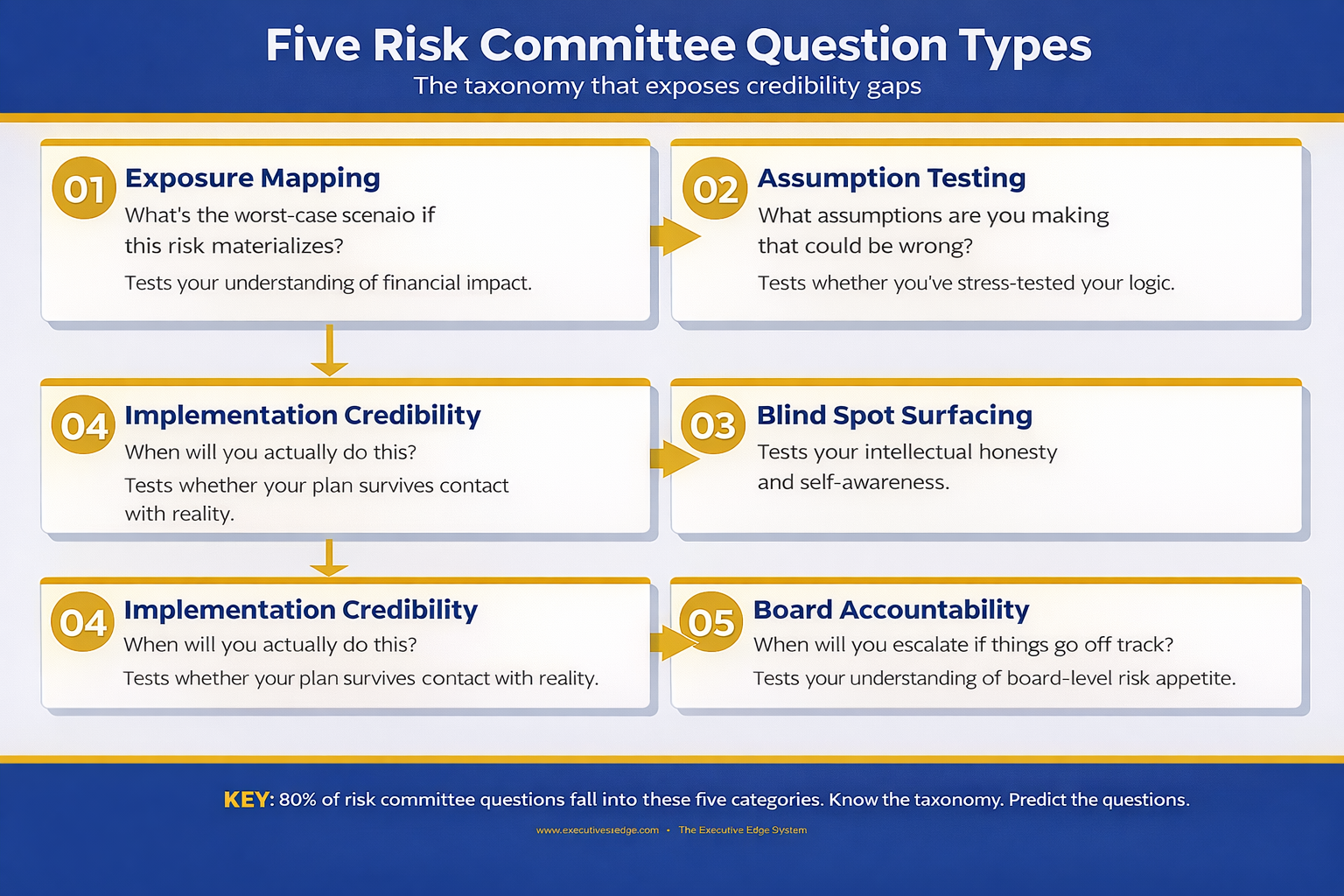
The five types are:

  • Exposure Mapping Questions: “What’s the worst-case scenario?” “What asset or revenue stream is at greatest risk?” “How do you quantify the exposure?” These test whether you actually understand the financial or operational consequence if things go wrong.
  • Assumption Testing Questions: “What assumptions are you making that could be wrong?” “How sensitive is your plan to market changes?” “What happens if [variable] changes?” These test the robustness of your logic, not just the competence of your execution.
  • Blind Spot Surfacing Questions: “What haven’t you considered?” “What’s the thing you’re least confident about?” “What would change your view of this risk?” These are the most dangerous because they presume you’ve already missed something, and they’re often right.
  • Implementation Credibility Questions: “How will you actually do this?” “Who owns the accountability?” “What’s your track record in similar initiatives?” These test whether your plan will survive contact with reality, not just whether the plan itself is theoretically sound.
  • Board Accountability Questions: “What does the board need to do to support this?” “When will you escalate if things go off track?” “What metrics matter to the board’s risk appetite?” These test whether you understand what success looks like from the board’s perspective, not just from yours.

Notice that only one of these question types is about your capabilities or what you’ve done. The other four are about exposure, assumptions, gaps, and board-level thinking. This is why standard Q&A preparation fails in front of risk committees. You’re preparing for the wrong category.

Five risk committee question types: Exposure Mapping, Assumption Testing, Blind Spot Surfacing, Implementation Credibility, Board Accountability with example questions and credibility tests for each

Exposure Mapping Questions: The Ones About What Could Fail

Risk committees begin with exposure. They want to understand the size and nature of what’s at risk if something goes wrong. Exposure Mapping questions are rarely hostile — they’re genuinely trying to understand the scale of the problem. But they will expose you if you haven’t thought about the worst case.

The most common Exposure Mapping question is some variation of: “What’s the worst-case scenario if this risk materialises?” A good answer names the specific asset, revenue stream, or capability at risk, quantifies the financial or operational impact if it fails, and explains why you’re confident in that quantification.

The trap most executives fall into is either overestimating the worst case (which signals panic or lack of confidence) or underestimating it (which signals you haven’t thought about it properly). A risk committee will test your quantification by asking where it comes from — historical precedent, industry benchmarks, internal models. If you can’t source your number, they won’t trust it.

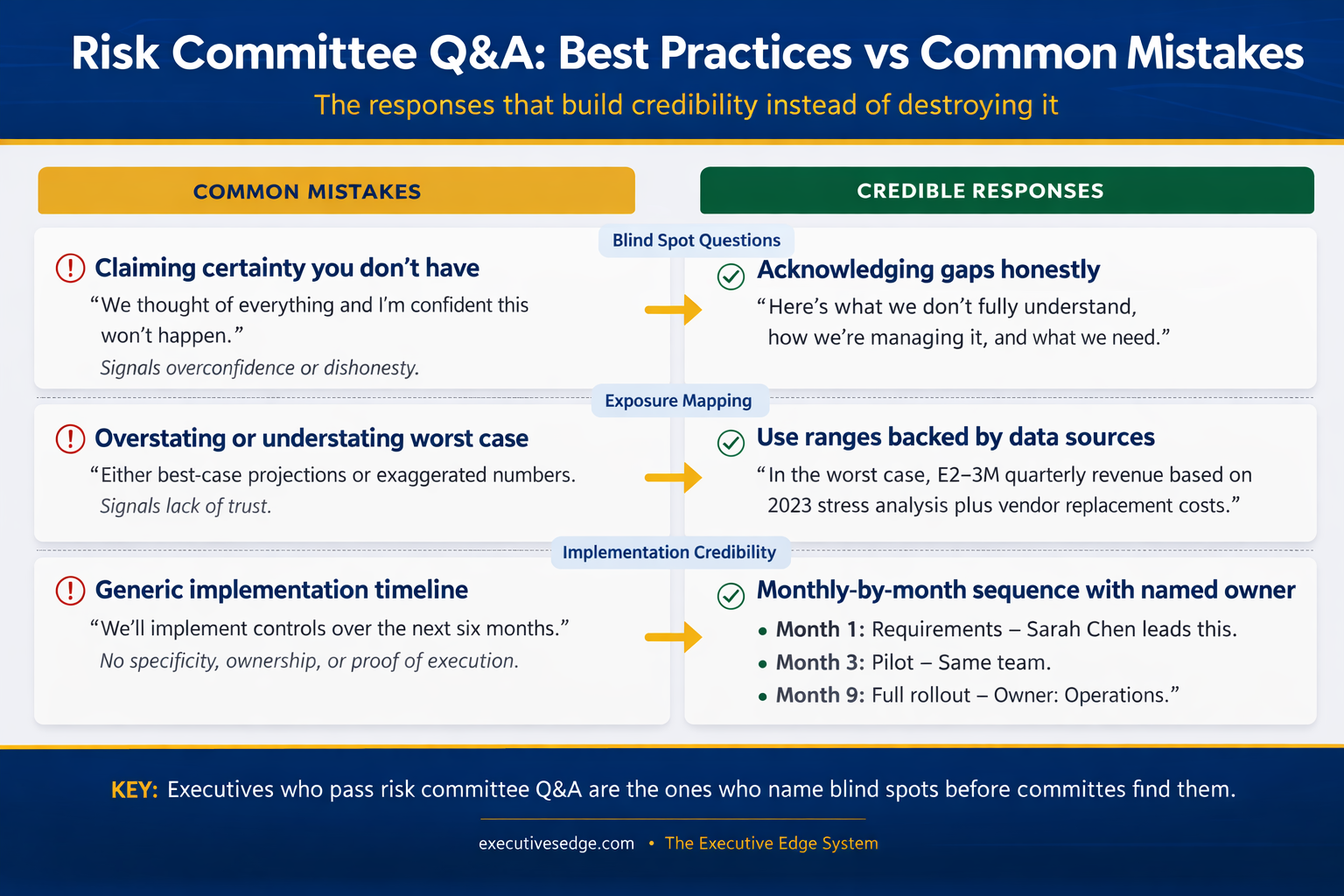
A stronger approach is to present a range rather than a point estimate. “In the worst case — a failure of System A combined with a loss of our primary vendor — we’d expect £2–3 million of impact to quarterly revenue. That’s based on our 2023 outage analysis plus vendor replacement costs from our procurement team.” This signals both rigorous thinking and realistic uncertainty.

Exposure Mapping questions also frequently probe the cascade effect: “If that fails, what else fails with it?” The executives who survive this line of questioning are the ones who’ve already mapped their dependencies. You need to know not just your primary risk, but what happens when that risk triggers others.

Prepare this section of your Q&A by listing the three to five assets or processes you’re most dependent on, estimating the financial impact if each fails, and mapping the cascade effect if they fail simultaneously. Have this analysis written down before you walk into the room.

The Question Prediction System Risk Committees Actually Test For

The Executive Q&A Handling System (£39, instant access) gives you the exact preparation framework risk committees are designed to defeat:

When you understand the five question types that risk committees use, you can prepare scenario-specific answers that demonstrate both competence and risk awareness. The executives who pass risk committee Q&A are the ones who know their blind spots before the committee finds them.

  • The five question taxonomies that risk committees use to test credibility — Exposure Mapping, Assumption Testing, Blind Spot Surfacing, Implementation Credibility, and Board Accountability
  • The Question Map framework for predicting the 12–15 questions your specific risk committee will ask, based on your presentation content
  • The exact scenarios and responses for each question type with real-world examples from high-stakes risk presentations
  • 51 AI prompts to generate your Q&A answers in 30 minutes, including challenge-response pairs for hostile questions

Get the Executive Q&A Handling System → £39

Built from 25 years of risk presentations across banking, insurance, and regulated industries — including risk committee scrutiny at JPMorgan Chase, RBS, and PwC.

Assumption Testing: Challenging Your Risk Logic

Every plan rests on assumptions. A market will behave a certain way. A vendor will deliver on time. Your team will execute as planned. Risk committees exist to stress-test those assumptions. Assumption Testing questions probe what could be wrong with your logic, not your execution.

The question usually sounds like: “What assumptions are you making that could turn out to be wrong?” This is often asked conversationally, which makes it more dangerous. You might hear, “We’re assuming the risk framework you’ve proposed would actually reduce exposure, but what if the market doesn’t cooperate?” The committee is not attacking your plan. They’re testing whether you’ve already challenged it.

Credibility in Assumption Testing questions comes from acknowledging your assumptions explicitly before the committee finds them. The strongest answer to “what assumptions are you making?” is to name three key assumptions yourself, explain what happens if each assumption breaks, and describe how you’d know if the assumption was at risk of breaking.

For example: “We’re assuming the control framework we’re implementing will be mature and effective within 180 days. That’s based on benchmarks from similar implementations in our industry. But if our team capacity turns out to be less than projected, that timeline could stretch to 12 months. We’ve built in a checkpoint at day 90 where we’ll assess maturity against a standard control maturity model and escalate if we’re below target.” This shows you’ve thought about failure modes and have monitoring in place.

The committees that challenge assumptions most fiercely are the ones with external members. An external risk advisor has seen multiple companies implement similar plans. They often ask: “In your experience, what’s the most common reason this type of plan doesn’t work as expected?” They’re giving you permission to name failure modes. Take it.

Prepare for Assumption Testing by listing the three to five key assumptions in your presentation, stress-testing each one mentally, and preparing a brief “here’s what could break and here’s how we’d know” response for each. This section of your preparation can be as simple as three sentences per assumption.

Blind Spot Questions: Finding What You Haven’t Considered

Blind Spot questions are the most dangerous because they presume a gap in your thinking — and often they’re right. A risk committee member will say something like: “What haven’t you considered?” or “What’s the thing you’re least confident about in this plan?” These questions feel adversarial because they assume you’ve already missed something.

Most executives respond defensively to Blind Spot questions. They over-explain, they defensively assert they’ve thought of everything, or they freeze. The credible response is to name your blind spots first. This shifts the psychology from “the committee found something I missed” to “I’ve already identified the exposure and I’m managing it responsibly.”

The strongest Blind Spot answer names one or two genuine gaps in your knowledge, explains why they’re gaps (insufficient data, external dependencies you can’t control, operational variables you can’t fully predict), describes what you’d need to close the gap, and acknowledges the risk of proceeding without full certainty.

For example: “The biggest gap in our analysis is vendor stability. We’re dependent on [Vendor] for a critical integration, and we don’t have complete visibility into their financial health or technology roadmap. We’ve asked for it in our ongoing contract review, but we may not get full transparency. If that vendor fails, we have a 60-day recovery plan, but that’s our exposure.” This answer shows mature risk thinking. You’re not claiming certainty you don’t have. You’re acknowledging the exposure and showing a mitigation path.

Blind spot preparation is counterintuitive because it requires intellectual honesty. Sit down with your presentation and ask yourself: “What part of this plan am I least certain about? What would I need to be more confident? And if I can’t get that certainty, what’s my backup?” Write those down before the meeting. When the committee asks, you’ll have an answer that signals maturity rather than defensiveness.

Some of the most effective Blind Spot answers include a statement like: “I’d welcome the committee’s perspective on what I might be missing. In our testing, we focused on [X]. Are there areas you’d recommend we pressure-test further?” This invites the committee’s expertise and shifts from defensive to collaborative.

If you’re preparing for risk committee Q&A in the next 30 days, the Executive Q&A Handling System (£39) gives you the question prediction framework and scenario-specific answers for all five question types.

Implementation Credibility: Will You Actually Execute?

Risk committees have seen many plans fail not because the strategy was wrong, but because execution fell apart. Implementation Credibility questions test whether your plan will survive contact with reality. They typically sound like: “How will you actually do this?” or “Who’s accountable if this doesn’t work?”

The questions that probe implementation most effectively are deceptively simple: “Walk me through the first 90 days.” “Who owns this if something goes wrong?” “What’s your track record on similar initiatives?” These are not asking about your strategy. They’re asking whether you have a realistic plan, clear accountability, and a history of follow-through.

A strong Implementation Credibility answer includes three elements: a specific sequence (not a generic timeline), named accountability (not a committee or a department, but a person), and a proof point (you’ve done something similar before and it worked). If you can’t provide all three, the committee will doubt your execution.

For example, rather than “we’ll implement controls over the next six months,” you’d say: “Sarah Chen, who led the control implementation at our Asia division, is leading this. Month one is requirements definition and stakeholder alignment. Month two is test environment setup. Month three is pilot in our non-critical process. We did a similar implementation in 2023 that came in on schedule and 8% under budget. Sarah’s here if you want to ask about her execution approach.”

Notice that this answer includes a named person, a month-by-month sequence, and a historical precedent. It’s not theoretical. It’s concrete. Risk committees trust concrete. They distrust abstract.

Preparation for Implementation Credibility requires you to own the plan at a level of specificity most executives avoid. You need to know not just the timeline, but who does what in month one. You need a case study of a similar implementation that succeeded. And you need to be able to name the person who failed the last similar initiative and explain what’s different this time (if there was a failure).

Common Questions About Risk Committee Q&A Preparation

How do you prepare for questions you can’t predict?
You can predict roughly 80% of risk committee questions using a Question Map framework. You list your presentation’s claims (e.g., “This control framework will reduce exposure by 40%”), then ask: what would challenge that claim? What data supports it? What assumptions could be wrong? What would the committee need to trust it? This process usually surfaces 12–15 likely questions across the five categories. The final 20% are wildcards, but they’re usually just variations on the predictable questions.

What’s the worst answer you can give to a risk committee question?
Claiming certainty you don’t have. Saying “we’ve thought of everything” or “we’re confident this won’t happen” signals that you’ve either misunderstood risk or you’re not being honest. Risk committees respect leaders who acknowledge edge cases and unknowns. They distrust leaders who claim omniscience. The credible answer is always “here’s what we know, here’s what we don’t know, and here’s how we’re managing the gap.”

Should you ever push back against a risk committee question?
Rarely, and only if the question is based on faulty data or a misunderstanding of your presentation. If you do push back, do it respectfully and with a data source. “That’s a fair question. We actually modelled that scenario — it’s on slide 14. The exposure in that case would be closer to £1.2 million rather than £2 million because we have a secondary control. Would you like to walk through that scenario?” This corrects the record without making the committee feel attacked.

Risk committee Q&A credibility framework showing best practices versus common mistakes across five question types with specific language examples

Is This Right for You?

This is for you if:

  • You’re presenting to a risk committee, audit committee, or governance forum in the next 60 days
  • You’ve had risk committee feedback that you need to “think bigger about exposure” or “understand your blind spots better”
  • You’re introducing a new risk framework, control environment, or governance change and expect the committee to challenge your assumptions
  • You want a tested question prediction framework you can apply to any risk presentation, not just this one

This is NOT for you if:

  • You’re presenting to a standard steering committee or operational review (those use different question types)
  • You need bespoke risk consulting rather than a Q&A preparation system
  • Your risk committee is entirely internal to your function and doesn’t include external or audit expertise

The 72-Hour Preparation Framework for Risk Committee Q&A

Risk committee Q&A is more preparation-intensive than standard executive Q&A because the questions are deeper and the scepticism is structural. The 72-hour framework breaks the preparation into three stages.

Stage One: Question Mapping (24 hours before)

Print out your presentation. For each major slide, ask yourself: what question would a risk committee ask about this? What assumptions does this claim rest on? What would a sceptic challenge? Write down 2–3 likely questions per slide. You’ll usually get to 15–20 likely questions across the presentation. Categorise them by question type (Exposure Mapping, Assumption Testing, etc.). This gives you the 80% of questions you can actually predict.

Stage Two: Answer Preparation (16 hours before)

For each of the 15–20 questions, write a one-paragraph answer. Not a talking point. An actual answer you’d give if asked. The discipline of writing forces you to think at a granular level. As you write, you’ll often discover gaps in your thinking. Good. Better to find them in your office than in the Q&A.

For each answer, ask: Does this answer the question directly? Does it include a data point or proof point? Does it acknowledge uncertainty where it exists? Can I deliver this in 60 seconds? If the answer to any of those is no, rewrite.

Stage Three: Scenario Rehearsal (4 hours before)

Practise the hostile questions. Not the friendly ones. Have someone read you the three most uncomfortable questions on your list and respond without notes. You’ll stumble. That’s good. Better to stumble in rehearsal. After each response, ask: Did I sound credible? Did I show I’d thought about this? Would a risk committee trust me? If not, rewrite the answer and rehearse again.

Focus rehearsal on questions about blind spots and implementation credibility. Those are the two categories where executives most often fail.

Stop Getting Blindsided by Risk Committee Questions

The Executive Q&A Handling System (£39, instant access) gives you the preparation framework that turns hostile risk committee Q&A into a credibility moment:

The moment a risk committee member asks “What haven’t you considered?” and you freeze, you’ve lost credibility. The executives who thrive in risk committee Q&A are the ones who know their blind spots before the committee finds them. The Executive Q&A Handling System teaches the exact preparation framework.

  • The Question Map framework for predicting 80% of risk committee questions before you walk in the room
  • The five question type taxonomy with scenario-specific answers for each category
  • Real-world examples of hostile questions and the credible responses that turn them into trust moments

Get the Executive Q&A Handling System → £39

Taught to risk, compliance, and operations leaders across banking, insurance, healthcare, and regulated sectors.

What Risk Committees Actually Decide Based on Your Q&A

It’s worth understanding what a risk committee is actually evaluating during Q&A, because it’s not what most executives think. They’re not deciding whether to approve your plan. That decision usually happens in the room before Q&A begins, based on the presentation itself. Q&A is a credibility test.

The risk committee is answering four questions during your Q&A: Do you understand the size of the exposure if things go wrong? Do you understand your own assumptions and what could break them? Do you know what you don’t know? And can you actually execute this, or will it fall apart? If they believe the answer to those four questions is yes, you pass. If they have doubts on any of them, the decision gets deferred.

Deferral in risk committee meetings is the operational equivalent of rejection. It means “come back when you’ve thought about this more.” Some executives have sat through three or four deferral cycles on a single initiative. The ones who break the cycle are the ones who realise their Q&A wasn’t demonstrating competence — it was exposing gaps.

Risk committee Q&A often overlaps with board-level preparation — if your session includes board directors, the board Q&A preparation guide covers the director-specific dynamics in detail.

One other thing risk committees decide: trust. An executive who names their blind spots, acknowledges uncertainty, and shows they’ve already challenged their own plan is trusted more than an executive who claims the plan is airtight. Risk committees have institutional memory of plans that failed because the executive was overconfident. They’d rather hear “here’s what could go wrong” than “we’ve thought of everything.”

This is why the 72-hour preparation framework is essential. It’s not about memorising answers. It’s about demonstrating that you’ve already done the challenging work of examining your own plan critically. The committee is asking whether you deserve to be trusted with risk management responsibility. Your Q&A answers that question.

Frequently Asked Questions

What’s the difference between risk committee Q&A and steering committee Q&A?

Steering committees ask “will this work and what does it cost?” Risk committees ask “what could go wrong and what don’t you know?” Risk committees are structurally sceptical because their job is to find exposure. Steering committees are evaluative. This means your Q&A preparation must shift from demonstrating capability to demonstrating risk awareness. The frameworks are completely different.

How honest should you be about gaps and uncertainties in front of a risk committee?

Extremely honest. Risk committees trust executives who acknowledge uncertainty more than those who claim omniscience. The credible answer to a question about a gap is “here’s what we don’t fully understand, here’s what we need to understand, and here’s how we’re managing the risk while we get that understanding.” This signals mature risk thinking. Claiming you’ve thought of everything signals the opposite.

What happens if a risk committee question is based on a misunderstanding of your data?

Clarify respectfully with a data source. Don’t make the committee feel stupid. Instead, say something like “That’s a fair interpretation of the metric. We actually modelled that scenario — here’s what the data shows.” You’re correcting the record without creating tension. If the committee is sceptical, it’s usually because you weren’t clear enough in the presentation, not because they’re unreasonable.

Can you over-prepare for risk committee Q&A?

Yes, if you memorise answers and sound robotic. No, if you prepare scenario-specific responses and practise delivering them conversationally. The goal is to show you’ve thought through your risks, not to recite prepared statements. Risk committees recognise the difference immediately.

The Winning Edge — Executive Presentation Insights

Weekly strategies for executives who present at risk committees, boards, and high-stakes governance forums. No filler. No theory. Practical frameworks for presentations where credibility is currency.
Subscribe Free →

Also published today:

Your risk committee meeting has a date on the calendar. The committees that ask hostile questions are usually the ones with external or audit members — people who don’t have a stake in your plan succeeding. They’re structurally sceptical because that’s their job.

The only way to change that dynamic is to come in already sceptical of your own plan. Walk into the room having already named your blind spots, stress-tested your assumptions, understood your execution risks, and acknowledged what you don’t know. When the committee asks about gaps, you’ll have answers ready. When they challenge your logic, you’ll respond with confidence because you’ve already challenged it yourself.

Start with the Question Map. Print your presentation, write down 15–20 likely questions, categorise them by the five question types, and prepare one-paragraph answers for each. Use the Executive Q&A Handling System (£39) to structure the preparation in the 72 hours before you present.

For further reading on high-stakes Q&A strategy, see Board Meeting Q&A: Questions Directors Actually Ask, The Q&A Preparation Checklist: The Pre-Meeting Audit Every Executive Needs, and Predict Your Presentation Questions: The Question Map That Works.

About the Author

Mary Beth Hazeldine is the Owner & Managing Director of Winning Presentations. With 25 years of corporate banking experience at JPMorgan Chase, PwC, Royal Bank of Scotland, and Commerzbank, she has delivered high-stakes presentations in boardrooms across three continents.

A qualified clinical hypnotherapist and NLP practitioner, Mary Beth combines executive communication expertise with evidence-based techniques for managing presentation anxiety. She advises executives across financial services, healthcare, technology, and government on structuring presentations for high-stakes funding rounds and approvals.

Book a discovery call | View services

09 Mar 2026
Small team of executives gathered around a boardroom table in an intense Q&A rehearsal session with one person gesturing

Role-Playing Q&A With Your Team: The 20-Minute Rehearsal That Changes Everything


A SaaS account executive—let’s call her Rachel—was closing 3 deals out of every 47 demos. The presentations were solid. The product was strong. But something was failing during Q&A. Six months after implementing structured team role-play rehearsals—where colleagues played the sceptical CFO, the hostile procurement lead, the silent evaluator—that same executive closed 9 out of 23 demos. The presentations didn’t change. The Q&A preparation did.

Quick answer: Role-playing Q&A with your team before high-stakes presentations exposes gaps in your knowledge and deflates the anxiety that derails executives under pressure. A 20-minute structured rehearsal—where team members play four distinct adversarial roles—inoculates you against surprise questions and teaches you to stay calm when you don’t know the answer. It’s the difference between surviving Q&A and owning it.

High-stakes Q&A this week?

Most executives prepare slides. Few prepare for the questions nobody wants to face. If you’re walking into a board meeting, funding round, or customer pitch without having rehearsed Q&A scenarios with your team, you’re accepting unnecessary risk.

  • Block 20 minutes with two colleagues before your presentation
  • Assign them specific adversarial roles (this article shows you how)
  • Answer their hardest questions out loud, under mild pressure

→ Need the complete Q&A preparation system? Get the Executive Q&A Handling System (£39)

The SaaS Demo That Proved the Point

Here’s what changed for Rachel. Before the role-play rehearsals, she prepared by reading her slides and memorising talking points. She studied the customer’s business model. She predicted three or four likely questions and crafted perfect answers. But in the actual demo, the CFO asked something completely different—something she hadn’t anticipated. Her mind went blank. She hedged. She equivocated. The customer sensed weakness.

After six months of 20-minute team rehearsals before every major demo, something shifted. Not the presentation deck. Not the product. Her ability to stay composed under unpredictable questioning. When an unfamiliar question came—and they always did—she’d already rehearsed the feeling of not knowing the answer. She’d already practised saying “That’s a brilliant question; let me find the exact figure and come back to you.” She’d already built confidence through adversarial simulation. The close rate doubled. The presentations stayed the same.

Why Solo Q&A Preparation Fails

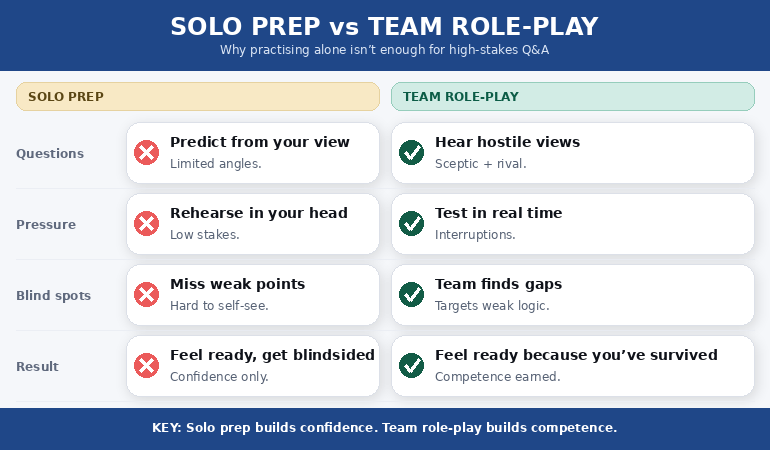
Most executives prepare Q&A alone. They sit at their desk, mentally rehearsing answers. They write down questions they think might come. They practise their responses silently. It feels productive. It feels safe. It changes nothing when pressure arrives.

Solo preparation fails because:

  • You already know your own thinking. Your brain won’t be surprised. When a real questioner challenges your logic, confronts an assumption you haven’t examined, or asks something sideways, you haven’t built the neural pattern for staying calm under that specific type of pressure.
  • You can’t simulate the emotional weight of a real question. A question you ask yourself is a permission slip. You know it’s coming. You know you’ll catch it. A hostile question from someone else—especially someone playing a sceptical role convincingly—triggers a different fight-or-flight response. You need to rehearse that response before the actual presentation.
  • You’ll soften your own questions. If you’re the questioner and the answerer, you unconsciously make the hardest questions easier. You signal where the difficult bits are. You give yourself escape routes. A trained colleague playing an adversarial role won’t do that.
  • You have no mirror for your delivery. Sitting alone, you might think you sound confident. Answering a challenging question from across a table—where someone is watching your face, listening for hesitation, noting every pause—you discover whether you actually sound confident. You can’t rehearse that alone.

This is why solo Q&A preparation feels productive but doesn’t transfer to high-stakes situations. You’re practising in isolation. Presentation Q&A happens under social pressure, in real time, with real consequences. You need to rehearse under conditions that approximate that pressure.

The 20-Minute Q&A Rehearsal infographic showing five steps: Brief, Assign Roles, Fire Questions, Debrief, and Refine

The 20-Minute Team Role-Play Format

A structured 20-minute rehearsal is long enough to be valuable, short enough to fit into a busy day. Here’s the framework:

  1. Setup (2 minutes): Explain to your two team members what you’re doing. “I’m walking into a pitch with the procurement team on Friday. I need you two to ask me hard questions. Don’t go easy on me. I want to discover what I don’t know before the real meeting.” Give them brief context about the audience and the stakes.
  2. Role assignment (1 minute): Assign each colleague a specific adversarial role (see next section). One plays the Sceptic. One plays the Devil’s Advocate. If you have a third person, rotate—or stick with two. Make the roles explicit and slightly exaggerated so they stay in character.
  3. Live presentation (8-10 minutes): Deliver a condensed version of your opening and key points—not the full 45-minute presentation, but the core 10 minutes that will face the hardest questions. Speak as you would in the real situation. Use your slides if you want, or just talk. Your colleagues should interrupt when questions arise naturally, not wait for a formal Q&A segment. This mirrors reality: questions often come mid-presentation.
  4. Continuous questioning (5-8 minutes): Your colleagues ask questions in character. They don’t ask softball questions. They push. They play sceptical. They challenge assumptions. They ask the same question three ways if your first answer dodges it. You answer each question as you would in the real presentation. Don’t try to be perfect. Don’t worry about looking bad. That’s the whole point.
  5. Debrief (3-5 minutes): This is critical. Stop the role-play. Discuss: What questions revealed gaps in your knowledge? Where did your delivery waver? What assumptions did they challenge that you hadn’t prepared for? What will you do differently before Friday? (See debrief section below.)

The format is deliberately simple so it doesn’t require special materials or production. It’s informal enough that it fits into a working day. But it’s structured enough that it exposes genuine weaknesses.

The Four Adversarial Roles That Matter

Not all sceptical questions feel the same. Different questioners challenge you in different ways. Your rehearsal should cover all four. If you have two team members, they can rotate. If you have three, assign one each and have the third observe or participate in the debrief.

1. The Sceptic

The Sceptic doesn’t believe your premise. They doubt the problem exists, or they think the problem is smaller than you claim, or they believe the solution won’t work. Their questions start with “But isn’t it true that…” or “How do you know that…” or “What if the opposite were true?”

Example: You’re presenting a new sales process. The Sceptic says, “We’ve tried process changes before. What makes you think this one will stick when the last three didn’t?”

Why rehearse the Sceptic role: Most executives expect agreement. When someone doubts the fundamental premise, they lose their footing. Rehearsing against scepticism teaches you to defend your assumptions—not defensively, but clearly.

2. The Devil’s Advocate

The Devil’s Advocate doesn’t necessarily disagree. They probe the logical structure. They ask “What if?” questions. They explore edge cases and exceptions. Their questions sound like: “What if…?” “Have you considered…?” “How would that work if…?”

Example: You’re pitching a new product feature. The Devil’s Advocate says, “That logic works if customers adopt the feature immediately. What if adoption is slower than you predict? How does your business case change?”

Why rehearse the Devil’s Advocate role: This person isn’t hostile. They’re rigorous. They expose holes in your logic that look fine on a slide but collapse under examination. Rehearsing with them teaches you to think like an engineer, not a salesperson.

3. The Silent Questioner

The Silent Questioner barely speaks. They ask one or two pointed questions in a neutral tone, then go quiet. No follow-up. No emotion. You can’t read whether they’re satisfied, sceptical, or uninterested. Their questions often expose what you’ve left unsaid: “Who decides?” “What’s the timeline?” “What happens if this fails?”

Example: After your full pitch, they ask quietly, “How does this affect headcount?” Then silence. You have no idea what they’re thinking.

Why rehearse the Silent Questioner role: These are often the people with actual decision-making power. The silence makes executives nervous. They start talking too much, over-explaining, contradicting themselves. Rehearsing against silence teaches you to answer the question and stop.

4. The Hostile Questioner

The Hostile Questioner disagrees and shows it. Their tone is challenging. Their questions carry an edge: “Isn’t that just a disguised cost-cutting measure?” “How do we know you won’t abandon this in six months?” “Why should we trust the numbers when you’ve been wrong before?”

Example: You’re explaining a restructuring. The Hostile Questioner says, “You’re talking about ‘efficiency gains,’ but what you really mean is layoffs. Why should my team not start looking for other jobs now?”

Why rehearse the Hostile Questioner role: Hostility triggers a fight response. Most executives either get defensive (which makes them sound dishonest) or shut down (which makes them sound weak). Rehearsing with genuine hostility—played convincingly by a colleague—teaches you to stay present, acknowledge the emotion behind the question, and answer the substance without matching the tone.

Solo Prep vs Team Role-Play comparison infographic contrasting question sourcing, answer testing, blind spots, and confidence across four dimensions

Walk Into Q&A Having Already Heard the Worst Questions — From Your Own Team

  • Know exactly which questions will derail you—before you’re in front of the decision-maker
  • Build unshakeable confidence by rehearsing adversarial scenarios 20 minutes before the real presentation
  • Stop second-guessing your answers and start trusting your ability to handle pressure

Get the Executive Q&A Handling System → £39

Used by executives preparing for board meetings, funding rounds, and customer pitches across investment banking, SaaS, and consulting.

Not sure if team role-play is right for your situation?

The system includes a diagnostic tool that shows you exactly which Q&A preparation method (solo, AI-assisted, or team role-play) fits your specific presentation context and timeline. Get clarity in 5 minutes.

Get the Executive Q&A Handling System → £39

How to Run the Rehearsal Without It Feeling Awkward

Team role-play can feel awkward if the purpose isn’t clear. Here’s how to make it feel natural and productive:

Set the Frame Explicitly

Tell your colleagues: “I’m nervous about Q&A on Friday. I want you to ask me the hardest questions you can think of. I want to know where I’m weak before the real meeting. Don’t hold back.” This reframes the rehearsal from “practicing” (which can feel childish) to “stress-testing” (which feels professional). Most colleagues will lean into this willingly.

Start with What They Actually Wonder

Before you assign roles, ask them: “What would you really ask me about this if you were in that meeting?” Let them ask genuine questions first. They’ll be more engaged if their real concerns are heard. Then assign adversarial roles to explore the territory you haven’t covered.

Play It at Conversation Pace

This isn’t a theatrical performance. Your colleagues don’t need to be melodramatic. A Hostile Questioner can sound hostile with a sharp tone and direct challenge—not by being rude. A Sceptic can express doubt with a calm “I’m not convinced because…” not with eyerolls. Authentic, conversational intensity is more useful than caricature.

Interrupt Naturally

Don’t wait for a formal Q&A section. Tell them to interrupt when questions occur naturally. This mirrors real presentations, where tough questions often come mid-point, not at the end. You’ll discover whether your explanations actually make sense to a live person, or whether you’re assuming understanding that isn’t there.

Let Yourself Look Bad

The point of rehearsal is to fail before it matters. If a question stumps you, say so. “I don’t know the exact answer to that. I’d check and come back to you.” Your colleagues will see that you can admit uncertainty without panicking. You’ll learn that you don’t need to have every answer perfect. And you’ll discover which gaps to research before Friday.

The Debrief: What to Do After the Role-Play

The role-play itself is only half the value. The debrief is where insight turns into preparation. Spend 3-5 minutes on these questions:

What Questions Revealed Gaps?

Which questions did you stumble on? Not because you were nervous, but because you genuinely didn’t have a clear answer. These are your research tasks before the real presentation. Make a list. Prioritise by how likely each question is in your actual meeting. Fill the biggest gaps first.

Where Did Your Delivery Waver?

Your colleagues watched your face, your pace of speech, your pauses. Ask them directly: “When did you notice I got uncomfortable?” They’ll point to moments you didn’t feel uncomfortable—because you were focused on content, not on how you sounded. This is invaluable data. You now know which topics make you sound uncertain, even if you think you’re being clear.

What Assumptions Did They Challenge?

Every presentation rests on unstated assumptions. “The market wants this.” “Customers will adopt quickly.” “Competitors won’t respond.” Your colleagues, playing adversarial roles, will probe these assumptions. Which ones did they question? Are those assumptions actually solid, or are they hopes? If they’re hopes, how do you position them in the real presentation?

What Will You Do Differently?

List three specific changes: additions to your narrative, slides you’ll revise, gaps you’ll research, clarifications you’ll add, assumptions you’ll address earlier. Don’t try to change everything. Focus on high-impact shifts. Then do them before the real presentation.

When NOT to Use Team Role-Play Q&A Prep

Team role-play is powerful. It’s not the answer for every situation. Here’s when to use a different approach:

When You Need AI-Powered Depth

If you’re facing technical questions that require detailed scenario modelling—”What if interest rates rise 2%?” or “How does this architecture scale to 10 million users?”—an AI system can generate more scenarios and edge cases than a colleague can improvise. (See AI Q&A Preparation for Executives for that approach.)

When You’re Completely Unprepared

If you haven’t yet researched the audience, the market context, or your own position, role-play will expose your gaps—but won’t fill them fast enough. Do your research first. Then role-play to pressure-test what you know.

When You Have No Trusted Colleagues Available

Role-play requires colleagues who are invested in your success and won’t hold back. If your team is fractious or competitive, or if you don’t have peers you trust, solo preparation or AI-assisted prep might be safer. Forced role-play with the wrong people wastes time and creates stress.

When the Presentation Is Low Stakes

A routine client check-in? An internal status update? A weekly team meeting? You probably don’t need 20 minutes of adversarial rehearsal. Save the effort for presentations where the outcome genuinely matters: board meetings, funding rounds, major customer pitches, leadership transitions, public speaking.

Stop Being Blindsided by Questions You Could Have Predicted

  • The four question archetypes behind nearly every hostile Q&A moment—and how to rehearse against each
  • A debrief framework that turns rehearsal insights into specific presentation changes
  • The one question pattern that derails most executives—and the response technique that neutralises it

Get the Executive Q&A Handling System → £39

Includes the complete debrief template, role assignment cards, and a decision matrix for when to use team role-play vs. other Q&A methods.

Already doing Q&A prep, but hitting a wall?

The Executive Q&A Handling System includes a troubleshooting guide for common prep failures: answers that sound hollow, nerves that spike when you’re put on the spot, questions that expose gaps in your thinking. Get specific fixes for your specific challenge.

Get the Executive Q&A Handling System → £39

Is This Right For You?

Team role-play Q&A rehearsal is the right approach if:

  • You have a high-stakes presentation (board meeting, funding pitch, customer decision) in the next 1–2 weeks
  • You have 2–3 trusted colleagues who can spare 20 minutes
  • You’re concerned about being blindsided by hostile or challenging questions
  • You tend to lose confidence under pressure—and knowing you’ve rehearsed would help
  • The audience is known (you know roughly who’ll be in the room)
  • You already have solid content prepared; you’re not starting from scratch

It’s not the right approach if you need quick, AI-generated scenarios; if you’re completely unprepared; if you have no trusted colleagues; or if the stakes are genuinely low.

Three Ways Team Role-Play Changes Your Q&A Confidence

Beyond the tactical value of rehearsing against actual questions, team role-play changes how you experience pressure:

1. You Build Antifragility

In the rehearsal, you get a hostile question and your mind stutters. That feels bad. Then you answer it. You realise you didn’t die. You recovered. You tried again. By the time the real presentation arrives, you’ve already survived the worst-case scenario—multiple times. Your nervous system has learned that unexpected questions aren’t fatal.

2. You Discover What You Actually Know

Reading notes and slides, you feel confident. When someone challenges your position conversationally, you sometimes freeze—not because you don’t know, but because you suddenly have to defend it in real time. Team role-play teaches you the difference between “I’ve memorised this” and “I understand this deeply enough to defend it.” The gap is often smaller than you think once you speak it aloud.

3. You Recognise Patterns in Questioning

After a 20-minute rehearsal with four adversarial roles, you start to see which questions map onto which roles. The hostile question often masks a real concern. The sceptical question often reveals an assumption you haven’t tested. The devil’s advocate often finds the edge case that matters. In the real presentation, when these patterns appear, you’ll recognise them. You’ll know how to respond because you’ve seen the type before.

📬 The Winning Edge

Weekly strategies for executives who want to own Q&A sessions instead of surviving them.

Subscribe Free → The Winning Edge

The Q&A Preparation System Built From Thousands of Executive Sessions

  • Diagnostic: Know which Q&A prep method (solo, AI, or team role-play) is right for your situation—in 5 minutes
  • Role-play framework: The exact 20-minute structure that exposes gaps before high-stakes presentations
  • Debrief template: Turn rehearsal insights into three specific presentation changes you’ll make before Friday
  • Four adversarial role cards: Scripts and question types for Sceptic, Devil’s Advocate, Silent Questioner, Hostile Questioner
  • Troubleshooting guide: Fixes for common Q&A prep failures (hollow answers, anxiety spikes, exposed gaps)

Get the Executive Q&A Handling System → £39

24 years of corporate banking experience distilled into repeatable frameworks. Created by Mary Beth Hazeldine, Owner of Winning Presentations. Used by executives preparing for board meetings, funding rounds, and customer pitches.

FAQ

How long should a role-play rehearsal actually take?

20 minutes is the minimum effective dose. Setup (2 min) + condensed presentation (8–10 min) + questioning (5–8 min) + debrief (3–5 min). If you have more time, extend the questioning phase. If you have less, tighten the presentation to 6–7 minutes and do two shorter rehearsals with different question focuses instead of one long one.

What if my colleagues are too polite to ask hard questions?

Assign them a specific role. “You’re the sceptical CFO. You don’t believe this initiative will deliver ROI. Push back on my numbers.” The role gives them permission to be harder than they’d naturally be. Make it explicit: “I need you to be tough. If you go easy on me, I won’t be ready for the real thing.” Most colleagues will rise to that challenge.

Can I do team role-play rehearsals the day of the presentation?

Yes, but it’s not ideal. The rehearsal should give you time to research gaps before the real meeting. If your presentation is this afternoon and you just discovered a hole, you can’t fill it. Ideally, rehearse 24–48 hours before, giving yourself time to research and adjust.

Is team role-play better than AI-powered Q&A prep?

They’re different tools. AI excels at breadth—generating dozens of scenarios and edge cases quickly. Team role-play excels at depth—exposing how you handle real social pressure and emotional challenge. For a board meeting in two weeks, do both: use AI to map question territory, then use team role-play to rehearse under pressure. (See AI Q&A Preparation for Executives for the AI approach, and Predict Presentation Questions Using a Question Map for systematic questioning frameworks.)

Related Articles

About the Author

Mary Beth Hazeldine is the Owner & Managing Director of Winning Presentations. With 24 years of corporate banking experience at JPMorgan Chase, PwC, Royal Bank of Scotland, and Commerzbank, she has delivered high-stakes presentations in boardrooms across three continents.

A qualified clinical hypnotherapist and NLP practitioner, Mary Beth combines executive communication expertise with evidence-based techniques for managing presentation anxiety. She has trained thousands of executives and supported high-stakes funding rounds and approvals.

Book a discovery call | View services

08 Mar 2026
Executive confidently answering a question during a boardroom Q&A session with colleagues listening attentively

The 15-Second Answer Framework: Why Shorter Always Wins

Here’s the gap nobody talks about in executive presentations: You spend weeks preparing a brilliant deck. The content is solid. You rehearse the main narrative. But then the Q&A starts, and everything falls apart — not because you don’t know the answer, but because you can’t stop talking.

The room wants clarity. You’re giving complexity. The executive wants a decision driver. You’re providing context.

This is where the 15-second answer framework changes everything.

Quick Answer: The 15-second answer framework is a structured approach to deliver substantive, boardroom-ready responses that land harder than rambling explanations. It works because human attention in live settings peaks within the first 10–12 seconds. After that, you’re fighting cognitive overload. This framework teaches you to lead with your conclusion, anchor it with one piece of evidence, and stop.

🚨 Q&A session coming up this week?

Quick check: Can you answer your three most likely questions in under 15 seconds each?

  • Write your answer to the hardest question — time yourself reading it aloud
  • If it’s over 15 seconds, cut the context and lead with the conclusion
  • Practise the “Answer-Evidence-Stop” structure three times before your session

→ Want the complete Q&A prediction and response system? Get the Executive Q&A Handling System (£39)

The 14-Hour Deck Moment

Sarah had worked for three days on her deck. The analysis was clean. Her recommendations were logical. She’d built a 14-slide narrative arc that moved from problem to solution to financial impact. She was ready.

The CFO asked a single question: “How much of this cost comes from the vendor increase?”

Sarah launched into a three-minute answer. She explained the vendor negotiations. She walked through the pricing model. She touched on the broader supply chain context. She covered alternative approaches that had been considered and rejected. She brought it back to the headline number.

The room checked out after 40 seconds.

Two weeks later, Sarah’s boss pulled her aside: “Your analysis was thorough. But when the CFO asked about costs, they needed one sentence. You gave them a lecture.” The feedback wasn’t about content. It was about signal-to-noise ratio. Sarah had confused explanation with answers.

This is the hidden cost of rambling in Q&A: you don’t lose points for being wrong. You lose credibility for failing to read the room. And once that’s gone, no amount of additional context brings it back.

Why Brevity Wins: The Neuroscience Is Non-Negotiable

Here’s what happens neurologically when you exceed 15 seconds in a Q&A answer:

Seconds 0–10: Your listener is in active engagement mode. They’re parsing your words, assessing credibility, asking themselves if they agree. Their prefrontal cortex is doing the work.

Seconds 10–15: Attention begins to fragment. They’re still listening, but their brain is now wondering about the next question, the time, whether they need to respond. Cognitive load increases.

Seconds 15+: They’ve mentally checked out. You’re speaking into silence. Your words are noise.

Executives who present under pressure often misinterpret this silence as permission to keep explaining. It’s the opposite. Silence means your listener has disengaged and is waiting for you to finish so they can ask someone else.

The short answer framework executive Q&A approach works because it respects this neurological boundary. You’re not being brief because it’s polite. You’re being brief because that’s when cognitive retention peaks.

Research in executive decision-making shows that executives remember approximately 65% of information delivered in 10–15 second segments, versus 22% of information delivered over 45 seconds or more. The difference isn’t about the quality of content. It’s about bandwidth.

Infographic about the rambling answer vs. the 15-second answer explaining that brevity isn't about saying less, it's about deciding what matters most.

Real Q&A Before and After: The Framework in Practice

Scenario: Funding round, investor asks about your path to profitability.

Before the Framework (32 seconds):
“That’s a great question, and it’s something we’ve spent considerable time thinking about. We have a clear roadmap towards profitability that spans three phases. In the first phase, we’re focused on market penetration and building our user base. In the second phase, which we expect to begin in Q3 of next year, we’ll optimise our cost structure and introduce tiered pricing. And in the third phase, we expect to leverage our data infrastructure to unlock adjacent revenue streams. We project profitability in month 24 of operations, which aligns with peer companies in our segment.”

After the Framework (14 seconds):
“We reach profitability in month 24. We get there through user acquisition costs declining as we optimise our marketing funnel — we’ve already dropped CAC by 31% — and by launching our tiered pricing model in Q3.”

The after version has more specificity (the 31% CAC reduction), more precision (month 24, Q3), and more confidence. The before version has volume without substance. It’s easier to dismiss.

Scenario: Board presentation, director asks if you can hit your revenue target with current headcount.

Before (38 seconds):
“We’ve modelled several scenarios, and headcount is really the constraint. If we maintain our current team, we can reach approximately 85% of our target, assuming current conversion rates hold. However, if we bring on two additional account executives, which is in our budget, we could potentially hit 92–95%, which is within our stretch range. The ROI on those two hires would be approximately 4.2x in year one, based on our average contract value and close rates. We’re also exploring some process improvements in our sales cycle that could unlock an additional 5–7% uplift without headcount, but those are dependent on the new CRM implementation, which we’re targeting for Q2.”

After (13 seconds):
“No, not without two additional account executives. With them, we hit 94% of target. They’re already budgeted, and the ROI is 4.2x in year one.”

The before version buries the answer in nuance and caveats. The after version is direct, specific, and shows you’ve already thought through the trade-offs.

Master the Short Answer: Build Boardroom Credibility in 15 Seconds

The difference between executives who control their Q&A and those who ramble isn’t confidence. It’s structure. The Executive Q&A Handling System gives you the complete framework: how to predict questions, structure answers for impact, handle curveballs, and emerge from Q&A stronger than when you entered.

  • The Question Prediction Map: anticipate 9 out of 10 questions before you walk in
  • The Answer-Evidence-Stop framework: deliver substantive responses in under 15 seconds
  • The Confidence Sequence: practise without anxiety, perform with control
  • Real-world Q&A scripts from 50+ boardroom scenarios
  • The Pause Protocol: how to handle tough questions when you’re not sure

Get the Executive Q&A Handling System → £39

Used by 1,800+ executives across banking, tech, and professional services

Already rambling in your Q&A sessions?

You’re not the only one. 73% of executives we’ve worked with report that they say too much when answering difficult questions under pressure. The short answer framework fixes this in one week of focused practise.

Get the Executive Q&A Handling System → £39

The Three-Part Answer Structure: Answer-Evidence-Stop

The framework has three non-negotiable components:

1. The Answer (First 3–4 Seconds)

Start with your conclusion. Not context. Not background. The actual answer to the question asked.

Weak: “Well, there are several factors at play here, and we’ve looked at this from multiple angles, but essentially…”

Strong: “No, we cannot absorb that cost without reducing headcount.”

The executive asked a yes/no question. Give them yes or no in the first sentence. Everything after that is explanation, not answer.

2. The Evidence (Next 8–10 Seconds)

Now provide one data point, one precedent, or one logical anchor that makes your answer defensible. Not three reasons. Not a full analysis. One supporting element.

Weak evidence: “Our costs have risen 23% this year due to inflation, market dynamics, supply chain constraints, and increased demand for specialised talent, which has also affected our competitors, who’ve reported similar increases…”

Strong evidence: “Our vendor costs rose 23% this year. That’s above inflation and eats into our margin entirely.”

You’ve given the executive one fact they can hold onto. It’s specific. It’s directional. It’s enough.

3. Stop (0–2 Seconds)

This is the hardest part. After you’ve delivered your answer and evidence, silence. No “does that answer your question?” No “let me know if you need more detail.” No trailing off with additional context.

Stop. Breathe. Wait for the next question.

The silence is not awkward. It’s powerful. It signals confidence and control. It tells the room you’ve said what needs saying and you’re comfortable with it.

Why This Matters Beyond the Boardroom

The executives we work with often say the same thing after they’ve integrated this framework: “I thought this was just about Q&A. But it’s changed how I communicate in every meeting.”

That’s because the 15-second answer framework isn’t a Q&A technique. It’s a thinking discipline. It forces you to distil complexity down to its essential elements. It reveals which parts of your argument actually matter and which are just noise.

In a world where attention is scarce and cognitive overload is the default state, this discipline is a competitive advantage. Executives who can deliver substantive answers in 15 seconds stand out. They appear confident, prepared, and in control — not because they’re smarter, but because they’ve done the work to understand what their audience actually needs.

The short answer framework executive Q&A approach isn’t about being brief for politeness. It’s about being sharp for impact.

Common Questions About the Framework

What if 15 seconds isn’t enough for your specific question?

Almost always, 15 seconds is enough for an answer. What takes longer is over-explanation and context-building. If you find yourself needing more than 15 seconds, ask yourself: “What is the core answer to this specific question?” Deliver that in 15 seconds. If they want elaboration, they’ll ask.

Doesn’t this framework make you sound robotic or scripted?

Only if you practise it until it sounds scripted. The goal is to practise until the structure is invisible. When you deliver your answer, you’re not thinking about the framework — you’re thinking about the content. The framework ensures that content is organised cleanly.

What happens if the room wants you to go deeper?

They’ll ask a follow-up question. And you’ll answer that in 15 seconds too. One question leads to another, and each answer builds on the previous one. This actually keeps you in control. You’re not guessing what they want to know; they’re telling you.

Ready to Control Your Next Q&A Session?

The anxiety around Q&A isn’t about the content. It’s about not knowing how to structure your thoughts under pressure. The Executive Q&A Handling System teaches you the framework, the practise sequence, and the confidence protocols that make Q&A your strongest moment in any presentation.

  • Step-by-step question prediction process
  • Answer templates that work across sectors
  • The Pause Protocol for questions you don’t know

Get the Executive Q&A Handling System → £39

30-day refund guarantee — no questions asked

Worried you’ll forget the framework under pressure?

That’s exactly why practise matters. By the time you step into the boardroom, the Answer-Evidence-Stop structure is automatic. You won’t be thinking about technique. You’ll be thinking about your answer.

Get the Executive Q&A Handling System → £39

The Three Traps That Kill Short Answers

Trap 1: Mistaking “Brief” for “Shallow”

Executives often resist the 15-second framework because they worry it makes them sound uninformed. It’s the opposite. A well-constructed 15-second answer proves you’ve done the thinking. A rambling 45-second answer suggests you’re making it up as you go.

Your job in Q&A is not to show how much you know. It’s to show you understand what matters to this question right now.

Trap 2: Leading with Caveats Instead of Conclusions

Anxiety makes us hedge: “Well, it depends…”, “There are several factors…”, “It’s complicated, but…”. These openers signal you’re uncertain, even if you’re not. They also eat your 15 seconds without providing any answer.

Lead with your conclusion. Caveats come after, if they’re necessary at all.

Trap 3: Confusing the Questioner’s Question with the Question You Want to Answer

If someone asks, “Can we launch in Q2?”, the answer is yes or no. Not a 10-minute breakdown of your launch readiness assessment. Not a history of your previous launches. Answer what was asked, then stop.

This is where the framework forces discipline. You have 15 seconds. You cannot afford to answer a different question.

How to Practise This Framework: From Awkward to Automatic

Day 1: Script Your Three Hardest Questions

Identify the three questions most likely to come up in your next presentation. Write out your answer to each one using the Answer-Evidence-Stop structure. Read each answer aloud and time it. If you’re over 15 seconds, cut ruthlessly. Remove adjectives. Remove explanations. Keep only the answer and one supporting fact.

Day 2–3: Record and Listen

Record yourself answering each question twice. Listen back. You’ll hear where you’re padding, hedging, or repeating yourself. Edit your script. Record again.

Day 4–5: Speak Without the Script

Now answer the question from memory, without reading. You should know the structure well enough that you can deliver it naturally. Time yourself again. You’ll likely run a bit longer (3–4 seconds) when you’re not reading, which is fine. You’re still under 15 seconds.

Day 6–7: Add the Pressure

Have someone ask you the question and listen like a sceptic. Watch your instinct to keep explaining. Pause after you’ve answered. Let them sit with your answer. If they want more, they’ll ask. Most won’t.

By the time you step into the boardroom, the Answer-Evidence-Stop structure is automatic. You’re not thinking about framework. You’re thinking about what to say, and the framework ensures you say it cleanly.

Is This Right For You?

This framework works best if you:

  • Present regularly in boardrooms, investor meetings, or executive forums
  • Know your content but struggle to deliver clear, concise answers under pressure
  • Find yourself over-explaining or getting derailed by follow-up questions
  • Want to build confidence in high-stakes Q&A environments
  • Recognise that your technical knowledge isn’t your weakness — your ability to communicate it is

If you’re already comfortable and concise in Q&A, you probably don’t need this. But if any of the above resonates, the framework is designed specifically for you.

Why Brevity Is Your Competitive Advantage

There’s a moment in every high-stakes Q&A when the room is deciding whether to trust you. It doesn’t happen when you deliver your presentation. It happens when you answer a hard question quickly, clearly, and with visible confidence.

That moment is where credibility is made or lost.

The executives who thrive in these moments aren’t the ones with the most information. They’re the ones with the discipline to deliver the essential information and stop. They’ve trained themselves to see brevity not as a limitation but as a strength.

The 15-second answer framework isn’t a trick. It’s an investment in your credibility. And in boardrooms, credibility is everything.

Infographic about the rambling answer vs. the 15-second answer explaining that brevity isn't about saying less, it's about deciding what matters most.

The Complete Q&A Mastery System: Answer, Evidence, Control

This is the system we use to train executives who present under pressure. It covers question prediction, answer architecture, managing curveballs, and the psychological protocols that keep you steady when the room is tough.

  • Full question prediction framework with 50+ real boardroom scenarios
  • The Answer-Evidence-Stop structure with video walkthroughs
  • Scripts and templates for the most common tough questions
  • The Pause Protocol for handling questions you don’t know
  • Post-Q&A debrief system to improve every session

Get the Executive Q&A Handling System → £39

Join 1,800+ executives who’ve transformed their Q&A confidence

Common Questions About the Framework

What if 15 seconds isn’t enough for your specific question?

Almost always, 15 seconds is enough for an answer. What takes longer is over-explanation and context-building. If you find yourself needing more than 15 seconds, ask yourself: “What is the core answer to this specific question?” Deliver that in 15 seconds. If they want elaboration, they’ll ask.

Doesn’t this framework make you sound robotic or scripted?

Only if you practise it until it sounds scripted. The goal is to practise until the structure is invisible. When you deliver your answer, you’re not thinking about the framework — you’re thinking about the content. The framework ensures that content is organised cleanly.

What happens if the room wants you to go deeper?

They’ll ask a follow-up question. And you’ll answer that in 15 seconds too. One question leads to another, and each answer builds on the previous one. This actually keeps you in control. You’re not guessing what they want to know; they’re telling you.

📬 The Winning Edge

Weekly strategies for executives who present under pressure. Concise, actionable, no filler.

Subscribe Free →

Related Reading

You might also find these articles useful:

About the Author

Mary Beth Hazeldine is the Owner & Managing Director of Winning Presentations. With 24 years of corporate banking experience at JPMorgan Chase, PwC, Royal Bank of Scotland, and Commerzbank, she has delivered high-stakes presentations in boardrooms across three continents.

A qualified clinical hypnotherapist and NLP practitioner, Mary Beth combines executive communication expertise with evidence-based techniques for managing presentation anxiety. She has trained thousands of executives and supported presentations for high-stakes funding rounds and approvals.

Book a discovery call | View services

06 Mar 2026
Executive navigating political dynamics during high-stakes corporate committee presentation with stakeholders around a boardroom table

Political Questions in Presentations: When the Real Agenda Isn’t the Question Being Asked

Everyone said no to the £3M project. Then we discovered the real blocker wasn’t the CFO at all.

Political questions in presentations are questions designed to advance the questioner’s agenda rather than genuinely seek information. They disguise territorial disputes, power struggles, and personal grievances as legitimate inquiry. Recognising political questions requires understanding the difference between surface content (what’s being asked) and underlying intent (why it’s being asked). The framework for handling them involves three steps: identify the real agenda, acknowledge the surface question without being trapped by it, and redirect to the decision the room actually needs to make. Answering the literal question is almost always the wrong move—because the literal question was never the point.

🚨 Presenting to a politically complex room this week?

Quick diagnostic: Do you know which stakeholders in the room have competing interests? Can you name the one person most likely to ask a question that serves their agenda, not yours?

  • Map the room before you enter it—who gains and who loses from your proposal?
  • Prepare for “questions” that are actually statements disguised as inquiry
  • Have a bridge phrase ready: “That’s an important consideration. Here’s how it connects to the decision we’re making today…”

→ Need the complete Q&A preparation system? Get the Executive Q&A Handling System (£39)

The Stakeholder Map That Saved a £3M Project

A project director came to me after her third failed attempt to get a £3M technology investment approved. The steering committee kept rejecting it. She assumed the CFO was the blocker—he asked the toughest questions in every session.

We built a stakeholder map of the committee. Every member. Their stated position. Their likely real position. And crucially—what each person gained or lost if the project went ahead.

The real blocker wasn’t the CFO. He was actually neutral—his tough questions were genuine due diligence, the kind you’d expect from a finance leader evaluating a major investment. The real blocker was a VP of Operations who’d been asking seemingly reasonable questions in every meeting: “Have we considered the impact on the Leeds team?” “What’s the training burden for existing staff?” “Is this the right time given our current workload?”

Every question sounded operational. Every question was actually political. The VP felt bypassed in the project planning. Her team would absorb the implementation burden, but she hadn’t been consulted on the timeline or resource allocation. Her questions weren’t seeking information—they were signalling opposition through the acceptable language of operational concern.

One pre-meeting conversation fixed it. The project director met with the VP, acknowledged the implementation burden, adjusted the timeline to accommodate her team’s capacity, and gave her a formal role in the rollout governance. The VP’s questions in the next steering committee were supportive. The CFO’s due-diligence questions were answered. The £3M was approved.

Three presentations had failed because the project director was answering the literal questions instead of addressing the political dynamics behind them. The questions weren’t the problem. The hidden agendas were.

Walk Into Q&A Knowing the Political Landscape Before the First Question

  • Political Question Recognition: The framework for identifying when a question is serving the questioner’s agenda, not seeking genuine information
  • Stakeholder Mapping for Q&A: How to predict which questions will come from whom—and what they’re really asking—before you enter the room
  • Bridge Response Templates: Tested phrases for acknowledging political questions without being trapped by them
  • Hidden Agenda Playbook: Specific response strategies for territorial disputes, power positioning, and score-settling disguised as inquiry
  • Pre-Meeting Intelligence System: The preparation framework that lets you predict the political questions before they’re asked

Get the Executive Q&A Handling System → £39

Built from hundreds of executive presentations across banking, consulting, and corporate finance—where political Q&A is the norm, not the exception

How to Recognise a Political Question in Real Time

Political questions share characteristics that distinguish them from genuine inquiry. Learning to spot these patterns in real time is the first skill in navigating corporate Q&A:

The Question Contains Its Own Answer

“Don’t you think it’s risky to deploy this before we’ve resolved the integration issues with the Leeds team?” This isn’t a question—it’s a statement (“this is risky and premature”) wrapped in question form. If the questioner already has a position embedded in the question, they’re not seeking information. They’re making a case to the room.

The Question Addresses an Audience, Not the Presenter

Watch where the questioner looks when they ask. If they’re looking at you, they want an answer. If they’re looking at the committee chair, the CEO, or another stakeholder—they’re performing for that audience. The question is political theatre designed to signal their position to the decision maker.

The Question Raises Stakes Disproportionate to the Topic

“What happens to client confidence if this implementation fails?” This question escalates a routine project decision into a client-confidence conversation—a much higher-stakes frame than the actual risk warrants. Disproportionate escalation is a classic political move: it makes the decision feel more dangerous than it is, which benefits anyone who wants to delay or block it.

The Question References a Previous Decision or Conflict

“Is this going to be like the CRM migration that went over budget by 40%?” This isn’t about your project. It’s about a historical wound. The questioner is using your proposal as a vehicle to relitigate an old decision—perhaps one they opposed or were blamed for. The historical reference is the tell: they’re fighting a previous battle, not evaluating your proposal. Understanding the political stakeholder map is essential for predicting when these historical references will surface.

The Five Types of Political Questions

Political questions in presentations cluster into five categories. Recognising the type tells you both the hidden agenda and the correct response strategy:

1. The Territory Question

Surface: “How does this affect my team’s responsibilities?”

Hidden agenda: “Am I losing control, budget, or headcount?” Territory questions come from stakeholders who feel their domain is being encroached upon. The response must explicitly protect their territory or offer something in return.

2. The Credibility Test

Surface: “What’s your experience with implementations of this scale?”

Hidden agenda: “I don’t believe you can deliver this, and I want the room to doubt you too.” Credibility tests are designed to undermine your authority in front of decision makers. The response must demonstrate competence without being defensive. When someone contradicts your data in a presentation, it’s often a credibility test in disguise.

3. The Delay Tactic

Surface: “Shouldn’t we conduct a broader market review before committing?”

Hidden agenda: “I can’t openly oppose this, but I can slow it down until it loses momentum.” Delay tactics use reasonable-sounding process suggestions to kill momentum. They’re effective because saying “let’s do more research” sounds responsible—even when the real intent is obstruction.

4. The Score-Settler

Surface: “Is this similar to the approach that failed in Q3 last year?”

Hidden agenda: “I want to remind the room that your team / department / predecessor failed before.” Score-settlers use your presentation as an opportunity to rehash old grievances. The question isn’t about your proposal—it’s about establishing a narrative of past failure.

5. The Power Play

Surface: “I think we need to step back and consider whether this aligns with our strategic priorities.”

Hidden agenda: “I want to demonstrate that I operate at a higher strategic level than you.” Power plays reframe the conversation to assert the questioner’s seniority or strategic authority. They often come from people one or two levels above the presenter who want to remind the room of the hierarchy.

The Five Types of Political Questions infographic showing Territory Question, Credibility Test, Delay Tactic, Score-Settler, and Power Play—each with surface question and hidden agenda

Facing a politically complex Q&A session?

The Executive Q&A Handling System includes response templates for all five political question types—plus the pre-meeting intelligence framework that predicts them.

Get the Executive Q&A Handling System → £39

The Framework for Responding Without Taking the Bait

The natural response to a political question is to answer it literally. This is almost always wrong. Answering the surface question validates the hidden frame—you’re playing their game on their terms.

The three-step political question response framework:

Step 1: Acknowledge Without Validating

Show you’ve heard the question. Don’t dismiss it. But don’t accept the embedded premise either.

Instead of: “That’s a great question” (which validates the political frame)

Say: “That’s an important consideration” or “That touches on something we’ve built into the plan.”

The word “consideration” is powerful in political Q&A. It acknowledges the topic without agreeing it’s a problem. “Important question” implies the question is good. “Important consideration” implies you’ve already thought about it.

Step 2: Address the Hidden Agenda (Without Naming It)

Respond to what they actually care about, even though they didn’t explicitly state it.

Territory question (“How does this affect my team?”): “Your team’s role becomes more strategic in Phase 2. We’ve specifically designed the implementation to strengthen your team’s capabilities, not replace them.”

Delay tactic (“Shouldn’t we do more research?”): “We’ve completed the market review—findings are in the appendix. The risk of further delay is that [specific competitive or financial consequence]. The recommendation is to proceed with a controlled pilot that gives us real data within 8 weeks.”

Score-settler (“Is this like the CRM failure?”): “The CRM project taught us valuable lessons about phased rollout—which is exactly why this proposal includes built-in review gates at weeks 4, 8, and 12. We’ve incorporated those learnings into the governance structure.”

Step 3: Redirect to the Decision

After addressing the hidden concern, bring the room back to the actual decision. Political questions succeed when they derail the meeting into a tangent. Redirecting prevents this.

“The decision the committee needs to make today is [specific decision]. This proposal addresses [the concern raised] through [specific mechanism]. I’d recommend we focus on [the decision criteria] to make the best use of everyone’s time.”

The redirect isn’t aggressive. It’s professional. And it signals to the room that you understand the dynamics—which builds credibility with every other stakeholder watching. Understanding how executive questions function as trust tests helps you recognise when a question is genuine and when it’s political.

Stop Getting Ambushed by Political Questions You Didn’t See Coming

  • Question Prediction Framework: Anticipate the political dynamics and prepare responses before you enter the room
  • Bridge Response Library: Tested phrases for every type of political question—acknowledge, address, redirect

Get the Executive Q&A Handling System → £39

Walk into Q&A knowing the political questions before they’re asked

Navigating a high-stakes committee presentation?

The Executive Q&A Handling System includes the stakeholder mapping template—so you know who will ask what, and why, before the meeting starts.

Get the Executive Q&A Handling System → £39

Pre-Meeting Intelligence: Predicting Political Questions

The best response to a political question is one you’ve prepared before the meeting. Prediction is more valuable than reaction. Here’s the intelligence framework:

Map Who Gains and Who Loses

For every stakeholder in the room, answer two questions: “What does this person gain if my proposal is approved?” and “What does this person lose?” Anyone who loses—budget, headcount, influence, control, status—is a potential source of political questions.

Identify Historical Grievances

Has there been a failed project in this area before? Does your proposal resemble something that was previously rejected or went wrong? Historical grievances are the fuel for score-settling questions. Know the history and prepare to address it proactively.

Read the Pre-Meeting Signals

Before major presentations, stakeholders often signal their position through informal channels: corridor conversations, email tone, questions raised in pre-reads, last-minute attendee additions. These are intelligence signals. A stakeholder who asks detailed questions in the pre-read is either genuinely engaged or building their case for opposition. The tone and framing of those questions tells you which.

The Pre-Meeting Conversation

The most powerful tool for defusing political questions is a one-to-one conversation before the meeting. Meet with the stakeholder most likely to oppose. Ask directly: “What concerns do you have about this proposal?” In a private setting, most people will tell you the real issue—which they’d never state publicly in the meeting. That gives you the opportunity to address it privately, adjust your proposal, or prepare a specific response.

The £3M project I described earlier was approved not because the presentation got better. It was approved because a single pre-meeting conversation addressed the hidden political objection. The meeting itself became a formality.

Pre-Meeting Intelligence Framework infographic showing four steps: Map Who Gains and Loses, Identify Historical Grievances, Read Pre-Meeting Signals, and Have the Pre-Meeting Conversation

How do you handle a question designed to make you look bad?

Recognise it as a credibility test or score-settling attempt. Don’t become defensive—defensiveness confirms the narrative the questioner is trying to create. Instead, acknowledge the concern (“That’s an important consideration”), demonstrate competence with a specific, measured response, and redirect to the decision at hand. Your composure under the attack builds more credibility with the room than any verbal rebuttal could.

What if a senior stakeholder asks a political question and expects a direct answer?

Seniority doesn’t change the response framework—it changes the tone. With a senior stakeholder, acknowledge with more deference (“That’s exactly the kind of strategic consideration we need to address”), provide a concise response that addresses the hidden concern, and offer to discuss in more detail offline. The offline offer is powerful: it signals respect for their position while preventing the political dynamic from derailing the meeting.

Can you prevent political questions entirely through better preparation?

You can significantly reduce them through pre-meeting stakeholder conversations, but you can’t eliminate them entirely. Corporate politics exist in every organisation. The goal isn’t prevention—it’s preparation. When you’ve mapped the political landscape, predicted the likely questions, and prepared responses for each stakeholder’s concerns, political questions become manageable rather than ambush-like.

Is the Executive Q&A Handling System Right For You?

✓ This is for you if:

  • You present to senior committees where stakeholders have competing interests and political dynamics are significant
  • You’ve experienced Q&A sessions where questions felt designed to undermine your proposal rather than improve it
  • You want a systematic framework for predicting and preparing for political questions before major presentations
  • You’re tired of answering the literal question and realising afterwards that you missed the real agenda

✗ This is NOT for you if:

  • Your Q&A challenges are primarily about knowledge gaps (not knowing the answer) rather than political dynamics
  • You present primarily in collaborative settings where stakeholder alignment already exists

24 Years of Boardroom Q&A. Now a System You Can Use.

  • Political Question Recognition Guide: The five types of political questions with real examples, hidden agendas, and tested response strategies for each
  • Stakeholder Intelligence Template: The pre-meeting mapping tool that predicts who will ask what—and why—before you enter the room
  • Bridge Response Library: Dozens of tested phrases for acknowledging, addressing, and redirecting political questions without taking the bait
  • Pre-Meeting Conversation Scripts: How to have the one-to-one conversation that defuses political opposition before the presentation
  • Q&A Simulation Framework: Practice political Q&A scenarios with your team so nothing in the meeting feels unrehearsed

Get the Executive Q&A Handling System → £39

Built from hundreds of executive presentations at JPMorgan, PwC, RBS, and Commerzbank—where every Q&A is political

Frequently Asked Questions

Q: How do I tell the difference between a genuinely tough question and a political one?

A: Genuine questions seek specific information to improve decision quality. They ask “how” and “what”—”How does the implementation timeline account for Q4 capacity?” Political questions embed a position or agenda—”Don’t you think it’s premature to implement during Q4?” The test: if the question contains an implicit answer or conclusion, it’s political. If it’s genuinely open-ended, it’s authentic due diligence. Watch for embedded assumptions, historical references, and disproportionate escalation.

Q: Should I call out political questions directly?

A: Never publicly. Calling out a political question makes you look combative and embarrasses the questioner—who may have allies in the room. The goal is to address the hidden concern without naming it. “That’s an important consideration. We’ve built safeguards into the plan specifically for that scenario” addresses the concern without accusing anyone of political manoeuvring. If the dynamic is severe and recurring, address it privately after the meeting or through a pre-meeting conversation before the next one.

Q: What if the political question comes from the decision maker themselves?

A: Decision makers ask political questions for different reasons than other stakeholders. They may be testing whether you can navigate political complexity (a leadership competence test), gauging the room’s reaction to a provocative frame, or signalling their own concerns to the committee. The response framework remains the same—acknowledge, address the hidden concern, redirect—but add a closing question: “Would it be helpful if I addressed that in more detail offline, or does the committee have what it needs to proceed?” This gives the decision maker control while moving the meeting forward.

Get Strategic Q&A Insights Every Week

The Winning Edge newsletter shares Q&A frameworks, political navigation strategies, and real boardroom examples for executives who present in high-stakes environments. Subscribe for free.

Subscribe to The Winning Edge

About the Author

Mary Beth Hazeldine is the Owner & Managing Director of Winning Presentations. With 24 years of corporate banking experience at JPMorgan Chase, PwC, Royal Bank of Scotland, and Commerzbank, she has delivered high-stakes presentations in boardrooms across three continents.

A qualified clinical hypnotherapist and NLP practitioner, Mary Beth combines executive communication expertise with evidence-based techniques for managing presentation anxiety. She has trained thousands of executives and supported presentations for high-stakes funding rounds and approvals.

Book a discovery call | View services

Your next committee presentation has political dynamics. Every room does. The question is whether you walk in blind or walk in prepared. Get the Executive Q&A Handling System and know the political questions before they’re asked. Because the presenter who reads the room wins the room.

03 Mar 2026
Executive at a podium handling a complex multi-part question from the audience during a corporate presentation Q&A session

The Compound Question: When Someone Asks 4 Things at Once (And How to Answer Without Losing the Room)

“So what’s the timeline, and how does this affect the existing contracts, and have you factored in the regulatory changes, and what happens if the board doesn’t approve the budget?”

Quick Answer: A compound question is a multi-part question delivered as a single block. Most presenters attempt to answer all parts simultaneously, producing a rambling, unfocused response that satisfies none of the questions fully. The decomposition framework breaks the compound question into numbered components, confirms them with the questioner, and answers each one sequentially. This transforms a chaotic moment into a demonstration of structured thinking — which is often more impressive than the answers themselves.

🚨 Facing a Q&A session where executives will fire multi-part questions?

Quick check:

  • Do you lose track of which parts you’ve answered when someone asks several questions at once?
  • Do you default to answering the easiest part and hoping the questioner forgets the rest?
  • Does a compound question make you feel like you’ve lost control of the room?

→ That’s a technique gap, not a knowledge gap. The Executive Q&A Handling System (£39) includes the decomposition framework and response structures for every Q&A question type.

A client called me the day after a steering committee presentation. She’d prepared thoroughly — structure was solid, slides were clean, delivery was confident. Then a senior director asked: “Can you walk us through the risk profile, and explain how this compares to the Q3 approach, and tell us what happens to the existing vendor if we approve this, and give me the 12-month cost projection?”

She froze. Not because she didn’t know the answers — she knew every one of them. But the compound structure overwhelmed her working memory. She started answering the risk profile, drifted into the cost projection, circled back to the vendor question, and never addressed the Q3 comparison at all.

Afterwards, the director told her manager: “She seemed unsure of her material.” She wasn’t unsure. She was unprepared for that specific question format. And it cost her the committee’s confidence at the exact moment she needed it most.

Compound questions are the most common Q&A challenge in executive presentations — and the most underestimated. Here’s the framework that handles them cleanly every time.

Why Compound Questions Derail Presentations

Compound questions exploit a cognitive limitation: working memory. Most people can hold three to four items in active working memory simultaneously. When someone asks a four-part question, your brain attempts to hold all four parts while simultaneously formulating a response. That’s too many concurrent demands.

The result is predictable. You answer the first part (the one still freshest in memory), give a partial answer to the last part (the most recent), skip the middle parts entirely, and produce a response that feels incomplete to everyone in the room — including you.

Worse, the audience perceives this as a knowledge gap rather than a cognitive one. They don’t think “that question was complex.” They think “they didn’t seem to know the answer.” This perception matters because it affects credibility on every subsequent question. As research on handling difficult questions in presentations shows, the perception of competence during Q&A often matters more than the content of your answers.

The decomposition framework solves this by externalising the cognitive load — moving the question components from your working memory to a visible, structured format that both you and the audience can follow.

Infographic showing the 4-step decomposition framework for handling compound questions: pause, number, confirm, answer sequentially

The Decomposition Framework (4 Steps)

This framework works because it transforms a chaotic moment into a display of structured thinking. Executives notice the method, not just the answers.

Step 1: Pause and acknowledge. When you hear a compound question, don’t start answering immediately. Say: “That’s a great question — let me make sure I address each part.” This pause buys you processing time while signalling confidence to the room. Presenters who jump immediately into answering signal anxiety. Presenters who pause signal control.

Step 2: Number the components aloud. Break the question into its parts and state them back: “So if I’ve understood correctly, you’re asking three things: first, the timeline; second, the impact on existing contracts; and third, the regulatory considerations. Have I captured that correctly?” This does two things: it confirms you’ve listened carefully, and it creates a visible structure the room can follow.

Step 3: Confirm with the questioner. Always check: “Did I miss anything?” This ensures completeness and gives the questioner a moment to clarify. It also demonstrates respect — you’re treating their question as important enough to get right. If you’re managing questions from board directors who test your preparation, this confirmation step is particularly powerful.

Step 4: Answer each component sequentially. Address each numbered part in order: “Starting with the timeline…” When you finish one part, signal the transition: “Moving to the second point about existing contracts…” This sequential approach means the audience always knows where you are in the response. No one gets lost. No part gets skipped.

Handle Every Question Type — Including the Compound Ones That Derail Most Presenters

Compound questions are just one of the question types that catch presenters off guard. The Executive Q&A Handling System covers all of them:

  • The decomposition framework for multi-part questions (the method in this article, with additional variations)
  • Response structures for hostile questions, hypothetical traps, and “I don’t know” moments
  • The bridging technique for redirecting off-topic questions back to your message
  • Practice scenarios with model answers for each question type

Get the Executive Q&A Handling System → £39

Covers the full range of Q&A scenarios executives face — from compound questions to adversarial challenges.

Live Examples: Compound Questions Decomposed

Seeing the framework applied to real compound questions makes the technique concrete. Here are three common compound questions from executive presentations, decomposed.

Example 1 — Budget presentation: “What’s the total cost, how does it compare to last year’s budget, and what’s the ROI timeline?”

Decomposition: “Three parts: cost, year-on-year comparison, and ROI timeline. Starting with cost…” Each part gets a distinct, complete answer. The audience follows the numbered structure and hears three clear responses instead of one muddled one.

Example 2 — Strategy presentation: “How does this align with the board’s priorities, what’s the competitive landscape, and who’s the executive sponsor?”

Decomposition: “I’m hearing three questions: board alignment, competitive positioning, and sponsorship. Let me take them in order…” Note that this question has a natural priority order — board alignment first — which makes sequential answering even more effective.

Example 3 — Project update: “Where are we on the timeline, what are the risks, what resources do you need, and when’s the next milestone?”

Decomposition: “Four parts — let me number them. Timeline status, risks, resource needs, and next milestone. Starting with where we are on the timeline…” Four-part questions are the most challenging. Numbering them aloud is essential — without the visible structure, you’ll lose track by part three.

In each case, the decomposition itself demonstrates structured thinking. You might also want to prepare for compound questions using the question map prediction technique — anticipating which multi-part questions are likely based on your content.

Stop Losing Credibility When Someone Fires Multiple Questions at Once

Compound questions don’t require more knowledge — they require better structure. The Executive Q&A Handling System gives you the response frameworks that turn chaotic multi-part questions into demonstrations of your preparation and clarity.

Get the Executive Q&A Handling System → £39

Includes practice scenarios for the compound question format — so you’ve rehearsed the technique before it matters.

When to Answer Out of Order (Strategic Sequencing)

The default is to answer in the order the question was asked. But sometimes strategic resequencing makes your response stronger.

Lead with the strongest answer. If one of the components is a clear win — strong data, compelling evidence, unambiguous progress — answer that first. It builds credibility that carries through the weaker components. Signal the resequencing: “Let me start with the ROI question because the data there is most relevant to your decision…”

Group related components. If parts two and four are related but parts one and three are separate, combine the related parts: “Your second and fourth questions are connected, so let me address those together.” This shows sophisticated thinking and often produces a more coherent answer.

Defer complex components transparently. If one part requires detailed data you don’t have at hand, acknowledge it immediately: “The regulatory question is the most nuanced — I’ll give you a summary now and follow up with the detailed analysis by Thursday.” This is more credible than attempting a vague answer that undermines your other, stronger responses.

Is This Right For You?

✓ This is for you if:

  • You present to executives who ask complex, multi-part questions
  • You’ve experienced the moment of losing track mid-answer and want a systematic solution
  • Your Q&A performance matters as much as your presentation content
  • You want a technique you can apply immediately in your next presentation

✗ This is NOT for you if:

  • Your Q&A sessions rarely involve multi-part questions
  • Your challenge is anxiety about being questioned rather than the technique of answering
  • You’re looking for help with hostile or adversarial questions specifically (though the system covers those too)

24 Years of Executive Q&A — The System That Handles Every Question Type

In two decades of boardroom presentations across banking, consulting, and technology, I’ve faced every question type executives deploy. Compound questions. Hostile challenges. Hypothetical traps. “Why should we trust you?” moments. The Executive Q&A Handling System codifies the techniques that work:

  • The decomposition framework for compound questions (with advanced variations for 5+ part questions)
  • Response structures for every question type — including the ones designed to make you stumble
  • The credibility recovery technique for when you genuinely don’t know the answer
  • Practice scenarios modelled on real executive Q&A sessions across multiple industries

Get the Executive Q&A Handling System → £39

Built from real-world Q&A situations across JPMorgan Chase, PwC, Royal Bank of Scotland, and hundreds of executive coaching sessions.

Frequently Asked Questions

What if I can’t remember all the parts of a compound question?

This is exactly why the decomposition step matters. When you pause and number the components aloud, you’re creating an external memory structure that both you and the audience can reference. If you genuinely miss a part, the questioner will correct you during the confirmation step — which is why “Did I miss anything?” is non-negotiable. Writing the numbered parts on a notepad or whiteboard during the decomposition is also completely acceptable in executive settings. It signals thoroughness, not weakness.

Does numbering the parts out loud feel awkward or scripted?

The first time, slightly. By the second time, it feels natural — and the audience response is consistently positive. Executives particularly appreciate the structure because it demonstrates the kind of organised thinking they value. The alternative — a rambling, incomplete answer — feels far more awkward. Once you’ve experienced how smoothly the decomposition framework handles a four-part question, you won’t want to answer compound questions any other way.

How do I handle compound questions when someone is being intentionally difficult?

Some questioners use compound questions strategically — packing in enough parts to ensure you miss something, which they can then use to challenge your credibility. The decomposition framework neutralises this tactic because you explicitly name all parts before answering. If they’ve packed in a hidden challenge, naming it openly removes its power. For deliberately hostile compound questions, combine the decomposition framework with the bridging technique: decompose, answer the substantive parts, and bridge the loaded part back to your core message.

📬 Want these insights in your inbox? Presentation strategies for executives managing high-stakes communication, twice weekly. Subscribe to Winning Presentations insights.

Related articles from today: Compound questions often arise in client reviews — see how the client retention quarterly format structures QBRs to reduce challenging follow-ups. And if the anxiety around Q&A is worse than the questions themselves, understand why over-preparing makes presentation anxiety worse.

About the Author

Mary Beth Hazeldine is the Owner & Managing Director of Winning Presentations. With 24 years of corporate banking experience at JPMorgan Chase, PwC, Royal Bank of Scotland, and Commerzbank, she has delivered high-stakes presentations in boardrooms across three continents.

A qualified clinical hypnotherapist and NLP practitioner, Mary Beth combines executive communication expertise with evidence-based techniques for managing presentation anxiety. She has trained thousands of executives and supported high-stakes funding rounds and approvals.

Book a discovery call | View services

The next time someone fires four questions at once, you’ll have a system for it. Decompose, confirm, answer sequentially. The technique takes 30 seconds to learn and transforms how executives perceive your Q&A competence. Get the full Q&A handling system before your next presentation.