Category: Executive Presentations

29 Apr 2026
Professional woman leads a business meeting, pointing to a whiteboard with a strategic flow diagram while colleagues listen around a long conference table in a glass-walled office with city skyscrapers outside.

Business Presentation Skills Training UK: What Executive Programmes Actually Deliver

Quick Answer

Business presentation training in the UK ranges from half-day workshops on slide design to comprehensive programmes covering executive-level structure, stakeholder analysis, and AI-assisted preparation. What separates credible programmes from generic courses is specificity: training built around the presentation types executives actually deliver — board updates, investment committee pitches, budget proposals — rather than general public speaking advice.

Parveen had been a divisional director at a FTSE 250 for three years when her CEO asked her to present the digital transformation business case to the board. She knew the material — she had built the strategy herself. What she lacked was a framework for structuring a twenty-minute argument that would convince eight non-executive directors to approve £12 million. She searched for presentation skills courses and found dozens: a £49 online course promising “boardroom confidence in two hours,” a £3,500 two-day London workshop, and everything in between. The cheaper options covered slide design and body language. The expensive workshops focused on group role-plays with no connection to investment committee dynamics. None addressed her actual challenge: structuring an argument so a sceptical board understood the recommendation before slide three. She eventually found a programme that broke executive presentations down by scenario — board approvals, budget pitches, stakeholder updates — and gave her a methodology she could apply to this case and every presentation after it. The board approved the investment on the first hearing. The difference was not confidence. It was structural.

If you want a structured programme designed for executives who present at board level and to senior stakeholders — the AI-Enhanced Presentation Mastery programme covers executive structure, stakeholder analysis, and AI-assisted preparation across 8 modules. Explore AI-Enhanced Presentation Mastery →

What Executive Presentation Training Should Cover

The challenges executives face are fundamentally different from those addressed by general presentation courses. A finance director presenting a restructuring proposal to a board needs a structural methodology that sequences the argument for a sceptical audience under time pressure — not tips on slide transitions or vocal projection.

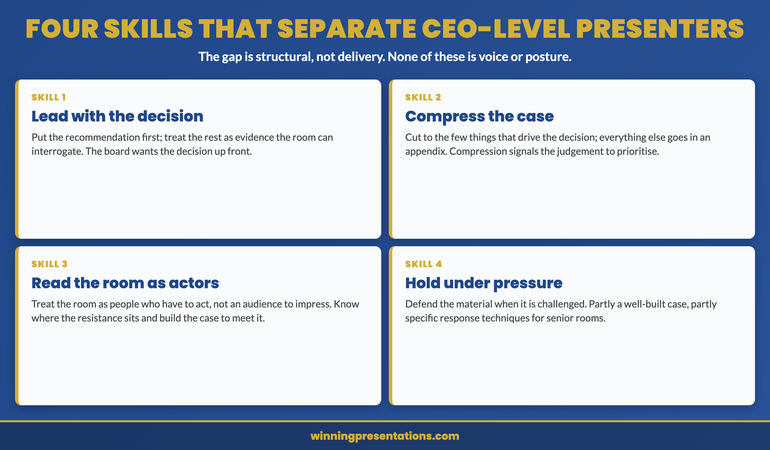
Credible executive training addresses four capabilities. First, structural methodology — how to lead with the recommendation, position evidence strategically, and address risk before the audience raises it. Second, stakeholder analysis: a board of non-executive directors evaluates differently from an investment committee, which evaluates differently from a leadership team. Training that treats all audiences as interchangeable produces presentations that are competent but not persuasive.

Third, scenario-specific practice. The presentation types executives deliver — annual budget presentations, risk committee updates, project approvals — each have their own structural logic. Generic role-plays miss this entirely. Fourth, Q&A preparation: for many executives, it is the question-and-answer session that determines the outcome, not the presentation itself.

If you are evaluating training options, the guide on choosing a presentation skills course for executives provides a detailed comparison framework.

A Complete Executive Presentation Programme — Self-Paced, Structured, Practical

AI-Enhanced Presentation Mastery covers the full executive presentation skill set: structural methodology, stakeholder analysis, AI-assisted preparation, and delivery under pressure. Self-paced. 8 modules. 83 lessons. £499/seat.

  • ✓ 8 structured modules covering executive presentation methodology
  • ✓ 83 lessons — work through at your own pace, no deadlines
  • ✓ 2 optional live coaching sessions with Mary Beth (fully recorded)
  • ✓ AI-assisted preparation techniques for faster, sharper presentations

Explore the Programme → £499/seat

Enrolment is open — join at your own pace. Self-paced. 8 modules. 83 lessons. Optional coaching sessions — fully recorded.

Red Flags in Budget Presentation Courses

Many courses marketed as “executive” or “advanced” are repackaged entry-level content with a higher price tag. Knowing what to avoid saves money and the opportunity cost of training that does not transfer to the presentations you actually deliver.

Generic content with executive branding. If the curriculum covers slide design basics, vocal projection, and “power poses” without addressing structural logic for board-level presentations, it is designed for a general audience regardless of how it is marketed.

One-day transformation promises. Complex skills do not transfer in a single workshop. Programmes that promise “boardroom confidence in eight hours” are selling motivation, not capability. Lasting improvement requires structured practice across scenarios, with feedback.

No scenario differentiation. A risk committee presentation requires a fundamentally different structure from a team strategy update. Courses that teach one framework for all contexts miss the point.

Trainer credentials without executive experience. Trainers with backgrounds in theatre or general communication may teach delivery well but struggle with executive-level structure. Look for trainers with corporate experience at the level you present to.

What Good Programmes Actually Include

The programmes that consistently improve executive presentation performance share several characteristics worth understanding before you evaluate marketing pages.

A repeatable structural methodology. The best programmes teach a framework covering argument sequencing (recommendation first, evidence second, risk addressed early), headline construction, and audience-specific framing. Once learned, this methodology accelerates preparation for every future presentation.

Scenario-based modules. Effective programmes break executive presentations into distinct types — board updates, budget proposals, investment pitches, strategic reviews — and address the structural logic of each.

Comparison chart showing what executive presentation training should include versus what generic courses typically cover: structural methodology, scenario-specific practice, stakeholder analysis, and Q&A frameworks versus slide design, body language tips, and generic role-plays

AI integration. The most current programmes now incorporate AI-assisted preparation — teaching executives how to use tools like Copilot, ChatGPT, or Gemini effectively for presentation development. The critical distinction is between programmes that teach prompt engineering for executive scenarios specifically (where the structural methodology informs the AI prompts) and those that simply demonstrate generic AI features.

Flexible access. Senior executives rarely have the schedule flexibility for multi-day residential workshops. Programmes that offer self-paced learning — with optional live coaching for those who want direct feedback — respect the reality that most participants are fitting professional development around demanding roles.

For a deeper look at what distinguishes executive-level courses from standard offerings, the guide on executive presentation masterclasses online examines what the market currently offers and where the gaps remain.

Do presentation courses improve confidence?

Confidence in executive presentations is primarily a function of preparation quality, not personality. Executives who have a clear structural methodology — who know their recommendation is on the right slide, their evidence is sequenced correctly, and their risk mitigation is positioned before the audience raises it — present with significantly more confidence than those relying on general delivery techniques. The most effective training builds confidence indirectly, by giving presenters a reliable preparation framework rather than coaching them to “appear confident” through body language adjustments.

Self-Paced Versus Live Formats

The format question — self-paced online learning versus live workshops — is one of the first decisions when choosing presentation skills training. Both formats have genuine strengths, and the right choice depends on the executive’s primary gap.

Self-paced programmes work well for structural skills. Learning how to sequence an argument or prepare for board-level Q&A does not require a live instructor. These skills benefit from reflection and application — working through a module, applying the framework to an upcoming presentation, then returning with real experience to build on.

Live workshops have an advantage for delivery feedback: pacing, presence, and the ability to read the room. However, for executives whose primary challenge is structural, a live workshop may address the symptom (delivery confidence) while missing the cause (weak argument architecture).

The hybrid model — self-paced structural methodology with optional live coaching — is increasingly common and offers the benefits of both.

The AI-Enhanced Presentation Mastery programme uses this hybrid approach — 83 self-paced lessons covering executive methodology, with two optional live coaching sessions that are fully recorded for those who cannot attend in real time.

How long does it take to improve presentation skills?

Structural presentation skills — argument sequencing, headline framing, evidence positioning — can be applied immediately. An executive who learns to lead with the recommendation rather than build up to it will see an immediate difference in how board members engage with their next presentation. Delivery skills take longer because they involve habit change, but most executives see noticeable improvement within four to six weeks of structured practice. The key is consistent application: each presentation becomes a practice opportunity when you have a methodology to apply.

Decision framework for choosing between self-paced and live presentation training formats: comparing flexibility, structural skills, delivery feedback, schedule fit, and cost considerations for executive professionals

How to Evaluate the ROI of Presentation Training

Most organisations evaluate training on satisfaction scores rather than on whether it changed presentation outcomes. A more useful framework looks at three indicators.

Preparation time. Presentations that currently take four to six hours should take one to two hours after effective training. If the programme provides structural frameworks, preparation becomes assembly rather than invention. This saving alone often justifies the investment.

Decision outcomes. If an executive consistently faces “come back next month with more detail” responses, the issue is almost always structural. Effective training reduces the number of presentations that require a follow-up session before a decision is reached.

Stakeholder feedback quality. After effective training, questions shift from “what are you asking us to approve?” to substantive challenges — assumptions, implementation detail, risk mitigation. This shift indicates the audience is engaging with the argument rather than struggling to find it.

For senior leaders preparing for high-stakes scenarios, the article on senior executive presentation skills explores the specific capabilities that distinguish competent presenters from genuinely persuasive ones at the highest levels.

Invest in the Methodology, Not Just the Motivation

AI-Enhanced Presentation Mastery is a self-paced programme for executives who want a repeatable system for structuring presentations that win decisions. 8 modules. 83 lessons. 2 optional coaching sessions. £499/seat — a career investment that applies to every high-stakes presentation from this point forward.

Explore the Programme → £499/seat

Self-paced. 8 modules. 83 lessons. Optional coaching sessions — fully recorded.

Choosing the Right Programme for Your Role

The “right” programme depends on the gap you are trying to close.

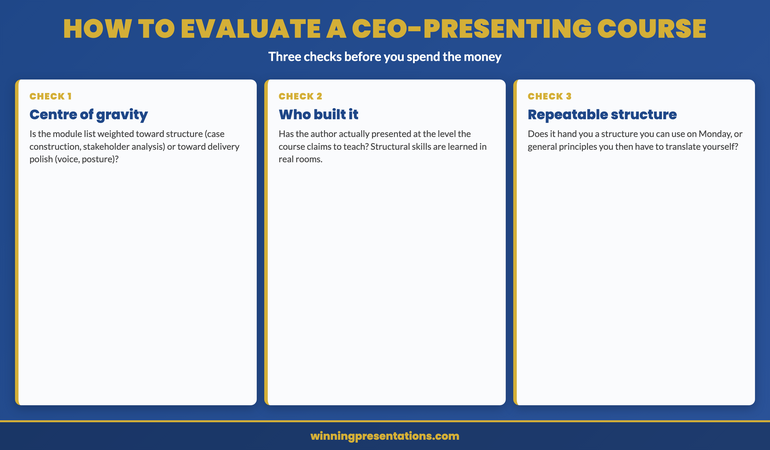
If your gap is structural — you know the material but struggle to build arguments that land with senior audiences — prioritise programmes that teach methodology, not delivery coaching. Look for modules organised by scenario type rather than skill type.

If your gap is delivery — your content is sound but you struggle with nerves or presence — a programme with live coaching is more valuable. For executives dealing with genuine anxiety, the guide on managing stomach-churning nerves before presentations addresses the physiological dimension that many programmes overlook.

If your gap is both — common for executives promoted into roles requiring more senior presentations — a comprehensive programme covering structure, preparation, and delivery is the most efficient path.

Finally, evaluate the trainer. The most credible trainers have worked directly with senior leaders in corporate environments, not just taught presentation skills in academic settings. Industry experience gives them an understanding of the decision dynamics and political sensitivities that shape how executive presentations succeed or fail.

Can AI replace presentation training?

AI tools accelerate preparation but do not replace the structural knowledge that determines whether a presentation persuades a senior audience. If the executive does not know the correct structure for a board approval versus a budget proposal, AI output will be fluent but structurally generic. The most effective approach combines structural training with AI tools. Without the structural foundation, AI produces more slides faster — but they remain the wrong slides for executive audiences.

Frequently Asked Questions

How much does executive presentation training cost in the UK?

Executive presentation training in the UK ranges from under £100 for self-paced digital programmes to £2,000–£5,000 per day for bespoke in-person delivery with a senior consultant. Mid-range options — typically £300–£800 — often include structured modules, scenario-based exercises, and some form of coaching or feedback. The price alone does not determine quality; what matters is whether the programme addresses the specific presentation types you deliver (board updates, investment committee pitches, stakeholder proposals) rather than generic public speaking or slide design.

What should executive presentation training include?

Credible executive presentation training should cover four areas: structural methodology (how to sequence arguments for senior audiences), stakeholder analysis (adapting content and delivery to different decision-makers), scenario-specific practice (board presentations, budget proposals, executive approvals — not generic role-plays), and a framework for handling Q&A under pressure. Programmes that focus primarily on body language, vocal projection, or slide design are typically designed for general business audiences, not executives presenting at board level or to investment committees.

Is online presentation training as effective as in-person?

For structural and strategic presentation skills — how to frame an argument, sequence evidence, and build a recommendation — online training can be equally effective, particularly when delivered as self-paced modules that allow executives to apply concepts between sessions. Where in-person training has an advantage is in real-time delivery feedback: body language, voice modulation, and room presence. The best approach depends on what the executive needs most. If the gap is structural (decks that fail to persuade despite clear delivery), online or self-paced programmes address the core issue efficiently.

How do I choose the right presentation training programme?

Start by identifying the specific gap: is the challenge structural (arguments that do not land with senior audiences), delivery-related (nerves, pacing, presence), or both? Then evaluate programmes against four criteria: does it address your specific presentation scenarios (not just generic business contexts), does the trainer have credible experience with senior audiences, does it include practical application (not just theory), and does the format fit your schedule (self-paced versus scheduled workshops)? Avoid programmes that promise transformation through a single workshop — presentation skills improve through structured practice, not one-off sessions.

The Winning Edge

Weekly insights on executive presentations, stakeholder communication, and career-defining moments at the podium — for professionals who present at the highest stakes.

Subscribe Free

About the author

Mary Beth Hazeldine is the Owner & Managing Director of Winning Presentations. With 24 years of corporate banking experience at JPMorgan Chase, PwC, Royal Bank of Scotland, and Commerzbank, she advises executives across financial services, healthcare, technology, and government on structuring presentations for high-stakes scenarios.

29 Apr 2026
Senior executive woman presenting a change management plan on a large boardroom screen to a group of senior stakeholders in a modern glass-walled corporate boardroom with navy and gold accents

Change Management Presentation: How to Get Senior Stakeholders Aligned Before You Start

Quick answer: A change management presentation earns executive buy-in when it leads with the cost of standing still, frames the change as the lower-risk option, and gives senior stakeholders a specific role in how the change will land. Most change presentations fail because they pitch the solution before the audience has accepted the problem. This article walks you through the narrative structure, the resistance-handling moves, and the slide sequence that turns a scepticial leadership team into active sponsors.

Amani had been given forty-five minutes to brief the executive committee on a twelve-month operating model redesign. She had been preparing for three weeks. The deck was thorough: thirty-two slides covering current-state pain points, the proposed future state, benchmark data from three peer organisations, an implementation timeline, and a risk register. She walked in confident.

The COO stopped her at slide eight.

“Amani, I’m hearing a proposal. What I need to hear is a choice. You’re showing me where you think we should go. You haven’t shown me what happens if we don’t go there, and you haven’t shown me why standing still is more expensive than moving.”

She spent the next fortnight restructuring the entire presentation. The proposed future state moved from slide six to slide sixteen. The first ten minutes became an argument about the cost of inaction — attrition patterns, unit economics declining year-on-year, regulatory exposure growing. By the time the new model appeared, the committee were already asking how fast it could happen. The change itself had not changed. The order of the argument had.

That sequencing is what separates a change management presentation that earns commitment from one that triggers a debate.

If you are building a change management presentation and want a structured starting point for your slides, the Executive Slide System includes scenario-specific templates for stakeholder alignment conversations, along with AI prompts designed to help you frame complex change arguments in executive terms.

Explore the System →

Why Most Change Management Presentations Lose the Room

A change management presentation is not really a presentation about change. It is an argument about risk, identity, and control. When an executive leadership team pushes back on a change proposal, they are rarely resisting the change itself. They are resisting the way the change has been framed.

Three framing problems appear in almost every change presentation that fails to land:

  • The solution arrives before the problem has landed. Most decks spend too long explaining what the new operating model, system, or structure will look like, and not enough time making the audience feel the cost of the current state. The leadership team have not emotionally agreed there is a problem. Arguing for a solution before the problem is accepted feels premature.
  • The change is positioned as ambitious, not conservative. Senior stakeholders see themselves as stewards of the organisation. Ambition feels like exposure. If the presenter positions the change as a bold move, the audience hears risk. If the presenter positions the change as the prudent response to a worsening situation, the audience hears governance.
  • Stakeholders are told about the change instead of given a role in it. A change presentation that treats the leadership team as an audience creates spectators. A presentation that treats them as active sponsors creates co-owners. The board presentation 15-minute framework makes this point directly: decisions happen faster when the decision-makers see themselves in the change, not outside it.

Fixing these three framing problems does not require new data or a better change plan. It requires a different argument structure. That is what the rest of this article walks through.

Build a Change Case Your Leadership Team Can Commit To

The Executive Slide System gives you 26 board-ready slide templates, 93 AI prompts for structuring executive-level arguments, and 16 scenario playbooks covering the high-stakes presentation moments change leaders face most often — including operating model redesigns, organisational restructures, and cross-functional transformation programmes.

Executive Slide System — £39, instant access.

Get the Executive Slide System →

Instant download. 3 files. Use it for your next executive change briefing.

The Four-Part Narrative That Earns Buy-In

A change management presentation that earns executive commitment almost always follows the same four-part narrative. Each part does a specific persuasive job. Skipping any one of them creates the resistance pattern the presentation was built to avoid.

1. The cost of standing still. Open with a direct, specific description of what the organisation is losing right now by continuing with the current state. Not a generic “the market is changing” statement — a concrete financial, operational, or reputational cost that the leadership team can feel. Decline in unit economics, rising attrition, compliance exposure, customer experience gaps. The goal is to make the status quo feel more expensive than the change.

2. The cost of late change. Even when the leadership team agrees there is a problem, they will default to deferring the response. The second part of the narrative neutralises that instinct by quantifying what happens if the change is delayed by six or twelve months. Lost time is its own cost — describe it. This is the element most change decks omit, and its absence is why so many proposals get a “let us think about it” response.

3. The proposed change, framed as the lower-risk path. Only now does the actual change arrive. Describe the future state and the pathway to it. Crucially, frame the change as the conservative option: it reduces exposure, tightens control, de-risks a current vulnerability. Ambition language (“bold”, “transformative”, “breakthrough”) invites scrutiny. Risk-reduction language (“restore”, “protect”, “stabilise”) invites agreement.

4. What you need from the committee today. End with specific, named decisions the leadership team is being asked to make. Not an abstract “we need your support” — a concrete set of commitments: endorsement of the change case, approval of a phase-one budget, nomination of executive sponsors, agreement on the communication sequence. Giving the committee a clear ask transforms the presentation from a briefing into a decision point.

These four parts, in this order, do the persuasion work that generic change decks miss. The sequence matters more than the individual slides.


Infographic showing the four-part narrative arc for a change management presentation: cost of standing still, cost of late change, proposed change framed as lower-risk path, and specific decisions requested from the leadership team

The Slide Structure That Supports the Argument

A forty-minute change management presentation does not need forty slides. It needs eight to twelve slides that each do a specific persuasive job, with supporting detail available in an appendix. Bloat is the enemy of buy-in: every additional slide increases the probability that the argument will lose momentum.

A decision-led change deck typically maps like this:

Slide 1: Executive summary and decisions requested. One page. Three decisions. This is the slide the committee will remember. The rest of the deck exists to support this slide.

Slide 2: The current-state cost, quantified. The financial or operational impact of the status quo, expressed in the committee’s native metrics. If they think in operating margin, show operating margin. If they think in customer outcomes, show customer outcomes.

Slide 3: The trajectory if nothing changes. A simple projection of the current-state cost over the next twelve to twenty-four months. This is what turns “we have a problem” into “we have a problem that will get worse”.

Slide 4: The proposed change, at one level of abstraction. Not the detailed target operating model. A single-page articulation of what changes and what stays the same. Your executive summary slide pattern works perfectly here: one clear statement, three supporting pillars.

Slide 5: Why this is the lower-risk path. The explicit risk-reduction argument. What exposures does the change reduce? What happens to them if the change is not made? This slide inoculates against the “but what if it goes wrong” challenge before it arrives.

Slide 6: Phased implementation and off-ramps. A phase-one commitment, with clear decision points before phase two is initiated. Leadership teams approve staged commitments far more readily than all-or-nothing investments.

Slide 7: Anticipated resistance and how it will be handled. Preempt the organisational pushback. Name the three or four groups most likely to resist and describe exactly how their concerns will be addressed.

Slide 8: What we need from you today. Return to the decisions requested. Name each sponsor role. Confirm the phase-one budget and timeline. Close the loop opened on slide one.

If your current change deck runs twenty-five slides and still feels short of answers, the problem is structure, not volume. The scenario playbooks and prompt cards inside the Executive Slide System are designed to compress a sprawling change narrative into the eight- to twelve-slide arc that executives can actually act on.

Anticipating Resistance Before It Becomes a Blocker

The most important resistance-handling move in a change management presentation happens before the question is asked. If the presenter can name the objection first, the dynamic shifts from defence to dialogue. That is why an explicit “anticipated resistance” slide is one of the most powerful persuasion tools in a change deck.

Most organisational change produces predictable resistance patterns. Naming them early builds credibility. Five recurring patterns show up in almost every significant change programme:

  • Identity resistance. Individuals or teams whose professional identity is tied to the current way of working. Their concern is not workflow — it is relevance. Address it by naming how their expertise is carried forward into the new state.
  • Loss aversion. Stakeholders who feel they are giving up influence, headcount, or perceived control. Address it by acknowledging the loss openly rather than minimising it.
  • Fatigue resistance. Teams who have lived through previous change programmes that did not deliver. Address it by distinguishing specifically how this change is different from the ones they remember.
  • Operational anxiety. Managers who are worried the change will distract from day-to-day delivery. Address it by quantifying the implementation load and naming the mitigations.
  • Political resistance. Senior stakeholders whose power base intersects with the area being changed. Address it directly with the sponsor rather than in the open session — the presentation should acknowledge the sensitivity without naming individuals.

Including this slide in the change deck communicates something important to the executive committee: the presenter has thought about the human reality of the change, not just the structural logic. That impression of thoroughness often carries the rest of the argument.


Infographic showing five predictable resistance patterns in organisational change: identity resistance, loss aversion, fatigue resistance, operational anxiety, and political resistance, with brief descriptions of how each typically manifests

Giving Senior Stakeholders a Specific Role

Change programmes rarely fail because the change itself was wrong. They fail because the senior leadership team never committed to a visible, specific role in making the change land. A good change management presentation closes by giving each relevant leader a named responsibility — and getting that commitment before the meeting ends.

The most effective role assignments follow three principles:

Specificity. “We need your support” is not a role. “We need you to host a monthly operational check-in with the project steering group and personally send the quarterly communication to the division” is a role. Vague asks produce vague commitments.

Visibility. Role assignments should be visible to the rest of the organisation. A CFO who commits to chairing the budget-realignment working group publicly has a different stake in the outcome than a CFO who has privately said yes.

Low friction. Each role should be achievable within the executive’s existing time commitments. A role that requires forty new hours per month will be declined quietly. A role that requires two hours of visible sponsorship per month will be accepted.

The work of securing these commitments often begins before the presentation itself — in the one-to-one conversations with each senior stakeholder in the week before the meeting. The presentation confirms publicly what has already been agreed privately. That pattern is developed in more detail in our guide to senior stakeholder management presentation skills.

Six Mistakes That Undermine Change Credibility

Across change programmes in financial services, healthcare, public sector transformation, and technology-driven operating model redesigns, the same presentation mistakes show up again and again. Each of them is easy to fix once it has been named.

  • 1. Leading with the future state. The future state is slide sixteen, not slide one. Earn the right to show it by making the current-state cost feel real first.
  • 2. Using ambition language instead of risk-reduction language. “Transformation” invites scrutiny. “Stabilisation” invites agreement. Word choice is argument choice.
  • 3. Presenting a single option without alternatives considered. Executives distrust binary proposals. Show the two or three alternatives that were considered and why the recommended path is the strongest.
  • 4. Treating resistance as something to manage later. If resistance is not named in the presentation, the committee will assume the presenter has not thought about it. Surface the pattern, describe the response.
  • 5. Ending with “any questions?” End with a named ask. “We are asking the committee to endorse the change case, approve the phase-one budget, and confirm executive sponsors today.” Silence signals uncertainty; specificity signals control.
  • 6. Presenting as the change programme rather than with the change programme. The presenter is not advocating for a proposal. The presenter is the voice of the committee’s own change programme. That subtle shift in positioning changes the room.

Fixing these six mistakes is often the fastest way to take a change proposal from contested to endorsed. None of them require the change plan to change. They only require the presentation to.

Is a Structured Slide System Right for You?

The Executive Slide System is designed for change leaders, programme directors, transformation officers, and senior managers who present to executive committees, sponsor groups, or cross-functional leadership forums on a recurring basis. If you build the same kind of change argument repeatedly and want a structured starting point rather than a blank slide, the templates and AI prompt cards will compress your preparation time significantly.

If your presentations are one-off events with no recurring executive audience, you may find more value in a single-scenario toolkit. The Executive Slide System is optimised for repeat presenters in executive settings.

Need the Templates, Not Another Article?

The Executive Slide System includes the four-part change narrative this article describes, applied to 16 real-world executive scenarios including operating model redesigns, restructures, cross-functional governance forums, and stakeholder alignment briefings. Executive Slide System — £39, instant access.

Get the Executive Slide System →

Designed for executive presentation scenarios.

Frequently Asked Questions

How long should a change management presentation be?

For an executive committee briefing, aim for an eight- to twelve-slide deck that can be presented in 20 to 25 minutes, leaving ample time for discussion and decision-making. Detailed supporting analysis belongs in an appendix. If the presentation runs longer than 30 minutes, the committee will run out of cognitive bandwidth before the decisions are made.

Should I share the deck with stakeholders before the meeting?

For a change management presentation, the pre-meeting one-to-one conversations matter more than the pre-read deck. Use the two to three days before the meeting to walk each key stakeholder through the argument privately, hear their objections in a low-stakes setting, and adjust the deck if needed. The formal deck can then be shared 24 to 48 hours before the meeting as a confirmation of what has already been discussed, not as a surprise.

What if the executive committee disagrees on whether the change is needed?

If the disagreement is about whether a problem exists, return to the cost-of-standing-still argument and strengthen the evidence. If the disagreement is about the proposed response, offer an alternative-path analysis that shows two or three options with clear trade-offs. Forcing the committee to pick between competing options is often more productive than trying to convince them of a single answer.

How do I present a change that will lead to redundancies?

Name the human impact explicitly and early in the deck. Avoid euphemisms. Describe how the affected individuals will be supported, what the transition timeline looks like, and how the communication will be handled. Executive committees respect presenters who acknowledge the cost honestly. They distrust presenters who bury the impact in process language.

Get The Winning Edge

A weekly note for executives who present to boards, executive committees, and senior stakeholders. Short, practical, and focused on what actually moves the decision.

Subscribe to The Winning Edge →

Not ready for the full system? Start here instead: download the free Executive Presentation Checklist — a short pre-flight check that helps you spot weak arguments, missing risk framing, and status-heavy slides before your next change briefing.

Related reading: If you also present to governance committees focused on enterprise risk, see our guide to the risk committee presentation — it applies a similar risk-reduction framing to board-level oversight briefings.

Before your next executive change briefing, rebuild the opening ten minutes around the cost of standing still. Everything else follows from there.

About the Author

Mary Beth Hazeldine is Owner & Managing Director of Winning Presentations. With 24 years of corporate banking experience at JPMorgan Chase, PwC, Royal Bank of Scotland, and Commerzbank, she advises executives across financial services, healthcare, technology, and government on structuring presentations for high-stakes funding rounds, board reviews, and change programmes. Winning Presentations was founded in 1990 by David Gilgrist, author of Winning Presentations (Gower Publishing), and Nigel Dickinson.

28 Apr 2026
Executive confidently responding to a challenging question during a boardroom Q&A session, with colleagues listening attentively around a polished conference table in a modern glass-walled office

Q&A Handling Training for Presentations: The Executive System

If you’re looking for Q&A handling training specifically designed for high-stakes executive presentations, the Executive Q&A Handling System (£39) provides the complete framework: bridge statements, deflection techniques, composure protocols, and structured preparation methods for boardroom, investor, and senior leadership Q&A sessions. This page explains exactly what the system covers, who it’s designed for, and how it works.

Why Q&A Is Where Most Executive Presentations Fall Apart

You delivered a strong presentation. Your slides were clear, your argument was structured, and you held the room’s attention throughout. Then someone asked a question you didn’t expect — and everything shifted. The confidence you built over twenty minutes evaporated in thirty seconds.

This is remarkably common at senior level. The presentation itself is rehearsed. The Q&A isn’t. And yet it’s during Q&A that decision-makers form their final impression of your credibility, your command of the subject, and whether they trust your judgement enough to act on your recommendation.

The problem isn’t a lack of knowledge. Most executives know their material thoroughly. The problem is structural: they have no repeatable method for processing unexpected questions, managing hostile or loaded queries, or maintaining composure when the conversation turns adversarial. Without a system, every difficult question becomes an improvisation — and improvisation under pressure is unreliable.

A Structured System for Executive Q&A

The Executive Q&A Handling System was built to solve this specific problem. Rather than offering general advice about “staying calm” or “thinking on your feet,” it provides a concrete, repeatable framework for handling the types of questions that derail executive presentations: the hostile challenge, the loaded question, the question designed to expose a weakness, the question you genuinely don’t know the answer to.

The system is built from Mary Beth Hazeldine’s 25 years working with executives in financial services, professional services, and corporate leadership — environments where Q&A sessions routinely determine whether proposals are approved, deals progress, or careers advance. Every technique in the system has been refined through real boardroom, investor, and procurement panel scenarios.

It covers the full arc of Q&A preparation and performance: from anticipating likely questions before you present, through managing your physiological response when a difficult question lands, to specific linguistic frameworks for bridging away from hostile territory without appearing evasive.

What You Get

  • Bridge statement frameworks — structured techniques for redirecting difficult questions back to your key message without appearing evasive or dismissive
  • Objection-handling methodology — a step-by-step approach for processing challenges, hostile queries, and loaded questions in real time
  • Composure protocols — practical methods for managing the physiological stress response when a question catches you off guard
  • Question anticipation system — a preparation framework for predicting the most likely challenges before you enter the room
  • Deflection techniques — methods for handling questions you cannot or should not answer directly, without damaging your credibility
  • Scenario-specific playbooks — tailored approaches for board Q&A, investor panels, procurement reviews, and internal stakeholder sessions

£39 — instant access, no subscription.

Stop Dreading the Questions You Can’t Predict

The difference between a presenter who crumbles under Q&A pressure and one who handles every question with authority isn’t talent — it’s preparation method. The Executive Q&A Handling System gives you bridge statements, composure protocols, and objection-handling frameworks designed for high-stakes executive settings. £39, instant access.

Get the Executive Q&A Handling System →

Designed for executives facing high-stakes Q&A in boardrooms, investor panels, and procurement reviews.

Is This Right for You?

This system is designed for professionals who present to senior decision-makers and face challenging Q&A sessions as part of their role. It’s particularly suited to executives, directors, and senior managers in corporate, financial services, consulting, or public sector environments — anyone who regularly needs to defend proposals, respond to scrutiny, or maintain credibility under questioning.

It is not a general presentation skills course. If your primary challenge is structuring slides, managing nerves before you speak, or improving your overall delivery, this isn’t the right starting point. This system is narrowly focused on what happens after your prepared material ends and the questions begin. If Q&A is where your presentations lose momentum, it’s built precisely for that problem.

See also: How to handle hostile questioners in executive presentations

Frequently Asked Questions

Is Q&A handling training worth the investment for experienced presenters?

Experience presenting and experience handling Q&A are different skills. Many confident, capable presenters struggle specifically when the structured portion ends and unpredictable questions begin. If you’ve ever felt your credibility slip during a Q&A session despite delivering a strong presentation, this training addresses that exact gap.

How quickly can I apply these techniques?

The bridge statement frameworks and composure protocols are designed to be immediately usable. Most professionals report applying specific techniques in their very next presentation. The question anticipation system takes slightly longer to build into your preparation routine, but the core frameworks are practical from day one.

Does this work for virtual presentations and video calls?

Yes. The principles of Q&A handling apply regardless of format. The system includes specific guidance for managing Q&A dynamics in virtual settings, where the loss of body language cues and the difficulty of reading the room create additional challenges.

What if my Q&A challenges are sector-specific?

The system includes scenario-specific playbooks covering board Q&A, investor panels, procurement reviews, and internal stakeholder sessions. The underlying frameworks — bridge statements, objection handling, composure management — are transferable across sectors. The playbooks show how to apply them in specific high-stakes contexts.

How does this differ from general communication training?

General communication training covers a broad range of skills: listening, presenting, writing, negotiating. This system focuses exclusively on one high-stakes moment: the Q&A session after an executive presentation. Every technique is designed for the specific dynamics of that situation — the time pressure, the adversarial questioning, the audience scrutiny, the career implications of how you respond.

Is the Executive Q&A Handling System a course or a toolkit?

It’s a structured toolkit — frameworks, templates, and protocols you can apply immediately. There are no video lectures to watch or modules to complete sequentially. You access the materials, identify which frameworks apply to your situation, and use them in your next presentation preparation.

28 Apr 2026
Man in a navy suit stands at the head of a conference table addressing colleagues in a boardroom with a city skyline outside the window? (informative)

Senior Stakeholder Management Presentation Skills: How to Influence Decision-Makers at Board Level

Quick Answer

Senior stakeholder management presentation skills determine whether your recommendation is approved, deferred, or quietly shelved. The difference between executives who consistently secure buy-in and those who face repeated deferrals is rarely the quality of the analysis — it is the ability to map the room, pre-align key decision-makers, structure an argument that addresses competing priorities, and handle objections without losing the thread. These are learnable skills that follow a structural logic most professionals have never been taught.

Beatriz had spent three months building the business case for a regional expansion across Southern Europe. The analysis was thorough — market sizing, competitive landscape, regulatory mapping, a detailed financial model with three scenarios. When she presented to the investment committee, the CFO interrupted on slide six to ask whether the working capital requirement had been stress-tested against the group’s existing covenant structure. It had — on slide twenty-two. The Chief Operating Officer wanted to know about local hiring timelines. That was in the appendix. The committee chair, who had seemed supportive in corridor conversations, said nothing at all. The proposal was deferred for further review, which in practice meant it would compete with the next quarter’s priorities and likely lose. Beatriz had built the right case. She had presented it to the wrong version of the room — the version she imagined rather than the one that actually existed, with its competing concerns, unspoken priorities, and pre-formed positions she had never mapped.

Preparing a high-stakes presentation that requires executive buy-in? The Executive Buy-In Presentation System teaches the complete framework for structuring presentations that secure approval from senior decision-makers. Explore the Programme →

Why Senior Stakeholder Presentations Fail at Board Level

The most common reason a stakeholder management presentation fails is that the presenter treats the room as a single audience. A board or investment committee is not one audience — it is a collection of individuals with different mandates, different risk tolerances, and different definitions of what constitutes a good decision. The CFO evaluates financial exposure. The COO assesses operational feasibility. Non-executive directors look for governance risk. The chair is often managing a broader agenda that includes priorities the presenter knows nothing about.

When a presenter builds one argument for this collection of perspectives, the result is a presentation that partially satisfies everyone and fully convinces no one. The analysis might be sound, the recommendation might be correct, but the structure fails because it does not address what each stakeholder needs to hear in order to support the decision.

A second failure pattern is the assumption that the presentation itself is where the decision is made. In most board-level settings, the formal presentation is closer to a ratification event than a persuasion opportunity. The actual influencing happens before the meeting — in one-to-one conversations, in pre-reads, in the informal exchanges that shape a stakeholder’s position before they sit down. Executives who rely solely on the quality of their slides are operating with only part of the influence system.

The third pattern is failing to anticipate the objections that will arise from each stakeholder’s specific mandate. Understanding the psychology behind stakeholder buy-in reveals that objections are rarely about the content itself — they are about the stakeholder’s need to demonstrate due diligence in their area of responsibility. A finance director who does not challenge the cost assumptions is not doing their job. A risk committee chair who does not probe the downside scenario is failing in their governance role. Anticipating these challenges is not pessimism — it is stakeholder literacy.

Frameworks for Stakeholder Alignment

Effective stakeholder alignment begins with a structured map of the decision landscape. Before building a single slide, the presenter needs to answer four questions about every stakeholder who will be in the room: What is their primary concern? What would cause them to object? What would make them actively support the recommendation? And what is their relationship to the other stakeholders in the room?

The first framework is priority mapping. Each stakeholder operates within a mandate that determines what they pay attention to. A Chief Financial Officer will evaluate any proposal through the lens of capital allocation, return on investment, and covenant compliance. A Chief Technology Officer will assess technical feasibility and integration risk. Mapping these priorities before the presentation allows the structure to address each one explicitly rather than hoping the general argument covers them all.

The second framework is influence architecture. Not all stakeholders carry equal weight in a decision. In most boardroom settings, one or two voices carry disproportionate influence — the committee chair, the longest-serving non-executive, or the person who most recently experienced a failure in the area under discussion. Identifying these influence centres and structuring the argument to address their specific concerns first is not manipulation — it is strategic communication. A presentation that wins the support of the two most influential voices in the room is more likely to succeed than one that distributes its persuasion effort equally across all attendees.

The third framework is concession mapping. Before entering the room, experienced presenters identify what they are willing to concede and what is non-negotiable. This is not a defensive posture — it is preparation for the negotiation that high-stakes presentations inevitably become. Knowing in advance that you can offer a phased implementation timeline but cannot reduce the budget below a certain threshold gives you structured flexibility rather than improvised compromise.

Understanding how to build a board presentation structure that accommodates these multiple stakeholder perspectives is the bridge between strategic analysis and practical execution.

Secure Executive Buy-In With a Structured Framework

The Executive Buy-In Presentation System is a self-paced programme that teaches the complete framework for structuring presentations that win approval from senior stakeholders. £499 — new cohorts open monthly, with optional Q&A calls (all recorded).

  • ✓ Stakeholder mapping and influence architecture frameworks
  • ✓ Decision-framing techniques for board-level audiences
  • ✓ Objection anticipation and handling strategies
  • ✓ Self-paced modules with optional live Q&A calls (recorded)

Explore the Programme →

Self-paced · new cohorts monthly · designed for senior executives

Infographic showing three stakeholder alignment frameworks: priority mapping, influence architecture, and concession mapping — with key questions for each

Objection Handling in Board Settings

Board-level objections are fundamentally different from the pushback you encounter in team meetings or management presentations. In a boardroom, objections serve a governance function. Non-executive directors are required to challenge — it is part of their fiduciary duty. A proposal that receives no challenge is more likely to concern the chair than one that generates robust questioning. Understanding this dynamic changes how you prepare for and respond to objections.

The first principle of board-level objection handling is anticipation over reaction. For every stakeholder in the room, you should be able to predict their most likely objection based on their mandate and their known concerns. A finance director will challenge the cost assumptions. A risk committee member will probe the downside scenario. The chair may raise a timing concern related to other strategic priorities. Preparing a structured response to each anticipated objection — with supporting data readily accessible — transforms what feels like an attack into a demonstration of thoroughness.

The second principle is acknowledgement before response. When a senior stakeholder raises an objection, the instinct to defend immediately is strong — and almost always counterproductive. Acknowledging the concern first (“That is a valid concern, and it is one we have modelled explicitly”) signals that you have taken the stakeholder’s perspective seriously before you present your response. This sequence — acknowledge, validate, respond with evidence — reduces the adversarial dynamic and repositions the exchange as collaborative problem-solving.

The third principle is structured concession. Not every objection requires you to hold your ground. Some objections are invitations to negotiate, and the ability to concede on secondary points while holding firm on the core recommendation is a skill that distinguishes experienced boardroom presenters from those who treat every challenge as an attack on their proposal. Knowing which elements are negotiable — and preparing those concessions in advance — gives you the flexibility to accommodate concerns without undermining the recommendation.

For a deeper exploration of how alignment conversations before the meeting shape the objection landscape during it, the guide on stakeholder alignment presentation training covers the pre-meeting strategies that reduce the intensity and unpredictability of boardroom challenges.

The Executive Buy-In Presentation System teaches these objection-handling frameworks as part of its structured approach to securing approval from senior decision-makers.

Building Pre-Meeting Alignment

The most effective approach to presenting to senior stakeholders begins weeks before the presentation itself. Pre-meeting alignment is the process of having individual conversations with key stakeholders to understand their concerns, incorporate their perspective into the materials, and build informal support for the recommendation before the formal meeting takes place.

This is not lobbying. It is intelligence gathering and relationship management. A fifteen-minute conversation with the CFO before the board meeting — in which you share the headline financial assumptions and ask whether anything concerns them — achieves two things simultaneously. First, it surfaces objections you can address in the presentation rather than being caught off guard. Second, it signals respect for the CFO’s expertise, which makes them more likely to be constructive rather than adversarial in the formal setting.

The timing matters. For significant decisions, the optimal window is two to three weeks before the formal presentation — early enough to make meaningful changes, late enough that the proposal is sufficiently developed to discuss credibly.

The structure of the pre-meeting conversation follows a specific pattern. Open with the headline recommendation. Share the one or two data points most relevant to that stakeholder’s mandate. Ask directly: “Is there anything in this approach that concerns you?” Then listen. The purpose is to understand, not to sell. The persuasion happens when you incorporate their feedback into the presentation and they see that their perspective has been taken seriously.

Turn Stakeholder Complexity Into a Structured Advantage

The Executive Buy-In Presentation System covers the full influence process — from stakeholder mapping through pre-meeting alignment to boardroom delivery. Self-paced, with optional Q&A calls (recorded). £499.

Explore the Programme →

Self-paced · new cohorts open monthly · all sessions recorded

Measuring Influence Effectiveness

Stakeholder influence is difficult to measure because the most important outcomes are often invisible. Nevertheless, there are practical indicators that allow you to assess whether your ability to influence senior stakeholders through presentations is improving over time.

The first indicator is objection predictability. If the objections raised during the presentation are ones you anticipated and prepared for, your stakeholder mapping is working. If the challenges come from directions you did not expect, it signals a gap in your understanding of the room’s priorities. Over multiple presentations, tracking the ratio of anticipated to unanticipated objections provides a clear measure of your stakeholder literacy.

The second indicator is decision velocity. Decisions that are approved in the first meeting represent a different level of influence effectiveness than decisions that require multiple presentations, revised papers, and additional committee sessions. If your proposals consistently require follow-up sessions, the issue is likely structural — either the argument is not framed clearly enough for a first-meeting decision, or the pre-meeting alignment was insufficient to build the support needed for immediate approval.

The third indicator is stakeholder feedback quality. When senior stakeholders engage with constructive, specific questions rather than broad, sceptical challenges, it indicates the presentation has earned their intellectual respect. “Have you considered the impact on the European subsidiary?” is qualitatively different from “I am not sure this has been fully thought through.” The former suggests engagement; the latter suggests the argument has not landed.

For presentations involving significant capital expenditure or technology investment, the structural requirements are even more demanding. The guide on technology investment presentations applies these same stakeholder management principles to one of the most challenging approval scenarios — where technical complexity and financial risk intersect in front of a non-technical board.

Infographic showing three indicators of influence effectiveness: objection predictability, decision velocity, and stakeholder feedback quality — with measurement approaches

Frequently Asked Questions

What is the difference between stakeholder management and stakeholder engagement?

Stakeholder management is the strategic process of identifying, analysing, and influencing the people who have decision-making authority over your initiative. Stakeholder engagement is the broader relationship-building activity that supports it. In presentation contexts, the distinction matters because management requires you to map power dynamics, anticipate objections, and structure your argument around what each stakeholder needs to hear — not simply keep them informed. Effective presentations to senior stakeholders are built around the decision architecture of the room, while engagement activities happen before and after the formal presentation itself.

How do you handle conflicting stakeholder priorities in a single presentation?

When stakeholders in the room hold different priorities — a CFO focused on cost containment and a CTO focused on capability — the presentation must acknowledge both without appearing to favour one. The most effective approach is to frame the recommendation in terms that satisfy the shared objective (usually organisational risk reduction or strategic positioning) and then address each stakeholder’s specific concern in dedicated sections. Pre-meeting alignment conversations reduce the likelihood of open conflict during the presentation, but the structure must still accommodate divergent priorities visibly.

How far in advance should you begin stakeholder alignment before a board presentation?

For significant decisions — budget approvals, strategic pivots, organisational restructures — stakeholder alignment should begin at least two to three weeks before the formal presentation. This allows time for individual conversations with key decision-makers, the incorporation of their concerns into your materials, and the informal building of support before the formal meeting. Attempting to align stakeholders in the room itself is one of the most common causes of deferred decisions at board level.

Can stakeholder management presentation skills be learned online?

The structural and strategic elements of presenting to senior stakeholders — stakeholder mapping, objection anticipation, pre-meeting alignment frameworks, and decision architecture — can be learned effectively through self-paced online programmes. The Executive Buy-In Presentation System, for example, teaches the complete framework for securing executive-level buy-in through structured modules that cover stakeholder analysis, persuasion architecture, and objection handling. The advantage of self-paced learning is that participants can apply each framework to their own real stakeholder scenarios as they progress, rather than practising on hypothetical cases.

Join The Winning Edge

Weekly strategies for executive presentations, stakeholder influence, and board-level communication — delivered every Thursday.

Subscribe to The Winning Edge →

Your next step: Before your next high-stakes presentation, map every stakeholder who will be in the room. Write down their primary concern, their most likely objection, and the one thing that would make them actively support your recommendation. Then have a fifteen-minute conversation with the two most influential voices before the meeting. That single action will change what happens when you present.

Mary Beth Hazeldine | Owner & Managing Director, Winning Presentations. With 24 years of corporate banking experience at JPMorgan Chase, PwC, Royal Bank of Scotland, and Commerzbank, she advises executives across financial services, healthcare, technology, and government on structuring presentations for high-stakes funding rounds and approvals.

28 Apr 2026
Senior female executive in a navy blazer presenting confidently to a boardroom of attentive directors, City skyline visible through the window behind her

The Executive Presentation Toolkit: A Complete Method for Senior Executives

Search for an executive presentation toolkit and Google returns PowerPoint template marketplaces. Templates can’t help you when the CFO interrupts your second slide, or when the board chair asks the question you didn’t see coming. This page is for senior presenters who want a complete method — slides, structure, storytelling, anxiety control, delivery mechanics, and Q&A — built across 25 years of corporate presenting and 16 years of training senior professionals. Not a slide library. A working executive’s resource system: seven digital products and three bundle-only tools, refined in real boardrooms across financial services, consulting, insurance, and technology.

How this presentation skills bundle differs from PowerPoint template packs

Template packs solve the wrong half of the problem. You can buy 200 editable PowerPoint slides for £40 and still freeze in Q&A, still lose the room by slide six, still rebuild your deck from scratch every quarter because the templates didn’t come with a structural method for what to put on each slide and why.

The Complete Presenter — Executive Presentation Bundle is not a slide library. It is a behavioural and structural system covering the full presentation lifecycle: prepare → structure → tell the story → manage your nerves → deliver → handle the questions → debrief and improve. The visual assets matter, but they are downstream of the decisions a senior presenter has to make first: what is this presentation supposed to do? What does the room need to believe by the end? What’s the sequence that gets them there?

Templates can’t answer those questions. The frameworks in this toolkit can — because they were built by someone who had to answer them, repeatedly, in JPMorgan Chase, PwC, Royal Bank of Scotland, and Commerzbank.

Slide titled 'Method, Not Templates' showing two cards: left card labeled THIS BUNDLE with 'Methodology — frameworks for thinking' and a four-item bullet list; right card labeled TEMPLATE PACKS with 'Templates — slides to fill in' and a faded, five-item checklist.

The presentation problems senior presenters actually face

A senior director sat in a coaching session and said something that’s been said a hundred times in different rooms:

“The slides were fine. I just fell apart when they started asking questions.”

His structure was solid. His content was clear. But the moment the CFO pushed back on the timeline, he rambled, got defensive, and lost the budget. That single missed Q&A cost more than every previous deck-building hour combined.

This is the pattern that template packs cannot fix. The method for surviving the room is different from the method for designing the slide:

  • Blank-page paralysis on a board pre-read — knowing the topic but not knowing what goes on slide one, two, three.
  • Technical-expert friction — being the smartest person in the room on the subject, but watching the non-technical decision-maker tune out at the third bullet point.
  • Pre-presentation anxiety — the night before a high-stakes presentation, when the slides are done but sleep won’t come and the body is already rehearsing failure.
  • The Q&A moment — the CFO challenges your numbers, the chair pivots away from your recommendation, and the next 30 seconds decide whether you walk out with a yes or with a “let’s reconvene next quarter.”
  • Slide-3 cut-off — when the room loses interest before you’ve reached your recommendation, and the rest of the deck is wasted.

None of these are slide-design problems. They are method problems, structure problems, behavioural problems. They need an integrated approach, not a template.

What it costs when these go wrong

Senior presenters underestimate the cumulative cost of a presenting problem. A single failed boardroom presentation rarely ends a career. A pattern of presenting that doesn’t quite land — where decisions stall, where executives leave with doubt instead of conviction — costs more than any individual missed approval.

It costs the budget that didn’t get signed off because the case wasn’t structured tightly enough. It costs the promotion that went to the colleague whose presentations the CEO trusts. It costs the deal that didn’t close because the room couldn’t follow your reasoning. It costs the board’s confidence in the function you lead — quietly, gradually, over many quarters.

Senior leaders who present well don’t necessarily build prettier slides. They build presentations that move decisions. That’s a learned system, not a template choice.

Build presentations that get past slide 3

The Complete Presenter — Executive Presentation Bundle gives you the method, frameworks, and reference tools to structure executive presentations that hold the room from opening to recommendation:

  • Slide structure for boards, steering committees, and investor meetings — decision architecture, not visual design
  • The Q&A handling framework for predicting tough questions and answering in 15 seconds without rambling
  • Anxiety-management techniques from a qualified clinical hypnotherapist — psychological mechanisms, not platitudes
  • Storytelling, vocal delivery, and openings/closings that make data land in non-technical rooms
  • Three integration tools — a pre-flight checklist, a hostile-question response bank, and a debrief sheet — that connect every product into one usable system

Get the Complete Presenter Bundle →

£99, lifetime access · 7 digital products + 3 bundle-only tools · Designed for senior presenters in financial services, consulting, insurance, and technology

The Complete Presenter Bundle: one method, seven scenarios

Most senior presenters end up buying presentation help one piece at a time — a slide course this year, an anxiety book next year, a Q&A workshop the year after. Each one teaches a different framework, and the gap between them is where the real presenting problems live.

The Complete Presenter — Executive Presentation Bundle was built around a single underlying method. The slide structure connects to the storytelling structure. The storytelling structure connects to the opening choice. The opening choice connects to the body language and vocal pacing. The vocal pacing connects to the Q&A response style. None of this is template-shaped — it is system-shaped.

The methodology underpinning the bundle draws on five named frameworks Mary Beth has developed and refined across 25 years of executive presenting and 16 years of training senior professionals:

  • AVP (Audience–Value–Proof) — the credibility framework for executive-level presentations: who is in the room, what value will land for them, and what proof will withstand scrutiny.
  • SPeeCH (Structure–Point–evidence–Connect–Hook) — the narrative method behind the storytelling work and the openings/closings file. Story-led structure for buyers who need data and decisions, not entertainment.
  • The 3Ps (Pause–Pace–Pitch) — the vocal framework running through the delivery mechanics in the Public Speaking Cheat Sheets. The control variables that separate presenters whose words land from presenters whose words rush past.
  • The 132 Rule — the slide-design principle informing the Executive Slide System: one decision per slide, three supporting points, two visual elements. Anti-clutter, anti-vanity-graphic.
  • The Storyboard Planner — the visual planning approach Mary Beth uses with senior coaching clients before any slide is built. Decision architecture before design.

These five run through every product in the bundle. The seven products are the application; the underlying method is what makes them work together.

What’s inside the executive presentation toolkit

Seven digital products, plus three bundle-only integration tools. All instantly downloadable. All designed to be skim-readable on a laptop or phone before a meeting.

1. Executive Slide System (£39 standalone)

The slide structure used in boardrooms, steering committees, and investor meetings. Not design advice — decision architecture. Twenty-six templates, ninety-three AI prompts, sixteen scenario playbooks. You’ll know exactly what goes on each slide, in what order, and why. Best for the executive who needs a yes, not applause.

2. Executive Q&A Handling System (£39 standalone)

The part most senior presenters dread, and the part nobody trains for. Frameworks for predicting questions, structuring answers in fifteen seconds, and recovering when you don’t know the answer — without losing credibility.

3. Conquer Speaking Fear (£39 standalone)

A psychological framework for managing presentation anxiety, built by a qualified clinical hypnotherapist who spent five years dreading every formal presentation before rebuilding her own approach from the inside out. Not platitudes. Not “just breathe.” The actual mechanisms behind fear, and how to dismantle them.

4. Calm Under Pressure (£19.99 standalone)

For the physical symptoms of presentation anxiety: shaking hands, racing heart, trembling voice, nausea before presenting. Rapid-response techniques to use in the room, in the moment, without anyone noticing.

5. Business Storytelling Mini-Course (£29 standalone)

Senior leaders don’t lose rooms with bad data — they lose rooms with no narrative. Turn numbers into stories that move decisions, without sounding like a TED Talk wannabe.

6. Presentation Openers & Closers Swipe File (£9.99 standalone)

Your first thirty seconds set the tone. Your last thirty seconds determine what they remember. Ready-made openings and closings adaptable to any executive presentation scenario.

7. Public Speaking Cheat Sheets (£14.99 standalone)

Body language, vocal pacing, eye contact, room control — the delivery mechanics that separate confident presenters from everyone else. One-page references reviewable in five minutes before any meeting.

Pricing section showing a Bundle Value Stack: a list of seven products with individual prices, and a right-side blue card with Bundle Price £99 and a yellow accent; below is a bordered You Save £91.97 panel.

Bundle-only bonuses (not sold separately)

Three integration tools that connect the seven products into one usable system. Not available on Gumroad individually:

  • The Presenter Pre-Flight Checklist — a one-page protocol for the ten minutes before any high-stakes presentation. Slide sanity check, Q&A rapid-fire, body reset, room read, opening rehearsal.
  • The Hostile Question Response Bank — twenty-five ready-made phrases for the moments when a tough question lands and the brain goes blank. Organised by attack type: budget challenges, timeline pushback, credibility attacks, ambush questions, and “I don’t know” recovery. Each phrase follows the same structure: Acknowledge → Redirect → Offer a path forward.
  • The Post-Presentation Debrief — a structured one-page sheet completed within thirty minutes of presenting (while it’s still fresh). Outcome, surprise, energy drop, slide diagnostics, self-score across structure / opening / Q&A / confidence. Most senior presenters never review their own presentations — this is how to stop repeating the same mistakes.

Stop rebuilding your deck from scratch every quarter

If every quarterly board pre-read starts with a blank PowerPoint and ends with three late nights, the system in this bundle replaces the rebuild cycle with a reusable structural method.

Get the bundle — £99, lifetime access →

Who this complete presentation system for executives is built for

The Complete Presenter Bundle is built for executives and senior professionals who present to boards, investors, clients, or steering committees — and who are tired of fixing one piece of presenting at a time.

It will be most useful for the senior presenter who:

  • Builds clear slides but dreads the Q&A that follows
  • Speaks confidently in informal meetings but tightens up in formal presentations
  • Knows the content cold but cannot get the room to commit to a decision
  • Has a recurring high-stakes presentation cycle (quarterly boards, capex reviews, steering committees) and wants a reusable structural method

It is not built for: theatrical public-speaking advice, motivational-speaker training, wedding-speech help, or first-time presenters with no corporate context. This is a system for high-stakes business presenting where the cost of getting it wrong is a budget, a deal, a promotion, or a board’s confidence.

Section showing the bundle's target audiences: Senior Managers, Directors, Board Presenters, and C-Suite Candidates (four cards).

Why £99 for the bundle vs £190.97 separately

If bought individually on Gumroad, the seven products total £190.97:

  • Executive Slide System — £39
  • Executive Q&A Handling System — £39
  • Conquer Speaking Fear — £39
  • Calm Under Pressure — £19.99
  • Business Storytelling Mini-Course — £29
  • Presentation Openers & Closers — £9.99
  • Public Speaking Cheat Sheets — £14.99
  • Total separately: £190.97

The bundle is £99. That includes the three bundle-only integration tools (Pre-Flight Checklist, Hostile Question Response Bank, Post-Presentation Debrief) which are not sold standalone on Gumroad at any price.

One-time purchase. Lifetime access. No subscription, no recurring fee, no upgrade path. Future updates to any of the seven products are included automatically — when the Executive Slide System was recently expanded from twenty-two to twenty-six templates, bundle owners received the updated version without paying again.

The same method used in capex pitches and board approvals

The frameworks in this bundle were built by Mary Beth Hazeldine across 25 years presenting at executive level in corporate banking — JPMorgan Chase, PwC, Royal Bank of Scotland, Commerzbank — followed by 16 years training senior professionals in financial services, consulting, insurance, and technology.

  • One method, seven scenarios — slides, Q&A, anxiety, storytelling, delivery, openings/closings, post-presentation review
  • Three integration tools to make the seven products work as one system
  • Designed for senior presenters facing real boardroom and steering-committee pressure — not generic public-speaking audiences

Get the Complete Presenter Bundle →

£99, lifetime access · Includes 3 bundle-only integration tools not sold separately

Frequently asked questions about the executive presentation toolkit

Is this the same as a PowerPoint template pack?

No. PowerPoint template packs are visual asset libraries — editable slide layouts you fill in with your own content. The Complete Presenter Bundle is a behavioural and structural system covering the full presentation lifecycle: preparing, structuring, telling the story, managing nerves, delivering, handling Q&A, and debriefing afterwards. The Executive Slide System inside the bundle does include scenario templates, but they are decision architecture (what goes on each slide and why) rather than visual design files.

How long does it take to apply the method?

The bundle is built as a reference library, not a course. Most senior presenters use the Pre-Flight Checklist and Hostile Question Response Bank before each presentation, and dip into the Slide System or Conquer Speaking Fear when they have a specific need. End-to-end reading time is around four to five hours; most buyers use the toolkit modularly, applying one piece at a time as situations arise.

Does this work for technical presenters who present to non-technical audiences?

Yes — this is one of the core scenarios the method is designed for. The Business Storytelling Mini-Course and the SPeeCH narrative framework are specifically structured to translate technical content into decision-ready language for board, investor, and steering-committee audiences. Several of the bundle’s scenario playbooks address the technical-expert-presenting-to-non-technical-decision-maker gap directly.

Is the £99 a recurring fee?

No. £99 is a one-time payment via Gumroad. Lifetime access. No subscription, no recurring charge, no upgrade tier. Future updates to any product in the bundle are included automatically.

What if the bundle isn’t right for me?

Every purchase is covered by Gumroad’s standard 30-day refund policy. If the bundle isn’t right for you within the first 30 days, request a refund through Gumroad and you’ll get your money back, no questions asked.

Does this work for UK and international audiences?

The bundle is written in British English by Mary Beth Hazeldine (based in the UK, with delivery experience across the UK, Europe, North America, the Middle East, and the Far East). The frameworks are not UK-specific — boards and investor meetings work the same way in London, Frankfurt, Singapore, and Toronto. The examples and language reference international corporate environments.

Do you offer team licensing or volume pricing for organisations?

Team licensing for organisations is available on request. Email marybeth.hazeldine@winningpresentations.com with the number of licences you need and your timeline, and I’ll come back with a quote within 1 working day.

What if I just want one product, not the bundle?

Every product in the bundle (except the three bundle-only integration tools) is sold standalone on Gumroad. If only the slide structure is needed, the Executive Slide System (£39) covers that. The bundle is for senior presenters who recognise they need more than one piece — typically because the previous “fix one piece” approach hasn’t held. The seven standalone prices total £190.97; the bundle is £99.

What format is everything in, and do I get future updates?

All products are PDFs and digital files, instantly downloadable after purchase. No videos, no scheduled live sessions, no software to install. Designed to be skim-readable on a laptop or phone before a meeting. Future updates are included with lifetime access — when a product is expanded or revised, bundle owners receive the new version automatically.

One purchase. Lifetime access. The whole executive presentation toolkit.

Every presentation given before the method is in place is a presentation that costs something — clarity, credibility, time, or a result. Most senior presenters keep solving the same recurring problem (Q&A panic, slide-three cut-off, technical-to-non-technical translation) one bad presentation at a time. The bundle replaces that pattern with a reusable system.

The Complete Presenter — Executive Presentation Bundle. Seven products, three bundle-only integration tools, lifetime access. £99 once. No subscription, no recurring fee.

£99, lifetime access · 30-day Gumroad refund policy · Instant download

Get the Complete Presenter Bundle →

About the author

Mary Beth Hazeldine — Owner & Managing Director, Winning Presentations.

25 years presenting at executive level in corporate banking — JPMorgan Chase, PwC, Royal Bank of Scotland, and Commerzbank — followed by 16 years training senior professionals across financial services, consulting, insurance, and technology. She advises executives on structuring presentations for high-stakes funding rounds, board approvals, capex pitches, and steering-committee reviews.

Spent five years dreading every formal presentation before qualifying as a clinical hypnotherapist and rebuilding her own approach from the inside out. Everything in this bundle comes from that experience — what works in real boardrooms, not what sounds good in a textbook.

28 Apr 2026
Businesswoman presents data on a large screens to colleagues in a modern conference room with city skyline outside the windows.

Technology Investment Presentation: How to Build a Business Case Your Board Will Approve

Quick answer: A technology investment presentation that wins board approval needs three elements most proposals lack: a financial narrative framed around business risk rather than technical capability, a phased implementation roadmap that de-risks the spend, and a clear decision framework that makes approval feel like the conservative choice. This article walks you through how to structure each element so your board sees the commercial logic before they see the price tag.

Marek had done everything right. His team had spent nine weeks evaluating platforms, running vendor demos, building comparison matrices, and stress-testing integration requirements. The final technology investment presentation to his organisation’s board was 42 slides of meticulous technical analysis.

The CFO stopped him on slide six.

“Marek, I understand the technology is impressive. What I need to understand is what happens to our operating margin if we don’t do this, and what happens to our risk exposure if we do.”

Marek had the answers. They were buried in appendix slides that the board would never see. He had built a technology proposal when what the board needed was a financial argument with a technology solution attached. Six weeks later, he restructured the entire narrative around business risk and financial outcomes. The board approved the full spend in twenty minutes. The technology hadn’t changed. The framing had.

That gap between technical rigour and board-level persuasion is where most technology proposals fail. Not because the investment is wrong, but because the presentation speaks the wrong language.

If you are building a technology investment case and want a structured starting point for your slides, the Executive Slide System includes scenario-specific templates for board-level presentations, along with AI prompts designed to help you frame technical proposals in financial terms.

Explore the System →

Why Most Technology Investment Proposals Get Sent Back

Board members who approve capital expenditure are not evaluating your technology. They are evaluating risk, return, and timing. When a CTO or IT director presents a technology investment case built around platform features, vendor comparisons, and migration timelines, the board hears complexity without a clear financial thesis.

The result is rarely outright rejection. More often, it is a request for “more information” or a suggestion to “come back next quarter.” Both responses mean the same thing: the board did not have enough financial clarity to make a decision.

Three patterns account for most stalled technology proposals:

  • Leading with the solution instead of the problem. Your board needs to feel the cost of inaction before they can evaluate the cost of action. If your first five slides describe what the new platform does, you have already lost the room.
  • Presenting total cost without a phased commitment. A request for a large capital allocation with no off-ramps feels like a binary gamble. Boards approve staged investments far more readily than single-tranche commitments.
  • Mixing technical detail with financial argument. When architecture diagrams sit alongside ROI projections, neither gets the attention it deserves. The board presentation 15-minute framework applies here: separate the decision narrative from the supporting evidence.

Understanding these patterns is the first step toward building a proposal that your board can actually approve in a single meeting.

Build Your Technology Investment Case in Hours, Not Weeks

The Executive Slide System gives you 26 board-ready slide templates, 93 AI prompts for structuring executive-level arguments, and 16 scenario playbooks covering high-stakes presentations from funding requests to strategic pivots. Instead of starting from a blank deck, you start from a structure that already speaks your board’s language.

Executive Slide System — £39, instant access.

Get the Executive Slide System →

Instant download. 3 files. Use it for your next board presentation.

Building a Financial Narrative Your Board Will Follow

A financial narrative is not a spreadsheet summary. It is a story about what money does and what money loses. For technology investments, the most effective financial narrative follows a four-part sequence:

1. Current-state cost. Quantify what the organisation spends today on the process, system, or capability that the proposed technology will replace or improve. Include direct costs (licence fees, headcount, maintenance contracts) and indirect costs (manual workarounds, error rates, delayed reporting). Board members need to see that the status quo already has a price.

2. Risk-of-delay cost. This is the element most proposals omit. If the board defers the decision for six months, what does the organisation lose? Market position, regulatory compliance risk, staff attrition from outdated tooling, or competitive exposure? Frame the delay in financial terms, not hypotheticals.

3. Investment breakdown by phase. Present the total cost, but immediately break it into phases. Phase one should represent the smallest viable commitment that demonstrates value. This gives the board a decision to make, not just a number to absorb.

4. Return timeline. Not a five-year NPV analysis buried in an appendix. A simple, clear statement: “Phase one delivers measurable efficiency gains by month four. Phase two breaks even by month nine.” Board members can anchor a decision to a concrete timeline far more easily than to a discounted cash flow model.

This four-part structure works because it mirrors how board members already think about capital allocation. They assess exposure, weigh risk, evaluate commitment size, and look for a return horizon. Your job is to hand them those four elements in that order.


Infographic showing four-part financial narrative sequence for technology business case presentations: current-state cost, risk-of-delay cost, phased investment breakdown, and return timeline

The Risk Framework That Makes Approval Feel Conservative

Board members do not see themselves as blocking innovation. They see themselves as protecting the organisation from poorly structured risk. The distinction matters, because it tells you exactly how to frame your proposal.

Instead of presenting the investment as an opportunity the board should seize, present it as a risk the board should manage. That means including three explicit risk elements:

Risk of inaction. What specific business risks increase if this investment is not made? Regulatory non-compliance, loss of competitive capability, dependency on unsupported legacy systems, or exposure to security vulnerabilities? Quantify where you can, describe where you cannot.

Risk of execution. Every technology implementation carries execution risk. Acknowledge it openly. Describe the three most likely failure modes and explain exactly how each will be mitigated. This is not a weakness in your proposal — it is a signal that you have thought beyond the sales pitch.

Risk mitigation through phasing. When the board can see that Phase One costs 20% of the total budget and delivers a testable proof of concept, the perceived risk drops dramatically. The approval shifts from “should we spend this much?” to “should we spend this much to find out?” That is a fundamentally easier decision. Your executive summary slide should crystallise this phased logic in a single view.

When you frame a technology investment as the prudent, risk-managed course of action rather than an ambitious bet, you align your proposal with the board’s own risk appetite. That alignment is what gets proposals approved in a single session.

If you want board-ready templates that help you structure this kind of risk-framed proposal, the Executive Slide System includes scenario playbooks designed specifically for high-stakes investment presentations.

Structuring Your Slides for Board-Level Decision Making

The slide structure for a technology business case should follow a decision logic, not a project plan. Board members are not sitting through your presentation to learn about the technology. They are looking for enough clarity to make a yes-or-no decision before the meeting overruns.

Here is a structure that works for most board-level technology cases:

Slide 1: The business problem in one sentence. Not “We need a new CRM.” Rather: “Our client retention rate has dropped 12% in eighteen months because our account managers cannot access real-time client data during renewal conversations.” One slide. One problem. No preamble.

Slide 2: Financial impact of the problem. What is this problem costing the organisation right now? Annual revenue loss, staff efficiency drag, compliance exposure. Numbers only. No narrative required — the numbers tell the story.

Slide 3: Proposed solution overview. What you intend to implement, in plain language. One paragraph maximum. Save the architecture diagram for the appendix.

Slide 4: Phased investment and timeline. Three columns: Phase, Cost, Deliverable. Board members should be able to read this slide in ten seconds and understand the commitment structure.

Slide 5: Risk analysis. Two-column layout: “Risk of proceeding” on the left, “Risk of not proceeding” on the right. Let the board compare the two positions visually.

Slide 6: Decision request. State exactly what you are asking for: the amount, the timeline, and the governance mechanism. “We are requesting approval for Phase One: £180,000 over four months, with a board review before Phase Two commitment.”

Six slides. That is the core decision narrative. Everything else — vendor evaluation, technical architecture, integration mapping, resource plans — belongs in a clearly labelled appendix that the board can review on their own time. This approach aligns with the principles behind effective dashboard presentations for executives: give decision-makers the signal, not the noise.

Structure Your Next Board Presentation With Confidence

The Executive Slide System gives you a complete framework for building board-level presentations: 26 templates, 93 AI prompts, and 16 scenario playbooks. £39, instant access.

Get the Executive Slide System →

Instant download. Works with PowerPoint and Google Slides.

Phased Implementation: How to De-Risk a Large Technology Spend

The single most effective technique for getting board approval on technology spending is phasing. A phased implementation plan does three things simultaneously: it reduces the initial financial commitment, it creates natural review points for governance, and it gives the board evidence-based confidence to approve subsequent phases.

Here is how to structure a technology investment into phases that boards can approve:

Phase One: Proof of Concept (10-20% of total budget). Select one business unit or one process to pilot. Define success criteria before starting. The board is approving a test, not a transformation. When Phase One delivers results, you return with data rather than projections.

Phase Two: Controlled Rollout (30-40% of total budget). Expand to additional business units based on Phase One results. Adjust scope and resources based on what you learned. This is where most of the integration complexity lives, and boards appreciate knowing you have planned for it separately.

Phase Three: Full Deployment (remaining budget). Organisation-wide rollout with training, change management, and legacy decommissioning. By this point, the board has seen evidence from two prior phases and the approval is a formality.

The key detail: include explicit exit criteria for each phase. If Phase One fails to meet its defined success metrics, Phase Two does not proceed. This gives the board the confidence that they are not signing a blank cheque. It also demonstrates that you have the discipline to kill your own project if the evidence does not support continuation.

If your organisation is simultaneously navigating other structural changes, the principles in this restructuring presentation guide apply equally to how you position the human side of technology transformation.


Infographic showing three-phase technology investment implementation roadmap with budget allocation percentages, exit criteria, and board review points

Five Mistakes That Stall Technology Approvals

Even well-prepared technology proposals can stall when they trigger the wrong response from a board. These five patterns account for most delays:

1. Vendor enthusiasm instead of business objectivity. If your slides read like a sales deck for the vendor you have selected, the board will question whether you have evaluated the decision objectively. Present the vendor choice as one component of a broader business decision, not as the centrepiece.

2. Optimistic timelines without contingency. Boards have seen enough delayed IT projects to be sceptical of any timeline that looks too clean. Build 15-20% contingency into your schedule and say so explicitly. This signals maturity, not weakness.

3. Burying the ask. If the board reaches slide fifteen before discovering how much money you need, they will spend the first fourteen slides wondering when the bad news arrives. State your ask early. Let the rest of the presentation justify it.

4. Ignoring the human cost. Technology implementations affect people. If your proposal does not address change management, retraining, and potential role changes, the board will raise these questions themselves — and your credibility drops when you do not have answers prepared.

5. Treating the board meeting as a presentation instead of a decision session. The goal is not to inform the board. The goal is to give them enough clarity to approve. Every slide should serve the decision, not the education. If a slide does not help the board say yes or no, move it to the appendix.

Frequently Asked Questions

How many slides should a technology investment presentation have?

The core decision narrative should be six to eight slides: problem statement, financial impact, proposed solution, phased investment plan, risk analysis, and a clear decision request. Supporting material — vendor comparisons, architecture diagrams, resource plans, and detailed financial models — belongs in a labelled appendix that board members can review independently. Boards make better decisions when the presentation focuses on clarity rather than comprehensiveness.

How do you justify ROI for a technology investment to a sceptical board?

The most effective approach is to shift the conversation from projected return to documented cost. Start by quantifying what the current state costs the organisation in direct expenses, manual workarounds, error rates, and missed opportunities. Then position the technology investment as a cost reduction or risk mitigation measure rather than a speculative bet on future gains. Boards are more comfortable approving spending that eliminates a known cost than spending that promises an uncertain return. Where possible, use Phase One results rather than projections to support Phase Two ROI claims.

Should a CTO or a business leader present the technology business case to the board?

The business leader who owns the problem should present the business case, with the CTO or IT director available for technical questions. Boards respond to business rationale presented by someone who understands the operational impact. When a technology leader presents alone, the conversation tends to drift toward implementation detail rather than business outcomes. The ideal format is a joint presentation where the business sponsor opens with the problem and financial case, and the technology lead covers the solution approach and risk mitigation. This signals cross-functional alignment, which boards value highly when approving large investments.

Join The Winning Edge

A weekly newsletter with practical frameworks, executive presentation strategies, and insights from 35 years of corporate experience. No fluff. No spam.

Subscribe to The Winning Edge →

Looking for a quick reference before your next board presentation? The Executive Presentation Checklist covers the essentials in a single page.

Mary Beth Hazeldine | Owner & Managing Director, Winning Presentations

With 24 years of corporate banking experience at JPMorgan Chase, PwC, Royal Bank of Scotland, and Commerzbank, she advises executives across financial services, healthcare, technology, and government on structuring presentations for high-stakes funding rounds and approvals.

28 Apr 2026
Business meeting: a presenter explains a flowchart on a blue screen to colleagues around a large conference table.

Restructuring Presentation: How to Brief Your Board on Organisational Change

Quick answer: A restructuring presentation should open with the strategic rationale for change, move into the proposed structure with clear reporting lines, outline the implementation timeline with decision gates, and close with a risk assessment that shows the board you have anticipated the hardest questions. Keep the deck under 15 slides and lead with the business case, not the org chart.

Benedikt had led transformation programmes across two continents, but when the CEO asked him to present the restructuring case to the board, he found himself staring at a blank slide deck for three days. The problem was not a lack of information. He had the financial models, the headcount projections, the market analysis. What paralysed him was the knowledge that twelve non-executive directors would be evaluating not just his proposal, but his judgement. Every slide would signal whether he understood the human cost of what he was recommending. Every data point would be weighed against the reputational risk the board was being asked to accept.

He spent the first two days building a 38-slide deck that walked through every scenario. Then his CFO looked at it and said: “This is a data dump, not a decision framework.” That feedback changed everything. Benedikt stripped the deck back to 14 slides, led with the strategic case, and built the rest around the three decisions the board actually needed to make. The restructuring was approved in a single session.

If you are preparing to present organisational change to your board, the structure of your argument matters more than the volume of your evidence. Here is how to build that structure.

Building a restructuring deck from scratch?

The Executive Slide System gives you ready-made templates for board-level restructuring presentations, including strategic rationale slides, implementation timelines, and risk frameworks you can adapt in minutes.

Explore the System →

Why Most Restructuring Presentations Fail at Board Level

The most common mistake in a restructuring presentation is treating it as a status update. Executives walk into the boardroom with slides that describe what is changing: new reporting lines, merged departments, headcount reductions. But the board does not need a description of the change. They need a decision framework that tells them why this change is necessary now, what happens if they delay, and what the organisation looks like on the other side.

Board members sit across multiple organisations. They have seen restructurings that saved a business and restructurings that accelerated its decline. The difference almost always comes down to whether the presenter understood what the board was actually evaluating: not the org chart, but the quality of thinking behind it.

Three patterns consistently undermine board confidence:

  • Leading with the solution before the problem. When the first slide shows the new org chart, the board immediately starts poking holes. They have not yet accepted the premise that change is necessary.
  • Treating headcount numbers as self-explanatory. “We are reducing from 340 to 285” tells the board nothing about capability retention, institutional knowledge, or delivery risk.
  • Hiding the hard questions. If your deck does not address the worst-case scenario, the board will assume you have not thought about it.

When you are presenting change to stakeholders, the sequence of your argument is your most powerful tool. The board needs to arrive at the decision you are recommending through their own reasoning, not because you told them the answer on slide two.

Executive Slide System

26 templates, 93 AI prompts, 16 scenario playbooks.

Build your restructuring deck in one sitting instead of three painful weeks.

£39 — Instant Access

Building the Strategic Rationale Your Board Needs First

Before you open your slide software, answer one question: why now? The board will ask this within the first five minutes, and if your answer is weak, nothing else in the deck will recover their confidence. “Because the market has shifted” is not sufficient. You need to connect the restructuring to a specific strategic pressure that the board already recognises.

The strategic rationale section of your deck should follow a tight three-part structure:

1. The current state and its limitations. Use no more than two slides to show where the organisation sits today. Focus on the structural constraints that are limiting performance or creating risk. This is not a SWOT analysis. It is a diagnosis of why the current structure cannot deliver the next phase of strategy.

2. The strategic imperative. One slide that connects the structural limitation to a business outcome the board cares about. Revenue at risk. Regulatory exposure. Competitive positioning. This slide is the hinge of your entire presentation. If the board accepts this premise, the rest of the deck flows logically.

3. The cost of inaction. Boards are loss-averse. Show them what happens if the organisation does nothing for 12 months. Quantify it where you can, but even a qualitative assessment of competitive erosion or talent flight is more persuasive than silence.

Notice that you have not yet shown the new org chart. That is deliberate. The board needs to accept the problem before they will evaluate the solution fairly.


Infographic showing the three-part strategic rationale structure for a board restructuring deck: current state, strategic imperative, and cost of inaction

Structuring the Implementation Timeline and Decision Gates

Once your board accepts the strategic case, their next concern is execution risk. They want to know that you have a plan that can be paused, adjusted, or reversed if assumptions prove wrong. This is where your timeline slide becomes critical.

A strong implementation timeline does three things simultaneously. It shows the sequence of changes, it identifies the decision points where the board retains control, and it makes visible the dependencies between workstreams. The worst version of this slide is a Gantt chart with forty rows. The best version is a phased roadmap with three to four stages, each ending at a board review gate.

Here is a framework that works across most organisational restructurings:

  • Phase 1: Design and consultation (weeks 1-6). Finalise the target operating model. Begin formal consultation where required. Board gate: approve the final structure before any announcements.
  • Phase 2: Communication and selection (weeks 7-12). Internal announcement. Role matching and selection processes. Board gate: review any escalated cases or legal risks before proceeding.
  • Phase 3: Transition and stabilisation (weeks 13-20). New structure goes live. Performance monitoring against baseline metrics. Board gate: six-week review of operational stability.

The decision gates are what separate a credible plan from an optimistic one. When you are presenting difficult news to senior leadership, showing that you have built in checkpoints tells the board you understand that not every assumption will hold. It gives them confidence to approve the overall direction while retaining oversight of the details.

One detail that is easy to overlook: your timeline must account for legal and regulatory requirements. Employment law consultation periods, union engagement, regulatory notifications. If these are missing, your board’s legal counsel will flag them immediately, and you will look underprepared.

The Executive Slide System includes phased timeline templates with built-in decision gates that you can adapt to your restructuring scope.

The Risk Assessment Slide That Earns Board Confidence

Most presenters treat the risk slide as an obligation. They list four or five risks, assign traffic-light ratings, and move on. This approach signals to the board that you are going through the motions rather than genuinely engaging with what could go wrong.

A risk assessment that earns confidence does something different. It shows the board that you have already stress-tested your proposal against the scenarios they are most worried about. Structure it around three categories:

Execution risks: What happens if the consultation process takes longer than planned? What if key talent leaves during the transition? What is the minimum team capability you need to maintain business-as-usual operations during the change?

Reputation and stakeholder risks: How will clients react? What is the communications plan for external stakeholders? If the restructuring becomes public before you are ready, what is the holding statement?

Financial risks: What are the one-off costs? What if the projected savings take six months longer to materialise? Where is the break-even point?

For each risk, show the mitigation. Not a vague “we will monitor this” but a specific action with an owner. Boards do not expect zero risk. They expect you to have thought about it with the same rigour you applied to the benefits case.

One technique that works particularly well: include a “what we decided not to do” slide. Show the board the alternatives you considered and why you rejected them. This demonstrates the depth of your analysis without adding slides to the main proposal.

Turn your restructuring rationale into a board-ready deck

The Executive Slide System includes risk assessment frameworks, stakeholder mapping templates, and scenario playbooks designed for organisational change presentations. 26 templates, 93 AI prompts, 16 scenario playbooks.

£39 — Instant Access

Delivering the Restructuring Message Without Losing the Room

The slides are only half the challenge. How you deliver a restructuring case determines whether the board engages with your proposal or retreats into scepticism. The stakes are high enough that your delivery needs to match the gravity of the decision without tipping into anxiety.

Start by acknowledging the weight of the decision. A single sentence at the opening: “I understand this decision affects people’s livelihoods, and I have approached this work with that in mind.” This is not performative empathy. It signals to the board that you are not treating headcount as an abstraction, which is a concern that sits behind many of their questions.

Control your pacing. The natural instinct when presenting difficult content is to speed up, to get through the uncomfortable slides quickly. Do the opposite. Slow down on the rationale slides. Pause after the cost-of-inaction slide. Give the board time to process before you move to the solution.

Anticipate the challenge questions and build your responses into the deck itself. If you know the chair is concerned about talent retention, include a slide on your retention strategy. If the audit committee will focus on restructuring costs, have a detailed cost waterfall ready as a backup slide. The best board presentations are the ones where the presenter appears to have read the room before entering it.

If the pressure of the room itself concerns you, that is worth addressing separately. Presenting restructuring proposals is among the most high-pressure scenarios an executive faces, and the physical symptoms of that pressure, the racing heart, the dry mouth, can undermine your credibility even when your content is strong. There are specific techniques for managing presentation anxiety that apply directly to board-level delivery.

Finally, close with a clear ask. Do not end on a summary slide. End on a decision slide: “I am asking the board to approve the restructuring framework, delegate implementation authority to the executive team, and schedule a Phase 1 review in six weeks.” Give them something specific to vote on. Ambiguity at the close is what sends proposals back for “further work.”


Infographic showing a board-level organisational change delivery checklist with pacing, empathy, and decision-slide guidance

Frequently Asked Questions

How many slides should a restructuring presentation have?

Aim for 12 to 15 slides in the main deck, with an additional five to eight backup slides for detailed questions. Board members lose focus after 20 minutes of slides, so your core argument needs to be tight. Use the backup deck for detailed financial models, legal timelines, and scenario analyses that you expect specific board members to request.

Should I share the restructuring deck with the board before the meeting?

Yes, with caveats. Send the deck 48 hours before the meeting with a one-page cover note summarising the proposal and the decision you are seeking. This gives non-executive directors time to prepare their questions, which actually works in your favour. Surprises in the boardroom create resistance. Pre-reading creates informed challenge, which is easier to manage and produces better decisions.

How do I handle board members who oppose the restructuring during the presentation?

Acknowledge the concern without becoming defensive. Use the “what we decided not to do” slide to show that you considered alternatives. If a board member raises a scenario you have not addressed, say so honestly: “That is a fair challenge. I would like to come back with analysis on that specific point before the next gate.” Boards respect intellectual honesty far more than forced confidence. The worst response is dismissing the concern or insisting your analysis already covers it when it clearly does not.

Join The Winning Edge

Weekly strategies for executives who present at board level. Tactical, concise, no fluff.

Subscribe Free

Want a quick-reference checklist before your next board presentation? Download the free Executive Presentation Checklist.

Mary Beth Hazeldine | Owner & Managing Director, Winning Presentations. With 24 years of corporate banking experience at JPMorgan Chase, PwC, Royal Bank of Scotland, and Commerzbank, she advises executives across financial services, healthcare, technology, and government on structuring presentations for high-stakes funding rounds and approvals.

27 Apr 2026
Featured image for Executive PowerPoint Training Online: How to Build Slide Decks That Win Boardroom Decisions

Executive PowerPoint Training Online: How to Build Slide Decks That Win Boardroom Decisions

Quick Answer

Most executive PowerPoint training focuses on design — cleaner layouts, better fonts, animation effects. For senior professionals presenting to boards and committees, design is rarely the problem. The real gap is structural: how to sequence an argument so the decision feels inevitable, how to frame the ask so it is clear before slide three, and how to build a deck that works as a standalone document when it is forwarded without you in the room. Effective training addresses the architecture of executive slides, not their appearance.

Henrik had been managing director at a mid-sized private equity firm for four years when he realised his slide decks were costing him deals. Not because they looked bad — they were immaculate. Consistent branding, clean typography, professional charts. His associate spent six to eight hours on every investment committee deck. The problem surfaced during a portfolio review when the senior partner interrupted him on slide four: “Henrik, what are you actually asking us to approve?” The recommendation was on slide nineteen. He had built the deck the way he always had — context, analysis, options, recommendation — and by the time the logic arrived at the ask, the committee had already formed their own conclusions based on incomplete information. He tried restructuring the next deck himself: leading with the ask, building the evidence underneath it, pre-empting the two objections he knew would come. The deck took forty minutes to build instead of six hours. The committee approved it without requesting a second session. The difference was not design skill or software knowledge. It was structural logic — the one capability that none of his PowerPoint training had ever addressed.

Building slide decks for board meetings or executive approvals? The Executive Slide System includes scenario-specific templates and AI prompts for structuring executive presentations. Explore the System →

Why Generic PowerPoint Training Fails Executives

The majority of PowerPoint training available online is built for a general business audience. It covers slide design principles, formatting shortcuts, animation timing, and chart creation. This content is useful for marketing teams, HR departments, and project coordinators who need their slides to look professional. It is largely irrelevant for executives who present to boards, investment committees, and senior leadership teams.

The gap is not knowledge of the software. Most senior professionals have used PowerPoint for fifteen or twenty years. They know how to create a slide, insert a chart, and apply a template. What they have never been taught — and what generic training does not cover — is how to structure an argument across slides so that a sceptical, time-pressured audience reaches the right conclusion before the presenter has finished speaking.

Executive audiences evaluate presentations differently from general business audiences. A board director reviewing a capital expenditure proposal is not assessing whether the slides are visually clean. They are assessing whether the logic is sound, whether the ask is clear, whether the risks have been addressed honestly, and whether the implementation plan is credible. These are structural judgements — and they are made in the first three to five slides. If the structure fails early, no amount of visual polish recovers it.

Generic training also fails executives because it treats all presentations as the same format. A board update is structurally different from a budget proposal. A project pitch requires a different evidence sequence from an executive approval request. Training that teaches one framework for all types produces decks adequate for none of them.

Understanding how to construct an executive summary slide that carries the full weight of your recommendation in a single view is one of the foundational structural skills that generic training never addresses.

Build Board-Ready Decks in 30 Minutes Instead of 3 Hours

The Executive Slide System gives you the structural starting point for every high-stakes scenario — so you spend time on the argument, not on rebuilding slide architecture. £39, instant access.

  • ✓ 22 scenario-specific slide templates for executive presentations
  • ✓ 51 AI prompts for building decision-ready decks
  • ✓ 15 scenario playbooks covering board updates, budget proposals, and approvals
  • ✓ Instant download — apply to your next presentation today

Get the Executive Slide System →

Designed for executives preparing board-level and committee presentations

What Executive-Level Slide Structure Looks Like

Executive-level slide structure is built around one principle: the audience should understand the recommendation before they encounter the evidence. This is the opposite of how most professionals are trained to present. The instinct is to build context, present analysis, explore options, and arrive at a recommendation. For general audiences, that sequence works. For senior decision-makers, it fails — because they form judgements early, and if they do not know what they are evaluating, they evaluate the wrong things.

The structural standard for executive presentations follows a specific architecture. The first slide states the recommendation and the ask. The second slide establishes why this decision matters now — the cost of delay, the competitive pressure, the regulatory deadline. The third slide presents the strongest evidence supporting the recommendation. The fourth addresses the primary risk and its mitigation. Everything after that is supporting detail, structured so the committee can stop reading when they have enough to decide.

This architecture works because board members and investment committee chairs read ahead. They skip slides. They look for the ask, the number, and the risk before engaging with the narrative. A deck that buries the recommendation on slide twelve forces them to construct their own interpretation — and that interpretation is almost always more cautious than the one the presenter intended.

The “so what” test applies at slide level. Every slide should carry a headline that states the implication, not the topic. “Q3 Revenue Performance” is a topic headline. “Q3 revenue exceeded forecast by 8%, driven by enterprise contract renewals” is an implication headline. The first requires the audience to study the chart and draw their own conclusion. The second tells them what the data means. Senior audiences consistently prefer the second.

For a practical framework on structuring dashboard presentations for executive audiences, the principles are the same: lead with the insight, not the data.

Infographic showing executive slide structure: recommendation first, then evidence, risk, and supporting detail — the architecture that moves boardroom decisions

Templates Versus Building From Scratch

Many senior professionals assume that building presentations from scratch demonstrates rigour. The reality is that starting from a blank slide is one of the most common sources of structural error. Without a structural template, presenters default to the sequence that feels natural — context first, recommendation last — and reproduce the same architectural mistakes in every deck.

Templates are not shortcuts. A well-designed executive slide template embeds the structural logic for a specific scenario — the slide sequence, the headline framing, the evidence architecture — so the presenter can focus on the content rather than reconstructing the framework. A budget proposal template that begins with the investment rationale and positions the cost after the value has been established is not limiting the presenter. It is preventing the most common sequencing error that causes budget proposals to fail in committee.

The distinction between design templates and structural templates matters. Design templates — the ones built into PowerPoint and available through Microsoft’s gallery — standardise fonts, colours, and layouts. They do nothing for the logic of the argument. Structural templates address the order of information, the framing of each headline, and the relationship between evidence and recommendation. These are the templates that change outcomes.

The efficiency gain is substantial. A presentation that takes three to four hours to build from scratch can be completed in thirty to forty minutes when the structural architecture is already in place. The time saved is not on formatting — it is on decision-making: which slide comes first, what the headline should say, how to sequence the evidence. A structural template makes those decisions in advance.

For executives who want to see what scenario-specific structural templates look like in practice, the executive slide templates page provides a detailed overview of the approach — templates built around the decision logic of each presentation type, not around visual formatting.

AI-Assisted Deck Building: What It Gets Right and Wrong

AI tools — Copilot, ChatGPT, Gemini — have changed the speed at which slide content can be generated. They have not changed the structural quality. An AI tool prompted with “create a board presentation on our Q3 performance” will produce a fluent deck following a generic structure: context, data, analysis, summary, next steps. That structure is precisely the one that fails in boardroom settings, because it buries the recommendation and forces the audience to extract the ask from surrounding content.

The limitation is not the AI — it is the prompt. Most professionals ask for a “presentation” without specifying the structural architecture that executive audiences require. The result is a deck that reads well but argues poorly, because the underlying logic was never specified.

Effective AI-assisted deck building requires the presenter to know what structural framework to request. Prompting Copilot with “lead with the recommendation, follow with the three strongest evidence points, address the primary risk on slide four, close with the specific ask and timeline” produces a fundamentally different output. But writing that prompt requires the same structural knowledge that effective slide training for executives should provide.

This is where AI prompts built for executive scenarios become particularly valuable. Rather than constructing the structural prompt from scratch each time, scenario-specific AI prompts embed the correct architecture for each presentation type. The Executive Slide System includes 51 AI prompts designed for exactly this purpose — directing Copilot or ChatGPT to produce structurally sound executive decks rather than generic business presentations.

Common Mistakes in Boardroom Slides

Certain structural errors appear repeatedly in boardroom presentations. Recognising them is faster than learning a complete structural framework — and avoiding them immediately improves deck quality.

Burying the ask. The single most common structural failure. The recommendation appears on slide fifteen of a twenty-slide deck, after extensive context-setting and analysis. By that point, the committee has already formed preliminary conclusions based on incomplete information. Fix: state the recommendation on slide one or two. The rest of the deck is evidence, not narrative.

Topic headlines instead of implication headlines. “Market Analysis” describes what the slide contains. “European market share grew 3.2% following pricing adjustment” states what the slide means. Topic headlines force the audience to study every data point. Implication headlines tell them what matters.

Presenting risks last. Many presenters save risks for the penultimate slide, treating them as obligatory disclosure. Senior audiences are trained to look for risks — and if they do not find them early, they spend the middle of the presentation wondering what has been omitted. Fix: address the primary risk immediately after the recommendation. This allows the rest of the deck to build confidence rather than defend against emerging scepticism.

Including too many slides. A board that has allocated fifteen minutes for a topic does not want thirty slides of analysis. They want five to eight slides that present the logic clearly and an appendix they can review afterwards. The discipline of reducing a complex topic to eight slides forces the presenter to distinguish between what the committee needs to decide and what it might find interesting.

If you are preparing for a high-stakes presentation and want to ensure your morning preparation is as structured as your slides, the guide on morning protocol for presentation day covers the practical steps that experienced presenters follow before they walk into the room. And for presentations involving sensitive or high-risk disclosures, the framework for structuring a data breach board presentation applies these same structural principles to one of the most challenging executive scenarios.

Infographic showing five common boardroom slide mistakes: buried ask, topic headlines, late risk disclosure, too many slides, and generic structure

Stop Rebuilding Slide Architecture From Scratch

The Executive Slide System gives you 22 templates, 51 AI prompts, and 15 scenario playbooks — the structural foundation for board updates, budget proposals, project pitches, and executive approvals. £39, instant access.

Get the Executive Slide System →

Designed for senior professionals who present to boards and executive committees

Frequently Asked Questions

Is online PowerPoint training worth it for senior executives?

For senior executives, the value of online PowerPoint training depends entirely on what it teaches. Design-focused courses — animation, layout, colour theory — rarely address the structural challenges that determine whether a boardroom presentation succeeds or fails. Training that focuses on slide architecture, decision framing, and scenario-specific structure is worth the investment because it directly reduces the time spent building decks and increases the likelihood that a committee approves the recommendation. The best online training is structured around the specific presentation types executives actually deliver, not generic slide design principles.

How quickly can I apply executive PowerPoint training?

The most practical training for executive-level PowerPoint skills is designed for immediate application. If the training provides scenario-specific templates and structural frameworks — rather than abstract theory — you should be able to apply it to your next presentation the same day. The Executive Slide System, for example, includes ready-to-use templates for board updates, budget proposals, and executive approvals that can be adapted to a specific meeting within thirty minutes, because the structural logic is already embedded in the template.

What is included in the Executive Slide System?

The Executive Slide System includes 22 scenario-specific slide templates for executive presentations, 51 AI prompts for building decision-ready decks, and 15 scenario playbooks that cover the structural logic for different high-stakes presentation types. It is priced at £39 with instant access. The system is designed for senior professionals who present to boards, investment committees, and executive teams — providing the structural starting point so you spend your time on the argument, not on reconstructing the slide architecture from scratch.

Do I need PowerPoint training if I already use Copilot?

Copilot and other AI tools accelerate slide production but do not replace structural knowledge. AI generates content based on prompts — and if the prompt does not specify the correct slide architecture for a board update versus a budget proposal versus an executive approval, the output will be fluent but structurally generic. Executive PowerPoint training gives you the structural frameworks that make AI tools genuinely useful, because you know what to ask for. Without that structural knowledge, AI produces more slides faster — but they are still the wrong slides for senior audiences.

The Winning Edge

Weekly insights on executive presentations, slide structure, and boardroom communication — for professionals who present at the highest stakes.

Subscribe Free

Preparing for a high-stakes presentation? Download the Executive Presentation Checklist — a structured self-review framework for senior professionals building board-level and executive committee decks.

About the author

Mary Beth Hazeldine, Owner & Managing Director, Winning Presentations. With 25 years of corporate banking experience at JPMorgan Chase, PwC, Royal Bank of Scotland, and Commerzbank, she works with executives across financial services, healthcare, technology, and government on structuring presentations for high-stakes approvals, board reviews, and senior stakeholder communication.

27 Apr 2026
Featured image for Data Breach Communication: How to Present a Security Incident to Your Board

Data Breach Communication: How to Present a Security Incident to Your Board

Quick answer: A data breach presentation to your board should open with the scope and severity of the incident, move into a clear timeline of what happened and when it was detected, outline the immediate containment measures already taken, and close with the remediation plan and regulatory obligations. Your board does not need technical forensics — they need governance-level clarity that enables decisive action within the first 72 hours.

Katarina Novak had spent eleven years building her reputation as a meticulous CISO. She had overseen penetration testing schedules, led compliance audits, and negotiated cyber insurance renewals without a single material incident on her record. Then, on a Tuesday afternoon in February, her security operations team flagged unusual data exfiltration patterns across three customer-facing databases.

Within four hours, the scope became clear: approximately 140,000 customer records had been exposed, including names, email addresses, and partial financial data. The regulatory clock was already ticking. Katarina had 72 hours to notify the ICO under UK GDPR, and her CEO had called an emergency board meeting for the following morning.

She sat at her desk at 9 PM, staring at a blank slide deck. She had every technical detail memorised. What she did not have was a structure that would give her board — five non-technical directors with fiduciary responsibilities and personal liability concerns — the clarity they needed to make decisions rather than spiral into recrimination.

Her challenge was not knowledge. It was translation. And that gap between technical mastery and boardroom communication is where most breach presentations fall apart.

If you need a structured approach to crisis board presentations, the Executive Slide System gives you ready-made templates for exactly this kind of high-pressure scenario.

Explore the System →

Why Most Board Breach Briefings Fail

The typical board breach briefing fails for a specific and predictable reason: the presenter structures it as a technical post-mortem rather than a governance decision document. CISOs and IT directors default to what they know — forensic timelines, attack vectors, system architecture diagrams — because that is the world they operate in daily. But a board meeting after a data breach is not a technical review. It is a governance session where directors need to discharge their fiduciary duties, assess organisational risk, and authorise specific actions.

When you present 40 slides of network topology to a room of non-executive directors, you are not being thorough. You are being unclear. The board’s primary concerns are legal exposure, financial impact, reputational damage, and regulatory compliance — in roughly that order. Every slide that does not address one of those four concerns is a slide that wastes the limited attention your board will give you under crisis conditions.

This is the same communication challenge that surfaces when presenting bad news to senior leadership in any context — the instinct to over-explain creates distance rather than clarity. A breach briefing compounds this problem because time pressure is extreme and the emotional stakes for individual directors are high. Non-executive directors carry personal liability under certain regulatory frameworks. They are not sitting in that room with academic curiosity.

The fix is structural, not rhetorical. You do not need to become a better public speaker to deliver an effective breach briefing. You need a framework that translates technical incident data into governance-level decision points — one that your board can follow even when anxiety is running high and trust is under strain.

Structure Your Crisis Board Briefing in 30 Minutes

The Executive Slide System includes 22 templates, 51 AI prompts, and 15 scenario playbooks — including crisis and incident response scenarios. Stop building breach presentations from scratch under time pressure.

£39 — instant access. Designed for high-stakes executive crisis presentations.

Get the Executive Slide System →

The Five-Section Framework for a Data Breach Board Briefing

An effective data breach presentation follows five sections, each designed to answer a specific governance question. This is not a suggestion — it is the logical sequence that allows your board to process the situation, assess risk, and authorise next steps without backtracking or circular discussion.

Section 1: Incident Summary (1-2 slides). What happened, when it was detected, and what data was affected. Use plain language. “Unauthorised access to customer database” is clearer than “threat actor exploited CVE-2026-XXXX via lateral movement from compromised endpoint.” Your board needs to understand the nature and scope of the incident, not the attack methodology.

Section 2: Current Status and Containment (1-2 slides). What has already been done to stop the breach, isolate affected systems, and prevent further data loss. This section is psychologically critical — it demonstrates that the organisation is already acting, which reduces the board’s anxiety and prevents the meeting from becoming a blame session.

Section 3: Regulatory and Legal Obligations (2 slides). Which regulators must be notified, by when, and what has already been filed. If you are presenting to a UK-regulated organisation, ICO notification under UK GDPR is mandatory within 72 hours where the breach poses a risk to individuals’ rights and freedoms. Your board needs to know whether you are within that window and what the notification will say. This connects directly to the kind of compliance presentation structure that boards expect in regulated environments.

Section 4: Impact Assessment (2-3 slides). Financial exposure, reputational risk, customer impact, and insurance coverage. Be specific where you can and honest about what remains uncertain. “We estimate direct costs between £200,000 and £500,000 based on comparable incidents, but this will refine as the forensic investigation concludes” is far more useful than either a precise figure you cannot defend or a vague “significant financial impact.”

Section 5: Remediation Plan and Decision Points (2-3 slides). What the organisation will do next, what resources are required, and what decisions the board needs to make today. This is where many breach briefings fall short — they describe the problem exhaustively but leave the board with no clear actions. Your final slides should include specific asks: approve the forensic investigation budget, authorise customer notification, confirm the external communications strategy.


Five-section framework for data breach board briefing showing incident summary, containment status, regulatory obligations, impact assessment, and remediation plan with decision points

How to Structure Your Opening Slide for Maximum Clarity

Your opening slide sets the cognitive frame for the entire meeting. Get it wrong, and you will spend the next 45 minutes fielding anxious, unfocused questions from directors who are still trying to understand the basics. Get it right, and your board enters the discussion with the mental model they need to engage with your recommendations rather than your forensic data.

The opening slide should contain exactly four elements:

  • Nature of the incident — one sentence. “Unauthorised access to customer records database via compromised vendor credentials.”
  • Scale — number of records, customers, or systems affected. Use ranges if the investigation is ongoing.
  • Detection and containment timeline — when the breach occurred, when it was detected, and when containment was achieved.
  • Current status — a single line: “Contained / Under investigation / Ongoing.” This immediately tells your board whether the building is still on fire.

Notice what is not on this slide: attribution, root cause analysis, system architecture, or vendor blame. Those details belong in the appendix for directors who want to review them after the meeting. Your opening slide is a governance summary, not an incident report.

If structuring crisis slides feels overwhelming, the Executive Slide System provides 22 ready-made templates designed for exactly this kind of high-stakes board scenario.

Presenting the Regulatory Timeline Without Creating Panic

Regulatory deadlines after a data breach are non-negotiable, and your board knows this. What they may not know is how to interpret those deadlines in context — and if you present them without context, you risk triggering panic rather than structured decision-making.

The most effective approach is to present regulatory obligations as a visual timeline rather than a bullet list. Show the 72-hour ICO notification window, the customer notification requirements, any sector-specific obligations (FCA for financial services, NHS Digital for healthcare), and — critically — mark which deadlines have already been met and which are pending. This shifts the board’s mental model from “we are in trouble” to “we are managing a process.”

One question boards frequently ask is: what happens if we miss a regulatory deadline? Prepare for this. Under UK GDPR, late notification can result in administrative fines up to £8.7 million or 2% of annual worldwide turnover, whichever is higher — though in practice, the ICO considers the circumstances and the organisation’s cooperation. Your slide should acknowledge the risk proportionally: serious enough to warrant urgency, not so catastrophic that the board loses confidence in your ability to manage it.

This is also the section where cross-border considerations surface. If affected customers are in multiple jurisdictions, you may have parallel notification obligations. A table showing jurisdiction, regulator, deadline, and status is the clearest format — and it demonstrates to your board that you have mapped the full regulatory landscape rather than focusing only on domestic requirements.

The psychological principle at work here mirrors what applies when presenting change to stakeholders: people accept difficult realities more readily when they can see a clear process for managing them. Your regulatory timeline slide is not just informational — it is a confidence-building tool.

Board-Ready Crisis Slides Without Starting From Scratch

When the clock is ticking and the board is waiting, you need structure, not a blank screen. The Executive Slide System gives you 15 scenario playbooks and 51 AI prompts to build your breach briefing in minutes.

£39 — instant access.

Get the Executive Slide System →

Building a Remediation Slide That Drives Board Confidence

Your remediation slide is where the meeting turns from backward-looking analysis to forward-looking action. This is the slide that determines whether your board leaves the room feeling that the organisation is in control or feeling that it is in freefall.

Structure your remediation plan around three time horizons:

Immediate (0-72 hours): System isolation, credential rotation, forensic investigation initiation, legal counsel engagement, regulatory notification. Most of these should already be in progress or complete by the time you present. Showing completed items demonstrates competence.

Short-term (1-4 weeks): Full forensic report, customer notification execution, external communications rollout, insurance claim filing, vulnerability remediation. Each item should have an owner and a target date.

Medium-term (1-6 months): Security architecture review, vendor risk reassessment, updated incident response procedures, board reporting cadence for ongoing updates. This section signals to your board that you are not just fighting the current fire — you are preventing the next one.

Another common board question: how do we know this will not happen again? The honest answer is that no organisation can guarantee zero risk. But you can demonstrate that the remediation plan addresses the specific vulnerability exploited in this incident and strengthens the broader security posture. Frame it as risk reduction, not risk elimination — your board will respect the honesty and trust your judgment more than if you offer unrealistic assurances.

End your remediation section with explicit decision points. “The board is asked to approve the following: (1) £150,000 budget for third-party forensic investigation, (2) customer notification strategy as outlined, (3) appointment of external crisis communications firm.” Give your board something concrete to vote on. Decision points convert anxiety into agency.


Remediation timeline showing three time horizons for post-breach recovery: immediate actions at 0-72 hours, short-term steps at 1-4 weeks, and medium-term security improvements at 1-6 months

Preparing for the Hardest Board Questions After a Breach

The presentation itself is only half the battle. The Q&A session that follows is where board confidence is truly won or lost. Directors under pressure ask pointed, sometimes adversarial questions — not because they are hostile, but because they are processing personal liability risk in real time.

Prepare for these five questions specifically:

  1. “Were we warned about this risk?” — Have your risk register entries and previous board reporting ready. If cybersecurity risks were flagged in prior meetings, reference those discussions to show continuity of governance.
  2. “What is our personal exposure?” — Non-executive directors carry personal liability under certain frameworks. Have your legal counsel’s assessment of director liability ready, even if it is preliminary.
  3. “Why did it take so long to detect?” — Be factual about dwell time. If detection took days or weeks, explain what detection capabilities were in place and what has changed since.
  4. “Should we disclose publicly before we are required to?” — This is a strategic decision, not a technical one. Present the arguments for early voluntary disclosure (trust, narrative control) alongside the arguments for regulatory-timeline disclosure (completeness, legal protection).
  5. “How much will this cost us?” — Provide a range with clear assumptions. Include direct costs (forensics, notification, remediation), potential regulatory fines, litigation exposure, and customer churn estimates. Be transparent about uncertainty.

The ability to handle hostile questions under pressure is a skill that extends well beyond breach presentations. If you are also preparing for competitive win-back presentations or any high-stakes board scenario, the same principle applies: anticipate the three hardest questions and prepare structured responses before you enter the room.

What should you include in a data breach presentation appendix? Keep the appendix technical and detailed — it is for directors who want deeper information after the meeting. Include the full forensic timeline, system architecture diagrams, vendor assessment reports, and the complete regulatory notification text. Label it clearly as supplementary material so that the board understands it is available but not required reading for the governance decisions at hand.

Frequently Asked Questions

How long should a data breach board presentation be?

Aim for 10 to 15 slides in the main presentation, with a technical appendix available for directors who want additional detail. Under crisis conditions, board attention is compressed — you have approximately 20 minutes before anxiety-driven questions begin to dominate. Structure your core briefing to fit within that window, and allocate the remaining meeting time for discussion and decision-making. Shorter is almost always better in a breach context; every unnecessary slide dilutes the urgency and clarity of your core message.

Should the CISO or the CEO deliver the breach briefing to the board?

In most organisations, the CISO should present the technical incident details and remediation plan, while the CEO or a senior executive should frame the strategic and reputational implications. Co-presenting demonstrates organisational alignment — the board sees that the security team and executive leadership are working from the same information and the same priorities. If your organisation does not have a CISO, the CTO or head of IT should lead the technical sections, with the CEO anchoring the governance narrative and decision points.

What is the biggest mistake executives make in a cybersecurity board briefing?

The most common mistake is presenting the breach as a purely technical event rather than a business risk event. Boards govern risk, not infrastructure. When you spend 80% of your slides on attack vectors, log analysis, and network diagrams, you force non-technical directors to translate that information into governance terms themselves — and most cannot. The second most common mistake is failing to include clear decision points. A briefing that ends with “any questions?” instead of “the board is asked to approve the following three actions” wastes the meeting’s decision-making authority and leaves the organisation in limbo during a period when speed matters.

Join The Winning Edge

Free weekly newsletter for executives who present at board level. Practical frameworks, crisis communication strategies, and slide structure guidance — delivered every Thursday.

Subscribe Free →

Not ready for the full system? Start here instead: download the free Executive Presentation Checklist — a quick-reference guide for structuring any high-stakes board presentation.

Mary Beth Hazeldine is the Owner & Managing Director of Winning Presentations. With 25 years of corporate banking experience at JPMorgan Chase, PwC, Royal Bank of Scotland, and Commerzbank, she advises executives across financial services, healthcare, technology, and government on structuring presentations for high-stakes funding rounds and approvals.