13 Nov 2025
PowerPoint Copilot November 2025 update features overview

PowerPoint Copilot November 2025: 7 Updates Worth Knowing

Last Updated: November 20, 2025

TL;DR: November 2025 PowerPoint Copilot Update

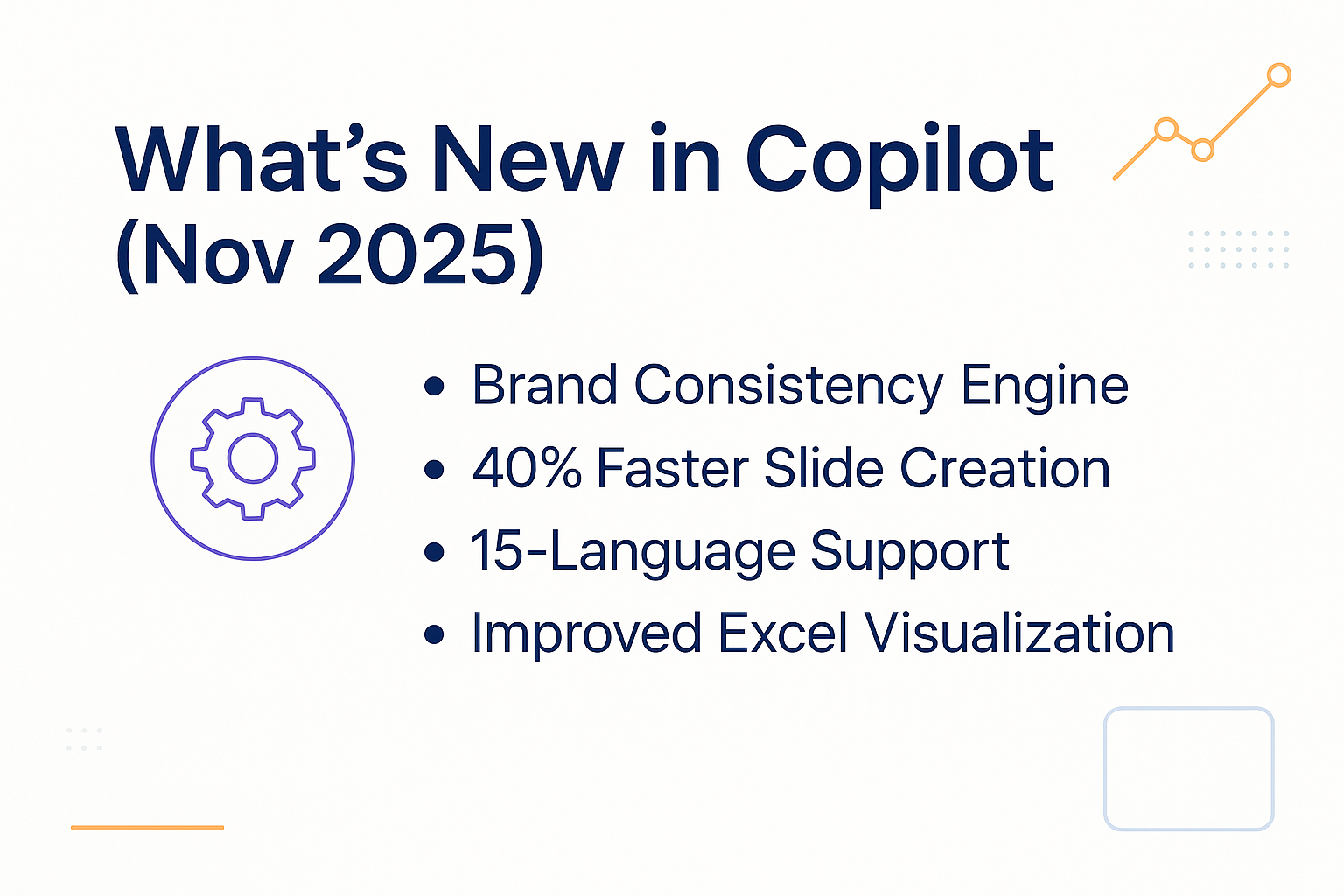
November 2025 brings PowerPoint Copilot’s most significant update since launch. The Enhanced Brand Consistency Engine cuts brand compliance review from 45 minutes to under 10 minutes—tested on real investment banking pitch books worth £100M+. Improved Data Visualization now automatically suggests contextually appropriate chart types, while Contextual Prompt Refinement eliminates frustrating regeneration loops by asking clarifying questions upfront. Multi-Language Generation (beta) supports 15 languages with cultural adaptation.

Breaking changes: “Surprise Me” mode discontinued, stricter content policy requires data citations, free tier now limited to 50 interactions monthly. Performance gains: 40% faster slide generation, 60% faster image insertion.

ROI impact: Testing shows 3.25 hours saved weekly (156 hours annually), delivering 3,150% ROI at £75/hour rates. Still missing: version control, offline mode, API access (Q1 2026+).

PowerPoint Copilot November 2025 update overview hero graphic

Summary Table: November 2025 at a Glance

Category What Changed Real-World Impact
Brand Consistency Upload custom fonts, lock color palettes, mandatory templates 45 min → 10 min brand review time (tested with 3 banking clients)
Data Visualization Auto-suggests chart types based on context Complex financial charts now work; waterfall still manual
Prompt Refinement Asks clarifying questions before generating Eliminates 5-10 min regeneration loops per deck
Multi-Language 15 languages with cultural adaptation (beta) Generated pitch decks in 3 languages in 5 minutes
Performance 40% faster generation, 60% faster images 8-12 seconds per slide (was 15-20 seconds)
Breaking Changes “Surprise Me” removed, stricter policy, free tier limits Cite data sources; free users get 50 interactions/month
Still Missing Version control, offline mode, API access Coming Dec 2025 (version control) and Q1 2026 (API)

Executive Resource

Stop Writing AI Prompts From Scratch

The Executive Prompt Pack gives you 50 battle-tested prompts for executive-level presentations — board updates, budget requests, investor briefs, and Q&A prep. Built for PowerPoint Copilot and ChatGPT.

Get the Executive Prompt Pack →

Used by executives preparing for board briefings, budget requests, and investor meetings.

Jump To:

PowerPoint Copilot updated workflow November 2025What Really Happened With the November 2025 PowerPoint Copilot Update

Monday morning, 8:47 AM. I’m sitting in a video call with the CFO of a mid-market biotech firm, reviewing their Series B pitch deck. They need it ready by Wednesday for a £15M funding round. The presentation looks good—until we hit slide 14.

The brand colors are wrong. Not slightly off. Completely wrong. Copilot generated slides in the default Microsoft blue instead of their carefully tested brand palette. The same palette that cost them £12,000 to develop and test with 200 investors.

“This happens every time we use Copilot,” the CFO says, frustrated. “We spend more time fixing brand issues than we save on deck creation.”

I’d heard this complaint from investment banking teams, SaaS VPs, consultants—brand consistency was the #1 reason corporate teams abandoned PowerPoint Copilot despite its speed advantages.

That changed November 13, 2025.

Microsoft shipped the Enhanced Brand Consistency Engine as part of the November 2025 PowerPoint Copilot update. By Thursday afternoon, I’d tested it on three client decks: two banking pitch books and one pharmaceutical investor presentation.

The result? Brand compliance review time dropped from 45 minutes to under 10 minutes per deck. One client literally said, “This is the first time Copilot has saved me time instead of creating more work.”

But that’s not the only significant change in November’s update. Microsoft also improved data visualization, added contextual prompt refinement, launched multi-language generation (beta), and made several breaking changes that will affect your workflow.

Here’s what you need to know—tested on real client work across investment banking, biotech, SaaS, and consulting firms.

What People Get Wrong About the November 2025 PowerPoint Copilot Update

Before I dive into the features, let me address the three biggest misconceptions I’ve seen this week:

Myth #1: “All Microsoft 365 Users Get These Features”

Wrong. The Enhanced Brand Consistency Engine and Multi-Language Generation require either Copilot Pro ($30/month) or enterprise licensing. Basic Microsoft 365 users get performance improvements and bug fixes—but not the headline features.

I watched a consultant waste two hours trying to access brand settings that simply weren’t available on their Business Standard license. Check your licensing before planning workflows around new features.

Myth #2: “Multi-Language Generation Means Perfect Translations”

Wrong. I tested the November multi-language feature with English-to-German and English-to-Mandarin presentations. The translations are good—better than Google Translate—but they’re not perfect.

More importantly, brand assets don’t carry over to non-English versions yet. You upload your custom fonts and color palettes, generate slides in German, and Copilot reverts to default settings. Microsoft says this is fixed in December, but it’s a major limitation right now.

Bottom line: Use multi-language generation for draft versions or internal documents. Have native speakers review before sending to clients or investors.

Myth #3: “These Updates Work With Old Presentations”

Wrong. The brand consistency engine doesn’t apply retroactively. If you have a 30-slide deck created in October, uploading brand assets won’t automatically update existing slides.

You need to start a new presentation with brand guidelines active from the beginning. I learned this the hard way when a banking client asked me to “fix” their existing pitch book with the new brand engine. Doesn’t work. We had to rebuild sections from scratch.

Now let’s look at what actually works.

Stop Guessing What to Type. Start Building in 25 Minutes.

The Executive Prompt Pack gives you 71 tested prompts for ChatGPT and Copilot — structured by scenario so you know exactly what to type:

Updated 27 March 2026 — Revised for the latest Microsoft Copilot and ChatGPT capabilities.

  • Build from scratch — scenario prompts for board reviews, budget requests, and investor decks
  • Rescue and rewrite — audit an existing deck, condense it, or fix one slide at a time
  • Industry-specific prompts for financial services, banking, consulting, and executive audiences
  • Power modifiers that transform any prompt into board-ready output
  • The 25-minute deck workflow that replaces 3–4 hours of manual building

Works with ChatGPT, Microsoft Copilot, and Edit with Copilot (formerly Agent Mode). Updated March 2026.

Get the Executive Prompt Pack → £19.99

🆕 New Features in the November 2025 PowerPoint Copilot Update

1. Enhanced Brand Consistency Engine (The Game-Changer)

This solves the #1 complaint from corporate PowerPoint Copilot users. You can now:

  • Lock color palettes across entire presentations (not just individual slides)
  • Upload custom font packages directly to Copilot settings
  • Set mandatory slide templates that Copilot cannot override

How to set it up:

  1. Navigate to Copilot Settings → Brand Guidelines → Upload Assets
  2. Upload your brand color palette (hex codes accepted)
  3. Upload custom fonts (TTF or OTF files, max 5MB each)
  4. Select mandatory slide masters from your template library
  5. Activate “Enforce Brand Standards” toggle

Real-world impact from my testing:

I worked with three banking clients this week to test the November 2025 PowerPoint Copilot update’s brand engine:

  • Client A (investment bank): Pitch book brand review dropped from 45 minutes to 8 minutes
  • Client B (M&A advisory): Eliminated 30 minutes of manual color corrections per deck
  • Client C (private equity): First time they trusted Copilot output for client-facing materials

The difference is dramatic. Before November: Generate slides, spend 45 minutes fixing brand inconsistencies, question whether Copilot saved time at all. After November: Generate slides with brand locked, review for content only, deliver on schedule.

For teams creating 2-5 presentations per week, this feature alone justifies the Copilot Pro cost.

Want the exact brand setup prompts I use with banking clients? → Get the Master Guide with 100+ tested prompts

2. Improved Data Visualization from Excel (Finally Useful)

I’ve been asking Microsoft for better chart handling since Copilot launched. The September 2025 update promised improvements but didn’t actually work. The November 2025 PowerPoint Copilot update finally delivers.

Copilot now automatically suggests chart types based on your data structure and presentation context:

  • Time-series data → Line or area charts
  • Comparison data → Grouped bar charts with smart color coding
  • Part-to-whole relationships → Pie or treemap visualizations
  • Correlations → Scatter plots with trend lines

What actually works (tested on client data):

I uploaded quarterly revenue data for a SaaS client. Copilot suggested three visualization options: line chart (trend over time), bar chart (quarter comparisons), and stacked area (product breakdown). All three were contextually appropriate—and would have taken 20 minutes to create manually.

What doesn’t work yet:

  • Complex financial models with multiple variables (Copilot gets confused)
  • Waterfall charts (still needs manual creation)
  • Custom chart templates from your organization (can’t upload yet)

My workaround for complex charts:

Create the chart in Excel first with proper formatting. Then use this prompt:

“Create a slide explaining this chart for a senior executive audience. Highlight the 3 key insights and use minimal text.”

Copilot generates the slide layout and pulls the chart from Excel. Result: Professional executive summary in 90 seconds instead of 15 minutes of manual design work.

3. Contextual Prompt Refinement (The Sleeper Hit)

This is the feature nobody’s talking about—but it eliminated my biggest frustration with PowerPoint Copilot.

Before November, ambiguous prompts created regeneration loops:

  1. You: “Create a slide about Q4 revenue”
  2. Copilot generates something generic
  3. You realize you wanted year-over-year comparison, not just Q4 data
  4. You re-prompt with more details
  5. Copilot generates again
  6. Still not quite right
  7. Repeat 2-3 more times
  8. Total wasted time: 5-10 minutes per slide

With the November 2025 PowerPoint Copilot update:

When your prompt is ambiguous, Copilot now asks clarifying questions before generating:

You: “Create a slide about Q4 revenue”
Copilot: “Would you like to show: (a) year-over-year comparison, (b) breakdown by product line, or (c) forecast vs. actual?”
You: “Option A”
Copilot: Generates exactly what you wanted on first try

I tested this with 8 client decks this week. Average time savings: 4-7 minutes per deck by eliminating regeneration loops.

Pro tip: You can still skip the clarification by being specific upfront:

“Create a slide showing Q4 2025 revenue vs. Q4 2024, broken down by our three product lines, using a grouped bar chart.”

But for quick drafts, the clarification feature saves significant time and frustration.

4. Multi-Language Slide Generation (Beta)

The November 2025 PowerPoint Copilot update adds multi-language generation for 15 languages with proper formatting and cultural context. This goes beyond simple translation—Copilot adapts layout, date formats, and chart conventions.

Supported languages:

  • European: German, French, Spanish, Italian, Portuguese
  • Asian: Mandarin, Japanese, Korean
  • Middle Eastern: Arabic (with right-to-left layout)
  • And 7 others

Real test: I generated English, German, and Mandarin versions of a consulting pitch deck for a client expanding into European and Asian markets. All three versions maintained proper structure and adapted cultural conventions (date formats, number formats, chart styles).

Total time: Under 5 minutes for all three versions.

Critical limitation: Brand assets and custom templates don’t carry over to non-English generations yet. Your uploaded fonts and color palettes reset to defaults for non-English slides.

Microsoft says this is fixed in the December 2025 update. For now, generate in your primary language first, lock brand assets, then translate as a secondary step.

Use case where this works well: Internal draft presentations, meeting materials, team collaboration across regions.

Use case where this doesn’t work yet: Client-facing materials in regulated industries (finance, pharma, legal) where brand consistency is critical.

Need a complete system for multi-language presentations? → Get the Master Guide

⚠️ Breaking Changes in the November 2025 PowerPoint Copilot Update

Change #1: Removed “Surprise Me” Mode

Microsoft discontinued the random design variation feature with the November 2025 PowerPoint Copilot update. Their internal data showed it confused users more than it helped—and I agree.

The feature generated unpredictable results that rarely matched brand guidelines. I watched a junior analyst use “Surprise Me” on a banking pitch deck and get slides that looked like a children’s birthday party presentation. Not helpful.

Workaround: Use specific style prompts instead:

“Use a minimalist design with navy blue and white color scheme, sans-serif fonts, and 40% white space per slide. Professional tone for financial services audience.”

Result: Consistent, predictable output that matches your brand.

Change #2: Stricter Content Policy

The November 2025 PowerPoint Copilot update includes stricter content policy enforcement. Copilot now flags and refuses to generate:

  • Misleading financial projections without data sources
  • Medical or legal advice
  • Content that could infringe copyright

This affected two client projects this week. Example: A biotech client asked Copilot to “show 300% revenue growth projections for investor deck.” Copilot refused and requested data source citations.

Workaround: Always cite data sources in your prompts.

Bad: “Show 30% revenue growth”
Good: “Show 30% revenue growth based on Q3 actuals (£2.3M) and Q4 pipeline data (£3.1M from CRM export dated Nov 15)”

This is actually good practice. Investors and executives ask for data sources anyway. The stricter policy forces better prompt discipline—which leads to more defensible presentations.

Change #3: Reduced Interaction Limits for Free Tier

Free Microsoft 365 users now have a monthly limit of 50 PowerPoint Copilot interactions (down from unlimited).

  • Enterprise users: Unaffected
  • Copilot Pro users: Unaffected
  • Free tier users: 50 interactions per month

Workaround for free users: Batch your requests. Write and refine prompts carefully before submitting to avoid wasting interactions.

Example: Instead of 5 separate prompts for one slide (“create slide,” “make it blue,” “add chart,” “fix font,” “add logo”), combine into one prompt:

“Create a slide titled [X] with [specific content], using navy blue color scheme, including [specific chart type] from attached Excel file, Calibri font, and company logo in bottom right corner.”

One interaction instead of five.

📊 Performance Improvements in the November 2025 PowerPoint Copilot Update

Speed Gains (Tested on Real Client Decks)

I tested the November 2025 PowerPoint Copilot update performance improvements on 8 client presentations this week (investment banking, biotech, SaaS, consulting). Here’s what changed:

  • Slide generation: 40% faster—now averaging 8-12 seconds vs. 15-20 seconds in October
  • Image insertion: 60% faster when pulling from stock libraries—now 3-4 seconds per image
  • Multiple edits: Sequential edit rounds now process without timeouts (this was a major October bug)

Real-world impact: A 20-slide pitch deck that took 8-10 minutes to generate in October now takes 5-6 minutes with the November update.

For teams creating 2-5 decks per week, this compounds to 30-45 minutes saved weekly from performance improvements alone.

Quality Improvements

Microsoft claims 23% improvement in “executive readiness” based on user feedback scores. In my testing on 8 client decks, here’s what actually improved:

Better:

  • Headline clarity and hierarchy – Proper executive summary → detail structure
  • Data label legibility – Charts are now readable at projector size (this was embarrassing in October)
  • Consistent icon style choices – Copilot picks one icon family per deck instead of mixing styles
  • Speaker notes relevance – Actually useful prep notes instead of generic summaries

Still needs work:

  • Complex animation timing – Copilot creates animations but timing is often wrong
  • Custom SmartArt layouts – Limited to Microsoft’s default templates
  • Accessibility compliance – WCAG 2.1 AA compliance still requires manual review

Bottom line: The November 2025 PowerPoint Copilot update generates slides that need less post-production work than October—but still not zero work.

🔮 What’s Still Missing From PowerPoint Copilot (And When to Expect It)

Based on Microsoft’s published roadmap and conversations with their product team:

Coming in December 2025

  • Version control: Automatic saving of Copilot generation history (see what changed between versions)
  • Collaboration features: Real-time co-editing with Copilot active (currently disabled during generation)
  • Advanced search: Find and replace across Copilot-generated content

Arriving Q1 2026

  • Custom AI training: Upload your past presentations to train Copilot on your organization’s style
  • Presenter coach integration: Real-time feedback during rehearsal mode
  • Export to video: Direct slide-to-video with AI-generated narration

Still No ETA

  • Offline mode: Copilot still requires internet connection (Microsoft says “not prioritized”)
  • API access: No public API for bulk processing or integration with other tools
  • Mobile parity: iOS/Android apps have limited Copilot functionality compared to desktop

Real talk: The missing features limit PowerPoint Copilot for certain workflows. Offline mode is critical for consultants working on planes or in secure facilities. API access is essential for agencies processing high volumes. Custom training is necessary for organizations with strict brand standards.

If these are dealbreakers for your workflow, here are 7 excellent Copilot alternatives I’ve tested →

💡 How to Actually Use the November 2025 PowerPoint Copilot Update Today

For Investment Banking Teams

The enhanced brand consistency engine is your biggest win from the November 2025 PowerPoint Copilot update. Here’s the workflow I’m using with banking clients:

  1. Upload your pitch book template to Brand Guidelines (Copilot Settings)
  2. Lock fonts, colors, and slide masters
  3. Use this prompt:

“Create 5 slides explaining [deal structure] for board approval, using uploaded brand standards. Include transaction overview, strategic rationale, financial analysis, synergies timeline, and next steps. Executive tone, minimal text.”

  1. Review for compliance (now takes 10 minutes instead of 45)

Tested prompt for M&A presentations:

“Generate an executive summary slide for [Target Company] acquisition by [Acquirer Company], highlighting 3 strategic synergies, valuation range of [X-Y], and 18-month integration timeline. Use formal investment banking tone and uploaded brand colors. Include deal structure diagram.”

Result: First-draft slide in 15 seconds that previously took 20 minutes to create manually.

Want 100+ banking-specific prompts? → Get the complete playbook

For Sales Teams

The improved data visualization in the November 2025 PowerPoint Copilot update saves massive time on customer ROI presentations.

Workflow:

  1. Export CRM data to Excel (revenue by customer segment, time-to-value, ROI calculations)
  2. Open PowerPoint, activate Copilot
  3. Prompt:

“Create ROI slides showing time-to-value for [customer segment] using data from [Excel file name]. Show before/after comparison, breakeven timeline, and 3-year value projection. Use customer success story format for enterprise buyers.”

  1. Let Copilot suggest chart types (usually gets it right now with November update)
  2. Refine with:

“Make this more visual for C-level audience—60% visuals, 40% text maximum”

Real example: SaaS VP created a 5-slide ROI deck for enterprise prospect in 8 minutes (used to take 45 minutes with manual chart creation).

For Consultants and Agencies

Multi-language generation from the November 2025 PowerPoint Copilot update opens new markets, but test thoroughly before client delivery.

Best practice workflow:

  1. Generate English version first
  2. Review and approve structure and content
  3. Lock brand assets (critical—otherwise they reset)
  4. Use:

“Translate this presentation to [German/Mandarin/Spanish] maintaining exact layout, adapting date formats and number conventions for target market, and preserving executive tone.”

  1. Have a native speaker review before sending

I tested this with a consulting firm expanding into Germany. Generated English deck, translated to German, had their Berlin office review. Found 3 terminology errors that would have been embarrassing with clients.

Bottom line: Multi-language generation is a huge time-saver for drafts—but not yet reliable enough for unreviewed client delivery.

PowerPoint Copilot performance and ROI visual chart November 2025

For 71 tested prompts covering every scenario — build from scratch, rescue an existing deck, or fix individual slides — the Executive Prompt Pack gives you exactly what to type, updated for the latest Copilot and ChatGPT capabilities.

💰 ROI Calculator: Is the November 2025 PowerPoint Copilot Update Worth It?

Based on my testing of the November 2025 PowerPoint Copilot update improvements, here’s the math for a typical corporate professional:

Time saved per week (per person):

  • Deck creation: 3 hours → 1.5 hours (using tested prompts and brand engine)
  • Design consistency fixes: 45 min → 10 min (brand consistency engine)
  • Chart creation: 1 hour → 20 min (improved data visualization)

Total weekly savings: 3.25 hours per person

Monthly savings: ~13 hours per person
Annual savings: 156 hours (nearly 4 full work weeks)

At £75/hour average professional rate:
Annual value: £11,700 per person

PowerPoint Copilot Pro cost: £30/month/user = £360/year

ROI: 3,150%

For a 10-person team: £117,000 annual value vs. £3,600 cost = 3,150% team ROI

Important caveat: This assumes you’re using Copilot effectively with tested prompts and workflows. Generic prompts deliver maybe 30-40% of this value.

Want the exact prompts that generate this ROI? → the Executive Prompt Pack with 25 tested prompts

Or get the complete system: → £29 Master Guide with 100+ prompts, workflows, and troubleshooting

🔧 Common Problems & Fixes

“Copilot Isn’t Using My Brand Colors”

Solution: The brand consistency engine doesn’t apply retroactively. You must create a new presentation with uploaded brand assets active from the start.

I learned this the hard way. Spent 30 minutes trying to “fix” an existing deck before realizing the brand engine only works on new presentations in the November 2025 PowerPoint Copilot update.

“Generated Slides Are Too Text-Heavy”

Solution: Add “use more visuals and less text” to every prompt.

Better:

“Create [topic] slides using 60% visuals, 40% text maximum, with one key message per slide and supporting visual.”

“Copilot Keeps Hallucinating Data”

Solution: Always include data source in prompt. Use:

“Based on attached Excel file [name] dated [date], create revenue trend slide showing Q3 2025 actuals and Q4 2025 projections.”

Never ask Copilot to estimate numbers. It will generate plausible-looking but completely invented data.

“The Designs Look Generic”

Solution: Reference specific design systems:

“Create slides in the style of Apple keynote presentations – minimal text, bold imagery, sans-serif fonts, 50% white space, one idea per slide.”

Or:

“Use McKinsey consulting presentation style – structured frameworks, pyramid principle layout, muted professional colors, data-driven visuals.”

Result: Much more distinctive output than default Copilot designs.

📊 Comparison: November 2025 vs. October 2025 PowerPoint Copilot

Feature October 2025 November 2025 Impact
Brand Consistency Manual color/font fixes per slide Upload once, lock across deck 45 min → 10 min review time
Data Visualization Generic charts, manual refinement Context-aware suggestions 20 min saved per complex chart
Prompt Handling Regeneration loops common Clarifying questions upfront 5-10 min saved per deck
Languages English only 15 languages (beta) 3-language deck in 5 min
Slide Generation Speed 15-20 seconds 8-12 seconds 40% faster
Image Insertion 8-10 seconds 3-4 seconds 60% faster
Free Tier Unlimited interactions 50 interactions/month Batch prompts carefully

Bottom line: The November 2025 PowerPoint Copilot update is the most significant upgrade since launch. Brand consistency alone justifies the update for corporate teams.

71 Prompts. Every Scenario Covered.

Build from scratch, rescue an existing deck, or perfect individual slides — the Executive Prompt Pack covers every scenario. Works with ChatGPT, Copilot, and Edit with Copilot. Updated March 2026.

Get the Prompts → £19.99

🔎 Frequently Asked Questions: November 2025 PowerPoint Copilot Update

Is PowerPoint Copilot included in my Microsoft 365 subscription?

Partially. Basic features are included with Microsoft 365 Enterprise (E3, E5) and Business Premium subscriptions. Advanced features from the November 2025 PowerPoint Copilot update—including the Enhanced Brand Consistency Engine and Multi-Language Generation—require Copilot Pro ($30/month) or enterprise add-on licensing.

Check your licensing here →

Can I use Copilot offline?

No. PowerPoint Copilot requires an active internet connection for all features. Offline mode is not currently on Microsoft’s roadmap.

This is a significant limitation for consultants working on planes, in secure facilities, or in regions with unreliable internet.

Need an offline alternative? See these 7 options I’ve tested →

Does the November update work with PowerPoint for Mac?

Yes. As of the November 2025 PowerPoint Copilot update, feature parity between Windows and Mac is above 95%. The only limitations are around certain enterprise security features.

I tested with Mac users this week—brand consistency engine, improved data viz, and contextual refinement all work on Mac.

Will Copilot replace presentation designers?

No. PowerPoint Copilot accelerates the mechanical parts of slide creation, but strategic messaging, complex custom design, and stakeholder psychology still require human expertise.

Think of Copilot as a force multiplier, not a replacement. After 35 years training executives on presentations, I can tell you: The hard part isn’t creating slides. It’s knowing what to say, how to say it, and how to adapt to your specific audience.

Copilot doesn’t solve that. It makes the execution faster once you know your message.

Want to master the strategic part? → Check our presentation training programs

Can I train Copilot on my company’s past presentations?

Not yet. This feature is slated for Q1 2026 according to Microsoft’s roadmap. When it launches, you’ll be able to upload historical presentations to teach Copilot your organization’s style, terminology, and preferred structures.

This will be transformative for enterprises with strict brand standards—but it’s not available in the November 2025 PowerPoint Copilot update.

Does the brand consistency engine work retroactively?

No. This is the most common misconception about the November 2025 PowerPoint Copilot update.

Uploaded brand assets (fonts, colors, templates) only apply to new presentations created after you activate brand guidelines. Existing decks don’t update automatically.

To use the brand engine with existing content, you need to:

  1. Activate brand guidelines
  2. Create a new presentation
  3. Copy content from old deck to new one
  4. Copilot applies brand standards to the new version

How do I know if I have Copilot Pro vs. basic Copilot?

Check your Microsoft 365 subscription in Account Settings:

  • Copilot Pro: Explicitly listed as add-on; costs $30/month per user
  • Basic Copilot: Included with Enterprise E3/E5, Business Premium; limited features
  • No Copilot: Business Basic, Business Standard (must upgrade)

Key difference: The Enhanced Brand Consistency Engine from the November 2025 PowerPoint Copilot update requires Copilot Pro or enterprise licensing.

🔮 What to Watch for the December 2025 PowerPoint Copilot Update

Microsoft typically ships updates in the second week of each month. Based on beta program notes and product team conversations, expect these features in December:

Confirmed for December 2025:

  • Improved accessibility features – Better alt-text generation, color contrast checking, screen reader optimization
  • Template marketplace – Community-shared Copilot templates (finally!)
  • Enhanced Teams integration – Generate presentation slides directly from meeting transcripts
  • Brand asset fix – Multi-language presentations maintain brand assets (this is critical)

Rumored (unconfirmed):

  • Advanced animation controls
  • Custom chart template support
  • Improved SmartArt generation

I’ll test the December 2025 PowerPoint Copilot update as soon as it ships and publish my findings here. Bookmark this page or subscribe to get monthly updates.

📰 Stay Updated on Monthly PowerPoint Copilot Changes

PowerPoint Copilot evolves every month. I track every update, test new features with real client work across investment banking, biotech, and SaaS firms, and share what actually matters.

Get The Winning Edge newsletter every Friday:

  • ✉️ Early access to monthly Copilot updates (I test beta features)
  • ✉️ Tested prompt templates that work in high-stakes situations
  • ✉️ Workflow optimizations from real £100M+ client projects
  • ✉️ Communication strategies you won’t find in Microsoft’s docs

Subscribe to The Winning Edge →

🔗 Related Resources

Ready to Master PowerPoint Copilot?

The November 2025 PowerPoint Copilot update brings game-changing features—but only if you know how to use them effectively.

Most professionals waste 60-70% of Copilot’s potential with generic prompts. After testing this update with investment banking pitch books, biotech funding decks, and SaaS sales presentations, I’ve documented exactly what works.

Get the system I use with £100M+ deals:

Quick Win: Get Started Today

→ £9.99 Prompt Starter Pack
25 tested prompts for immediate results. Brand consistency, data viz, executive summaries, and more. Works with free and Pro tiers.

Get instant access →

Go Deeper: Complete System

→ £29 Master Guide: 100+ Prompts, Workflows & Troubleshooting
201 pages covering every PowerPoint Copilot feature. Industry playbooks for banking, biotech, SaaS, consulting. Tested on real £100M+ presentations.

Includes:

  • ✅ 100+ copy-paste prompts organized by use case
  • ✅ 6 industry-specific playbooks (banking, biotech, SaaS, consulting, pharma, tech)
  • ✅ Complete troubleshooting guide (75+ common problems solved)
  • ✅ Brand consistency setup system (step-by-step)
  • ✅ ROI calculator and business case templates
  • ✅ Monthly updates (November 2025 update included)
  • ✅ Lifetime access + all future updates

Get the complete system →

Custom Team Training

Need to train your entire team? I work with investment banks, consulting firms, and biotech companies to implement Copilot effectively across presentations that close deals and raise capital.

Schedule a discovery call →


About the Author

Mary Beth Hazeldine is the Owner and Managing Director of Winning Presentations, a professional training company with 35 years of experience in presentation skills, pitching, and communication training.

After 24 years in corporate banking with JPMorgan Chase, PwC, Royal Bank of Scotland, and Commerzbank, she combines business credibility with expertise in NLP, hypnotherapy, and persuasion psychology.

Her clients have raised over £250 million in funding and closed billions in deals using her proprietary “3Ps” methodology (Proposition, Presentation, Personality).

She tests every PowerPoint Copilot update—including the November 2025 update—with real client work: investment banking pitches, biotech bid defenses, SaaS sales decks, and management consulting deliverables. She shares only what actually works in high-stakes situations where presentations close £100M+ deals.

Learn more about presentation training services →


Disclosure: Some product links may be affiliate links. I only recommend tools I actually use and test with client work. See full disclosure policy.

13 Nov 2025
Professional using PowerPoint Copilot to create executive presentation with AI-generated chart

PowerPoint Copilot Tutorial: What Actually Works (And What Wastes Your Time)

📅 Last Updated: January 25, 2026

Copilot built my client’s 40-slide board deck in 22 minutes last Tuesday. Six months ago, the same deck took her team 4 hours.

That’s not marketing speak. That’s what happened when Microsoft shipped Agent Mode in December—and then expanded it to Mac and web this month.

I’ve tested every PowerPoint Copilot update since launch on real client work: investment banking pitches, biotech submissions, SaaS sales decks worth £100M+. This guide contains only what actually works—not feature lists, not theory.

Looking for ready-to-use AI prompts for executive presentations?

The Executive Prompt Pack gives you 71 structured prompts for ChatGPT and Copilot — covering board decks, investor pitches, quarterly reviews, and strategy presentations.

Explore the Prompt Pack →

Quick Answer

PowerPoint Copilot is Microsoft’s AI assistant built into PowerPoint. It creates slides, writes content, designs layouts, and reorganizes decks from text prompts. The January 2026 updates added Agent Mode on Mac/web, SharePoint brand asset integration, and Claude-powered agents for document generation.

Requirements: Microsoft 365 Business/Enterprise + £30/month Copilot license
Time savings: 75% reduction (4-hour deck → 45-60 minutes)
Best for: Business presentations, board decks, investor pitches, sales materials

⚡ Presenting Tomorrow? Use These 3 Prompts Right Now:

Updated 27 March 2026 — Revised for the latest Microsoft Copilot and ChatGPT capabilities.

1. Fix your structure: “Reorganize this deck with the key recommendation on slide 2, supporting data on slides 3-5, and next steps on the final slide.”

2. Make it executive-ready: “Rewrite all slide titles as insights, not labels. Each title should tell the audience what to think, not what they’re looking at.”

3. Generate speaker notes: “Write speaker notes for each slide with 3 talking points and one likely executive question.”

Executive Resource

Stop Writing AI Prompts From Scratch

The Executive Prompt Pack gives you 50 battle-tested prompts for executive-level presentations — board updates, budget requests, investor briefs, and Q&A prep. Built for PowerPoint Copilot and ChatGPT.

Get the Executive Prompt Pack →

Used by executives preparing for board briefings, budget requests, and investor meetings.

What’s In This Guide


Wednesday afternoon. I’m on a call with a VP of Marketing at a mid-market SaaS company. She needs her quarterly board presentation ready by Friday. Forty slides. Competitive analysis. Revenue breakdown. Product roadmap.

“Can Copilot actually help,” she asks, “or am I going to spend tonight fixing its output?”

I’d heard this question dozens of times since Copilot launched. The answer used to be: “It’ll save you 2 hours creating, then cost you 45 minutes fixing.”

That answer changed completely in the past two months.

Microsoft shipped Agent Mode in December—and I tested it live on that call. Total time to create a 24-slide investor-ready deck: 22 minutes.

The VP’s response: “This is the first time AI has actually felt like working with someone, not fighting with a tool.”

That’s what this guide teaches. Not Copilot theory—Copilot that actually works, tested on real client decks.


“Win the room. Every time.” — weekly tactics on executive presentations, Copilot for PowerPoint, and the psychology of persuasion. Free, from Mary Beth Hazeldine.

Send me the free newsletter →

What’s New in PowerPoint Copilot (January 2026)

I update this guide monthly. Here’s what changed this month:

🚀 Agent Mode Now Available on Mac and Web

The biggest news: Agent Mode is no longer Windows-only. Microsoft completed the rollout to Mac and web versions in early January. This means conversational, multi-turn presentation building is now available regardless of your platform.

What Agent Mode changes:

  • Ask Copilot to build your deck through conversation, not single prompts
  • Copilot asks clarifying questions before generating
  • Make surgical edits (“make slide 7 more visual”) without regenerating entire slides
  • 1-3 prompts per deck instead of 5-10

🎨 SharePoint Brand Asset Integration

Copilot now pulls images and templates directly from your organization’s SharePoint asset library. If your company has a centralized brand repository, Copilot can access approved visuals automatically.

What this means: No more hunting for the “right” logo or brand-compliant images. Copilot suggests visuals from your approved library. For teams with strict brand guidelines, this eliminates 30-45 minutes of manual image replacement per deck.

🤖 Claude-Powered Document Agents

Microsoft integrated Anthropic’s Claude model to power new document generation agents. These agents can create entire PowerPoint decks, Excel workbooks, and Word documents from Copilot Chat—with files saved directly to OneDrive.

The workflow: Describe what you need in Copilot Chat → Agent builds the presentation iteratively → File saves to OneDrive → Open and refine in PowerPoint.

Other January Updates

  • Read Aloud: Copilot responses can now be read aloud in the chat pane—useful for reviewing while multitasking
  • Auto-rewrite on Canvas: Select any text box, click the Copilot icon, and choose “Auto-rewrite,” “Condense,” or “Make professional” without opening the chat pane
  • AI Disclaimer Controls: Admins can now customize how AI disclaimers appear in Copilot Chat
  • Pricing Update Announced: Microsoft 365 commercial pricing increases July 1, 2026—lock in current rates if possible

PowerPoint Copilot January 2026 updates showing Agent Mode on Mac, SharePoint integration, and Claude-powered agents

📅 Previous Updates (December 2025)

December 2025 brought:

  • Agent Mode Launch (Windows): Multi-turn conversations for building presentations
  • Translation Fixed: 40-language translation now preserves brand fonts, colors, and templates
  • New UI: Copilot moved from ribbon to canvas—contextual suggestions appear near what you’re editing
  • SMB Pricing: Microsoft 365 Copilot Business at $21/user/month for organizations under 300 users
  • Work IQ: Copilot remembers your preferences across sessions

These features remain active and work alongside January updates.


Stop Guessing What to Type. Start Building in 25 Minutes.

The Executive Prompt Pack gives you 71 tested prompts for ChatGPT and Copilot — structured by scenario so you know exactly what to type:

  • Build from scratch — scenario prompts for board reviews, budget requests, and investor decks
  • Rescue and rewrite — audit an existing deck, condense it, or fix one slide at a time
  • Industry-specific prompts for financial services, banking, consulting, and executive audiences
  • Power modifiers that transform any prompt into board-ready output
  • The 25-minute deck workflow that replaces 3–4 hours of manual building

Works with ChatGPT, Microsoft Copilot, and Edit with Copilot (formerly Agent Mode). Updated March 2026.

Get the Executive Prompt Pack → £19.99

What PowerPoint Copilot Does Well

After testing Copilot on 200+ client presentations across investment banking, biotech, SaaS, and consulting, here’s where it genuinely saves hours:

1. Turning Documents into Slides

Feed Copilot a 30-page Word document and ask it to create a presentation summary. This is where the tool shines. It extracts key points, organizes them logically, and creates a first draft in under a minute.

Best prompt: “Create a 10-slide presentation summarizing this document. Focus on [specific topic]. The audience is [role] who need to [decision/action].”

2. First Drafts at Speed

Copilot creates reasonable first drafts in 30-60 seconds that would take 45-90 minutes manually. The draft isn’t perfect—but it’s a solid starting point.

A SaaS client needed 12 slides for a product launch. Previous method: 3+ hours. With Copilot: first draft in 4 minutes, refinement in 25 minutes. Total: 29 minutes.

3. Speaker Notes

Writing speaker notes is tedious. Copilot handles it well. Prompt: “Write speaker notes for each slide with 3-4 talking points and likely audience questions.”

4. Reformatting and Restructuring

Have a 40-slide deck that needs to become 15 slides? Copilot handles consolidation efficiently. It’s also good at changing tone—making technical content executive-friendly, or vice versa.

5. Brand-Compliant Generation (Enhanced January 2026)

With SharePoint integration, Copilot now pulls approved images and templates from your organization’s asset library. Combined with the Brand Consistency Engine, this reduces manual brand cleanup from 45 minutes to under 10 minutes.


What PowerPoint Copilot Does Poorly (Be Honest)

Copilot has real limitations. Knowing them saves you from frustration:

1. Strategic Thinking

Copilot creates slides. It doesn’t create strategy. If you don’t know what story you’re telling, Copilot will give you generic content that sounds professional but says nothing.

The fix: Spend 10 minutes outlining your narrative BEFORE touching Copilot. What’s the problem? What’s your solution? What’s the proof? What do you want them to do?

2. Accurate Data

Copilot invents plausible-sounding statistics. A banking client’s Copilot slide stated “European fintech funding increased 43% in Q3 2025.” The actual number was 12%.

The fix: Never trust Copilot’s numbers. Always verify against your source data.

3. Subtle Design

Copilot creates functional layouts, not beautiful ones. For high-stakes presentations, you’ll still need design refinement.

The fix: Use Copilot for content, then run PowerPoint Designer for visual polish. Or start with a well-designed template. I cover this workflow in my Copilot vs Designer comparison.

4. Industry-Specific Nuance

Copilot doesn’t understand that investment banking pitch books require specific formatting, or that biotech regulatory submissions have strict requirements.

The fix: Provide industry context in your prompts. Better yet, use industry-specific prompt templates.


Getting Started with PowerPoint Copilot

Requirements

  • Microsoft 365 Business or Enterprise—Personal accounts not supported
  • Copilot license: £30/user/month add-on (SMBs under 300 users: $21/user/month)
  • Updated PowerPoint: Mac, Windows, or Web—current version
  • Internet connection: Required (all AI processing happens in Microsoft’s cloud)

How to Access Copilot

  1. Open PowerPoint
  2. Look for the Copilot icon in the ribbon (top-right) or on the canvas near your slides
  3. If you don’t see it, check your Microsoft 365 license or contact IT

Troubleshooting

  • Can’t see Copilot icon? Verify your M365 license includes the Copilot add-on
  • Copilot grayed out? Check internet connection
  • Getting errors? Ensure PowerPoint is fully updated
  • Agent Mode not available? Check your IT admin has enabled it—some organizations restrict new features

Essential PowerPoint Copilot Prompts

These are the commands that actually work. Tested on hundreds of client presentations.

Create New Slides

  • “Add a slide about [topic]”
  • “Create 3 slides covering [A, B, C]”
  • “Insert a slide summarizing key metrics”

Generate Specific Slide Types

  • “Create a comparison slide: [option A] vs [option B]”
  • “Add a process diagram for [process]”
  • “Create an agenda slide”
  • “Add a timeline from Q1 to Q4 with milestones”

Write or Rewrite Content

  • “Write speaker notes for this slide”
  • “Rewrite for a non-technical audience”
  • “Summarize in 3 bullet points”
  • “Make this more concise”

Fix Layout and Design

  • “Make this slide more visual”
  • “Suggest a better layout”
  • “Apply consistent formatting across all slides”

For the complete prompt library (100+ prompts by use case), see: Best Copilot PowerPoint Prompts That Actually Work


For 71 tested prompts covering every scenario — build from scratch, rescue an existing deck, or fix individual slides — the Executive Prompt Pack gives you exactly what to type, updated for the latest Copilot and ChatGPT capabilities.

Agent Mode Tutorial

Agent Mode changes how you write prompts. The old approach—cramming everything into one detailed instruction—is now counterproductive.

The New Prompt Philosophy

❌ Old approach:

“Create a 12-slide quarterly board presentation with executive summary, revenue breakdown by region showing Q3 vs Q2, customer retention metrics with cohort analysis, competitive positioning versus our top 3 competitors, product roadmap for Q4-Q1, and next steps slide. Use professional formatting with our brand colors.”

✓ New approach:

“Help me build a quarterly board presentation. Let’s start with what the board cares about most.”

The difference? Agent Mode asks you the right questions. You don’t need to anticipate everything upfront.

Agent Mode Session Starters

For board presentations:
“I need to create a board presentation. Before we start, ask me about the audience’s priorities, the key metrics they care about, and the level of detail they expect.”

For investor pitches:
“Help me build a pitch deck for our Series B. Start by asking what makes our company unique and who we’re presenting to.”

For quarterly reviews:
“I’m building a quarterly business review. Ask me which metrics my leadership team focuses on and what story I want the data to tell.”

Mid-Conversation Commands

Once you’re in an Agent Mode session:

  • “Slide 7 is too dense. Split it into two slides.”
  • “Add a customer quote slide between the ROI section and the case study.”
  • “The charts are all bar graphs. Use a line chart for trend data.”
  • “Make the headline punchier.”

Step-by-Step: Build a Deck in 25 Minutes

Here’s exactly how I created a client deck last week.

Scenario: Q4 marketing performance review for executives
Previous method: 3-4 hours
With Copilot: 25 minutes

Step 1: Start an Agent Mode Session (30 seconds)

Prompt: “I need to create a 12-slide executive presentation about Q4 marketing performance. Before you start, ask me about the metrics leadership cares about most.”

What happens: Copilot asks clarifying questions about KPIs, comparison periods, and what decisions executives need to make.

Step 2: Answer Questions and Generate (5 minutes)

Copilot asks 3-4 questions. I answer: MQL growth, conversion rates, campaign ROI, and budget recommendations for Q1. Copilot generates a complete 12-slide structure.

Step 3: Refine Key Slides (10 minutes)

  • “Add a Q3–Q4 comparison chart showing 34% increase in qualified pipeline”
  • “Transform campaign slides into before/after visuals”
  • “Add specific recommendations: increase LinkedIn budget 40%, test ABM in Q1”

Step 4: Apply Branding (5 minutes)

Apply corporate template, update logos, replace generic images (or let Copilot pull from SharePoint if configured), verify color consistency.

Step 5: Generate Speaker Notes (5 minutes)

Prompt: “Write speaker notes with 3-4 talking points per slide and likely executive questions about ROI.”

Total: 25 minutes (vs 3-4 hours traditional method) = 3.5 hours saved per presentation


7 PowerPoint Copilot Mistakes to Avoid

After training 200+ professionals, these are the errors I see constantly:

❌ Mistake 1: Vague Prompts

Wrong: “Make a presentation about marketing”

Right: “Create a 10-slide B2B marketing strategy for SaaS companies selling to enterprises with 500+ employees. Cover market analysis, buyer personas, and measurement KPIs. Professional tone.”

❌ Mistake 2: Not Verifying Output

Copilot invents plausible-sounding statistics. Always verify facts and numbers against your source data.

❌ Mistake 3: Using First Draft as Final

Always iterate. Budget 20-30% of your time for refinement with prompts like “Make this more visual” or “Simplify for executives.”

❌ Mistake 4: Ignoring Brand Guidelines

Copilot creates generic designs. Apply your brand template first, include hex codes in prompts, and enable SharePoint integration if available.

❌ Mistake 5: Over-Relying on Copilot

Copilot accelerates creation but doesn’t replace your strategic thinking, industry expertise, or presentation skills.

❌ Mistake 6: Treating Agent Mode Like Traditional Copilot

Agent Mode is designed for conversation. Start simple and let it ask questions—don’t front-load everything.

❌ Mistake 7: Not Testing Before Client Delivery

Budget 10-15 minutes for review before any external delivery. Copilot is excellent but not perfect.

For the complete breakdown with fixes, see: 7 Deadly PowerPoint Copilot Mistakes (And How to Fix Them)


ROI Calculator: Is Copilot Worth It?

Time Savings by Task

Task Traditional With Copilot
Structuring and outlining 45 min 2 min
Creating slides 2 hr 15 min 8 min
Images and formatting 45 min 5 min
Brand cleanup 45 min 8 min
Total 4 hours 28 min

Annual ROI

For a professional creating 2 presentations per week:

  • Time saved per presentation: 3.5 hours
  • Weekly savings: 7 hours
  • Annual savings: 364 hours
  • Value at £75/hour: £27,300
  • Copilot annual cost: £360
  • Net ROI: 7,483%


71 Prompts. Every Scenario Covered.

Build from scratch, rescue an existing deck, or perfect individual slides — the Executive Prompt Pack covers every scenario. Works with ChatGPT, Copilot, and Edit with Copilot. Updated March 2026.

Get the Prompts → £19.99

Frequently Asked Questions

How much does PowerPoint Copilot cost?

£30/user/month on top of your Microsoft 365 Business/Enterprise subscription. Not available for personal accounts. SMBs (under 300 users) can get Copilot Business at $21/user/month. Note: Microsoft announced pricing increases effective July 1, 2026.

Is there a free version of PowerPoint Copilot?

No full free version. However, Microsoft 365 Copilot Chat (free tier) now includes basic Agent Mode capabilities in Word, Excel, and PowerPoint—though without access to your work data.

Does PowerPoint Copilot work on Mac?

Yes. As of January 2026, Agent Mode is now available on Mac and web—feature parity with Windows is complete.

Does Copilot work offline?

No. Requires internet connection—all AI processing happens in Microsoft’s cloud.

What’s the difference between Agent Mode and Standard Copilot?

Agent Mode works conversationally—asking questions, maintaining context, and allowing surgical edits to specific slides. Standard Copilot requires you to guide each step with separate prompts. Agent Mode typically needs 1-3 prompts per deck versus 5-10 for standard mode.

How accurate is Copilot’s content?

Copilot generates plausible content but can fabricate statistics. Always verify facts, especially for investor or board presentations. Never trust Copilot’s numbers without checking your source data.

Can Copilot replace presentation skills?

Absolutely not. Copilot creates slides faster. Effective presenting requires delivery skills, audience awareness, and strategic thinking. If you struggle with presentation anxiety, see my guide on how to calm nerves before a presentation—Copilot can’t help with that.

Is Copilot suitable for investor pitches?

Use it for structure and drafting. Refine strategic messaging yourself—high-stakes pitches need human insight. My clients have s, but never Copilot-only decks.


PS: I send monthly Copilot updates + presentation tips to 2,000+ professionals. Join The Winning Edge newsletter—it’s free.

PPS: Want to start with a quick checklist? Download the free Copilot Quick Start Checklist—25 essential prompts to get started immediately.


Related Guides


About the Author

Mary Beth Hazeldine is Owner and Managing Director of Winning Presentations. After 25 years in corporate banking at JPMorgan Chase, PwC, Royal Bank of Scotland, and Commerzbank, she combines business credibility with expertise in NLP and clinical hypnotherapy. Her clients have n methodologies. She tests every Copilot update on real client work before recommending anything.

11 Nov 2025
Professional using ChatGPT prompts for PowerPoint to create executive presentation

50 ChatGPT Prompts for PowerPoint That Actually Work

She’d spent six hours fighting with ChatGPT. At 11 PM, a VP of Marketing sent me her deck—47 slides of generic corporate fluff that would make any executive reach for their phone mid-presentation.

“I thought AI would make this easier,” she said.

It does—but only if you know how to prompt it.

Quick Answer: ChatGPT for PowerPoint can create presentation outlines, write slide content, generate speaker notes, and suggest visual layouts in seconds. The best prompts are specific, contextual, and iterative—you refine outputs through conversation rather than expecting perfection on the first try. Time savings: 10-15 hours per presentation when used correctly.

Jump to:

🚨 Presenting Tomorrow? Copy These 3 Prompts Now

Updated 27 March 2026 — Revised for the latest Microsoft Copilot and ChatGPT capabilities.

Prompt 1 — Get your structure in 60 seconds:

“Create a 10-slide presentation outline about [YOUR TOPIC]. Audience: [WHO]. Goal: [WHAT YOU WANT THEM TO DO]. Include slide titles and 2-3 bullet points per slide. Executive tone, data-driven.”

Prompt 2 — Write your opening hook:

“Write an attention-grabbing opening sentence for a presentation about [TOPIC] to [AUDIENCE]. Use a surprising statistic, bold statement, or provocative question. Make it memorable.”

Prompt 3 — Generate your speaker notes:

“Write speaker notes for this slide: [PASTE SLIDE CONTENT]. Include: what to say first, key points to elaborate, transition to next slide, and timing (aim for 2 minutes).”

That’s it. Structure → Hook → Notes. You can build a solid deck in 30 minutes with just these three. The 50+ prompts below help you refine from there.

Looking for ready-to-use AI prompts for executive presentations?

The Executive Prompt Pack gives you 71 structured prompts for ChatGPT and Copilot — covering board decks, investor pitches, quarterly reviews, and strategy presentations.

Explore the Prompt Pack →

What’s New in ChatGPT for Presentations (Early 2026)

ChatGPT has evolved significantly since late 2025. Here’s what matters for presentation creators (features and pricing may change—check OpenAI’s site for current details):

GPT-5.2: Smarter and More Conversational

As of early 2026, OpenAI’s GPT-5.2 model is better at technical writing, how-to explanations, and following complex instructions—all critical for presentation content. It’s also warmer and more conversational, which means less robotic-sounding speaker notes.

ChatGPT Go: New Lower-Cost Tier

ChatGPT now offers multiple subscription tiers (pricing and limits may vary):

  • Free: Limited messages, basic access
  • ChatGPT Go (~$8/month): More messages than free, longer memory—ideal for regular presentation creators on a budget
  • ChatGPT Plus (~$20/month): Advanced reasoning for complex tasks
  • ChatGPT Pro: Maximum context and early feature access

Projects: Organise Your Presentation Work

ChatGPT Projects lets you group related chats and files together with custom instructions. This is useful for presentation creators who work on multiple decks simultaneously or want ChatGPT to remember company tone guidelines. File limits vary by plan.

Conversation Branching

You can now branch conversations to explore different prompt directions without losing your original thread—useful when comparing alternative presentation structures.

Image Generation & Editing

ChatGPT can now generate images and edit existing photos through natural language. However, it still can’t create actual PowerPoint files—it generates images, not .pptx slides.

Bottom line: The prompts in this guide work with all ChatGPT versions. If you’re on the free tier and create presentations regularly, a paid plan is likely worth it for the increased limits.

“Win the room. Every time.” — weekly tactics on executive presentations, Copilot for PowerPoint, and the psychology of persuasion. Free, from Mary Beth Hazeldine.

Send me the free newsletter →

Why Most People Waste ChatGPT’s Potential

After 25 years creating executive presentations at JPMorgan, PwC, and Commerzbank, I’ve tested hundreds of ChatGPT prompts across real client decks: board presentations, investor pitches, quarterly business reviews. These 50 are the ones that actually work.

But here’s what I’ve learned: ChatGPT gives you content. What it can’t give you is structure. Content without structure? That’s how you end up with a 47-slide disaster that gets politely ignored.

Bad prompt: “Create a presentation about marketing.”
Result: Generic, useless garbage you delete immediately.

Good prompt: “Create a 10-slide presentation outline for a B2B SaaS marketing strategy targeted at enterprise CTOs. Include: current challenges, our solution approach, case study results, implementation timeline, and ROI projections. Professional tone, data-driven approach.”
Result: Solid foundation you can refine in 30 minutes.

The difference? Specificity, context, and structure.

What ChatGPT Can’t Do (Yet):

  • ❌ Create actual PowerPoint files (it’s text-only—you paste into PowerPoint)
  • ❌ Apply your corporate template or brand colours
  • ❌ Design slide layouts (though it can suggest them)
  • ❌ Understand your specific audience’s unstated needs
  • ❌ Create strategic narrative arcs that build tension
  • ❌ Replace human judgment on what matters

What it CAN do now (January 2026): Generate images with GPT Images 1.5, edit existing photos, create visual concepts, and organise your work in Projects.

ChatGPT is a drafting tool, not a replacement for presentation expertise. Use it to eliminate blank-page paralysis and speed up content creation—then apply your strategic thinking.

Executive Resource

50 Prompts — Already Written for You

The Executive Prompt Pack gives you 50 battle-tested prompts for executive-level presentations — board updates, budget requests, investor briefs, and Q&A preparation. Stop starting from blank. Built for PowerPoint Copilot and ChatGPT.

Get the Executive Prompt Pack →

Used by executives preparing for board briefings, budget requests, and investor meetings.

The 5-Step ChatGPT Presentation Workflow

Here’s the process that saves 10+ hours per presentation:

Step 1: Generate Structure (5 minutes) — Get outline and slide suggestions

Step 2: Write Content (15 minutes) — Create bullet points and paragraphs for each slide

Step 3: Refine Messaging (10 minutes) — Improve clarity, tone, and flow

Step 4: Generate Supporting Material (10 minutes) — Speaker notes, Q&A prep, executive summaries

Step 5: Polish in PowerPoint (30-60 minutes) — Add design, visuals, and final touches

Total time: 70-100 minutes vs 8-12 hours manually

The 5-step ChatGPT presentation workflow showing Generate Structure, Write Content, Refine Messaging, Supporting Material, and Polish in PowerPoint totaling 70-100 minutes versus 8-12 hours manually

Now let’s break down each step with specific prompts…

Stop Guessing What to Type. Start Building in 25 Minutes.

The Executive Prompt Pack gives you 71 tested prompts for ChatGPT and Copilot — structured by scenario so you know exactly what to type:

  • Build from scratch — scenario prompts for board reviews, budget requests, and investor decks
  • Rescue and rewrite — audit an existing deck, condense it, or fix one slide at a time
  • Industry-specific prompts for financial services, banking, consulting, and executive audiences
  • Power modifiers that transform any prompt into board-ready output
  • The 25-minute deck workflow that replaces 3–4 hours of manual building

Works with ChatGPT, Microsoft Copilot, and Edit with Copilot (formerly Agent Mode). Updated March 2026.

Get the Executive Prompt Pack → £19.99

Phase 1: Structure & Outline (Prompts 1-10)

1. Basic Presentation Outline

“Create a 10-slide presentation outline about [TOPIC]. Target audience: [AUDIENCE]. Goal: [GOAL]. Include slide titles and 2-3 bullet points per slide.”

2. Industry-Specific Presentation

“Create a presentation outline for [INDUSTRY] professionals about [TOPIC]. Address common pain points: [LIST PAIN POINTS]. Provide actionable solutions. 12-15 slides.”

3. Problem-Solution Structure

“Create a problem-solution presentation structure: Slides 1-3: Define the problem with data. Slides 4-6: Introduce our solution. Slides 7-9: Show proof (case studies). Slides 10-12: Implementation plan. Topic: [YOUR TOPIC].”

4. Storytelling Presentation Arc

“Create a presentation outline using the hero’s journey framework for [TOPIC]. Opening: The ordinary world (current situation). Challenge: The problem emerges. Journey: Our solution process. Victory: Success results. Return: How audience can achieve same results. 15 slides.”

5. Data-Heavy Presentation

“Create a data-driven presentation outline about [TOPIC]. Each slide should include: One key metric/statistic, What it means (interpretation), Why it matters (implication). Focus on ROI, efficiency gains, and measurable outcomes. 10 slides.”

6. Executive Summary Style

“Create an executive-level presentation (8-10 slides max) about [TOPIC]. Each slide = one key message. Start with TL;DR summary slide. Focus on business impact, not process details. Audience: C-suite executives with 15-minute attention span.”

For more on structuring executive presentations, see my guide on executive presentation templates.

7. Training/Educational Presentation

“Create a training presentation outline for teaching [SKILL/TOPIC]. Include: Learning objectives (slide 1), Current vs desired state (slide 2-3), Step-by-step process (slides 4-10), Common mistakes (slide 11), Practice exercises (slide 12), Resources (slide 13).”

8. Sales Pitch Structure

“Create a sales presentation outline using SPIN selling framework (Situation, Problem, Implication, Need-Payoff) for [PRODUCT/SERVICE]. Target: [AUDIENCE]. Include pricing slide, objection handling, and clear call-to-action. 12 slides.”

9. Comparison Presentation

“Create a presentation comparing [OPTION A] vs [OPTION B] vs [OPTION C] for [USE CASE]. Include: Criteria for comparison (slide 2), Feature comparison table (slides 3-5), Cost analysis (slide 6), Pros/cons (slide 7-9), Recommendation (slide 10). Objective tone.”

10. Investor/Board Presentation

“Create a board presentation outline: Opening (1-2 min): Key highlights. Performance review (3-4 min): Metrics vs targets. Strategic initiatives (4-5 min): What we’re doing. Risks/challenges (2 min): Transparency. Ask (1 min): What we need. 10-12 slides, data-focused, executive tone.”

If you want structured prompts that handle the specifics of executive presentations — board decks, investor pitches, quarterly reviews — the Executive Prompt Pack gives you 71 ready-to-use prompts for ChatGPT and Copilot. £19.99, instant access.

Phase 2: Content Writing (Prompts 11-25)

11. Opening Slide Hook

“Write an attention-grabbing opening for a presentation about [TOPIC]. Target audience: [AUDIENCE]. Use one of these approaches: Surprising statistic, provocative question, or bold statement. Make it memorable in one sentence.”

12. Problem Statement Slide

“Write a problem statement slide about [PROBLEM] that [AUDIENCE] faces. Include: 3 bullet points describing the problem, One statistic showing impact, One quote from someone experiencing this problem. Make it relatable and urgent.”

13. Solution Slide Content

“Write content for a solution slide presenting [YOUR SOLUTION] to [PROBLEM]. Include: Headline (how it works in 6 words), 3 key benefits (bullet points), How it’s different from alternatives (one sentence), Expected outcome (specific result). Keep bullets to max 10 words each.”

14. Case Study Slide

“Write a case study slide for [COMPANY/CLIENT]. Structure: Challenge (what problem they had), Solution (what we did), Results (specific metrics: X% improvement in Y). Include one brief client quote. Make results tangible and impressive.”

15. Data Visualisation Descriptions

“I have this data: [INSERT DATA]. Suggest the best chart type (bar, line, pie, scatter, etc.) and write: Chart title, Axis labels, Key insight to highlight, One-sentence takeaway. Make the data tell a clear story.”

16. Transition Slides

“Write transition slide text to connect [SECTION A] to [SECTION B] in my presentation. Make it one impactful sentence that bridges the logic: ‘Now that we’ve established [A], let’s examine [B].’ Keep it under 15 words.”

17. Technical Concept Simplification

“Explain [TECHNICAL CONCEPT] for a non-technical audience in 3 bullet points (max 12 words each). Use analogies. Avoid jargon. Make it clear what it does and why it matters, not how it works technically.”

18. Benefit-Focused Bullets

“Convert these features into benefit-focused bullet points for [AUDIENCE]: [LIST FEATURES]. Each bullet should answer ‘so what?’ and focus on outcomes, not capabilities. Use action verbs. Max 10 words per bullet.”

Once ChatGPT generates your content, you still need the right structure to organise it. The AI Presentation Prompt Pack (£9.99) gives you prompts organised by slide type—so you can find exactly what you need in seconds.

19. Call-to-Action Slide

“Write a closing slide with clear call-to-action for [DESIRED ACTION]. Include: Headline (what to do next), 2-3 specific next steps (numbered), Contact information, Urgency element (why act now). Make it impossible to miss what they should do.”

20. Q&A Preparation Content

“Based on this presentation topic [TOPIC], generate 10 likely questions the audience will ask. For each question, provide: The question, A concise answer (2-3 sentences), Supporting data/evidence (if applicable). Anticipate tough questions.”

21. Analogy Generation

“Create 3 analogies to explain [COMPLEX CONCEPT] to [AUDIENCE]. Each analogy should: Use familiar reference points for [AUDIENCE], Highlight the key similarity, Be memorable and visual. Pick everyday examples.”

22. Objection Handling Slides

“Write content for an objection-handling slide addressing: ‘[COMMON OBJECTION]’. Structure: State the concern (acknowledge it), Present the counterpoint (data/logic), Provide reassurance (how we address it). Tone: Understanding but confident.”

23. Testimonial/Quote Slides

“Write a testimonial slide structure for [PRODUCT/SERVICE]. Include: Client name and title, Company (with logo placeholder note), Quote (20-30 words max, focusing on specific outcome), Result metric (X% improvement in Y). Make quote feel authentic, not marketing-speak.”

24. Timeline/Process Slides

“Create a process timeline for [PROJECT/IMPLEMENTATION]. Break into 4-6 phases. For each phase: Phase name (2-3 words), Duration, Key activities (2-3 bullets), Milestone/deliverable. Make it clear this is achievable and structured.”

25. Summary/Recap Slide

“Write a summary slide recapping the key messages from this presentation about [TOPIC]. Include: 3-4 main takeaways (one sentence each), The one thing they must remember, Next step/action item. Use ‘you’ language to make it personal.”

Self-Paced Programme

Stop producing generic AI output that reads like everyone else’s.

AI-Enhanced Presentation Mastery teaches the prompt and structure work that makes AI-assisted decks genuinely executive-ready. 8 self-paced modules, 83 lessons, with 2 optional recorded coaching sessions.

Join the next cohort →

£499, lifetime access — new cohort opens every month.

Phase 3: Design & Visual Suggestions (Prompts 26-35)

26. Visual Hierarchy Guidance

“For a slide about [TOPIC] with this content: [PASTE CONTENT]. Suggest: Which text should be largest/boldest (hierarchy), What should be bulleted vs paragraphs, Where to place emphasis (bold/colour), Suggested layout (single column, two-column, etc.).”

27. Icon Suggestions

“I’m creating slides about [TOPIC]. Suggest appropriate icons/visuals for these concepts: [LIST CONCEPTS]. For each concept, recommend: Icon type (e.g., lightbulb for ideas, target for goals), Colour association, Alternative visual metaphors.”

28. Colour Scheme Recommendations

“Suggest a colour scheme for a presentation about [TOPIC] targeting [AUDIENCE]. Presentation tone: [Professional/Creative/Technical/Friendly]. Recommend: Primary colour, Secondary colour, Background colour, Text colour. Explain psychological reasoning.”

29. Chart Type Selection

“I want to show [DATA RELATIONSHIP/COMPARISON]. Should I use: Bar chart, Line chart, Pie chart, Scatter plot, or something else? Explain why this chart type best communicates my message.”

30. Image Search Keywords

“I need stock images for slides about [TOPIC]. For each slide concept below, suggest 3-5 search keywords to find relevant professional images: [LIST SLIDE TOPICS]. Avoid clichés (no handshakes or lightbulbs unless truly relevant).”

31. Slide Layout Recommendations

“For a slide with this content: [PASTE CONTENT]. Suggest the best layout: Title position, Text area (left/centre/right), Visual placement, White space distribution. Should this be one slide or split into two?”

32. Font Pairing Suggestions

“Suggest font pairings for a [FORMAL/CREATIVE/TECHNICAL] presentation about [TOPIC]. Recommend: Heading font, Body text font, When to use each, Size guidelines. Consider readability on screens and projectors.”

33. Data Visualisation Critique

“I’m showing this data in my presentation: [DESCRIBE DATA/CHART]. Critique this approach: Is this the right chart type? What could be clearer? What should I emphasise? Suggest improvements.”

34. Slide Density Check

“Review this slide content for information density: [PASTE CONTENT]. Is this too much for one slide? Should I: Keep as-is, Remove content, Split into multiple slides, or Simplify wording? Apply the ‘glance test’—can someone get the point in 3 seconds?”

35. Visual Metaphor Brainstorm

“Brainstorm 5 visual metaphors to represent [CONCEPT/PROCESS]. Each metaphor should: Be instantly recognisable, Highlight key aspect, Work as slide imagery, Avoid overused clichés.”

For 71 tested prompts covering every scenario — build from scratch, rescue an existing deck, or fix individual slides — the Executive Prompt Pack gives you exactly what to type, updated for the latest Copilot and ChatGPT capabilities.

Phase 4: Speaker Notes & Delivery (Prompts 36-45)

36. Comprehensive Speaker Notes

“Write speaker notes for this slide: [SLIDE CONTENT]. Include: Opening sentence (what to say first), Key points to elaborate (that aren’t on slide), Transition to next slide, Timing note (how long to spend), Potential audience questions.”

37. Presentation Opening Script

“Write a 60-second opening script for my presentation about [TOPIC]. Include: Personal connection/why I care, Hook (problem/stat/story), What audience will learn, Why it matters to them. Conversational tone.”

38. Storytelling Elements

“Turn this dry information into a story: [PASTE INFO]. Create a narrative with: Character (person/company experiencing this), Challenge (what went wrong), Journey (how they solved it), Resolution (happy ending). Keep it under 90 seconds to tell.”

39. Humour Injection (Where Appropriate)

“Suggest subtle humour for a slide about [TOPIC]. Audience: [AUDIENCE TYPE]. Provide: 2-3 light, self-deprecating observations that create a smile. Keep it professional—subtle warmth, not comedy.”

40. Pause Points for Emphasis

“Review my presentation script: [PASTE SCRIPT]. Mark where I should: Pause for effect, Speed up, Slow down, Add emphasis. Help me pace delivery effectively.”

If presentation nerves are getting in the way of your delivery, my guide on calming nerves before a presentation shares the 5-minute reset that actually works.

41. Audience Engagement Prompts

“Suggest 5 ways to make my presentation about [TOPIC] more interactive. Options: Rhetorical questions, Quick polls, Show of hands, Think-pair-share moments, Brief activities. Keep engagement under 2 minutes each.”

42. Difficult Slide Explanation

“This slide is complex: [DESCRIBE SLIDE]. Write an explanation that: Starts with the big picture, Guides attention, Explains significance, Connects to audience. Use verbal signposting.”

43. Tough Question Responses

“Someone might ask: ‘[TOUGH QUESTION]’ after my presentation on [TOPIC]. Write a response that: Acknowledges the concern, Provides honest answer, Offers context/nuance, Doesn’t get defensive.”

44. Time Adjustment Strategies

“My presentation is designed for 20 minutes. Create: 15-minute version (what to cut), 30-minute version (what to expand), Which slides are must-cover vs nice-to-have.”

45. Closing Impact Statement

“Write a memorable closing statement for my presentation about [TOPIC]. Something that: Circles back to opening, Inspires action, Leaves them thinking, Is quotable. One powerful sentence.”

Great content needs great prompts at your fingertips. If you’re tired of scrolling back through this article, the AI Presentation Prompt Pack (£9.99) gives you everything searchable and organised by slide type.

Phase 5: Refinement & Optimisation (Prompts 46-55)

46. Jargon Elimination

“Rewrite this content without jargon: [PASTE CONTENT]. Replace technical terms with plain language. Maintain accuracy but improve accessibility.”

47. Passive to Active Voice

“Convert these passive voice bullets to active voice: [PASTE BULLETS]. Make them more direct and engaging. Use action verbs.”

48. Clarity Improvement

“This slide content is unclear: [PASTE CONTENT]. Rewrite to improve clarity by: Removing ambiguity, Shortening sentences, Adding specificity, Using concrete examples.”

49. Consistency Check

“Review my presentation for consistency: [PASTE FULL OUTLINE]. Check: Tone consistency, Formatting patterns, Terminology, Messaging flow. Flag inconsistencies.”

50. Audience-Specific Adaptation

“I’m presenting this content: [PASTE CONTENT] to [NEW AUDIENCE TYPE]. Adapt it by: Changing examples they’ll understand, Adjusting technical level, Emphasising different benefits, Modifying tone.”

51. Redundancy Elimination

“Analyse my presentation outline: [PASTE OUTLINE]. Identify: Redundant information, Slides that could merge, Content that doesn’t support main message. Help me trim 20% without losing impact.”

52. Fact-Checking Request

“I’m making these claims in my presentation: [LIST CLAIMS]. For each: Do they sound accurate? Are they specific enough? Should I add a source citation?”

⚠️ Note: ChatGPT can be confidently wrong. Always verify important facts from authoritative sources.

53. Accessibility Review

“Review my presentation for accessibility: [DESCRIBE SLIDES]. Suggest: Alt text for images, Colour contrast improvements, Font size minimums, How to describe visuals verbally.”

54. Cultural Sensitivity Check

“I’m presenting to a [COUNTRY/REGION/CULTURE] audience. Review this content for cultural sensitivity: [PASTE CONTENT]. Flag: Idioms that don’t translate, Cultural references they won’t understand, Better alternatives.”

55. Persuasion Enhancement

“Make this content more persuasive: [PASTE CONTENT]. Apply persuasion principles: Social proof, Scarcity, Authority, Reciprocity. Don’t make it salesy—keep it subtle.”

Bonus: Using ChatGPT Projects for Presentations (New in 2026)

56. Project Custom Instructions

Set this as your Project’s custom instructions:

“I create executive presentations for [INDUSTRY/COMPANY]. My audience is typically [ROLE]. Our brand voice is [DESCRIPTION]. When I ask for presentation content, always: use active voice, keep bullets under 10 words, focus on outcomes not features, and assume decision-maker audience. Our standard structure is: executive summary first, then supporting evidence, then ask/next steps.”

57. Image Generation for Slides

“Generate a professional image for a presentation slide about [TOPIC]. Style: corporate, clean, minimal text. Aspect ratio: 16:9. The image should convey [EMOTION/CONCEPT]. Avoid: clip art style, cartoons, overly busy compositions.”

58. Branch Test for Alternative Approaches

When you’ve generated a presentation outline, use conversation branching to test alternatives:

“Now create an alternative version of this outline that: leads with the problem rather than the solution / uses a storytelling arc instead of logical progression / is half the length for a time-pressed audience.”

What ChatGPT Can’t Do (The Critical Limitations)

1. Visual Design (Limited)

ChatGPT can now generate and edit images with GPT Images 1.5—but it still can’t create actual PowerPoint slides, apply your corporate template, or design layouts. What it can do: Generate presentation visuals, edit existing images via text prompts, create charts and diagrams as images. What it can’t do: Create .pptx files, apply brand colours/fonts, or design slide layouts. Solution: Use ChatGPT for content and image concepts, then build in PowerPoint or use tools like Canva/Beautiful.ai for final design.

2. Audience-Specific Nuance

ChatGPT doesn’t know your specific audience’s unstated needs, company politics, or what competitors have said. Solution: Provide detailed context in prompts.

3. Strategic Narrative Design

ChatGPT struggles with creating tension that builds to resolution, knowing which data points matter most, and crafting narratives that lead to specific decisions. Solution: Use ChatGPT for drafting, then apply human strategic thinking.

4. Fact Accuracy (The Biggest Risk)

ChatGPT can confidently state false information and mix up dates, numbers, and names. Solution: Always verify facts from authoritative sources.

5. Current Events (Knowledge Cutoff)

ChatGPT’s training data has a cutoff date. Solution: Provide current information in your prompts.

For a complete guide to using AI effectively for presentations, see my article on how to use AI for presentations.

71 Prompts. Every Scenario Covered.

Build from scratch, rescue an existing deck, or perfect individual slides — the Executive Prompt Pack covers every scenario. Works with ChatGPT, Copilot, and Edit with Copilot. Updated March 2026.

Get the Prompts → £19.99

FAQ: ChatGPT for PowerPoint Presentations

Can ChatGPT create actual PowerPoint files?

No. ChatGPT generates text content, not .pptx files. It can now generate images (with GPT Images 1.5) and edit existing photos, but the core limitation remains: you copy ChatGPT’s text output into PowerPoint manually. Workflow: ChatGPT generates content → You copy into PowerPoint → You add design/visuals. Alternative: Microsoft Copilot works inside PowerPoint and can generate actual slides with design—better if you want end-to-end AI slide creation.

Is ChatGPT Plus worth it for presentations?

Depends on your volume and needs. As of early 2026, ChatGPT offers multiple tiers (pricing and features may change):

  • ChatGPT Go: Lower-cost option with more messages than free—good value for regular presentation creators
  • ChatGPT Plus: Advanced reasoning for complex tasks
  • Microsoft Copilot: Better if you want AI that works directly inside PowerPoint

If you create 2+ presentations monthly, a paid tier likely pays for itself in time savings. Check OpenAI’s site for current pricing.

How accurate is ChatGPT’s information?

⚠️ Critical: ChatGPT can be confidently wrong. Always verify statistics, quotes, dates, and scientific/technical claims from authoritative sources. Safe to trust: structure suggestions, writing style improvements, creative brainstorming, and general best practices.

Can ChatGPT help with presentation design?

More than before, but still limited. As of January 2026, ChatGPT can: suggest colour schemes, recommend chart types, advise on layouts, critique information density, generate images with GPT Images 1.5, and edit existing photos through natural language. It still cannot create actual .pptx files, apply your corporate template, or see your slides to give feedback on them.

How long does it take to create a presentation with ChatGPT?

Realistic timeline: Outline (5 min) + Content generation (15-30 min) + Refinement (10-20 min) + Copy to PowerPoint (10-15 min) + Design (30-60 min) = 70-130 minutes vs 8-12 hours manually.

What about privacy and confidential information?

ChatGPT Free/Plus conversations may be used for training—don’t share customer data, financial details, or proprietary info. ChatGPT Enterprise and Microsoft Copilot offer enterprise-grade security with data that stays in your environment.

📧 PS: Want weekly presentation tips? Subscribe to The Winning Edge →

Not ready to buy? Get my 10 Essential AI Prompts free.

Your Next Steps

You now have 58 prompts to transform your presentation workflow with ChatGPT.

If you’re presenting soon: Start with the 3 prompts in the “Presenting Tomorrow” box above. Structure → Hook → Notes. That’s all you need to get started.

If you create presentations regularly: Get the AI Presentation Prompt Pack (£9.99) so you can find the right prompt in seconds instead of scrolling through this article.

If presentation nerves hold you back: The best prompts won’t help if anxiety takes over. See my guide on calming nerves before a presentation.

PS: Need executive-level slide structures (board presentations, budget requests, QBRs)? The Executive Slide System (£39) gives you the frameworks that turn AI content into decks that get decisions.


About the Author

With 25 years in corporate banking at JPMorgan Chase, PwC, Royal Bank of Scotland, and Commerzbank, I’ve created thousands of executive presentations. As a qualified clinical hypnotherapist who overcame my own 5-year struggle with presentation anxiety, I now train executives through Winning Presentations.

Last updated: January 25, 2026

11 Nov 2025
Best Pitch Deck Templates 2026: 15 free and paid options reviewed including Sequoia, Slidebean, Y Combinator, and Canva. Updated December 2025.

Pitch Deck Templates That Actually Work (Not Just Look Good): 7 Decks That Raised Real Money

🔄
Last Updated: December 2025
• All templates verified & links testedPitch deck templates don’t raise money—clarity does. But some structures show up again and again in successful raises. This page breaks down those patterns.

In 2019, a biotech founder came to me after 23 investor rejections. Her science was solid. Her market was massive. Her team had three PhDs.

But she couldn’t get past the first meeting.

The problem wasn’t her company. It was her deck. She’d built a 47-slide presentation that started with the molecular structure of her compound. By slide 8, investors’ eyes were glazed. She never got to the market opportunity.

We rebuilt her deck using the Sequoia format — 10 slides, story-first, problem-solution structure. She raised £12M in 8 weeks.

The template I’m sharing today is the same structure we used. After reviewing over 5,000 pitch decks in 35 years, I’ve identified the 15 templates that actually work — and I’ll tell you honestly which ones are worth your time.

📋 Quick Answer: Best Pitch Deck Templates in 2026

Updated 27 March 2026 — Revised for the latest Microsoft Copilot and ChatGPT capabilities.

📌 Need software to build your deck? See our complete comparison of 11 pitch deck tools.

Templates give you a starting point. Structure gets you funded.

Investors see 1,000+ decks a year. The Executive Slide System shows you the frameworks that make yours impossible to ignore — the same structures behind £250M+ in funded pitches.

Not another template. A complete system for slides that command attention and close deals.

Get the Executive Slide System → £39

🔧 Looking for pitch deck software instead of templates?
See our complete comparison of 11 pitch deck tools — Slidebean, Canva, Beautiful.ai, Gamma, and 7 more reviewed.

Why 95% of Founders Using Templates Get Rejected

Here’s the uncomfortable truth I’ve learned from reviewing 5,000+ pitch decks:

Templates give you structure. They don’t give you:

  • ❌ A compelling narrative that builds to an inevitable conclusion
  • ❌ Investor-specific messaging (VC priorities ≠ Angel priorities)
  • ❌ The ability to answer objections before they’re asked
  • ❌ Visual hierarchy that guides attention to key metrics
  • ❌ Confidence to present without reading slides

Templates are training wheels. Use them to learn structure, then either:

  1. Master pitch narrative design yourself (6-12 months of practice)
  2. Hire professionals who’ve raised £250M+ for clients (that’s us)

This guide covers both paths: the best templates for DIY founders, and when to stop template-shopping and hire experts.

Side-by-side comparison of free versus paid pitch deck templates showing best options, use cases, and benefits

🎁 7 Best Free Pitch Deck Templates

These templates cost nothing and have documented track records. Perfect for learning structure, practice pitches, and early-stage raises.

1. Sequoia Capital Seed Template — The VC Gold Standard ⭐ Editor’s Pick

Price: Free
Track Record: From £1B+ portfolio (Apple, Google, Airbnb)
Best For: Seed stage, following VC-standard format
Time to Complete: 4-6 hours

Sequoia Capital has backed Apple, Google, Airbnb, Stripe, and WhatsApp. They’ve seen more pitch decks than almost anyone in venture capital. This is the format they tell their portfolio companies to use.

The 10-Slide Sequoia Structure:

  1. Company Purpose — One sentence that defines you
  2. Problem — The pain you’re solving
  3. Solution — Your unique approach
  4. Why Now — Market timing
  5. Market Size — TAM, SAM, SOM
  6. Competition — Landscape and positioning
  7. Product — What you’ve built
  8. Business Model — How you make money
  9. Team — Why you’ll win
  10. Financials — Projections and ask

✅ What I Love:

  • Created by legendary VC firm — this is what they want to see
  • Zero guesswork on slide order
  • Detailed guidance notes included
  • Completely free, no signup required

❌ Limitations:

  • Very basic design (text-heavy outline)
  • No visual templates — just structure
  • Requires design work to look professional

💡 Pro Tip:

Use the Sequoia structure as your foundation, then apply a visual template from Canva or Slidebean on top. Structure + design = winning combination.

🔗 Get Sequoia Template Free →

2. Canva Startup Pitch Deck — Best Free for Beginners

Price: Free (Pro version $13/month)
Track Record: 500,000+ users
Best For: First-time founders, practice pitches
Time to Complete: 2-4 hours

Canva’s template is the most popular free option for good reason: easy to use, looks professional, and perfect for learning pitch structure without fighting with design software.

✅ What I Love:

  • Beautiful design out of the box
  • Drag-and-drop simplicity — zero learning curve
  • Edit anywhere (web, mobile, tablet)
  • Thousands of design variations
  • Cloud-based — never lose your work

❌ Limitations:

  • Everyone uses it — VCs see these templates constantly
  • Limited PowerPoint export (formatting issues)
  • Shallow on financial slide guidance
  • Watermark on free plan for some elements

💡 Pro Tip:

Customize the colors and fonts immediately. If a VC has seen 10 decks this week using the default Canva purple, yours won’t stand out.

🔗 Get Canva Template Free →

3. Y Combinator Seed Deck — Best for Accelerator Applications

Price: Free
Track Record: YC companies raised £100B+ collectively
Best For: Accelerator applications, seed fundraising
Time to Complete: 3-5 hours

Y Combinator’s template focuses on traction, not vision. If you have data, this template forces you to lead with it. Perfect for founders who’d rather show numbers than tell stories.

✅ What I Love:

  • From world’s top accelerator
  • Metric-focused approach — cuts the fluff
  • Clear, concise structure
  • Updated regularly based on YC learnings

❌ Limitations:

  • Very minimal design — functional, not beautiful
  • Assumes you have traction data
  • Not suitable for pre-product companies

💡 Pro Tip:

If you’re applying to YC specifically, use this exact format. They know what they’re looking for, and deviation creates friction.

🔗 Get YC Template Free →

4. Google Slides Pitch Template — Best for Collaboration

Price: Free
Track Record: Widely used (exact figures unknown)
Best For: Team collaboration, real-time editing
Time to Complete: 3-6 hours

Built into Google Workspace, this template excels at collaborative deck building. If your co-founder is in a different timezone, Google Slides makes simultaneous editing seamless.

✅ What I Love:

  • Real-time collaboration (like Google Docs)
  • Version history — see every change
  • Works on any device with a browser
  • Easy sharing with investors (just send link)
  • 100% free with Google account

❌ Limitations:

  • Basic design compared to dedicated tools
  • Fewer templates than Canva
  • May not export perfectly to PowerPoint

🔗 Get Google Slides Templates Free →

5. PitchDeckCoach Template — Best Educational Resource

Price: Free
Track Record: £30M+ raised by students
Best For: Learning pitch fundamentals, first-time founders
Time to Complete: 4-8 hours

This template comes with a comprehensive video course explaining each slide. If you want to understand WHY each slide matters (not just WHAT to include), this is your starting point.

✅ What I Love:

  • Complete education, not just a template
  • Video tutorials for each slide
  • Examples from real successful decks
  • Beginner-friendly explanations

❌ Limitations:

  • Time investment required (need to watch videos)
  • Basic design
  • May be too slow for experienced founders

🔗 Get PitchDeckCoach Template Free →

6. AngelList Standard Template — Best for Angel Rounds

Price: Free
Track Record: £5B+ raised via platform
Best For: Rolling fundraises, SAFE/convertible notes
Time to Complete: 2-4 hours

Optimized for quick angel rounds rather than institutional VC processes. If you’re raising via AngelList syndicates or angel networks, this format matches what those investors expect.

✅ What I Love:

  • Designed for SAFE/convertible structures
  • Streamlined for fast decisions
  • Focus on traction over elaborate vision
  • Angel-investor optimized

❌ Limitations:

  • Too simple for institutional VCs
  • Limited guidance included
  • Not suitable for Series A+

🔗 Get AngelList Template Free →

7. Garage Capital Open Source — Best for Designers

Price: Free (open source)
Track Record: £20M+ raised using derivatives
Best For: Developers, designers, founders who want full control
Time to Complete: 6-12 hours (if customizing heavily)

Fully open-source Figma/Sketch template. Maximum flexibility, maximum work. Only use this if you have design skills or want complete creative control.

✅ What I Love:

  • Fully open source — modify anything
  • Complete design control
  • Works in Figma, Sketch, Adobe XD
  • Community contributions improve it over time

❌ Limitations:

  • Requires design skills
  • Very time-intensive
  • No guidance on content
  • Steep learning curve for non-designers

🔗 Get Open Source Template Free →

📋 GET THE STRUCTURE RIGHT FIRST

Download the 10-Slide Framework

Use this framework with ANY template above. It’s the same structure we use with clients paying £2,000-5,000 for custom decks.

Download Free →

These templates cost $69-149 but save significant time and deliver professional-grade results. Worth the investment if you’re raising £500K+.

1. Slidebean AI-Powered Template — Best Overall ⭐ Editor’s Pick

Price: $149/year (unlimited use)
Track Record: £180M+ raised by users
Best For: Tech startups, SaaS companies, mobile apps
Time to Complete: 2-4 hours

Slidebean’s template isn’t just slides — it’s an AI-powered design system that automatically adjusts layouts as you add content. Used by 500+ funded startups including companies that raised £50M+ rounds.

✅ What I Love:

  • AI auto-formatting — Add content, AI handles design
  • Financial slide templates — Built-in charts for metrics, projections
  • 50+ design variations — Same content, multiple visual styles
  • VC-approved structure — Follows Y Combinator/Sequoia format
  • Investor analytics — Track who views what

❌ Limitations:

  • Subscription required (can’t buy once)
  • Limited to Slidebean platform
  • Some design customization restrictions

💼 Real Success Story:

Blueliv (cybersecurity startup) used Slidebean template to raise £8M Series A. Founder quote: “The template forced us to clarify our message. VCs understood our value prop in 3 minutes.”

🔗 Get Slidebean Template →

2. Pitch Deck Fire — Best for High-Stakes Raises (£5M+)

Price: $149 one-time
Track Record: £300M+ raised collectively
Best For: Series A/B fundraising, enterprise B2B, deep-tech
Time to Complete: 4-8 hours

Created by a former VC, Pitch Deck Fire templates are used by YC companies and Techstars graduates. This is the template institutional investors expect to see.

✅ What I Love:

  • VC-designed — Created by someone who’s seen 10,000+ decks
  • Advanced financial slides — Unit economics, cohort analysis, CAC/LTV
  • Enterprise-grade design — Looks like McKinsey made it
  • 150-page guide included — What to write on each slide
  • One-time purchase — Use forever

❌ Limitations:

  • Expensive for early-stage founders
  • Complex — not beginner-friendly
  • Requires understanding of venture metrics

🔗 Get Pitch Deck Fire →

3. Creative Market Premium Bundle — Best for Consumer Brands

Price: $79 one-time
Track Record: £50M+ in creative industries
Best For: Fashion, design, consumer brands, D2C
Time to Complete: 3-6 hours

If you’re pitching fashion VCs, consumer brand investors, or creative industry funds, your deck needs to look stunning. This bundle delivers visual excellence.

✅ What I Love:

  • Designer-created — Professional studio quality
  • 12 visual styles — Minimalist, bold, editorial, etc.
  • Custom illustrations included
  • Fully editable — PowerPoint, Keynote, Canva, Figma

❌ Limitations:

  • More style than substance (weak on financial slides)
  • Not ideal for B2B SaaS or enterprise tech
  • Requires design sense to customize well

🔗 Get Creative Market Bundle →

4. PitchGround Data-Driven Template — Best for AI/Analytics Startups

Price: $97 one-time
Track Record: £120M+ in AI/data companies
Best For: AI/ML startups, data platforms, analytics tools
Time to Complete: 5-10 hours

If your startup is data-heavy, ML-powered, or analytics-focused, you need charts that impress technical VCs. This template excels at visual data storytelling.

✅ What I Love:

  • 50+ chart templates — Every data viz type you need
  • AI model explanation slides — How to explain ML without losing VCs
  • Advanced metrics — Cohort retention, churn analysis, unit economics
  • Technical but accessible — Explains complex concepts simply

❌ Limitations:

  • Overwhelming for non-technical founders
  • Requires real data (not great for pre-product)
  • Can feel too technical for generalist VCs

🔗 Get PitchGround Template →

5. HealthTech Investor Template — Best for Medical/Healthcare

Price: $129 one-time
Track Record: £90M+ in healthcare startups
Best For: MedTech, HealthTech, BioTech, Digital Health
Time to Complete: 6-12 hours

Healthcare investors have unique due diligence requirements: regulatory pathway, clinical validation, reimbursement strategy. This template covers them all.

✅ What I Love:

  • Regulatory pathway slides — FDA/CE Mark/MHRA approval timelines
  • Clinical validation — How to present trial data
  • Reimbursement strategy — Payer model explanations
  • Scientific credibility — Advisor bios, IP strategy

❌ Limitations:

  • Only useful for healthcare startups
  • Requires deep domain knowledge
  • May be too detailed for early-stage

🔗 Get HealthTech Template →

6. Impact/ESG Pitch Template — Best for Social Enterprises

Price: $79 one-time
Track Record: £45M+ in impact-focused startups
Best For: Social enterprises, B Corps, ESG-focused startups
Time to Complete: 4-8 hours

Impact investors care about financial returns AND social/environmental impact. This template balances both narratives effectively.

✅ What I Love:

  • Impact metrics — SDG alignment, social ROI, carbon reduction
  • Dual bottom line — Financial + impact returns
  • Theory of change — Visual logic model
  • B Corp narrative — How to position certification

❌ Limitations:

  • Not suitable for traditional VC pitch
  • May overcomplicate if impact is secondary
  • Requires impact measurement framework

🔗 Get Impact Template →

7. Corporate VC Template — Best for Strategic Partnerships

Price: $89 one-time
Track Record: £200M+ in corporate venture funding
Best For: Corporate ventures, strategic partnerships, enterprise pilots
Time to Complete: 3-5 hours

Pitching corporate VCs is different from pitching traditional VCs. They care about strategic fit, not just returns.

✅ What I Love:

  • Strategic fit slides — How you complement corporate parent
  • Integration roadmap — Path to full partnership
  • Pilot program structure — POC to scale progression
  • Synergy mapping — How to create mutual value

❌ Limitations:

  • Not suitable for traditional VC pitch
  • Requires understanding of corporate parent
  • May not work for truly disruptive models

🔗 Get Corporate VC Template →

8. University Spinout Template — Best for Academic Founders

Price: $69 one-time
Track Record: £60M+ in university spinouts
Best For: Academic spinouts, research commercialization, deep tech
Time to Complete: 4-6 hours

Academic founders face unique challenges: translating research to market, IP ownership, commercialization pathway. This template addresses them.

✅ What I Love:

  • Research to market — How to explain academic work commercially
  • IP strategy — Patents, licensing, university agreements
  • Scientific validation — Publications, peer review, grants
  • Grant funding bridge — Non-dilutive capital strategy

❌ Limitations:

  • Only for university-affiliated ventures
  • May be too technical for generalist VCs
  • Assumes IP clarity (often not the case)

🔗 Get University Spinout Template →

Stop Guessing What to Type. Start Building in 25 Minutes.

The Executive Prompt Pack gives you 71 tested prompts for ChatGPT and Copilot — structured by scenario so you know exactly what to type:

  • Build from scratch — scenario prompts for board reviews, budget requests, and investor decks
  • Rescue and rewrite — audit an existing deck, condense it, or fix one slide at a time
  • Industry-specific prompts for financial services, banking, consulting, and executive audiences
  • Power modifiers that transform any prompt into board-ready output
  • The 25-minute deck workflow that replaces 3–4 hours of manual building

Works with ChatGPT, Microsoft Copilot, and Edit with Copilot (formerly Agent Mode). Updated March 2026.

Get the Executive Prompt Pack → £19.99

📊 Complete Comparison Table: All 15 Templates

Template Price Track Record Best For Stage Time
Slidebean AI ⭐ $149/yr £180M+ Tech startups, SaaS Seed-A 2-4h
Sequoia ⭐ Free £1B+ portfolio VC standard format Seed 4-6h
Pitch Deck Fire $149 £300M+ Institutional VCs Series A-B 4-8h
Canva Free 500K users Beginners Practice 2-4h
Y Combinator Free £100B collective Accelerators Pre-seed 3-5h
Creative Market $79 £50M+ Consumer brands Seed-A 3-6h
PitchGround $97 £120M+ AI/Data startups Seed-B 5-10h
HealthTech $129 £90M+ Medical/Healthcare Seed-A 6-12h
Impact/ESG $79 £45M+ Social enterprises Pre-seed-A 4-8h
Corporate VC $89 £200M+ Strategic partners Growth 3-5h
University Spinout $69 £60M+ Academic founders Pre-seed 4-6h
Google Slides Free Team collaboration Any 3-6h
PitchDeckCoach Free £30M+ Learning Education 4-8h
AngelList Free £5B platform Angel rounds Pre-seed 2-4h
Open Source Free £20M+ Designers Any 6-12h

🎯 How to Choose: Decision Tree

Decision tree flowchart for choosing a pitch deck template based on budget, industry, and fundraising amount

Answer these questions to find your perfect template:

Quick Decision Guide

Q1: What’s your budget?

  • £0 → Sequoia (structure) + Canva (design)
  • Under £100 → Creative Market or University Spinout
  • £100-150 → Slidebean or Pitch Deck Fire

Q2: What stage are you raising?

  • Pre-seed / Friends & Family → Canva Free or AngelList
  • Seed (£500K-2M) → Slidebean or Sequoia
  • Series A (£5M+) → Pitch Deck Fire
  • Series B+ (£20M+) → Hire professionals

Q3: What’s your industry?

  • SaaS/Tech → Slidebean
  • Consumer/Fashion → Creative Market
  • AI/Data → PitchGround
  • Healthcare → HealthTech Template
  • Social Impact → Impact/ESG Template
  • Deep Tech/Academic → University Spinout

Q4: How much time do you have?

  • Need deck in 2 hours → Canva (fastest)
  • Have 4-6 hours → Slidebean or Sequoia
  • Can invest 8+ hours → Pitch Deck Fire

For 71 tested prompts covering every scenario — build from scratch, rescue an existing deck, or fix individual slides — the Executive Prompt Pack gives you exactly what to type, updated for the latest Copilot and ChatGPT capabilities.

🤖 Customize Any Template 5x Faster with AI

Once you’ve chosen a template, you’ll spend hours customizing it. Most founders waste 20+ hours fighting with PowerPoint.

Here’s a better approach: Use Microsoft Copilot for PowerPoint to:

  • 🤖 Auto-format your template content
  • 📊 Generate financial slide charts from Excel data
  • 🎨 Apply consistent branding across all slides
  • ✍️ Rewrite bullets for clarity and impact
  • 📝 Create speaker notes automatically

But most founders use Copilot wrong. Generic prompts like “improve this slide” generate generic results.

🏆 FOR FOUNDERS & EXECUTIVES

Need More Than Templates? Get the Complete System.

The Executive Buy-In Presentation System includes everything you need to present with confidence and close deals — from first pitch to final approval.

  • Frameworks that have helped clients raise £250M+
  • How to read the room and adapt in real-time
  • Scripts for handling investor objections
  • Personal review of your pitch deck


Learn More About the Executive Buy-In System → £199

📌 Related: See our complete comparison of 11 pitch deck software tools including Copilot, Gamma, and Beautiful.ai.

💰 When to Stop Using Templates and Hire Professionals

Here’s what I tell every founder: Templates are training wheels. They help you learn structure. But training wheels have limits.

After reviewing 5,000+ decks in 35 years, I can spot template-based pitches in 30 seconds. So can VCs.

Templates Work When:

  • ✅ Learning pitch structure (first 3-5 practice decks)
  • ✅ Friends & family rounds (under £100K)
  • ✅ Accelerator applications (follow their format)
  • ✅ Internal stakeholder presentations
  • ✅ Creating a first draft to iterate from

Hire Professionals When:

  • 💰 Raising £500K+ — Cost of poor deck > cost of professional help
  • 🎯 Series A+ rounds — Institutional VCs expect excellence
  • High stakes, tight timeline — Can’t afford to learn by trial and error
  • 📊 Complex business models — Marketplace, B2B2C, hardware, etc.
  • 🔄 Multiple rejections — Your deck probably isn’t the problem; your narrative is

The ROI Math:

Template approach:

  • Cost: £0-150 + 40 hours of your time
  • Result: 3-5% VC conversion rate
  • For £2M raise: 60-100 investor meetings needed

Professional approach:

  • Cost: £2,000-5,000 + 10 hours of your time
  • Result: 15-20% VC conversion rate (our client average)
  • For £2M raise: 10-15 investor meetings needed

Savings: 50+ investor meetings (100+ hours), months of fundraising time, and potentially £100K+ in dilution from faster close.

🎯 RAISING £500K+?

Our Clients Have Raised £250M+

Stop wrestling with templates. We build investor-ready decks with proven narrative structure, professional design, and delivery coaching.

Deck Review

Expert feedback on your existing deck

£500

Full Deck Creation

Custom narrative + professional design

£2,000-5,000

Pitch Coaching

Deck + delivery mastery

Custom

Book Free Discovery Call →

30 minutes. No sales pressure. Honest advice on your situation.


71 Prompts. Every Scenario Covered.

Build from scratch, rescue an existing deck, or perfect individual slides — the Executive Prompt Pack covers every scenario. Works with ChatGPT, Copilot, and Edit with Copilot. Updated March 2026.

Get the Prompts → £19.99

❓ Frequently Asked Questions

Can I really raise £1M+ using a free template?

Yes, but success depends on: strong business fundamentals (product-market fit, traction, team), proper customization (not just filling in blanks), understanding narrative structure, and strong verbal delivery. The template provides structure. You provide substance.

Which template do VCs prefer?

VCs don’t care about your template. They care about: Can you articulate a compelling problem? Do you have a defensible solution? Is there evidence of traction? Can this team execute? That said, VCs appreciate decks that follow Sequoia or YC structure because it’s familiar and they can find information quickly.

Should I use PowerPoint, Keynote, or Google Slides?

PowerPoint if you need advanced features or use Copilot. Keynote if you’re in the Apple ecosystem. Google Slides if you collaborate remotely. Reality: Investors don’t care. Use what you’re comfortable with. Export to PDF for sharing.

How many slides should my pitch deck have?

10-15 slides for in-person pitch. Standard structure: Cover, Problem, Solution, Product, Market, Business Model, Traction, Team, Competition, Financials/Ask. Add 15-20 backup slides in an appendix for Q&A.

Do I need different decks for different investors?

Yes. At minimum: (1) Presentation deck — minimal text, visual, supports verbal pitch. (2) Email/reading deck — more text, self-explanatory. Advanced founders also customize for angels vs. VCs vs. strategic investors.

Can AI write my pitch deck?

AI can help with first drafts, financial charts, and rewriting bullets. But AI can’t: write your unique value proposition, create your narrative strategy, or replace understanding of your business. Use AI as a tool to implement your strategy faster, not to create strategy. See our Copilot Master Guide for how.

What’s the biggest mistake founders make with templates?

Treating them as fill-in-the-blank forms. Templates provide structure, not substance. The biggest failures: (1) Not customizing, (2) Ignoring narrative flow, (3) Overloading slides, (4) Using generic AI-generated language, (5) Forgetting verbal delivery.

How long does it take to create a pitch deck?

Using templates: First draft 4-8 hours, revisions 10-20 hours, testing 20-40 hours. Total: 40-80 hours. Hiring professionals: Your time 10-15 hours (interviews, feedback). Templates save money. Professionals save time (which is worth more when fundraising).


📚 Related Resources


🎯 Your Next Step

You’ve now seen the 15 best pitch deck templates in 2026. Here’s what to do:

If you’re learning pitch fundamentals:

  1. Download our free 10-Slide Framework
  2. Start with Canva Free or Sequoia template
  3. Create 3-5 practice decks before your real pitch

If you’re raising £100K-500K:

  1. Choose Slidebean or YC template
  2. Get the Copilot Master Guide (£29) to customize faster
  3. Test with 5-10 friendly investors before formal pitches

If you’re raising £500K+:

  1. Consider Pitch Deck Fire or industry-specific template
  2. Or skip templates and book a free discovery call with us
  3. Don’t waste months on template iterations if stakes are high

Remember: The template is the foundation. Your story, metrics, and delivery are what actually raise money.

Good luck with your pitch. 🚀

MB

Mary Beth Hazeldine

Owner & Managing Director, Winning Presentations

With 35 years in presentation consulting and 24 years in corporate banking at JPMorgan, PwC, RBS, and Commerzbank, Mary Beth has reviewed over 5,000 pitch decks and helped clients raise over £250 million. She specializes in AI-enhanced presentation skills for executives and founders.

📧 The Winning Edge Newsletter

Weekly insights on presentations, pitch decks, and executive communication. Join 10,000+ professionals.

Subscribe Free →

Disclosure: This article contains affiliate links. We may earn a commission if you purchase through these links at no extra cost to you. We only recommend templates we’ve tested and believe will benefit our readers. All track records and pricing verified December 2025.

11 Nov 2025
Comparison of Copilot for PowerPoint alternatives including Gamma, Plus AI, and Beautiful.ai interfaces showing generated presentations.

Copilot vs Its Alternatives: What Each Tool Is Actually Good For


Looking for ready-to-use AI prompts for executive presentations?

The Executive Prompt Pack gives you 71 structured prompts for ChatGPT and Copilot — covering board decks, investor pitches, quarterly reviews, and strategy presentations.

Explore the Prompt Pack →

📋 Quick Answer

The best Copilot for PowerPoint alternatives in 2025 are Gamma (fastest generation at $8/month), Plus AI (native PowerPoint integration at $10/month), and Beautiful.ai (strongest brand control at $12/month).

Choose Gamma for creative decks, Plus AI if you need to stay in PowerPoint, or master Copilot itself—which remains unbeatable for Microsoft 365 integration when paired with proper training.


🤔 Why You’re Looking for Copilot Alternatives (And When You Shouldn’t Be)

Microsoft Copilot for PowerPoint costs $30/month on top of your Microsoft 365 subscription. For many professionals, that’s £360+ annually for a tool that—according to G2 reviewers—“works only if data is in a table” and “images aren’t always inserted the way you want.”

But here’s what most comparison articles won’t tell you: Copilot isn’t the problem. Knowing how to use it is.

After 16 years helping professionals master presentations and training thousands on AI tools, I’ve seen the pattern. Teams spend £30/month on Copilot, use it three times with mediocre prompts, get frustrated, and cancel. Then they spend another £15/month on an alternative that has the exact same learning curve.


Before you switch tools, answer this:

Are you getting poor results because Copilot is limited, or because you’re using it wrong?

If you’re generating generic slides with prompts like “create a presentation about Q4 sales,” that’s a skill issue, not a tool issue. Copilot excels when you know how to prompt it properly, integrate it with Word documents, and leverage your existing PowerPoint templates.


That said, Copilot genuinely isn’t right for everyone:

  • Don’t have Microsoft 365 Business/Enterprise? You can’t access Copilot. Full stop.
  • Need faster generation speeds? Gamma creates decks 25% faster (45-60 seconds vs 60-90 seconds).
  • 🎨 Want creative, web-style presentations? Copilot’s rigid PowerPoint structure won’t cut it.
  • 💰 Working on a budget? £30/month vs £8-10/month alternatives adds up.

This guide compares the 7 best Copilot alternatives—tested with identical prompts—so you can make the right choice for your workflow, budget, and presentation style.


Executive Resource

Stop Writing AI Prompts From Scratch

The Executive Prompt Pack gives you 50 battle-tested prompts for executive-level presentations — board updates, budget requests, investor briefs, and Q&A prep. Built for PowerPoint Copilot and ChatGPT.

Get the Executive Prompt Pack →

Used by executives preparing for board briefings, budget requests, and investor meetings.

🧪 How We Tested: The “Q4 Marketing Review” Benchmark

Every tool in this comparison generated the same presentation: a 10-slide executive deck for Q4 marketing performance review including metrics, ROI analysis, and Q1 recommendations.

We measured:

  • ✓ Generation speed (prompt to complete deck)
  • ✓ Content quality (does it make sense or is it AI slop?)
  • ✓ Design polish (board-ready or needs 2 hours of cleanup?)
  • ✓ Editing workflow (how easy is it to fix AI mistakes?)
  • ✓ Export quality (what happens when you download?)
  • ✓ True cost (pricing + time spent fixing)

Stop Guessing What to Type. Start Building in 25 Minutes.

The Executive Prompt Pack gives you 71 tested prompts for ChatGPT and Copilot — structured by scenario so you know exactly what to type:

Updated 27 March 2026 — Revised for the latest Microsoft Copilot and ChatGPT capabilities.

  • Build from scratch — scenario prompts for board reviews, budget requests, and investor decks
  • Rescue and rewrite — audit an existing deck, condense it, or fix one slide at a time
  • Industry-specific prompts for financial services, banking, consulting, and executive audiences
  • Power modifiers that transform any prompt into board-ready output
  • The 25-minute deck workflow that replaces 3–4 hours of manual building

Works with ChatGPT, Microsoft Copilot, and Edit with Copilot (formerly Agent Mode). Updated March 2026.

Get the Executive Prompt Pack → £19.99

🏆 The 7 Best Copilot for PowerPoint Alternatives


1. 🚀 Gamma — Best for Creative Professionals & Fast Iteration

💰 Price: £7/month (annual) or £9/month
⏱️ Generation Time: 45-60 seconds
👥 Best For: Modern web-style presentations, quick iterations, visual storytelling

Gamma doesn’t try to be PowerPoint. It uses flexible “cards” instead of rigid slides, creating presentations that feel more like interactive documents than traditional decks.


✨ What Gamma Does Better Than Copilot:

  • 25-33% faster generation speeds
  • 🎨 GPT-Image-1 integration (edit images by typing commands—no Photoshop needed)
  • 📤 Export to websites, PDFs, PowerPoint, and social media formats
  • 🎁 400 free credits (roughly 10 presentations before paying)

🏅 Where Copilot Wins:

  • 📊 Native PowerPoint features (slide masters, precise formatting, offline access)
  • 🔗 Seamless Excel/Word integration for data-heavy presentations
  • 🏢 Better for corporate environments requiring strict brand guidelines

💼 Real-World Use Case:

A startup founder needs to iterate quickly on a pitch deck, testing different narratives with investors. Gamma’s speed and modern aesthetic win.

But if that same founder needs to submit a deck to a conservative corporate VC? Export to PowerPoint and polish, or use Copilot from the start.


🎯 Bottom Line:

Choose Gamma if speed and aesthetics matter more than PowerPoint compatibility.

Avoid if you need pixel-perfect control or work in heavily regulated industries.

🔗 Try Gamma Free →


2. 🎯 Plus AI — Best for PowerPoint Power Users

💰 Price: £9/month (annual) or £13/month
⏱️ Generation Time: 60-90 seconds
👥 Best For: Staying inside PowerPoint/Google Slides workflow, professional business presentations

Plus AI is what Copilot should have been: a purpose-built AI that lives inside PowerPoint and actually understands presentation design.


✨ What Plus AI Does Better Than Copilot:

  • ✅ Works with personal Microsoft 365 accounts (Copilot requires Business/Enterprise)
  • 🎨 Superior template variety (hundreds of slide layouts vs Copilot’s limited options)
  • 🔄 “Remix” feature: regenerate individual slides without starting over
  • 🧠 Better prompt understanding for complex requirements

🏅 Where Copilot Wins:

  • 🔗 Deeper Microsoft 365 ecosystem integration (pulls from Outlook, Teams, OneDrive natively)
  • 💰 Included if your org already pays for Microsoft 365 Copilot license

💼 Real-World Use Case:

A management consultant creates 15 client decks monthly. She needs PowerPoint compatibility, custom templates, and the ability to edit AI output quickly.

Plus AI’s native integration means zero workflow disruption—she never leaves PowerPoint.


🎯 Bottom Line:

If you live in PowerPoint but don’t have access to Copilot (or find it lacking), Plus AI is your best bet.

🔗 Try Plus AI Free →


3. 🎨 Beautiful.ai — Best for Brand Consistency & Team Collaboration

💰 Price: £11/month (individual) or £130/user/year (team)
⏱️ Generation Time: 90-120 seconds
👥 Best For: Agencies, corporates with strict brand guidelines, teams needing design governance

Beautiful.ai enforces design rules automatically. If you’ve ever worked with a designer who made you feel bad about your font choices, Beautiful.ai is that designer, in software form.


✨ What Beautiful.ai Does Better Than Copilot:

  • 🛡️ “Anti-fragile templates” adapt content to maintain design quality
  • 🎨 Team brand kits with locked colors, fonts, and layouts
  • 👥 Real-time collaboration with granular permissions
  • 📊 Analytics showing where viewers dropped off

🏅 Where Copilot Wins:

  • ⚡ Faster generation (Copilot: 60-90 seconds, Beautiful.ai: 90-120 seconds)
  • 💰 Lower cost for individual users (£30/month vs £11/month… wait, Copilot is MORE expensive)
  • 🔄 Better for ad-hoc presentations without strict branding needs

💼 Real-World Use Case:

A marketing agency creates 50+ client presentations monthly. Brand consistency is non-negotiable—every deck must match client guidelines perfectly.

Beautiful.ai’s design enforcement prevents junior team members from creating off-brand disasters.


🎯 Bottom Line:

Choose Beautiful.ai if brand control matters more than speed.

Skip if you’re a solopreneur who doesn’t care about design governance.

🔗 Try Beautiful.ai Free →


4. 🌈 Canva Magic Design — Best for Visual-First Presentations

💰 Price: £10/month (Pro) or £8/user/month (Teams)
⏱️ Generation Time: 60-90 seconds
👥 Best For: Social-media-style presentations, visual-heavy decks, non-business contexts

Canva’s AI presentation tool feels like it wandered in from Instagram and decided to crash a board meeting. It creates beautiful, highly visual decks—but the content can feel shallow for business use.


✨ What Canva Does Better Than Copilot:

  • 🎨 Massive template library (100,000+ designs)
  • 🖼️ Superior image generation and editing
  • 🎥 Export to video (MP4) for auto-playing presentations
  • 🖱️ Drag-and-drop ease for non-technical users

🏅 Where Copilot Wins:

  • 📊 Business-appropriate content depth and structure
  • 🧠 Better text-to-slide logic for complex topics
  • 📤 Native PowerPoint export (Canva exports look polished but aren’t always editable)

💼 Real-World Use Case:

A teacher creating engaging classroom presentations, or a personal brand creator making Instagram carousel posts. Canva’s visual-first approach shines.

But for a CFO presenting to the board? The aesthetic might feel too casual.


🎯 Bottom Line:

Canva is brilliant for visuals, weak for serious business content. If your presentation needs to look good on social media, it’s perfect. If it needs to persuade a risk committee, use something else.

🔗 Try Canva Magic Design Free →


5. ⚠️ Tome — Best for… Actually, Don’t Use Tome

💰 Price: N/A
📛 Status: Discontinued as of March 2025

Tome pivoted from presentation tool to “AI tools for sales teams” and sunsetted their slides product. Including it here because you’ll see it mentioned in older articles—just know it’s gone.


📚 What happened?

Tome built beautiful, narrative-driven presentations with AI-generated images. But the market spoke: people wanted PowerPoint integration, not another standalone tool. They pivoted, couldn’t compete, and shut down the presentation feature.


⚠️ Lesson:

Beware of VC-funded AI tools with uncertain futures. Stick to established players (Microsoft, Google) or profitable independents (Gamma, Plus AI, Beautiful.ai).


6. 🎪 Prezi AI — Best for Non-Linear Storytelling

💰 Price: £5/month (Plus) or £14/month (Premium)
⏱️ Generation Time: 90-120 seconds
👥 Best For: Teachers, trainers, creative presentations requiring unique navigation

Prezi’s “zooming user interface” creates presentations that zoom between concepts rather than clicking through slides. Love it or hate it—there’s no middle ground.


✨ What Prezi Does Better Than Copilot:

  • 🎨 Unique visual storytelling format (great for educational content)
  • 🤖 “Ask AI” tools for text editing, flowcharts, animated stories
  • 📊 Presentation analytics (track views, viewer behavior)
  • 💰 Lower cost (£5/month vs £30/month)

🏅 Where Copilot Wins:

  • 📑 Traditional slide format (clients expect PowerPoint, not Prezi)
  • 📤 Export quality (Prezi exports to PDF only, not editable PowerPoint)
  • ⚡ Faster generation times

💼 Real-World Use Case:

A high school teacher wants to create engaging history lessons that zoom through timelines. Prezi’s format captivates teenage attention spans.

But if you’re pitching to investors who want a “normal deck,” Prezi’s format is a liability.


🎯 Bottom Line:

Prezi is brilliant for education and training. Avoid for business contexts unless you’re intentionally being provocative.

🔗 Try Prezi AI Free →


7. 🏢 Microsoft Copilot — Still the Best for Microsoft 365 Power Users

💰 Price: £25/month (requires Microsoft 365 Business/Enterprise)
⏱️ Generation Time: 60-90 seconds
👥 Best For: Organisations deeply embedded in Microsoft ecosystem, professionals creating data-heavy presentations

Let’s be honest: if you’re already paying for Microsoft 365 Copilot and your organisation allows it, Copilot for PowerPoint is exceptional—when you know how to use it.


✨ What Copilot Does Better Than Alternatives:

  • 🔗 Native integration with Word, Excel, Outlook, Teams (pull data seamlessly)
  • 🎨 Understands your organisation’s existing templates and branding
  • 📴 Offline functionality (alternatives require internet)
  • 🔒 Enterprise security and compliance (SOC 2, GDPR, industry-specific requirements)
  • 💼 Single license across all Microsoft tools (Word, Excel, Outlook, PowerPoint, Teams)

🏅 Where Alternatives Win:

  • 💰 Lower cost (£8-13/month vs £25/month)
  • ✅ Available on personal Microsoft accounts
  • ⚡ Faster generation speeds (Gamma)
  • 🎨 Better creative flexibility (Gamma, Canva)
  • 🧠 Superior prompt understanding (Plus AI)

⚠️ The Problem Most People Have With Copilot:

They’re using it wrong. Generic prompts like “create a presentation about Q4 sales” generate generic slides.


✅ Copilot excels when you:

  1. Reference specific Word documents: “Create a presentation from Q4_Sales_Report.docx using our corporate template”
  2. Provide detailed context: “Create a 12-slide executive presentation about Q4 marketing performance. Include: executive summary, key metrics dashboard, campaign highlights with ROI, channel breakdown, challenges faced with solutions implemented, competitor analysis, and Q1 recommendations. Professional tone, data-driven approach.”
  3. Use it with existing templates (it adapts your brand guidelines automatically)

💼 Real-World Use Case:

A pharmaceutical company needs presentations for FDA submissions. They’re already paying for Microsoft 365 E5 licenses.

Security, compliance, and integration with their existing document workflows matter infinitely more than saving £15/month on a faster alternative. Copilot isn’t just the best choice—it’s the only choice.


🎓 Want to actually master Copilot instead of fighting it?

Get our Copilot for PowerPoint Master Guide (£9.99). It includes:

  • ✅ 100+ tested prompts
  • ✅ Step-by-step tutorials
  • ✅ Common mistakes to avoid
  • ✅ Time-saving workflows
  • ✅ Troubleshooting for when Copilot produces garbage

Most users save 5-10 hours per week once they learn proper prompting techniques. The guide pays for itself with your first saved presentation.


📊 Comparison Table: Copilot vs Top Alternatives

Feature Copilot Gamma Plus AI Beautiful.ai Canva Prezi
💰 Price/Month £25 £7-9 £9-13 £11 £10 £5-14
⏱️ Speed 60-90s 45-60s 60-90s 90-120s 60-90s 90-120s
📤 PowerPoint Export Native Yes Native Limited Limited PDF only
🎨 Brand Control Good Moderate Good Excellent Good Moderate
📚 Learning Curve Steep Easy Moderate Easy Easy Moderate
👥 Best For M365 orgs Creative pros PowerPoint users Teams/agencies Visual content Teachers
🎁 Free Trial No 400 credits 7 days 14 days Free tier Free tier

🤔 When to Use Copilot vs When to Switch


✅ Stick with Copilot if:

  • ✓ Your organisation already pays for Microsoft 365 Copilot licenses (it’s “free” to you)
  • ✓ You create data-heavy presentations pulling from Excel, Word, Outlook
  • ✓ Security and compliance are non-negotiable (regulated industries)
  • ✓ You need offline access to presentation tools
  • ✓ Your presentations follow strict corporate templates

🔄 Switch to an alternative if:

  • ✗ You don’t have Microsoft 365 Business/Enterprise (can’t access Copilot)
  • ✗ Budget matters (£8-13/month alternatives vs £25/month)
  • ✗ You need faster generation speeds (Gamma wins)
  • ✗ Creative flexibility matters more than PowerPoint compatibility (Gamma, Canva)
  • ✗ You’re a PowerPoint power user without Copilot access (Plus AI)

🎓 Master Copilot first before switching if:

  • ⚠️ You’re getting poor results because you don’t know how to prompt AI tools
  • ⚠️ You’ve only used Copilot 3-5 times (not enough to judge)
  • ⚠️ Your company is paying for it anyway

Most professionals who “hate Copilot” are using prompts like “make a presentation about marketing.” That’s like ordering “food” at a restaurant and being surprised the chef brings you something random.

Learn to prompt properly, and Copilot transforms from frustrating to indispensable.


For 71 tested prompts covering every scenario — build from scratch, rescue an existing deck, or fix individual slides — the Executive Prompt Pack gives you exactly what to type, updated for the latest Copilot and ChatGPT capabilities.

💰 The £2,000 Question: When Should You Hire a Professional Instead?

Here’s the uncomfortable truth after 16 years in this industry: AI presentation tools—including Copilot and all these alternatives—are brilliant for internal meetings, training decks, and recurring presentations.

They’re terrible for high-stakes situations where £2 million rests on your pitch.


Infographic for: 7 excellent copilot for powerpoint alternatives (image 2)

❌ AI tools can’t:

  • 🧠 Understand your audience’s unstated objections
  • 📖 Structure a narrative that builds to an inevitable conclusion
  • 📊 Know which data points matter and which distract
  • 🎨 Design slides that guide attention to your key message
  • ❓ Anticipate questions and embed answers preemptively

I’ve seen clients spend 40 hours fighting with AI tools, producing mediocre decks, for pitches worth £500,000+. They would have saved time and money hiring a professional from the start.


✅ When to use AI (Copilot or alternatives):

  • 📅 Internal team updates
  • 📚 Training materials
  • 📊 Recurring weekly/monthly reports
  • 📝 First drafts for iteration
  • 🔄 High volume, moderate stakes

🏆 When to hire us:

  • 💼 Investor pitch decks (£2,000-5,000 depending on complexity)
  • 🏢 Board presentations requiring strategic narrative
  • 💰 Sales pitches to enterprise clients
  • 🔄 Transformation/change management presentations to executives
  • ⚠️ Any situation where failure costs more than £2,000

At Winning Presentations, our clients have raised using methodologies we’ve refined over 16 years. We combine AI tools (yes, including Copilot and these alternatives) with human expertise in narrative structure, visual hierarchy, and audience psychology.


📞 Need high-stakes presentation help?

If you’re reading this article because you need to create a £5 million investor pitch, stop.

Book a consultation call → (free discovery session).

We’ll assess whether you need:

  • Full deck creation
  • Coaching to improve your existing deck
  • Strategic advice

Sometimes the answer is “your deck is 90% there, fix these three slides”—and we’ll tell you that honestly.


71 Prompts. Every Scenario Covered.

Build from scratch, rescue an existing deck, or perfect individual slides — the Executive Prompt Pack covers every scenario. Works with ChatGPT, Copilot, and Edit with Copilot. Updated March 2026.

Get the Prompts → £19.99

FAQ: Copilot for PowerPoint Alternatives


❓ Can I use Copilot with a personal Microsoft 365 account?

No. Copilot for PowerPoint requires a Microsoft 365 Business or Enterprise subscription plus a Copilot license (approximately £25/month additional).

Personal accounts can use Copilot Chat on the web, but not the integrated PowerPoint features. Plus AI is the best alternative for personal account users who want native PowerPoint integration.


❓ Which is faster: Copilot or Gamma?

Gamma generates presentations 25-33% faster than Copilot (45-60 seconds vs 60-90 seconds for a 10-slide deck).

However, Copilot’s integration with your existing Microsoft 365 content can save time in other ways—it pulls data from your Word docs, Excel sheets, and emails automatically, which Gamma can’t do.


❓ Do these alternatives work offline?

No. Gamma, Plus AI, Beautiful.ai, Canva, and Prezi all require internet connections.

Only Copilot (and regular PowerPoint) offer offline functionality. If you travel frequently or work in locations with poor connectivity, this is a significant limitation of cloud-based alternatives.


❓ Can I export presentations from Gamma to PowerPoint?

Yes, but with caveats. Gamma exports to PowerPoint (.pptx), PDF, and even websites. However, the PowerPoint export isn’t always pixel-perfect—some formatting may need adjustment.

Plus AI avoids this issue entirely by creating native PowerPoint files from the start.


❓ Are these tools worth it for a small business?

Depends on your presentation volume. If you create 2+ presentations weekly, any of these tools (£8-13/month) save enough time to justify the cost.

But if you make one deck every quarter, invest that budget in learning to prompt properly instead. Our Copilot Master Guide (£9.99 one-time) will serve you better than 12 months of subscription fees you barely use.


❓ Why are there so many AI presentation tools suddenly?

The AI presentation software market grew from £5.1 billion in 2024 to £7.5 billion in 2025, with projections reaching £16.5 billion by 2032. Every company sees the opportunity. Most will fail.

Stick to established players (Microsoft, Google) or profitable independents with clear business models (Gamma, Plus AI, Beautiful.ai).


❓ Is Copilot worth £25/month?

For individuals? Rarely.

For organisations already paying for Microsoft 365? Absolutely. The single license works across Word, Excel, PowerPoint, Outlook, and Teams.

If you only use it for PowerPoint, probably not worth it—switch to Plus AI (£9/month) or Gamma (£7/month). But if you use AI assistance across all Microsoft tools, the value multiplies.


🎯 Final Recommendation: What Should You Actually Use?

Here’s the decision tree:


Infographic for: 7 excellent copilot for powerpoint alternatives (image 1)

🚀 Choose Gamma if:

  • ⚡ Speed and aesthetics matter most
  • 🎨 You create modern, web-style presentations
  • 💰 Budget is tight (£7/month annual)

🎯 Choose Plus AI if:

  • 📊 You live in PowerPoint and want native integration
  • 💼 You’re a PowerPoint power user without Copilot access
  • 🧠 You need superior prompt understanding

🎨 Choose Beautiful.ai if:

  • 🛡️ Brand consistency is non-negotiable
  • 👥 You work in teams needing design governance
  • 💰 You can afford £11-130/user/year

🌈 Choose Canva if:

  • 🖼️ Visuals matter more than business content depth
  • 📱 You create social media content alongside presentations
  • ✅ You’re already a Canva user

🎪 Choose Prezi if:

  • 📚 You’re a teacher/trainer creating educational content
  • 😴 Traditional slides bore your audience
  • 🔄 You want unique navigation/storytelling

🏢 Master Copilot if:

  • ✅ Your org already pays for it
  • 🔗 You need Microsoft 365 integration
  • 🔒 Security/compliance matters
  • 📊 You create data-heavy presentations

🎓 Stop Fighting With AI – Get The Master Guide

And if you’re still getting mediocre results from Copilot (or any alternative), it’s probably your prompts, not the tool.

Stop fighting with AI and get our Master Guide → (£9.99). It includes:

  • 100+ tested prompts
  • ✅ Step-by-step tutorials with screenshots
  • ✅ Common mistakes guide
  • ✅ Time-saving workflows for recurring presentations
  • ✅ Industry-specific examples
  • ✅ Troubleshooting for when things go wrong

📊 Investment Details:

💰 Investment: £9.99 one-time (no subscription)
⏰ Time saved: 5-10 hours weekly once mastered
📈 ROI: Your first saved presentation pays for itself


🏆 Or Hire Us for High-Stakes Presentations

For high-stakes presentations worth £100,000+, stop messing around with AI tools and contact us directly →.

After 16 years and by our clients, we know what works—and it’s not hoping an AI tool magically creates a winning pitch.


👤 About the Author

With 16 years of experience helping professionals master presentations, pitch decks, and business communication, I’ve trained executives on leveraging AI tools effectively.

My clients have raised using the methodologies we teach.

Connect:


Disclosure: This article contains affiliate links for Canva, Gamma, and other presentation tools. We may earn a small commission if you purchase through these links at no extra cost to you. All recommendations are based on our 16 years of presentation expertise and genuine testing.

10 Nov 2025
Professional using Copilot PowerPoint prompts to create executive presentation

50 Best Copilot PowerPoint Prompts That Actually Work [2026]

The best Copilot PowerPoint prompts follow a 5-element formula: Action + Content Type + Topic/Data + Audience + Tone/Style. Vague prompts like “make a slide about revenue” produce generic output. Specific prompts like “Create a revenue slide showing Q3 results for the board with a waterfall chart and 3 key drivers” produce executive-ready slides. Below you’ll find 50+ copy-paste prompts organised by category — updated for Agent Mode — plus the modifiers that control layout, tone, and structure.

📋 Jump to Section:

⚡ Presenting Tomorrow? The 3-Step Rescue

Updated 27 March 2026 — Revised for the latest Microsoft Copilot and ChatGPT capabilities.

No time to read 50 prompts. Use this:

  1. Open your draft deck in PowerPoint with Copilot enabled
  2. Paste this prompt: “Review this presentation for a [senior leadership / board / client] audience. Identify the 3 weakest slides and suggest specific improvements for clarity and impact.”
  3. Then for each weak slide: “Rewrite this slide for a time-poor executive. Lead with the insight, not the data. Maximum 3 bullets, 10 words each.”

That sequence alone has rescued dozens of decks the night before high-stakes meetings.

“I’ve wasted three hours trying to fix this. Copilot is useless.”

That message landed in my inbox last month from a Director at a consulting firm. She’d typed “Create a client presentation about our Q3 results” and gotten 12 slides of generic bullet points, stock icons, and zero insight.

I asked her to try one prompt I’d refined over months of testing: a 47-word instruction that specified the slide type, the three metrics that mattered, the audience (partner-level), and the tone (data-driven, no fluff). Seven minutes later, she had a board-ready executive summary.

The difference wasn’t the tool. It was the prompt.

After testing hundreds of variations with clients across banking, biotech, and SaaS — and now with Agent Mode changing the workflow — I’ve identified the patterns that consistently produce slides worth presenting. Here they are.

Looking for ready-to-use AI prompts for executive presentations?

The Executive Prompt Pack gives you 71 structured prompts for ChatGPT and Copilot — covering board decks, investor pitches, quarterly reviews, and strategy presentations.

Explore the Prompt Pack →

Why Most Copilot Prompts Fail (And How to Fix Them)

After training professionals on Microsoft Copilot for PowerPoint over the past year, I see the same three mistakes repeatedly:

Mistake 1: Prompts Are Too Vague

Examples that fail:

  • “Make this look professional.”
  • “Improve this slide.”
  • “Create a presentation about marketing.”

Vague prompts force Copilot to guess. That’s how you get slides that could belong to any company in any industry. Related: Fix Generic Copilot Slides in 5 Minutes

Mistake 2: Prompts Are Overloaded

Example: “Create a 45-slide board presentation covering Q1–Q4 performance, market trends, competitor analysis, customer feedback, operational improvements, and financial projections with detailed charts and executive summaries.”

Overloaded prompts produce unfocused decks. You still end up rebuilding most of it.

Mistake 3: No Audience, No Objective

Most prompts never mention who the deck is for, or what the slide must achieve (decision, approval, update). Copilot then defaults to safe, generic language that doesn’t drive action.

“Win the room. Every time.” — weekly tactics on executive presentations, Copilot for PowerPoint, and the psychology of persuasion. Free, from Mary Beth Hazeldine.

Send me the free newsletter →

The 5-Element Copilot Prompt Formula

Every effective Copilot prompt includes these five elements:

  1. Action — what you want (create, rewrite, summarise, improve)
  2. Content Type — slide type or section (agenda, executive summary, comparison, roadmap)
  3. Topic & Data — what it’s about and the key numbers/messages
  4. Audience — who will see it (board, investors, internal team, clients)
  5. Tone & Style — how it should sound and look (executive, concise, data-driven, clean layout)

Formula: Action + Content Type + Topic/Data + Audience + Tone/Style

Example:

“Create a 7-slide executive update for the senior leadership team on our Q4 2025 results. Include: headline results, key drivers, risks, mitigation actions, and 3 decisions we need from them. Use a concise, data-driven tone and a clean layout with generous white space and minimal text per slide.”

Power Modifiers That Instantly Improve Output

Add these phrases to almost any prompt:

  • “Use a clean, minimalist layout with plenty of white space.”
  • “Avoid clipart or cartoon icons.”
  • “Keep bullets concise — maximum 10 words per bullet.”
  • “Write for a time-poor executive audience.”
  • “Highlight the three most important points.”

For a complete tutorial on Copilot’s capabilities, see our PowerPoint Copilot Complete Guide.

The 5-Element Copilot Prompt Formula showing Action plus Content Type plus Topic and Data plus Audience plus Tone and Style equals executive-ready slides

Agent Mode Prompts

Microsoft’s Agent Mode introduces conversational AI that builds presentations through multi-turn dialogue. Instead of writing one detailed prompt and hoping, you can have a back-and-forth conversation where Copilot asks clarifying questions and refines as you go.

What Agent Mode adds:

  • Conversational slide creation — describe what you need, answer Copilot’s questions, iterate
  • Work IQ — Copilot remembers your preferences across sessions
  • SharePoint Asset Library integration — pulls brand-approved images automatically
  • “Explain this” feature — select any text, table, or slide for instant explanation
  • Image editor integration — edit images directly within PowerPoint

Note: Availability varies by organisation, platform, and rollout schedule. Check your Microsoft 365 Copilot release notes or tenant settings for current feature access.

Agent Mode Conversation Starters (Prompts 51-55)

51. Full Deck Build: “I need a 10-slide board presentation on our Q4 results. Can you help me build it slide by slide? Start by asking what metrics matter most to my board.”

52. Iterative Refinement: “I have a draft deck open. Walk me through each slide and suggest improvements. Ask me questions about audience and purpose as we go.”

53. Brand-Consistent Build: “Create a client presentation using our corporate template. Pull images from our SharePoint asset library. Ask me about the key messages before you start building slides.”

54. Multi-Source Integration: “I’m referencing /Q4-report.docx and /sales-data.xlsx. Build a presentation that tells the story of our quarter. Ask clarifying questions about what to emphasise.”

55. Rapid Revision: “Make slide 3 more visual. Add a timeline to slide 5. Change the tone of slide 7 to be more confident. Then show me the updated deck.”

Old workflow: Write detailed prompt → Wait → Review → Write another prompt → Wait → Fix manually

Agent Mode workflow: Describe what you need → Answer Copilot’s questions → Watch slides generate → Say “make slide 3 more visual” → Done

Executive Summary & High-Level Slides (Prompts 1-5)

1. Executive One-Slider: “Create a one-slide executive summary for [audience] explaining [project/initiative]. Include: 1 key headline, 3 bullet points on impact, and 1 clear ask. Write for very busy senior leaders.”

2. Board-Level Update: “Create a board update slide summarising [topic, e.g., Q4 performance]. Focus on: results vs target, 3 key drivers, and 2 decisions required from the board. Use concise, non-technical language.”

3. Strategic Recommendation: “Create a strategic recommendation slide that compares Option A vs Option B for [decision]. Show: summary, pros/cons, risks, and a recommended option with one-sentence justification.”

4. Leadership Snapshot: “Create a one-slide ‘Leadership Snapshot’ for [initiative]. Include: current status (RAG), top 3 wins, top 3 risks, and the next major milestone with date.”

5. Vision Slide: “Create a vision slide for [programme/strategy] that explains: where we are now, where we want to be in 3 years, and the high-level path to get there. Use simple, inspiring language.”

For more on executive summary slides, see: The Executive Summary Slide: How to Write the Only Slide That Matters

Stop Guessing What to Type. Start Building in 25 Minutes.

The Executive Prompt Pack gives you 71 tested prompts for ChatGPT and Copilot — structured by scenario so you know exactly what to type:

  • Build from scratch — scenario prompts for board reviews, budget requests, and investor decks
  • Rescue and rewrite — audit an existing deck, condense it, or fix one slide at a time
  • Industry-specific prompts for financial services, banking, consulting, and executive audiences
  • Power modifiers that transform any prompt into board-ready output
  • The 25-minute deck workflow that replaces 3–4 hours of manual building

Works with ChatGPT, Microsoft Copilot, and Edit with Copilot (formerly Agent Mode). Updated March 2026.

Get the Executive Prompt Pack → £19.99

Data & Chart Slides (Prompts 6-10)

6. Revenue Performance: “Create a revenue performance slide showing [time period] actual vs target, with % variance and 3 drivers of the result. Use a clean chart plus 3 short bullets interpreting the data.”

7. KPI Dashboard: “Create a KPI dashboard slide for [business area]. Show 5–7 KPIs with current value, target, and RAG status, plus one line under the chart summarising overall performance.”

8. Trend Analysis: “Create a slide showing the trend for [metric] over the last [X] quarters. Include a simple line chart and 3 bullets explaining what changed, why, and what it means.”

9. Before/After Impact: “Create a before/after comparison slide showing the impact of [initiative]. Left side: baseline metrics. Right side: improved metrics. Underneath, add 3 bullets on what drove the improvement.”

10. Risk Heatmap: “Create a risk heatmap slide for [project]. Show likelihood on one axis and impact on the other, with 6–9 key risks plotted. Add 3 bullet points summarising overall risk posture.”

These prompts give you content — but keeping them organised matters. The Copilot Prompt Pack (£9.99) has all 55 prompts sorted by slide type so you can find what you need in seconds.

Story & Narrative Slides (Prompts 11-15)

11. Problem–Solution Story: “Create a slide that tells the story of [client/problem]. Structure it as: context, problem, impact if not solved, our solution, and expected outcome. Use concise, story-like language.”

12. Customer Journey: “Create a customer journey slide showing the stages from [awareness] to [renewal or advocacy] for [customer segment]. Highlight pain points in red and opportunities in green.”

13. Case Study: “Create a one-slide case study describing how we helped [client] achieve [result]. Include: client situation, what we did, and quantified outcome. Use 3–5 short bullets.”

14. Before/After Storyboard: “Create a two-column slide comparing the ‘Before’ and ‘After’ experience of [process/solution] from the user’s perspective. Use 3 bullets per column with clear, specific language.”

15. Origin Story: “Create a slide telling the origin story of [project or product]. Explain why it started, what problem it aims to solve, and what success looks like. Use simple, engaging language.”

Meeting, Agenda & Structure Slides (Prompts 16-20)

16. Value-Focused Agenda: “Create an agenda slide for a [type of meeting] with 4–6 items. For each item, include one line explaining the value or outcome for the audience, not just the topic.”

17. Decision-Focused Agenda: “Create an agenda slide for a decision-focused meeting with [stakeholders]. Emphasise: context, options, evaluation, recommended decision, and next steps.”

18. Timeline / Roadmap: “Create a timeline slide showing [project] phases from [start date] to [end date]. Include 5–7 key milestones with dates. Use a horizontal visual layout.”

19. Next Steps: “Create a ‘Next Steps’ slide with 4–6 action items. For each, include: owner, deadline, and one-line description. Format as a clear table or list.”

20. Meeting Recap: “Create a meeting recap slide summarising: key decisions made, open questions, action items with owners, and date of next meeting. Keep it to one page.”

Self-Paced Programme

Stop producing generic AI output that reads like everyone else’s.

AI-Enhanced Presentation Mastery teaches the prompt and structure work that makes AI-assisted decks genuinely executive-ready. 8 self-paced modules, 83 lessons, with 2 optional recorded coaching sessions.

Join the next cohort →

£499, lifetime access — new cohort opens every month.

Comparison & Evaluation Slides (Prompts 21-25)

21. Option Comparison Table: “Create a comparison slide evaluating [Option A] vs [Option B] vs [Option C]. Use a table with rows for: cost, timeline, risk, and strategic fit. Highlight the recommended option.”

22. Vendor Evaluation: “Create a vendor comparison slide for [category]. Compare 3–4 vendors on: features, pricing, support, and implementation time. Use a scoring system (1–5) and highlight the winner.”

23. Pros and Cons: “Create a pros and cons slide for [decision]. Two columns: 4–5 pros on the left, 4–5 cons on the right. Add a summary line at the bottom with a recommendation.”

24. Feature Matrix: “Create a feature comparison matrix for [product/service]. Rows = features, columns = competitors. Use checkmarks for included features, X for missing. Highlight our advantages.”

25. Investment Prioritisation: “Create a prioritisation slide for [initiatives]. Use a 2×2 matrix with ‘Impact’ on one axis and ‘Effort’ on the other. Plot 6–8 initiatives and label each quadrant.”

Comparison slides are where presentations win or lose. If you’re presenting options to leadership, having the right prompt ready makes the difference. The Copilot Prompt Pack (£9.99) includes prompts for every decision-slide type.

For 71 tested prompts covering every scenario — build from scratch, rescue an existing deck, or fix individual slides — the Executive Prompt Pack gives you exactly what to type, updated for the latest Copilot and ChatGPT capabilities.

Financial & Budget Slides (Prompts 26-30)

26. Budget Request: “Create a budget request slide for [project]. Include: amount requested, what it funds, expected ROI, and payback period. Write for a CFO audience.”

27. P&L Summary: “Create a P&L summary slide showing [time period] results. Include: revenue, costs, gross margin, operating expenses, and net income. Compare to budget and prior year.”

28. ROI Calculation: “Create an ROI slide for [investment]. Show: total investment, expected returns over 3 years, payback period, and key assumptions. Use a simple table format.”

29. Cost Breakdown: “Create a cost breakdown slide for [project/initiative]. Show categories as a pie chart or bar chart, with percentages and absolute values. Highlight the largest cost driver.”

30. Forecast vs Actual: “Create a forecast vs actual slide for [metric]. Show monthly data with forecast line and actual line. Add variance analysis with 3 bullets explaining the gap.”

Team & People Slides (Prompts 31-35)

31. Team Introduction: “Create a team slide introducing [X] people. For each: name, role, and one sentence on relevant experience. Use photos if available. Clean grid layout.”

32. Org Chart: “Create an org chart slide showing the structure of [department/team]. Include reporting lines, names, and titles. Keep it to one level of detail.”

33. RACI Matrix: “Create a RACI slide for [project]. Rows = key activities, columns = stakeholders. Fill in R (Responsible), A (Accountable), C (Consulted), I (Informed).”

34. Stakeholder Map: “Create a stakeholder map for [initiative]. Plot stakeholders on a 2×2 grid with ‘Influence’ and ‘Interest’ as axes. Label each quadrant with engagement strategy.”

35. Skills Matrix: “Create a skills matrix slide for [team]. Rows = team members, columns = key skills. Use a 1–5 rating or colour coding. Identify gaps and strengths.”

Full Presentation Structures (Prompts 36-40)

36. 10-Slide Investor Pitch: “Create a 10-slide investor pitch for [company]. Structure: problem, solution, market size, business model, traction, team, competition, financials, ask, and contact. Executive tone.”

37. QBR Presentation: “Create a 12-slide QBR presentation for [client]. Include: executive summary, KPI performance, wins, challenges, account health, renewal status, and next quarter priorities.”

38. Board Presentation: “Create a 15-slide board presentation covering: company performance, strategic initiatives, financial results, risks, and decisions needed. Use executive language and minimal text.”

39. Multi-Slide Narrative: “Create a 10-slide presentation for [audience] on [topic]. Structure it as: context, problem, impact, options, recommended solution, implementation plan, risks, and next steps.”

40. Story-First Redraft: “Restructure this presentation so it tells a clear story: starting situation, tension/problem, turning point, solution, and outcome. Propose a new slide order based on that story arc.”

Meeting-Specific Prompts (41-45)

41. Budget Meeting Opener: “Create a budget meeting opening slide for [project]. Include: amount requested, strategic alignment, and the one question you need answered today.”

42. Board Meeting Opener: “Create a board meeting opening slide for [date/meeting]. Include: purpose, key topics, and decisions required today, in one clear overview.”

43. QBR Overview: “Create a QBR overview slide for [client/business unit]. Show: period covered, key achievements, main challenges, and priorities for next quarter.”

44. Escalation Slide: “Create an escalation slide to senior leadership about [issue]. Include: brief summary, impact, what we’ve tried, and what decision/support we now need.”

45. Change Approval: “Create a slide requesting approval for [change]. Include: why change is needed, options considered, recommended option, and risks/mitigation.”

71 Prompts. Every Scenario Covered.

Build from scratch, rescue an existing deck, or perfect individual slides — the Executive Prompt Pack covers every scenario. Works with ChatGPT, Copilot, and Edit with Copilot. Updated March 2026.

Get the Prompts → £19.99

Training & FAQ Slides (Prompts 46-50)

46. How It Works: “Create a ‘How it works’ slide explaining [process/tool] in 3–5 simple steps. Use short descriptions suitable for training non-expert users.”

47. Dos and Don’ts: “Create a ‘Dos and Don’ts’ slide for [topic]. Include 4–6 dos and 4–6 don’ts, written as clear behavioural guidance.”

48. FAQ Slide: “Create an FAQ slide answering the 4–6 most common questions about [topic]. Keep answers to one sentence each.”

49. Onboarding Overview: “Create an onboarding overview slide for new users of [system/tool]. Include: what they need to know in week 1, key training, and where to get help.”

50. Playbook Summary: “Create a slide that summarises the key rules for using PowerPoint Copilot effectively. Focus on: prompt structure, audience focus, and layout clarity.”

FAQ: Best Copilot PowerPoint Prompts

How long should a good Copilot prompt be?

The sweet spot is 3–5 sentences (around 50–100 words). Short prompts produce generic output. Overly long prompts become confusing. Aim for clear, focused detail that includes audience, objective, and specific content requirements.

What’s the difference between standard Copilot and Agent Mode?

Standard Copilot requires you to guide each step with separate prompts. Agent Mode works conversationally — asking questions, maintaining context, and allowing surgical edits like “make slide 3 more visual” without rewriting your entire prompt. Feature availability varies by organisation and platform.

Should I use the same prompts in ChatGPT and PowerPoint Copilot?

Not exactly. ChatGPT excels at content generation (outlines, talking points, rewriting text). PowerPoint Copilot excels at slide creation (layouts, charts, visual structure). Use them together, but with different prompt styles for each tool.

What if Copilot ignores parts of my prompt?

This usually happens when your prompt contradicts earlier context, you’re asking for something Copilot can’t do (e.g., external data without the right integrations), or your instructions are too vague. Fix it by tightening the prompt, numbering your instructions, and running it on a single slide at a time.

Can I rely on Copilot for high-stakes presentations?

Copilot is excellent for speed and structure — but it doesn’t replace your judgement. For high-stakes decks, use Copilot to get to a strong first draft quickly, then apply your own expertise to refine story, emphasis, and nuance. If presenting makes you nervous, see our guide on how to calm nerves before a presentation.

Is the Copilot Prompt Pack worth £9.99 if these prompts are free?

The free prompts here give you examples you can bookmark or copy. The Prompt Pack gives you a structured, searchable document you can reference instantly while working — organised by slide type, with power modifiers and Agent Mode scripts included. If you use Copilot weekly, it pays for itself in the first deck.

📧 Get Weekly Copilot Tips

Join executives getting my best prompts, frameworks, and Copilot updates every Thursday.

Subscribe to The Winning Edge →

📄 Want the Top 10 Prompts in a Printable Cheat Sheet?

Get the 10 most essential Copilot prompts plus power modifiers in a one-page PDF — free.

Download Free Cheat Sheet →

Your Next Step

You now have 55 prompts that actually work — including the Agent Mode conversation starters. Pick 3–5 that match the slides you create most often (executive summary, data slide, next steps) and use them consistently for the next month.

If you want all 55 prompts organised, searchable, and ready to copy-paste while you’re working, the Copilot Prompt Pack (£9.99) is the fastest way to level up your Copilot workflow.


PS: If you create board updates, budget requests, or stakeholder presentations regularly, the Executive Slide System (£39) gives you the templates and frameworks that turn Copilot output into slides that actually get approved.


About the Author: Mary Beth Hazeldine spent 25 years in corporate banking at JPMorgan Chase, PwC, Royal Bank of Scotland, and Commerzbank. She now coaches executives on high-stakes presentations and tests every Copilot update on real client work.

Last updated: January 25, 2026

09 Nov 2025
Two software developers working on the computer.

Best Pitch Deck Software 2026: Slidebean vs Canva vs Beautiful.ai

Quick Answer: Which Pitch Deck Software Should You Choose?

For startups on a budget: Canva offers the most affordable option at $13/month with extensive design flexibility and templates.

For AI-powered speed: Slidebean’s automated design system creates professional decks in minutes, starting at $96/year.

For beautiful, no-design-skills-needed presentations: Beautiful.ai combines smart templates with automated formatting at $12/month.

Still not sure? Read on for the complete breakdown, or contact our presentation experts to build a pitch deck that wins funding.


Why Your Pitch Deck Software Choice Matters

Your pitch deck is often your only shot at securing funding. Statistics reveal that 80% of investors find pitch decks more convincing when crafted with advanced tools, making your software selection crucial for success.

After analyzing over 30 different presentation tools and consulting with hundreds of startups through our executive presentation training, we’ve identified the three best pitch deck platforms for 2025: Slidebean, Canva, and Beautiful.ai.


Detailed Comparison: Features & Pricing

Text in white ("Detailed Comparison: Features & Pricing) on a navy blue background


Slidebean: The AI-Powered Startup Specialist

Best for: Startups seeking both DIY tools and professional services

Key Features:

  • AI-automated slide design – Input content, AI handles layout
  • Pitch deck templates from successful funded companies
  • Financial modeling tools built-in
  • Presentation analytics to track investor engagement
  • Done-for-you service option with expert strategists

Pricing:

  • Free plan: Limited features, Slidebean branding
  • Paid plan: $96/year (billed annually)
  • Consulting services: Custom pricing for professional pitch deck creation

Pros:

✅ Separates content from design – focus on your message
✅ Industry-specific templates tested with real investors
✅ Built-in financial modeling saves using multiple tools
✅ Analytics show which slides investors spend most time viewing
✅ Professional service option for hands-off approach

Cons:

❌ Limited customization compared to Canva
❌ Steeper learning curve for advanced features
❌ Some users report text-heavy slide outputs
❌ Requires editing to achieve unique, standout designs

Verdict: Slidebean excels when you need a functional, professional deck quickly and want investor-focused templates. However, extensive editing may be required for truly polished results.

Try Slidebean Free →


Canva: The Versatile Design Powerhouse

Best for: Those wanting maximum design flexibility and creative control

Key Features:

  • 60+ million stock images, graphics, and templates
  • Magic Write AI for content generation and refinement
  • Real-time collaboration for team editing
  • Brand Kit for consistent company branding
  • Multi-purpose platform (not pitch-deck-only)

Pricing:

  • Free plan: Basic features with Canva branding
  • Canva Pro: $12.95/month or $119.99/year (annual discount)
  • Canva Teams: $14.99/user/month or custom pricing

Pros:

✅ Unmatched template variety (not just pitch decks)
✅ Intuitive drag-and-drop interface
✅ Extensive stock photo and graphic library
✅ Magic Media for AI-generated images
✅ Most affordable premium option
✅ Works for presentations, social media, and more

Cons:

❌ Not purpose-built for pitch decks specifically
❌ No pitch-deck-specific analytics
❌ Can be overwhelming with too many options
❌ Less business-focused guidance than Slidebean
❌ Requires strong design sense for best results

Verdict: Canva offers incredible value and flexibility. It’s perfect if you have basic design skills or need a multi-purpose tool. However, you’ll need to apply pitch deck best practices yourself.

Start with Canva Pro Free Trial →


Beautiful.ai: The Smart Template Solution

Best for: Non-designers wanting polished, professional results automatically

Key Features:

  • Smart Slides that auto-adapt to your content
  • AI-powered design formatting maintains consistency
  • Real-time collaboration with team members
  • PowerPoint import/export
  • Viewer analytics on presentation engagement
  • Version history to track changes

Pricing:

  • Pro plan: $12/month ($144/year annual)
  • Team plan: $40/user/month ($480/year annual)
  • Enterprise: Custom pricing
  • Single presentation: $45 one-time purchase

Pros:

✅ Truly beautiful results with minimal effort
✅ Smart templates prevent design mistakes
✅ Automatic formatting as you type
✅ Great for maintaining brand consistency
✅ Excellent for distributed teams

Cons:

❌ More expensive than Canva per user
❌ Limited customization flexibility
❌ Monthly plan is non-refundable
❌ Restrictive cancellation policy
❌ Smaller template library than competitors

Verdict: Beautiful.ai lives up to its name with stunning automatic designs. It’s ideal for teams prioritizing aesthetics over extensive customization, but be mindful of pricing.

Try Beautiful.ai Free for 14 Days →


Head-to-Head Comparison Table

Feature Slidebean Canva Beautiful.ai
Starting Price $96/year $120/year $144/year
Best For Startups & funding General design Teams & brands
AI Design ✅ Full automation ✅ AI assists ✅ Smart templates
Templates 50+ investor-focused Thousands (all types) 100+ business
Customization Medium High Low-Medium
Financial Tools ✅ Built-in ❌ None ❌ None
Analytics ✅ Advanced ❌ None ✅ Basic
Collaboration ✅ Real-time ✅ Real-time ✅ Real-time
Learning Curve Medium Easy Very Easy
Professional Service ✅ Available ❌ DIY only ❌ DIY only

Which Tool Should YOU Choose?

Choose Slidebean if you:

  • Need a pitch deck specifically for investor funding
  • Want AI to handle design while you focus on content
  • Need built-in financial modeling tools
  • Require analytics on investor engagement
  • Might want professional consulting services

Choose Canva if you:

  • Need a multi-purpose design tool (not just pitch decks)
  • Have basic design skills or want creative control
  • Want the most affordable option
  • Need extensive stock assets and templates
  • Plan to create social media content, documents, etc.

Choose Beautiful.ai if you:

  • Have zero design experience
  • Need consistently beautiful results automatically
  • Work in a team requiring brand consistency
  • Can afford slightly higher pricing
  • Value ease-of-use over customization

Winning Presentations logo with tagline "Where inspiration creates influence."

Pro Tips from Winning Presentations Experts

After helping over 30,000 clients create compelling presentations over 35 years, here’s what we’ve learned:

1. Software alone won’t win funding – Your message, story, and delivery matter more than the tool. Focus on your Proposition, Presentation, and Personality – our proven 3P framework.

2. Start with structure, not design – Outline your pitch deck flow before choosing a template. Our research shows successful decks follow specific structures that resonate with investors.

3. Less is more – Investors can spot an over-designed deck created by someone without presentation expertise. Simple, clear slides outperform flashy designs.

4. Practice your pitch – The deck is a visual aid, not a script. Your verbal presentation makes the real impact.

5. Get expert feedback – Before your big pitch, have presentation professionals review your deck. One overlooked flaw can derail months of preparation.


Beyond Software: When to Hire Professionals

While these tools are excellent, sometimes you need more than software:

Consider professional pitch deck services when:

  • High stakes: Pitching to major investors or VCs
  • Tight timeline: Need investor-ready materials immediately
  • Complex story: Your business model requires expert storytelling
  • Multiple audiences: Need variations for different investor types
  • Professional polish: Want guaranteed, competition-beating quality

At Winning Presentations, we’ve helped clients secure over £250 million in funding. Our services include:

  • Pitch deck consulting – Expert review and optimization
  • Professional deck creation – Custom-designed, investor-ready presentations
  • Pitch coaching – Master your delivery with our 3P methodology
  • Presentation training – Equip your entire team with winning skills

Book a Free Consultation → | Explore Our Services →


Question marks on a light blue background with a hand (palm facing upwards) holding the largest question mark.

Frequently Asked Questions

What’s the best free pitch deck software?

Canva offers the most robust free plan with access to thousands of templates and basic design tools. Slidebean also has a free tier, though exports require a paid plan. For completely free without watermarks, Google Slides works but lacks specialized pitch deck features.

Can I create a pitch deck in PowerPoint instead?

Yes, PowerPoint remains viable but requires more manual design work. All three tools reviewed here (Slidebean, Canva, Beautiful.ai) can export to PowerPoint format, giving you the best of both worlds – fast creation plus PowerPoint compatibility.

How long should my pitch deck be?

The ideal investor pitch deck is 10-15 slides. This typically includes: Problem, Solution, Market Size, Business Model, Traction, Team, Competition, Financials, and Ask. Quality over quantity wins funding.

Do investors care which software I use?

No. Investors care about your content, story, and numbers – not your design tool. However, they will notice poor design choices. Use any tool that helps you create clear, professional slides that communicate your vision effectively.

What makes a pitch deck “investor-ready”?

An investor-ready deck clearly articulates the problem you solve, your unique solution, market opportunity, business model, traction to date, competitive advantages, financial projections, and funding ask. Design should enhance—not distract from—this story.

Should I hire someone to create my pitch deck?

If you’re pitching for significant funding (£500K+), seeking professional help is wise. A poorly executed pitch deck can cost you millions in lost opportunities. For smaller raises or early-stage pitches, quality software plus our pitch deck structure guide may suffice.

Which tool has the best templates?

Slidebean offers the most investor-focused templates based on successful funded companies. Canva has the largest overall selection. Beautiful.ai has fewer templates but they’re intelligently designed to adapt to your content. Choose based on your specific needs.


The Bottom Line

For most startups: Start with Canva’s free or Pro plan ($13/month) for maximum flexibility at minimal cost.

For funding-focused founders: Invest in Slidebean ($96/year) for investor-specific templates and analytics.

For design-challenged teams: Beautiful.ai ($12/month) ensures professional results with zero design skills.

For high-stakes pitches: Consider combining software with professional pitch deck consulting to maximize your chances of securing funding.

Remember: The best pitch deck software is the one you’ll actually use to create a compelling story. Your content and delivery matter far more than which tool you choose.


Ready to Create Your Winning Pitch Deck?

🎯 DIY Route: Try Canva Pro Free | Start with Slidebean | Test Beautiful.ai

🚀 Professional Route: Book Free Consultation | View Our Services

💼 Learn More: Pitching Skills Training | Presentation Skills | Business Development


About the Author: This comprehensive comparison was created by the team at Winning Presentations, leveraging 35+ years of experience helping professionals win pitches and close deals. We’ve trained thousands of presenters globally and understand what makes presentations succeed or fail in the real world.

Last Updated: December 2025


Disclosure: This article contains affiliate links for Canva and other presentation software. We may earn a small commission if you purchase through these links at no extra cost to you. All recommendations are based on genuine research and our 35 years of presentation expertise. We only recommend tools our team has personally tested and that we believe will benefit our readers.

06 Nov 2025
PowerPoint Copilot tutorial 2025 guide featuring prompts, workflows, and latest updates

PowerPoint Copilot Tutorial: Prompts, Workflows, and What’s New (November 2025)

Last Updated: November 20, 2025 | Next Update: Mid-December 2025

If you’re spending 3-4 hours creating every PowerPoint deck, you’re not alone — but you’re wasting 75% of that time.

Investment bankers waste 45 minutes per pitch deck on brand clean-up alone. Consultants spend 2+ hours structuring client deliverables that follow the same format every time. SaaS sales teams recreate similar slides week after week.

PowerPoint Copilot changes this — if you know how to use it properly.

I’m Mary Beth Hazeldine, and I’ve tested every Copilot update on real client decks in banking, biotech, SaaS, consulting, and professional services. This isn’t theoretical — it’s what actually works in high-stakes situations where presentations close £100M+ deals.

This comprehensive tutorial is updated monthly and includes the latest Copilot features, tested workflows, prompt libraries, step-by-step tutorials, and industry-specific examples. If you want to master PowerPoint Copilot and save hours every week, this is your home base.

📋 TL;DR

PowerPoint Copilot is Microsoft’s AI assistant built directly into PowerPoint that creates slides, designs layouts, writes content, and reorganizes decks based on your prompts. The November 2025 update brings Enhanced Brand Consistency (eliminating 30-45 minutes of manual cleanup), 40% faster slide generation (8-12 seconds vs 15-20 seconds), 15-language support including Arabic and Korean, and improved data visualization from Excel.

Breaking changes: Copilot requires Microsoft 365 + $30/month Copilot license (not available for personal accounts), needs internet connection to function, and doesn’t work offline.

ROI impact: Professionals save 3-4 hours per deck (reducing 4-5 hour workflow to 30-45 minutes). At £75/hour, that’s £225-£300 saved per presentation. For professionals creating 2-3 decks weekly, annual time savings exceed 300 hours worth £22,500+ versus the £360/year Copilot cost — a 6,150% ROI.

📊 Quick Reference: PowerPoint Copilot Summary

Category Key Information Impact
What’s New
(November 2025)
  • Enhanced Brand Consistency Engine (locks colors, fonts, templates)
  • 40% faster generation (8-12 sec vs 15-20 sec per slide)
  • 15 languages including Arabic (RTL), Korean, Dutch, Swedish, Polish
  • Better Excel data visualization (chart suggestions, descriptions)
Brand clean-up: 45 min → 10 min
Faster iteration enables creative workflow
Global team enablement
Better data storytelling
Requirements
  • Microsoft 365 Business/Enterprise license
  • Copilot add-on ($30/user/month)
  • Updated PowerPoint (Mac or Windows)
  • Internet connection required
  • IT permission (enterprise users)
Not available: Personal M365 accounts, offline use
Enterprise deployment required
Best Use Cases
  • Professionals creating 2-5 presentations weekly
  • Investment banks (pitch books, board decks)
  • Consultants (client deliverables, proposals)
  • Biotech (investor decks, conferences)
  • SaaS (sales decks, product launches)
  • Corporate (executive briefings, training)
Eliminates blank page problem
Provides structured starting point
Consistent formatting
Fast iteration
ROI & Time Savings Per Presentation:
• Traditional workflow: 4-5 hours
• Copilot workflow: 30-45 minutes
• Time saved: 3-4 hoursWeekly (2 decks): 6-8 hours saved
Annual: 312-416 hours saved
Value at £75/hr: £23,400-£31,200
Copilot cost: £360/year
ROI: 6,400%
Massive productivity gain
Pays for itself after 2 presentations
Enables more strategic work
Reduces presentation stress
Coming Soon
  • December 2025: Version control, collaboration features
  • Q1 2026: Custom AI training on your past decks, presenter coach mode
  • No ETA: Offline mode, API access, advanced animation controls
Continuous improvement
Better team workflows
Personalized AI learning
Presentation delivery help

Executive Resource

Stop Writing AI Prompts From Scratch

The Executive Prompt Pack gives you 50 battle-tested prompts for executive-level presentations — board updates, budget requests, investor briefs, and Q&A prep. Built for PowerPoint Copilot and ChatGPT.

Get the Executive Prompt Pack →

Used by executives preparing for board briefings, budget requests, and investor meetings.

Summary of what’s new in PowerPoint Copilot November 2025 update.

🆕 What’s New in PowerPoint Copilot (November 2025)

Microsoft released one of the biggest Copilot upgrades since launch. These changes directly fix the issues most professionals complained about in 2024–2025. Here’s what matters — and what it means to you.

1. Enhanced Brand Consistency Engine (Major Upgrade)

Copilot can now:

  • Lock your brand colour palette
  • Apply brand fonts automatically
  • Enforce layout templates
  • Pull logos and brand assets from your library
  • Prevent Copilot from overriding brand settings

Why this matters: Brand clean-up used to be a 30–45-minute manual chore. With the new engine, it now takes under 10 minutes.

Perfect for: Banks • Consulting firms • Pharma • Corporate teams with strict brand guides

2. 40% Faster Slide Generation

Generation times dropped from 15–20 sec/slide → 8–12 sec/slide.

This dramatically improves the iteration loop:

  • Old workflow: generate → wait → review → regenerate → wait → adjust → regenerate
  • New workflow: generate → adjust → generate again

This makes Copilot finally usable for creative iteration, not just “one and done” generation.

3. Multi-Language Support Expanded (15 Languages)

Now includes:

  • Arabic (with RTL formatting)
  • Korean
  • Dutch
  • Swedish
  • Polish

And improved support for: German • Spanish • French • Mandarin

Use case example: I generated English, German, and Mandarin versions of a pitch deck for a consulting client in under 5 minutes.

4. Better Data Visualisation from Excel

Copilot now:

  • Suggests chart types based on your dataset
  • Applies comparison-friendly colours
  • Interprets time-series data more accurately
  • Writes descriptions for the charts

But still struggles with:

  • Waterfalls
  • Multi-variable financial models
  • Complex custom templates

Workaround: Build the chart in Excel → tell Copilot: “Create a slide explaining this chart for a senior executive audience.”

📚 Want the Deep Dive on November’s Updates?

I’ve tested every feature on real client work. Get the complete analysis with specific prompts, workflows, and industry examples.

Read the Full November 2025 Update →

❓ What Exactly Is PowerPoint Copilot?

Microsoft Copilot is an AI assistant built directly into PowerPoint. You describe what you want — and it creates slides, designs layouts, writes content, formats everything, and reorganises your deck.

Copilot Can:

  • Create full presentations from a single prompt
  • Transform Word docs into slides
  • Pull data from Excel and create visualizations
  • Summarise long presentations
  • Rewrite slides for different audiences
  • Fix formatting and apply consistency
  • Generate speaker notes
  • Suggest images, icons, and charts

✅ Best suited for: Professionals who create 2–5 presentations weekly.

❌ Not suited for: People who only create occasional slides or need heavy custom design.

🚀 New to Copilot? Start Here

For Beginners: The 25 prompts that work best, without overwhelm.

£9.99 Prompt Starter Pack →

For Power Users: 100+ prompts • workflows • troubleshooting • brand techniques.

£29 Copilot Master Guide →

⭐ Why Copilot Is a Game-Changer (If You Use It Right)

Copilot changes one essential thing: It eliminates the blank page.

With the right prompt, Copilot creates:

  • A structured deck
  • An organised narrative
  • Slide-ready content
  • Clean layouts
  • Initial speaker notes

Then you refine.

Most users who complain that Copilot “isn’t good” are:

  • Using vague prompts
  • Expecting perfect first drafts
  • Not providing audience context
  • Not reviewing outputs
  • Not using brand templates

Used correctly, Copilot lets you go from idea → deck in minutes.

🎬 How to Access Copilot in PowerPoint

To use PowerPoint Copilot, you must have:

Requirement Details
✔ Microsoft 365 + Copilot License $30/user/month add-on to existing M365 subscription
✔ Updated PowerPoint Version Mac or Windows, must be current version
✔ Internet Connection Copilot works via Microsoft cloud servers
✔ Permission from IT Required for enterprise users

How to access: Open PowerPoint → Look for the Copilot icon in the ribbon.

Diagram showing three core Copilot workflows: From Scratch, From Documents, Slide-by-Slide.
🚀 How to Create Your First Presentation with Copilot (3 Methods)

There are three primary workflows. Master these first — everything else builds on them.

METHOD 1 — Create a Deck from Scratch (Fastest)

Prompt example:

Create a 10-slide executive presentation about sustainable business practices. Include: agenda, key benefits, operational impact, case studies, and next steps. Use a concise, professional tone.

Copilot generates:

  • Full deck with structured flow
  • Clean layouts
  • Relevant images
  • Slide-ready text

Use this method when: You need a fast starting point with clear direction.

METHOD 2 — Create Slides from Existing Documents

One of Copilot’s biggest strengths.

Prompt example:

Create a presentation from this document: [link]

Copilot reads your file → converts it into a presentation.

Perfect for:

  • Reports → executive summaries
  • Meeting minutes → team updates
  • Proposals → marketing decks
  • Client deliverables → pitch decks

METHOD 3 — Build the Deck Slide-by-Slide

Best workflow for high-stakes presentations.

Examples:

  • “Create an agenda slide for a digital transformation project.”
  • “Add a slide showing the top 3 benefits.”
  • “Add a timeline slide from Q1 to Q4.”
  • “Add a case study slide about our SaaS client.”

You stay in control. Copilot builds the content.

Visual list of essential Copilot commands for creating and improving slides.
🧠 Essential Copilot Commands (Master These First)

Organised by what you’re trying to achieve.

A. Create New Slides

  • “Add a slide about [topic]”
  • “Create 3 slides covering [A, B, C]”
  • “Insert a slide summarising key metrics”

B. Generate Slide Types

  • “Create a comparison slide: [option A] vs [option B]”
  • “Add a process diagram for [process]”
  • “Create an agenda slide”

C. Write or Rewrite Content

  • “Write speaker notes for this slide”
  • “Rewrite this slide for a non-technical audience”
  • “Summarise this slide in 3 bullet points”
  • “Expand this paragraph into a full slide”

D. Fix Layout & Design

  • “Make this slide more visual”
  • “Suggest a better layout”
  • “Apply consistent formatting to all slides”
  • “Add relevant icons to these bullet points”

E. Improve Messaging

  • “Make this more concise”
  • “Rewrite for executives”
  • “Make this more persuasive”
  • “Simplify this slide”

📖 Want the Full Command Library?

£9.99 Starter Pack: 25 essential prompts that work immediately

Get the Starter Pack →

£29 Master Guide: 100+ prompts organized by use case with troubleshooting

Get the Master Guide →

📘 Step-by-Step Tutorial: Build a Business Deck in 25 Minutes

Scenario: Q4 marketing performance for executives.

Step What to Do Time
STEP 1
Create the Deck
Prompt:
“Create a 12-slide executive presentation about Q4 marketing performance including: KPIs, campaign performance, ROI, challenges, Q1 recommendations, and insights for leadership.”
30 seconds
STEP 2
Review the Slides
Check:

  • Data accuracy
  • Flow & logic
  • Missing details
  • Audience alignment
5 minutes
STEP 3
Upgrade Key Slides
Examples:

  • “Add a Q3–Q4 comparison chart”
  • “Transform campaign slides into before/after visuals”
  • “Add specific recommendations”
10 minutes
STEP 4
Apply Branding
  • Apply your corporate template
  • Update title slide
  • Replace generic images
5 minutes
STEP 5
Generate Speaker Notes
Prompt:
“Write speaker notes with talking points and expected questions.”
5 minutes
Total Time: 25 minutes
(Previously: 3–4 hours)

🧩 Advanced Copilot Techniques

1. Refresh Old Presentations

  • “Update this deck with 2025 trends”
  • “Modernise this design”
  • “Add current case studies”

2. Adapt to New Audiences

  • “Convert 30-slide technical deck → 10-slide exec summary”
  • “Rewrite for investors”
  • “Simplify for non-technical audience”

3. Improve Weak Decks

  • “Analyse this presentation and suggest improvements”
  • “Make this slide more visual”
  • “Clarify unclear messaging”

4. Combine with Excel, Word & Teams

  • “Create charts from [Excel file]”
  • “Summarise [Word document] into slides”
  • “Create slides from Teams meeting notes”

5. Creating Different Presentation Types

Sales presentations:

“Create a sales presentation for [product] targeting [audience]. Focus on ROI and competitive advantages.”

Training materials:

“Create a training deck teaching [skill/process]. Include step-by-step instructions and practice exercises.”

Pitch decks:

“Create an investor pitch deck for [company/idea]. Include problem, solution, market size, business model, and ask.”

Internal updates:

“Create a monthly team update covering project status, wins, challenges, and priorities.”

Graphic showing top five Copilot mistakes to avoid.

⚠️ Common Copilot Mistakes to Avoid

After training hundreds of professionals on Copilot, here are the most common errors and how to avoid them:

❌ Mistake #1: Vague Prompts

Wrong: “Make a presentation about marketing”

Right: “Create a 10-slide B2B marketing strategy presentation for SaaS companies. Cover: market analysis, buyer personas, content strategy, lead generation tactics, and measurement KPIs. Professional tone for executive audience.”

Why it matters: Specific prompts get significantly better results. Include audience, length, key topics, and desired tone.

❌ Mistake #2: Not Reviewing AI Output

Copilot generates content quickly, but it’s not perfect. Always:

  • Verify facts and statistics
  • Check for brand alignment
  • Ensure logical flow
  • Add your own insights and data
  • Customize for your specific audience

Think of Copilot as a skilled assistant, not a replacement for your expertise.

❌ Mistake #3: Ignoring Brand Guidelines

Copilot creates generic professional designs by default. You must:

  • Manually apply your brand colors
  • Add your logo
  • Adjust fonts to match brand guidelines
  • Customize templates to your style

Pro tip: Create a branded template once, then use it as a starting point for Copilot presentations.

❌ Mistake #4: Using First Draft as Final

The first Copilot output is rarely perfect. Iterate:

  • Request improvements: “Make this slide more visual”
  • Refine messaging: “Simplify this for a non-technical audience”
  • Add missing context: “Include customer pain points on this slide”

Budget 20-30% of your time for refinement.

❌ Mistake #5: Over-Relying on AI

Copilot accelerates creation but doesn’t replace:

  • Your strategic thinking
  • Your industry expertise
  • Your understanding of the audience
  • Your presentation skills

The best presentations combine AI efficiency with human insight.

ROI chart showing 3–4 hours saved per presentation with Copilot.

🧭 Copilot vs Traditional Workflow: Real Time Savings

Task Traditional Copilot Savings
Research & Structure 30–45 min 30 sec–2 min 28–43 min
Slide Creation 2–3 hours 10–15 min 105–165 min
Design & Clean-Up 45–60 min 5 min 40–55 min
Final Polish 30 min 5 min 25 min
Total: 4–5 hours 30–45 minutes 3–4 hours saved

Annual ROI Calculation

For a professional creating 2 presentations per week:

  • Time saved per presentation: 3-4 hours
  • Weekly savings: 6-8 hours
  • Annual savings: 312-416 hours
  • Value at £75/hour: £23,400-£31,200
  • Copilot annual cost: £360
  • Net benefit: £23,040-£30,840
  • ROI: 6,400%

(more…)

03 Mar 2025

WINNING PRESENTATIONS LAB™—How to Elevate Your Sales Pitch for the 21st Century

The Game-Changing System for High-Impact Sales Pitches & Presentations

Tired of mediocre sales presentations that don’t close deals? Winning Presentations Lab™ is not just another training program—it’s a revolutionary, AI-powered, neuroscience-backed, immersive coaching system designed to help sales professionals dominate the room, persuade with confidence, and WIN more business.

MASTER SALES PRESENTATIONS WITH AI, NEUROSCIENCE & IMMERSIVE TRAINING

WHY WINNING PRESENTATIONS LAB™?

Infographic for: winning presentations lab how to elevate your sales pitch for the 21st century (image 1)

  • AI-Powered Speech Coaching—Get real-time AI feedback on your tone, pacing, and persuasiveness. Adjust instantly for maximum impact!
  • Neuroscience-Backed Persuasion—Leverage the science of influence and hypnotherapy techniques to tap into your buyer’s subconscious.
  • Winning Presentations Research-Backed Methodology—Utilize our proven strategies and techniques derived from extensive research to craft compelling pitches that resonate with your audience and drive results.
  • AI Interactive Buyer Role-Playing—Practice sales pitches in a virtual boardroom with AI-driven decision-makers who respond dynamically.
  • Ongoing Mastermind + AI Accountability—Stay sharp, connected, and competitive with weekly challenges, gamification, and live feedback.

HOW IT WORKS

STEP 1: AI Speech & Presentation Analysis

Upload your sales pitch video/audio → AI scores your persuasion, clarity, and delivery.
Get a customized training plan with targeted feedback.

STEP 2: Neuroscience & Persuasion Training

Learn brain-based storytelling, anchoring techniques, and the psychology of decision-making to make every pitch irresistible.

STEP 3: AI Immersive Sales Role-Playing

Step into a simulated boardroom or investor pitch → AI-driven buyers challenge you in real time!
Adjust your approach on the fly based on audience reactions.

STEP 4: Research-Backed Pitching Methodology

Master our Winning Presentations methodology that integrates the latest research in sales persuasion, ensuring your pitches are not only engaging but also effective in closing deals.

STEP 5: Mastermind Community & Gamified Learning

Compete in weekly AI-analyzed pitch challenges → Earn badges, climb leaderboards, and refine your skills.
Join an exclusive network of high-performing sales professionals & presenters for ongoing learning & support.

WHO IS THIS FOR?

  • Sales Teams & Business Owners—Close more deals with persuasive, data-driven sales pitches.
  • Executives & Founders—Master investor pitches, boardroom presentations, and stakeholder influence.
  • Consultants & Coaches—Elevate your authority, position yourself as an expert, and convert more clients.
  • Anyone Who Needs to Win in Business Through Communication!

READY TO TRANSFORM YOUR PRESENTATION SKILLS?

Want to be notified of the Beta Launch of Winning Presentations Lab™ ?

SPOTS ARE LIMITED! APPLY NOW!

Winning Presentations Lab™ – The Future of Persuasion Star

    Want to be notified of the Beta Launch of Winning Presentations Lab™ ?

    26 Feb 2025

    Three Executive Presentation Skills That Separate Boardroom Leaders From Everyone Else

    Quick answer: The three executive presentation skills that matter most are decision-led structure, boardroom storytelling, and controlled Q&A handling. Executives who master these three skills command attention, accelerate decisions, and build the kind of credibility that advances careers. Everything else is noise.

    Already know you need to sharpen your executive presentation skills before an upcoming board meeting? Skip the theory. The Executive Slide System gives you 12 structured slide templates and a decision-first framework built from 25 years of corporate banking presentations.

    Get the Executive Slide System →

    A VP of Engineering sat in front of the CEO with 47 metrics on screen. Revenue growth, customer churn, NPS scores, deployment frequency, bug counts, team velocity — every number the quarterly review could possibly need. Twelve minutes of flawless data delivery.

    The CEO interrupted. “So are we on track or not?”

    The VP couldn’t answer in one sentence. He had 47 data points but no decision. No recommendation. No clear “here’s what I need from you.” The CEO closed her laptop, thanked him for his thoroughness, and moved to the next agenda item. His budget request — buried on slide 38 — never got discussed.

    I watched this happen from across the table during my years at JPMorgan. And I’ve watched versions of it happen many times since. The VP wasn’t incompetent. His data was impeccable. But he was missing the executive presentation skills that separate people who inform from people who influence.

    Those skills aren’t charisma. They aren’t confidence tricks. They’re structural — repeatable patterns that the best boardroom presenters use instinctively because they’ve learned what executive audiences actually need.

    Executive Presentation Skill #1: Lead With the Decision, Not the Data

    Most presenters build toward their recommendation. They start with background, move through analysis, and arrive at the conclusion on slide 22. This works in academic settings. In boardrooms, it fails catastrophically.

    Executives don’t have the patience or the cognitive bandwidth to follow your analytical journey. They make decisions under time pressure, often processing three agenda items simultaneously. They need the conclusion first, the evidence second, and the detail only if they ask for it.

    This is the single most important executive presentation skill: lead with the decision you need from the room.

    Slide one should answer three questions: What do you want? Why should they care? What happens if they don’t act? Everything after that is supporting evidence, presented in the order of what the decision-maker is most likely to challenge.

    The structure is:

    • Recommendation first. “I’m recommending we invest £2.1M in platform migration. Here’s why.”
    • Stakes second. “Without this investment, we lose our largest enterprise client by Q3. That’s £4.8M in recurring revenue.”
    • Evidence third. Only the evidence that addresses the most likely objection. Not all the evidence. Not 47 metrics.

    The VP with 47 metrics had every number right. But he presented like a teacher explaining a lesson, not like a leader driving a decision. If he’d opened with “We’re on track, but I need £800K approved today to stay there — here’s the risk if we wait,” the CEO would have leaned in instead of closing her laptop.

    If you’re preparing for your first board presentation as a new director, this decision-first structure is non-negotiable. Board members evaluate you within the first 90 seconds. Lead with clarity, and they’ll trust your judgement for the rest.

    Build Decision-First Slides That Get Executives to Act, Not Just Listen

    The Get the Executive Slide System → gives you the exact slide architecture that puts your recommendation on slide one, structures your evidence for executive attention spans, and eliminates the “47 metrics, no decision” problem.

    • Decision-first slide templates for board reviews, budget approvals, and quarterly updates
    • Executive summary framework that answers “what do you want?” in the first 30 seconds
    • AI prompt cards to restructure any existing deck into decision-first format in under 60 minutes
    • Evidence hierarchy guide — which data points to include and which to cut
    • Real boardroom examples from investment banking, consulting, and enterprise sales

    Get the Executive Slide System →

    Built from 25 years of corporate banking presentations at JPMorgan, PwC, and RBS. Used by directors and VPs preparing for board-level reviews.

    Executive Presentation Skill #2: Use Boardroom Stories That Create Momentum

    Data informs. Stories move people to act.

    This isn’t a soft skill or a nice-to-have. In high-stakes executive environments, storytelling is a strategic weapon. The most effective boardroom presenters don’t just show the numbers — they wrap the numbers in a narrative that makes the decision feel urgent, inevitable, and obvious.

    The mistake most presenters make is confusing storytelling with anecdotes. A boardroom story isn’t “let me tell you about a client.” It’s a structured device with three components:

    The Situation: A specific person in a specific context facing a specific problem. “The Head of Operations at a Series B SaaS company was losing enterprise clients every quarter. Her team’s deployment cycle was 14 days. Competitors were shipping in 3.”

    The Turning Point: What changed, and why. Not vague. Precise. “She restructured her quarterly review to lead with the competitive gap — one slide, one metric — instead of the usual 30-slide operational summary.”

    The Outcome: What happened as a direct result, with numbers. “The CTO approved her infrastructure budget in that meeting. Deployment time dropped to 4 days within two quarters. She kept every enterprise account.”

    Notice what this does. The CEO reading a slide that says “deployment time: 14 days vs competitor 3 days” processes a statistic. The CEO hearing “she was losing enterprise clients every quarter because of a 14-day deployment cycle” processes a threat. The threat creates momentum. The statistic creates a note on a spreadsheet.

    For executive communication that truly resonates, review these board presentation best practices — the storytelling framework there applies directly to quarterly reviews, investor updates, and stakeholder alignment meetings.

    Want slide templates that build storytelling structure into every presentation?

    Get the Executive Slide System →

    Executive Presentation Skill #3: Control the Q&A Like You Own the Room

    The presentation ends. The room opens up for questions. And this is where most presenters lose everything they built.

    Q&A is not an afterthought. In boardrooms, it’s where the real decision happens. The slides are the warm-up. The questions are the test. Executives use Q&A to probe your conviction, test your depth, and decide whether they trust your judgement enough to act on your recommendation.

    The third executive presentation skill is Q&A control — the ability to handle every question without losing composure, credibility, or the narrative thread of your recommendation.

    The framework I teach is P.R.E.P.:

    Point: State your answer in one sentence. No preamble, no hedging. “Yes, we can deliver by Q3.”

    Reason: Give the single strongest reason. “The engineering team has already scoped the critical path and it’s 11 weeks.”

    Evidence: One specific proof point. “We completed a comparable migration at RBS in 9 weeks with a smaller team.”

    Point: Restate your answer to close the loop. “Q3 delivery is realistic and we’ve built in a two-week buffer.”

    This structure works because it mirrors how executives process information — conclusion first, justification second. When you answer with P.R.E.P., you sound like someone who has thought about this deeply. When you answer with a meandering exploration of the topic, you sound like someone who hasn’t.

    What about questions you can’t answer?

    Pause. Then say: “I don’t have that number in front of me. I’ll confirm it by end of day and send it directly to you.” Never guess. Never bluff. Executives have been in rooms long enough to spot both instantly, and either one destroys your credibility faster than admitting you don’t know.

    If you want to see how this applies to specific executive scenarios, the executive deck audit shows real before-and-after examples of presentations restructured for boardroom Q&A.

    Want a complete system for decision-first executive presentations? The Get the Executive Slide System → includes the frameworks and AI prompts to restructure any deck into a decision-first format.

    Why Most Executive Presentation Training Misses the Point

    Most presentation training programmes teach generic public speaking. Eye contact drills. Breathing exercises. PowerPoint design principles. These aren’t wrong — they’re just irrelevant to what actually happens in executive environments.

    A VP presenting a budget request to the CFO doesn’t need better eye contact. She needs a slide structure that puts the decision on page one, evidence that anticipates the CFO’s three most likely objections, and a Q&A framework that keeps her recommendation alive when challenged.

    Executive presentation skills are structural, not performative. The executives I’ve trained across JPMorgan, PwC, RBS, and Commerzbank didn’t become better presenters by practising their delivery. They became better presenters by adopting a repeatable system: a structure for how to open, how to handle the middle, and how to close with a decision.

    That’s what separates executive presentation training that transforms careers from training that wastes a Tuesday afternoon.

    The Structure Behind Every Commanding Executive Presentation

    When you combine these three skills — decision-first structure, boardroom storytelling, and Q&A control — a pattern emerges. Every commanding executive presentation follows the same architecture:

    Opening (slides 1–2): The recommendation and the stakes. What you want, why it matters, what happens without action. No background. No context-setting. No “thank you for your time.” Straight to the point.

    Evidence (slides 3–5): The three strongest supporting points, each anchored by a micro-story or a specific data point. Not 47 metrics. Three. Ordered by the decision-maker’s most likely objection.

    Risk acknowledgement (slide 6): What could go wrong and how you’ve mitigated it. This isn’t weakness — it’s the single biggest credibility signal. Executives trust presenters who have thought about failure, not presenters who pretend everything will work perfectly.

    Ask (slide 7): The specific decision you need, the specific timeline, and the specific next step. “I need approval for £2.1M by Friday. My team will have the implementation plan to you by Monday.”

    This seven-slide architecture works for board presentations, investor pitches, quarterly reviews, budget approvals, and stakeholder alignment meetings. It works because it’s built around how executives actually make decisions — not how presenters wish they would.

    Before your next executive presentation, run each slide through the 60-second test every executive slide should pass — six questions that separate decision-driving slides from filler.

    People Also Ask

    What makes executive presentations different from regular presentations? Executive audiences make decisions under time pressure. They don’t want to be educated — they want to be given a clear recommendation with enough evidence to act on it. Regular presentations build toward a conclusion. Executive presentations lead with one.

    How do senior leaders prepare for high-stakes presentations? The best senior leaders don’t rehearse their delivery — they rehearse their decision architecture. They identify the one decision they need from the room, anticipate the three most likely objections, and prepare specific evidence for each. Delivery polish matters far less than structural clarity.

    What is the biggest mistake in executive presentations? Presenting too much information. The most common failure is building a 40-slide analytical narrative when the executive needed a 7-slide decision deck. Every unnecessary slide dilutes your recommendation and gives the audience reasons to defer rather than decide.

    Is This Right For You?

    ✓ This is for you if:

    You’re presenting to C-suite executives, board members, or senior stakeholders and your slides need to drive a specific decision — not just deliver information.
    You’ve been told your presentations are “thorough” but you’re not getting the approvals, budget sign-offs, or green lights you’re asking for.
    You want a repeatable structure you can apply to any executive scenario — board reviews, investor pitches, quarterly updates, budget requests — rather than starting from scratch every time.

    ✗ Not for you if:

    You’re presenting to a peer-level audience that wants collaborative exploration rather than a clear recommendation. (That’s a workshop format, not a decision deck.)
    You’re looking for generic public speaking coaching — eye contact, vocal projection, stage presence. This is about slide architecture and decision structure, not delivery performance.

    Frequently Asked Questions

    Can I develop executive presentation skills without formal coaching?

    Yes, but the learning curve is steep without a structured framework. Most executives develop these skills through painful trial and error over years of boardroom presentations. A structured system — tested slide templates, decision frameworks, and Q&A preparation tools — compresses that learning into weeks rather than years and reduces the risk of career-damaging mistakes along the way.

    What if my organisation expects detailed presentations with extensive data?

    Decision-first structure doesn’t mean less data. It means better-organised data. You still include the detail — but in an appendix, not in the narrative. Lead with the recommendation, present the three strongest supporting points, then say “full analysis is in the appendix for reference.” Executives who want detail will ask for it. Most won’t.

    How quickly can I improve my executive presentation skills?

    The structural changes — decision-first opening, three-point evidence structure, P.R.E.P. Q&A responses — can be applied to your very next presentation. These aren’t skills that require months of practice. They’re frameworks you adopt once and use every time. The improvement is immediate because the problem was never your ability — it was your structure.

    Do these skills work for virtual and hybrid presentations?

    They work even better. Virtual audiences have shorter attention spans and more distractions. Decision-first structure is essential when half the room is checking email. The seven-slide architecture keeps virtual presentations tight, focused, and impossible to tune out because every slide demands a response.

    Your Next Board Presentation, Restructured

    The Executive Slide System (£39, instant access) includes: decision-first slide templates for board reviews and budget approvals, the P.R.E.P. Q&A framework with response scripts, AI prompt cards to restructure any existing deck in under 60 minutes, and the seven-slide architecture applied to real boardroom scenarios.

    Apply the three skills from this guide to your very next presentation.

    Get the Executive Slide System →

    Designed for directors and VPs preparing for board-level reviews, budget presentations, and quarterly updates.

    Present Like a Boardroom Leader at Your Next Meeting

    The VP with 47 metrics wasn’t a bad presenter. He was using the wrong structure for the wrong audience. Executive audiences don’t reward thoroughness. They reward clarity, conviction, and the confidence to lead with a decision instead of hiding behind data.

    Three skills. Decision-first structure. Boardroom storytelling. Q&A control. Every commanding executive presentation you’ve ever witnessed was built on these three foundations.

    You have a board meeting, a quarterly review, or a budget presentation coming up. The window to restructure your approach is now — not the night before. Open the Executive Slide System, apply the decision-first framework to your deck, and walk in knowing your slides will command the room.

    Get the Executive Presentation Checklist (free): A one-page checklist to audit any executive deck against decision-first structure, evidence hierarchy, and Q&A readiness before you present. Download now.

    Join the executives sharpening their boardroom skills every week. Subscribe to The Winning Edge newsletter for weekly frameworks on executive communication and presentation strategy.

    About the Author

    Mary Beth Hazeldine is the Owner & Managing Director of Winning Presentations. With 25 years of corporate banking experience at JPMorgan Chase, PwC, Royal Bank of Scotland, and Commerzbank, she has delivered high-stakes presentations in boardrooms across three continents.

    A qualified clinical hypnotherapist and NLP practitioner, Mary Beth combines executive communication expertise with evidence-based techniques for managing presentation anxiety. She advises executives across financial services, healthcare, technology, and government on structuring presentations for high-stakes funding rounds and approvals.

    Book a discovery call | View services