

Why the Best Presenters Can State Their Whole Deck in One Sentence
Quick answer: Most decks that lose a room do not fail on any single slide; they fail because there is no one sentence the whole deck is serving. The fix is to write that sentence first, before you build anything: a one-sentence through-line in the shape ‘We should do X, because Y, and the evidence is Z’ — one decision, one reason, one proof, said in roughly fifteen seconds. Every slide then earns its place by advancing that sentence; anything that does not advance it is an appendix, not a slide. The test is the elevator test: say your through-line to a colleague who has not seen the deck, then ask them to predict what your slides cover. If they can sketch your structure from the sentence alone, the deck has a spine and the room will follow it. If they cannot — if your sentence has two ‘and’s and three subjects — you do not have a through-line yet, and no amount of slide polish will rescue the deck until you do.
JUMP TO:
In 2008, I watched a colleague present a strategy proposal to a planning committee that I will never forget — not because it was bad, but because it was so nearly good. He had built forty-one slides over the better part of three weeks. The market analysis was thorough. The competitor teardown was genuinely sharp. The financial model had clearly cost him several late nights. He stood up, said ‘Let me take you through where we are and where I think we should go,’ and began, slide by slide, to take us through exactly that. About eighteen minutes in, the committee chair — who had been quietly turning to the back of the printed pack while he spoke — put her pen down on the table, circled something on the agenda in front of her, and said: ‘I’m sorry, can you just tell me in one line what you’re actually asking us to agree to today?’ There was a pause. He could not. He had forty-one slides and no sentence. The proposal was deferred for ‘a tighter version,’ and the tighter version, when it came back a month later, was nineteen slides and got approved in fifteen minutes.
Over the years since, coaching somewhere around fifty senior leaders through board papers, strategy decks, and investment cases, I have come to believe that the single most reliable predictor of whether a deck will land is not the quality of any individual slide. It is whether the presenter can say, in one breath, the one thing the entire deck exists to do. The presenters who can say it have decks that feel like an argument. The presenters who cannot have decks that feel like a folder — a collection of competent slides arranged in roughly the right order, with no line running through them that a tired committee can hold on to.
(This article was created with AI assistance; all stories and insights are based on 35 years of real client work.)
The discipline that fixes this is not a slide technique. It is a sentence you write before you open the deck-building software at all: the one-sentence through-line. It is the spine the whole deck hangs off, and once you have it, every decision about what to include, what to cut, and what order to use answers itself. Without it, you are arranging slides and hoping a story emerges. It rarely does.
If you are staring at a folder of half-finished slides with no line running through them:
The Executive Slide System ships 26 executive templates built around a single load-bearing idea per deck — a front recommendation layout that forces the through-line onto slide one, plus a signposted body that keeps every following slide tied back to it. It also includes 16 scenario playbooks for board, committee, and strategy decks and 7 checklists, including a structure pass that catches the slides which do not advance your sentence. You build from a spine instead of reverse-engineering one after the fact.
Why a deck without a through-line drifts
Think about how most decks actually get built. You start with the material you have — the analysis, the model, the slides someone sent you from last quarter — and you assemble. You put the context up front because context feels like the responsible place to begin. You add the data because the data is the work. You build to a recommendation at the end because that is the shape of a story you half-remember being taught. What you have produced is chronological: here is what we looked at, here is what we found, here is what we therefore propose. It is honest, it is complete, and it is almost impossible for a busy room to follow, because the room does not know where you are taking them until you arrive.
A senior audience does not experience a deck the way you experience building it. You have lived with the material for weeks; the conclusion is obvious to you, so the journey to it feels like a courtesy. They are seeing it cold, often at the end of a long agenda, and what they are doing the entire time is trying to work out one thing: what is this person asking me to believe or decide, and is it safe? If your deck withholds that until slide thirty-eight, you have asked them to hold thirty-seven slides of context in suspension with no frame to file it against. Most people cannot, and will not. They will start guessing at your point, and they will usually guess a smaller, more cautious version than the one you intended.
The through-line solves this because it gives the room the frame first. When a director knows in the opening minute that the whole deck is arguing ‘we should acquire this capability now, because building it ourselves takes two years we do not have, and the evidence is that the buy pays back inside eighteen months,’ every subsequent slide has somewhere to land. The market slide is now obviously about the two years. The financial slide is obviously about the payback. The same slides that drifted past an unframed audience now click into place, because the audience has the sentence to hang them on. This is the same instinct behind stating the conclusion out loud before you show the chart — lead with the point, support it second — applied at the level of the whole deck rather than a single slide.
Build every deck around one load-bearing sentence, from a structure that already does it for you.
The Executive Slide System gives you the through-line discipline as a ready starting point: a front recommendation layout that puts your one sentence on slide one, and a signposted body where every section visibly serves it. It ships 26 executive templates, 93 AI prompts for turning your raw analysis into a single clean argument, 16 scenario playbooks covering board approval, strategy review, and investment cases, plus 7 checklists. Built for senior presenters who take a real decision to a senior room more than once a quarter. £39, instant download, lifetime access.
- 26 executive templates — recommendation-first layouts with a signposted, re-enterable body
- 93 AI prompts — for distilling weeks of analysis into one through-line sentence
- 16 scenario playbooks — board approval, strategy review, investment committee, finance review
- 7 checklists — including the structure pass that flags slides not advancing your argument
The one-sentence through-line
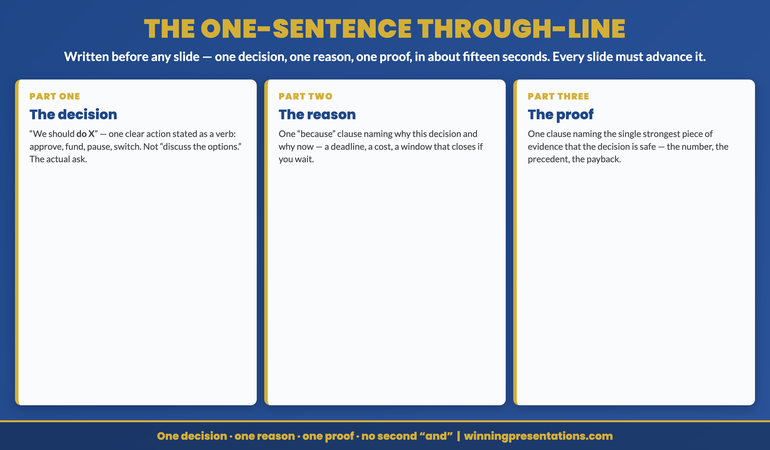
A through-line is not a topic and it is not a title. ‘Our 2027 capital plan’ is a topic; it tells the room what the deck is about but not what you want them to do about it. A through-line is a complete argument compressed into one sentence, and it has exactly three parts. The first is the decision: the single action you are asking the room to take or endorse, stated as a verb — approve, fund, pause, switch, acquire. Not ‘discuss the options’; the actual recommendation. The second is the reason: one ‘because’ clause that names why this decision, and ideally why now. The third is the proof: one clause naming the strongest single piece of evidence that the decision is safe — the number, the precedent, the deadline. Put together: ‘We should X, because Y, and the evidence is Z.’
The discipline is in the word ‘one.’ One decision, not three. One reason, not a list of seven. One proof, not your whole evidence base. The instinct of a thorough person is to resist this — surely the decision rests on more than one reason, surely there is more than one relevant number. Of course there is, and all of it can live in the deck. But the through-line is not the deck; it is the line the deck serves. If your sentence has two ‘and’s joining three different recommendations, you do not have a through-line, you have an agenda, and an agenda is exactly what a tired room cannot follow. When a deck genuinely needs to carry two decisions, it almost always needs to be two decks, or one deck with a clear primary ask and the second held as a follow-on.
I watched this transform a deck for a marketing director I coached in 2017. She came to a session frustrated that her quarterly reviews kept ‘going nowhere’ — lots of nodding, no decisions. I asked her to tell me, without the deck, what her next review was for. She talked for almost two minutes: the campaign performance, the channel shifts, the budget reallocation she was thinking about, the team structure question, the agency contract coming up for renewal. Five things. I asked her to pick the one that, if the room agreed to nothing else, would make the meeting worth having. She chose the budget reallocation. Her through-line became: ‘We should move next quarter’s spend from events to digital, because our last three events cost four times what digital did per qualified lead, and the pipeline is already shifting that way.’ Decision, reason, proof. The other four things became either supporting slides or a separate note. At the next review she opened with that sentence, and for the first time the room actually decided something. The material had always been there. The sentence had not.
Once you have the sentence, the deck almost builds itself, because every slide now faces a simple question: does this advance the through-line, and if so, which part? A slide advancing the ‘because’ goes in the reason section. A slide carrying the proof is your evidence anchor. A slide that does not advance any part of the sentence — the org chart you included out of habit, the history slide that sets context no one needs — is not a bad slide, it is simply not part of this argument, and it belongs in the appendix or the bin. The same logic is what lets you survive a brutal cut to your time, which is its own discipline worth knowing if you ever get told your twenty-minute slot is now eight — the through-line tells you instantly which slides are load-bearing and which are decoration.
If you are using AI to draft decks and it keeps producing five competent points instead of one clear argument:
The AI-Enhanced Presentation Mastery course is a self-paced programme of 8 modules and 83 lessons on using AI — including Copilot — to structure, draft, and refine executive presentations, with the prompt and editorial work that turns generic AI output into a single argued line rather than a balanced summary. There are no deadlines and no mandatory sessions; 2 optional live coaching sessions are fully recorded so you can watch them back anytime, with monthly cohort enrolment and lifetime access to the materials. £499.
The elevator test
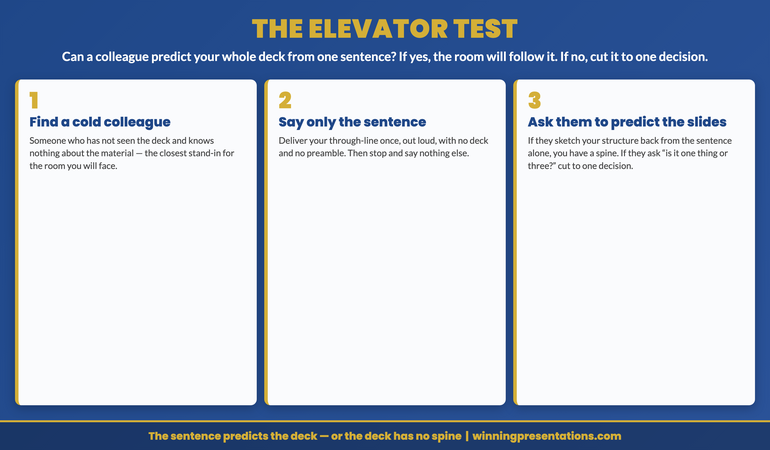
You cannot judge your own through-line, for the same reason you cannot proofread your own writing: you know what you meant, so the sentence reads as clear to you even when it is not. The way to test it is to hand it to someone who knows nothing about the deck and see whether the sentence alone tells them what is coming. That is the elevator test, and it is the diagnostic at the centre of this method. Find a colleague who has not seen your material. Say your through-line once, out loud — just the sentence, no deck, no preamble. Then ask them one question: based on that sentence, what do you think my slides cover?
If your through-line is doing its job, they will sketch your structure back to you with surprising accuracy. ‘Well — you’d show me the cost comparison that proves the four-times claim, something on why the pipeline is already shifting, probably the new budget split, and what you’d stop doing.’ That is the deck. The sentence predicted it, which means the room will be able to follow it, because they will be holding the same frame your colleague just built from one line. If instead they say ‘I’m not totally sure what you’re asking for — is it about the budget or the events or the team thing?’ then your sentence is carrying more than one decision, and the test has caught it before the committee did. The failure is almost always too much, not too little: you have tried to make the through-line carry the whole case instead of the single line the case rests on.
The most useful thing the elevator test does is force the cut while it is still cheap. It is far less painful to discover that your sentence has three competing subjects in a two-minute conversation with a colleague than to discover it eighteen minutes into a committee meeting when the chair puts her pen down. And the fix is always the same: choose. Pick the one decision that, if the room agreed to nothing else, would make the meeting worth having, and make the deck serve that. The rest does not disappear; it becomes supporting material, a follow-on, or an appendix. For the high-stakes rooms where this matters most, the executive coaching work on board and committee presenting uses the elevator test as a standard rehearsal check before anyone builds a slide.
One structure for every deck you will ever build. Pay once, keep it for good.
Instant download, lifetime access to the Executive Slide System — 26 templates, 93 AI prompts, 16 scenario playbooks, 7 checklists. There is no subscription to renew and no licence to track; you pay £39 once and open every future deck from a layout that puts your through-line on slide one and keeps every following slide tied to it. Built for the senior presenter who would rather start from a tested spine than assemble slides and hope a story appears. The structure pass alone will save you the eighteen-minute drift more than once.
Frequently asked questions
Isn’t reducing a complex strategy to one sentence dangerously simplistic?
The through-line is not a reduction of the strategy; it is the entry point to it. All the complexity still lives in the deck — the second and third reasons, the full evidence base, the risks and the trade-offs. What the one sentence does is give the room a frame to file that complexity against, so the nuance lands as nuance rather than as noise. A senior audience handles complexity far better when it knows what the complexity is in service of. Withholding the headline in the name of doing justice to the detail almost always backfires: the room cannot tell which details are load-bearing, so it discounts all of them. Lead with the line, then earn it.
What is the most common mistake people make when writing a through-line?
They write a topic instead of an argument. ‘An update on the transformation programme’ feels like a through-line because it is one sentence, but it contains no decision, no reason, and no proof — it tells the room what the deck is about, not what you want them to conclude or do. The fix is to force a verb of decision into the sentence: not ‘an update on’ but ‘we should continue funding’ or ‘we should pause.’ The second most common mistake is the opposite extreme — cramming three decisions into one line joined by ‘and.’ If your sentence has two ‘and’s doing structural work, you have more than one through-line, and you need to choose.
Does every presentation need a through-line, or just decision decks?
Any presentation where you want the room to come away holding a single clear idea benefits from one, which is almost all of them. A pure information update — here is the dashboard, no decision sought — can run on a different logic, but even there a through-line sharpens it: ‘The quarter is on track except for one number that needs watching’ gives a status update a point. The decks that genuinely do not need a through-line are rare. If you find yourself presenting something where you cannot name what you want the room to think or do afterwards, that is usually a sign the presentation does not yet have a reason to exist, not that it is exempt from needing a spine.
I have built the deck already — is it too late to add a through-line?
It is never too late, and retrofitting one is often the fastest way to fix a deck that feels flabby. Do not start from the slides. Put the deck aside, write the through-line from scratch as if the deck did not exist, then run the elevator test on it. Once you have a sentence that passes, go back through the deck and sort every slide into one of three piles: advances the sentence, supports it as backup, or belongs in neither. The first pile is your deck, roughly in the order the sentence implies. The second becomes your appendix. The third you cut. Most people find this halves their slide count and roughly doubles the clarity, which is the same trade my 2008 colleague made between the forty-one-slide version and the nineteen-slide one that got approved.
The Winning Edge — weekly newsletter
The Winning Edge is a weekly newsletter for senior professionals who present at the executive level. One short email a week on the structural moves that separate decisions a room acts on from decks it merely sits through. Subscribe to The Winning Edge →
For the wider library of presentation assets senior leaders draw on — slide system, storytelling primer, Q&A taxonomy, delivery references — the complete presenter library (£99) bundles seven products plus three bundle-only bonuses, worth over £190, covering slides, storytelling, confidence, and delivery in one place. See the wider board-readiness work on the services page, and the companion article on saying the number out loud before you show the chart.
About the author
Mary Beth Hazeldine is Owner & Managing Director of Winning Presentations Ltd. With 24 years of corporate banking experience at JPMorgan Chase, PwC, Royal Bank of Scotland, and Commerzbank, she advises executives across financial services, healthcare, technology, and government on structuring presentations for high-stakes funding rounds, board approvals, and strategic decisions.
The next time you are about to build a deck, do one thing before you open a single slide: write the one sentence the whole thing is for — we should X, because Y, and the evidence is Z — and say it to a colleague who has never seen the work. If they can predict your slides from that one line, you have a spine, and the room will follow it. If they cannot, you have a folder of slides and a chair somewhere who is about to put her pen down and ask you, eighteen minutes in, what exactly you are asking them to agree to. Write the sentence first, and you will never be the person who cannot answer her.