
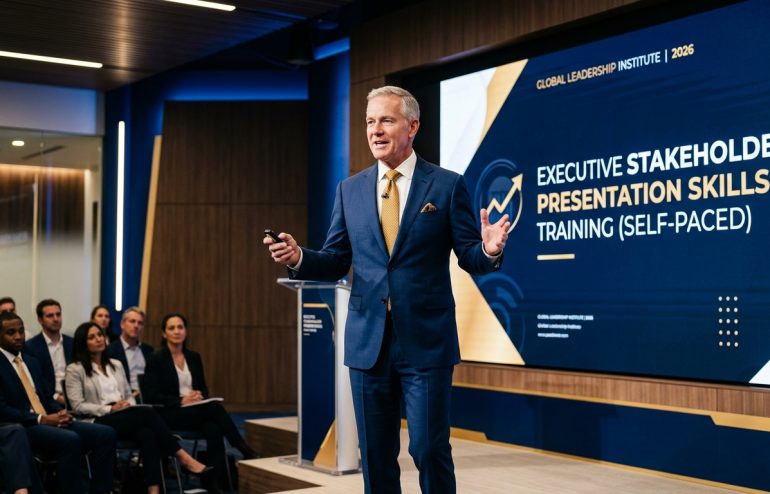
Executive Stakeholder Presentation Skills Training (Self-Paced, 2026)
Quick answer: Executive stakeholder presentation skills training is the structured discipline of presenting to senior decision-makers — boards, executive sponsors, investment committees, reluctant stakeholders — in a way that secures approval. Generic presentation training does not cover it. The skills it requires are stakeholder analysis, case construction under scrutiny, structured Q&A handling, and the room-design work that makes the difference between a meeting that approves and a meeting that defers. The right programme is self-paced, structured, and built specifically for the senior context.
Jump to:
A senior professional presents differently from a mid-career one because the room is different. The audience is more senior, the scrutiny is sharper, the stakes are higher, and the social dynamics around the decision are more complex. Generic public-speaking training does not prepare anyone for this room. It teaches presence, voice, and slide design. Those are necessary. They are not sufficient. The room you walk into when you present to a board or executive committee requires a different skill set entirely — one built around stakeholder analysis, case construction, structured Q&A, and the discipline of designing a room before you walk into it.
Executive stakeholder presentation skills training is the discipline that covers this. It is narrower than general presentation training and considerably more specific. The buyers are usually senior professionals — directors, partners, VPs, MDs — who have realised that the presentation skills that worked at mid-career do not scale to the rooms they now present in. Some have tried general training and found it pitched too low. Some have tried executive coaching and found it expensive for the cadence at which they actually present. A structured self-paced programme sits between these two — designed for the senior context, available without retainer-level cost.
This article describes what the discipline covers, what to look for in a programme, and how the Executive Buy-In Presentation System fits the brief.
Looking for stakeholder presentation training right now?
The Executive Buy-In Presentation System is a self-paced programme for senior professionals who present to boards, executive sponsors, and reluctant stakeholders. 7 modules, monthly cohort enrolment, optional recorded Q&A. £499, lifetime access to materials.
What executive stakeholder presentation training actually covers
A serious programme covers four areas. Each one is largely absent from generic presentation training and each one is essential at senior level.
Stakeholder analysis. The discipline of mapping the people who will be in or around the room — their influence, their current position, their likely objections, and the social structure that connects them. Senior decisions are rarely made by individuals in isolation. They are made by groups whose dynamics shape the outcome before anyone speaks. A programme that does not cover stakeholder analysis is teaching presentation skills in a vacuum. The actual presentation is one variable among several.
Case construction under scrutiny. Building a case that holds up under board-level questioning is a different discipline from building a case that lands well in a friendly room. The structural choices are different. The recommendations sit at different points in the deck. The objections are pre-empted in the body rather than deferred to Q&A. The opening does specific work — it anchors the proposal to strategic ground the room has already endorsed. Most generic training teaches the friendly version. Executive training teaches the structural version.
Structured Q&A handling. The questions a senior presenter receives are not the questions a junior presenter receives. They are sharper, more political, often deliberately uncomfortable, and frequently designed to test the presenter rather than the proposal. Comparison questions, prioritisation challenges, and trade-off provocations are routine. A structured programme covers the answer patterns that hold up — calm, decision-safe, anchored to strategy — and the delivery rules that make the answer land. Generic training rarely goes here.
Room design and political navigation. The room is not a neutral container. The chair, the sponsor, the supporters, the swing votes, the blockers — each one plays a role in how the meeting unfolds. A senior presenter has to design the room before walking into it. Pre-briefs, proxy champions, scrutiny absorption, post-meeting follow-up — these are the structural moves that determine whether a proposal survives the meeting. Generic training does not cover them. Executive training does, because at this level the proposal is rarely won by the deck alone.
Why generic presentation training does not work at this level
Most senior professionals have tried general presentation training at some point in their career. Many have found it useful at the time and inadequate later. The reason is structural. Generic training is designed for an audience that is decreasingly the audience a senior presenter actually faces.
The audience is wrong. Generic training teaches you to present to a polite, attentive room — typically a training-context audience that wants to engage with the material. A senior boardroom is structurally different. The audience is sceptical, time-pressed, and not always interested in being engaged. They want to make a decision. The skills that win a friendly room are different from the skills that earn approval in a sceptical one.
The content is too broad. Generic training covers the universal — voice, slide design, body language, story structure. All of these matter. None of them are the leverage point at senior level. The leverage at senior level is in the structure of the case, the design of the room, and the discipline of the Q&A. Generic training treats these as advanced topics that come at the end. Executive training treats them as the core curriculum.
The trainers are often pitched wrong. Many generic trainers have a TED-talk or keynote background. That experience is genuine, but it is the wrong kind of senior presentation experience. Keynote skills are different from boardroom skills. The presenter who is excellent at the inspirational closing speech may not have the structural muscle for the seventeen-minute investment-committee proposal where every minute is contested. Executive training requires trainers whose direct experience is in the senior boardroom context.
The format is poorly matched to senior schedules. Generic training is often delivered in workshops — full-day or two-day intensives. Senior professionals rarely have two consecutive days available, and intensive workshops do not build the kind of long-term structural capability that senior presenters need. Self-paced programmes with optional live components fit senior schedules far better, because the work can be done in fifteen-minute increments around the demands of the actual job.
The right format — what to look for
When evaluating an executive stakeholder presentation skills training programme, four format questions matter more than the marketing copy.
Is it self-paced? Senior schedules do not accommodate fixed weekly attendance. A programme that requires a two-hour live call every Wednesday at 5pm is structurally incompatible with the actual rhythm of senior work. Self-paced programmes — where the core content is recorded and any live components are optional and themselves recorded — are the only format that survives the calendar pressures of executive roles. A senior professional can complete a self-paced programme; many cannot complete a fixed-schedule one.
Is the content built specifically for senior context? Read the module list. If it covers voice, presence, slide design, and story structure, it is generic training relabelled as executive. If it covers stakeholder analysis, board dynamics, case construction under scrutiny, structured Q&A handling, and room design, it is built for the senior context. The module structure tells you which one you are buying. Marketing language is unreliable. The module list is honest.
Is there access after the cohort closes? Many programmes restrict access to the duration of the cohort — eight weeks, twelve weeks, whatever the marketing structure dictates. This is bad fit for senior buyers. The first time you complete the programme, you build initial capability. The third or fourth time you return to a specific module — usually before a high-stakes meeting — is when the capability becomes deep. Programmes that withdraw access after the cohort effectively prevent the second category of value. Look for lifetime access to materials.
Is the live component genuinely optional? Some programmes describe themselves as self-paced but require live attendance for credit, certification, or continued access. This is a hidden constraint that re-imposes the schedule problem. The right format treats live components as optional — useful when available, fully recorded when not, and never a barrier to completing the programme. Senior buyers should be able to complete the entire programme without ever attending a live session.
Self-paced executive stakeholder presentation skills training
The Executive Buy-In Presentation System — designed for senior professionals presenting to boards, sponsors, and reluctant stakeholders
The Executive Buy-In Presentation System is the structured framework for senior professionals who need to secure board-level approval. 7 modules, self-paced, with monthly cohort enrolment and optional recorded Q&A sessions available. Designed by Mary Beth Hazeldine on the basis of 25 years of corporate banking and 16 years of coaching senior professionals across financial services, insurance, consulting, and technology.
- 7 self-paced modules covering stakeholder analysis, case construction, room design, structured Q&A, and the post-meeting work that protects approved decisions
- Optional live Q&A / coaching calls — fully recorded, watch back at your own pace
- No deadlines, no mandatory live attendance, lifetime access to all materials
- Monthly cohort enrolment — enrol any time, start with the next cohort
£499 · Self-paced · Lifetime access to materials · Next cohort enrolment opens monthly
The Executive Buy-In Presentation System
The Executive Buy-In Presentation System is built around the four areas described above — stakeholder analysis, case construction under scrutiny, structured Q&A handling, and room design. It is structured as 7 self-paced modules. Each module covers a specific structural capability and is paired with practical artefacts — frameworks, checklists, and the structures senior presenters apply directly to their next meeting.
The format is self-paced. Modules are recorded and available at any time. There are no deadlines and no mandatory live attendance. Optional live Q&A and coaching calls run periodically and are fully recorded so participants who cannot attend live can watch back at any time. The format is designed around the calendar realities of senior roles — a senior buyer can complete the programme in fifteen-minute increments around their actual work, and can return to specific modules indefinitely as new high-stakes meetings arise.
Enrolment runs monthly. A new cohort opens every month, which means there is no waiting for the next intake — enrol whenever it suits you and begin with the next monthly cohort. Lifetime access to materials means the programme stays useful for as long as the buyer continues to present at senior level, not just for the eight or twelve weeks of the initial cohort.
Pricing is £499. That is positioned at the lower end of meaningful executive training — substantially less than retainer-level 1:1 coaching, on the same order as a single high-stakes coaching engagement. The economics tend to favour the structured programme for senior professionals who present meaningfully four to twelve times a year, with 1:1 coaching reserved for the highest-stakes one-off events. Many participants use the programme as the structural framework and engage 1:1 coaching specifically for capital markets days, regulatory hearings, or activist investor pitches.
For senior professionals whose work also touches AI-generated or AI-assisted decks, a parallel programme — Maven AI-Enhanced Presentation Mastery — exists at the same price point with a different focus. The Buy-In programme is appropriate where the central challenge is securing approval from senior stakeholders. The AI-Enhanced programme is appropriate where the central challenge is using AI to produce executive-grade output. Many senior buyers eventually engage with both, but for stakeholder presentation skills specifically, the Buy-In programme is the direct fit.
Who the programme is and is not for
The right fit is senior professionals who present to boards, executive committees, sponsors, and reluctant stakeholders. Directors, partners, VPs, MDs, finance leaders, transformation programme leads, regulatory leads — anyone whose work involves regularly seeking approval at senior level. The programme assumes baseline presentation capability and builds on top of it. It is not designed to teach foundational presentation skills.
It is also a fit for senior professionals stepping up. A new director who has been promoted into a role that requires significantly more board-level presenting. A new partner who is now expected to lead investment committee discussions. A new MD whose team’s proposals now go through them rather than around them. The programme is structured for the transition from competent presenter to senior-context presenter, which is a real skill jump that most professionals make implicitly and slowly. The programme makes it explicit and faster.
It is not a fit for foundational presentation training. A junior professional learning to present for the first time, an early-career individual contributor wanting to improve workshop delivery, or anyone whose challenge is voice, presence, or basic deck design — the programme is too senior for that brief. Foundational training is widely available, often at lower cost, and is the right starting point. The Buy-In programme assumes the foundational ground is already in place.
It is also not a fit for keynote-style training. Senior professionals who need to deliver inspirational keynotes, large-stage public-speaking sessions, or media appearances need a different programme. The Buy-In programme is specifically about boardroom and executive-committee work — small-room, high-stakes, decision-driven contexts. Keynote-style speakers should look at programmes designed for that context.
For a wider perspective on how stakeholder presentation skills training fits inside the broader picture of board-level presentation work, see the related discussion of getting board approval through structured presentation training — which describes the broader context the Buy-In programme sits inside.
Companion templates for stakeholder-led decks
The Executive Slide System — board-ready slide structures for the cases the programme teaches you to build
Senior buyers often pair the programme with the Executive Slide System — 26 templates, 93 AI prompts, and 16 scenario playbooks for building board-ready slides that match the structures the programme covers. £39, instant download, lifetime access. Explore the slide system →
Frequently asked questions
Is the programme suitable for participants outside the UK?
Yes. The programme is delivered online, in English, and the structural content is designed for any senior corporate context — not just the UK market. Participants from financial services, insurance, consulting, technology, healthcare, and government across multiple geographies have used the programme. The boardroom dynamics, stakeholder structures, and Q&A patterns the programme covers are recognisable across most senior corporate environments. Local adjustments to language and tone are usually small.
How long does the programme take to complete?
Most participants complete the core content in three to five weeks at a pace of two to three hours a week. Because the programme is self-paced and access is lifetime, many participants do not actually complete it linearly — they complete the modules most relevant to their immediate work first, then return to specific modules before high-stakes meetings later. The programme is designed to be useful both as a linear curriculum and as a reference library returned to over time.
What does the £499 price include?
7 self-paced modules of course content, optional live Q&A and coaching sessions (fully recorded so non-attendance does not affect access), lifetime access to all course materials, and entry to the current monthly cohort. There is no subscription, no expiry, and no recurring fee. Once enrolled, materials remain accessible indefinitely. New cohort intakes do not require re-enrolment for previous participants.
How does this compare to 1:1 executive coaching?
The two are complementary rather than competitive. A 1:1 coach reads your specific deck and works on the meeting in front of you. A structured programme builds the framework that lets the coaching focus on the specific rather than the structural. Many senior buyers use the programme as the structural framework and engage 1:1 coaching specifically for the highest-stakes one-off events — capital markets days, regulatory hearings, activist investor pitches. The economics make the programme the better fit for the standing rhythm of senior presentation work, with 1:1 coaching reserved for the moments where marginal value is highest.
Maven cohort enrolment — open this month
Built on 25 years of corporate banking and 16 years of senior presentation coaching
Built on 25 years in corporate banking and 16 years coaching senior professionals across financial services, insurance, consulting, and technology. The Executive Buy-In Presentation System — 7 modules, self-paced, monthly cohort enrolment, optional recorded Q&A calls. £499, lifetime access.
- 7 self-paced modules — work through at your own pace, no deadlines
- Optional live Q&A calls — fully recorded, watch back any time
- Monthly cohort enrolment — enrol any time, start with the next cohort
- Lifetime access to all materials, no subscription, no expiry
£499 · Self-paced · Lifetime access · Next cohort enrolment opens monthly
The Winning Edge — weekly
One short note each Thursday on board-level presentation patterns, structural shortcuts, and the behaviours senior presenters use under scrutiny. Written for professionals who do not have time for newsletters that read like newsletters.
Want a starting point first? The free Executive Presentation Checklist covers the structural fundamentals senior presenters use before formal training.
For a related view of how stakeholder skills training connects to broader executive presentation work, see the discussion of executive presentation training online.
Next step: Look at the next senior presentation on your calendar. Identify which of the four executive skill areas — stakeholder analysis, case construction, structured Q&A, room design — is the weakest link for that meeting. Start there. The Executive Buy-In Presentation System is structured so you can begin with the module that addresses the immediate gap rather than working linearly.
Mary Beth Hazeldine is the Owner & Managing Director of Winning Presentations. With 25 years of corporate banking experience at JPMorgan Chase, PwC, Royal Bank of Scotland, and Commerzbank, she advises senior professionals across financial services, healthcare, technology, and government on structuring presentations for high-stakes board meetings, investment committees, and executive sessions. She speaks German and works extensively with the German-speaking financial markets.