

How to Present to Win Stakeholder Approval: The Senior Approver’s Logic
QUICK ANSWER
Winning stakeholder approval is a discipline, not a personality trait. It rests on four things: knowing what is in each stakeholder’s head before they walk in, building the case in load-bearing order, pre-handling the predictable objections in writing, and choosing slide patterns that survive senior scrutiny. Presenters who earn approval consistently are not the most charismatic. They are the most prepared, in specific ways the rest of the room cannot see.
JUMP TO
What stakeholders are actually doing in the room ·
Map the stakeholders before you build the deck ·
Build the case in load-bearing order ·
Pre-handle the predictable objections ·
Use slide patterns that survive scrutiny ·
What to do in the room ·
FAQ
Kwame had been turned down twice on the same proposal. Once by the operating committee in November. Once by the executive committee in February. The case had not changed. The market had not changed. His sponsor had not got more senior. What changed the third time, when the board approved it, was the work he had done between the meetings.
The first version of his deck had a polished narrative arc and a strong personal opening. The second version was tighter, with cleaner data. The third version was structurally different. He had stopped trying to convince the room and started preparing the room. He had mapped each board member’s appetite for the kind of decision he was asking for. He had pre-handled the seven objections he expected. He had rebuilt the slides so the recommendation was visible in the first three minutes and every slide was defensible on its own. The board approved in twenty-two minutes and the chair told him afterwards that the case had been “the cleanest we have seen this quarter.”
The work that produced that outcome is what this article is about. It is not about charisma. It is not about confidence. It is about the four disciplines senior professionals who earn approval consistently apply to every high-stakes presentation, often invisibly to the people watching.
Want a structured framework rather than a single article?
If you would rather work through the four disciplines as a framework than reverse-engineer them across years of approvals and refusals, the Executive Buy-In Presentation System is built around exactly the work below.
What stakeholders are actually doing in the room
Senior approvers are not really listening to your slides. They are running an internal calculation about whether to bet their judgement on what you are recommending. The calculation has three components: how solid is the case, how reliable is this person, and what does the rest of the room think.
The case is what most presenters focus on. It is the easiest part to prepare and the most visible. The reliability assessment is harder to prepare for, because it is not really about what you say — it is about how you handle the moments where the case is challenged. The rest-of-the-room read is the part most presenters do not see. Senior approvers watch each other. They are reading whether the chair is leaning in or sitting back, whether the CFO has flicked to a specific page, whether the sponsor is silent or speaking up.
This means winning stakeholder approval is rarely about persuading the room from a standing start. It is about preparing the room so that, by the time the meeting begins, most of the persuading has already been done. The visible meeting is the tip of the iceberg. The work that produces the approval lives mostly underwater, in the days and weeks before.
Map the stakeholders before you build the deck
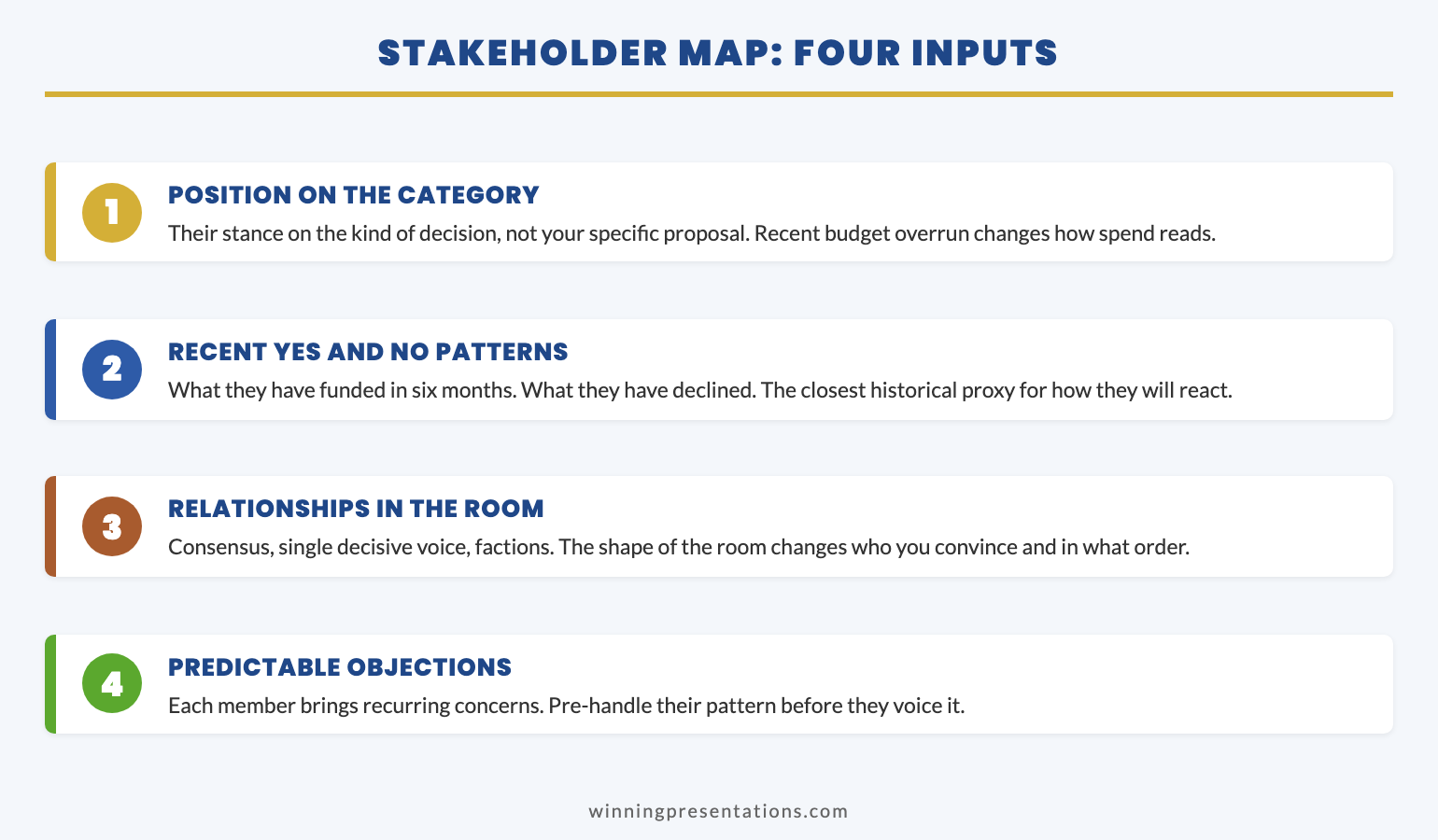
Most senior professionals know who is in the room. Stakeholder approval requires knowing what is in their head before they walk in. For each person, write out four things in advance.
Their position on the kind of decision you are asking for. Not their position on your specific proposal — their position on the category. A CFO who has just absorbed a budget overrun reads any new spend differently from one whose unit is over-performing. A regulator-facing director who is currently under scrutiny reads any new risk differently from one who is not. The framing of your proposal needs to land where each person currently is, not where you wish they were.
What they have said yes and no to recently. The closest historical proxy for how a senior approver will react is what they have funded or declined in the last six months. The patterns are remarkably stable across people. If a board has declined three operational risk increases this year, your proposal needs to lead with the risk treatment. If they have approved three growth-oriented investments, your proposal needs to fit that template.
Their relationship to your sponsor and to each other. Some approval rooms run on consensus. Some run on a single decisive voice. Some run on factions. The shape of the room matters because it changes who you need to convince and in what order. The chair is rarely the only person whose view counts.
Their predictable objections. Each senior approver brings a recurring set of concerns to every proposal — cost, risk, alternatives, timing, execution. Knowing their pattern lets you pre-handle their specific objections before they voice them. Stakeholder management for presentations walks through the upstream mapping work in more detail.
Build the case in load-bearing order
The case is the underlying logic that takes the audience from “this is the situation we are in” to “this is the decision that follows.” Senior approvers read for two things: what are you asking me to decide, and what are the load-bearing reasons. Everything else is texture.
Load-bearing order is the opposite of analytical order. Analytical order moves from inputs to conclusions. Senior approval order moves from conclusion to the inputs that make it defensible. Both are valid. Only one of them earns approval at speed.
A defensible case usually has four to six load-bearing components: the recommendation, the rationale, the alternative considered and rejected, the risk treatment, the implementation plan, and the cost or financial implications. Each of these has its own logic. None of them can be left out without the room asking for it.
The most common case-construction failure I see in senior presentations is omitting the alternative-considered-and-rejected. Senior approvers want to know that you have done the comparison. They are not impressed by a recommendation that arrives without context. The slide that addresses “we considered X and rejected it because…” is often the slide that converts a sceptical chair into an approving one. The presenter who has not prepared it tends to be asked about it on the spot, and tends to flounder.
Pre-handle the predictable objections in writing
Approving rooms are rarely silent rooms. They are rooms where the most predictable objections have already been answered before they are voiced. Pre-handling means walking into the meeting with a written list of the seven to ten questions you expect, the order they are likely to surface, and a structured response to each one that you can give without hesitation.
The discipline is to write the objections out before the deck is built — not after. The deck then carries the answers in advance. A well-pre-handled deck has slides that address the predictable objections inline, so that the questions either do not get asked at all or are asked already half-answered. The room moves through them quickly because the speaker has already done the work.
The five categories worth scanning for every senior presentation are cost, risk, alternatives, timing, and execution. Within each category, the questions cluster predictably. “Have you considered the cheaper option?” “What happens if the volume forecast is wrong?” “Why now, rather than next quarter?” “Who is going to lead the implementation?” These are not hostile questions — they are normal senior approver questions. The difference between presenters who earn approval and those who do not is whether they walked in expecting them.
The decline you remember is almost always the decline you did not pre-handle. Stakeholder buy-in psychology covers the deeper reasons pre-handling has the disproportionate effect it does in senior rooms.
EXECUTIVE BUY-IN PRESENTATION SYSTEM
Build the case your stakeholders cannot dismiss
The Executive Buy-In Presentation System is a self-paced framework — 7 modules covering stakeholder mapping, case construction, objection pre-handling, and the slide patterns that hold up to senior scrutiny. The discipline that turns reluctant rooms into approving ones.
- 7 modules of self-paced course content
- Optional live Q&A / coaching calls (fully recorded — watch back anytime)
- No deadlines, no mandatory session attendance
- New cohort opens every month — enrol whenever suits you
- Lifetime access to all course materials
£499, lifetime access. Self-paced with monthly cohort enrolment — optional recorded Q&A sessions available.
Designed for senior professionals presenting decisions to boards, investment committees, and executive sponsors.
Use slide patterns that survive scrutiny
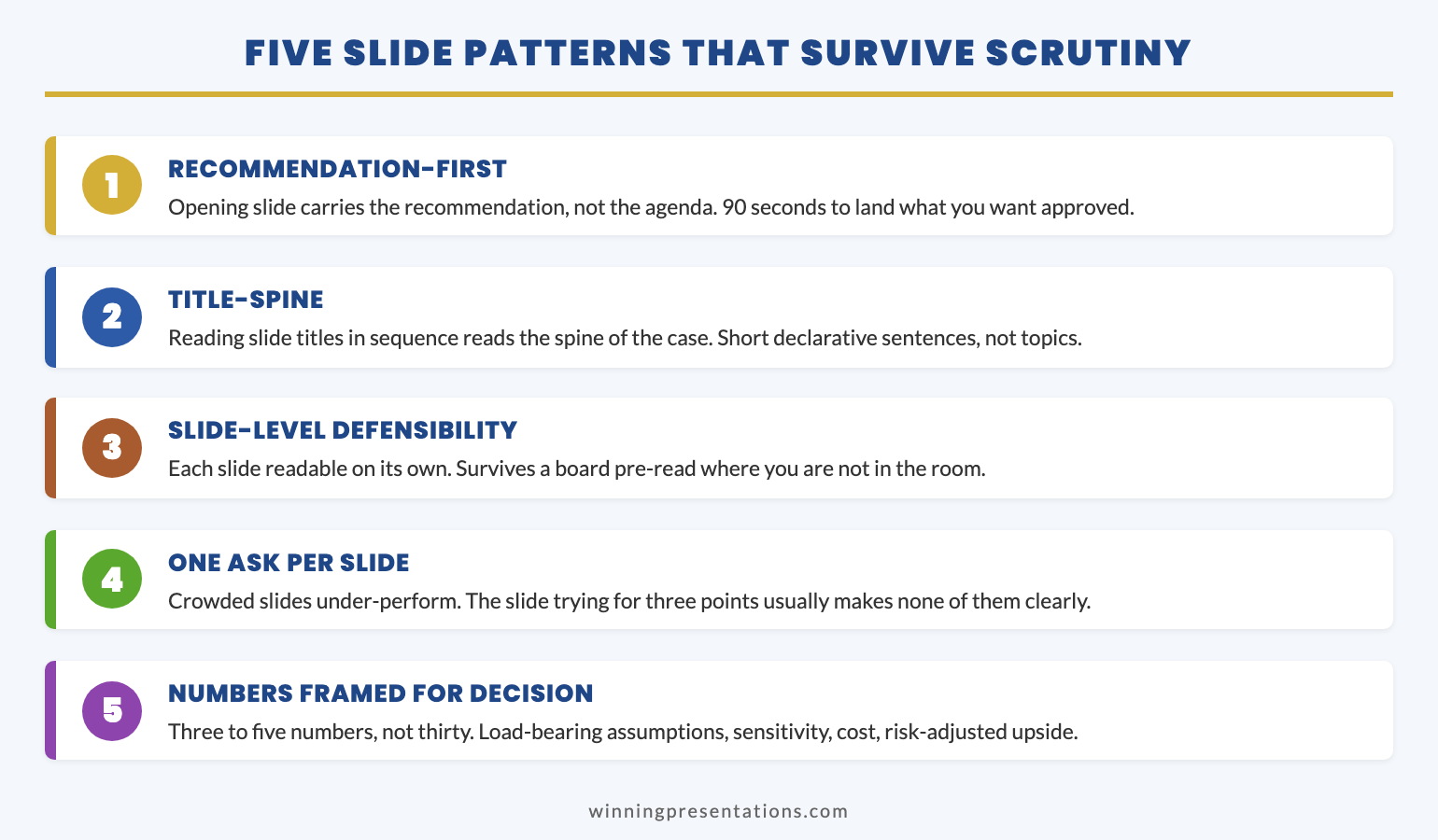
Senior approvers do not read presentations the way working audiences do. They scan. They jump ahead. They land on a single slide for the first time and expect it to make sense without a verbal walkthrough. The slide patterns that earn approval at senior level have specific properties.
Recommendation-first. The opening slide carries the recommendation, not the agenda. Within ninety seconds, senior approvers know what you want them to approve and what the implications are if they do.
Title-spine. A senior approver who reads only the slide titles in sequence should be able to read the spine of the case. The titles are short declarative sentences, not topics. “Recommend approving the £8m capital request” rather than “Capital request overview.”
Slide-level defensibility. Every slide should be readable on its own. A senior approver who lands on slide five for the first time should be able to understand it without you in the room. This is what allows the case to survive a board pre-read where you are not present to explain it.
One ask per slide. Crowded slides under-perform at senior level. The slide that tries to make three points usually makes none of them clearly. The slide with one point, supported, lands.
Numbers framed for decision. Senior approvers do not want every number from the analysis. They want the numbers that bear on the decision: the load-bearing assumptions, the sensitivity, the cost, the risk-adjusted upside. A clean financial slide carries three to five numbers, not thirty.
What to do in the room
If the upstream work has been done well, the in-the-room work becomes straightforward. State the recommendation. Walk the case in load-bearing order. Take questions calmly — most of them are pre-handled and you have the answers ready. Acknowledge the ones you have not pre-handled honestly: “That is a good question I have not prepared a full answer to. The first thought is…” rather than improvising on a position you cannot defend.
The single biggest in-the-room behaviour that separates approving meetings from declining ones is calmness under challenge. The chair asks a difficult question. The room watches your reaction more than they listen to your answer. The presenter who pauses, breathes, and gives a structured two-sentence answer at slightly lower pitch than the question reads as in command of the case. The presenter who jumps in fast, pitch slightly raised, reads as defensive even if the answer is correct.
Calmness is downstream of preparation. The presenter who has done the four disciplines — stakeholder mapping, case construction, objection pre-handling, slide patterns — rarely has to reach for calmness. The case carries them. The presenter who has skipped the upstream work has to manufacture composure under pressure, which is much harder. The board approval presentation framework walks through the in-the-room behaviour in more detail.
The slide structures behind the curriculum
The Executive Slide System is the templates side of the same picture — 26 templates, 93 AI prompts, and 16 scenario playbooks built around the patterns senior approvers respond to. Designed to pair with the Buy-In curriculum, not replace it.
Why this is a discipline, not a technique
None of the four disciplines is, in isolation, complicated. Each can be described in a paragraph. The reason senior approval is hard is that all four have to be applied together, every time, with the consistency that comes from treating the work as a craft rather than a one-off effort.
The presenters who earn approval consistently treat each high-stakes presentation as the application of the same curriculum. The audience changes; the four disciplines do not. Stakeholder mapping for a regulator looks different from stakeholder mapping for an investment committee, but the structure of the discipline is identical. Case construction in financial services has different content from case construction in a healthcare procurement panel, but the load-bearing logic is the same.
That portability is what makes the curriculum worth treating as a curriculum. Once it is built, it transfers across audiences, across organisations, across decades of senior professional life. The presenters who have it tend to be the ones whose careers compound. Approval becomes the default, not the exception.
JOIN THE NEXT COHORT
The four disciplines, as a structured curriculum
The Executive Buy-In Presentation System gives you 7 self-paced modules covering stakeholder mapping, case construction, objection pre-handling, and the presentation structures that hold up to scrutiny. Monthly cohort enrolment — £499, lifetime access.
Self-paced with monthly cohort enrolment. No deadlines, no mandatory session attendance.
Frequently asked questions
How do I know if I have mapped my stakeholders well enough?
The test is whether you can predict each person’s first question with reasonable confidence. If you can write out the first thing the chair will ask, the first thing the CFO will ask, and the first thing your sponsor will say, you have probably done enough mapping. If you cannot, the deck is being built without enough audience information.
How long should I spend pre-handling objections?
Most senior professionals find that two to three hours of focused pre-handling work, on the seven to ten most likely objections, produces more durable change in approval rates than another full day of polishing slides. The leverage is in writing the answers out in full sentences, then rehearsing them aloud until they come out cleanly. Bullet points are not enough — the room asks complete sentences and expects complete sentences in reply.
What if I get an objection I did not prepare for?
Acknowledge it honestly. “That is a question I have not prepared a full answer to. My first thought is…” earns more credibility than improvising on a position you cannot defend. Senior approvers respect “I have not done that work yet” much more than a confident-sounding answer that falls apart on the second question. The pre-handling discipline reduces how often this happens, but it never eliminates it entirely.
Does this work for non-board audiences?
Yes. The same four disciplines apply to investment committees, regulators, joint venture partners, government commissioning panels, and senior client procurement. The audience changes the inputs to stakeholder mapping. It does not change the structure of the case, the discipline of pre-handling, or the patterns that hold up to scrutiny. Senior professionals who learn the framework typically find it transfers across audiences with minor adaptation.
How long does it take to develop reliable buy-in skills?
Senior professionals who absorb the curriculum in fragments tend to take eight to fifteen years. Those who work through it as a structured discipline can apply the four disciplines to a real proposal within weeks. The constraint is not how long the material takes to learn — it is how many real approval cycles you can apply it to. Two or three live applications, with feedback, builds more competence than another year of theory.
The Winning Edge
A weekly newsletter for senior professionals who present at board level. One specific structural idea per issue, drawn from real boardroom and committee work. No filler.
Not ready for the full system? Start here instead: download the free Executive Presentation Checklist — the pre-flight checks that catch the structural mistakes most senior professionals make in the last 24 hours before a high-stakes meeting.
If this article landed for you, Voice coaching for senior executives is the natural next read. It walks through the in-the-room dimension — how the voice carries (and fails to carry) under senior pressure, and how the structural and pre-handling work upstream reduces the load on it.
Next step: open a real proposal you are working on now and run the four disciplines against it. Where is the curriculum already strong? Which discipline is doing the least work? That is where the next round of approval is being won or lost.
Mary Beth Hazeldine is the Owner & Managing Director of Winning Presentations. With 24 years of corporate banking experience at JPMorgan Chase, PwC, Royal Bank of Scotland, and Commerzbank, she advises senior professionals across financial services, healthcare, technology, and government on structuring presentations for high-stakes funding rounds and approvals. She speaks German and works extensively with the German-speaking financial markets.