

Technology Investment Presentation: How to Build a Business Case Your Board Will Approve
Quick answer: A technology investment presentation that wins board approval needs three elements most proposals lack: a financial narrative framed around business risk rather than technical capability, a phased implementation roadmap that de-risks the spend, and a clear decision framework that makes approval feel like the conservative choice. This article walks you through how to structure each element so your board sees the commercial logic before they see the price tag.
In this article:
- Why Most Technology Investment Proposals Get Sent Back
- Building a Financial Narrative Your Board Will Follow
- The Risk Framework That Makes Approval Feel Conservative
- Structuring Your Slides for Board-Level Decision Making
- Phased Implementation: How to De-Risk a Large Technology Spend
- Five Mistakes That Stall Technology Approvals
- Frequently Asked Questions
Marek had done everything right. His team had spent nine weeks evaluating platforms, running vendor demos, building comparison matrices, and stress-testing integration requirements. The final technology investment presentation to his organisation’s board was 42 slides of meticulous technical analysis.
The CFO stopped him on slide six.
“Marek, I understand the technology is impressive. What I need to understand is what happens to our operating margin if we don’t do this, and what happens to our risk exposure if we do.”
Marek had the answers. They were buried in appendix slides that the board would never see. He had built a technology proposal when what the board needed was a financial argument with a technology solution attached. Six weeks later, he restructured the entire narrative around business risk and financial outcomes. The board approved the full spend in twenty minutes. The technology hadn’t changed. The framing had.
That gap between technical rigour and board-level persuasion is where most technology proposals fail. Not because the investment is wrong, but because the presentation speaks the wrong language.
If you are building a technology investment case and want a structured starting point for your slides, the Executive Slide System includes scenario-specific templates for board-level presentations, along with AI prompts designed to help you frame technical proposals in financial terms.
Why Most Technology Investment Proposals Get Sent Back
Board members who approve capital expenditure are not evaluating your technology. They are evaluating risk, return, and timing. When a CTO or IT director presents a technology investment case built around platform features, vendor comparisons, and migration timelines, the board hears complexity without a clear financial thesis.
The result is rarely outright rejection. More often, it is a request for “more information” or a suggestion to “come back next quarter.” Both responses mean the same thing: the board did not have enough financial clarity to make a decision.
Three patterns account for most stalled technology proposals:
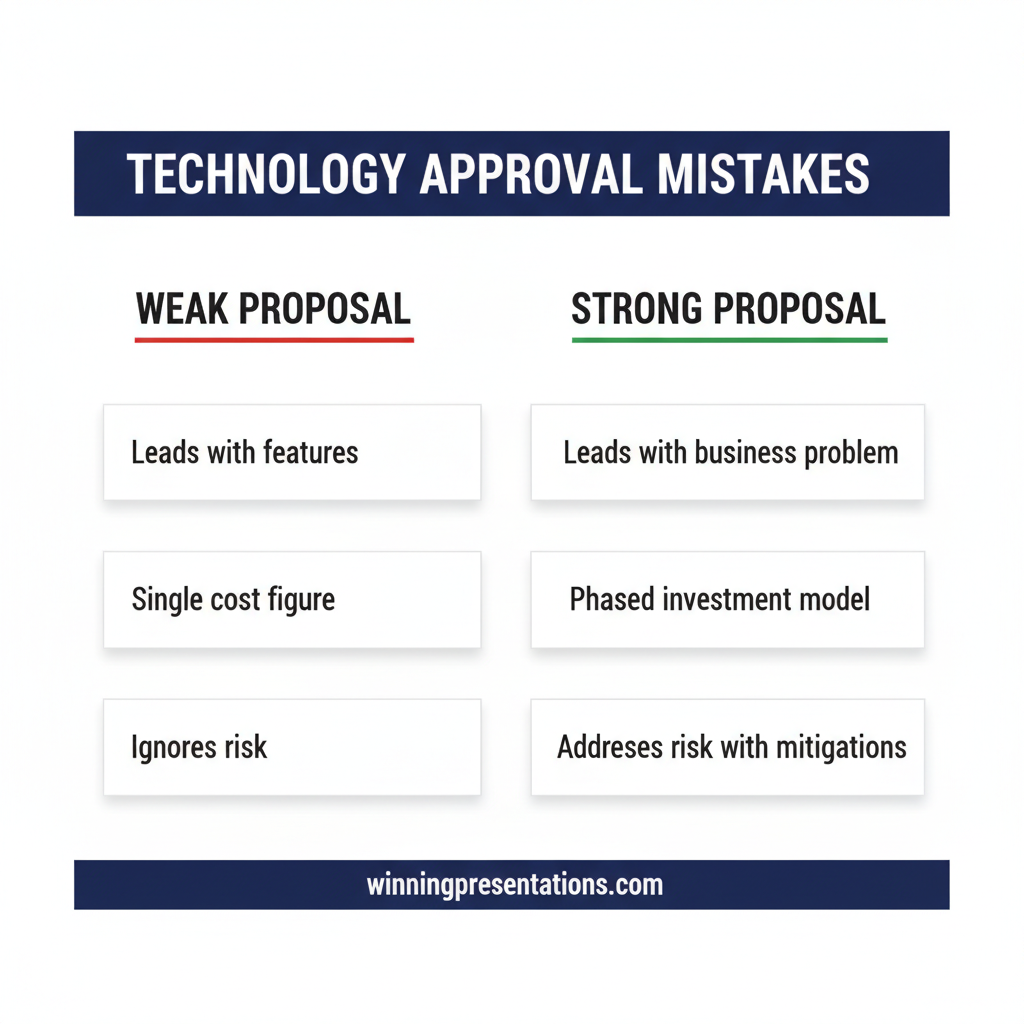
- Leading with the solution instead of the problem. Your board needs to feel the cost of inaction before they can evaluate the cost of action. If your first five slides describe what the new platform does, you have already lost the room.
- Presenting total cost without a phased commitment. A request for a large capital allocation with no off-ramps feels like a binary gamble. Boards approve staged investments far more readily than single-tranche commitments.
- Mixing technical detail with financial argument. When architecture diagrams sit alongside ROI projections, neither gets the attention it deserves. The board presentation 15-minute framework applies here: separate the decision narrative from the supporting evidence.
Understanding these patterns is the first step toward building a proposal that your board can actually approve in a single meeting.
Build Your Technology Investment Case in Hours, Not Weeks
The Executive Slide System gives you 26 board-ready slide templates, 93 AI prompts for structuring executive-level arguments, and 16 scenario playbooks covering high-stakes presentations from funding requests to strategic pivots. Instead of starting from a blank deck, you start from a structure that already speaks your board’s language.
Executive Slide System — £39, instant access.
Get the Executive Slide System →
Instant download. 3 files. Use it for your next board presentation.
Building a Financial Narrative Your Board Will Follow
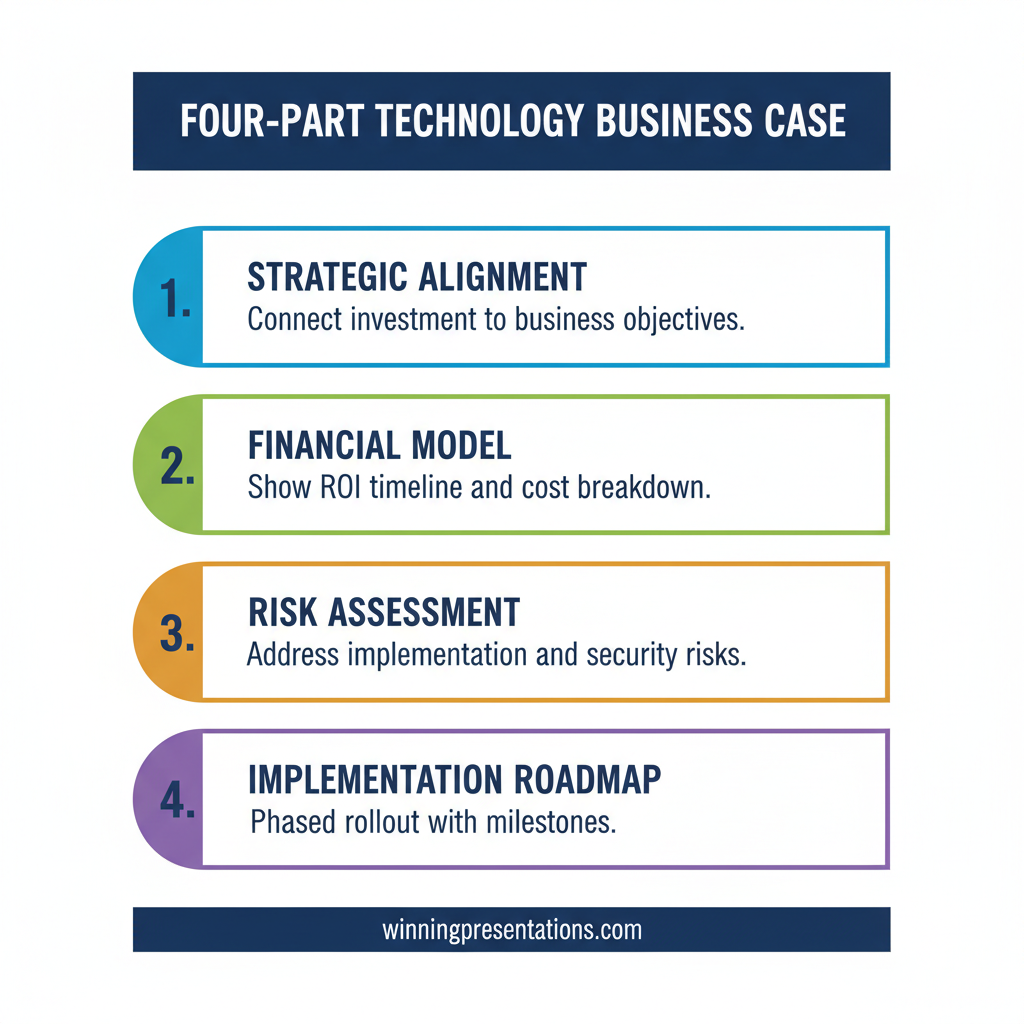
A financial narrative is not a spreadsheet summary. It is a story about what money does and what money loses. For technology investments, the most effective financial narrative follows a four-part sequence:
1. Current-state cost. Quantify what the organisation spends today on the process, system, or capability that the proposed technology will replace or improve. Include direct costs (licence fees, headcount, maintenance contracts) and indirect costs (manual workarounds, error rates, delayed reporting). Board members need to see that the status quo already has a price.
2. Risk-of-delay cost. This is the element most proposals omit. If the board defers the decision for six months, what does the organisation lose? Market position, regulatory compliance risk, staff attrition from outdated tooling, or competitive exposure? Frame the delay in financial terms, not hypotheticals.
3. Investment breakdown by phase. Present the total cost, but immediately break it into phases. Phase one should represent the smallest viable commitment that demonstrates value. This gives the board a decision to make, not just a number to absorb.
4. Return timeline. Not a five-year NPV analysis buried in an appendix. A simple, clear statement: “Phase one delivers measurable efficiency gains by month four. Phase two breaks even by month nine.” Board members can anchor a decision to a concrete timeline far more easily than to a discounted cash flow model.
This four-part structure works because it mirrors how board members already think about capital allocation. They assess exposure, weigh risk, evaluate commitment size, and look for a return horizon. Your job is to hand them those four elements in that order.
The Risk Framework That Makes Approval Feel Conservative
Board members do not see themselves as blocking innovation. They see themselves as protecting the organisation from poorly structured risk. The distinction matters, because it tells you exactly how to frame your proposal.
Instead of presenting the investment as an opportunity the board should seize, present it as a risk the board should manage. That means including three explicit risk elements:
Risk of inaction. What specific business risks increase if this investment is not made? Regulatory non-compliance, loss of competitive capability, dependency on unsupported legacy systems, or exposure to security vulnerabilities? Quantify where you can, describe where you cannot.
Risk of execution. Every technology implementation carries execution risk. Acknowledge it openly. Describe the three most likely failure modes and explain exactly how each will be mitigated. This is not a weakness in your proposal — it is a signal that you have thought beyond the sales pitch.
Risk mitigation through phasing. When the board can see that Phase One costs 20% of the total budget and delivers a testable proof of concept, the perceived risk drops dramatically. The approval shifts from “should we spend this much?” to “should we spend this much to find out?” That is a fundamentally easier decision. Your executive summary slide should crystallise this phased logic in a single view.
When you frame a technology investment as the prudent, risk-managed course of action rather than an ambitious bet, you align your proposal with the board’s own risk appetite. That alignment is what gets proposals approved in a single session.
If you want board-ready templates that help you structure this kind of risk-framed proposal, the Executive Slide System includes scenario playbooks designed specifically for high-stakes investment presentations.
Structuring Your Slides for Board-Level Decision Making
The slide structure for a technology business case should follow a decision logic, not a project plan. Board members are not sitting through your presentation to learn about the technology. They are looking for enough clarity to make a yes-or-no decision before the meeting overruns.
Here is a structure that works for most board-level technology cases:
Slide 1: The business problem in one sentence. Not “We need a new CRM.” Rather: “Our client retention rate has dropped 12% in eighteen months because our account managers cannot access real-time client data during renewal conversations.” One slide. One problem. No preamble.
Slide 2: Financial impact of the problem. What is this problem costing the organisation right now? Annual revenue loss, staff efficiency drag, compliance exposure. Numbers only. No narrative required — the numbers tell the story.
Slide 3: Proposed solution overview. What you intend to implement, in plain language. One paragraph maximum. Save the architecture diagram for the appendix.
Slide 4: Phased investment and timeline. Three columns: Phase, Cost, Deliverable. Board members should be able to read this slide in ten seconds and understand the commitment structure.
Slide 5: Risk analysis. Two-column layout: “Risk of proceeding” on the left, “Risk of not proceeding” on the right. Let the board compare the two positions visually.
Slide 6: Decision request. State exactly what you are asking for: the amount, the timeline, and the governance mechanism. “We are requesting approval for Phase One: £180,000 over four months, with a board review before Phase Two commitment.”
Six slides. That is the core decision narrative. Everything else — vendor evaluation, technical architecture, integration mapping, resource plans — belongs in a clearly labelled appendix that the board can review on their own time. This approach aligns with the principles behind effective dashboard presentations for executives: give decision-makers the signal, not the noise.
Structure Your Next Board Presentation With Confidence
The Executive Slide System gives you a complete framework for building board-level presentations: 26 templates, 93 AI prompts, and 16 scenario playbooks. £39, instant access.
Get the Executive Slide System →
Instant download. Works with PowerPoint and Google Slides.
Phased Implementation: How to De-Risk a Large Technology Spend
The single most effective technique for getting board approval on technology spending is phasing. A phased implementation plan does three things simultaneously: it reduces the initial financial commitment, it creates natural review points for governance, and it gives the board evidence-based confidence to approve subsequent phases.
Here is how to structure a technology investment into phases that boards can approve:
Phase One: Proof of Concept (10-20% of total budget). Select one business unit or one process to pilot. Define success criteria before starting. The board is approving a test, not a transformation. When Phase One delivers results, you return with data rather than projections.
Phase Two: Controlled Rollout (30-40% of total budget). Expand to additional business units based on Phase One results. Adjust scope and resources based on what you learned. This is where most of the integration complexity lives, and boards appreciate knowing you have planned for it separately.
Phase Three: Full Deployment (remaining budget). Organisation-wide rollout with training, change management, and legacy decommissioning. By this point, the board has seen evidence from two prior phases and the approval is a formality.
The key detail: include explicit exit criteria for each phase. If Phase One fails to meet its defined success metrics, Phase Two does not proceed. This gives the board the confidence that they are not signing a blank cheque. It also demonstrates that you have the discipline to kill your own project if the evidence does not support continuation.
If your organisation is simultaneously navigating other structural changes, the principles in this restructuring presentation guide apply equally to how you position the human side of technology transformation.
Five Mistakes That Stall Technology Approvals
Even well-prepared technology proposals can stall when they trigger the wrong response from a board. These five patterns account for most delays:
1. Vendor enthusiasm instead of business objectivity. If your slides read like a sales deck for the vendor you have selected, the board will question whether you have evaluated the decision objectively. Present the vendor choice as one component of a broader business decision, not as the centrepiece.
2. Optimistic timelines without contingency. Boards have seen enough delayed IT projects to be sceptical of any timeline that looks too clean. Build 15-20% contingency into your schedule and say so explicitly. This signals maturity, not weakness.
3. Burying the ask. If the board reaches slide fifteen before discovering how much money you need, they will spend the first fourteen slides wondering when the bad news arrives. State your ask early. Let the rest of the presentation justify it.
4. Ignoring the human cost. Technology implementations affect people. If your proposal does not address change management, retraining, and potential role changes, the board will raise these questions themselves — and your credibility drops when you do not have answers prepared.
5. Treating the board meeting as a presentation instead of a decision session. The goal is not to inform the board. The goal is to give them enough clarity to approve. Every slide should serve the decision, not the education. If a slide does not help the board say yes or no, move it to the appendix.
Frequently Asked Questions
How many slides should a technology investment presentation have?
The core decision narrative should be six to eight slides: problem statement, financial impact, proposed solution, phased investment plan, risk analysis, and a clear decision request. Supporting material — vendor comparisons, architecture diagrams, resource plans, and detailed financial models — belongs in a labelled appendix that board members can review independently. Boards make better decisions when the presentation focuses on clarity rather than comprehensiveness.
How do you justify ROI for a technology investment to a sceptical board?
The most effective approach is to shift the conversation from projected return to documented cost. Start by quantifying what the current state costs the organisation in direct expenses, manual workarounds, error rates, and missed opportunities. Then position the technology investment as a cost reduction or risk mitigation measure rather than a speculative bet on future gains. Boards are more comfortable approving spending that eliminates a known cost than spending that promises an uncertain return. Where possible, use Phase One results rather than projections to support Phase Two ROI claims.
Should a CTO or a business leader present the technology business case to the board?
The business leader who owns the problem should present the business case, with the CTO or IT director available for technical questions. Boards respond to business rationale presented by someone who understands the operational impact. When a technology leader presents alone, the conversation tends to drift toward implementation detail rather than business outcomes. The ideal format is a joint presentation where the business sponsor opens with the problem and financial case, and the technology lead covers the solution approach and risk mitigation. This signals cross-functional alignment, which boards value highly when approving large investments.
Join The Winning Edge
A weekly newsletter with practical frameworks, executive presentation strategies, and insights from 35 years of corporate experience. No fluff. No spam.
Looking for a quick reference before your next board presentation? The Executive Presentation Checklist covers the essentials in a single page.
Mary Beth Hazeldine | Owner & Managing Director, Winning Presentations
With 24 years of corporate banking experience at JPMorgan Chase, PwC, Royal Bank of Scotland, and Commerzbank, she advises executives across financial services, healthcare, technology, and government on structuring presentations for high-stakes funding rounds and approvals.