

Competitive Tender Presentation: How to Win the Room Against an Established Vendor
Quick Answer
A competitive tender presentation wins when it addresses the buyer’s real risk — the risk of switching — rather than simply competing on features and price. Structure your presentation around the cost of staying, your transition credibility, and a specific decision path. The goal is not to be the best option in the room. It is to make switching feel safer than staying.
In this article:
- Why challengers lose tender presentations before they begin
- The five structural elements of a winning competitive tender presentation
- How to frame the risk of change without triggering inertia
- The competitor comparison that builds credibility
- Handling the “you’re too new” objection in Q&A
- The closing sequence in competitive tender presentations
- Frequently asked questions
Valentina had spent eleven years building her consultancy’s reputation in supply chain technology. When a procurement opportunity came through from a global retail group — one the firm had been pursuing for two years — she put together what she considered the strongest pitch deck of her career. Detailed capability statements, three comparable implementation case studies, and a pricing model that came in twelve per cent below the incumbent.
She presented to a panel of seven. The conversation was professional, the questions were substantive, and she left the room feeling cautiously optimistic. Two weeks later, the client renewed with the incumbent.
When she called the procurement lead to ask for feedback, the response was instructive: “Your capability was not in question. But when we tried to imagine the transition, it felt like a risk we didn’t know how to manage. The incumbent knows our systems. You don’t — yet.”
Valentina had done what most challengers do: she had built a presentation designed to prove she was good enough. What she had not done was address the one question that actually drove the decision: Is switching worth the disruption?
A competitive tender presentation is not a capability audit. It is a risk management conversation. The buyers already know you have capability — you passed the initial screening. What they are evaluating in the room is whether the risk of choosing you is lower than the risk of staying with a known quantity. Every slide in your tender deck needs to speak to that question, directly or indirectly.
Preparing a competitive tender deck?
If you’re structuring a tender presentation from scratch and want a framework built for high-stakes competitive pitches, the Executive Slide System provides templates and scenario guides designed for exactly this context. Explore the System →
Why challengers lose tender presentations before they begin
The structural disadvantage facing any challenger in a competitive tender is well understood: the incumbent has relationships, institutional knowledge, and the powerful psychological advantage of familiarity. Buyers know exactly what they are getting if they stay. They do not know exactly what they are getting if they switch — which means switching carries uncertainty even when your offering is objectively superior.
What is less well understood is how challengers make this disadvantage worse through their presentation choices. The most common mistake is building a capability-led deck: a presentation that leads with who you are, what you have done, and why you are qualified. This structure unintentionally confirms the buyer’s anxiety. It says, in effect, “here is why we are good enough to consider.” The incumbent does not need to make this argument. They are already the default.
A capability-led presentation also invites the wrong comparisons. When you open with your track record and credentials, you prompt the panel to compare your track record with the incumbent’s track record — a comparison the incumbent will almost always win, simply by virtue of having more history in the specific industry or category.
The challenge-led presentation works differently. It opens with the buyer’s problem — ideally the specific cost or risk the buyer is carrying by staying with the current provider — and positions your solution as the structured response to that cost. This is a fundamentally different conversation. Instead of competing on the same territory as the incumbent, you are reframing what the tender decision is actually about.
For related thinking on competitive pitch structure, see how to structure a competitive displacement pitch against an incumbent vendor.
The five structural elements of a winning competitive tender presentation
The most effective competitive tender presentations share a consistent architecture regardless of sector or deal size. The specific content changes; the structure does not.
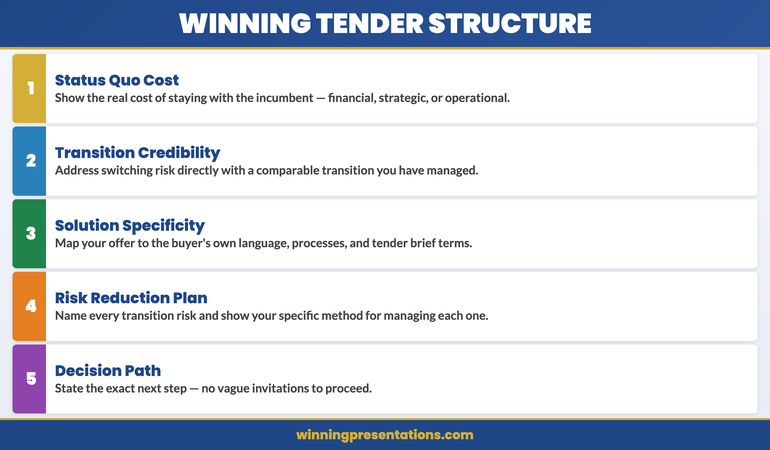
1. The status quo cost (slides 1–2). Open not with who you are, but with what staying is currently costing the buyer. This requires research — you need to identify the specific operational, financial, or strategic cost the buyer is bearing under the current arrangement. It might be underperformance against a contract metric, a capability gap the current supplier has not addressed, or an emerging strategic risk the buyer faces that the incumbent’s offering does not cover. Frame this cost in terms the panel will recognise immediately.
2. Transition credibility (slides 3–4). Before presenting your solution, address the switching risk directly. Show comparable transitions you have managed — the complexity involved, the timeline, and the method by which you reduced disruption for the previous client. If you can include a specific example from a similar procurement environment, do so. The goal is to make the buyer feel that your transition management is a known and tested capability, not an aspiration.
3. Solution specificity (slides 5–7). Now present your solution — but do so in the specific language of this buyer’s context. Generic capability slides undermine your credibility at this stage. Instead, map your solution to the specific requirements, processes, and terminology in the tender brief. Buyers notice — and respond positively — when a presenter has absorbed their language rather than presenting in their own.
4. Risk reduction plan (slide 8). This slide is often absent from challenger decks, and its absence is frequently the deciding factor. A risk reduction plan shows the panel that you have already anticipated the transition risks they are worried about and have a specific method for managing each one. Include timelines, accountability, and escalation paths. The more concrete this slide is, the more it neutralises the incumbent’s primary advantage.
5. Decision path (slide 9). End with a specific next step rather than a general invitation to proceed. Name the decision the panel needs to make, the information they would need to make it, and the timeline within which you can begin. This demonstrates operational readiness and removes the vagueness that allows panels to defer rather than decide.
Executive Slide System
Structure Your Tender Pitch to Win — Not Just Compete
When the incumbent has the relationship advantage, your presentation structure becomes the differentiator. The Executive Slide System — £39, instant access — gives you the frameworks and templates designed for competitive, high-stakes pitches where capability alone is not enough.
- Slide templates for competitive and procurement scenarios
- AI prompt cards to build challenger narratives quickly
- Framework guides for structuring risk-reduction arguments
- Scenario playbooks for high-stakes client and tender presentations
Get the Executive Slide System →
Designed for executives presenting in competitive, high-stakes procurement environments.
How to frame the risk of change without triggering inertia
The most counterproductive thing a challenger can do in a tender presentation is ignore the switching risk. Buyers know the risk is there. If you do not address it, they will carry it silently through the rest of your presentation — and that unaddressed anxiety will eventually outweigh your capability argument.
The equally counterproductive response is to minimise the switching risk: “The transition is very straightforward” or “We have done this hundreds of times.” These reassurances are generic and feel hollow because they do not engage with the specific complexity of this buyer’s context. They can actually increase anxiety by suggesting you have not fully understood what you are taking on.
The approach that works is specificity. Acknowledge the real complexity of the transition — name the specific systems, processes, or stakeholders that will be affected — and then show your specific method for managing each point of complexity. This demonstrates that you understand the buyer’s environment in detail and that your transition plan is not a template but a tailored response.
There is also a reframing technique that experienced tender presenters use to good effect: explicitly comparing the risk of switching with the risk of staying. If the buyer is considering switching, it is because the current arrangement carries some form of risk — performance, capacity, strategic fit, or cost. A slide that maps the risks on both sides of the decision helps the panel see that the question is not “shall we take on a transition risk?” but “which risk is more manageable?” This reframe moves the conversation from a comparison of you versus the incumbent to a comparison of two different risk profiles — and gives the panel a more honest basis for deciding.
See also: how to structure a partnership proposal presentation that gets to yes in one meeting — the risk-reframing principle applies equally in partnership contexts.
The competitor comparison that builds credibility
Many tender presentations either include a direct competitor comparison slide or avoid it entirely. Both approaches, handled poorly, create problems. A direct comparison slide can look defensive and invites the panel to scrutinise every claim. Avoiding comparison entirely can leave the panel drawing their own comparisons — which may be less favourable.
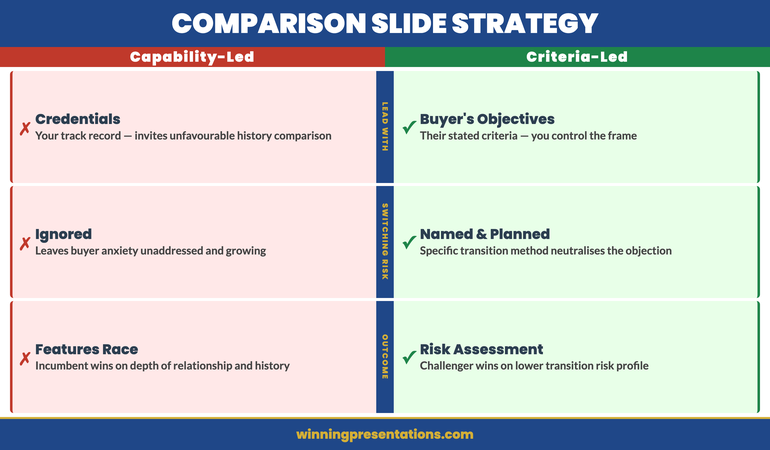
The most effective comparison approach focuses not on features but on decision criteria. Rather than building a table that compares your offering directly against the incumbent’s (which you will lose on depth of relationship and institutional knowledge regardless of your product superiority), build a table that maps both options against the buyer’s specific stated objectives from the tender brief.
This approach has three advantages. First, it anchors the comparison in criteria the buyer has already committed to publicly — making it harder to dismiss. Second, it shifts the conversation from a personality contest to a strategic assessment. Third, it gives you control over which criteria appear on the slide — allowing you to emphasise the dimensions where the challenger naturally performs strongly and where the incumbent’s age or approach is genuinely a limiting factor.
The comparison slide also works well as a device for naming the switching cost explicitly. A row labelled “Transition risk management” that shows your specific methodology against the incumbent’s “existing relationship” creates a natural opening for the risk-reduction conversation.
One important discipline: every claim you make on a comparison slide must be defensible in Q&A. If a panel member challenges a point, you need to be able to substantiate it calmly and specifically. Vague claims — “we offer superior customer service” — will be challenged and undermine your overall credibility if you cannot back them up with a specific example or metric.
If you are building this presentation from scratch and want a framework for structuring competitive pitches at executive level, the Executive Slide System includes scenario-specific templates and prompt cards designed for high-stakes procurement presentations.
“You’re too new to us” — handling the relationship objection in Q&A
Almost every competitive tender Q&A will include some version of the relationship objection. It may be explicit: “How do we know you’ll understand our business quickly enough?” Or it may be implicit, emerging as a series of questions about your experience in their specific sector, their geography, or with organisations of their scale.
The relationship objection is not really about your knowledge or capability — you have already demonstrated those through the tender process. It is about the buyer’s anxiety around the unknown. They are asking, in effect: “When something goes wrong — and something always goes wrong — will you know how to respond in a way that fits how we operate?”
The most effective response pattern has three parts. First, validate the concern without dismissing it: “You are right that we are building this relationship from scratch rather than extending an existing one — and that is worth taking seriously.” Second, reframe what ‘knowing your business’ actually requires at the operational level: most organisations’ internal processes are not as unique as they feel from inside, and your experience with comparable organisations is directly transferable. Third, offer a specific mechanism for accelerating the relationship: a structured discovery process, named relationship managers, and a defined escalation path during the first six months.
The worst response to the relationship objection is a defensive one: “We have significant experience in your sector and have worked with organisations like yours across twelve countries.” This reads as a credential recitation — which the panel has already seen — rather than an engagement with their specific concern. It confirms the anxiety rather than addressing it.
For a related account management scenario, see how to structure an account review presentation to retain a client.
The closing sequence in competitive tender presentations
The close of a competitive tender presentation is where most challengers revert to convention — a summary slide, a “thank you for your time” acknowledgement, and a general invitation to proceed. This is a missed opportunity.
The closing sequence of a tender presentation should do three things. First, it should consolidate the decision logic — not rehearse your entire capability argument, but name the single most important reason why selecting you is the lower-risk decision. One sentence, delivered with authority. Second, it should anticipate the next step specifically: not “we look forward to your decision” but “the next step would be a thirty-minute technical review with your operations team, which we can schedule for any time this week.” Third, it should leave the panel with something tangible — a one-page summary of your risk-reduction plan, your transition timeline, or your named relationship team.
The tangible handout serves two purposes: it gives the panel something to refer to during their deliberations, and it demonstrates the operational confidence that distinguishes a serious challenger from a speculative one. Incumbents rarely bring handouts to tender presentations — they do not need to. You do. Use them.
For a deeper treatment of closing sequences in high-stakes presentations, see the companion article: presentation closing framework: the techniques that drive executive decisions.
Executive Slide System — £39
The Framework Behind Every Competitive Pitch
The Executive Slide System — £39, instant access — gives you the templates, AI prompt cards, and scenario playbooks to structure competitive tender presentations that address switching risk, demonstrate transition credibility, and close with a specific decision path.
Get the Executive Slide System →
Designed for executives presenting in competitive procurement environments.
Frequently Asked Questions
How long should a competitive tender presentation be?
Most procurement panels allocate thirty to sixty minutes for a tender presentation, including Q&A. Structure your presentation to use no more than two-thirds of the allotted time for the formal presentation, leaving the remainder for questions. If you are given sixty minutes, aim for a forty-minute deck. A presentation that runs over time signals poor planning — a significant disadvantage in a competitive context. The goal is a tight, decision-focused narrative, not a comprehensive capability audit.
Should I name the incumbent in my tender presentation?
Name the incumbent only if doing so is strategically useful and you can substantiate every claim you make. In most cases, it is more effective to reference the incumbent obliquely through the “status quo cost” framing — describing the type of limitation the buyer is experiencing — rather than directly naming them. Direct naming can come across as aggressive and may put the panel in a defensive posture if they have an existing positive relationship with the provider. The exception is a direct comparison slide anchored to the buyer’s own tender criteria, where naming the incumbent is expected and framing is neutral and factual.
What if the buyer tells us we lost on price?
If price is cited as the reason for losing, it is worth exploring whether price was the actual reason or a proxy for a different concern. Procurement panels sometimes cite price because it is a defensible, objective explanation — whereas the real hesitation may have been around relationship, transition confidence, or internal politics. Ask for a thirty-minute debrief and listen carefully for what sits behind the price objection. Occasionally the real opportunity is to address the underlying concern rather than adjust your pricing.
The Winning Edge
Weekly executive communication insight — in your inbox every Thursday
Join executives across financial services, healthcare, and technology who receive practical, no-filler analysis of what works in high-stakes presentations and what doesn’t.
Free resource: Download the Executive Presentation Checklist — a pre-presentation audit used by Mary Beth’s clients before every high-stakes pitch.
About the Author
Mary Beth Hazeldine — Owner & Managing Director, Winning Presentations
With 25 years of corporate banking experience at JPMorgan Chase, PwC, Royal Bank of Scotland, and Commerzbank, Mary Beth advises executives across financial services, healthcare, technology, and government on structuring presentations for high-stakes funding rounds, procurement decisions, and board approvals. Her work focuses on the communication architecture that moves decisions — not just the slides.