

Win-Back Presentation for Lost Clients: The 4-Slide Structure That Reopens Conversations
Quick answer: A win-back presentation for lost clients holds up in 2026 when it is built around four slides, in this order: a named acknowledgement of the specific reason the client left, owned without defensiveness; the specific structural change inside your business that addresses that reason; a tailored proposition that names the gap this client felt and how it is now covered; and a low-friction next step that asks for a thirty-minute conversation rather than a contract. Decks that lead with apology lose the meeting in the first ninety seconds; decks that lead with named evidence of change earn the second call. The four-slide structure is short on purpose — the client is reading it through the lens of “is this worth my time?”, and a forty-page deck answers that question with “no” before the first slide loads.
JUMP TO:
In 2019, a head of business development at a London-headquartered B2B SaaS firm sat down to write a win-back deck for a mid-cap retail bank that had cancelled its contract eighteen months earlier. The cancellation note from the bank’s chief operating officer had been three lines long: the integration had been slower than promised, the dedicated account manager had changed three times in the first year, and the bank’s procurement team had moved to a competitor on a shorter, cheaper rolling agreement. The head of business development had spent the eighteen months since the loss watching the bank publish quarterly reports that suggested the competitor had not delivered what it had promised either — the bank’s operating metrics in the divisions the competitor served had slipped in two consecutive quarters. She had a window. The window was a single LinkedIn message thread, restarted three weeks earlier when the bank’s new chief operating officer had connected and politely asked what had changed at the SaaS firm since the contract ended. The head of business development drafted a thirty-two-page win-back deck over the weekend, sent the LinkedIn message asking for a thirty-minute call, and rebuilt the deck twice on Monday morning before the call was booked. The meeting was on a Thursday. By the Tuesday before, she had reduced the deck to four slides. The Thursday meeting ran twenty-eight minutes; the second call was booked in the room. The contract was not won back in that meeting — the second call was where the real conversation started — but the conversation reopened. The thirty-two-page version, she said afterwards, would have closed it.
(This article was created with AI assistance; all stories and insights are based on 35 years of real client work.)
This piece walks through the four-slide structure that has been working for senior sales leaders, account directors, and business development partners running win-back campaigns in 2026 — what each of the four slides has to carry, why the long deck reads as anxiety rather than evidence, how to acknowledge the specific reason the client left without lapsing into apology, what the structural-change slide has to prove, how to design the next step so the client says yes without committing to a full procurement cycle, and the recurring failure mode that destroys win-back decks before the second slide loads.
Before the next win-back meeting, a one-page structural check is worth a look.
The Executive Presentation Checklist walks through the structure that holds up in front of a sceptical former client — the acknowledgement slide, the evidence-of-change slide, the tailored proposition page, and the low-friction next-step ask. Free download, no email gate.
Why four slides and what the long deck gets wrong
The four-slide count is not a length constraint — it is a structural answer to the specific cognitive state of the person reading a win-back deck. The former client is not in the seat a new prospect occupies. The new prospect arrives curious, neutral, and willing to be persuaded; the former client arrives sceptical, time-pressured, and quietly defensive about the original decision to leave. Their first question, before any slide loads, is not “what can you do for me?” — it is “is this going to waste my time?” A thirty-two-page win-back deck answers that question in the negative before the cover slide finishes rendering. A four-slide deck answers it in the affirmative. The decision the client is making in the first ninety seconds is whether to keep reading; everything else — the proposition, the commercial terms, the implementation plan — only matters if the deck survives that first ninety seconds.
The long win-back deck reads as anxiety. Senior sales leaders who write long win-back decks are usually trying to compensate for the original loss with volume: more context, more reassurance, more evidence, more case studies, more team biographies, more architecture diagrams. The compensatory volume is what tells the former client the original problem has not been resolved. A confident win-back deck is short for the same reason a confident apology is short — both name the issue, own the change, and ask for the specific thing they want. The four-slide structure is the cognitive shape of that confidence; the long deck is the cognitive shape of its absence.
What has changed since 2024, and changed sharply in 2026, is how former clients now read win-back decks before the meeting. The LinkedIn message thread that opens a win-back conversation is rarely the only artefact in play. The former client’s new procurement lead has typically pulled the historical service records, the original cancellation note, and the competitor’s most recent quarterly update before they accept the calendar invite. They arrive in the meeting with three or four specific questions already framed. The win-back deck that ignores those questions, or buries them behind eighteen pages of context, reads as junior. The deck that surfaces the questions in the first slide reads as senior, regardless of how long the relationship has been dormant. For a closer look at the structural moves that hold attention in front of a senior audience that has done its homework, see how to present to a board of directors.
Slide 1: the named acknowledgement
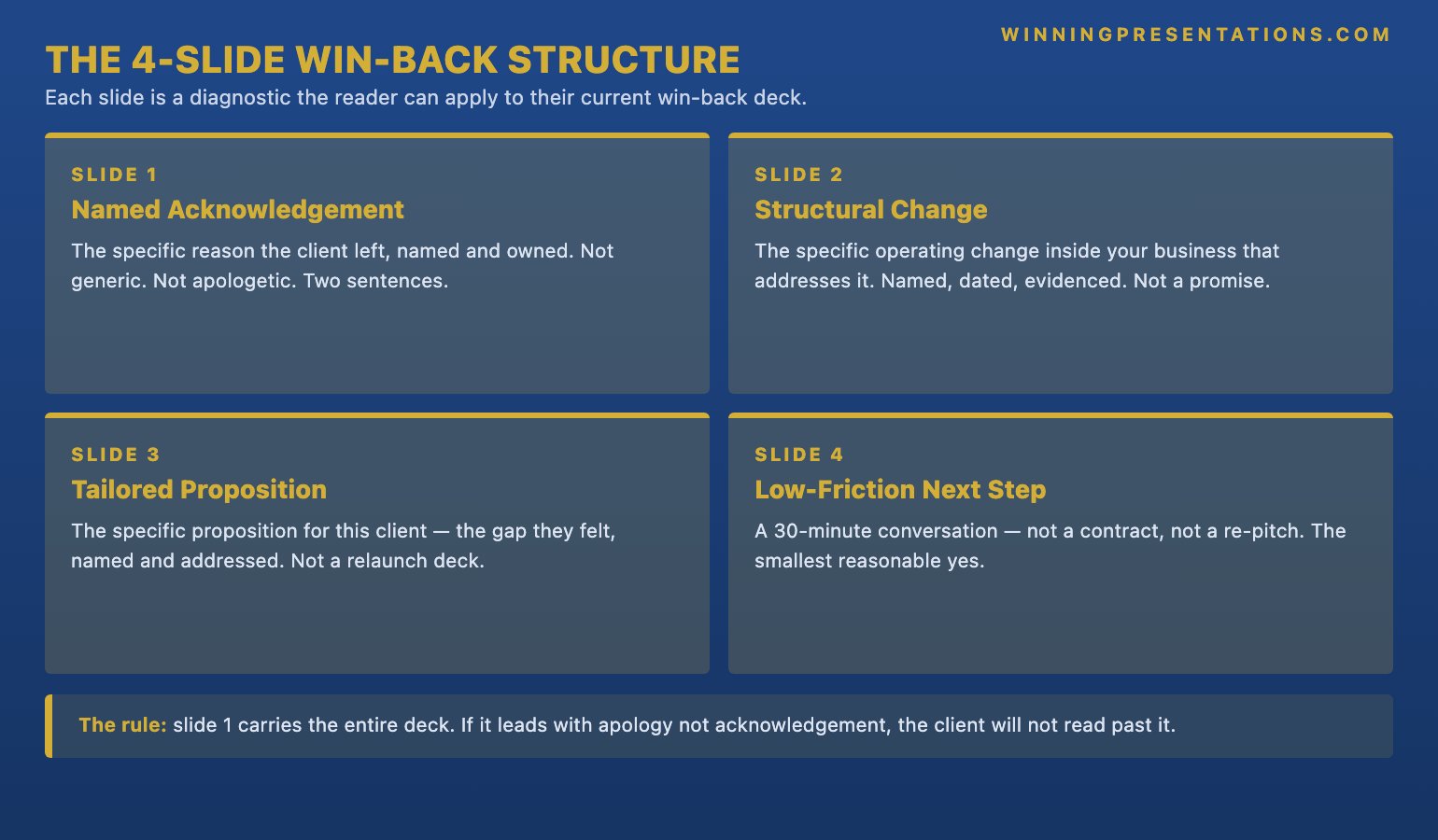
The first slide names the specific reason the client left, owned in two sentences without defensiveness, hedging, or apology language. Not “we know things did not always go as smoothly as we would have liked.” Specifically: “You left in March 2024 because the integration ran four months late, the account-manager seat changed three times in the first year, and the rolling-contract option you needed was not available to you at the price your procurement team had budgeted.” The reason is named in the client’s words where possible — the cancellation note, the exit-interview transcript, the procurement lead’s email — not in the win-back author’s words. The acknowledgement is owned in the second sentence: “That was a structural failure on our side, not a misunderstanding. The three reasons were real and the contract loss followed from them.” No qualifiers, no extenuating circumstances, no “in fairness.” The slide does not apologise — apology asks the client to forgive, which is the wrong request to make in this conversation. The slide acknowledges — acknowledgement establishes the facts and clears the ground for the next slide.
The discipline on slide one is precision. A generic acknowledgement — “we know we did not meet your expectations last time” — reads as worse than no acknowledgement at all, because it signals the win-back author has not done the homework of identifying what specifically went wrong. The former client knows what went wrong — they wrote the cancellation note, they ran the post-mortem, they briefed the new supplier — and they will read the generic acknowledgement as a sign that the supplier still does not understand the loss. The named acknowledgement is the diagnostic test for whether the win-back conversation is worth the former client’s time. If slide one names the specific reasons, the deck stands a chance. If it does not, the rest of the deck dissolves on contact.
The diagnostic for slide one: read the slide aloud, and ask whether anyone other than this specific former client could read it and recognise their own loss in it. If the answer is yes, the slide is too generic. The acknowledgement should be unusable as a template for any other win-back deck the sales team writes — the specificity is the point.
Slide 2: the structural change
The second slide names the specific structural change inside the win-back author’s business that addresses each of the named reasons on slide one. Structural is the operating word. A statement of intent is not a structural change — “we have invested in training” or “we have improved our processes” reads as marketing language and produces an immediate eye-roll from a sceptical former client. A structural change is named, dated, and provable. “We moved the integration function out of professional services into a separate delivery group reporting to the chief operating officer in September 2025. The integration team is now sixty people, up from twenty-two when you left. The average integration time for the customer segment you sat in has dropped from seven months to three.” Each sentence carries a verifiable claim: a specific organisational change, a specific date, a specific number, and a specific outcome the former client can test.
Slide two is the slide that earns the meeting. Slide one establishes that the win-back author understands the loss; slide two establishes that the loss has been addressed at the level of the operating model, not merely papered over with a contrition pitch. The former client is testing for a specific thing: has anything actually changed since the contract ended, or is this the same supplier with a new sales hire trying to reopen the conversation? Named structural changes, with the dates and numbers attached, answer the question affirmatively. Generic improvement claims answer it in the negative. The former client will not say “your generic claim convinced me to come back”; they will not say it because no former client has ever said it.
The discipline on slide two is restraint. The win-back author has typically run the loss through a post-mortem and identified five or six structural changes the business has made since the original contract ended. The instinct is to list all of them on slide two as proof of effort. The instinct is wrong — the slide that lists six structural changes reads as defensive (over-explaining), and the slide that lists two reads as confident (concentrated). The discipline is to pick the two changes that map directly onto the two most damaging reasons on slide one, name them with the dates and numbers, and leave the other four changes for the appendix or for the second call. The former client will ask about the other four if they want to; if they do not ask, the other four would not have helped.
A win-back deck holds up when the underlying slides are built right — not because the deck is shorter.
The Executive Slide System is the slide library senior sales leaders are using to build the named acknowledgement slide, the structural-change page, the tailored proposition layout, and the low-friction next-step ask this four-slide format depends on — without rebuilding them from scratch every time a former client opens the door. 26 templates, 93 AI prompts, 16 scenario playbooks. Lifetime access, instant download. £39.
- 26 executive slide templates — named acknowledgement slides, structural-change layouts, tailored proposition pages, low-friction next-step asks, evidence-of-change formats, and other win-back-relevant structures
- 93 AI prompts — for drafting and sharpening each slide in thirty minutes rather than rewriting the deck three times before the meeting
- 16 scenario playbooks — win-back presentation, board approval, capital request, fundraising pitch, transformation update, and other senior-stakes meetings
- Instant download — usable in the next win-back meeting
- Lifetime access, lifetime updates — £39
Slide 3: the tailored proposition
The third slide names the specific proposition for this client — not the generic offering. The structural change on slide two was the supplier-side answer; slide three is the client-side answer. It names the specific gap the client has felt in the eighteen or twenty-four months since the contract ended, and the specific way the new proposition addresses that gap. The gap is not assumed — it is sourced from the LinkedIn conversation, the quarterly reports the former client has published, the public commentary from their new supplier’s most recent customer events, and (where possible) the new procurement lead’s first conversation with the win-back author. “Since you moved, your integration cycle has stretched from the four months you were targeting to closer to nine months on the two divisions where the competitor is delivering. We can now hold a three-month integration on your segment with the operating-model change on slide two. The rolling-contract option your procurement team needed is also now available at the price they budgeted in 2024.” Specific, named, testable.
The tailored proposition slide is the slide where most win-back decks slip back into the new-prospect register. The win-back author, having got through the acknowledgement and the structural change, defaults to the generic case study or the generic value proposition. The slide reads as a pivot away from the conversation that slides one and two opened, and the former client’s attention slips. The discipline is to keep slide three as specific to this client as slides one and two were. The proposition is for this client, named, with the gap they felt and the answer to that gap. If the proposition could be sent unchanged to any other former client, it is the wrong slide.
The diagnostic for slide three: the proposition must be one the new supplier (the competitor that won the contract eighteen months ago) genuinely could not make on the same call. If the new supplier could make the same offer at the same price with the same operating model, the win-back author is selling on parity — and parity is not what wins a former client back. The proposition has to name the specific thing the new supplier cannot or has chosen not to do, and offer the thing the original supplier can now provably do.
When the win-back conversation is the moment a board, an investment committee, or a senior stakeholder group has to sign off on returning to a supplier they previously left, the deck only does half the work.
The Executive Buy-In Presentation System is the self-paced programme senior sales leaders use to walk a former client’s procurement team, executive sponsor, and reluctant operating committee through the structured case for re-engagement — the stakeholder mapping, the pre-handling of the partner-meeting objection, and the post-meeting tempo that gets the second call booked without forcing a contract decision in the first one. 7 modules, self-paced with monthly cohort enrolment, optional recorded Q&A calls. £499, lifetime access to materials.
Slide 4: the low-friction next step
The fourth slide names the next step, and the discipline is to ask for the smallest specific commitment the former client can make without involving their procurement team, their operating committee, or their finance director. A thirty-minute conversation, scheduled in the meeting itself, with two named people on the win-back author’s side (the new account director and the operating-model lead who can answer technical questions about slide two). Not a contract, not a pilot, not a request for a tender, not a “let us know when you are ready.” A specific calendar conversation, with specific people, on a specific topic — “let us walk through the integration plan on your retail-banking segment with your incoming operations head in the next three weeks.” The former client says yes to the small ask because saying no has no cost; the small ask becomes the second meeting; the second meeting becomes the conversation that decides whether the contract reopens.
The instinct on slide four is to ask for the contract. The instinct is the second most damaging mistake in win-back decks (the first is leading with apology). Asking for the contract on the first call signals that the win-back author has not understood the cognitive state of the former client — the former client cannot commit to the contract in the first meeting, because the contract is the decision they made eighteen months ago in the opposite direction. Reversing that decision is the work of three or four conversations, not one. The first conversation has to end with the second conversation booked, and the deck has to make that the easy outcome. A four-slide deck that ends on “let us talk for thirty minutes about the integration plan with your incoming operations head on the 14th” reads as confident and proportionate; a four-slide deck that ends on “let us reopen the contract for the next financial year” reads as opportunistic and the meeting closes politely with nothing booked.
The diagnostic for slide four: the next step must be something the former client can agree to in the meeting itself, without leaving the room to check with anyone else. If the next step requires the former client’s procurement lead, finance director, or operating-committee chair to sign off, the slide has been written at the wrong altitude for the first meeting. The right altitude is a conversation, not a commitment. The commitment comes later, after slides two and three have been tested across two or three calls. For the slide-structure work that holds up across those subsequent calls, the executive slide templates hub catalogues the structures other senior presenters are using.
What the failed win-back deck looks like
In 2022, an account director at a publicly-listed industrials manufacturer ran the win-back conversation for a long-dormant client — a regional logistics company that had ended the contract two years earlier after a botched fleet-integration project. The account director had been at the manufacturer for six months and inherited the win-back file. The dormant client had agreed, after a careful LinkedIn approach by the manufacturer’s new chief commercial officer, to a single thirty-minute call. The account director built a forty-eight-page deck. The deck opened with twelve pages of company context (corporate history, market positioning, awards, customer logos), moved into a sixteen-page case-study block on three other logistics clients the manufacturer had served since the dormant contract ended, then closed with twelve pages of generic value proposition and an eight-page commercial-terms appendix. Slide one of the deck did not mention the dormant client by name. The named reasons for the original loss were absent. The structural change inside the manufacturer was implied across the twelve context pages but never stated as a specific operating-model change with a date.
The meeting ran twenty-two minutes. The dormant client’s operations director listened politely for the first ten minutes, asked a single specific question at the eleven-minute mark (“what changed about your fleet-integration approach after we ended the contract?”), received a generic answer about continuous improvement, and closed the meeting at minute twenty-two with “we appreciate the update; we’ll be in touch if anything changes on our side.” Nothing changed on their side. The win-back never reopened. The account director’s diagnosis afterwards was that the deck had been too short — he wished he had added more context. The diagnosis was wrong. The deck had been too long, and it had led with the wrong thing. A four-slide deck that named the fleet-integration failure on slide one, named the structural change the manufacturer had made to its integration function on slide two, named the specific gap the dormant client had felt with their replacement supplier on slide three, and asked for a thirty-minute follow-up on the integration plan on slide four would have produced a different meeting. The cognitive state of the dormant client was not “tell me more about you”; it was “show me you understand what happened.”
The takeaway, time-bounded and concrete: before sending your next win-back deck, read slide one aloud. If it names the specific reason the client left and owns it in two sentences without hedging, the rest of the deck stands a chance. If slide one is a generic acknowledgement — “we know things did not go as planned” — the client will not reply, and no amount of context on the slides that follow will change the outcome. The deck that wins the second call is the deck that survives the first ninety seconds; slide one is the first ninety seconds.
Frequently asked questions
Is four slides really enough when the original contract loss involved multiple commercial, technical, and relationship failures?
It is, when the four slides are built to carry the weight of the conversation rather than to demonstrate the win-back author’s effort. Multiple failures compress onto slide one as a named list of two or three specific reasons — the client knows the list better than the win-back author does, and naming the top two or three is the test. Multiple structural changes compress onto slide two as two named changes mapped to the top two reasons on slide one. The other failures and the other structural changes live in the appendix, ready to be walked when the former client asks about them. The discipline is to trust that the conversation will surface the second-order items if they matter, and to keep the deck itself at the cognitive shape the former client can hold in the first thirty minutes. A six-slide or eight-slide deck does not make the conversation safer; it makes the first ninety seconds harder.
What if the named reason the client left was a single individual who has since left our business — do we lead with that?
Yes, and the discipline is to name the individual’s exit as a structural change rather than a piece of gossip. Slide one names the original failure as the former client experienced it (account-manager seat changed three times in the first year, or sales engineer never returned calls, or operating-committee contact stopped showing up). Slide two names the structural change — the individual has left, the seat has been redesigned, the cover has been restructured — with the date. Naming the individual is fine if it is fact, but the slide does not lapse into blame or character commentary. The structural framing reads as senior; the individual-blaming framing reads as junior, even when the individual concerned was genuinely the source of the problem.
Does the four-slide structure work when the former client has already publicly named us as the reason for the original loss?
It works particularly well in that case, because slide one is no longer a discovery exercise — the named reasons are in the public record. The work shifts forward: slide two has to be more specific (the public record has set the bar for what the structural change has to prove), slide three has to be more tailored (the public record has primed the former client to expect specifics), and slide four has to be smaller (the next step has to be commensurate with how publicly the loss was discussed). A small private conversation about one specific segment of the original work is what slide four asks for; a contract conversation in the first meeting is not. That sequencing holds regardless of how strong slides one through three are. The publicly-discussed loss is a higher trust hurdle, not a faster one.
How is this different from a standard B2B sales presentation to a new prospect?
The four-slide structure runs in reverse. A new-prospect presentation typically opens with discovery (what the prospect cares about), moves through positioning (how the supplier fits), and closes with the proposition. The win-back deck opens with acknowledgement of the original loss, moves through structural-change evidence, and closes with a small specific ask. The cognitive state is different: the new prospect is curious and assumes good faith; the former client is sceptical and assumes the original problem persists. The structural shape of the deck has to mirror that cognitive state. Applying the new-prospect deck shape to a win-back conversation is the single most common mistake in win-back campaigns, and it reads to the former client as if the win-back author has not understood the meeting they are walking into.
What happens when the former client opens slide one and disagrees with our characterisation of why they left?
That is the productive outcome, not the failure mode. A former client who pushes back on slide one is engaging with the deck rather than dismissing it; the conversation has reopened. The win-back author’s job in that moment is to listen to the corrected version and adjust slide one in the next deck (or in the second meeting). The unproductive outcome is the former client who reads slide one, recognises a generic acknowledgement that could apply to any of their suppliers, and politely closes the meeting at minute fifteen with no second call booked. Specific named reasons produce engagement; generic acknowledgements produce a polite end. If the former client disagrees, the deck has earned the conversation. If they agree, the deck has earned the second meeting. Either way, slide one has done the work it was built to do.
The Winning Edge — weekly newsletter
The Winning Edge is a weekly (Thursday) newsletter for senior professionals who present at the executive level. One short email a week, focused on the structural moves that separate decks that reopen conversations from decks that close them. Subscribe to The Winning Edge →
For the broader picture across slides, storytelling, confidence, and delivery, the Complete Presenter bundle is the seven-product set most senior sales leaders find useful as a single library — £99 for everything, lifetime access.
About the author
Mary Beth Hazeldine is Owner & Managing Director of Winning Presentations Ltd. With 24 years of corporate banking experience at JPMorgan Chase, PwC, Royal Bank of Scotland, and Commerzbank, she advises executives across financial services, healthcare, technology, and government on structuring presentations for high-stakes funding rounds, board approvals, and client recovery conversations.