

Quick answer: When an executive drops “you look tired” mid-presentation, the comment is rarely about your appearance. It is a soft test of how you handle being knocked off-script. The response that protects authority has four parts — acknowledge briefly, decline to engage with the substance, redirect to the request on the table, and resume at the same pace and pitch you were using before the comment. Defending, apologising, explaining your sleep, or laughing it off all read as destabilised. A neutral one-line acknowledgement and a clean return to the recommendation reads as composed. The comment is over in fifteen seconds.
JUMP TO:
Tomás had been preparing the operations review for two weeks. He had not slept particularly well — his daughter had a cold, his calendar had been compressed, and the dry run with his manager had run late the night before. He walked into the executive committee meeting at 9:00 AM looking, by his own account, “fine, just tired”. Eleven minutes into the presentation, on slide six, the most senior executive in the room — a divisional president with a reputation for direct comment — stopped him with: “You look tired, Tomás. Are you all right?” The room turned to him.
Tomás did the thing most presenters do. He explained. His daughter had been ill, the prep had run late, he had not slept well, but he was fine, really, the data was solid, and could he continue? The explanation took about forty seconds. By the end of it the divisional president had lost interest in the answer, the rest of the room had absorbed the framing of “this presenter is depleted”, and the next slide felt diminished before he had spoken to it. The recommendation was eventually approved, but the post-meeting feedback was that he had not seemed “fully on top of it”. He had been on top of it. The comment, and the way he had handled the comment, had cost him.
Three months later, in a different but similar meeting, the same executive made a similar comment to a different presenter. That presenter — Astrid, who had been on the receiving end of executive coaching after her own earlier missteps — said, with neutral warmth: “Thank you, all good. Coming back to the proposal, the recommendation rests on three structural moves.” She paused for two seconds. The executive nodded. She continued. The whole exchange took eleven seconds. The room read her as composed. The proposal landed cleanly. The difference between Tomás and Astrid was not whether they were tired. They probably both were. The difference was the response.
If you want a structured system for the off-script comments and challenges senior executives drop into Q&A:
The Executive Q&A Handling System covers tough questions, calm authority, and decision-safe answers — designed for the moments when a presentation is challenged off-script.
Why senior executives drop personal observations mid-presentation
The personal observation mid-presentation is one of the more confusing interruptions a senior presenter encounters. It does not seem to be about the data. It does not seem to be about the recommendation. It seems to be about the presenter as a person. The reflex is to take it personally, to assume the executive is being kind, or rude, or testing — depending on the relationship — and to respond to whatever motive the presenter ascribes to it. That response is usually wrong because the motive ascribed is usually wrong.
The most common reason senior executives drop personal observations is reflex. They have noticed something. They are senior enough that they say it. The comment is not strategic. It is observational. The executive is not testing the presenter; they are commenting in the way they would comment on the weather. The presenter who responds with a forty-second explanation has read meaning into the comment that was never there. The same comment, met with a neutral fifteen-second acknowledgement and redirect, reads as having been a non-event — which it was.
The second reason is genuine but mild concern. The presenter does look tired, or pale, or strained, and the executive — particularly an older one with a habit of plain talk — registers the concern out loud. The right response is the same as for the reflex case. Acknowledge briefly, decline to engage with the substance, redirect to the request. Even when the concern is genuine, the meeting is not the place to litigate the presenter’s sleep. The presenter signalling that they want to keep the meeting on its agenda is what the executive actually needs to see — it answers the underlying question of whether the presenter is functional.
The third reason — less common but worth naming — is power testing. Some executives use personal observations as a soft destabilisation move, to see how the presenter handles being knocked sideways. The right response is identical to the first two cases. Acknowledge, decline, redirect. The power-testing executive is looking for a reaction. The neutral redirect denies them the reaction without making the denial visible. Three different motives, one response. The presenter does not need to diagnose which motive is at play. They need to deliver the same composed sequence regardless. For the closely related discipline of handling correction-attempt questions, see the “actually…” question and how to handle correction attempts without losing authority.
The anatomy of a clean response
The clean response to a mid-presentation personal observation has four parts in sequence. First, brief acknowledgement — typically two to four words, warm but not effusive. “Thank you, all good.” “Appreciate that, fine.” “Long week, but we’re well.” The acknowledgement is short because the comment is short. Matching length signals that the presenter has heard the comment, has not made it more than it was, and is ready to move on. A long acknowledgement reads as a defence; a short one reads as a deflection that is also a settlement.
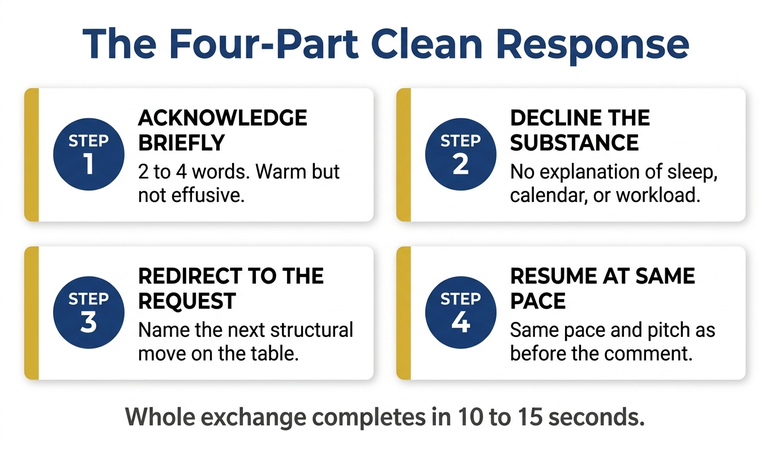
Second, decline to engage with the substance. The presenter does not explain why they look tired. They do not narrate sleep, calendar, family, travel, or workload. The detail is not what the room needs. Detail invites further detail; the conversation can spiral into a chat about the presenter’s life that has nothing to do with the presentation. Declining the substance is not rude. It is professional. The room does not feel snubbed; it feels respected for the agenda time.
Third, redirect to the request on the table. “Coming back to the proposal.” “On the recommendation.” “Picking up at the third structural move.” The redirect is the part that pulls the room back to the work. It can be a single phrase. It can be the next structural element of the deck. The phrase should be active — naming what comes next, not asking permission to continue. Asking permission (“Would you like me to continue?”) puts the executive in the position of granting it, which extends the interruption rather than closing it.
Fourth, resume at the same pace and pitch the presenter was using before the comment. This is the part most presenters get wrong even when they nail the first three. The acknowledgement is fine, the decline is fine, the redirect is fine, but the next sentence comes out at a faster pace and slightly higher pitch. The room reads the vocal change as: “the presenter is rattled”. The clean response holds vocal steadiness through the redirect. The whole exchange takes ten to fifteen seconds. The room moves on. For more on the vocal mechanics that hold under questioning, see authority challenged mid-presentation and the neutral voice technique.
Stop being knocked off-script by hostile or unexpected interruptions.
The Executive Q&A Handling System covers the structural responses senior leaders use to handle tough questions, hostile challenges, and off-script comments — composed authority and decision-safe answers. £39, instant access, no subscription.
- Response frameworks for the tough questions, hostile challenges, and off-script interruptions senior committees produce
- Designed for the moments when the presentation is being knocked off track by a comment or question
- Covers calm authority, redirect technique, and decision-safe answer structure
- Instant access on purchase, no subscription, no recurring billing
What not to do — five reactions that destabilise
There are five common responses to “you look tired” — and variants of it — that destabilise the presenter. Each of them has a specific failure mode worth naming. The first is over-explanation. The presenter narrates the sleep deficit, the calendar pressure, the personal context. Forty seconds disappear. The room has now absorbed a story about the presenter’s life that overshadows the substance of the presentation. Even if the explanation is true and reasonable, it is the wrong move because it expands a comment that should have been closed in fifteen seconds.
The second is apology. “Sorry, I had a long week.” The apology accepts a frame that did not need to be accepted — that there is something to apologise for. Senior committees register apologies more sharply than presenters realise. A presenter who apologises for being tired is signalling, structurally, that they should not be in the room. The chair will not articulate this thought consciously, but it is what the apology produces in the room.
The third is the deflective joke. “Yes, the kids are giving us hell at the moment.” The joke can land if the presenter has the relationship with the executive to carry it. More often it lands flat — the room does not laugh, the presenter feels the gap, and the next sentence comes out half a beat off pace. The joke also redirects the conversation in a personal direction the presenter then has to find a way back from. Better to skip the joke and use the four-part response.
The fourth is the false denial. “I’m great, thanks!” delivered in a voice that is clearly not great. The mismatch between the words and the vocal cues makes the destabilisation more visible than it would have been with a neutral acknowledgement. Senior audiences read the mismatch. A short truthful acknowledgement — “long week, but we’re well” — is better than a cheery denial because it lines up the words with the cues the room is already perceiving.
The fifth is freezing. The presenter says nothing for several seconds, looks slightly stricken, and then resumes the slide one beat too quickly. The freeze is the worst of the five because it draws the longest attention to the comment. Senior committees read freezes as loss of composure. The whole point of practising the four-part response is to have a default that prevents the freeze when the comment lands. Presenters who have rehearsed even once or twice rarely freeze in the moment. The rehearsal is what makes the response automatic.
Variants of the personal observation — and how each lands
“You look tired” is one variant of a broader category — the personal observation dropped mid-presentation. Other variants come up too. “You sound congested.” “You seem distracted today.” “Are you all right? You look pale.” “You haven’t been getting much sleep, have you?” “You look like you needed that coffee.” “Big week, isn’t it?” Each of these is structurally the same as “you look tired” — a personal observation made by an executive in the middle of a presentation. The four-part response handles all of them with minor variation in phrasing.
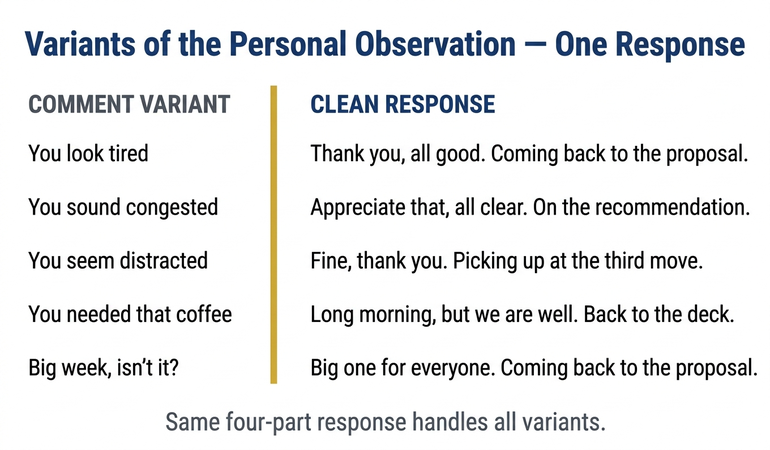
The variants that require slightly different handling are those that touch on health rather than tiredness. “Are you all right?” is closer to a genuine welfare check than “you look tired” is. The acknowledgement can be a beat warmer — “Thank you, fine. Coming back to the proposal.” — but the structure is the same. The presenter is not narrating their health; they are settling the welfare check briefly and returning to the agenda. If the welfare concern is genuinely warranted — the presenter is in real distress — that is a different conversation, and the right move is to step out of the meeting rather than try to push through. But for the everyday “you look a bit pale today” the four-part response holds.
One additional variant deserves a separate mention. “Have you been on holiday?” The question is the inverse of “you look tired” — it implies the presenter looks fresh and rested. Some executives use it warmly; others use it as a soft test of whether the presenter has been working hard enough on the case. The same response structure handles it. “Thank you, came back last week. Coming back to the proposal.” The presenter does not over-explain the holiday and does not protest that they have been working hard. The redirect is the move that holds the room. For the related discipline of fielding more direct challenge questions, see executive Q&A objections and how to handle “we have tried that” pushback.
What to do after the comment is past
The fifteen seconds of the comment are followed by a longer-tail challenge — staying mentally in the presentation rather than ruminating on the comment for the next ten minutes. Most presenters who handle the four-part response well still then spend the rest of the presentation half-attending to the slides and half-replaying the comment internally. This is where second-half delivery quality slips. The slides come out a little flatter, the pacing a little less intentional, the answers to the next questions a little less crisp. The comment did its damage in the second half rather than in the first fifteen seconds.
The discipline that prevents the second-half slip is to mentally close the comment. Decide, internally, that the comment is over. The exchange happened, it was handled, the room has moved on. The presenter should move on too. Practically, this means returning attention to the next slide, reading what is on it, and speaking the next sentence with the same level of intention that was driving the first half. It is a cognitive discipline rather than a vocal one. Senior presenters who have been through this kind of moment several times find the closure happens automatically. Newer presenters benefit from rehearsing the closure move alongside the four-part response.
Post-meeting, the closure is also useful. There is a temptation to debrief the comment with colleagues afterwards — “did I handle that right? did I look as tired as he said?”. The debrief tends to magnify the moment rather than process it. A short reflection — what was said, what was the response, what would I do differently — captured in two minutes after the meeting is more useful than a thirty-minute conversation with a colleague who was not in the room. The four-part response becomes durable through repetition, and the post-meeting reflection is what makes the next instance easier.
Frequently asked questions
What if I genuinely am exhausted and the comment is a fair read?
The fact that the comment is accurate does not change the response. The room is not the place to litigate accuracy. The four-part response — acknowledge briefly, decline the substance, redirect to the request, resume at steady pace — works regardless of whether the underlying observation is right. If you are exhausted enough that the presentation itself is being affected, the right move is upstream of the comment — restructure the meeting, hand off the presentation, or ask for it to be rescheduled. Trying to deliver a presentation while audibly exhausted creates a different problem; the comment is a symptom rather than a cause. In the moment, though, the response is the same: acknowledge, redirect, continue.
Does the response differ if the comment comes from a peer rather than a senior?
Slightly. From a peer or a junior, a slightly warmer acknowledgement is appropriate because the power dynamic is different. “Yeah, big week. Thanks for asking — back to the proposal.” The redirect is still the move that holds the room. From a senior — particularly a chair, CEO, or board member — the acknowledgement should be neutral and brief. The instinct can be to be more deferential to a senior; this is the wrong instinct. Deference reads as destabilisation. Neutral composure reads as composed. Same four parts, slightly different tonal calibration.
Should I deliberately try to look more rested before high-stakes meetings?
Some adjustments are sensible — not pulling an all-night dry run, getting a reasonable amount of sleep, not arriving straight from a red-eye flight. But the deeper answer is that the response to the comment matters more than the appearance. A presenter who looks slightly tired but handles the comment cleanly reads as composed. A presenter who looks fully rested but gets thrown by a stray observation reads as fragile. Energy management before a high-stakes meeting matters; obsessing over appearance does not. Spend more preparation time on the deck and on the four-part response than on whether you look tired.
How do I rehearse the response when I cannot predict whether the comment will come?
You rehearse the response as a default rather than as a contingency. Five times through the four-part sequence, out loud, with a colleague playing the role of the executive — variations of the comment, different tones, different timings. Twenty minutes of rehearsal builds enough automaticity that when a comment lands in a real meeting, the response is ready. The rehearsal does not need to be performed every week. Once or twice in the run-up to a high-stakes meeting, plus a brief mental rehearsal in the minutes before walking in, is enough. The rehearsal is what prevents the freeze.
The Winning Edge — weekly newsletter
The Winning Edge is a weekly newsletter for senior professionals who present at the executive level. One short email a week, focused on the response patterns and structural moves senior committees treat as composed. Subscribe to The Winning Edge →
About the author
Mary Beth Hazeldine is Owner & Managing Director of Winning Presentations Ltd. With 24 years of corporate banking experience at JPMorgan Chase, PwC, Royal Bank of Scotland, and Commerzbank, she advises executives across financial services, healthcare, technology, and government on structuring presentations for high-stakes funding rounds, board approvals, and strategic decisions.