

Quick answer: Performance review presentations trigger more anxiety than board meetings for a specific reason: the audience is evaluating you, not the work. Board presentations have stakes, but the stakes attach to the recommendation. Performance reviews have stakes that attach to the presenter — your competence, your judgement, your future. The nervous system processes that as a personal threat, not a professional task. The work to do beforehand is less about polishing the deck and more about separating self-evaluation from self-worth, structuring a defendable narrative, and reducing the unknowns the meeting introduces.
JUMP TO:
Ngozi has presented to her bank’s executive committee fourteen times in the last three years. She has handled questions from the chief risk officer about a £180m portfolio decision. She has briefed the chief executive on regional strategy. She is, by her own account and by her colleagues’ assessment, calm in high-stakes rooms. And yet, the night before her annual performance review presentation to her line manager and one other senior leader, she could not sleep. She rehearsed talking points she had not needed to rehearse since her first year in the company. The presentation was 25 minutes, half of them hers. She had prepared the content in two hours. The anxiety she felt about it was disproportionate to anything the content justified. She knew this and could not shift it.
What Ngozi was experiencing is one of the most common patterns among senior professionals: anxiety that scales not with the stakes of the decision in the room, but with the proximity of the evaluation to the self. Board presentations are about the work. Performance reviews are about the worker. The nervous system is exquisitely tuned to that distinction, and it responds disproportionately to threats to identity even when, professionally, the stakes are nominally smaller.
This article is about that mechanism, the three specific anxieties it produces, and the preparation work that reduces the load before the meeting. It is not a deck-design article. The deck for a performance review presentation is the easiest part. The hard part happens between the ears in the days leading up to it.
If the nerves are the part you cannot move past:
Conquer Your Fear of Public Speaking is a self-paced programme for senior professionals whose presentation anxiety persists despite competence in the work — built from 35 years of working with executives who present well in some rooms and freeze in others.
Why performance reviews hit harder than boards
Board presentations carry decision stakes — money, strategy, organisational direction. The stakes are large, but they are oriented outwards, away from the presenter. Even a contested recommendation, when it gets pushed back, is a pushback on the recommendation. The presenter walks out of the room with the decision still about the work.
Performance review presentations invert that. The stakes are smaller in absolute terms — your annual rating, a development conversation, a band placement — but they are oriented inwards. Every question is, at root, “tell me more about you.” Every silence is, at root, “I am evaluating you.” Every nuance of facial expression on the other side of the table is information the nervous system reads as feedback on you specifically, not on the work.
The neurological response is not metaphorical. The body’s threat-detection system evolved primarily for social threats, not financial ones. Being evaluated by people whose assessment of you matters for your status in the group activates the same circuitry as being assessed by the tribal elders. The fact that the evaluation is benign — your manager probably thinks well of you, the conversation is structured, the outcomes are largely already determined — does not deactivate the response. The body responds to the structure of the situation, not to the rational analysis of it.
This explains why senior professionals who walk calmly into board rooms can feel disproportionate dread before a 25-minute conversation with their line manager. The deck is irrelevant. The threat is structural.
The three anxieties most presenters underestimate
Three specific anxieties tend to fuse into the larger pre-review dread. Naming them separately is the first step in reducing the load.
The mirror anxiety. The fear that the meeting will surface something about yourself you have not yet acknowledged — a weakness, a blind spot, a pattern your manager sees clearly that you do not. Mirror anxiety is heaviest in people who care about getting it right. The protective response is to over-prepare a self-assessment that pre-empts every possible critique, which paradoxically makes the meeting feel more high-stakes because you have invested so much in controlling it.
The injustice anxiety. The fear that you will be misjudged, that contributions you know are real will not be visible to the people in the room, that scope you carried quietly will not be credited. Injustice anxiety produces a particular kind of presentation: defensive, list-heavy, eager to enumerate. The body language reads as anxious because it is. The content reads as protesting too much because, structurally, it is.
The future anxiety. The fear that the conversation will set the next twelve months in motion in ways you cannot yet undo — the project you will be moved off, the role you will not get considered for, the geography you will be asked to move to. Future anxiety is often the heaviest of the three because it is genuinely uncertain. Unlike mirror anxiety, which is about what is already true about you, future anxiety is about what the meeting might trigger that has not yet happened.
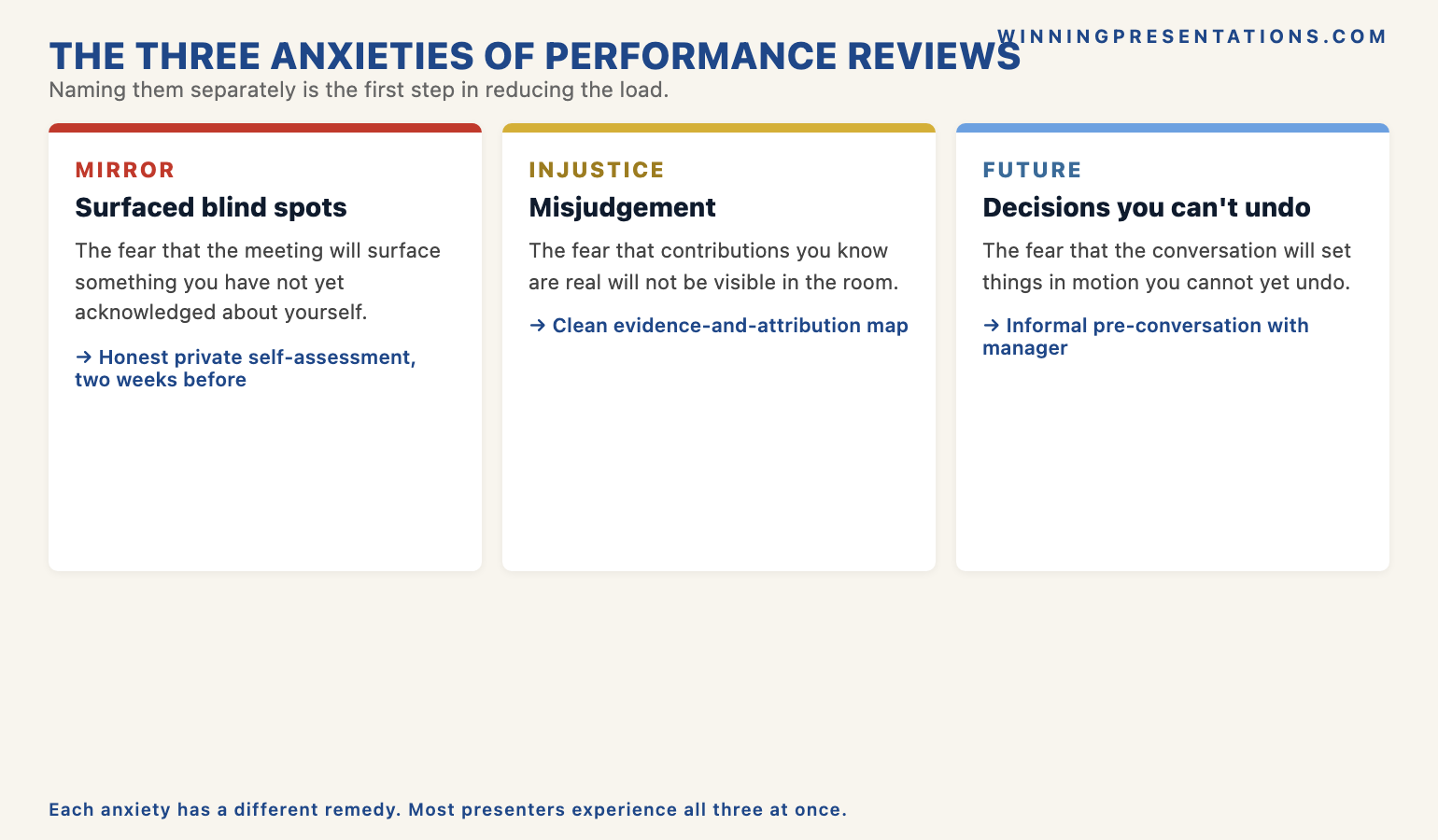
Most presenters experience all three at once and process them as a single cloud of dread. Pulling them apart helps, because each one has a different remedy. Mirror anxiety reduces with honest self-assessment done in private well before the meeting. Injustice anxiety reduces with a clean evidence-and-attribution approach to the deck. Future anxiety reduces with conversations before the meeting that surface the larger picture, so you walk in informed about the territory rather than ambushed by it.
The preparation pattern that lowers the load
The deck for a performance review presentation should take about ninety minutes to build. Anything more is overwork driven by anxiety, not content. The structure most managers ask for is well-defined: what you have done, how you have done it, what you have learned, what you would like the next twelve months to focus on. Four sections. Five to seven slides. No theatrics required.
The work that actually moves the needle on the anxiety happens before the deck. Three pieces, in this order:
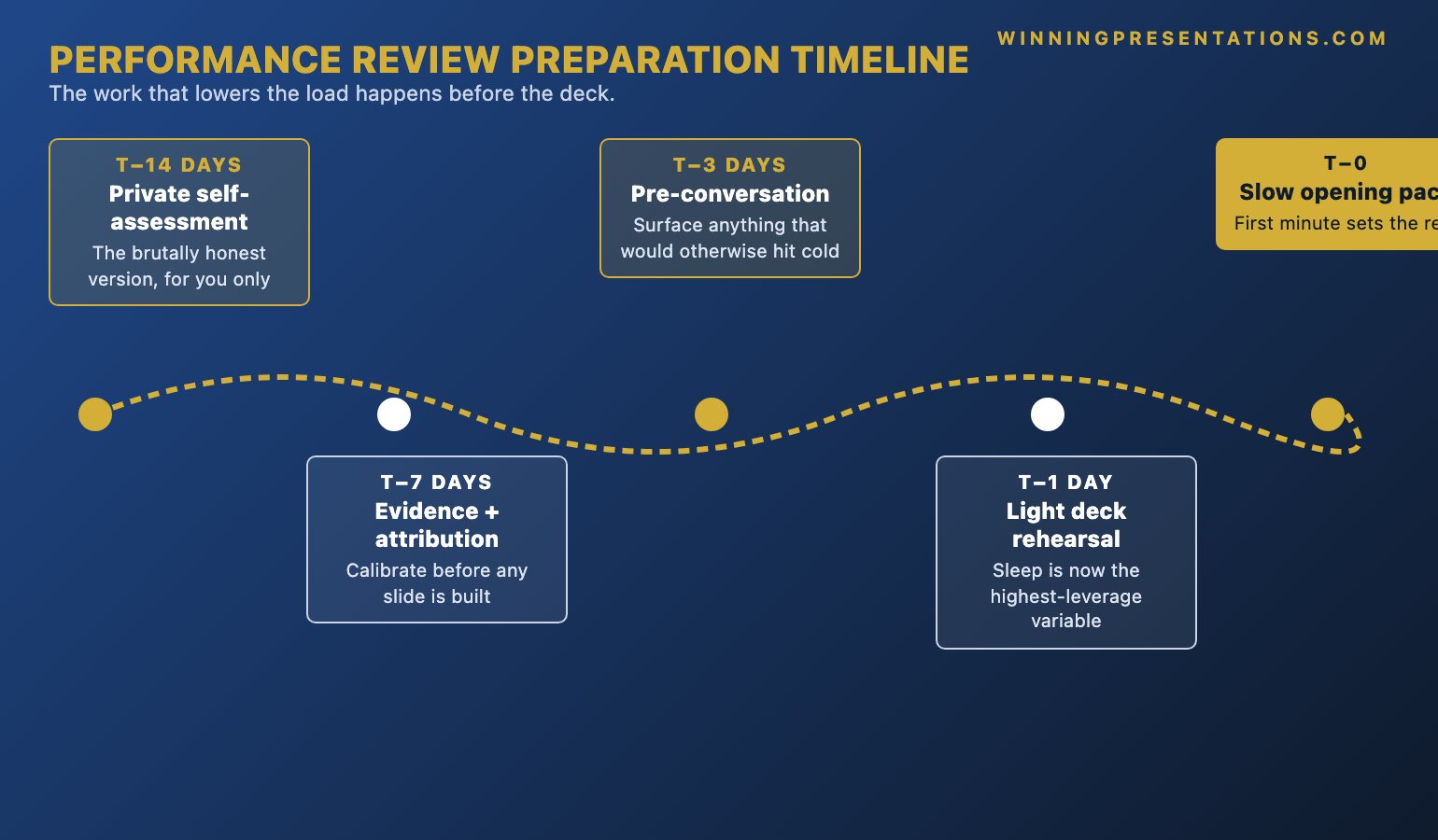
One. Write a brutally honest self-assessment in private, two weeks before the meeting. Not the polished version that goes in the deck — the version you would tell a trusted colleague over a coffee. What did you do well? What did you do badly? Where did you fall short of the standard you set yourself? Where did you exceed it? Why? This document is for you only. Reading it on the morning of the meeting will be uncomfortable in a useful way: the things you most fear someone else surfacing become much less powerful when you have already named them yourself in private.
Two. Map the evidence and attribution before you map the slides. Make a list of the major pieces of work you contributed to in the year. For each, write a one-line attribution. “I owned this.” “I led this with the team.” “I contributed to this; the lead was X.” “This was a collective effort.” This is not the version that goes in the slides — it is the calibration that lets you write the slides honestly without overclaiming or underclaiming. Underclaiming is the failure mode senior professionals are most prone to in self-assessments; this exercise pre-empts it.
When the body responds before the meeting starts.
Conquer Your Fear of Public Speaking is a self-paced programme for senior professionals whose presentation anxiety persists despite competence at the work. £39, instant access, designed around the specific psychology of high-stakes presentations where the threat is to identity, not to the project.
- The nervous-system mechanics of performance anxiety in senior contexts
- Pre-meeting protocols that reduce baseline arousal in the days before
- In-the-room recovery techniques that work without anyone noticing
- The cognitive reframes that separate self-evaluation from self-worth
- Designed for senior professionals across financial services, healthcare, technology, and government
Instant access. No subscription.
Three. Have the larger-picture conversation before the meeting, not in it. If you have any anxiety about what the meeting might trigger — a role change, a redeployment, a band freeze — try to surface it informally with your manager in the days before. Five minutes of “I want to use the review well; is there anything you would want me to come prepared to discuss?” gives them a chance to flag anything that would otherwise hit you cold in the room. Most managers welcome the question; the ones who do not give you useful information about the relationship.
For the broader pattern of why anxiety the night before a meeting often disproportionate to the meeting itself, see Sunday dread before a Monday presentation — the same nervous-system mechanism is at work.
What to do in the room
The two highest-leverage moves in the room are pace and pause.
Pace is the variable that gives away anxiety most quickly. Senior professionals who present to boards regularly can override their natural pace; in a performance review setting, the override often slips, and the speech speeds up to fifteen or twenty per cent above baseline. The audience reads this immediately. The fix is to deliberately slow the opening minute — feel like you are speaking too slowly to your own ears, which will land as composed to the listener. The first minute sets the rest; if you anchor the pace in the first 60 seconds, the rest tends to hold.
Pause is the variable most senior presenters under-use in performance review settings specifically. The dynamic is asymmetric — your manager has more authority than you do in the room, even if the relationship is warm. There is a temptation to fill silences quickly, to keep talking, to soften any point that feels too direct. Holding a pause after a substantive point — three full seconds, longer than feels comfortable — does two things. It signals that you are not anxious to fill space, and it gives your manager room to engage with what you said rather than waiting for you to finish.
For the physical recovery side — when the body responds during the meeting in ways that do affect performance — the techniques in the voice-shakes mid-presentation reset apply directly to performance review settings.
What to do after, regardless of outcome
The hours after a performance review presentation are when the nervous system finishes its threat-response cycle, regardless of how the meeting actually went. Cortisol is elevated for hours; the brain replays moments looking for evidence of how it landed. This is normal and is not a signal that the meeting went badly. It is the body finishing the work it started two days before.
Three things help in the immediate aftermath:
Movement. A 30-minute walk, ideally outside. The body needs to discharge the activation that has been building. Sitting still in your office processing the meeting in your head amplifies it; moving allows it to settle.
One coffee with one trusted person, not five. Talking to too many people about the meeting tends to inflate it — every retelling sharpens minor moments into major ones. One conversation with one person who knows the territory is enough.
A 24-hour pause before drawing conclusions. Whatever the meeting actually meant for the next twelve months, your reading of it the same evening will be coloured by the threat response that has not yet finished. Wait a day. Read your notes from the meeting. The picture will look different from the one your nervous system was painting on the way home.
For the in-the-moment physical symptoms specifically:
Calm Under Pressure covers rapid-response techniques for the physical symptoms of presentation anxiety — shaking hands, racing heart, trembling voice — methods you can use in the room, in the moment, without anyone noticing. £19.99, instant access.
Frequently asked questions
Why am I more anxious about a performance review than about presenting to the executive committee?
Because the audience is evaluating you, not the work. Board presentations have stakes that attach to the recommendation; performance reviews have stakes that attach to the presenter. The body’s threat-detection system responds more strongly to social and identity threats than to professional-task threats, even when the rational analysis says the executive committee meeting is more consequential.
How long before the meeting should I start preparing?
Two weeks for the private work (honest self-assessment, evidence map, informal conversation with your manager). Ninety minutes for the deck itself. Building the deck earlier than a week out tends to amplify rather than reduce anxiety because every revision pulls you back into the territory the body is trying to settle. The private work is what reduces the load; the deck is the artefact, not the preparation.
What if my manager surprises me with a question I have not prepared for?
Pause. Three full seconds. Then answer at half the pace you would normally use. Surprise questions trigger the speed-up response that signals anxiety; deliberately slowing the answer is the strongest countermeasure. If you genuinely do not know the answer, say so directly: “I have not thought through that — let me come back to it before the end of the conversation.” Senior managers respect that response far more than the panicked filler that usually replaces it.
Is it normal to feel disproportionately anxious if my performance has actually been strong?
Yes, and often more so. Strong performance raises the stakes of the evaluation in your own mind — there is more to lose, and the gap between how the meeting might go and how it should go feels larger. The anxiety is not a signal about performance; it is a signal about how much you care about being seen accurately. That is a healthy professional trait, not a problem to fix. The work to do is on calibrating the response, not on suppressing the underlying care.
When the deck is fine but the dread is not.
Conquer Your Fear of Public Speaking is built around the specific psychology of senior professionals whose anxiety doesn’t match their competence. £39, instant access.
Get The Winning Edge newsletter
A weekly note from Mary Beth on the structure, psychology, and preparation that earns senior approval. One idea, one application, one specific scenario — every Thursday morning.
Not ready for the full programme? Start here instead: download the free Executive Presentation Checklist — a single-page reference for the structural side of senior presentations.
Next step: Block 30 minutes in your calendar two weeks before your next performance review. Write the brutally honest private self-assessment first, before any deck-building. The deck takes ninety minutes; the private work is what reduces the dread.
About the author
Mary Beth Hazeldine is Owner & Managing Director of Winning Presentations Ltd, founded in London in 1990. With 24 years of corporate banking experience at JPMorgan Chase, PwC, Royal Bank of Scotland, and Commerzbank, she advises executives across financial services, healthcare, technology, and government on structuring presentations for high-stakes funding rounds and board approvals.