

She’d built those relationships for eight years. Four exit interview answers destroyed them in twenty minutes.
Quick answer: Your exit interview answers follow you for years — through reference calls, industry networks, and the colleagues who become future hiring managers. A former colleague sent me a recording of her transition handover to the leadership team after resigning from a large listed company. The slides were fine. Then the Q&A started. Four questions from the senior team. Four exit interview answers that left the room colder than when she’d walked in. I’ve broken down each answer below — the exact words used, what the panel actually heard, and the rewritten version that would have preserved eight years of professional capital. Each fix follows a 20-second framework called Generous-Specific-Forward. If you have an exit interview coming up, read these four answers before you walk in.
Jump to:
- The Setup: Why Exit Presentations Are the Hardest Q&A
- Answer #1: The Passive-Aggressive Goodbye (Culture Question)
- Answer #2: The Over-Honest Brain Dump (Process Question)
- Answer #3: The Vague Non-Answer (Successor Question)
- Answer #4: The Emotional Leak (Future Plans Question)
- The Pattern: All 4 Answers Made the Same Mistake
- The Exit Q&A Framework: Generous, Specific, Forward
- Frequently Asked Questions
Early in my banking career, I sat in on the worst exit interview I’ve ever witnessed. Senior VP. Fourteen years at the firm. Respected by everyone in the division. She used her final leadership handover to settle scores — subtly, professionally, but unmistakably. By the time she finished, the room was silent. Not the respectful silence of a good ending. The silence of people recalibrating everything they’d ever thought about her.
She’d spent fourteen years building a reputation. She spent twenty minutes dismantling it. Two years later, when she needed a reference for a board position, three of the five people she asked said no. Not because of her work. Because of how she left.
The exit interview is the most dangerous Q&A session of your career — because the consequences don’t land until months or years after you’ve left the building.
The Setup: Why Exit Presentations Are the Hardest Q&A
Before I break down the four answers, here’s what makes exit Q&A uniquely treacherous. In every other presentation, you’re asking for something — budget, approval, alignment. In an exit interview, you have nothing left to ask for. Which means the instinct to “be honest” has no natural brake.
My former colleague — I’ll call her Susan — had resigned to take a bigger role at a competitor. She was well-liked. The handover was genuinely well-prepared. But she walked into that room carrying eight years of accumulated frustrations that she’d never voiced, and the Q&A gave her a stage to voice them.
Details have been changed to protect identities. The question types, answer structures, and panel dynamics are drawn from real situations I’ve coached through — the patterns are real.
The leadership team asked four questions. Not hostile questions. Normal, reasonable questions that every departing senior professional gets asked. Susan answered all four from her emotional state rather than her professional judgment — and each answer cost her something she couldn’t get back. These are the same patterns I see in every executive presentation Q&A failure, amplified by the fact that there’s no follow-up meeting to fix the damage.
The Q&A That Decides Your Professional Legacy
The Executive Q&A Handling System gives you the response structures, question mapping templates, and recovery scripts for every high-stakes Q&A scenario — including transitions, handovers, and exit interviews where the wrong answer follows you for years. Built from real corporate situations where what you say after the slides decides everything.
Get the Executive Q&A Handling System → £39
Instant download. Built from 24 years in corporate banking where how you left a room mattered as much as how you entered it.
Answer #1: The Passive-Aggressive Goodbye (Culture Question)
The question:
“Susan, is there anything about how we work that you think we should change?”
What she said (before):
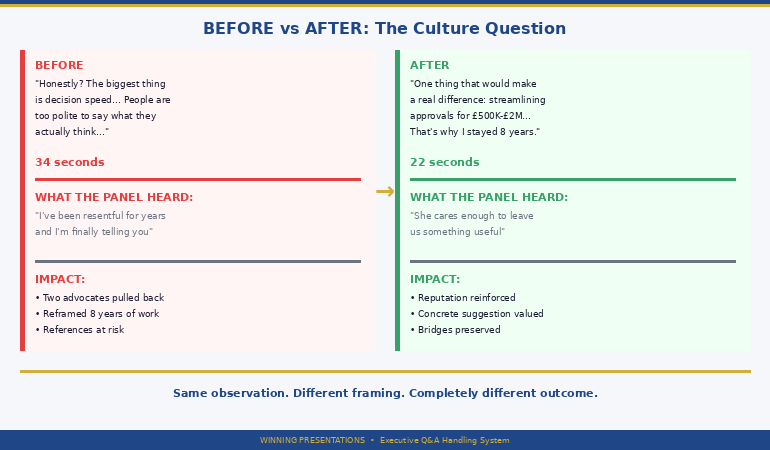
“Honestly? The biggest thing is decision speed. We talk about being agile but it takes three months to approve anything significant. I’ve raised this multiple times and it’s always ‘we’re working on it.’ The other thing is the way feedback works here — or doesn’t work, really. People are too polite to say what they actually think, so nothing changes. I think there’s a real gap between what leadership says they want and what actually happens on the ground.”
Duration: 34 seconds.
What the panel heard:
“I’ve been resentful for years and I’m finally telling you.” Every word Susan said was arguably true. Decision speed was slow. Feedback culture was poor. But the tone — the accumulated frustration bleeding through the word “honestly?” at the start, the “or doesn’t work, really” aside, the veiled accusation of leadership hypocrisy — turned valid observations into a personal indictment. The room shifted. Two directors who’d been her advocates for years visibly pulled back. She wasn’t leaving — she was departing. There’s a difference.
What she should have said (after):
“One thing I think would make a real difference is streamlining the approval process for mid-size initiatives — the £500K to £2M range. The scrutiny is right for larger programmes, but the same process applied to smaller ones slows down teams that are ready to execute. I’d suggest looking at a tiered approval structure. The talent and ambition are here — that’s why I stayed eight years. Removing some of the friction would let people move faster on the ideas that are already strong.”
Duration: 22 seconds.
Same core observation. Completely different impact. The rewrite does four things: names a specific, fixable problem (not a cultural indictment), suggests a concrete solution (tiered approvals), reaffirms her respect for the organisation (“that’s why I stayed eight years”), and frames the change as unlocking existing strengths rather than fixing brokenness. Nobody left that answer feeling attacked. And Susan’s reputation as someone with good judgment — even on the way out — would have been reinforced rather than damaged.
PAA: What should you say in an exit interview when asked about company culture?
Focus on one specific, fixable thing — not a list of grievances. The structure that works: name the issue without blame, suggest a concrete fix, and reaffirm something genuine about the organisation. The moment your answer sounds like a list of complaints, the room stops hearing the content and starts re-evaluating you. You’re not there to fix the company. You’re there to leave it well.
Answer #2: The Over-Honest Brain Dump (Process Question)
The question:
“Are there any process gaps the team should know about as they take over your workstreams?”
What she said (before):
“Quite a few, actually. The reporting process for the quarterly client reviews is basically held together with manual workarounds because the system migration was never finished properly. And the vendor management — I’ve been handling three supplier relationships that technically sit outside my role because nobody else picked them up when James left. Plus the risk framework for the new product line hasn’t been formally documented because we ran out of time before the launch. I’ve been managing it on spreadsheets.”
Duration: 38 seconds.
What the panel heard:
“I’ve been propping up a broken system single-handedly, and now you’ll see how much you needed me.” This is the most common exit interview mistake for high performers — the instinct to reveal everything that was secretly difficult. Susan thought she was being helpful. What the room heard was: (a) critical processes are undocumented, (b) vendor relationships are unassigned, and (c) the new product risk framework lives on one person’s spreadsheets. Each revelation made the leadership team look negligent for not knowing. Nobody thanks you for making them look bad in front of their peers.
I see this pattern constantly in difficult Q&A situations — the presenter confuses thoroughness with helpfulness.
What she should have said (after):
“I’ve documented the three priority handover items in the transition pack I shared on Monday — the quarterly client review process, the vendor relationships, and the new product risk tracking. Each one has a recommended owner and a timeline for transition. I’d suggest the team walks through the pack this week so we can use my remaining time to address any gaps. The foundations are solid — it’s mainly about making sure the institutional knowledge transfers cleanly.”
Duration: 20 seconds.
The rewrite takes the same information and frames it as prepared, documented, and solvable — rather than as a dramatic reveal of hidden fragility. “I’ve documented” signals competence. “Recommended owner and timeline” signals responsibility. “The foundations are solid” signals confidence in the team she’s leaving behind. Susan leaves looking like a professional who prepared properly, not a martyr who finally told the truth.
📋 The Q&A Handling System includes question mapping templates for exactly these scenarios — transitions, handovers, and exit interviews.
Plus the response frameworks that keep you generous rather than resentful when the pressure is on.
Prepare the Answers Before the Questions Land
Exit presentations have a unique Q&A dynamic: every answer becomes permanent. There’s no follow-up meeting to correct the record. The Executive Q&A Handling System gives you question mapping by situation type, the Generous-Specific-Forward response structure, and recovery scripts for the moments when emotion threatens to override judgment.
Get the Executive Q&A Handling System → £39
Instant download. Question mapping templates + response frameworks + recovery scripts. Built from 24 years in corporate banking where departures were remembered longer than arrivals.
Answer #3: The Vague Non-Answer (Successor Question)
The question:
“Do you have a view on who should take over the client portfolio?”
What she said (before):
“I think there are a few people who could do it. It depends on how the team wants to restructure. I don’t want to overstep by making recommendations about roles when I’m leaving.”
Duration: 10 seconds.
What the panel heard:
“I either don’t care enough to have an opinion, or I have an opinion I’m withholding.” This is the opposite mistake from Answer #2 — where Susan over-shared, here she under-shared. The panel asked a direct question seeking her institutional knowledge. She had eight years of working with these people. Her view on succession was genuinely valuable. By dodging with “I don’t want to overstep,” she sent two damaging signals: that she’d already mentally left, and that her loyalty to the team didn’t extend to helping them navigate the transition.
What she should have said (after):
“Based on eight years working with this team, I’d recommend Sarah for the enterprise clients — she already has strong relationships with three of the five accounts, and the clients trust her judgment. For the mid-market portfolio, David has the operational depth but would benefit from a month of shadowing on the strategic accounts first. I’ve written a one-page transition brief for each client that covers relationship dynamics, current priorities, and upcoming decision points. Happy to walk either of them through it this week.”
Duration: 24 seconds.
This answer is generous, specific, and forward-looking. It names the people, explains why, acknowledges development needs honestly, and offers a concrete resource (the transition briefs). Susan leaves looking like someone whose judgment the team will miss — which is exactly the legacy you want.
Answer #4: The Emotional Leak (Future Plans Question)
The question:
“Can you tell us about what you’ll be doing next?”
What she said (before):
“I’m going to be heading up the European portfolio at [Competitor]. It’s a bigger role with more autonomy, which is something I’ve been wanting for a while. I’m really excited about it — their approach to client development is much more progressive and they’re investing heavily in the areas I care about. It feels like the right time for a fresh start.”
Duration: 22 seconds.
What the panel heard:
“You weren’t enough for me, and the competitor is better.” Every phrase was a comparison that diminished the current organisation. “Bigger role with more autonomy” implies the current role was too small. “Something I’ve been wanting for a while” reveals long-standing dissatisfaction. “Much more progressive” directly compares — and the current company loses. “Fresh start” implies the existing environment was stale. Susan was answering honestly. She was also, unintentionally, telling a room of senior leaders that their company wasn’t good enough. These are people she’ll need references from. People who’ll be asked about her in industry conversations for the next decade.
What she should have said (after):
“I’ll be leading the European client portfolio at [Company]. I’m looking forward to it — though I’ll genuinely miss this team and the work we’ve done together. The experience I’ve had here over eight years is what prepared me for a role like this. I’m grateful for that, and I hope the relationships we’ve built continue beyond my time here.”
Duration: 16 seconds.
No comparisons. No implications. The answer states the fact (new role), expresses genuine warmth (miss the team), credits the current organisation (prepared me for this), and keeps the door open (relationships continue). Susan leaves with every bridge intact — and a room full of people who’ll speak well of her for years.
PAA: How do you answer “why are you leaving?” in a professional setting?
State the opportunity without comparing it to the current role. The structure: name the new role briefly, express genuine appreciation for the current team, credit the organisation for your development, and express a desire to maintain the relationship. What to avoid: any sentence that implies the current company is inferior, any phrase that reveals long-standing frustration, and any comparison — even a positive one — between the old and the new. The question is a social ritual, not a request for honest feedback.
📋 The Q&A Handling System includes question mapping for transition scenarios and the “emotional override” recovery scripts.
When emotion wants to hijack your answer, you need a structure that redirects it.
The Pattern: All 4 Answers Made the Same Mistake
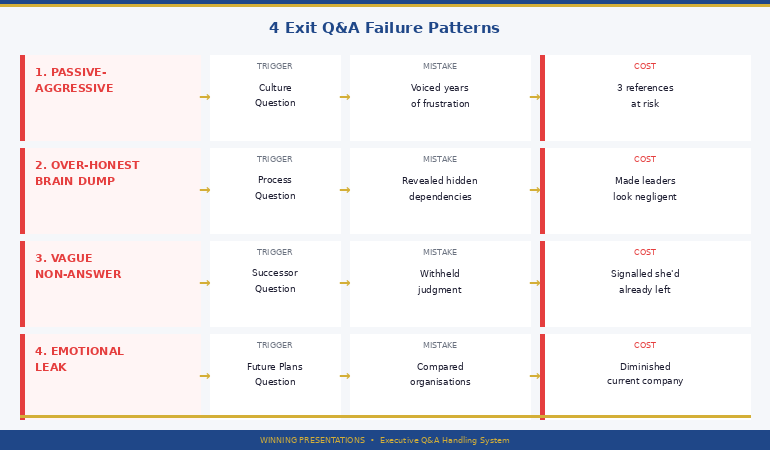
When I watched Susan’s recording the second time, the pattern was unmistakable. Every answer treated the exit interview as a confessional instead of a professional performance.
The culture question? She used it to voice years of frustration. But the question was an invitation to be constructive — not cathartic.
The process question? She used it to reveal how much she’d been doing alone. But the question was asking for a clean handover — not a dramatic reveal of hidden dependencies.
The successor question? She dodged because she’d already mentally left. But the question was asking for her judgment — the most valuable thing she had left to give.
The future plans question? She used it to validate her decision to leave. But the question was a social grace — not a request for a comparative review.
This is the fundamental exit interview trap: every question feels like permission to finally be honest, but what the room needs is for you to be generous. Honesty serves you. Generosity serves the relationships you’ll need for the next twenty years. I’ve written about this dynamic in the context of how Q&A failures create lasting damage — the exit version is worse because there’s no second chance.
PAA: How do you prepare for exit interview answers?
Write down the five questions you’ll definitely be asked: why are you leaving, what should we change, what are the risks in the handover, who should take over, and what’s your advice for the team. For each one, write a 20-second answer using the Generous-Specific-Forward framework. Then read each answer out loud and ask: “If someone quoted this back to me in two years, would I be proud of it?” If the answer is no, rewrite it. Your exit interview is the last thing people remember. Make it worth remembering well.
The Exit Q&A Framework: Generous, Specific, Forward
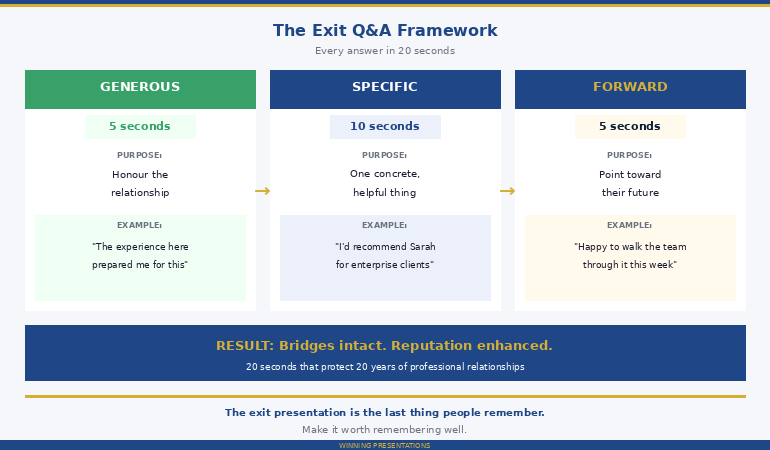
Every exit Q&A answer should follow the same three-part structure:
Generous (5 seconds): Start with something that honours the relationship, the team, or the organisation. Not sycophantic — genuine. “The experience here prepared me for this.” “This team has exceptional people.” “Eight years taught me what good looks like.”
Specific (10 seconds): Answer the actual question with one concrete, helpful observation. Not a list. Not a speech. One useful thing. “I’d recommend Sarah for the enterprise accounts because she already has the client relationships.” “The approval process for mid-size initiatives could be streamlined with a tiered model.”
Forward (5 seconds): Point toward the future — theirs, not yours. “I’ve documented this in the transition pack.” “Happy to walk the team through it this week.” “The talent here is strong enough to handle this.”
Twenty seconds. Generous, Specific, Forward. Every answer preserves the relationship, provides genuine value, and leaves the room feeling good about you — not relieved that you’re leaving.
The biggest mistake professionals make in exit interviews isn’t saying something wrong. It’s confusing their last meeting with their last chance to be heard. Those are two very different things.
Every High-Stakes Q&A Has a Structure. Learn It Once.
The Executive Q&A Handling System covers transitions, exits, budget approvals, board presentations, and hostile question scenarios. Question mapping templates by stakeholder type, the 3-part executive response structure, “I don’t know” recovery scripts, and defensive-to-directive answer rewrites. One system for every Q&A situation in your career.
Get the Executive Q&A Handling System → £39
Instant download. Built from 24 years in corporate banking and consulting environments where how you left a role shaped how people talked about you for years afterwards.
Frequently Asked Questions
How long should exit interview answers be?
Keep the slides to 15-20 minutes maximum. The handover detail should live in a separate transition document that the team can reference after you’ve gone. Your presentation should cover three things only: current status of key workstreams, recommended priorities for the next 90 days, and specific successor recommendations. Everything else goes in the written pack. The shorter your slides, the more time for Q&A — and Q&A is where the real value (and the real danger) lives.
Should I be honest about why I’m leaving in the exit interview?
Be honest in your exit interview with HR — that’s what it’s for. In the handover meeting with the leadership team, be generous rather than honest. The distinction matters: honest feedback about systemic problems is genuinely useful in a confidential HR conversation. The same feedback in a group setting, delivered by someone on their way out, reads as bitterness regardless of how it’s phrased. Protect the relationships. Give the feedback where it can be heard without an audience.
What if someone directly asks me to criticise the organisation during my exit interview?
Redirect to specifics rather than generalities. “If I could change one thing, it would be [specific, fixable process issue] — and here’s how I’d suggest approaching it.” This gives them something actionable without becoming a grievance session. If pressed further, the professional response is: “I think the most useful thing I can do is leave a detailed transition document and make myself available for questions during the notice period. That’s where my honesty is most valuable.” This acknowledges the request without taking the bait.
📬 The Winning Edge Newsletter
Weekly strategies for executive presentations, Q&A preparation, and career-critical communication. No fluff.
Related: Exit presentations amplify the internal voice that says “everyone is judging me.” If that thought loop is familiar — in exits, board meetings, or any high-stakes setting — the strategies in breaking the audience judgment anxiety loop directly complement the structural framework in this article.
Four answers. Twenty minutes. Eight years of professional capital. Susan’s slides were fine. Her Q&A rewrote everything the room thought about her. Map your exit questions before the meeting. Write 20-second answers using Generous, Specific, Forward. Read them out loud. And when the question lands, answer from generosity — not from the eight years of frustration that finally has a stage.
📋 Get the question mapping templates + response frameworks + recovery scripts.
Optional bundle: If you present regularly and want slides, Q&A, confidence, storytelling, and delivery in one package — The Complete Presenter (£99) includes all seven Winning Presentations products. Save over 50%.
About the Author
Mary Beth Hazeldine is the Owner & Managing Director of Winning Presentations. With 24 years of corporate banking experience at JPMorgan Chase, PwC, Royal Bank of Scotland, and Commerzbank, she’s watched dozens of senior professionals destroy years of professional capital in a single exit interview — and coached many more to leave with their reputation not just intact, but enhanced.
She now helps executives prepare for every high-stakes Q&A scenario, from budget approvals to board presentations to the career-defining moments when how you answer matters more than what you present.