
Quick answer: When your voice shakes mid-presentation, the wobble is a physiological response — adrenaline is tightening the small muscles around your vocal cords and shortening your breath. It is not a signal that you are unprepared or that the audience is judging you. It is a signal that your nervous system is in a high-arousal state. The reset takes about thirty seconds and uses three techniques in sequence: a controlled exhale to lengthen the breath, a deliberate pause with a sip of water, and a lower-register restart on a short, declarative sentence. The audience rarely registers any of it.
Jump to
Marietta Skoglund is a senior director at a UK insurance group, presenting Q3 financials to her CEO and three non-executive directors over a live video board call. She has rehearsed the deck twice. She has eaten. She has slept. By slide three she is in flow. On slide six — the underwriting variance slide — her throat tightens without warning. The next sentence comes out thin and reedy. She hears it before the room does. The voice she rehearsed at home is not the voice in her ears now. Her first thought is everyone just heard that.
This is the moment most presenters lose the next two minutes. Not because the wobble itself does damage — it usually does not — but because the inner monologue that follows the wobble crowds out the actual content. Marietta starts thinking about her voice instead of her numbers. The variance slide takes ninety seconds longer than it should. By the time she reaches the closing recommendation, her authority has frayed slightly. Not from the wobble. From the recovery.
What she did not have, in the moment, was a reset routine. A short, learnable sequence that takes the throat tension down in about thirty seconds and lets the next sentence land at full register. Most senior presenters who experience the voice wobble are operating on the assumption that there is nothing to do about it except endure. There is something to do about it. It starts with understanding what the shake is actually signalling.
Carrying speaking anxiety into every high-stakes presentation?
Conquer Your Fear of Public Speaking is a structured approach to speaking anxiety, built from Mary Beth’s own five-year experience of presentation fear during a corporate banking career. A self-study programme of techniques for managing the physical response, field-tested for executive presenters who need to keep delivering while they work through it.
What is actually happening when your voice shakes
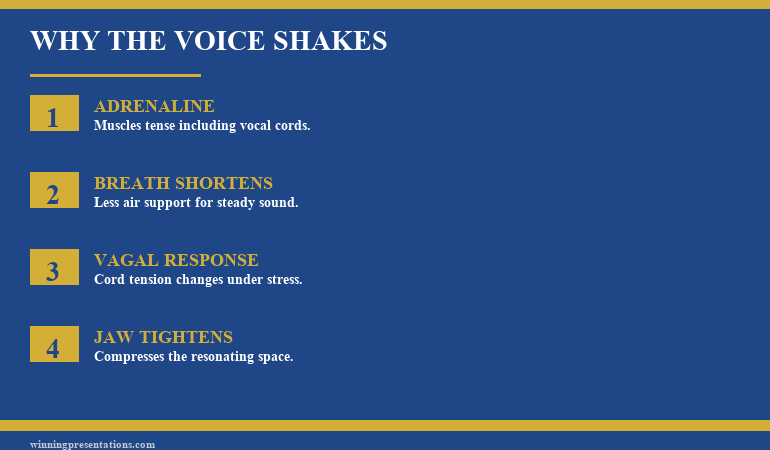
The voice tremor is a downstream effect of a faster underlying response. When your nervous system perceives the meeting as high-stakes, the sympathetic branch releases adrenaline and noradrenaline. Heart rate rises. Breath shortens. Blood is redirected toward the large muscle groups. The smaller muscles — including the intrinsic laryngeal muscles around your vocal cords — receive a different signal. They tense up.
The vagus nerve is part of this picture. It carries motor fibres to the larynx via the recurrent laryngeal nerve, and under stress its signalling to the vocal cord muscles becomes uneven. The cords either tighten too much, producing a thin, reedy sound, or fluctuate in tension, producing the wobble that listeners hear as a shake. At the same time, your breath has shortened. You are now trying to drive a slightly tense vocal mechanism with less air than you usually have. The mismatch is what cracks the voice.
None of this is a signal that you are unprepared. Senior leaders with twenty years of speaking experience get the wobble. So do trial barristers, opera singers, and surgeons giving press conferences. The triggers vary — an unexpected camera-on board member, a question phrased more pointedly than expected, a slide you skipped over too quickly — but the physiology is the same. Your body has classified the moment as high-stakes and adjusted accordingly. The voice is the messenger.
Understanding this matters because the most common reaction to the wobble — tightening further, speaking more carefully, trying to control the voice with effort — is exactly the thing that prolongs it. The vocal cords do not respond well to conscious tightening. They respond to lengthened breath and lower laryngeal tension. The reset uses both.
Why the audience is not making the judgement you fear
One reason presenters spiral after a voice wobble is the assumption that the audience is now silently downgrading their credibility. In senior settings — board meetings, investment committees, executive reviews — that assumption is usually wrong, and worth interrogating before the next high-stakes meeting.
Audiences at this level are processing content, not vocal performance. Their attention is on whether the numbers add up, whether the recommendation is sound, whether the risks have been thought through. Voice quality registers only when it crosses a threshold of distraction — usually something prolonged or repeated, not a single thin sentence. A wobble on one phrase that is then followed by a steady recovery sentence is rarely noticed and almost never remembered. Most listeners do not consciously hear it at all.
The exception is when the presenter draws attention to it. Stopping mid-sentence to apologise for “sounding nervous” is the move that makes the wobble visible. So is repeating the sentence in an obviously tighter, over-careful tone. So is trailing off, looking down, and re-entering on a quieter voice. Each of these signals to the audience that something has gone wrong, when in fact what they heard was a half-second of tonal variation they had already moved past.
The reset routine is built on this asymmetry. The audience will not register the wobble if the recovery is unobtrusive. The recovery is what they hear. If the recovery sounds like a deliberate pause and a clear sentence, the wobble retroactively becomes a non-event. This is why naming it, in most cases, is the wrong move. The next section explains the few cases where naming it is the right move.
The thirty-second reset, step by step
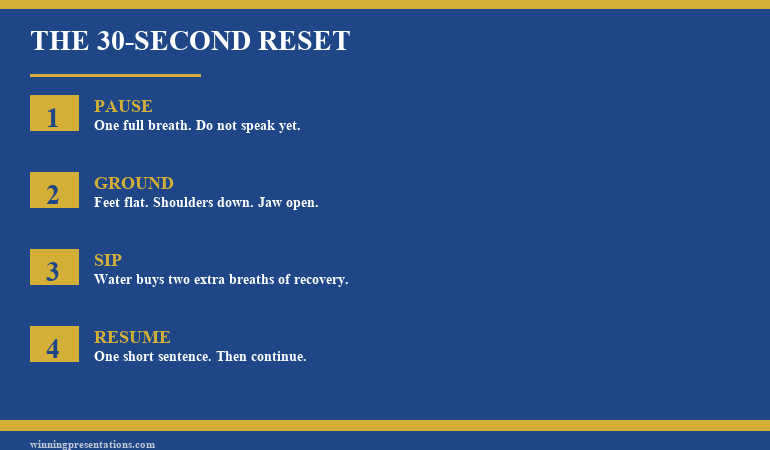
The reset has three components. Each is small. Each is performable without the audience interpreting it as anything other than normal presenter behaviour. The combination takes the laryngeal tension down enough to let the next sentence land at full register.
Step one: a controlled exhale before you do anything else. When the voice cracks, the instinct is to push on. Resist that for two seconds. Close the current sentence — even if you have to truncate it slightly — and breathe out. The exhale is the part most presenters skip. Breathing in feels active and useful; breathing out feels like surrender. But the exhale lengthens the breath cycle, which is what your nervous system needs to read as “the threat is reducing”. A four-second exhale is enough. The audience reads it as a natural pause between thoughts.
Step two: a deliberate pause with a sip of water or a slide click. The pause needs an excuse. Pausing for no visible reason in a high-stakes presentation can read as hesitation. Pausing to sip water, advance a slide, or glance at notes reads as composure. Use the pause to drop your shoulders, unclench your jaw, and settle your stance. These are micro-adjustments — none of them visible to the audience — that release the muscular bracing that is feeding the laryngeal tension. Five to seven seconds is enough.
Step three: a lower-register restart on a short declarative sentence. Do not restart with the long, complex sentence you were on. Restart with something short, finding, factual. “The variance comes from three sources.” “The decision in front of the committee is binary.” “Two things matter on this slide.” Short sentences let you find your full register before the next breath. They also re-anchor the audience on content. The longer the recovery sentence, the more chance the wobble has to return mid-clause.
The whole sequence takes about thirty seconds. Practised once or twice in low-stakes settings, it becomes automatic. The first time you use it in a board meeting, it will feel obvious. The third time, it will feel invisible. The audience never sees a reset. They see a presenter who took half a sip of water and continued.
The preparation layer that reduces the likelihood
The reset handles the wobble in the moment. The preparation layer is what reduces the probability of needing the reset in the first place. None of these are about eliminating the physiological response — that is not a reasonable goal. They are about lowering the baseline activation level so that a stress trigger has less existing tension to work with.
Three preparation moves matter most. First, vocal warm-up before the meeting. Five minutes of humming, lip trills, and reading aloud at conversational volume warms the laryngeal muscles in the same way a brief jog warms hamstrings. Cold cords under stress crack more easily than warmed cords. Second, breath rehearsal. Practise the opening ninety seconds of your presentation while paying attention to where you breathe. Most presenters under-breathe in the first two minutes. Marking the deck with three or four breath points gives your body a known structure, which keeps the breath longer when adrenaline arrives.
Third, structural preparation that reduces in-the-moment cognitive load. The wobble is more likely on slides where you are improvising structure on the fly. If your deck is built so that each slide does one job, the headline states the finding, and the supporting evidence is laid out predictably, you spend less working memory on “where am I going next?” and more on the breathing pattern. A clean appendix structure serves the same purpose for Q&A — it removes the mental scramble that often produces the wobble in the answer to a hard question.
This is the practical reason that confidence and structure are not separate problems. Presenters with strong, deliberate slide structures experience fewer voice wobbles, not because the structure does anything to the larynx directly, but because it lowers the cognitive load that is feeding the activation level. The structure carries some of the weight that the nervous system would otherwise carry.
A structured approach to speaking anxiety, for executives who keep presenting through it
Conquer Your Fear of Public Speaking is a self-study programme built from Mary Beth’s own five-year experience of presentation anxiety during her corporate banking career. It walks through structured preparation techniques, the physical response, and the mental moves that let senior professionals continue delivering at executive level while they work through the underlying fear. £39, instant access, lifetime use.
- Structured techniques for managing the physical response — voice, breath, posture
- Pre-meeting preparation routines you can run in fifteen minutes
- Mental rehearsal patterns for high-stakes board and committee settings
- Field-tested for executive presenters in finance, professional services, and senior leadership roles
- Self-paced, downloadable, no schedule pressure
A structured framework for speaking anxiety. Not a cure, not a quick fix — a working programme for senior presenters who need to keep delivering while they work through it.
When to name it and when to keep going
The default rule is do not name the voice wobble. The audience usually has not registered it, and naming it makes them notice. There are two narrow exceptions where a brief acknowledgement actually steadies the room.
The first is when the wobble has been prolonged enough that the audience has clearly noticed. If your voice has cracked three times across two slides and you can see board members exchanging glances, the room is now waiting for some kind of resolution. In this case, a short, level acknowledgement can reset the dynamic — something like “give me a moment” followed by a clear pause and a clean restart. Note that this is not an apology. It is a directive that takes back the floor. Apologising for “being nervous” introduces a frame the audience will then read into the rest of the presentation. A neutral pause-marker does not.
The second exception is when you are presenting in a context where naming the dynamic genuinely lowers the temperature — for example, a small executive offsite where the room is collegial and the chair is supportive. In that setting, a brief honest line (“apologies — that came out reedier than I intended; let me restart that point”) can land as confidence rather than weakness. The reading of the room matters. If you are unsure, default to the silent reset.
What never works is mid-sentence apology. Stopping yourself partway through a clause to say “sorry, I’m a bit nervous” introduces a pause, a frame, and a content interruption all at once. The audience now has to decide what to do with that information, and most will conclude that the rest of the presentation might be unreliable. The brain reads “apology mid-content” as a signal that something is wrong. Save acknowledgements, when you do use them, for the breath between sentences — never inside one.
Want the structural preparation that lowers the cognitive load before you walk in?
The Executive Slide System — £39, instant access — is the structural framework Mary Beth uses to build executive decks where each slide does one job and the headline states a finding. Cleaner structure means less in-the-moment improvisation, which means less of the cognitive load that feeds the voice wobble. Built for senior presenters working at board and committee level.
Marietta — the senior director from the opening — used the reset for the first time at her next quarterly board meeting. The wobble came on the new business pipeline slide. She closed the sentence, exhaled, advanced to the next slide while taking a slow sip of water, and restarted on a short, factual sentence: “Three deals account for sixty per cent of the pipeline.” She made it through the rest of the presentation without another tremor. In the debrief afterwards, her chair commented that the deck was the cleanest she had given that year. No one mentioned her voice. They mentioned the pipeline structure. That is what the reset is for. The technique is structural preparation paired with a learnable in-the-moment routine — the same combination explored further in staying calm under pressure and in recognising the physical symptoms of presentation anxiety.
Stop dreading the voice wobble before every senior presentation
If the anticipation of the voice shake is now its own source of dread before every committee meeting, the underlying speaking anxiety is doing more damage than the wobble itself. Conquer Your Fear of Public Speaking is the £39 structured programme for working through that anticipatory pattern — built specifically for executive presenters, not general audiences.
FAQ
Does drinking water actually help when my voice shakes?
Yes, but mostly indirectly. A sip of water briefly lubricates the vocal tract, which can ease the immediate dryness that often accompanies the tremor. The bigger value is what the sip lets you do — a five to seven second pause without it reading as hesitation, during which you can lengthen your breath and release jaw and shoulder tension. Have water within reach for every senior presentation. The pause it buys is more useful than the hydration.
How long does it take to learn the reset routine well enough to use it under pressure?
Two or three rehearsals in lower-stakes settings — a team update, a one-to-one, a recorded practice run — are usually enough to make the sequence familiar. The point is not perfection but pattern recognition. When the wobble comes in a real meeting, you want your body to recognise the situation and start the sequence without conscious decision. That recognition forms quickly with deliberate practice, but it does not form passively. You need to actually rehearse the breathe-pause-restart sequence, ideally aloud.
What if my voice shakes from the very first sentence?
This is more common than people admit and usually points to a very high opening activation level — adrenaline arriving before the meeting starts. Two adjustments help. First, a longer vocal warm-up beforehand: ten minutes of humming and reading aloud, not five. Second, a deliberately short and simple opening line — “Thank you, Chair. Three things from this quarter” — that lets you find your register before any complex content. Save your fuller opening sentence for the second beat of the presentation, by which point the breath has usually settled.
The Winning Edge — Thursday newsletter
Every Thursday, The Winning Edge delivers one structural insight for executives presenting to boards, investment committees, and senior stakeholders. No general tips. No motivational framing. One specific technique, one executive scenario, one action. Subscribe to The Winning Edge →
Not ready for the full programme? Start here instead: download the free 7 Presentation Frameworks card — a single-page reference of the structural patterns Mary Beth uses for board, investment, and steering committee presentations.
Next step: rehearse the breathe-pause-restart sequence aloud once today, in your office or at your desk. Read a paragraph from a report. Pretend the third sentence cracks. Practise the four-second exhale, the slide-click pause, and the short restart sentence. The first rehearsal feels artificial. By the third you will not need a script. That is what you want loaded into your nervous system before the next high-stakes meeting.
Related reading: the physical symptoms of presentation anxiety and what each one signals, and staying calm under pressure during executive Q&A.
About the author. Mary Beth Hazeldine is Owner & Managing Director of Winning Presentations Ltd, founded in 1990. With 24 years of corporate banking experience at JPMorgan Chase, PwC, Royal Bank of Scotland, and Commerzbank, she advises executives across financial services, healthcare, technology, and government on structuring presentations for high-stakes funding rounds, approvals, and board-level decisions.