

Quick answer: Strategic vision anxiety is the disproportionate freeze that hits experienced presenters when they have to talk about big ideas — strategy, vision, multi-year direction — even when they handle operational topics smoothly. It happens because abstraction strips away the small confirmations the body uses to regulate threat: there is no specific number to land, no concrete process to walk through, no defensible operational fact to point at. The anxiety is structural, not personal. The fix is preparation that translates abstraction back into the operational anchors the body recognises as safe.
JUMP TO:
Tomás had presented quarterly business reviews for nine years. He was respected in the executive suite, comfortable with hostile questions, fluent under financial pressure. Then, in March, the executive committee asked him to present the divisional five-year vision. He spent six weeks preparing — more than he had ever spent on any QBR. The night before, he could not sleep. Walking into the room, his throat tightened in a way it had not done since his first board meeting in 2018. By slide three, he was rushing. By slide five, his voice was thin. The committee did not seem to notice — they engaged warmly — but Tomás left the meeting shaken. Nothing about the audience or the stakes was different from QBRs he had presented many times. So why had vision broken him?
The answer is structural, and it is the same answer for almost every senior professional who has experienced this pattern. Strategic vision anxiety is not the same as general presentation anxiety. It does not respond to the standard moves — breath work, rehearsal, exposure — the way operational presentation anxiety does. It targets a specific class of presenter (experienced, operationally fluent, senior) and a specific class of presentation (high-abstraction, low-evidence, future-state). Once you understand why it happens, you can prepare for it specifically rather than wondering why your usual preparation has failed.
If you want a deeper system for handling presentation anxiety:
Conquer Your Fear of Public Speaking is the structured programme behind the techniques in this article. Designed for senior professionals whose anxiety is targeted to specific high-stakes situations rather than general speaking nerves.
Why vision presentations trigger more anxiety than operational ones
Operational presentations have a specific feature that disguises just how much it does for the presenter’s nervous system: defensible operational fact. The Q3 number is what the Q3 number is. The customer cohort behaves the way the data shows it behaves. The technology delivery hit the milestone, or it did not. Even when the answer is uncomfortable, it is anchored. The presenter is not the source of authority — the operational reality is.
Vision presentations strip away that anchor. The presenter is being asked to make claims about a future state, with no operational fact yet existing to defend the claims. The audience has to take the leader’s word for whether the future they are describing is achievable, and the leader has to take their own word for it too. The body responds to that absence of anchor as a threat signal — not because the audience is hostile, but because the support structure that usually contains operational presentation pressure is missing.
This is why operationally fluent senior professionals are often the most affected by strategic vision anxiety. The presenters who handle operational sessions well have built reliance on the very anchor that vision sessions remove. Less senior presenters often handle vision sessions with less anxiety, paradoxically, because they have not yet built the operational reliance the body misses.
The abstraction trap
Vision presentations sit at a particular level of abstraction. Too concrete, and the deck becomes operational; senior audiences will read it as a tactical plan rather than a vision. Too abstract, and it becomes a placeholder that anyone could give in any organisation. The discipline is to find the specific level of abstraction the audience can engage with — concrete enough to be testable, abstract enough to leave room for the future to differ from the present in ways the leader has not yet fully specified.
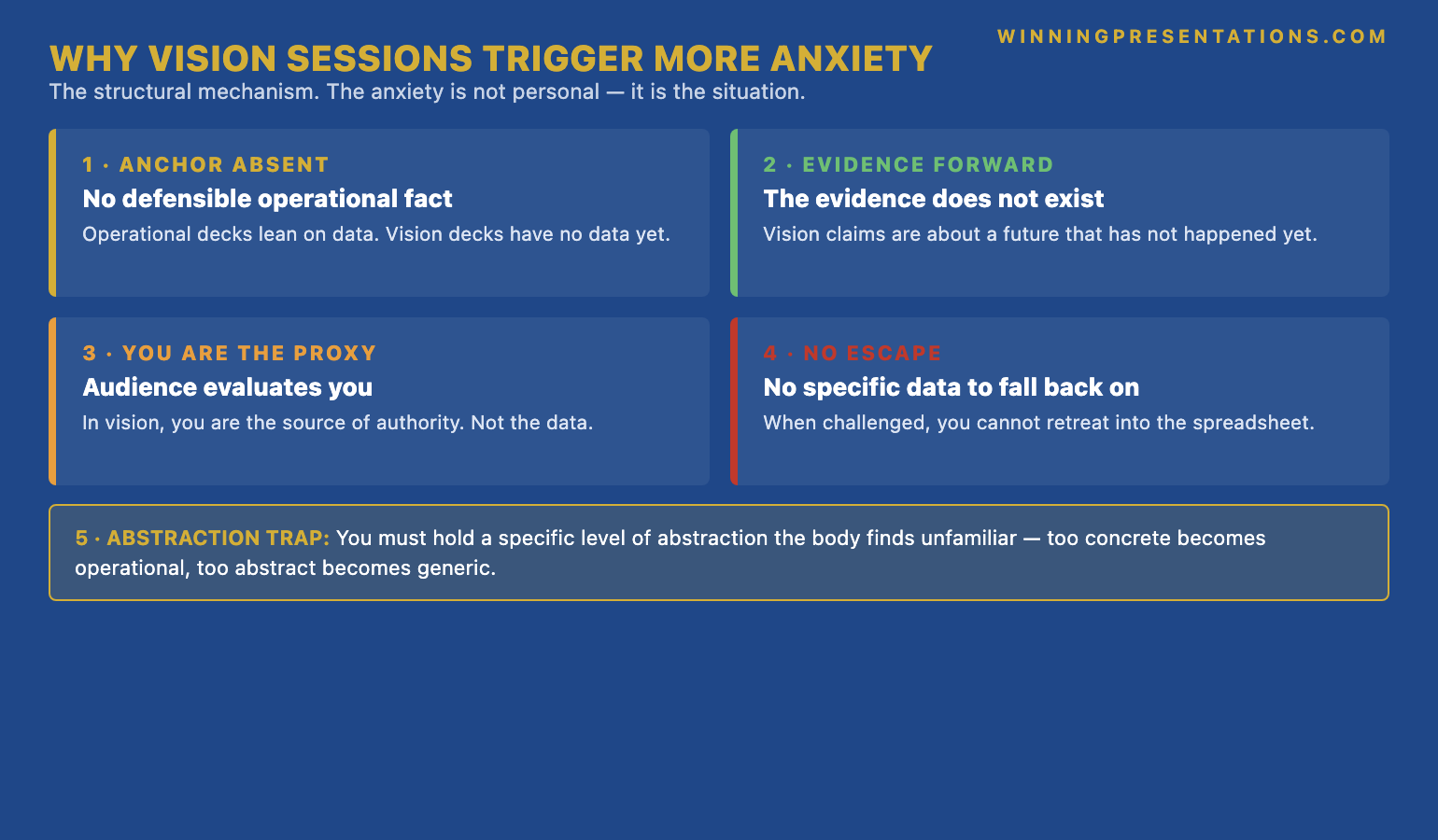
This level of abstraction is harder to inhabit when anxious. Anxiety pulls thinking toward two extremes — either rigid concreteness (“let me read this slide carefully”) or untethered generality (“transformative impact on customer outcomes”). Both fail with senior audiences. The disciplined middle requires the presenter to hold tension that anxiety actively resists. Knowing this in advance helps. Tomás’s anxiety was not random; it was a predictable response to being asked to operate in an unfamiliar abstraction range while senior people watched.
Build the system that quiets specific high-stakes anxiety.
Conquer Your Fear of Public Speaking is a structured programme designed for senior professionals whose anxiety targets specific moments — board presentations, vision sessions, hostile Q&A — rather than speaking in general. Field-tested techniques for managing the physical and cognitive symptoms in the room. £39, instant access, no subscription.
- Techniques for the physical symptoms (racing heart, tight throat, shaking hands)
- Cognitive frameworks for the anxious thinking patterns that hijack rehearsal
- Designed for senior professionals whose anxiety is targeted, not generalised
- Practical moves you can apply the day before, the morning of, and during the meeting itself
The senior-room effect
Strategic vision presentations almost always happen in front of senior audiences — executive committees, supervisory boards, senior partner groups, owners. This is not coincidental. Vision is, by definition, the level of conversation that requires senior approval. Which means the room itself contributes to the anxiety mechanism.
Senior rooms have a specific quality the body picks up on. The pace of speech is slower. Silences are longer. The questions that come are more pointed and less frequent. The audience is harder to read because senior listeners have, over their careers, learned not to telegraph their reactions. For a presenter accustomed to reading audience cues — which most operationally fluent senior professionals are — the absence of those cues itself feels like a negative signal. The body fills in the missing information with its default assumption: silence means the audience is unconvinced.
This is almost always wrong. Senior audiences who are following the argument tend to be quieter, not louder. The signal you are looking for — that the room is engaged — is largely invisible. Knowing this in advance lets you stop reading silence as judgement. The committee is most likely thinking, not dismissing.
The preparation pattern that works
Standard presentation preparation does not solve strategic vision anxiety. Rehearsing the slides more times will not help; the presenter is not anxious about the slides. Memorising the deck makes things worse because it removes the flexibility the abstraction range requires. The disciplined preparation for vision presentations is different.
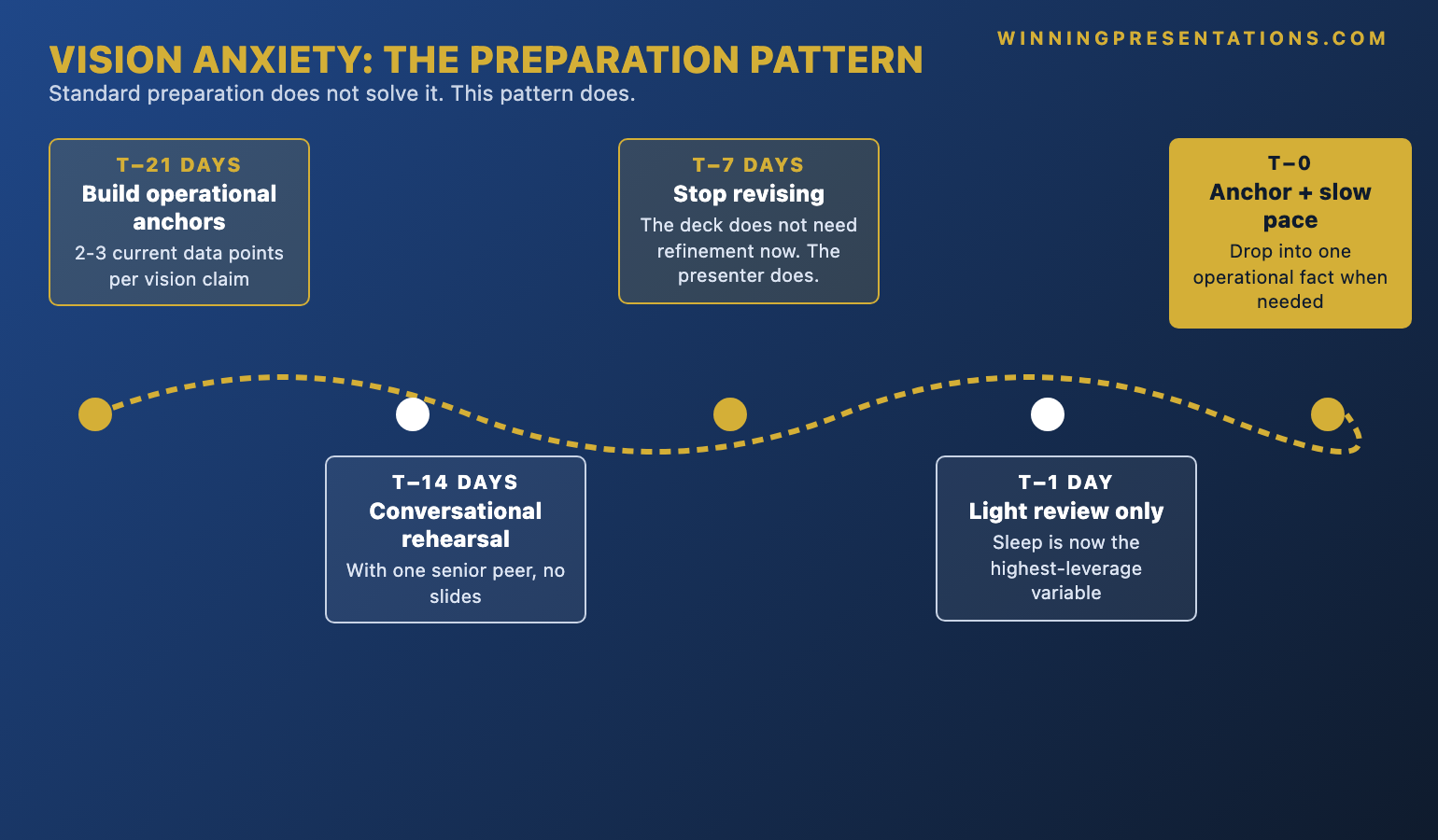
The first move is internal: build operational anchors yourself. For every claim in the vision, write down two or three concrete, current operational facts that ground the claim. If the vision claims that a specific market shift is structural, write down two or three current data points that would be hard to reconcile with a non-structural reading. If the vision claims that the future operating model will compress decision cycles, write down two or three current cycle-time observations that exemplify the problem. The audience will not see these notes. You will not refer to them in the room. They exist for your nervous system. They restore the operational anchor that the abstraction has otherwise stripped away.
The second move is conversational rehearsal, not slide rehearsal. Find one or two people senior enough to ask hard questions, and walk them through the vision in conversation — not from the deck, just talking through it. The questions they ask are the questions the committee will ask. The act of fielding them in a low-stakes setting builds the specific muscle the high-stakes setting requires. For more on the structural moves that hold up under senior scrutiny, see presenting a vision to senior leaders.
The third move is timing. Build the deck early — at least three weeks before — and then leave it alone for a week before the meeting. Daily revision in the run-up to the presentation amplifies anxiety because every revision pulls you back into the abstraction the body is trying to settle into. The deck does not need more refinement in week three. The presenter does.
In the moment: the operational anchor move
If anxiety hits during the presentation itself, the move that works is the operational anchor. Stop the abstraction. Drop into one specific operational fact you know cold — a current customer behaviour, a current revenue line, a current decision-making pattern — and use it as a bridge back to the vision. “If you look at how we currently allocate capital across our top three products — and I know this from running it in the executive committee for the last two years — you can see the structural problem the vision is solving.”
This move does several things at once. It restores the operational anchor your nervous system was missing. It signals to the audience that the vision is grounded in current reality, not speculation. It buys you a moment to slow down. And it demonstrates seniority — the move of bridging between abstract vision and concrete operational fact is one senior audiences read as evidence the leader has actually done the underlying work.
The other in-the-moment move that helps: deliberately slow the pace of speech. Strategic vision anxiety almost always speeds the presenter up — the body is trying to escape the abstraction by getting through the deck faster. Slowing down counterintuitively reduces the anxiety because it forces the body to inhabit the room rather than rush through it. Senior audiences also experience slower delivery as more confident, which provides additional positive feedback.
If the presentation itself is to a senior audience for buy-in:
The Executive Buy-In Presentation System is a self-paced programme covering the structure, psychology, and delivery moves senior professionals use when they need a board, executive committee, or stakeholder group to back a strategic decision. Monthly cohort enrolment, optional recorded Q&A sessions, lifetime access. £499.
After the presentation: how to read your own performance
The most common mistake after a vision presentation is to over-weight the felt anxiety in the assessment of how it went. Tomás left his presentation feeling shaken, which made him conclude the presentation had gone badly. Two weeks later, the committee approved the vision in full and named Tomás as the executive sponsor for the first phase of the programme. The audience had not experienced the presentation the way Tomás had.
This is the standard pattern, not the exception. Internal and external assessments of a vision presentation diverge more than they do for operational presentations because the anxiety mechanism is more internal and less visible. The presenter feels the anxiety acutely. The audience sees a leader thinking carefully under abstraction — which is largely indistinguishable from a leader thinking carefully without anxiety.
Practical rule: do not draw conclusions about a vision presentation from your own felt experience. Instead, look for one or two specific external signals — the questions the committee asked, who followed up afterwards, what the executive sponsor said in the next 1:1. The signal-to-noise ratio of those signals is much higher than the signal-to-noise ratio of your own anxiety reading.
Conquer Your Fear of Public Speaking — for the targeted, high-stakes moments.
Structured techniques for the physical and cognitive symptoms of presentation anxiety, designed for senior professionals whose nerves target specific situations — vision sessions, board meetings, hostile Q&A — rather than speaking in general. £39, instant access.
Frequently asked questions
Why does strategic vision anxiety hit harder than operational presentation anxiety?
Because abstraction strips the operational anchors the nervous system uses to regulate threat. In operational presentations, the data, the numbers, and the defensible facts do most of the support work — the presenter is not the source of authority, the operational reality is. In vision presentations, the presenter is the source of authority, because the future state has no operational evidence yet. The body experiences that absence of anchor as threat, even when the audience is engaged and the vision is sound.
I am not generally an anxious presenter — why is this happening to me now?
Because operational fluency does not transfer cleanly to high-abstraction situations. The presenters who experience strategic vision anxiety most acutely are often the same presenters who handle operational pressure exceptionally well. Their nervous system has built reliance on the operational anchor that vision sessions strip away. Less operationally experienced presenters sometimes handle vision sessions with less anxiety because they have not built the same reliance. The anxiety is not a sign that something is wrong — it is a sign that you are operating in an unfamiliar abstraction range.
How do I prepare differently for a vision presentation than an operational one?
Three differences matter most. First, build operational anchors for yourself — concrete current facts that ground each abstract claim, even if the audience never sees them. Second, rehearse conversationally with a senior peer rather than from the slides — the act of fielding hard questions in conversation builds the muscle the high-abstraction setting requires. Third, finish the deck early and stop revising it in the week before. Continued revision amplifies anxiety; the deck does not need more refinement, the presenter does.
What do I do if I feel the anxiety hit during the presentation itself?
Drop into one concrete operational fact you know cold and use it as a bridge back to the vision. The move restores the operational anchor your nervous system is missing, signals to the audience that the vision is grounded in current reality, buys you a moment to slow down, and demonstrates the kind of seniority senior audiences read positively. Also: deliberately slow your pace of speech. Vision anxiety almost always speeds the presenter up; slowing down reduces the anxiety and improves how the room receives you at the same time.
Should I tell my manager I struggle with strategic vision presentations?
Probably not, and not for the reason most people assume. The risk is not that the manager judges you — most senior managers will be sympathetic — but that flagging it pre-presentation primes both you and them to look for the anxiety in the room, which makes it more likely to surface. Better practice: do the structural preparation described above, deliver the presentation, and assess the outcome on the external signals (committee response, follow-ups) rather than your felt experience. If a pattern persists across multiple presentations, then have the conversation — but with evidence from outcomes, not from internal experience.
The Winning Edge — weekly newsletter
The Winning Edge is a weekly newsletter for senior professionals presenting under pressure. One short email a week covering the structural moves that make high-stakes presentations land — including the psychological side of presenting at the executive level. Subscribe to The Winning Edge →
Not ready for the full system? Start here instead: download the free Pyramid Principle Template — the framework behind every executive briefing where the conclusion comes first.
About the author
Mary Beth Hazeldine is Owner & Managing Director of Winning Presentations Ltd. With 24 years of corporate banking experience at JPMorgan Chase, PwC, Royal Bank of Scotland, and Commerzbank, she advises executives across financial services, healthcare, technology, and government on structuring presentations for high-stakes funding rounds, board approvals, and strategic decisions.