

Quick Answer: A camera-shy executive almost never has a confidence problem in person. The trigger is the small video tile in the corner of the screen showing them their own face in real time. The fix is mechanical, not psychological: hide the self-view, fix the camera setup so it stops feeding distortion, and rebuild on-camera time in short, low-stakes blocks. Confidence returns within four to six weeks of structured practice.
JUMP TO:
Kenji had been a senior partner at his firm for eleven years. He had presented to global investment committees, defended deals in front of regulators, and spoken at industry conferences without a tremor. When the firm went hybrid in 2020, something changed. The pre-meeting nerves he had not felt since his analyst days came back. By 2024 he was avoiding video calls where possible, finding excuses to dial in audio-only, declining speaking slots that were on Zoom rather than in person.
He came to me embarrassed. He could speak in front of three hundred people in a conference hall. He could not bring himself to start a video meeting with seven colleagues without rehearsing the first sentence five times. The pattern was specific to the camera, not to public speaking. He was a camera-shy executive in a profession that had moved most of its high-stakes communication onto camera.
The recovery took six weeks. Not because the underlying nerves were severe. Because the diagnostic was simple and the protocol was structured. He is back to leading remote calls without the avoidance pattern, six months on.
If you have started avoiding video calls and not telling anyone
Conquer Speaking Fear is a structured programme for executives who have developed presentation anxiety later in their careers — including the on-camera variant that has become more common since 2020.
What camera shyness actually is for a senior executive
Most camera shyness in senior executives is not the same condition as the general anxiety of speaking in public. It is a more specific, more recent pattern that has become widespread since 2020.
The mechanism is consistent. A senior executive who is comfortable in person experiences a meaningful asymmetry on a video call. In person, the audience is in front of them and they cannot see themselves. On camera, they see their own face in real time in the corner of the screen, often a slightly distorted version through a wide-angle laptop lens, often badly lit, almost always at a moment when they are concentrating and not consciously composing their face.
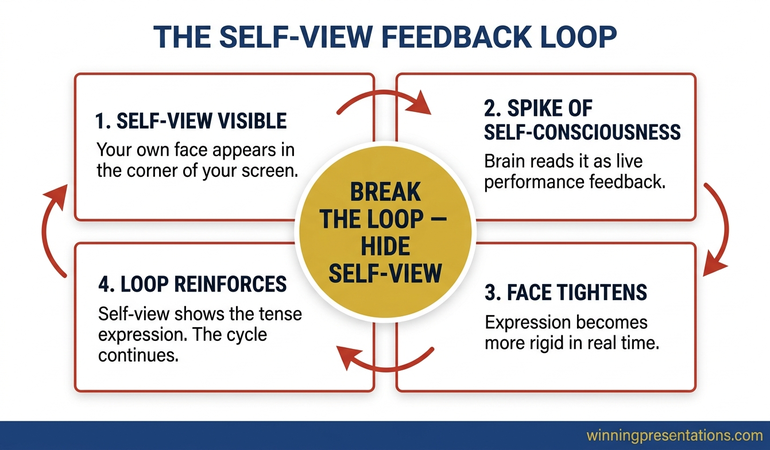
The brain does not distinguish between “this is what I look like to the audience” and “this is feedback on my performance right now”. A flicker of an unflattering expression in the self-view tile becomes a small spike of self-consciousness, which becomes a tighter face, which produces a more rigid expression on camera, which loops back into the self-view. The audience sees a senior executive looking slightly tense. The executive sees themselves looking tense and feels worse.
The label “camera-shy” is not quite right. The accurate label is “self-view feedback loop”. Naming it accurately is the first step to fixing it. The condition is mechanical, not characterological. It is also fixable.
The self-view loop and how to break it
The fastest single intervention is to hide your own video tile. Every major video platform allows this. Zoom: right-click your own tile and choose “Hide Self View”. Teams and Google Meet have the equivalent. Your audience still sees you. You no longer see yourself.
Most camera-shy executives report a noticeable drop in tension within the first call after making this change. The reason is that the self-view feedback loop simply cannot run if you cannot see yourself. The brain has nothing to react to.
The reason most executives have not made this change is because they assume they should be able to “handle” looking at themselves. Senior leaders are trained to face uncomfortable feedback. The self-view feels like a small piece of feedback to lean into, not avoid. This intuition is wrong for this specific case. The self-view is not signal — it is noise that produces a real-time stress response with no useful information attached. Hiding it is not avoidance. It is removing a malfunctioning input.
For executives who have developed this pattern alongside other remote-related anxiety, the presentation anxiety on remote camera guide covers related triggers and how to separate them.
CONQUER SPEAKING FEAR — £39
A structured programme for executives whose nerves came back unexpectedly
Conquer Speaking Fear is the structured programme for senior leaders who have developed acute presentation anxiety — including the on-camera variant that did not exist before video calls became routine. Self-paced, designed for executives, no group sessions required. £39, instant access.
Designed for senior leaders managing acute presentation nerves in remote and in-person formats.
The setup changes that rebuild confidence quickly
Once the self-view loop is broken, the next layer of fixes is physical. The setup most senior executives use on video calls actively works against them, even when they are not consciously camera-shy.
Camera at eye level. A laptop on a desk, with the camera angled up at the chin, distorts the face. The forehead recedes, the chin enlarges, expressions read as awkward. Every camera-shy executive I work with has an under-positioned camera. Raise it to eye level using a laptop stand or a stack of books. The image of yourself you would otherwise see in the self-view tile (which you have now hidden) becomes objectively more flattering and more authoritative. Even though you are not looking at it, the audience is.
Front lighting. A window behind the executive turns the face into a silhouette. The audience cannot read the expression and the executive looks shadowy and tentative. Move the desk so any window is in front of you, or place a single soft light at eye level. This single change rebuilds perceived warmth and presence.
Close framing. The wide-shot view, with the entire room behind a small head, signals that the executive is small in their own space. Tighter framing — head and upper shoulders filling the upper third of the frame — signals presence. Adjust the camera distance until you fill the frame the way a senior broadcaster does.
Quality microphone, not laptop default. The internal microphone on a laptop produces tinny, distant audio that the audience has to work to follow. A £80 USB microphone or a decent headset transforms how seriously the room takes you, regardless of your facial expression. Audio carries authority more than camera does.
For executives whose anxiety also includes vocal flatness or low energy on screen, the virtual presentation energy guide covers vocal pacing and breath techniques specifically for camera presence.
The four-week recovery protocol
For executives who have developed an avoidance pattern around video calls — declining the meeting type, dialling in audio-only, accepting smaller speaking slots than they used to — the structured recovery is more important than any single intervention. Avoidance reinforces itself. Each video call avoided makes the next one more uncomfortable.
The protocol that works:
Week 1 — Setup and self-view. Hide the self-view permanently. Fix the camera setup once. Do not change anything else about how you handle calls. Notice whether the baseline tension drops on the first three or four calls of the week. For most executives it does, noticeably.
Week 2 — Short low-stakes blocks. Schedule three 15-minute video calls with trusted colleagues you would normally take by audio. Camera on. No agenda pressure. The exposure is the point, not the content. The brain re-learns that being on camera produces no actual consequence.
Week 3 — Structured medium-stakes calls. One presentation-format call where you are presenting for 5–10 minutes, ideally to a known audience. Pre-write the first three sentences. Use the structure rules from any standard remote presentation framework — named questions, eye-level camera, decision-first opening. Notice that the format helps. The structure is doing some of the work that nerves used to disrupt.
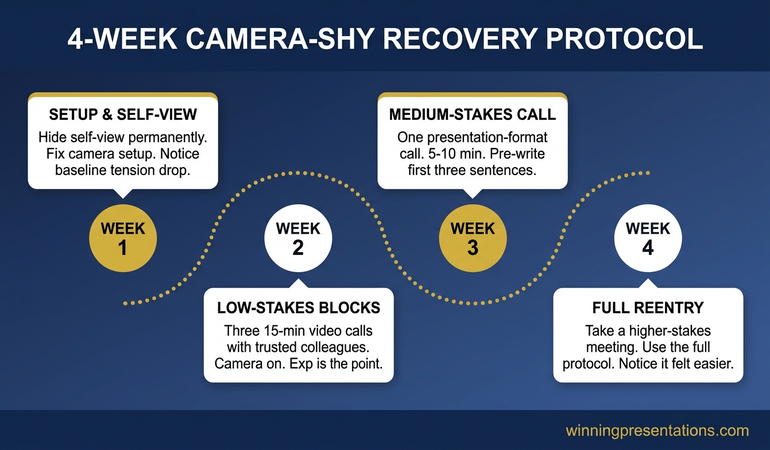
Week 4 — Full presentation reentry. Take one of the higher-stakes meetings you would have previously avoided or downgraded. Use the protocol. Notice afterwards whether the call felt as uncomfortable as you had anticipated. For most executives it does not.
The shift after four to six weeks is reliable. The condition does not require deep psychological work. It requires the right diagnosis, a small set of mechanical fixes and structured exposure that removes the avoidance pattern.
In-the-moment techniques when the camera light comes on
For the call you have to take this week, before the protocol has had time to work, three techniques that help in the moment.
The 90-second pre-call breath. Sit in front of your camera 90 seconds before the call begins. Breathe slowly — in for four counts, out for six. The longer exhale activates the parasympathetic nervous system and reduces the acute stress response. Do not skip this. The pre-call state determines the first two minutes of the call.
The first sentence written down. Write the first sentence of whatever you will say in the call on a sticky note. Not bullet points. The exact sentence. When the chair turns to you, read it word for word if necessary. Once the first sentence is out, the rest tends to flow. The bottleneck is almost always the start.
One trusted face on screen. If you are presenting to a larger audience, identify one colleague on the call who you trust. Make occasional eye contact with their tile rather than the camera. Their nod functions as the in-person equivalent of someone leaning forward in the room. The connection slows your breath and steadies the delivery.
For the related challenge of watching senior colleagues present brilliantly and feeling worse rather than better, the comparison trap guide covers why watching great speakers can intensify anxiety in the recovery period.
When to get structured help
The four-week protocol works for the majority of camera-shy executives because the underlying condition is recent, mechanical and limited to the camera context. If the protocol does not produce a noticeable shift after four weeks, consider whether the underlying pattern is broader than camera shyness. Three signals that suggest a more comprehensive approach is needed:
- The avoidance pattern extends beyond video calls into in-person presentations.
- The acute stress response includes physical symptoms during the call (visible shaking, voice cracking, sustained heart rate elevation).
- The anticipatory dread starts more than 24 hours before the meeting, regardless of stakes.
If any of these are present, a structured programme is more useful than self-managed exposure. Working through the material in order, with the techniques sequenced for executives specifically, addresses the broader presentation anxiety pattern of which camera shyness is one expression.
FOR THE CALL THIS WEEK YOU ARE QUIETLY DREADING
A structured path through executive presentation anxiety
Conquer Speaking Fear walks senior leaders through the diagnostic, the mechanics, the recovery protocol and the in-the-moment techniques referenced above — in a structured order designed for executives, not a generic public speaking course. £39, instant access, no subscription.
Frequently Asked Questions
Is camera shyness the same as social anxiety?
For most senior executives, no. The pattern is usually specific to the on-camera context and not present in other social or professional settings. The trigger is mechanical (the self-view tile, the awareness of being recorded, the absence of normal in-person feedback) rather than a general anxiety about social interaction. Treating it as a specific condition with a specific protocol works faster than treating it as social anxiety.
Should I tell my team I find video calls difficult?
Selectively. With your direct manager and one trusted peer, candour is helpful — it gives them context for any avoidance behaviour they might otherwise read as disengagement. With the broader team, no — the disclosure adds nothing useful and changes how they read your subsequent presence. Address the issue mechanically, fix the setup, run the protocol. Their experience of you on camera will improve before the conversation needs to happen.
What if I can never get fully comfortable on camera?
The realistic goal is not to enjoy being on camera. The realistic goal is to be functional on camera at the level your role requires. Many senior executives who have run this protocol report sustained mild discomfort but no longer experience the avoidance pattern or the in-the-moment freeze. Functional is enough. Comfort is a bonus, not the target.
Does practising in front of a mirror help?
Less than you might expect. The mirror does not replicate the specific feedback loop of the self-view tile, and it can reinforce self-conscious facial monitoring. Better to practise on a recorded call and watch back later, or to practise on real low-stakes calls with the self-view hidden. The condition resolves through real exposure with the loop disabled, not through more self-observation.
Presentation playbooks, delivered Thursdays
The Winning Edge newsletter covers the structures real executives use for high-stakes meetings — including the psychological mechanics behind presence, nerves and recovery. One issue per week, typically read in four minutes.
Not ready for the full programme? Start here instead: download the free Executive Presentation Checklist — a one-page review for any high-stakes meeting on your calendar this week.
Partner post: Once the camera shyness is no longer in the way, the structural rules of the meeting itself matter most. The virtual board meeting presentation guide covers that next layer.
Your next step: Hide the self-view tile on your next video call. That single change is enough for week one. Notice whether the call felt different. The protocol builds from there.
About the Author
Mary Beth Hazeldine is Owner & Managing Director of Winning Presentations Ltd. With 24 years of corporate banking experience at JPMorgan Chase, PwC, Royal Bank of Scotland, and Commerzbank, she advises executives across financial services, healthcare, technology, and government on structuring presentations for high-stakes funding rounds and approvals.