

Quick answer: A hostile questioner simulation is a structured rehearsal exercise in which colleagues challenge your answers under conditions that mimic the pressure of the real executive meeting. It is the most reliable way to identify the gaps in your Q&A preparation before those gaps become visible in the room. The simulation works because it compresses the emotional and cognitive conditions of real Q&A into a controlled environment where you can practise and adjust without consequences.
In This Article
- The Problem With Traditional Q&A Preparation
- Why Hostility in Q&A Follows Predictable Patterns
- The Three-Layer Simulation Framework
- How to Recruit Your Internal Challengers
- Running the Simulation: Rules and Format
- Processing the Feedback Without Defensiveness
- The Day-Before Refresh That Consolidates Gains
- Frequently Asked Questions
Kenji had prepared more thoroughly for this board presentation than for any other in his career. He had rehearsed the deck twice, reviewed the financial model, pre-read the board papers, and anticipated six questions he thought were likely. When the Non-Executive Director challenged him on a specific assumption in the revenue model — an assumption that was methodologically sound but superficially easy to attack — Kenji answered competently. But he felt his voice tighten. He heard himself become slightly defensive. He watched the NED’s expression shift from interrogative to satisfied.
After the meeting, his CFO told him the presentation had gone well overall, but flagged the moment with the NED. “You answered correctly,” she said. “But you looked rattled. That matters in a room like this.” Kenji asked what he should have done differently. “You needed to have been in that moment before,” she said. “The answer wasn’t the problem. The unexpectedness was the problem.”
The CFO’s observation points to something that conventional Q&A preparation almost always misses. Preparing answers to likely questions is necessary but not sufficient. What determines performance under hostile Q&A is not primarily whether you know the answer — it is whether you have experienced the emotional and physiological conditions of challenge before you walk into the room. That experience is what the simulation creates.
The hostile questioner simulation is, at its core, an inoculation exercise. It does not eliminate the discomfort of challenge — it reduces its novelty, which reduces its power to destabilise.
Preparing for high-stakes Q&A?
The Executive Q&A Handling System is a structured approach to predicting and preparing for executive Q&A — including frameworks for anticipating hostile question patterns and building answers that hold up under scrutiny.
The Problem With Traditional Q&A Preparation
The standard approach to Q&A preparation involves compiling a list of likely questions and drafting answers to each. This is useful — and should remain part of any preparation process — but it has two significant limitations that become visible only under real conditions.
It optimises for content, not for performance under pressure. A well-drafted answer in a preparation document is produced in conditions of low stress, unlimited time, and no social consequence for a weak response. The same answer, delivered under challenge from a sceptical Non-Executive Director, is produced under entirely different conditions. The cognitive load is higher. The emotional stakes are visible. The time pressure is real. The answer that looked clean on paper often sounds hesitant, over-hedged, or defensive in the room.
It cannot anticipate the follow-up. Hostile questioners rarely accept a first answer and move on. They push — often with a follow-up that accepts the substance of your answer while attacking the framing, or that redirects to a related vulnerability. A preparation document can anticipate the first question. It cannot anticipate the third exchange in a sequence, because that exchange depends on the specific choices made in the first two. Only a live simulation can generate the genuine unpredictability of an experienced interrogator.
These limitations do not mean that written preparation is unhelpful — they mean that it is incomplete. The simulation fills the gap between preparation and performance.
Why Hostility in Q&A Follows Predictable Patterns
Hostile Q&A in executive settings is not random. It follows a small number of recurring patterns that can be anticipated and prepared for specifically. Understanding these patterns transforms the simulation from a general stress-exposure exercise into a targeted preparation tool.
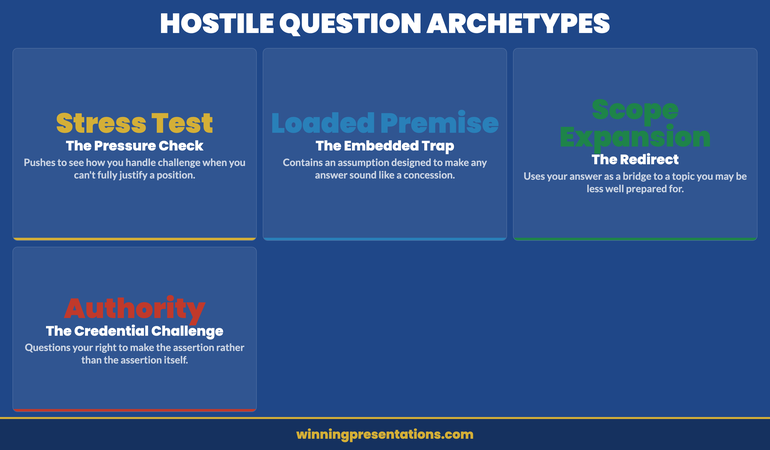
The stress test. The questioner pushes on a position not because they necessarily disagree with it, but to assess how you handle pressure. The question is often framed as a challenge to your methodology, your assumptions, or your confidence in the conclusion. The intent is less about the content and more about observing how you respond when challenged. The indicator is the quality of your second answer — the one you give after you have been pushed.
The loaded premise. The question contains an embedded assumption that, if accepted, positions any answer as a concession. “Given that your team has consistently missed this metric for the past three quarters…” is a loaded premise — it accepts as given something that may be contested. Accepting the premise before answering it transfers control of the narrative to the questioner. The correct response is to address the premise explicitly before answering the question.
Scope expansion. The questioner uses your answer to a specific question as a bridge to a broader topic that you may be less well prepared for. “You’ve addressed the operational impact — can you also speak to the regulatory exposure?” moves from a territory you anticipated to one you may not have. The effective response is to acknowledge the legitimacy of the broader question while clearly framing what you can answer now and what requires further analysis. For related patterns, see this guide on handling hostile questions in board meetings.
The authority challenge. The questioner questions your credentials to make the assertion rather than questioning the assertion itself. This is particularly common in cross-functional presentations where the presenter is speaking on topics that touch another executive’s domain. The authority challenge is a social manoeuvre as much as an intellectual one — and responding to it as if it were purely intellectual often misses the dynamic.
The Three-Layer Simulation Framework
The most effective hostile questioner simulations are structured in three layers of escalating intensity. Each layer serves a different function in the preparation process, and all three should be completed in the sequence below for maximum benefit.
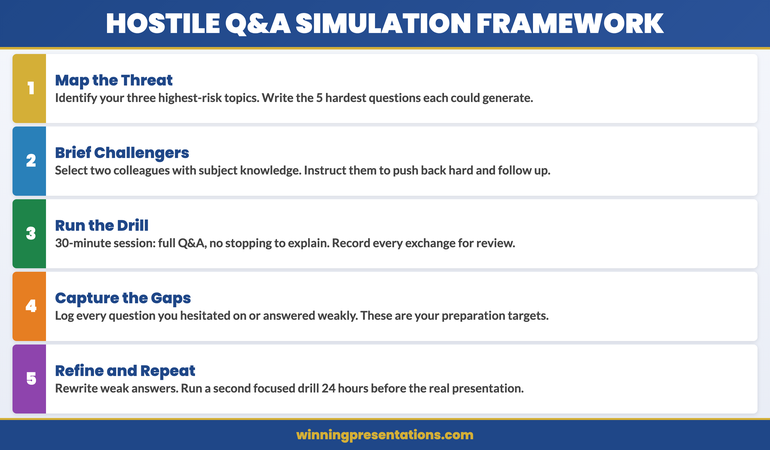
Layer one — Question mapping. Before any live simulation, conduct a systematic mapping of the questions most likely to arise and the questions you most hope will not. These are different lists and both are necessary. The first list drives the content of your written preparation. The second list drives the focus of your simulation — because the questions you hope will not arise are almost certainly the ones a hostile questioner will reach for. A useful exercise at this stage is to brief a colleague on your presentation content and ask them to identify the three points they would push on if they were seeking to challenge your credibility. Their perspective as an intelligent insider is often more accurate than your own assessment of where you are vulnerable.
Layer two — Structured challenge session. With one or two colleagues briefed on your material and given explicit instructions to challenge hard, run a full Q&A session lasting 20 to 30 minutes. The challengers should cover all four hostile question archetypes — stress test, loaded premise, scope expansion, and authority challenge — and should push back on first answers rather than accepting them. You should respond as you would in the real room: under time pressure, without notes, and without stopping to explain yourself mid-answer. The session should feel uncomfortable — that discomfort is the point.
Layer three — Gap analysis and refinement. Immediately after the simulation, while the experience is fresh, identify every question where you hesitated, gave a weak answer, or felt rattled. These are your priority preparation targets. For each one, write a revised answer — clear, specific, and no longer than 60 seconds when spoken aloud. Then return to your challengers for a focused second session covering only the gap questions. This second session is typically shorter (10 to 15 minutes) and produces the most significant improvement in both content quality and delivery confidence.
The Executive Q&A Handling System
A structured system for predicting and handling executive Q&A — designed for high-stakes presentations where the questions are as consequential as the content.
- Framework for predicting the questions most likely to arise in any executive meeting
- Structured approaches for handling the four main hostile question archetypes
- Answer frameworks that hold up under follow-up pressure
- System for building and maintaining an executive Q&A preparation habit
Get the Executive Q&A Handling System — £39
Designed for executives preparing for Q&A in high-scrutiny board and leadership meetings.
How to Recruit Your Internal Challengers
The quality of the simulation depends almost entirely on the quality of the challengers. A colleague who softens their challenge to avoid causing discomfort defeats the purpose of the exercise. Recruiting the right people — and briefing them correctly — is as important as the simulation itself.
Select challengers with genuine subject knowledge. The most effective challengers are people who know your subject well enough to identify real weaknesses — not people who will ask generic difficult questions. A colleague from finance, risk, or a directly adjacent function is usually a better challenger than a generalist, because they can probe the same dimensions a real hostile questioner would. Their challenge will land closer to the actual vulnerability than the challenge of someone working purely from the question list you have given them.
Brief them to be genuinely uncomfortable to answer. The default social behaviour of a colleague asked to challenge you is to be challenging-but-supportive — to push but pull back before causing real discomfort. This instinct is natural and must be explicitly overridden. Your brief to your challengers should include a clear instruction: “I need this to feel like the worst version of the real meeting. Don’t ease up. If I look rattled, that’s useful information.” Without this explicit permission, most colleagues will moderate their challenge.
Brief them on the four hostile archetypes. Give each challenger a written brief that includes the four main hostile question types — stress test, loaded premise, scope expansion, authority challenge — and ask them to use each at least once across the session. This ensures that your simulation covers the full range of challenge you might face, rather than focusing on the most obvious lines of questioning. For related preparation strategies, see the companion article on addressing objections before they are raised in Q&A.
The Executive Q&A Handling System includes a structured framework for predicting and preparing for the specific question archetypes most likely to arise in your meeting context.
Running the Simulation: Rules and Format
The following rules make the simulation as useful as possible. Each rule addresses a common shortcut that reduces the exercise’s effectiveness.
No stopping to explain. In the real meeting, you will not be able to pause, step out of your presenter role, and explain what you meant to say. The simulation should replicate this condition exactly. If you give a weak answer, it stands — you do not get to revise it mid-session. The discipline of living with imperfect answers in the simulation is what makes the experience useful. Stopping to explain converts the simulation into a seminar, which has no preparation value.
No notes for your answers. Your challengers may have notes. You should not. If you answer from notes in the simulation, you will not develop the cognitive pathways that allow you to construct clean answers under real pressure. The simulation is specifically designed to build those pathways through repetition under stress. Notes short-circuit the process.
Record the session. The most valuable data from a simulation is the difference between how you thought you performed and how you actually performed. These two assessments are almost never identical. Recording the session — even audio only — allows you and your challengers to review specific moments with precision rather than relying on impressions. Pay particular attention to pace, to hedging language, and to the quality of your second answers after a follow-up challenge.
Do not debrief immediately. The instinct after a difficult simulation is to debrief in the same room, immediately. Resist this. Allow 30 minutes before reviewing the recording or discussing the session. The initial emotional response to being challenged — even in a safe environment — can distort the analytical assessment. A brief gap allows you to separate the experience of the challenge from the evaluation of your performance, and produces more accurate identification of genuine gaps. For the parallel challenge of managing risk committee scrutiny, see this guide on identifying Q&A blind spots before risk committee meetings.
Processing the Feedback Without Defensiveness
The feedback from a simulation is inherently personal — it reveals gaps in your preparation, weaknesses in your argumentation, and moments where your composure broke down. Receiving this feedback without defensiveness requires a specific mindset that is worth establishing explicitly before the session begins.
Treat gaps as information, not as judgements. A gap identified in a simulation is a gap you can address before the meeting. A gap that surfaces for the first time in the real room cannot be addressed — it simply becomes part of the record of that meeting. The simulation’s purpose is to surface gaps in a context where they are correctable. Receiving that information with gratitude rather than defensiveness accelerates the preparation cycle.
Distinguish between content gaps and performance gaps. Some weaknesses revealed in a simulation are content gaps — the answer is genuinely incomplete or the analysis has a real hole. Others are performance gaps — the content is sound but the delivery under pressure was unclear, defensive, or hesitant. These require different responses. Content gaps require further analysis and a revised answer. Performance gaps require repetition — giving the same answer again, more cleanly, until the delivery matches the quality of the content.
Focus debrief time on the follow-up questions. The most revealing moments in any simulation are typically the third or fourth exchange in a sequence — when the initial answer has been challenged and the follow-up challenges have been layered on top. These late-sequence exchanges are where real preparation is tested, and where most presenters discover they run out of both content and composure simultaneously. The debrief should spend proportionally more time on these multi-exchange sequences than on standalone questions that were answered well.
The Day-Before Refresh That Consolidates Gains
The gap between the simulation and the real meeting is where most of the preparation gains are consolidated or lost. A structured day-before refresh — distinct from the full simulation and shorter in duration — ensures that the improvements made during the simulation are accessible under real conditions.
Review the gap question list, not the full question list. The day before the meeting is not the time to rehearse answers to every possible question. It is the time to run through the specific questions where you identified gaps in the simulation — testing whether the revised answers are now clean and confident. Limiting the review to these priority questions prevents the cognitive overload that comes from attempting to rehearse everything.
Speak the answers aloud. Reading a preparation document silently is qualitatively different from speaking the answer aloud under conditions that approximate the real room. The day-before refresh should involve speaking — ideally in a physical posture similar to how you will present (standing if you will be standing, at a table if you will be seated). This physical rehearsal activates the motor memory of the delivery, not just the cognitive memory of the content.
Close with a confidence anchor. After the content review, spend five minutes reviewing the questions from the simulation that you answered well — cleanly, confidently, without hesitation. This is not indulgence; it is calibration. Entering a high-stakes Q&A with your recent mental reference points skewed toward difficulty produces a different physiological state than entering with a balanced recent reference — and that physiological state affects your first answer. The day-before refresh should end with evidence of your own competence, not with a catalogue of everything that could go wrong. For techniques specifically related to vocal control in the Q&A context, see the companion piece on using your voice to command the room during Q&A.
Build a System for Predicting Executive Q&A
The Executive Q&A Handling System gives you a structured approach to anticipating the questions most likely to arise in any executive meeting — so your simulation starts from the right question list.
View the Executive Q&A Handling System — £39
Designed for executives preparing for high-scrutiny board and leadership Q&A.
Frequently Asked Questions
How far in advance of the presentation should I run the simulation?
The ideal timeline is to run the main simulation two to three days before the presentation, leaving sufficient time to address the gaps identified and conduct a shorter second session. Running the simulation the evening before leaves insufficient time for meaningful gap-closing. Running it more than a week before allows too much time for the specific emotional and cognitive experience of being challenged to fade, reducing its inoculation effect. If you can only conduct one session, two days before is the optimal timing.
What if I don’t have access to knowledgeable colleagues who can challenge me effectively?
There are two alternatives. The first is to brief a generalist colleague on the question archetypes and give them a written list of challenging questions drawn from your question mapping exercise. While a generalist challenger cannot probe the content as deeply as a subject-matter colleague, they can still generate the social and emotional experience of challenge — and that experience has preparation value even without deep content knowledge. The second alternative is self-simulation: recording yourself presenting, then reviewing the recording as a hostile questioner would, identifying every point where a challenge could be mounted and drafting answers. This is less effective than live simulation but more effective than written preparation alone.
How do I handle a question in the real meeting that I genuinely cannot answer?
Acknowledge it clearly and commit to a specific follow-up. “I don’t have the precise data in front of me — I’ll send it to you by end of day tomorrow” is a credible response that maintains trust. What undermines trust is either bluffing — attempting an answer you are not confident in — or over-hedging, which signals that you are uncertain about a wide range of things rather than one specific data point. The simulation is the safest place to practise saying “I don’t know” cleanly — to build the habit of using it precisely and without apology when the situation genuinely requires it.
The Winning Edge — Weekly Newsletter
Executive presentation strategy, delivered every Thursday. Frameworks for Q&A preparation, difficult questions, and high-stakes executive communication.
About the Author
Mary Beth Hazeldine is Owner & Managing Director of Winning Presentations. With 24 years of corporate banking experience at JPMorgan Chase, PwC, Royal Bank of Scotland, and Commerzbank, she advises executives across financial services, healthcare, technology, and government on structuring presentations for high-stakes funding rounds and approvals. Connect at winningpresentations.com.