
Tag: stress management

01 Apr 2026

Box Breathing for Executives: Why Navy SEALs Use It Before High Stakes

Box breathing is a physiological reset button—a four-step technique that brings your nervous system back into balance within minutes. Navy SEALs use it before covert operations. Emergency room surgeons use it before complex procedures. And senior executives use it before board meetings, earnings calls, and regulatory hearings where composure determines the outcome. The technique is simple, evidence-backed, and discreet enough to use in a conference room lavatory or in the five minutes before you walk into a shareholder meeting.

The Story: Henrik’s Regulatory Hearing

Henrik sat in the corridor of the regulatory office with nine minutes to spare before presenting a critical approval hearing. As Chief Financial Officer of a pharmaceutical company, he’d presented to boards and regulators dozens of times—but this was different. A competitor’s recent failure in a similar category had made the regulator more scrutinising. His hands were cold. His jaw was tight. His voice, when he’d rehearsed it an hour earlier, had sounded thin and uncertain.

He’d tried everything: positive affirmations (felt hollow), visualisation (his mind wandered), pacing (made him more anxious). Then a former Navy officer on his executive advisory board had mentioned something in passing at a networking event: box breathing. Not meditation. Not mindfulness. Just a structured breathing pattern that resets the autonomic nervous system in under five minutes.

Henrik pulled up a quiet side room and spent four minutes doing exactly that. Four counts in. Four counts hold. Four counts out. Four counts hold. Repeat. When he walked into the hearing room, something had shifted. His voice was steady. His thoughts were clear. He moved through the presentation with the kind of composed authority the regulators needed to see. The approval came through three weeks later.

The reality of presentation anxiety

Anxiety before high-stakes presentations isn’t a personal failing—it’s a physiological response to perceived threat. Your body doesn’t distinguish between physical danger and reputational risk. When you’re about to present to a board or speak at a regulatory hearing, your sympathetic nervous system activates, flooding your system with cortisol and adrenaline. Box breathing counteracts this directly by engaging your parasympathetic nervous system. It’s not about feeling confident. It’s about getting your physiology out of the way so your competence can show.

The Neuroscience Behind Box Breathing

Your autonomic nervous system has two branches: the sympathetic (fight-or-flight) and the parasympathetic (rest-and-digest). When you’re facing a high-stakes moment, your sympathetic system dominates. Your breathing becomes shallow and rapid. Your heart rate climbs. Blood pools in your muscles instead of your prefrontal cortex. This is useful if you’re facing a predator. It’s catastrophic if you’re trying to communicate complex information clearly.

Box breathing works because extended exhalation—particularly the pause at the end of the breath—directly activates the vagus nerve, which controls parasympathetic activation. The equal counting pattern (four in, four hold, four out, four hold) creates a rhythm that your nervous system recognises and responds to. Within minutes, your heart rate variability improves, your cortisol begins to drop, and your prefrontal cortex—the part of your brain responsible for rational thought, composure, and articulation—comes back online.

This isn’t speculation or wellness theory. The physiological mechanisms have been studied in military contexts, clinical psychology, and sports performance for decades. The technique appears in trauma protocols, anxiety management programmes, and athlete preparation routines because it works at a biochemical level that doesn’t require belief or motivation. Your body simply responds.

The 4-4-4-4 Technique: Step by Step

Box breathing for executives is deliberately straightforward. There’s nothing to remember beyond counting. Here’s the method:

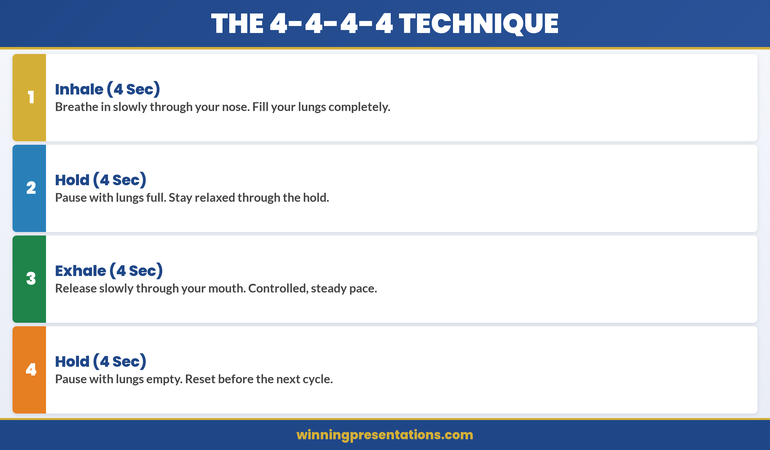
Step 1: Exhale completely
Before you begin the pattern, expel all the air in your lungs with a slow, deliberate exhale. This triggers an immediate parasympathetic response and signals to your body that you’re intentionally shifting your state.

Step 2: Inhale for four counts
Close your mouth if you’re in a shared space and breathe slowly through your nose. Count steadily: one, two, three, four. Inhale with intention but without strain.

Step 3: Hold for four counts
Once you’ve inhaled, pause without forcing. One, two, three, four. This pause is crucial—it allows your body to absorb the oxygen and signals a return to equilibrium.

Step 4: Exhale for four counts
Slowly release the breath over four counts through your mouth or nose. This is the longest part of your breathing cycle in terms of nervous system effect. Extended exhalation is where the parasympathetic activation happens.

Step 5: Hold for four counts
Pause again for four counts. You’ve completed one cycle of box breathing.

Repeat this cycle five to ten times. Three to five minutes is typically enough to restore composure before a presentation. Some executives do it for longer before particularly high-stakes moments, but diminishing returns set in after ten cycles.

The count can be adjusted if four feels uncomfortable. Some people use five or six counts per phase. The critical variables are that all four phases are equal in duration and that you’re breathing slowly and deliberately—roughly one full cycle every 20 seconds.

Ready to master your nervous system before high-stakes presentations?

Conquer Speaking Fear gives you box breathing, grounding techniques, and frameworks to manage anxiety when your reputation is on the line.
Take Control of Your Nervous System

Step-by-step box breathing technique diagram for executives before high-stakes presentations

Why Executives Resist Box Breathing

The most capable executives often resist breathing techniques, and it’s worth understanding why. There are three consistent objections.

First, it feels too simple. After years of building complex financial models and navigating geopolitical market dynamics, a four-count breathing pattern can feel trivial. The executive brain interprets simple as ineffective. But physiology doesn’t care about complexity. Your vagus nerve doesn’t require intellectual sophistication. It responds to the pattern regardless of whether you believe in it.

Second, there’s a perception problem. Some worry that using a breathing technique signals weakness or that they need external props to manage their state. The reality is inverted: controlling your physiology before a high-stakes moment is a mark of professionalism and preparation. Navy SEALs, emergency surgeons, and Olympic athletes aren’t weak. They’re disciplined about managing the variables they can control.

Third, they haven’t learned it during low-stakes moments. Attempting box breathing for the first time ten minutes before a regulatory hearing adds cognitive load when you can least afford it. The technique works best when it’s already familiar, when your body recognises the pattern and responds automatically. This is why rehearsal matters.

When to Use Box Breathing: Timing and Context

Box breathing isn’t a tool you pull out only in crisis. The executives who benefit most from it integrate it into routine preparation. Here are the most effective moments:

Fifteen to thirty minutes beforehand. This is the optimal window. Your nervous system has time to absorb the reset, but you’re close enough to the event that the effect persists. If you practise earlier, arousal will begin to climb again as you move closer. If you try it two minutes before, you might not have enough time to feel the shift.

During breaks in longer presentations or meetings. If you’re presenting for an hour with a break halfway through, use that break to do one or two cycles of box breathing. It resets your energy and brings you back into a composed state for the second half.

As part of your morning routine on presentation days. Starting the day with three to five minutes of box breathing sets your baseline lower. When the presentation happens later that day, you’re starting from a calmer physiological state, which means you don’t have as far to climb in terms of arousal.

In the moment, if you feel anxiety climbing during the presentation itself. If you’re mid-presentation and notice your heart rate rising or your thoughts becoming scattered, you can excuse yourself for 90 seconds, find a private space, do one or two cycles of box breathing, and return. The reset is noticeable even in such a compressed timeframe.

Adapting Box Breathing for Corporate Settings

The advantage of box breathing for executives is that it’s invisible. You’re not lighting scented candles. You’re not chanting. You’re not wearing any special equipment. You’re simply breathing in a particular pattern, which you can do anywhere without drawing attention.

In a conference room waiting for a board meeting to start, you can do two cycles of box breathing while reviewing your notes. In a client dinner before a major pitch, you can excuse yourself to the restroom for a discreet reset. Before stepping into a shareholder meeting, you can use the elevator ride as your practice window. The technique adapts to the environment because it requires nothing but your breath and your attention.

Some executives integrate it into their pre-presentation routine as casually as they’d check their slides or review their opening line—a standard part of preparation, not a special intervention. This normalisation is precisely what makes it sustainable over time.

If you’re concerned about appearing unusual, remember: most people are too focused on themselves to notice your breathing pattern. And if anyone does notice you taking slow, deliberate breaths before a presentation, the only conclusion they’ll draw is that you’re composed and in control.

Struggling with the structural side of your presentation?

Conquer Speaking Fear combines breathing techniques with frameworks for clarity and confidence under pressure.

Advanced Variations and Adaptations

Once you’re comfortable with the basic 4-4-4-4 pattern, several variations can be useful depending on your situation and what your nervous system needs in the moment.

Extended exhale. If you’re particularly activated, lengthen the exhale phase: 4 counts in, 4 counts hold, 6 counts out, 4 counts hold. The extended exhale amplifies parasympathetic activation. This is particularly useful if you’re feeling panic or very high arousal.

Variable pacing. You can adjust the base count from four to six or even eight, depending on your lung capacity and what feels natural. A 6-6-6-6 pattern gives you a longer cycle, which some people find more meditative. The absolute values matter less than the consistency—equal pacing across all four phases.

Layered breathing in the morning. Some executives combine box breathing with other techniques as part of their morning routine. Five minutes of box breathing, followed by a three-minute visualisation of the day’s presentations going well, followed by a grounding exercise (feet on the floor, five senses awareness). This layered approach creates a robust baseline of composure that persists throughout the day.

Real-time use during the presentation. As you become more practised, you can integrate subtle breathing patterns into your speaking without pausing. Between major points or while your audience is digesting information, you can use shortened versions of the pattern—2-2-2-2 or 3-3-3-3—to maintain a calm, centred state throughout the entire presentation.

Build your complete presentation confidence toolkit

Beyond breathing techniques, you need frameworks for handling objections, managing complex narratives, and staying composed under pressure. That’s what Conquer Speaking Fear covers.
Explore Conquer Speaking Fear

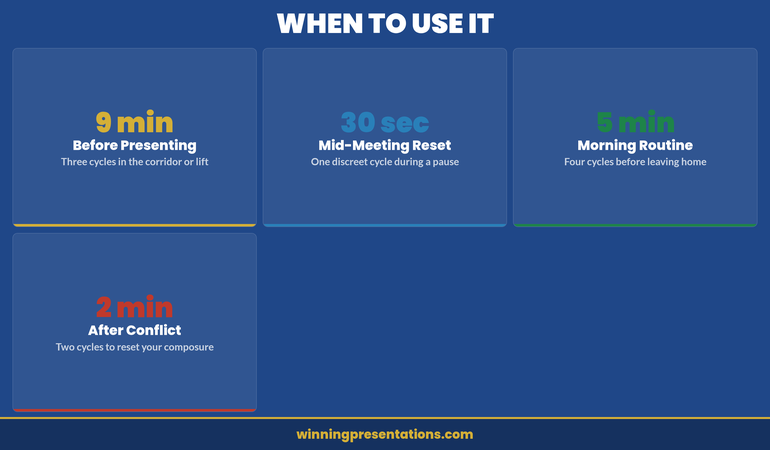
When and where executives can use box breathing in corporate settings

Frequently Asked Questions

How quickly does box breathing work?

Most people notice a physiological shift within 60–90 seconds of starting the technique. Heart rate decreases, breathing slows, and the subjective sense of calm increases. The speed of effect depends on your baseline arousal level and how practised you are. Regular practitioners report faster onset—sometimes within 30 seconds.

Can you do box breathing too much?

In practical terms, no. Box breathing is a self-regulating technique: once your nervous system reaches a calm baseline, the technique simply maintains that state. There’s no risk of over-calming yourself into lethargy before a presentation. If anything, regular practice trains your autonomic nervous system to return to baseline faster, which is a performance advantage.

What if I feel lightheaded during box breathing?

Lightheadedness usually means you’re breathing too deeply or holding too long. Reduce the count from 4 to 3 seconds, and ensure you’re breathing into your diaphragm rather than your chest. If lightheadedness persists, stop the technique and breathe normally. You may also be hyperventilating slightly—focus on the exhale being complete before starting the next inhale.

Does box breathing work if you don’t believe in it?

Yes. Box breathing works through direct physiological mechanisms—specifically, vagus nerve activation and CO2 regulation—not through placebo or belief. Your autonomic nervous system responds to the breathing pattern regardless of your cognitive stance. Sceptical executives often report being surprised by how quickly it works precisely because they didn’t expect it to.


Stay Composed Under Pressure

Box breathing is a tool for executives who want to control the variables they can influence. You can’t control whether the board will approve your proposal. You can’t control market conditions or regulatory decisions. But you can control your physiology in the minutes before you walk into the room. You can control whether your voice is steady, whether your thinking is clear, and whether your audience perceives you as composed and in command of the situation.

Those who integrate breathing techniques into their preparation routine aren’t less capable than those who don’t. They’re more disciplined. They treat their physiology the same way they treat their slides and messaging—as a critical component that requires planning and rehearsal.

Join The Winning Edge newsletter for weekly strategies on presentation structure, executive communication, and managing high-stakes moments.

Subscribe to The Winning Edge

Need to structure the presentation itself? The Executive Slide System gives you slide templates and frameworks for high-stakes executive scenarios.


See also from today:


Further reading on presentation anxiety:


About the Author

Mary Beth Hazeldine is the Owner & Managing Director of Winning Presentations. With 24 years of corporate banking experience at JPMorgan Chase, PwC, Royal Bank of Scotland, and Commerzbank, she advises executives across financial services, healthcare, technology, and government on structuring presentations for high-stakes funding rounds and approvals.

28 Mar 2026
Abstract representation of anticipatory anxiety before a high-stakes presentation showing a lone figure in a dimly lit corridor

The Anticipatory Anxiety Loop: Why Dreading the Presentation Is Worse Than Giving It

Most executives don’t fear the presentation itself. They fear the days leading up to it. The dread starts on Monday when the presentation is Friday. It builds through the week—rehearsal feedback loops in your mind, worst-case scenarios feel plausible, sleep becomes difficult. Then Thursday night arrives and you’re exhausted before you’ve even stepped in front of the room. The paradox is that the actual presentation, once it starts, rarely feels as bad as the week of anticipating it.

Amara had scheduled a board presentation for March 15th. It was important—a funding case for a new product line, the kind of thing that could accelerate her career if she landed it. When she put it on her calendar on February 28th, it felt manageable.

By March 10th, five days before, her stomach started tightening every morning. She rehearsed in her head while commuting. She woke at 3 a.m. replaying questions she imagined the board might ask. She changed slides twice—not because they were broken, but because she was searching for safety that no slide could provide.

On March 14th, exhausted, she called a colleague. “I’m not sleeping. I’m stressed about this. I don’t know if I’m ready.” The colleague asked: “Do you know your material?” “Yes,” she said. “Could you explain the investment case to me right now?” “Yes, easily.” “Then the presentation will be fine. The dread you’re feeling isn’t about readiness—it’s just dread.”

It was the most useful thing anyone said to her that week. Not “You’ll be great,” which felt hollow. Not “Don’t be nervous,” which is impossible. Just: “That feeling isn’t information. It’s just the anticipatory loop running.”

If presentation anxiety is making the week before your big talk harder than the talk itself, you might explore Conquer Speaking Fear. It’s structured specifically for acute presentation anxiety—with nervous system techniques, reframing exercises, and practical tools designed for the hours leading up to high-stakes presentations.

Explore Conquer Speaking Fear →

What is anticipatory anxiety?

Anticipatory anxiety is the worry you experience before an event—in this case, a presentation. It’s not the nervousness you feel when the presentation actually starts. It’s the dread that builds in the days (or hours) leading up to it.

The distinction matters because the two anxieties serve different purposes. Nervousness during the event is your nervous system preparing you to perform. Adrenaline, focus, heightened awareness—these are useful. Your mind narrows, your perception sharpens, you adapt to the room’s energy.

Anticipatory anxiety is different. It’s abstract worry about something that hasn’t happened yet. Your mind runs through scenarios. You imagine questions you can’t answer. You rehearse failed moments. You lose sleep. You check the slides one more time looking for problems. You might feel physically unwell—nausea, chest tightness, difficulty concentrating.

And here’s the cruel part: anticipatory anxiety doesn’t improve your performance. It just makes the waiting harder. By the time the presentation arrives, you’re already depleted.

Why it intensifies the longer you wait

Anticipatory anxiety follows a predictable pattern. The further away the presentation, the more abstract your fear. “I have a board presentation in six weeks.” Manageable. “I have a board presentation next Friday.” Now it’s concrete. “I have a board presentation tomorrow.” Now your nervous system is engaged.

Each day that passes without the event happening allows your mind to generate new “what if” scenarios. What if the projector fails? What if I forget my key points? What if they ask me something I can’t answer? What if I panic?

Most executives, particularly those who care about performance, respond to anticipatory anxiety by preparing harder. You run the presentation again. You revise the slides. You rehearse answers to tougher questions. This is rational—if I’m more prepared, I’ll be less anxious.

But the research is clear: beyond a certain point, additional preparation doesn’t reduce anticipatory anxiety. It reinforces it. Each rehearsal is another opportunity to find something “wrong” or to imagine the audience’s judgment. You’re feeding the anxiety loop, not breaking it.

The anticipatory anxiety cycle showing four stages: trigger, catastrophise, avoid, and escalate

Techniques Designed for Presentation Anxiety

Conquer Speaking Fear gives you nervous system techniques, reframing exercises, and decision-making frameworks designed for acute presentation anxiety—the kind that starts days before and peaks the morning of.

  • Nervous system reset techniques for anxiety spirals
  • Reframing exercises that separate dread from actual risk
  • Pre-presentation routines that build confidence
  • Tools to manage the anxious mind without ignoring it

Explore Conquer Speaking Fear — £39

Designed for executives managing acute presentation anxiety

The neuroscience of dread

Your brain doesn’t distinguish between anticipating something bad and experiencing it. When you imagine the board asking a question you can’t answer, your amygdala (your brain’s threat detector) activates as if it’s happening right now. Your nervous system releases cortisol and adrenaline. Your heart rate rises. You feel the physical symptoms of anxiety even though the threat is imagined.

This is useful when you’re genuinely in danger. Your body prepares you to fight or flee. But when the threat is abstract—”What if I mess this up?”—the physical response becomes a problem. You can’t fight or flee from a presentation. You can only sit with the activation.

The longer the time between now and the presentation, the more time your mind has to rehearse worst-case scenarios. Each rehearsal deepens the neural pathway, making the anxiety feel more real, more inevitable. By Thursday night, your brain has convinced you that failure is probable, even though nothing has actually happened.

Add sleep disruption to this equation, and your emotional regulation gets worse. You’re more irritable, more prone to catastrophic thinking, less able to distinguish between real risk and imagined risk. The presentation itself hasn’t changed. Your mental state has deteriorated.

How to break the loop

The first step is recognising that anticipatory anxiety is not information about your readiness. It’s a feeling that your nervous system is generating based on threat-perception, not on actual risk assessment.

This seems obvious when you read it. But in practice, when you’re exhausted and anxious, your mind treats dread as evidence. “I’m this anxious, so something must be genuinely wrong.” In fact, you can be completely prepared and still experience intense anticipatory anxiety. The two are independent.

The second step is stopping the preparation loop. Once you reach a threshold of readiness—you know your material, you’ve done one solid rehearsal, you have answers to likely questions—additional rehearsal is counterproductive. It gives your anxious mind more material to worry about.

Instead of rehearsing more, you need to:

  1. Name the loop: “This is anticipatory anxiety, not actual danger. It will pass.”
  2. Interrupt the rehearsal: When you notice yourself running through scenarios, consciously stop. Physical activity (a walk, a gym session) interrupts the mental loop more effectively than trying to think your way out of it.
  3. Reset your nervous system: Breathing techniques, cold water, grounding exercises—these activate your parasympathetic nervous system and counteract the threat activation.
  4. Establish a boundary: “I will prepare until Wednesday. After that, no more slides, no more rehearsal.” This protects you from the preparation loop extending into the presentation day.
  5. Redirect attention: The night before, shift focus away from the presentation. Read something unrelated. Spend time with people you care about. Let your mind rest from the threat narrative.

If your anticipatory anxiety is severe enough to disrupt your sleep or work in the days before a presentation, Conquer Speaking Fear includes specific nervous system techniques designed for those hours when the dread feels most intense.

Four-step roadmap for breaking the anticipatory anxiety loop before presentations

In practice, breaking the anticipatory anxiety loop follows four moves. The first is to acknowledge — name the dread without judging yourself for feeling it. “I’m anxious about Thursday’s presentation” is a statement of fact, not a confession of weakness. The moment you name it, you create distance between yourself and the feeling. You’re observing the anxiety rather than being consumed by it.

The second move is to prepare early — start with one slide to break the avoidance pattern. Anticipatory anxiety often creates a paradox: the dread makes you avoid the very preparation that would reduce it. Opening the presentation file and writing a single slide title — even a bad one — interrupts avoidance. Action, however small, breaks the freeze.

The third is to rehearse aloud — speak the opening three times to build familiarity. Not a full run-through. Just the first sixty seconds. Your voice forming the words builds a physical memory that your body can fall back on when anxiety spikes. The opening is where panic is strongest. If your mouth already knows the first two sentences, your nervous system calms faster.

The fourth move is to reframe — shift your focus from performance to contribution. Instead of “Will I do well?”, ask “What does the room need from me?” When you reframe the presentation as a contribution rather than a test, the threat perception drops. You’re not being judged; you’re providing something valuable. That distinction changes how your nervous system responds to the approaching event.

Practical strategies that shift anxiety to readiness

Beyond interrupting the anxiety loop, there are specific practices that help executives convert anticipatory dread into something more useful: focused readiness.

Compartmentalise the presentation time. Instead of thinking about “the presentation” as this amorphous future threat, break it into concrete actions: What do you do 10 minutes before you start? What’s your opening line? Where do you stand? What do you do if you forget a point? When you focus on specific micro-actions rather than “Will I perform well?”, your brain shifts from threat-assessment to task-execution.

Create a pre-presentation routine. The night before, the morning of, the hour before—develop a specific sequence of actions that signal to your nervous system, “This is expected. This is manageable.” For some people it’s a specific breakfast, a particular walk, a few minutes of breathing. The content matters less than the consistency. Routines reduce the novelty and uncertainty that feed anticipatory anxiety.

Identify your specific “what if” fears and reality-test them. Not generally—specifically. If your fear is “What if they ask me something I don’t know?”, the reality is: “If they ask something I don’t know, I’ll say, ‘That’s a great question—let me follow up with you separately.’ And the presentation continues.” You’re not avoiding the fear; you’re proving to yourself that you can handle it.

Separate the days before from the day of. What you do Monday through Thursday should be different from what you do Friday morning. Early in the week, preparation and rehearsal are valuable. As you approach presentation day, shift to rest, routine, and nervous system regulation. This signals a boundary between “get ready” and “be ready.”

Managing the evening before

The evening before a high-stakes presentation is often the worst moment for anticipatory anxiety. You’ve done all the prep you can. The event is real and imminent. Your mind is searching for something to control.

Here’s what actually helps:

Do not rehearse the presentation. You’ve already rehearsed. One more run-through will not make you more confident. It will only give your anxious mind more material to second-guess. Close the laptop. Put the slides away.

Engage in something that requires focus. Cook a meal. Watch a film that demands your attention. Play a game that requires strategy. Anything that pulls your conscious mind away from the anticipatory narrative. You’re not ignoring the anxiety; you’re not giving it the spotlight.

Manage the physical symptoms directly. If you can’t sleep, don’t lie in bed fighting the insomnia. Get up. Read. Stretch. The pressure to “get good sleep before the big day” can itself generate anxiety. Sleep matters, but obsessing about sleep is counterproductive. A mediocre night’s sleep followed by a good presentation is far better than an anxious night spent worrying about sleep.

Remember that the nervousness you feel the morning of is not a problem to solve—it’s your nervous system preparing you. Some anxiety on presentation day is actually useful. It sharpens focus. It elevates your energy. The goal is not to eliminate it. The goal is to interpret it correctly: “This is not danger. This is readiness.”

Nervous System Tools for Presentation Anxiety

Conquer Speaking Fear includes breathing techniques, reframing exercises, and pre-presentation routines designed for the hours when anxiety is most intense.

Get the Tools — £39

Frequently asked questions

Is it normal to feel this anxious about a presentation?

Yes. High-stakes presentations trigger real physiological responses. Your nervous system perceives public performance as a potential threat. This is true across cultures and industries. The executives who manage it best aren’t those who don’t feel anxiety—they’re those who understand what anticipatory anxiety is and have tools to work with it.

Does better preparation reduce anticipatory anxiety?

To a point, yes. But after you’ve reached competence—you know your material, you can answer likely questions, you’ve done a full rehearsal—additional preparation doesn’t reduce anxiety. It often increases it because each rehearsal creates new opportunities for self-criticism. The threshold is usually after one to two solid rehearsals, not five or ten.

What if my anxiety is so severe that I’m considering cancelling the presentation?

Severe anticipatory anxiety (where you’re genuinely considering avoidance) is a signal to get support. This might be a coach, a therapist, or someone trained in anxiety management. Avoidance reinforces anxiety—it tells your nervous system, “This is genuinely dangerous.” But with structured support and targeted techniques, even severe anticipatory anxiety can be managed. You do not have to cancel.

Get practical frameworks for high-stakes presentations. Join The Winning Edge, a weekly newsletter for executives who lead with confidence. Presentation techniques, communication frameworks, anxiety management—sent to your inbox every Thursday.

Subscribe to The Winning Edge →

Related: If you’re presenting quarterly results or a strategic plan, read The Q2 Planning Presentation: Setting Your Team Up for the Next 90 Days for a structural framework that reduces the pressure on delivery.

Anticipatory anxiety is not a sign of weakness or lack of readiness. It’s how your nervous system responds to stakes. The executives who manage it best don’t ignore the dread—they work with it. They understand what it is, they interrupt the rehearsal loop, they protect their sleep, they develop routines, and they remember that the anxiety before the presentation is almost always worse than the presentation itself. You don’t need it to disappear. You need to understand it, and then move forward anyway.

Mary Beth Hazeldine is Owner & Managing Director of Winning Presentations. With 24 years of corporate banking experience at JPMorgan Chase, PwC, Royal Bank of Scotland, and Commerzbank, she advises executives across financial services, healthcare, technology, and government on structuring presentations for high-stakes funding rounds and approvals.