

Quick answer: You do not influence board members during the presentation. You influence them in the days before it, in the one-to-one conversations that decide where each member stands before they walk into the room. By the time the meeting starts, most board decisions are already substantially made — the presentation either confirms a leaning or, if you have done no pre-work, exposes you to a room full of positions you have never tested. The work that actually moves a board is the pre-read that lands two days early and the pre-wire conversations that surface each member’s real objection while there is still time to address it. The presentation is where the decision is ratified, not where it is won.
JUMP TO:
In 2016, I watched a capital proposal get approved in under ten minutes, and the presenter who delivered it was not the reason. He was competent — a clear deck, a steady voice — but the decision had been settled the previous week. The chair had spoken to three of the five members individually, the proposal sponsor had walked the finance director through the numbers over a quiet lunch, and the one member likely to object had been heard, and partly accommodated, in a phone call two days before. By the time the presenter stood up, every position in the room was known and every objection had already been worked. The presentation confirmed a decision; it did not create one.
A month later I watched the opposite. A strong proposal, arguably stronger than the first, presented by someone who had done none of that pre-work. He walked into the room cold, met five positions he had never tested, and spent the whole slot reacting — a question he had not anticipated from one member, a concern from another that turned out to be a known sensitivity everyone but him understood, a quiet sponsor who said nothing because no one had asked them to speak up. The proposal was deferred for “further consultation.” The consultation that would have saved it was the consultation he should have done before the meeting, not the one the board now ordered after it.
(This article was created with AI assistance; all stories and insights are based on 35 years of real client work.)
The difference between the two was not the quality of the proposal or the polish of the delivery. It was that the first presenter understood where board influence actually happens, and the second believed it happened in the room. Almost everyone believes it happens in the room. It is the single most expensive misunderstanding in board presenting, because it concentrates all the effort on the slot where the least influence is available.
If you need board members on side before the meeting starts:
The Executive Buy-In Presentation System is the self-paced programme for exactly this — stakeholder analysis, decoding resistance, and the pre-work and structures that turn reluctant board members into advocates. 7 modules, optional recorded Q&A calls. £499, lifetime access to materials.
Why board decisions are mostly made before the meeting
Board members are senior people with limited time and strong prior views. They do not arrive at a meeting as blank slates waiting to be persuaded by a deck. They arrive with a leaning, formed from the pre-read if there was one, from conversations with the chair and with each other, and from their own standing priorities. The meeting is where those leanings are surfaced, tested against each other, and resolved — but the raw material of the decision is already in the room before you start speaking.
This is not cynicism about how boards work; it is how serious decisions get made by busy senior people. Nobody wants to form a view on a seven-figure commitment for the first time, live, while a presenter clicks through slides. They want to have thought about it, raised their concern with someone, and heard a response before they have to commit in front of their peers. A board member ambushed by a proposal they have not pre-considered will default to the safe answer, which is “not yet.” Deferral is the path of least risk for anyone caught undecided, and an undecided board member is one you failed to reach before the meeting.
So the leverage is not in the room. The leverage is in the days before, when each member still holds their position privately and can move without losing face in front of their peers. A board member will adjust a view in a one-to-one conversation that they would defend to the death in open session, because in private there is nothing to defend. Influence lives in that private window, and it closes the moment the meeting opens. For the specific case of a board that already has reservations about you personally, the related dynamics are in mapping difficult stakeholders before a presentation.
The pre-read and the pre-wire: the two moves that matter
The framework I give every senior leader presenting to a board has two parts, and I call it the pre-read and the pre-wire. The pre-read is the document. The pre-wire is the set of conversations. Both happen before the meeting, and together they do most of the work that the presentation gets the credit for.
The pre-read is a short document — two pages, not the full deck — that lands with board members two clear days before the meeting. Two days, not the night before, because the purpose is to give each member time to form a considered view and, crucially, time to raise a concern with you before the meeting rather than in it. The pre-read states the recommendation first, the case in brief, and the specific decision being asked for. A pre-read sent too late, or padded to thirty pages, does the opposite of its job: it arrives unread, and the member forms their first view live in the room, which is the outcome you were trying to prevent.
The pre-wire is the set of one-to-one conversations with the board members who matter most to the outcome — typically the chair, the member most likely to object, and your sponsor. The conversation has one purpose: to surface each member’s real objection while there is still time to address it. You are not selling in these conversations; you are listening for the thing that would make them say “not yet,” so you can either accommodate it in the proposal or prepare a genuine answer for the room. The objection you hear in a quiet pre-wire is a gift, because the alternative is meeting it for the first time in open session with no time to respond. Pay particular attention to the sponsor who will not be vocal unless asked — the supportive member who stays silent because no one briefed them to speak is wasted influence, a dynamic covered in what to do when your sponsor is not in the room.
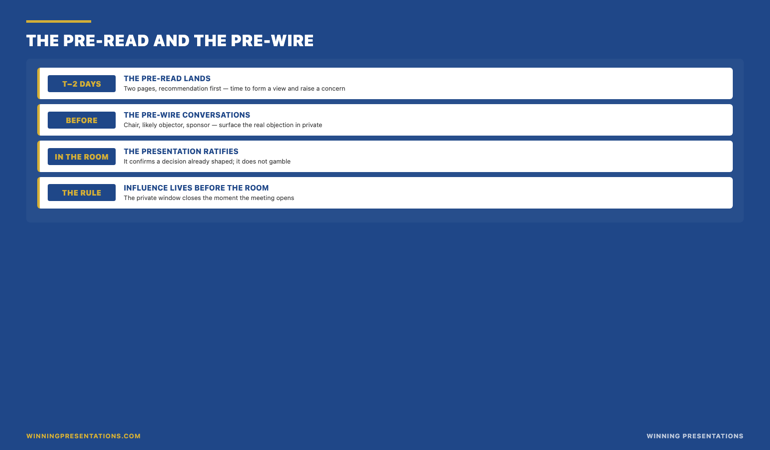
Done together, the pre-read and the pre-wire change what the meeting is. Instead of a verdict delivered on a proposal the board is meeting for the first time, it becomes a ratification of a decision that has already been substantially shaped through the pre-work. The objections have been heard. The accommodations have been made. The sponsor knows their cue. The presentation confirms; it does not gamble.
Turn reluctant board members into advocates before the meeting.
The Executive Buy-In Presentation System is the self-paced programme that teaches the whole influence sequence — reading the room before it convenes, decoding what each member needs in order to say yes, and building the case and the pre-work that get senior approval. 7 modules, monthly cohort enrolment, optional live Q&A / coaching calls that are fully recorded so you can watch back anytime. £499, lifetime access to materials.
- Stakeholder analysis and the psychology of decoding resistance before the meeting
- The pre-work and case construction that turn reluctant stakeholders into advocates
- 7 self-paced modules — no deadlines, no mandatory live attendance
- New cohort opens every month — lifetime access to all course materials
The count test: how much influence work have you actually done?
There is a simple, uncomfortable test for whether you have done the influence work, and it is a count. Before your next board presentation, count how many board members you will have had a real one-to-one conversation with — about this specific proposal — before the meeting. Not a copied email. Not a hallway hello. A conversation in which you asked what would make them hesitate and listened to the answer.
If the count is zero, you have done no influence work, and your presentation is a gamble in which you will meet every position in the room for the first time live. If the count is one — usually your sponsor — you have a friend but no map of the resistance. If the count covers the chair, the likely objector, and your sponsor, you have done the work that actually moves boards, and the meeting is yours to confirm rather than yours to survive. The number you are aiming for is not “all of them”; it is the two or three whose positions decide the outcome. The test is honest because it cannot be fudged: either you had the conversations or you did not, and the count tells you which board meeting you are about to walk into.
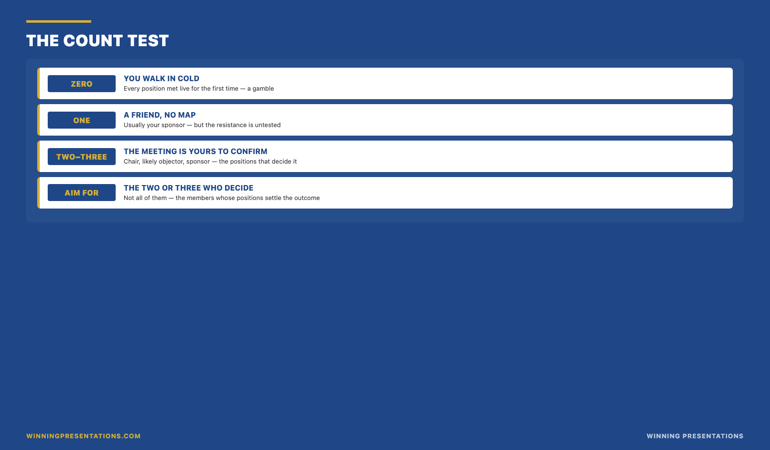
Run the count now, for your next one. If it is zero or one, you have your answer about where this week’s effort should go — and it is not into another revision of the deck. It is into the diary, finding time for two conversations before the meeting. The structural side of building the case those conversations refer back to is covered in getting board approval through presentation training.
For the deck the pre-read and the room both rely on:
The Executive Slide System gives you the 26 board-ready templates, 93 AI prompts, and 16 scenario playbooks behind senior decision presentations — including the recommendation-first structures that make a two-page pre-read and a clean board slot possible. £39, instant access. The structural complement to the influence work.
What the presentation itself is for
None of this means the presentation does not matter. It means its job is narrower and more specific than people assume. In a meeting where the pre-work is done, the presentation does three things: it gives each member a clean, shared version of the case so the discussion starts from the same place; it provides the moment where the chair can move the group from individual leanings to a collective decision; and it gives you the chance to handle the one or two objections that the pre-wire surfaced but could not fully resolve. That is real work, but it is confirmation work, not persuasion work.
The practical consequence is that the presentation should be built to support a decision the room is ready to make, not to make the case from scratch as if to strangers. Lead with the recommendation, because everyone has already pre-considered it. Keep it short, because the discussion is where the value is. Leave room for the objection you know is coming, because you heard it in the pre-wire and have prepared a genuine answer. A board presentation built this way feels almost anticlimactic from the inside — and that flatness is the sign you did the influence work in the right place. The dramatic board presentation, where everything hangs on the delivery, is almost always the one where the pre-work was skipped.
This month’s cohort enrolment is open.
The Executive Buy-In Presentation System opens a new cohort enrolment every month, and this month’s is open now. Self-paced, 7 modules, optional recorded Q&A calls, lifetime access. £499. Pair it with the wider toolkit in the Complete Presenter bundle (£99, seven products) when you want the slides, storytelling, and delivery assets alongside the framework.
Frequently asked questions
Is pre-wiring board members not just lobbying or going behind the chair’s back?
No — done properly, the chair is the first person you pre-wire, not someone you work around. Pre-wiring is the normal, expected practice of giving senior decision-makers the chance to consider a proposal and raise concerns before they have to commit in front of their peers. It is transparent: you are not hiding the conversations, you are having the consultation that serious decisions require. What looks like going behind backs is the opposite of this — surprising a board with an unconsulted proposal and hoping the deck carries it. The respectful move is to let people think before they decide.
What if I cannot get one-to-one time with senior board members?
Start with the ones you can reach and the ones who matter most — usually your sponsor and the member most likely to object — rather than abandoning the pre-wire because you cannot reach everyone. For members you genuinely cannot meet, the pre-read does more of the work, so invest in making it land: short, recommendation-first, sent two clear days ahead. You can also ask your sponsor or the chair to carry a question to a member you cannot access directly. Partial pre-wiring beats none; the count test is about doing the work where you can, not perfection.
How far in advance should the pre-read reach board members?
Two clear days before the meeting is the working rule. Earlier than that and it risks being read and forgotten; the night before and there is no time for a member to form a considered view or raise a concern with you while it can still be addressed. Two days gives each member time to think, time to flag an objection in the private window, and time for you to respond before the room convenes. Keep it to roughly two pages — recommendation first, the case in brief, the specific decision being asked for — not the full deck.
Does this work the same way for an investment committee or executive committee?
The mechanics are nearly identical, because the underlying dynamic is the same: senior people with limited time and strong priors, deciding in front of their peers, who do not want to form a first view live. Investment committees often have an even stronger pre-read culture, which makes the document more load-bearing; executive committees can be more relationship-driven, which makes the pre-wire conversations more so. The two moves — pre-read and pre-wire — apply to any senior decision-making body. What changes is the weighting between them, not the principle.
The Winning Edge — weekly newsletter
The Winning Edge is a weekly newsletter for senior professionals who present at the executive level. One short email a week on the structural moves that separate decks committees back from decks they defer. Subscribe to The Winning Edge →
About the author
Mary Beth Hazeldine is Owner & Managing Director of Winning Presentations Ltd. With 24 years of corporate banking experience at JPMorgan Chase, PwC, Royal Bank of Scotland, and Commerzbank, she advises executives across financial services, healthcare, technology, and government on structuring presentations for high-stakes funding rounds, board approvals, and strategic decisions.