Tag: stakeholder mapping

14 Feb 2026
Executive mapping stakeholder names and influence dynamics on whiteboard before high-stakes presentation

The Political Landscape Map: Who Blocks, Who Enables, Who Decides

The Political Landscape Map: Who Blocks, Who Enables, Who Decides

Quick answer: Most presentations fail because of politics, not content. Before you build a single slide, you need to map three things: who has the power to say yes, who will quietly block you, and who can champion your recommendation when you’re not in the room. This article gives you the framework to identify all three — and a system for navigating each.

The best deck I ever helped a client build got rejected in seven minutes.

It wasn’t the content. The data was solid. The recommendation was clear. The slides were tight — twelve of them, structured exactly right. My client, a Head of Strategy at a mid-cap bank, had rehearsed until the delivery was calm and confident.

The problem was a person he’d never spoken to. A Group Risk Director sitting three chairs from the decision-maker. She had concerns about implementation timelines that nobody had surfaced before the meeting. When the CFO looked at her for a reaction, she shook her head. Meeting over.

Afterwards, my client said: “I prepared for every question. I just didn’t prepare for every person.”

That sentence changed how I teach presentation strategy. In 24 years of corporate banking at JPMorgan Chase, PwC, Royal Bank of Scotland, and Commerzbank, I watched this pattern repeat hundreds of times: brilliant content, devastating political blindspot. The people who consistently got approvals weren’t the best presenters. They were the ones who mapped the room before they entered it.

That mapping process is what I now call the Political Landscape Map.

Why Politics Kills More Presentations Than Bad Slides

Here’s something most presentation training ignores entirely: the decision about your recommendation is rarely made during your presentation.

It’s made before, in conversations you weren’t part of. In hallway exchanges between stakeholders. In the silent risk calculations happening while you’re still on slide two. In the relationship dynamics between people who have history you know nothing about.

When executives decide, they silently ask three questions: What happens if I say yes and it goes wrong? What happens if I say no and miss out? Can I defend this decision to my peers? Your slides can answer the first two. Only political preparation can answer the third.

The uncomfortable truth is that most professionals prepare exclusively for the content challenge — clearer data, better structure, tighter delivery. But in rooms where decisions involve multiple stakeholders, political dynamics determine outcomes more often than presentation quality.

This doesn’t mean content doesn’t matter. It means content is necessary but not sufficient. You need both the right slides and the right relationships with the people evaluating them.

PAA: Why do good presentations still get rejected?
Good presentations get rejected when the presenter addresses the content but not the politics. If a key stakeholder has concerns that weren’t surfaced before the meeting, or if someone in the room feels bypassed or threatened by the recommendation, no amount of data will overcome that resistance. Mapping the political landscape before you present is as important as building the deck itself.

The System for Getting Decisions — Not Just Delivering Presentations

The Executive Buy-In Presentation System teaches you how decisions actually get made in senior rooms — and how to position yourself on the right side of that decision before you open your mouth. 7 modules covering decision psychology, stakeholder mapping, proof strategy, and pressure response.

Includes: Decision Definition Canvas • Stakeholder Landscape Map template • Proof Selector Matrix • Executive Buy-In Blueprint • Pressure Response Playbook with scripts

Get the Executive Buy-In System → £199

Self-study programme with modules released over 4 weeks + live Q&A calls. Currently £199 — price rises to £499 (self-study) / £850 (live cohort) on March 1st.

The Three Roles in Every Decision Room

Every room where a significant decision gets made contains three types of people. Your job is to identify all of them before you present — not during.

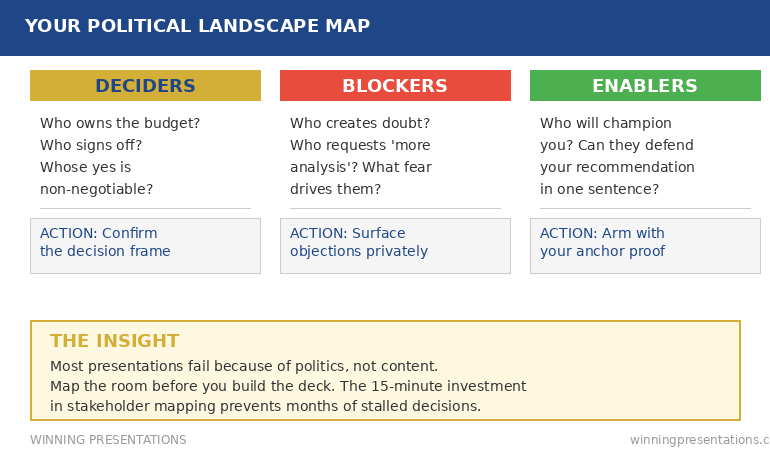
I call this framework the Decider / Blocker / Enabler model — a political landscape map that categorises every stakeholder by their role in the decision, not their title on the org chart. It’s the same approach used in change management and consulting, adapted specifically for high-stakes executive presentations where the politics of the room matter as much as the quality of the slides.

The Decider. This is the person whose “yes” actually matters. In some rooms, it’s obvious — the CEO, the CFO, the Board Chair. In others, it’s not. I once watched a VP present to a room of eight people, addressing his entire pitch to the most senior person present. The actual decision-maker was a Commercial Director two levels below, who controlled the budget line. The VP never made eye contact with her. The proposal died.

The Decider isn’t always the most senior person. They’re the person who owns the budget, the risk, or the political capital required to move forward. Ask yourself: Who actually signs off on this? Whose approval is non-negotiable?

The Blocker. This is the person who can prevent your recommendation from being approved — even if they can’t approve it themselves. Blockers don’t always announce themselves. They ask careful questions. They raise “concerns for consideration.” They request “further analysis.” My client’s Group Risk Director was a classic blocker: she didn’t reject the proposal directly. She simply signalled doubt, and the room followed.

Blockers are motivated by different fears. Some worry about career risk — what if this makes me look bad? Some worry about territorial loss — does this reduce my influence? Some have legitimate technical concerns that haven’t been addressed. The key is understanding which fear is driving the resistance, because each requires a different response.

The Enabler. This is the person who will champion your recommendation when you’re not in the room. Enablers are the most underutilised asset in executive presentations. They’re the colleague who says “I’ve seen the analysis, it’s solid” in the pre-meeting conversation. They’re the board member who turns to the Decider and says “I think this addresses my concern from last quarter.”

You can’t create enablers in the presentation itself. You create them before it — through pre-meeting alignment conversations that give them the information and confidence to support you publicly.

Do this in 60 seconds before your next deck:

Write down the names of everyone in the room. Label each person: D (Decider), B (Blocker), or E (Enabler).

If you can’t label them, you’re not ready to present yet.

Fix it fast: The Executive Buy-In Presentation System (£199 — rises March 1st) includes a ready-to-use Political Landscape Map template + the Decision Definition Canvas so you can do this properly in under 10 minutes.


Executive mapping stakeholder names and influence dynamics on whiteboard before high-stakes presentation

The Executive Buy-In Presentation System includes the Decision Definition Canvas and the Proof Selector Matrix — tools specifically designed to map stakeholder dynamics and match your approach to each person’s concerns. Learn more about the Executive Buy-In System (£199).

Building Your Political Landscape Map

The map itself takes 15 minutes. The intelligence it reveals can save you months of stalled decisions.

For every significant presentation, before you build a single slide, write down every person who will be in the room (or who influences people in the room). Then answer four questions about each:

1. What is their role in this decision? Decider, Blocker, or Enabler. Some people are genuinely neutral — they’ll follow whoever has the strongest signal. Mark them too. They matter because they’re the audience your Enablers are trying to influence.

2. What is their primary fear? Career risk, financial risk, reputation risk, or timing risk. This isn’t about what they’ll say — it’s about what they’re silently calculating. A CFO who asks “What’s the ROI?” is usually asking “What happens to me if this loses money?” Those are different questions requiring different answers.

3. What is their relationship to your recommendation? Does this increase or decrease their influence? Does it create work for their team? Does it solve a problem they’ve been publicly advocating for — or does it contradict something they’ve championed before? People don’t evaluate recommendations in isolation. They evaluate them through the lens of their own position.

4. What would make them feel safe saying yes? This is the critical question. Not “what evidence would convince them?” but “what would reduce their perceived risk enough to support this?” For some, it’s precedent. For others, it’s a guarantee of reversibility. For others, it’s simply being consulted before the meeting so they don’t feel ambushed.

PAA: How do you identify stakeholder dynamics before a presentation?
Start by listing everyone in the room and categorising them as Decider, Blocker, Enabler, or Neutral. Then identify each person’s primary concern — career risk, financial risk, reputation risk, or timing risk. Finally, have one-on-one conversations before the meeting to surface objections and build support. The goal is to know the room’s dynamics before you enter it.

Decisions Happen Before the Meeting. Your Preparation Should Too.

Module 1 of the Executive Buy-In System includes the Decision Definition Canvas — a diagnostic that maps the decision, the decision-maker, the perceived risk, and the success criteria in under 10 minutes. Module 4 teaches you how to match proof to each stakeholder’s specific fear type.

Get the Executive Buy-In System → £199

Study at your own pace with live Q&A calls for support. 7 modules, 36 lessons, built from real boardroom experience where political preparation consistently separated approved proposals from stalled ones.

Presenting this week? Do this in 15 minutes:

1. List every attendee + two influencers who won’t be in the room but shape opinions.
2. Label each: D (Decider) / B (Blocker) / E (Enabler) / N (Neutral).
3. Write each person’s likely fear: career risk, financial risk, reputation risk, or timing risk.
4. Schedule one 10-minute conversation with the most likely Blocker.
5. Add one slide that directly addresses the Blocker’s concern.
6. Confirm the decision question with the Decider’s office.

How to Work the Map Before You Present

The map is useless if you build it and then present as though you haven’t. Here’s how to act on it.

For Deciders: Confirm the decision frame. Before the meeting, have a brief conversation with the Decider (or their gatekeeper) to confirm what decision they’re actually expecting. “I want to make sure I’m structuring this around the right question — is the decision whether to proceed, or which option to proceed with?” This single question has saved my clients more time than any slide redesign. It also signals competence — you’re thinking about their decision, not your content.

For Blockers: Surface the objection privately. This is the most important step, and the one most people skip. Meet the Blocker before the presentation. Not to persuade them — to listen. “I’m presenting the X recommendation next week. I’d value your perspective before I finalise the approach.” Most Blockers don’t want to destroy your proposal. They want their concern acknowledged. When they feel heard in private, they’re far less likely to ambush you in public.

If you discover a concern you can address, build it into your presentation explicitly: “Sarah in Risk flagged the implementation timeline, and I’ve adjusted the phasing to reflect that.” This does two things: it neutralises the objection and it publicly credits the Blocker, which converts them from opponent to contributor.

For Enablers: Arm them with your anchor proof. Your Enabler can only champion your recommendation if they can articulate why it’s the right call — in one sentence, from memory, to sceptics. Give them that sentence. “The anchor proof is [X]. If anyone pushes back on [concern], the response is [Y].” When your champion can defend your recommendation as confidently as you can, the decision doesn’t depend solely on your performance in the room.

For Neutrals: Make the default easy. Neutral stakeholders will follow the strongest signal. If your Enabler speaks first and confidently, Neutrals tend to follow. Structure your presentation so the ask is clear and the next step is simple. People default to “yes” when saying yes is easier than asking more questions.

If you’re interested in the broader stakeholder mapping process for your executive presentations, I’ve written a detailed tactical guide.

The Executive Buy-In System covers this entire process in depth — from the Decision Definition Canvas (Module 1) through pressure response scripts for when Blockers challenge you in the room (Module 6). See the full Executive Buy-In System syllabus (£199).

What to Do When the Politics Are Against You

Sometimes you map the landscape and the picture isn’t good. The Blocker is powerful. Your Enabler is junior. The Decider is risk-averse. What then?

Don’t present until the ground is prepared. The biggest mistake I see is professionals walking into rooms they haven’t prepared politically because “the meeting is already scheduled.” Postponing a meeting to do proper alignment work is almost always a better outcome than presenting into a hostile or uncertain room. You lose a week. You gain a decision.

Reframe the ask to reduce perceived risk. If the political landscape suggests a full “yes” is unlikely, consider presenting a smaller ask: a pilot, a phased approach, a “proceed to next stage” rather than “approve the full programme.” This isn’t weakness — it’s reading the room accurately and adapting. Executives trust people who propose manageable risks over those who push for everything at once.

Use the Blocker’s language in your framing. If you’ve had a pre-meeting conversation with the Blocker, use their exact words in your presentation. “As [Name] rightly pointed out in our earlier conversation, the implementation timeline needs careful sequencing.” This isn’t manipulation — it’s demonstrating that you’ve listened. It’s remarkably difficult for someone to oppose a recommendation that explicitly incorporates their concern.

PAA: What do you do when executives resist your presentation recommendation?
First, diagnose the type of resistance. Is it a content objection (they need more evidence), a risk concern (they need reassurance), a political dynamic (they have competing interests), or a trust issue (they don’t yet believe you can deliver)? Each requires a different response. The psychology of executive buy-in is about addressing the real concern, not just the stated one.

Stop Presenting Into Rooms You Haven’t Read

The Executive Buy-In Presentation System teaches you how senior people actually decide — and how to structure your approach around their psychology, their politics, and their risk calculations. 7 modules: decision clarity, buy-in structure, credibility, proof strategy, AI execution, pressure response, and your personal executive playbook.

Get the Executive Buy-In System → £199

⏰ Launch pricing ends March 1st. The price rises to £499 (self-study) / £850 (live cohort). Lock in £199 before it changes.

Self-study modules + live Q&A calls. Built from 24 years in corporate banking where political preparation consistently separated approved proposals from stalled ones.

Frequently Asked Questions

How far in advance should I map the political landscape?

For high-stakes presentations (board approvals, budget requests, major client pitches), start mapping at least two weeks before. You need time for one-on-one conversations with Blockers and Enablers. For routine updates, a quick mental map the day before is usually sufficient — but even five minutes of stakeholder thinking prevents most political blindspots.

What if I can’t get access to the Blocker before the meeting?

If direct access isn’t possible, find someone who has it. Ask a mutual colleague: “What’s [Name]’s main concern about this area right now?” Even indirect intelligence is better than walking in blind. If you truly can’t get any information, acknowledge the gap in your presentation: build in a slide that explicitly addresses the most likely objection from that person’s position. Showing you’ve anticipated their concern — even without a conversation — signals respect for their perspective.

Is this approach manipulative?

Stakeholder mapping is standard practice in change management, consulting, and programme leadership. It’s not about manipulating anyone — it’s about understanding what different people need in order to feel confident making a decision. The pre-meeting conversations are about listening, not persuading. The goal is to build a presentation that genuinely addresses everyone’s legitimate concerns, not to circumvent them.

How do I handle a situation where two stakeholders have conflicting interests?

This is more common than most people realise. When stakeholders conflict, your job is to name the tension rather than pretend it doesn’t exist. “I’m aware that this recommendation creates different priorities for Operations and Finance, and I’ve tried to structure a phased approach that addresses both.” Naming the conflict demonstrates political awareness. Ignoring it guarantees that one side will surface it — on their terms, not yours.

📬 The Winning Edge Newsletter

Weekly executive presentation strategies, stakeholder navigation techniques, and career-critical communication insights. No fluff.

Subscribe free →

🎯 Free: Executive Presentation Checklist

The pre-presentation checklist I give every executive before a high-stakes meeting. Covers structure, messaging, and audience preparation — including a stakeholder mapping section.

Download free →

Related: If you’ve recently been promoted and you’re presenting to a room where you don’t yet know the political dynamics, read The Presentation You Give After Getting Promoted (Most Get It Wrong) — the listening-led approach is your fastest path to mapping a new political landscape. And if the politics of presenting trigger anxiety, introverted executives often have an advantage in these situations because they observe dynamics rather than performing over them.

The best presentation in the world fails when it’s delivered into a room you haven’t read. Map the Deciders, the Blockers, and the Enablers. Have the conversations before the meeting. Build your slides around their concerns, not just your content.

Start with the Executive Buy-In Presentation System (£199 — launch pricing ends March 1st) — and learn the decision psychology that turns political awareness into consistent approvals.

About the Author

Mary Beth Hazeldine is the Owner & Managing Director of Winning Presentations. With 24 years of corporate banking experience at JPMorgan Chase, PwC, Royal Bank of Scotland, and Commerzbank, she spent over a decade navigating the political dynamics of boardroom decisions before teaching others to do the same.

A qualified clinical hypnotherapist and NLP practitioner, Mary Beth combines executive communication expertise with decision psychology and stakeholder strategy. She has trained thousands of professionals and helps leaders turn political complexity into consistent buy-in.

Book a discovery call | View services

10 Feb 2026
Executive reviewing stakeholder notes before entering boardroom meeting

Reading the Room Before You Enter It: The Intelligence-Gathering Phase

The decision was made before I opened my mouth.

I didn’t know it at the time. I walked into that boardroom at Chase Manhattan with 47 slides and absolute confidence in my analysis. The CFO stopped me on slide 3. “We’ve already discussed this with the CEO,” he said. “The answer is no.”

I’d spent three weeks on that presentation. The analysis was bulletproof. The recommendation was sound. None of it mattered — because I’d walked into a room where the political dynamics had already determined the outcome.

That was the day I learned: the presentation doesn’t start when you stand up. It starts weeks before, when you begin gathering intelligence on every person who will be in that room.

Quick answer: The intelligence-gathering phase is the pre-presentation work that determines whether your proposal succeeds or fails. Before you build a single slide, you need to know: who has decision authority, who influences the decision-maker, what each stakeholder’s hidden priorities are, where potential resistance will come from, and who might champion your proposal. Senior executives spend as much time on this phase as they do on the presentation itself — because they know the room’s dynamics matter more than the deck’s content.

I’m writing this because I’m seeing more senior teams make decisions before the meeting — and presentations are becoming confirmation, not persuasion. If you’re still building slides before mapping the room, you’re solving the wrong problem first.

After that Chase disaster, I started paying attention to something I’d previously ignored: how the senior executives who consistently got approval actually prepared.

What I noticed surprised me. They spent relatively little time on slides. But they spent enormous amounts of time in conversations — casual coffees, brief check-ins, “quick questions” that weren’t quick at all. They were gathering intelligence.

One executive I worked with at JPMorgan had an almost supernatural ability to get proposals approved. I finally asked him his secret. He laughed and said: “I never present anything the room hasn’t already agreed to. The presentation is just the formality.”

That’s when I understood: the best presenters aren’t better at presenting. They’re better at the work that happens before.

Why Intelligence Beats Content

Here’s an uncomfortable truth about executive decision-making: the quality of your analysis is rarely the deciding factor.

Executives make decisions based on:

  • Trust — Do they believe you understand their world?
  • Risk — What happens if this goes wrong, and who gets blamed?
  • Politics — How does this affect relationships and power dynamics?
  • Priorities — Does this align with what they’re measured on?

Your spreadsheet addresses none of these. Your stakeholder intelligence addresses all of them.

When you walk into a room understanding each person’s hidden concerns, unspoken priorities, and political position, you can shape your presentation to speak directly to what actually matters to them — not what you assume matters.

This is why two people can present identical recommendations and get opposite outcomes. One understood the room. The other understood only the content.

The Four Phases of Pre-Meeting Stakeholder Research

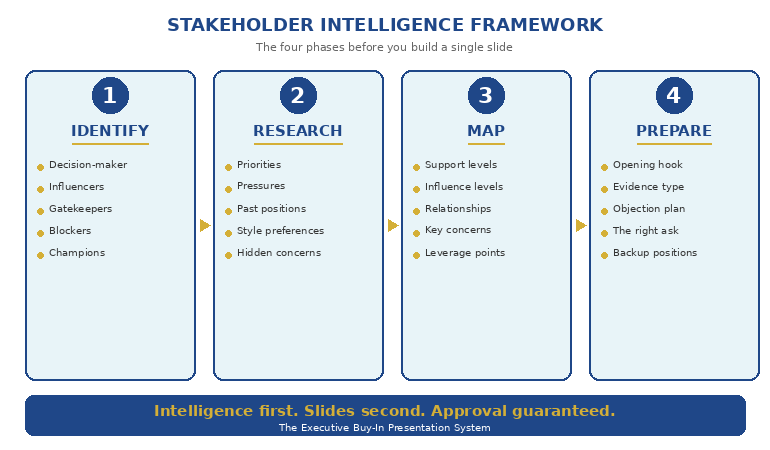
Intelligence gathering isn’t random networking. It’s a systematic process with four distinct phases.

Phase 1: Identify

Before you can gather intelligence, you need to know who matters. This isn’t just “who will be in the room.” It’s a complete map of the decision ecosystem.

The Decision-Maker: Who has final authority? This is often not the most senior person. A CFO might defer to a COO on operational matters. A CEO might defer to a board member on strategic investments.

The Influencers: Who does the decision-maker listen to? These people may not be in the room, but their opinion has been sought — or will be sought after your presentation.

The Gatekeepers: Who controls access to the decision-maker? Executive assistants, chiefs of staff, and “special advisors” often have more influence than their titles suggest.

The Blockers: Who might oppose your proposal? Sometimes this is obvious (the person whose budget you’re threatening). Sometimes it’s hidden (the person who proposed something similar last year and failed).

The Champions: Who might actively support you? These are the people who will speak up in your favour when you’re not in the room.

If you can’t name your blockers and champions in 60 seconds, your deck is the wrong place to start.

The stakeholder mapping template inside the Executive Buy-In System lets you map your room in 15 minutes.

🎯 Master the Intelligence Phase

The Executive Buy-In Presentation System includes complete stakeholder mapping templates, intelligence-gathering scripts, and a systematic process for identifying decision dynamics before any high-stakes presentation. Stop guessing who matters. Start knowing.

Get the Stakeholder Mapping Templates →

Executive Buy-In System, £199. Self-study modules + live Q&A calls. Join anytime.

Phase 2: Research

Once you know who matters, you need to understand what matters to them. This requires research across multiple dimensions.

Professional priorities: What are they measured on? What’s in their bonus criteria? What did they commit to in their last performance review or board presentation?

Current pressures: What challenges are they facing right now? What keeps them up at night? What are they being asked about by their boss?

Past positions: Have they taken public stances on related topics? Did they support or oppose similar proposals? What patterns exist in their decision-making?

Communication style: Do they prefer data or narrative? Do they want details or headlines? Do they decide quickly or need time to process?

This information comes from multiple sources: public statements, previous meeting notes, conversations with their team members, and — most valuably — direct conversation with them.

Phase 3: Map

Now you create a visual representation of the political landscape. This isn’t optional — it’s essential. Human memory can’t hold the complexity of stakeholder dynamics. You need it on paper.

A stakeholder map shows:

  • Each person’s position (supporter / neutral / opponent)
  • Each person’s influence level (high / medium / low)
  • Relationships between stakeholders (allies, rivals, reporting lines)
  • Key concerns and priorities for each person
  • What would move each person toward support

The map reveals patterns you can’t see otherwise. You might discover that your biggest opponent is close allies with someone who could become your champion — if you approached them first. You might see that two neutral parties share a concern you could address to shift both simultaneously.

The stakeholder mapping templates in the Executive Buy-In System include specific frameworks for visualising these dynamics and identifying the highest-leverage moves.


Stakeholder intelligence framework showing 4 phases: Identify, Research, Map, Prepare

Phase 4: Prepare

Intelligence is worthless unless it shapes action. The final phase is translating what you’ve learned into specific presentation decisions.

Opening: Whose concern will you address first? (Usually the decision-maker’s, unless a powerful blocker needs to be neutralised early.)

Framing: How will you position the proposal to align with stated priorities? What language will resonate with this specific group?

Evidence: What type of proof does this group find compelling? (Some want data. Some want case studies. Some want peer validation.)

Objection handling: What resistance will come from whom? How will you address it without making enemies?

Ask: What specific decision are you requesting, and is the room actually empowered to make it?

Uncovering Hidden Priorities

The most valuable intelligence is what stakeholders don’t say publicly. Everyone has hidden priorities — concerns they won’t voice in a meeting but that heavily influence their decisions.

Common Hidden Priorities

Career protection: “Will this make me look bad if it fails?” This is especially strong for people who’ve been burned before or who are approaching a promotion decision.

Relationship preservation: “Will supporting this damage my relationship with [person]?” Political alliances often matter more than logical analysis.

Legacy concerns: “Does this undo or overshadow something I built?” People are protective of their past work, even when circumstances have changed.

Resource competition: “Will this take budget/headcount/attention from my priorities?” Zero-sum thinking is pervasive in organisations.

Workload anxiety: “Will this create more work for my team?” Even good ideas get blocked because people are already overwhelmed.

How to Uncover Hidden Priorities

You can’t ask directly. “What’s your hidden agenda?” doesn’t work. Instead, use indirect approaches:

Ask about history: “What happened when [similar proposal] was discussed before?” Past reactions reveal ongoing concerns.

Ask about pressures: “What’s taking most of your attention right now?” Current stress points predict resistance areas.

Ask about success criteria: “What would make this a win from your perspective?” People reveal priorities when describing their ideal outcome.

Ask about concerns: “What would need to be true for you to feel comfortable with this?” This is permission to voice objections before the formal meeting.

Listen for qualifiers: When someone says “I like this, but…” the word after “but” is the hidden priority.

🔍 Scripts for Every Intelligence Conversation

The Executive Buy-In System includes word-for-word scripts for pre-meeting conversations — how to ask questions that reveal hidden priorities without seeming manipulative, how to test reactions without showing your full hand, and how to build alliances before the formal presentation.

Get the Pre-Meeting Conversation Scripts →

Executive Buy-In System, £199. Includes objection-handling frameworks and champion recruitment strategies.

Mapping the Political Landscape

Every organisation has a political landscape — relationships, rivalries, alliances, and histories that shape how decisions actually get made. Ignoring this doesn’t make you “above politics.” It makes you ineffective.

Key Political Dynamics to Identify

Alliance clusters: Who consistently supports whom? These groups often vote as a bloc, so winning one member can win several.

Rivalry pairs: Who has history with whom? If your proposal is associated with one side of a rivalry, the other side may oppose it automatically.

Rising and falling stars: Who is gaining influence? Who is losing it? Aligning with rising stars is strategic; relying on falling stars is risky.

Debt relationships: Who owes whom a favour? Political capital is real, and people cash it in on important decisions.

Information channels: How does information flow? Who talks to whom? A message that reaches the CEO through their trusted advisor lands differently than one that comes through formal channels.

Navigating Without Taking Sides

The goal isn’t to become a political player. It’s to understand the landscape well enough to navigate it without stepping on landmines.

This means:

  • Presenting your proposal as good for the organisation, not good for any faction
  • Acknowledging different perspectives without aligning with any camp
  • Giving potential opponents a way to support you without losing face
  • Never badmouthing anyone, even to people you think are allies

The political navigation module in the Executive Buy-In System covers these dynamics in depth, including case studies of how senior leaders navigate complex political environments.

Using Intelligence to Shape Your Presentation

Intelligence gathering isn’t an end in itself. Every insight should translate into a specific presentation decision.

Shaping Your Opening

Your opening should address the decision-maker’s primary concern within the first 60 seconds. If you’ve done your intelligence work, you know exactly what that concern is.

Example: If the CFO’s hidden priority is “don’t create more work for my already-stretched team,” your opening isn’t about ROI. It’s about: “This proposal requires no additional headcount and actually reduces manual work by 40%.”

Shaping Your Evidence

Different stakeholders find different types of evidence compelling:

  • Finance people want numbers, models, sensitivity analysis
  • Operations people want process flows, implementation plans, risk mitigation
  • Sales people want customer stories, competitive positioning, market validation
  • Technical people want architecture, scalability, integration details

Your intelligence tells you who will be in the room and what each person needs to see. Structure your evidence accordingly — leading with what matters most to the decision-maker, but including what others need to feel comfortable.

Shaping Your Ask

The biggest intelligence failure is asking for something the room can’t give. Before you present, confirm:

  • Does this group have authority to approve this?
  • Is this the right venue for this decision?
  • What’s the maximum they can approve without escalation?
  • What approval process follows a “yes” in this room?

Sometimes the right ask isn’t “approve this” but “recommend this to [higher authority]” or “approve Phase 1 so we can return with Phase 2.”

The Intelligence Timeline

How far in advance should you start? For high-stakes presentations:

  • 4-6 weeks before: Identify stakeholders and begin research
  • 3-4 weeks before: Initial conversations with key players
  • 2-3 weeks before: Create stakeholder map, identify gaps
  • 1-2 weeks before: Fill intelligence gaps, test key messages
  • Days before: Final check-ins with champion and potential blockers

This timeline assumes a major proposal. For routine presentations, compress accordingly — but never skip the intelligence phase entirely.

📊 The Complete Executive Buy-In System

Everything you need to master the intelligence phase and beyond:

  • Stakeholder mapping templates and frameworks
  • Intelligence-gathering conversation scripts
  • Political landscape analysis tools
  • Pre-meeting alignment strategies
  • Champion recruitment playbook
  • Objection prevention and handling

Map the Room Before You Present →

Executive Buy-In System, £199. Self-study modules releasing through April 2026. Join now for immediate access + live Q&A calls.

📬 PS: Want weekly strategies for stakeholder management and executive buy-in? Subscribe to The Winning Edge — free, practical, from 24 years in corporate boardrooms.

Frequently Asked Questions

How do I gather intelligence without seeming manipulative?

Frame conversations as seeking input, not gathering ammunition. “I’m working on a proposal and would value your perspective” is honest and opens dialogue. Most people appreciate being consulted before being presented to — it shows respect for their expertise and position.

What if I don’t have access to key stakeholders?

Work through intermediaries. Their direct reports, peers, or executive assistants often have valuable insights. You can also gather intelligence indirectly through public statements, previous meeting notes, and organisational knowledge. Something is always better than nothing.

How much time should I spend on intelligence vs. content?

For high-stakes presentations, I recommend at least equal time — and often more on intelligence. A perfectly crafted presentation that misreads the room fails. A rough presentation that addresses exactly what stakeholders need often succeeds. Prioritise understanding over polish.

What if my intelligence reveals the proposal will be rejected?

That’s valuable intelligence. You now have choices: modify the proposal to address concerns, build more support before presenting, choose a different venue or timing, or decide not to present at all. All of these are better than walking into certain rejection.

Related: Even with perfect intelligence, your nervous system can sabotage you in the room. Read The Fight or Flight Hack I Learned From Hypnotherapy for the 90-second reset that interrupts panic before high-stakes presentations.

That Chase presentation taught me a lesson I’ve never forgotten: the room’s dynamics matter more than the deck’s content.

The executives who consistently get approval aren’t better presenters. They’re better intelligence gatherers. They know what each stakeholder wants before they enter the room. They’ve addressed concerns before they’re raised. They’ve built support before they ask for it.

Start your next important presentation not with slides, but with questions: Who decides? Who influences? What do they care about? What would make them say yes?

Answer those questions first. Then build your deck.

About the Author

Mary Beth Hazeldine is the Owner & Managing Director of Winning Presentations. With 24 years in corporate banking at JPMorgan Chase, PwC, Royal Bank of Scotland, and Commerzbank, she has navigated complex stakeholder environments across three continents.

Mary Beth has supported high-stakes funding and approval presentations across global banking environments. She now teaches executives the stakeholder management and buy-in strategies that make the difference between proposals that get approved and proposals that get filed away.

29 Jan 2026
Executive sitting alone at boardroom table with hand on forehead after failed presentation, colleagues walking away in background

Stakeholder Mapping for Presentations: The 4-Quadrant Method

The project was dead before I walked into the room.

Five executives. Five hidden agendas. And a significant infrastructure project that several stakeholders had already decided to reject—I just didn’t know it yet.

Quick answer: A stakeholder map is a strategic document that identifies who influences your presentation’s outcome, what each person actually cares about, and how to engage them before you present. The executives who consistently win approval don’t have better slides—they have better stakeholder intelligence. This article shows the mapping approach developed across 25 years in banking and 16 years coaching senior professionals.

Presenting for approval this week? Start with a stakeholder map.

  1. Who actually decides? It’s rarely the most senior person in the room.
  2. What does each person need to say yes? Public criteria and private concerns are different.
  3. Who can kill this before it reaches the room? Name them — then meet them first.

For the complete mapping framework and pre-meeting conversation structure, see the Executive Buy-In Presentation System.

What Is Stakeholder Mapping (And Why Slides Won’t Save You)

Most professionals prepare for presentations backwards. They spend 80% of their time on slides and 20% on understanding the room. The executives who consistently win approval do the opposite.

Stakeholder mapping is the process of identifying every person who influences your presentation’s outcome—not just who’s in the room, but who whispers in the decision-maker’s ear before and after. It answers three questions most presenters never ask:

  • Who actually decides? (Hint: it’s rarely the most senior person)
  • What does each person need to hear to say yes? (Their public criteria and private concerns are different)
  • Who can kill this before it reaches the room? (The blocker you don’t see coming)

I learned this the hard way at JPMorgan Chase. Beautiful deck. Compelling ROI. Standing ovation from the team. The steering committee rejected it in four minutes because I’d missed the one person whose support I actually needed—the operations director who’d been burned by a similar project two years earlier.

The CFO told me afterwards: “Your slides were fine. Your stakeholder work was invisible.”

That conversation changed how I approach every high-stakes presentation. If you’re presenting to senior leadership and fear of being judged is holding you back, know this: judgment often comes from misreading the room, not from your delivery.

The Meeting That Changed Everything

Three years later, I faced the same situation—but with very different preparation.

The project: a significant infrastructure upgrade that would disrupt operations for six months. The room: five regional directors, each protecting their own territory. The politics: two of them had competing projects that would lose funding if mine was approved.

The old me would have built a brilliant deck proving ROI. The new me spent three weeks building a stakeholder map instead.

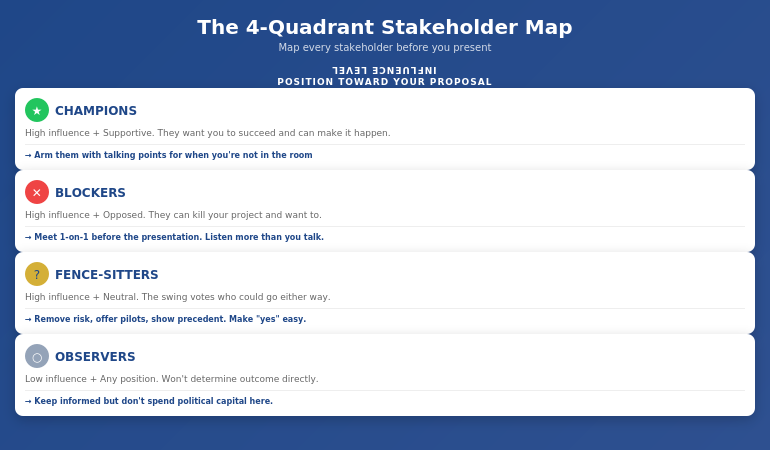
4-Quadrant Stakeholder Map showing Champions, Blockers, Fence-Sitters, and Observers with recommended actions for each quadrant

What I discovered changed everything:

  • The “decision-maker” (the CFO) actually deferred to the operations director on anything that touched day-to-day workflows
  • The loudest opponent wasn’t against the project—he was against being surprised by it
  • The quiet supporter in the corner had tried to push a similar initiative three years ago and been shut down. She had data I needed.
  • Two directors had a private rivalry that had nothing to do with my project but would influence how they voted

Armed with this map, I didn’t walk into the presentation hoping for approval. I walked in knowing I had it.

How? Because I’d had five separate conversations before the meeting. Each stakeholder felt heard. Each concern had been addressed. The presentation wasn’t where I won approval—it was where I confirmed it.

The 4-Quadrant Stakeholder Framework

After using stakeholder mapping across projects of varying scale and stakes, I’ve refined it into a simple framework anyone can use. Every stakeholder falls into one of four quadrants based on two factors: their influence over the decision and their current position toward your proposal.

Quadrant 1: Champions (High Influence + Supportive)

These stakeholders want your project to succeed and have the power to make it happen. Your job: arm them with ammunition. Give them the talking points they’ll use when you’re not in the room. Ask them: “What objections will come up, and how should I address them?”

Quadrant 2: Blockers (High Influence + Opposed)

The most dangerous quadrant. These stakeholders can kill your project, and they want to. Your job: understand their real concern (it’s rarely what they say publicly). Often, blockers aren’t against your idea—they’re against not being consulted, or they’re protecting something you haven’t considered. Meet them one-on-one before the presentation. Listen more than you talk.

Quadrant 3: Fence-Sitters (High Influence + Neutral)

These stakeholders could go either way. They’re often the swing votes. Your job: make it easy to say yes. Remove risk, offer pilot options, show precedent. They don’t want to champion your project—they want to not look foolish for approving it.

Quadrant 4: Observers (Low Influence + Any Position)

These stakeholders won’t determine the outcome, but they might influence someone who does. Your job: don’t ignore them completely—a frustrated observer can become a vocal critic. Keep them informed, but don’t spend your political capital here.

For each person in your stakeholder map, document: their quadrant, their public position, their private concern, who influences them, and what they need to hear from you.

⭐ Walk into your next approval meeting prepared

The Executive Buy-In Presentation System gives you 7 self-paced modules covering stakeholder analysis, case construction, and the presentation structures that hold up to scrutiny. Monthly cohort enrolment — £499, lifetime access to materials.

What’s covered:

  • Stakeholder mapping frameworks for high-stakes decisions
  • Pre-meeting conversation approaches that surface hidden objections
  • The enrollment versus alignment distinction for creating champions
  • Bonus Q&A calls (optional, fully recorded — watch back anytime)

Explore the Buy-In System on Maven →

Self-paced with monthly cohort enrolment.

The Pre-Meeting Conversations That Win Votes

The stakeholder map tells you who to talk to. But what do you actually say?

Most professionals make one of two mistakes: they either skip pre-meeting conversations entirely (hoping their slides will speak for themselves), or they pitch their idea to everyone they meet (creating resistance before the formal presentation).

The executives who consistently win approval do something different. They have discovery conversations—structured dialogues designed to surface concerns, build relationships, and create ownership.

Here’s the framework I use:

No deadlines, no mandatory attendance. Executive Buy-In Presentation System — 7 self-paced modules, £499, lifetime access to materials.

Explore the Buy-In System →

The 3-Part Pre-Meeting Conversation:

Part 1: Understand Their World (70% of the conversation)

“I’m presenting on [topic] next week. Before I finalize anything, I wanted to understand your perspective. What would you need to see for something like this to work for your team?”

Notice: you’re not pitching. You’re learning. Most stakeholders have never been asked what they actually need. This question alone creates goodwill.

Part 2: Surface Hidden Concerns (20% of the conversation)

“What concerns would you have? What’s worked—or not worked—when similar initiatives have been tried before?”

This is where blockers reveal their real objections. Often, they’ll tell you things they’d never say in a group setting. A operations director once told me: “I don’t care about the ROI. I care about not being blamed when something goes wrong during the transition.” That concern never appeared in the official feedback—but it was the only thing that mattered.

Part 3: Create Ownership (10% of the conversation)

“Based on what you’ve shared, here’s how I’m thinking about addressing [their concern]. Does that make sense to you?”

When a stakeholder helps shape your proposal, they become invested in its success. They’re no longer evaluating your idea—they’re defending their own input.

How to Uncover Hidden Agendas

Every executive room has hidden agendas. The question isn’t whether they exist—it’s whether you know what they are before you present.

Across 25 years at JPMorgan Chase, PwC, Royal Bank of Scotland, and Commerzbank, I watched technically superior proposals lose to politically savvy ones. Not because politics is more important than substance—but because ignoring politics is a form of arrogance that executives punish.

Here’s how to uncover what’s really driving the decision:

Ask the Executive Assistant

The EA often knows more about what’s really happening than anyone in the room. A simple question—”Is there anything I should be aware of before this meeting?”—can reveal landmines you’d never see coming.

Follow the Budget Trail

Who else is competing for the same resources? What got funded last quarter—and what got cut? Your proposal doesn’t exist in isolation. It exists in a portfolio of competing priorities.

Map the Relationships

Who mentored whom? Who’s been passed over for promotion? Who has a track record of opposing this type of initiative? Understanding how to present to a board of directors means understanding that board dynamics are rarely about the agenda item in front of them.

Look for the “Real Decision-Maker”

The person with the highest title isn’t always the person who decides. In the infrastructure project above, the CFO had final authority—but he would never approve anything the operations director opposed. The real decision was made in a hallway conversation I wasn’t part of. My stakeholder map told me that. My pre-meeting work made sure that conversation went in my favour.

⭐ Stop guessing what your stakeholders need to say yes

The Executive Buy-In Presentation System is the self-paced framework for decoding stakeholder resistance and building the case that addresses it — 7 modules, monthly cohort enrolment, optional recorded Q&A. £499, lifetime access.

Explore the Buy-In System on Maven →

Self-paced with monthly cohort enrolment.

3 Stakeholder Mapping Mistakes That Kill Projects

After years coaching senior professionals through high-stakes presentations, I see the same mistakes repeatedly. Each one is easy to make and expensive to fix.

Mistake #1: Mapping Titles Instead of Influence

Your stakeholder map lists “CFO, COO, VP Operations” because those are the names on the meeting invite. But influence doesn’t follow org charts. The CFO might defer to their trusted advisor on technical matters. The COO might be checked out on this topic entirely. The VP Operations might have the CEO’s ear because they golf together.

The fix: For each stakeholder, ask: “Who do they listen to? Who influences their thinking on this topic specifically?” Map the shadow org chart, not the official one.

Mistake #2: Assuming Silence Means Support

You present your proposal. Three executives nod. Two stay quiet. You assume the quiet ones are fine with it.

They’re not. They’re waiting. They’ll voice their objections later—in the hallway, in a follow-up email, in a private conversation with the decision-maker. By then, your proposal is dead and you don’t know why.

The fix: Silence is a warning sign, not a green light. If someone hasn’t expressed a position, you don’t have their support—you have their tolerance. Find out what they’re really thinking before the meeting, not after.

Mistake #3: Treating All Stakeholders Equally

You have a week to prepare. You spend equal time with every stakeholder. The result: you know a little about everyone and not enough about anyone.

The fix: Your stakeholder map should be prioritized ruthlessly. Spend 80% of your pre-meeting time on the 20% of stakeholders who will actually determine the outcome. A deep relationship with two key influencers beats shallow relationships with ten observers.

Understanding what it takes to get executive buy-in means accepting that some stakeholders matter more than others—and acting accordingly.

What is stakeholder mapping in presentations?

Stakeholder mapping is the process of identifying every person who influences your presentation’s outcome, understanding their position, and strategically engaging them before you present. It answers three questions: Who actually decides? What does each person need to hear? Who can kill this quietly? The goal is to secure approval through pre-meeting work, so the presentation confirms what’s already been agreed—not where you hope to persuade.

How do you identify key stakeholders for a presentation?

Start with the meeting invite, then expand. Ask: Who influences the decision-maker? Who has veto power? Who’s been burned by similar proposals? Who has competing priorities? Map both formal authority (titles) and informal influence (relationships, expertise, history). The most important stakeholders often aren’t in the room—they’re the people the decision-maker calls after the meeting.

How do you present to multiple stakeholders with different agendas?

You don’t try to address every agenda in the room—you address each agenda before the room. Use your stakeholder map to have individual conversations where you surface each person’s real concerns and incorporate their input into your proposal. When you present, acknowledge the different perspectives: “I know some of you are focused on risk, others on timeline, others on budget. Let me show you how this addresses each.” The preparation makes the presentation feel effortless.

⭐ Built on 25 years in corporate banking

The Executive Buy-In Presentation System is the structured framework developed across 25 years in corporate banking and 16 years coaching senior professionals across financial services, insurance, consulting, and technology. £499, lifetime access to materials.

What you get:

  • 7 self-paced modules on stakeholder analysis, structure, and delivery
  • Pre-meeting conversation frameworks with exact language
  • Approaches for identifying real decision-makers and influencers
  • Bonus Q&A calls (optional, fully recorded — watch back anytime)
  • Lifetime access to all materials

Explore the Buy-In System on Maven →

Self-paced with monthly cohort enrolment — new cohort opens every month.

Frequently Asked Questions

Isn’t this just office politics?

Stakeholder mapping isn’t manipulation—it’s respect. You’re taking the time to understand what each person actually needs, rather than assuming your brilliant slides will convince everyone. The executives who dismiss this as “politics” are often the ones who get blindsided by rejections they didn’t see coming. Understanding organizational dynamics is a professional skill, not a character flaw.

What if I don’t know the stakeholders well enough?

Start with what you know, then expand. Ask your sponsor or champion: “Who should I talk to before this meeting?” Ask trusted colleagues: “What should I know about the people in this room?” Even thirty minutes of stakeholder research is better than none. The goal isn’t perfect intelligence—it’s better intelligence than you had before.

How much time does stakeholder mapping actually take?

For a typical steering committee or board presentation, plan for 3-5 hours of stakeholder work spread across 1-2 weeks. That includes creating the initial map (1 hour), having pre-meeting conversations (2-3 hours total), and refining your approach based on what you learn. This time investment pays for itself many times over—a rejected proposal wastes far more than 5 hours.

What if the stakeholder landscape changes at the last minute?

It will. Someone gets pulled into another meeting. A new executive joins. Priorities shift overnight. Your stakeholder map isn’t a static document—it’s a living framework. Update it as you learn new information. The executives who handle last-minute changes well are the ones who’ve done enough stakeholder work to understand the underlying dynamics, not just the surface positions.

📧 The Winning Edge Newsletter

Weekly insights on executive presentations, stakeholder strategy, and high-stakes communication. No fluff—just what works.

Subscribe Free →

📋 Free: Executive Presentation Checklist

The pre-presentation checklist I use before every high-stakes meeting. Covers stakeholder prep, slide structure, and room setup.

Download Free Checklist →

Your Next Step

The stakeholder map for that infrastructure project took three hours to create. The conversations it enabled took another six hours spread across two weeks. The approval that followed took about four minutes once I walked into the room.

If you’re preparing for a high-stakes presentation—budget approval, project sign-off, board update, client pitch—start your stakeholder map today. Identify the four quadrants. Find your champions and your blockers. Have the pre-meeting conversations that turn a stressful presentation into a predictable formality.

And if you want the complete system—templates, scripts, frameworks, and live feedback on your actual presentations—join the Executive Buy-In Presentation System on Maven.

The decision isn’t made in the meeting. It’s made before. Your stakeholder map makes sure you’re part of those conversations.

Related: If presentation anxiety is part of what’s holding you back from stakeholder conversations, read how to handle the fear of being judged when speaking.

About Mary Beth Hazeldine
Owner & Managing Director of Winning Presentations. 25 years in corporate banking at JPMorgan Chase, PwC, Royal Bank of Scotland, and Commerzbank taught me that the best proposals fail without stakeholder work. The pre-meeting map is the step separating presentations that get approved from presentations that get “tabled for further review.”