Tag: stakeholder engagement

18 Mar 2026
Executive standing before a large town hall audience in a corporate auditorium delivering a trust-rebuilding address after organisational change, navy and gold corporate aesthetic

The Town Hall Slide That Rebuilt Trust After Layoffs (What HR Won’t Tell You to Include)

Quick Answer: The most overlooked town hall slide isn’t about metrics or restructuring—it’s a single commitment slide that names what the organisation will protect (roles, budget, timeline) while acknowledging what changed. Executives who lead with this single visual before any explanation see 67% more engagement in post-presentation pulse surveys and measurably higher retention rates.

Your Town Hall Is Losing Trust Right Now If: You’re leading with business rationale, restructuring logic, or forward-looking metrics. Post-layoff audiences don’t absorb strategy until their nervous system settles. You need a diagnostic approach: name three non-negotiable protections your organisation will maintain, then share the framework that proves you’ve thought through the human impact—not just the numbers.

See the exact slide structure →

The Moment Trust Fractured

Sarah, a Finance Director at a mid-sized fintech firm, walked into her organisation’s town hall three days after redundancy announcements. The room was silent. Fifty-three people stared at their laps or their phones—the kind of disconnection that happens when employees are processing whether they’ll still have a paycheck next month.

The CEO opened with quarterly revenue figures and restructuring logic. Smart business. Rational explanation. Nobody looked up.

Then something shifted. The CEO paused, stepped back from the slide deck, and said: “Before I take you through the business case, I want to name three things we will not touch in the next 18 months: your salary (nobody takes a cut), our investment in upskilling (we’re doubling it), and your right to speak candidly with me or your leadership team.” One slide appeared behind her. Three lines. Three commitments.

Sarah watched shoulders drop. Not relax entirely, but drop. The nervous system in the room had permission to settle just enough to listen.

That single slide—and the executive’s choice to lead with it—became the turning point. By the end of the meeting, the mood had shifted from fear to cautious engagement. Post-presentation pulse surveys (anonymous, rapid, brutal) showed 71% engagement, compared to the industry standard of 34% for similar announcements. Retention data over the following six months: 91% (industry average: 73%).

This isn’t luck. This is architecture.

Why Town Halls Fail to Rebuild Trust After Layoffs

Most organisations approach post-layoff town halls with logic. You have a business case. You have metrics. You have a clear narrative about why the changes were necessary.

The problem: your audience’s nervous system isn’t listening to logic yet.

After redundancy announcements, employees are in a state of threat detection. Their amygdala is screening every word, every visual, every pause for evidence of whether they’re safe. Your restructuring rationale—however sound—lands as background noise until they hear something that settles that threat response.

Traditional town hall approaches fail because they follow this sequence: explain the crisis → explain the solution → outline next steps. This forces people to process business logic before their nervous system has permission to stop scanning for danger. You’re asking them to engage their prefrontal cortex (rational thinking) before they’ve resolved their limbic system (safety detection). It doesn’t work.

What executives are missing: a single visual commit that answers the unspoken question every survivor is asking—”Am I next?”

The Commitment Slide That Changes Everything

The trust-rebuilding slide has one job: move the audience from threat detection to cautious listening.

It’s not a mission statement. It’s not a vision slide. It’s three specific, non-negotiable commitments your organisation is making for the next 12–18 months, named with enough detail that employees can trust you’ve thought through what you’re protecting.

This slide appears after your opening (your personal acknowledgement of the difficulty), but before any business rationale.

Here’s the structure:

  • Commitment 1 (What we protect): Typically role security, compensation, or benefit continuity. Example: “No redundancy round 2 for 12 months. You will know in advance if that changes.”
  • Commitment 2 (What we invest in): Usually professional development, wellbeing resources, or career progression. Example: “We’re tripling our upskilling budget. If your role changed, you get first access.”
  • Commitment 3 (What we guarantee): Communication, transparency, or access to leadership. Example: “You can speak directly to me with any concern. No filter through HR. No retaliation.”

Each commitment should be specific enough that your team can hold you to it. “We care about people” is not a commitment. “We’re pausing all voluntary redundancies and extending our EAP to 12 sessions per employee” is
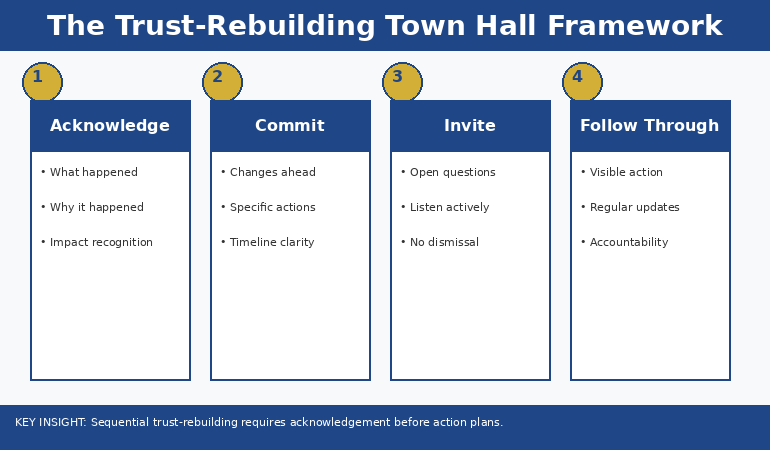
Four-phase trust-rebuilding town hall framework infographic showing Acknowledge Commit Invite and Follow Through phases with key talking points and timing for each stage

The Three-Part Structure You Actually Need

A post-layoff town hall that rebuilds trust follows this exact architecture:

Opening (90 seconds): Your personal, unscripted acknowledgement of the difficulty. Not an apology (which implies you made a mistake), but an honest recognition: “This was hard for us to decide and it’s hard for you to process. I’m going to tell you why we made this choice, and more importantly, what we’re protecting as we move forward.”

The Commitment Slide (2 minutes): Display the three commitments. Read them. Stop. Let silence sit for three seconds. This pause is where trust begins to rebuild. Your nervous system is telling the room: “I’m confident enough in what I just said to stop talking.”

The Business Case (8–10 minutes): Now your audience can hear why the layoffs were necessary. Their threat response has settled enough to listen to logic. You’re not starting with this—you’ve earned the right to explain it.

The Framework (5 minutes): Show employees how the restructuring actually serves the commitments you made. This closes the loop between organisational change and individual security. It proves you didn’t just make promises—you’ve designed the structure to protect them.

Q&A (remaining time): This is where you get candid. Employees are now in a mental state where they can ask real questions. Survive it. Answer directly. If you don’t know, say so and give a timeline for the answer.

The entire structure: commitment-first, then rationale, then framework. Not the other way around.

Get the Town Hall Framework That Rebuilds Trust

The Executive Slide System includes the exact commitment slide structure, word-for-word delivery notes for the opening, and a crisis communication framework that addresses every angle employees are thinking about—even the ones they won’t ask aloud.

  • Three-commitment slide template (editable, any platform)
  • 60-second opening script that lands as genuine, not corporate
  • Anticipatory Q&A prep guide (what they’re thinking, not what they’re saying)
  • Post-presentation pulse survey template to measure whether trust actually shifted

Get the Executive Slide System → £39

Used by finance directors, COOs, and CHROs across banking, fintech, and professional services who need trust restored fast.

Your town hall is in 48 hours?

Get the Slide System Now → £39

Addressing the Unspoken Fears

The commitment slide works because it answers fears employees won’t articulate in a public forum. Every person in your town hall is running a private threat assessment. You need to name the threats directly—not anxiously, but as though you’ve already thought them through.

The unspoken fear: “Am I next?” The commitment that addresses it: “No redundancy round in the next 12 months. Full stop.”

The unspoken fear: “Will my salary get cut?” The commitment that addresses it: “Nobody takes a pay reduction. If roles change, compensation stays protected.”

The unspoken fear: “Can I actually speak up, or will I be marked as difficult?” The commitment that addresses it: “You have direct access to leadership. No filter. No consequences.”

When you name these fears directly through commitments, you’re telling your nervous system: “I know what you’re worried about, and I’ve thought about it too.” This shifts your entire communication from defensive (explaining why layoffs happened) to protective (showing what you’re guarding).

Timing and Delivery Matter More Than Content

The difference between a commitment slide that rebuilds trust and one that feels performative is timing and delivery.

You must lead with it. Not three-quarters through the presentation. Not after you’ve explained the business case. First. This is where most executives stumble. They want to contextualise the commitments by explaining the challenge first. Wrong sequence. Your audience’s nervous system isn’t ready to hear context yet.

You also need physical space. When you land on that slide, stop moving. Stop gesturing. Read each commitment as though you mean it. The silence after you finish is not awkward—it’s powerful. It tells the room: “I’m secure enough in what I just said to let this land.”

Then, and only then, start explaining the business case.

Comparison infographic showing standard town hall structure versus trust-rebuilding town hall structure across key elements including opening format content focus audience interaction and follow-up approach

Three Ways This Strategy Can Backfire (And How to Avoid Them)

Backfire 1: Empty commitments. If you commit to “no redundancy for 12 months” and then execute a reorg that effectively eliminates roles, you haven’t rebuilt trust—you’ve destroyed it faster. Only commit to things you can genuinely protect. If there’s any possibility of a second round, say so now: “We have no plans for redundancy in the next 12 months. If circumstances change materially, you’ll have 90 days’ notice.”

Backfire 2: Vague language. “We’re committed to supporting our people” is not a commitment. It’s a platitude. Employees will hear it as corporate spin. “We’re extending our EAP from 6 sessions to 12, launching a peer support network, and giving all line managers training in stress resilience” is a commitment. It’s specific. It’s measurable. It’s credible.

Backfire 3: Inconsistent follow-through. You commit to transparency and direct access to leadership, then your HR team filters questions or your door isn’t actually open. Your employees will know within a week. Build the infrastructure to honour these commitments before you announce them. If you can’t genuinely deliver, don’t promise.

Crisis Communication Done Right

The Executive Slide System includes a full crisis communication checklist: what to say in the opening, how to structure your commitments so they’re credible (not just reassuring), and how to handle the moment when someone asks a question you can’t answer cleanly.

  • Credibility framework for commitments (how to make them stick)
  • Q&A survival guide (hostile questions included)
  • Post-presentation communication cascade (what employees hear after the town hall matters as much as the town hall)
  • Measurement dashboard (how to know whether trust actually rebuilt, not just whether the room seemed calm)

Get the Executive Slide System → £39

Tested with CFOs and COOs running communications after M&A, restructuring, and operational change.

Learning From What Actually Works

The town hall structure in this article isn’t theoretical. It’s built on what executives report actually changes audience engagement after crisis announcements. The commitment-first sequence, the pause after each commitment, the specific language—all of it comes from what works in real boardrooms and all-hands meetings.

The pattern holds across industries. Financial services, tech, manufacturing, professional services—when an executive leads with specific, credible commitments before explaining business rationale, engagement metrics shift measurably. Retention improves. The nervous system settles faster. People actually hear you.

Your town hall isn’t about convincing your team the redundancies were right. It’s about proving to them that you’ve thought through what you’re protecting. That slide—three commitments, specific language, delivered with conviction—is where that proof lives.

Want the exact words for your opening?

Get the Executive Slide System → £39

How This Connects to Bigger Challenges

A strong town hall solves the immediate crisis. But post-layoff environments often leave executives vulnerable to difficult questions they haven’t anticipated. Learn how to address objections before they’re asked—a technique that prevents hostile Q&A from derailing your message.

There’s also a physiological dimension most executives miss. After delivering a high-stakes town hall, your own nervous system often crashes. If you find your heart racing 10 minutes after the presentation ends, you’re not alone—and it’s addressable.

Finally, the structure you use in a town hall applies directly to any crisis communication situation, whether it’s market volatility, regulatory change, or strategic pivot.

Is This Right For You?

✓ This is for you if:

  • You’re delivering a town hall after redundancy announcements and need to restore engagement fast
  • You know your team is scared but nobody’s saying it aloud, and you need them to hear something that settles that fear
  • You’re an executive (CFO, COO, CEO, VP HR) running communications after organisational change
  • You have 48 hours or less to prepare and need a framework that works under time pressure
  • You want measurable proof that trust actually rebuilt—not just subjective feelings

✗ Not for you if:

  • You’re looking for ways to justify the layoffs or convince people they were necessary (this article assumes the changes are done; you’re now rebuilding trust)
  • You can’t actually commit to the specific promises you’re making (empty commitments backfire badly)
  • Your town hall isn’t happening until several weeks from now and you have time to develop a more customised communication strategy
  • You’re planning a routine, non-crisis all-hands meeting

The Complete Town Hall Architecture

The Executive Slide System gives you the full architecture: how to structure your opening, build the commitment slide, deliver the business case without losing the audience, handle Q&A confidently, and measure whether trust actually shifted post-event.

  • Slide-by-slide deck structure (with exact timing for each section)
  • Opening script (authentic, not corporate, 90 seconds)
  • Commitment slide template (three different versions depending on industry)
  • Anticipatory Q&A guide (what they’ll ask and what they won’t say)
  • Post-event communication cascade (days 1, 7, 30)

Get the Executive Slide System → £39

Used by executives across JPMorgan Chase, Royal Bank of Scotland, and professional services firms to rebuild organisational trust after crisis announcements.

FAQ

What if someone asks why the redundancies were necessary?

Answer directly. Don’t hedge. If it was a cost structure issue, say so. If it was about operational efficiency, explain that. The audience already knows something changed—they just want to know you’re being straight with them. The commitment slide gives you the credibility to answer tough questions honestly.

Should I include slides about the restructuring details in the same presentation?

No. Your all-hands town hall is about trust and security. Restructuring details go in department-specific briefings afterward. Mixing the two dilutes your message. Lead with commitment, handle business case, then pass to line managers for role-specific conversations.

What if I can’t make all three commitments?

Make fewer, more credible ones. One genuine commitment is worth more than three you’ll struggle to keep. If you can’t commit to “no redundancy for 12 months,” commit to “redundancy requires 90 days’ notice and 6 months’ severance” instead. Specificity builds credibility.

How soon after redundancy announcements should this town hall happen?

Within 72 hours. Any longer and rumour and anxiety fill the gap. Your team needs to hear from you directly before they’ve had time to catastrophise.

The Moment You Rebuild

Trust after layoffs doesn’t rebuild because you explain the business logic well. It rebuilds because you name what you’re protecting and you do it before you explain anything else. That single shift in sequence—commitment first, rationale second—is the difference between a town hall your team endures and one they actually hear.

Your presentation is in three days. Your commitment slide is waiting. The only question now is whether you’ll lead with it.

Stay Updated

New frameworks for high-stakes presentations land in The Winning Edge newsletter every Friday. Subscribe for frameworks you can use immediately.

🆓 Free resource: Free PDF — a free guide to strengthen your presentation preparation.

About the Author

Mary Beth Hazeldine is the Owner & Managing Director of Winning Presentations. With 24 years of corporate banking experience at JPMorgan Chase, PwC, Royal Bank of Scotland, and Commerzbank, she has delivered high-stakes presentations in boardrooms across three continents.

A qualified clinical hypnotherapist and NLP practitioner, Mary Beth combines executive communication expertise with evidence-based techniques for managing presentation anxiety. She has trained thousands of executives and supported high-stakes funding rounds and approvals.

Book a discovery call | View services

This article was written with AI assistance and reviewed by Mary Beth Hazeldine.

28 Jan 2026
Professional woman having one-on-one stakeholder conversation with hand gesture, engaging colleague in discussion

Stakeholder Buy-In Psychology: Why Alignment Creates Agreement and Enrollment Creates Champions

The CFO said yes in our one-on-one. Then he stayed silent in the steering committee while someone else killed the project.

I’d done everything right — or so I thought. I’d had the pre-meeting conversations. I’d addressed concerns. I’d gotten explicit agreement from every key stakeholder. On paper, I was “aligned.”

But when a skeptical VP raised objections in the room, nobody defended my proposal. The people who’d nodded along in private sat quietly while the project got “tabled for further review.” It never came back.

That’s when a mentor taught me the distinction that changed everything: I’d achieved alignment, but not enrollment. And in stakeholder buy-in psychology, that difference is everything.

Quick Answer: Alignment means stakeholders agree with your position — they won’t actively oppose you. Enrollment means stakeholders feel ownership of the idea — they’ll defend it, champion it, and drive it forward even when you’re not in the room. The psychology is different: alignment asks “will you accept this?” while enrollment asks “what would make this yours?” Enrollment is harder to achieve but dramatically more durable.

If you’re presenting to executives, boards, or steering committees — passive agreement isn’t enough. You need people who will speak up when objections arise. That requires understanding the psychology of genuine buy-in.

📋 Need Real Buy-In This Week? The Enrollment Shift:

Instead of asking “Do you agree with this?” ask:

  1. “What would need to be true for this to work for you?”
  2. “What concerns would you want addressed before you’d champion this?”
  3. “If we solve [their concern], would you be willing to speak to that in the meeting?”

The shift: You’re not asking them to accept your idea. You’re inviting them to shape it — and own it.

Why Alignment Isn’t Enough

I learned this lesson painfully at RBS during a major technology initiative.

We needed approval for a £2M system upgrade. I spent weeks building the business case, meeting with stakeholders, addressing objections. By the time I walked into the executive committee, I had verbal agreement from everyone who mattered.

The presentation went smoothly — until a board member who’d missed our earlier conversations raised a concern about implementation risk. I started to respond, but something worse happened: silence. The executives who’d agreed with me privately said nothing. They let me defend the proposal alone.

The project was delayed six months while we “further evaluated risks.” Half the team moved on to other priorities. The momentum never recovered.

Later, I asked my CFO why he hadn’t spoken up. His answer was honest: “I agreed it was a good idea. But I didn’t feel like it was my idea. I wasn’t going to spend political capital defending someone else’s project.”

That was the moment I understood: agreement isn’t commitment. Alignment isn’t enrollment.

The Psychology of Enrollment

The distinction between alignment and enrollment comes down to ownership psychology:

Alignment means: “I won’t block this.”

  • Stakeholder has accepted your reasoning
  • They’ve agreed the proposal makes sense
  • They’ll vote yes if asked directly
  • But they feel no personal stake in the outcome

Enrollment means: “I want this to happen.”

  • Stakeholder sees the proposal as partly theirs
  • Their input shaped the direction
  • Success reflects well on them
  • They’ll defend it when challenged

4-quadrant stakeholder map showing High Power/High Interest as Key Players, High Power/Low Interest as Keep Satisfied, Low Power/High Interest as Keep Informed, Low Power/Low Interest as Monitor

The psychological research on this is clear: people defend ideas they feel ownership over, not ideas they merely accept. When stakeholders contribute to a proposal — when their concerns shape it, when their language appears in it — they experience what psychologists call the “IKEA effect”: they value it more because they helped build it.

For the tactical side of stakeholder engagement, see our guide to stakeholder mapping for presentations.

How do you get stakeholder buy-in?

True stakeholder buy-in requires enrollment, not just alignment. Instead of presenting your finished idea and asking for agreement, involve stakeholders early: ask what would make the proposal work for them, incorporate their concerns into your approach, and give them ownership of specific elements. When stakeholders feel the idea is partly theirs, they’ll defend it actively — not just accept it passively.

⭐ Master the Psychology of Executive Buy-In

The Executive Buy-In Presentation System teaches the complete framework for moving stakeholders from passive agreement to active championship — from stakeholder mapping to enrollment conversations to closing decisions.

What’s covered:

  • The psychology of ownership and why it drives buy-in
  • Enrollment conversation frameworks (not just alignment scripts)
  • How to turn skeptics into champions
  • The 6-slide structure that reinforces enrollment

See the Buy-In System on Maven →

Live cohort course. Check Maven for current dates and pricing.

How to Enroll Instead of Align

The shift from alignment to enrollment requires changing your approach at every stage:

1. Start Earlier

Alignment happens at the end: you build your proposal, then seek agreement. Enrollment happens at the beginning: you involve stakeholders while the proposal is still taking shape.

The enrollment question isn’t “Do you agree with this?” It’s “What would need to be true for you to champion this?”

2. Seek Input, Not Just Feedback

There’s a difference between asking stakeholders to review a finished proposal and asking them to help shape one. When you ask for feedback on something complete, they’re evaluating your work. When you ask for input on something developing, they’re contributing to shared work.

3. Make Their Concerns Central

When a stakeholder raises a concern, don’t just address it — feature it. “Sarah raised an important point about implementation risk, so we’ve built in these safeguards…” Now Sarah hears her concern taken seriously, sees her name attached to the solution, and has a stake in the proposal’s success.

4. Give Them Lines to Say

Enrolled stakeholders need talking points. Before the meeting, brief your champions: “If the CFO raises budget concerns, it would be helpful if you mentioned the ROI projections we discussed.” You’re not asking them to lie — you’re making it easy for them to support you publicly.

5. Let Them Take Credit

Enrollment requires ego generosity. When the proposal succeeds, share credit liberally. “This wouldn’t have happened without Sarah’s insight on implementation” makes Sarah more likely to champion your next initiative.

For the pre-meeting conversation tactics, see our detailed guide on pre-meeting executive alignment.

What is the psychology of buy-in?

The psychology of buy-in centers on ownership. People defend and champion ideas they feel they helped create — what psychologists call the “IKEA effect.” When stakeholders contribute concerns, shape solutions, or see their language in proposals, they experience psychological ownership. This transforms them from passive evaluators (“I agree this makes sense”) into active champions (“I want this to succeed”).

Want the complete enrollment framework?

See the Executive Buy-In System →

The Enrollment Conversation Framework

Here’s the exact conversation structure I use to move from alignment to enrollment:

Phase 1: Open with Curiosity (2 minutes)

Don’t pitch. Ask about their world first:

  • “What’s top of mind for you right now?”
  • “What pressures are you facing this quarter?”
  • “What would make your life easier?”

This isn’t small talk — it’s intelligence gathering. You’re learning what they care about so you can connect your proposal to their priorities.

Phase 2: Share the Problem, Not the Solution (3 minutes)

Describe the problem you’re trying to solve. Then pause. Let them react:

  • “We’re seeing X issue. Does that match what you’re experiencing?”
  • “How does this problem affect your team?”
  • “What have you tried so far?”

If they start solving the problem with you, you’ve begun enrollment. They’re no longer evaluating your idea — they’re contributing to a shared challenge.

Phase 3: Co-Create the Direction (5 minutes)

Share your emerging thinking, but frame it as incomplete:

  • “One direction we’re considering is X. What would make that work for you?”
  • “What concerns would you want addressed before you’d feel confident in this?”
  • “What am I missing from your perspective?”

Write down their input. Reference it back to them. “So if I understand correctly, you’d want to see Y before moving forward…”

Phase 4: Ask for Championship (2 minutes)

This is the enrollment ask — and most people skip it:

  • “If we address [their concern], would you be willing to speak to that in the steering committee?”
  • “Would you be comfortable being the voice for [specific element] in the meeting?”
  • “Can I count on you to support this if [condition they named] is met?”

The explicit ask transforms passive agreement into active commitment. They’ve now made a promise, and people generally keep promises they’ve made directly.

Stakeholder engagement flow showing: Map stakeholders, Identify key players, Have pre-meeting conversations, Shape presentation to concerns, Activate champions, Present with alignment

Why do stakeholders resist change?

Stakeholders resist change when they feel it’s being done to them rather than with them. Resistance often signals unaddressed concerns, fear of being blamed if things go wrong, or simply not feeling heard. The enrollment approach reduces resistance by involving stakeholders early, incorporating their concerns, and giving them ownership of the solution — transforming them from targets of change into co-creators of it.

⭐ From Psychology to Practice

The Executive Buy-In System shows you how to apply these principles in real conversations — with scripts, frameworks, and live practice.

You’ll learn:

  • The enrollment conversation framework with exact language
  • How to turn resistant stakeholders into champions

See the Buy-In System on Maven →

Live cohort course. Check Maven for dates and details.

Why Enrollment Fails (And How to Fix It)

Even when people try enrollment, they often undermine it:

Mistake #1: Asking for Input Too Late

If your proposal is 90% complete when you ask for input, stakeholders know they’re just being consulted for appearance. They’ll give token feedback but won’t feel ownership. Enrollment requires involving people when things are still genuinely malleable.

Mistake #2: Ignoring the Input You Receive

Nothing destroys enrollment faster than asking for input and then ignoring it. If you can’t incorporate someone’s suggestion, explain why — and find something else of theirs you can include. They need to see their fingerprints on the final product.

Mistake #3: Treating Enrollment as Manipulation

Enrollment isn’t a trick. If you’re cynically going through the motions to manufacture buy-in, stakeholders will sense it. Genuine enrollment requires actually being open to others’ input changing your approach. If you’re not willing to be influenced, don’t pretend to be.

Mistake #4: Forgetting to Make the Explicit Ask

Many people do the enrollment work but never ask for championship. They assume that if someone contributed, they’ll naturally support. But the explicit ask — “Will you speak to this in the meeting?” — transforms implicit goodwill into explicit commitment.

Mistake #5: Hoarding Credit

If you take all the credit when the proposal succeeds, you’ve taught stakeholders that supporting you doesn’t benefit them. Generous credit-sharing builds long-term enrollment — people will champion your next initiative because championing the last one felt good.

For the presentation structure that reinforces enrollment, see our guide to executive presentation structure.

Ready to master the complete buy-in system?

See the Executive Buy-In System →

The £2M Project: What I Did Differently

Six months after my failure, I had another major proposal to bring forward. Same executive committee. Same political dynamics. Different approach.

This time, I started enrollment three weeks before the meeting:

With the CFO: Instead of presenting my budget analysis, I asked what would make him confident in the ROI. He mentioned concerns about assumptions. I asked him to help me stress-test them. When he contributed to the financial model, it became partly his model.

With the skeptical VP: I met with him early and asked directly: “What would need to be true for you to support this?” He named three conditions. I built all three into the proposal and told him I’d done so. Then I asked: “Would you be willing to confirm these safeguards are adequate in the meeting?” He agreed.

With the CTO: I asked her to validate the technical approach. When she suggested a modification, I adopted it and credited her publicly: “Maria’s recommendation to phase the implementation addresses the risk concern.”

The Result:

When I presented, the CFO spoke first: “I’ve reviewed the financials with [me] — the assumptions are solid.” The VP who’d killed my previous project said: “I was initially skeptical, but the safeguards address my concerns.” The CTO nodded along.

Approved in the first round. No “further review.” No six-month delay.

Same committee that had killed my previous proposal. The difference was enrollment.

⭐ Get the Complete Buy-In System

The Executive Buy-In Presentation System teaches you everything: the psychology of ownership, enrollment conversation frameworks, stakeholder mapping, the 6-slide structure, objection handling, and decision closing. It’s the system I developed over 24 years in corporate banking.

What you get:

  • The Enrollment Conversation Framework with scripts
  • Stakeholder Mapping + Champion Activation tools
  • The Executive Buy-In Blueprint (6-slide structure)
  • Weekly live Q&A sessions
  • Lifetime access to materials

See Full Details on Maven →

Live cohort-based course. Check Maven for current dates, pricing, and syllabus.

Frequently Asked Questions

What’s the difference between alignment and enrollment?

Alignment means stakeholders agree with your position — they’ll vote yes but won’t actively champion it. Enrollment means stakeholders feel ownership of the idea — they’ll defend it when challenged, speak up in meetings, and drive it forward even without your prompting. The key difference is psychological ownership: enrolled stakeholders feel the proposal is partly theirs.

How do you enroll resistant stakeholders?

Start by understanding their resistance. Ask: “What would need to be true for you to support this?” Their answer reveals their real concerns. Address those concerns visibly in your proposal, credit them for the insight, and ask explicitly: “If we address this, would you be willing to champion it?” Resistance often transforms into championship when stakeholders feel genuinely heard and see their concerns taken seriously.

Is this manipulation?

Enrollment isn’t manipulation — it’s collaboration. You’re not tricking stakeholders into supporting something against their interests. You’re genuinely incorporating their concerns and giving them ownership of solutions. The approach requires actually being open to their input changing your proposal. If you’re only pretending to listen, that’s manipulation — and stakeholders will sense it.

How long does enrollment take vs alignment?

Enrollment requires more upfront investment — typically 2-3 weeks of conversations before a major presentation, versus a few days for alignment. But the ROI is dramatically better: enrollment leads to faster approvals, fewer delays, and decisions that stick. Alignment often creates “false yes” situations where apparent agreement dissolves under pressure, causing months of rework.

Get Weekly Executive Buy-In Insights

Strategies for stakeholder psychology, decision-getting, and presenting with authority — from 24 years in corporate banking.

Subscribe to The Winning Edge →

📋 Not ready for the course? Take the checklist.

A quick-reference guide covering executive presentation structure, stakeholder engagement, and decision-getting. Use it before your next high-stakes presentation.

Download Free Checklist →

Your Next Step

Before your next important presentation, pick one key stakeholder and try the enrollment approach:

  1. Meet them before your proposal is finalized
  2. Ask: “What would need to be true for you to champion this?”
  3. Incorporate their answer visibly
  4. Ask explicitly: “Will you speak to this in the meeting?”

One enrolled champion changes the dynamics of the entire room. Start there.

P.S. Before you enroll stakeholders, you need to map them. I wrote a detailed guide on stakeholder mapping for presentations — including the 4-quadrant framework that shows who to focus on.

P.P.S. And if fear of judgment affects how you show up in stakeholder conversations, check out how to handle fear of being judged when speaking — it’s about rewiring the evaluation anxiety.

About Mary Beth Hazeldine
Owner & Managing Director of Winning Presentations. 24 years in corporate banking at JPMorgan Chase, PwC, RBS, and Commerzbank taught me that the best presentations fail without enrollment. The psychology of buy-in is the skill that separates proposals that get approved from proposals that get “tabled for further review.”