Tag: speaking nerves

02 May 2026
Composed female executive taking a brief breathing reset moment backstage before a presentation

Voice Tremor During Presentations: The 3-Second Reset

Quick Answer: Voice tremor in a presentation is the audible result of shallow, chest-level breathing combined with tensed vocal cords. The 3-second reset is a silent exhale, a deliberate throat-release, and a single slow inhale before the next sentence. It interrupts the tremor cycle without drawing attention to it. Technique matters more than confidence here.

Mei had just finished her introduction at a medical affairs conference when the tremor started. She was three slides in — the point at which she had always told herself the nerves would subside. Instead, her voice thinned, then wavered. She heard it before the audience did. By slide five, the tremor had taken over the consonants. She could hear herself producing the words, but they sounded like someone else’s words, filtered through tension.

The presentation did not fail. But she left the stage convinced that it had, and the next three presentations she was scheduled to give — she cancelled two and sent a colleague to the third. That is the real cost of voice tremor: not the moment itself, but the pattern of avoidance that follows.

What we worked on afterwards was not confidence building. It was mechanics. Voice tremor is a physical event that happens in specific conditions. Those conditions can be interrupted, reliably, with a specific sequence. Mei is back on stage. The tremor still appears occasionally. It just no longer runs the presentation.

If voice tremor is limiting what you say yes to

Conquer Speaking Fear is a structured approach to the physical mechanics of presentation anxiety — including the voice control techniques referenced here.

Explore the Programme →

Why your voice shakes under pressure

Voice tremor is not a signal that you are unprepared. It is a signal that two physical systems have gone out of alignment. Breathing has moved from the diaphragm into the upper chest. Vocal cords have tightened from protective muscular tension. When you try to speak through that alignment, the cords produce uneven pitch — what the audience hears as a shake.

The reason this happens in presentations and not in everyday conversation is straightforward. Under threat perception, the body prioritises oxygen to large muscle groups. Breathing becomes shallow and fast. Vocal muscles tighten as a protective reflex. Neither system is consciously controlled in the moment.

This matters because it changes the solution. Telling yourself to relax does not work — the systems are not responsive to verbal instruction once they are activated. What works is a specific physical interruption that resets the breathing pattern and releases the vocal cord tension. Three seconds is usually enough.

The 3-second reset sequence

The sequence has three components, performed in order, inside the space of a natural sentence pause. The audience will not see it happening. They will hear the next sentence arrive with the tremor reduced or gone.

Second 1: Silent, complete exhale. Not a sigh — a full release. Push the last of the air out through slightly parted lips. This is the critical step. Most people try to resolve voice tremor by breathing in more. The opposite is correct: breathe out first. A full exhale is what triggers the diaphragm to drop back into its natural position and invites a deeper inhale.

Second 2: Deliberate throat release. Briefly swallow, then consciously let the muscles at the back of the throat soften. The sensation is similar to the moment just before a yawn. This releases the vocal cord tension that has been producing the tremor.

Second 3: Single slow inhale through the nose. Count to three as you breathe in. The slowness matters more than the depth. Shallow chest breathing is fast. Diaphragmatic breathing is slow. By slowing the inhale, you force the diaphragm to engage.

Cycle infographic showing the three steps of the voice tremor reset: silent complete exhale, deliberate throat release, and slow nasal inhale

Speak the next sentence starting from a lower pitch than you were previously using. The lower pitch is deliberately rebuilt because the chest-breathing pattern tends to push pitch upward. Starting lower creates headroom and reduces the probability that the tremor returns.

CONQUER SPEAKING FEAR — £39

Stop cancelling presentations because of what your voice might do

Conquer Speaking Fear is a structured programme addressing the physical mechanics of presentation anxiety — breathing, vocal control, body reset techniques, and the mental rehearsal protocol for high-stakes moments. Designed for executives who cannot afford to avoid the room. £39, instant access.

Get Conquer Speaking Fear →

Designed for executives with acute presentation anxiety before high-stakes moments.

Where to use the reset in a presentation

The reset fits inside the natural pauses that already exist in a presentation. Four spots in particular:

Between sections, at transitions. If the deck has a clear transition point (“Let me move on to the second area”), that transition earns a natural two- to three-second beat. The reset goes here, silently, before the next statement.

Between the question and your answer in Q&A. A two- to three-second pause after a question is universally read as thoughtful. Use it to run the reset before you begin the answer. This is particularly useful because Q&A is often when tremor returns — even if it had subsided during the prepared content.

At any point where you notice the tremor starting. Early interruption is more effective than late intervention. If you feel the first waver, pause mid-sentence if necessary, reset, and pick up the sentence from a natural break point. The audience reads this as a considered pause. They do not hear the mechanical work happening underneath.

Before a high-stakes statement. If you know a specific sentence is going to be emotionally loaded — a financial commitment, a direct disagreement with a senior executive, a personal admission — do the reset before it. Prime the breathing. It prevents the tremor from appearing exactly where it would do the most damage.

The 60-second pre-presentation protocol

The reset works best when the breathing system is already close to diaphragmatic before the presentation begins. Sixty seconds of protocol beforehand dramatically reduces the probability that tremor appears in the first place.

The protocol:

  • Seconds 0-20: Stand somewhere out of sight if possible. Shoulders dropped. Jaw released — bite down briefly on a closed mouth, then let the jaw hang slightly open for a moment.
  • Seconds 20-40: Five slow breath cycles. Inhale through the nose for a count of three, exhale through slightly parted lips for a count of four. The slightly longer exhale is deliberate — it activates the parasympathetic response.
  • Seconds 40-60: Mentally rehearse the first sentence of your opening. Not the whole introduction — just the first sentence. Starting from a primed breathing state with the first sentence already in working memory means the opening goes cleanly.

The opening sentence is the one that matters most. If the tremor appears in the first sentence, it often anchors there and becomes harder to interrupt. A cleanly delivered first sentence from primed breathing is how you prevent the anchor from forming.

For a broader pre-presentation routine, the pre-presentation nerves protocol covers the gastrointestinal and body-level preparation that accompanies this vocal work.

What to do when the tremor wins

Sometimes the reset does not hold. The tremor returns, or never fully left. The question then is not how to hide it. It is how to prevent the tremor from becoming the thing the audience remembers.

Three tactical choices help.

First, use shorter sentences. Long sentences require more sustained breath support, and when breath support is compromised, long sentences will expose the tremor multiple times. Short declarative sentences expose it less. The rhythm is different but the content can be the same.

Second, drink water visibly. A water sip is the universally accepted presentation interruption. It buys you ten seconds. During those ten seconds, run the reset twice. When you begin speaking again, the voice is usually rebuilt. Have water on the table. Use it without apology.

Third, if the tremor persists and the stakes are high, name it once. Briefly, without apology. “Apologies — give me a moment to collect.” Then pause, reset, and continue. Audiences are significantly more forgiving than presenters expect. What damages credibility is not the tremor — it is the visible attempt to hide the tremor while still speaking. Naming it breaks the cycle.

For the mental recovery after a difficult presentation, the confidence recovery framework covers the hours and days afterwards — arguably more important than the moment itself.
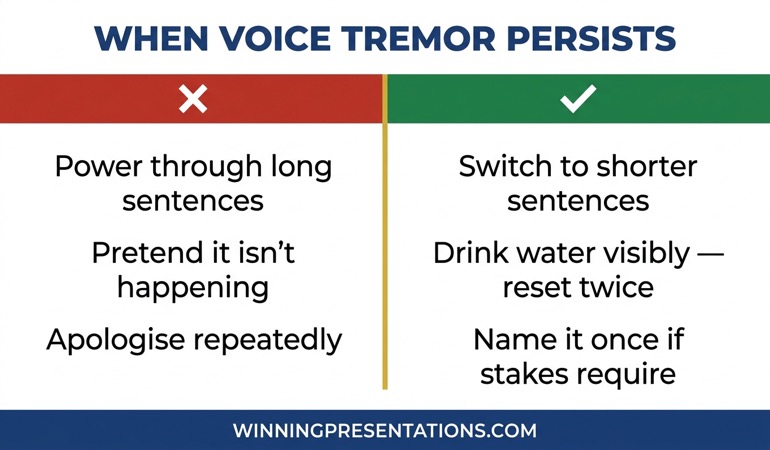
Split comparison infographic showing what to do versus what to avoid when voice tremor persists mid-presentation

The Conquer Speaking Fear programme goes into the full set of recovery techniques — including the specific scripts for the rare moments when naming the tremor is the right choice.

TECHNIQUE, NOT CONFIDENCE

The complete physical mechanics programme for presentation anxiety

Conquer Speaking Fear covers the breath, voice, body, and mental rehearsal techniques for the high-stakes presentation moments that confidence alone does not solve. £39, instant access, self-paced.

Get Conquer Speaking Fear →

Frequently Asked Questions

Will the audience notice my voice tremor?

Often less than you think, and less still if you do not draw attention to it. Voice tremor feels enormous to the person experiencing it because it happens inside the skull. From the audience’s position in the room, minor tremor is often inaudible. Moderate tremor is usually attributed to thoughtful pausing. The presenter who notices it most is almost always you.

Does caffeine make voice tremor worse?

For many people, yes — particularly in the hours before a high-stakes presentation. Caffeine amplifies the sympathetic nervous system response that underlies the tremor mechanism. If you rely on morning coffee, consider moving the final cup at least three hours before the presentation start time, or switching to a smaller serving.

What about beta blockers for voice tremor?

Beta blockers are sometimes prescribed for performance anxiety and can reduce physical tremor. Whether they are appropriate is a medical decision, not a presentation decision. Speak to a GP. The techniques described here are not a substitute for medical advice where anxiety is severe or sustained.

Can I practise the reset outside of presentations?

Yes, and this is what makes it reliable. Run the three-second reset sequence daily for a week — during any brief pause in your day. By the time you need it in a presentation, the body has already practised it. The reset becomes automatic rather than something you have to remember to do under pressure.

Weekly techniques, practical, read in four minutes

The Winning Edge is a weekly newsletter on the mechanics of high-stakes presentations — including physical technique, structural frameworks, and the moments in between.

Subscribe to The Winning Edge →

Partner post: After the presentation is over, the recovery work matters. The confidence after a bad presentation framework covers the reframing and rehearsal that protects your future appearances.

Your next step: Practise the three-second reset once a day this week. Pick a moment when you are not under any pressure — between meetings, before reading an email. By the time you need it in a presentation, the sequence will already feel natural.

About the Author

Mary Beth Hazeldine is Owner & Managing Director of Winning Presentations Ltd. With 24 years of corporate banking experience at JPMorgan Chase, PwC, Royal Bank of Scotland, and Commerzbank, she advises executives across financial services, healthcare, technology, and government on structuring presentations for high-stakes funding rounds and approvals.


29 Jan 2026
Woman looking anxious before presenting with thought bubble showing worried inner critic

Every Time I Stood Up to Speak, the Same Thought Hijacked Me.

“They can all see you’re faking it.”

That was the thought. Every single time. Standing up in meetings. Walking to the front of a room. Unmuting on a video call. The same voice, the same accusation: they’re watching you fail.

For five years, I believed it was true. The fear of being judged when speaking wasn’t just uncomfortable—it ran my career. I turned down opportunities. I stayed silent when I had something valuable to say. I spent hours rehearsing, then hours afterward replaying every stumble.

Then I trained as a clinical hypnotherapist. And I discovered something that changed everything: the judgment I feared wasn’t coming from the audience. It was coming from inside my own head—and it had been lying to me the whole time.

Quick Answer: The fear of being judged when speaking is a cognitive loop—your brain predicting criticism, scanning for evidence, then “confirming” the prediction with selective attention. In practice, audiences are far more generous than speakers imagine. Breaking the loop requires understanding that most judgment you fear is projection: your inner critic’s voice, not actual audience opinion.

🎯 Does This Sound Familiar?

  • You replay presentations for hours, fixating on every mistake
  • You assume a neutral face means disapproval
  • You feel like everyone noticed that one stumble—even when no one mentions it
  • You avoid speaking opportunities because the judgment feels unbearable
  • You’ve been told you’re “too hard on yourself”—but can’t seem to stop

If three or more apply, you’re caught in the judgment loop. There’s a way out—keep reading.

Want a Structured Way to Break the Loop?

For readers who prefer a guided framework over working through techniques alone, Conquer Speaking Fear walks through the cognitive and physiological work step-by-step — designed by a qualified clinical hypnotherapist.

Explore the Programme →

The Moment I Realised I’d Been Wrong for Years

The turning point came during my hypnotherapy training. We studied a cognitive distortion called “mind reading”—the assumption that you know what others are thinking.

I realised I’d been doing it for my entire career.

Every frown in the audience meant disapproval. Every glance at a phone meant boredom. Every person who didn’t smile was silently cataloguing my failures.

Except none of it was real. I was projecting my own self-criticism onto faces that were actually neutral, distracted, or simply processing information.

When I finally started asking for actual feedback after presentations, the gap between my perception and reality was staggering. “Clear and confident,” people said. “Really useful.” Meanwhile, I’d spent the previous night convinced I’d humiliated myself.

The fear of being judged when speaking wasn’t coming from the audience. It was coming from a voice in my own head—and that voice had been running the show for five years.

The Judgment Loop: Why Your Brain Creates Critics That Don’t Exist

The fear of being judged isn’t irrational—it’s an ancient survival mechanism running outdated software.

Thousands of years ago, social rejection meant death. Being cast out from the tribe meant no protection, no food, no survival. Your brain evolved to be hyper-vigilant about social threats—scanning constantly for signs of exclusion.

The problem? That same brain now treats a Tuesday morning team meeting like a life-or-death tribal evaluation.

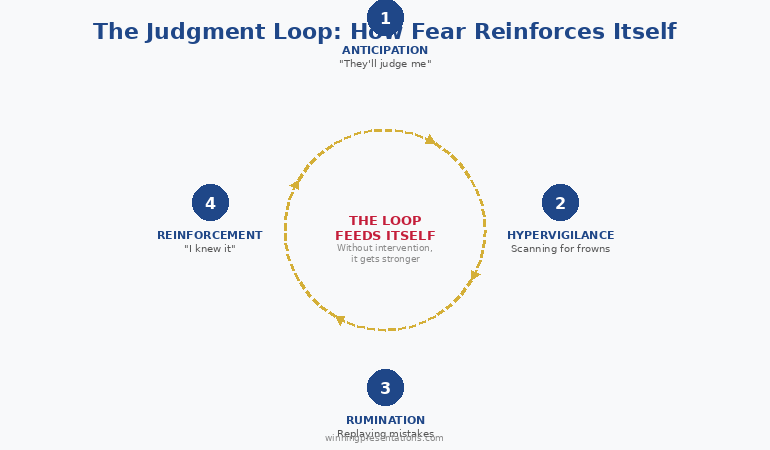
The judgment loop works in four stages:

Stage 1: Anticipation. Before you speak, your brain predicts negative outcomes. “They’ll think you’re incompetent. They’ll see through you. They’re already judging.”

Stage 2: Hypervigilance. During the presentation, you scan for evidence confirming those predictions. A frown. A yawn. Someone checking their phone. Each gets flagged as “proof.”

Stage 3: Rumination. Afterward, you replay every micro-moment, constructing a narrative of failure. The frown becomes contempt. The yawn becomes boredom. The silence becomes criticism.

Stage 4: Reinforcement. This post-event analysis “proves” your fears were justified—making the anticipation worse next time.

The loop feeds itself. Without intervention, it strengthens with every presentation.

#image_title

Fear of being judged when speaking diagram showing the judgment loop cycle of anticipation hypervigilance rumination and reinforcement

What Audiences Actually Think (The Research)

Cognitive psychology research consistently shows the same thing: audiences are far more generous than speakers believe.

The Illusion of Transparency

Speakers dramatically overestimate how visible their nervousness is. In studies, presenters rated their anxiety as obvious; audiences barely noticed. Your racing heart, sweaty palms, and internal panic are largely invisible to everyone but you.

The Audience Wants You to Succeed

Most audiences are sympathetic, not critical. They’re not hoping you’ll fail—they’re hoping you’ll give them something useful. When you stumble, their instinct is usually empathy, not judgment.

Think about your own experience. When a speaker loses their place, do you think “what an idiot”? Or “that happens to everyone”?

Attention Is Scattered, Not Focused

You feel like every eye is drilling into you, evaluating every word. In reality, audience attention is distributed. People are thinking about their next meeting, their lunch, their own concerns. You’re not the centre of their mental universe—even while you’re speaking.

This is liberating, not dismissive. The judgment you fear isn’t happening because people aren’t paying the microscopic attention your brain assumes.

For a deeper look at building sustainable confidence, see my guide on genuine presentation confidence.

⭐ Stop the Loop Before Your Next Presentation

The fear of being judged isn’t something you manage—it’s something you can resolve. Get the complete system for rewiring how you experience speaking.

Conquer Speaking Fear includes:

  • The psychological framework behind judgment fear (and how to dismantle it)
  • NLP techniques to interrupt the rumination loop
  • Pre-presentation protocols that prevent the spiral before it starts

Get Conquer Speaking Fear → £39

Created by a clinical hypnotherapist who spent 5 years trapped in the same loop.

The Spotlight Effect: Why You Feel Watched When You’re Not

Psychologists call it the “spotlight effect”—the tendency to believe others are paying more attention to us than they actually are.

In one famous study, participants wore embarrassing t-shirts and estimated that about half the people they encountered noticed. The actual number? Less than 25%.

When speaking, the spotlight effect intensifies. You feel like you’re under a microscope when you’re actually just… talking to people who are half-listening while thinking about their own lives.

Why does this matter?

Because the fear of being judged is based on a false premise: that people are watching you closely enough to judge you in the first place.

They’re not.

That stumble you replayed forty times? Most people didn’t register it. That “um” that haunts you? Nobody counted. That moment you lost your place? They assumed you were pausing for effect.

The spotlight you feel isn’t real. It’s a cognitive illusion created by a brain that evolved to overestimate social threats.

Why am I so afraid of being judged when I speak?

Fear of judgment when speaking stems from your brain’s ancient threat-detection system treating social evaluation like physical danger. This was useful for tribal survival—social rejection once meant death. But it creates false alarms in modern contexts. The fear feels real because your nervous system can’t distinguish between actual threat and imagined social rejection.

How do I stop caring what people think when presenting?

You don’t stop caring—you recalibrate. The goal isn’t indifference but accurate perception. When you understand that most “judgment” is projection (your inner critic, not actual audience opinion), you can focus on connection rather than performance. Cognitive reframing and pre-presentation protocols help shift this automatically.

Is fear of judgment a form of anxiety?

Yes—fear of being judged when speaking is a core component of social anxiety and performance anxiety. It involves the same neural pathways: amygdala activation, stress hormones, hypervigilance for threat. The good news is that anxiety responses can be rewired with the right techniques.

Your Inner Critic Isn’t Protecting You—It’s Sabotaging You

Here’s the uncomfortable truth: the harshest judge in any room is the one inside your own head.

Your inner critic sounds like it’s helping. “Don’t mess up. They’re watching. Be careful.” But this voice doesn’t protect you from judgment—it creates the anxiety that undermines your performance.

The inner critic creates a self-fulfilling prophecy:

You fear being seen as nervous → The fear makes you nervous → The nervousness confirms the fear was “justified.”

Meanwhile, the audience sees someone who seems slightly tense and thinks nothing of it. The “judgment” exists only in the loop between your ears.

The voice isn’t objective

If you recorded your inner critic’s commentary and played it back, you’d recognise it as absurdly harsh. “Everyone thinks you’re incompetent” is not reasonable analysis—it’s catastrophising. But in the moment, it feels like truth.

Part of breaking the judgment loop is learning to hear that voice as a voice—not as reality. It has opinions. Those opinions are usually wrong. You don’t have to believe everything it says.

For more on the physical side of this response, see my guide on managing high-stakes presentation nerves.

For the Inner Critic Loop

The structured programme for silencing the inner critic that logic alone won’t quiet

Conquer Your Fear of Public Speaking (£39, instant access) — cognitive reframing techniques and NLP pattern interrupts designed by a qualified clinical hypnotherapist.

Get the Programme →

How to Break the Loop: The 4-Step Reset

Understanding the loop intellectually is useful. Breaking it requires action. Here’s the framework I use with clients—and used on myself:

Step 1: Catch the Prediction

Before you speak, notice the anticipatory thoughts. “They’ll think I’m boring. They’ll judge my voice. They’ll see I’m nervous.”

Don’t argue with them. Just notice. “Ah, there’s the prediction.” Awareness alone begins to weaken the loop.

Step 2: Question the Evidence

During or after speaking, when you catch yourself “mind reading,” ask: “What’s my actual evidence for this?”

A frown isn’t evidence of judgment. It might be concentration. Confusion. Indigestion. You don’t know—and assuming the worst isn’t data.

Step 3: Interrupt the Replay

Post-presentation rumination is where the loop reinforces itself. When you catch yourself replaying mistakes, use a pattern interrupt:

— Physically move (stand up, change rooms)
— Say “that’s not useful” out loud
— Redirect attention to something requiring focus

The goal isn’t suppression—it’s breaking momentum before the spiral.

Step 4: Collect Contrary Evidence

Actively seek feedback. Not “how did I do?” (too vague) but “what’s one thing that worked well?” and “what’s one thing I could improve?”

Real feedback—almost always more positive than imagination—begins to overwrite the false narrative.

From Performing to Connecting: What Real Confidence Looks Like

The deepest shift happens when you stop treating speaking as a performance to be judged and start treating it as a connection to be made.

Performance mindset asks: “How am I being perceived?”
Connection mindset asks: “How can I be useful to these people?”

When you focus on the audience’s needs rather than your own evaluation, the spotlight effect diminishes naturally. You’re not the subject anymore—the value you’re providing is.

This isn’t fake-it-till-you-make-it. It’s genuine confidence from redirecting attention away from self-judgment and toward service.

The irony: When you stop worrying about being judged, you become a better speaker. Your delivery improves. Your presence strengthens. You become the confident person you were trying to perform.

Not because the audience changed. Because you stopped inventing critics who were never there.

For more on overcoming fear of public speaking at a deeper level, that guide covers the physiological techniques that complement this cognitive approach.

⭐ Ready to Break the Loop for Good?

The fear of being judged when speaking isn’t permanent. It’s a pattern—and patterns can be changed. Get the complete system for rewiring your relationship with speaking.

Conquer Speaking Fear gives you:

  • The psychological framework behind judgment fear
  • Step-by-step techniques to interrupt the loop at every stage
  • Pre-presentation protocols that prevent spiralling

Get Conquer Speaking Fear → £39

Created by a qualified clinical hypnotherapist and NLP practitioner who knows the loop from the inside.

Frequently Asked Questions

How long does it take to overcome fear of being judged when speaking?

Most people notice a significant shift within 2-4 weeks of consistent practice with these techniques. The judgment loop took years to build, so complete rewiring takes time—but acute intensity often reduces quickly once you understand the mechanism and have tools to interrupt it.

Will the fear ever go away completely?

For most people, the fear transforms rather than disappears entirely. You may still notice old thoughts arise, but they lose their power. Instead of believing “everyone’s judging me,” you recognise it as an old pattern and let it pass. The fear stops controlling behaviour even if echoes remain.

What if I really am being judged?

Sometimes you are—but rarely as you imagine. Even when someone judges a presentation negatively, their opinion is usually fleeting and less extreme than feared. The key: their judgment of one presentation isn’t judgment of your worth as a person. Those are different things.

Should I avoid speaking situations until I’ve overcome this?

Avoidance strengthens fear. Each avoided presentation teaches your brain that speaking is genuinely dangerous. Instead, seek smaller, lower-stakes opportunities to practice the techniques. Gradual exposure with new tools is more effective than waiting until you feel “ready.”

Get Weekly Confidence Insights

Practical techniques for speaking with confidence—no fluff, just what works.

Subscribe to The Winning Edge →

If your body reacts before your mind does

Racing heart, shaking hands, tight chest before you speak? Calm Under Pressure (£19.99) covers the physiological techniques — breathing, posture, vocal resets — designed to complement the cognitive work in this article.

Get Calm Under Pressure →

Related: Fear of judgment often spikes when presenting to senior leaders. Read What Executives Actually Want From Your Presentation to understand what they’re really looking for—it’s not what most people assume, and knowing this can reduce the pressure significantly.

The Bottom Line

The fear of being judged when speaking feels like truth. It feels like you’re perceiving reality accurately—that the audience really is cataloguing your flaws.

They’re not.

The judgment loop is a cognitive distortion created by a brain evolved for tribal survival, not conference room presentations. The critics in your head aren’t real. The spotlight isn’t on you. And the audience is far more sympathetic than your inner voice has led you to believe.

Once you understand this—really understand it—the loop begins to break.

Your next step: Before your next presentation, notice the anticipatory thoughts. Don’t fight them. Just notice: “There’s the prediction.” That simple act of awareness is the first crack in the loop that’s been running your speaking life.

Mary Beth Hazeldine is Owner & Managing Director of Winning Presentations and a qualified clinical hypnotherapist and NLP practitioner. After spending 5 years trapped in the judgment loop herself — while working 25 years in corporate banking at JPMorgan Chase, PwC, Royal Bank of Scotland, and Commerzbank — she developed techniques that help senior professionals across financial services, consulting, and technology speak with genuine confidence.