

Quick answer: When your body betrays you mid-presentation — shaking hands, wobbling voice, sweat soaking through your shirt — the work is not to “stop being nervous”. The work is in-the-moment recovery. Shaking hands respond to grip and grounding. A wobbling voice responds to a single deep breath and a deliberate slow re-entry on the next sentence. Sweating responds to a small posture shift and a calm acknowledgement to yourself that the room cannot tell as much as you fear. None of these techniques requires the audience to know anything has happened. The presenter recovers inside the next 30 seconds and continues.
JUMP TO:
Mei was twenty minutes into a forty-minute strategy presentation to a regional executive committee when her right hand started to shake. She had been holding the laser pointer steadily until that moment. The committee had asked one slightly tougher question than the others — about regulatory exposure in a market she did not have a fully prepared answer for — and within seconds of finishing her answer, the hand started moving on its own. She put the laser pointer down on the table. The hand kept shaking. She crossed her arms briefly to hide it. The arms-crossed posture made her look defensive. She uncrossed them. The hand was still shaking.
What Mei did next was the right move, by accident. She took a breath that lasted slightly longer than her usual breath — maybe two seconds longer — and started the next sentence at a deliberately slower pace. She rested her hand on the back of the chair next to her, lightly, just enough to ground it. The shake reduced within thirty seconds. By the time she reached the next slide, the hand was steady. She finished the presentation. The recommendation was approved. After the meeting two committee members complimented her on the calm tone of the second half. They had not seen the hand. They had heard the slow re-entry and read it as composure.
The body’s betrayal in the middle of a high-stakes presentation is one of the most isolating experiences a senior professional can have. The presenter feels exposed in a way that the audience almost never reads. The work is not to stop the body from reacting — that is a long-term project rooted in nervous-system retraining. The work in the moment is to know what each symptom needs and to deliver that with as little disruption as possible. Most physical symptoms have a known recovery move that takes less than thirty seconds. The room does not need to know it is happening.
If you want a structured set of in-the-moment techniques for the physical symptoms of presentation anxiety:
Calm Under Pressure covers rapid-response techniques for shaking hands, racing heart, trembling voice, nausea — methods you can use in the room, in the moment, without anyone noticing.
Why the body betrays even prepared presenters
The first thing to know about mid-presentation physical symptoms is that they are not a sign of insufficient preparation. Many of the presenters who experience them are the most thoroughly prepared people in the room. The body’s stress response operates on a separate track from cognitive readiness. A presenter can know the material cold, have rehearsed the deck nine times, and still have their hands start shaking on slide twelve when the chair leans forward and asks an unexpected question. The shake is not about the question. It is about the body’s threat-detection system firing in a context where the social stakes feel high.
The second thing to know is that these symptoms are physiological, not psychological in any straightforward sense. The “calm down, you’ve got this” self-talk that some books recommend rarely works in the moment because the body has already decided to react. The cognitive layer is overruled by the autonomic layer. What works is moving the recovery into the autonomic layer too — through breath, through posture, through small physical adjustments that send the body a different signal. Once the body receives the new signal, the symptom typically resolves within thirty to ninety seconds. The cognitive self-talk can come afterwards. In the moment, the work is physical.
The third thing is that experienced senior presenters get these symptoms too. The pattern of “I’ve never had this happen before, what is wrong with me” is misleading. It happens to people who have presented for thirty years. It happens to CFOs and managing directors. The difference between someone who recovers in thirty seconds and someone who is derailed for the rest of the presentation is not whether the symptom appeared. It is whether the presenter knew the recovery move for that specific symptom. The recovery moves are learnable. They are the work.
Shaking hands — recovery in two breaths
Shaking hands are the most visible of the common physical symptoms and the easiest to recover. The shake is a fine tremor caused by adrenaline arriving in the small muscles of the hand. It typically starts when the presenter is holding something — a laser pointer, a remote, a piece of paper, a glass of water. The held object amplifies the tremor visually. Three things help simultaneously. First, put the object down. Even a slight tremor in an empty hand is much less visible than the same tremor in a hand holding a laser pointer. Second, ground the hand on something stable — the back of a chair, the edge of a table, your own opposite forearm in a relaxed posture. Third, take a single deep breath in through the nose and a slow exhale out through the mouth.
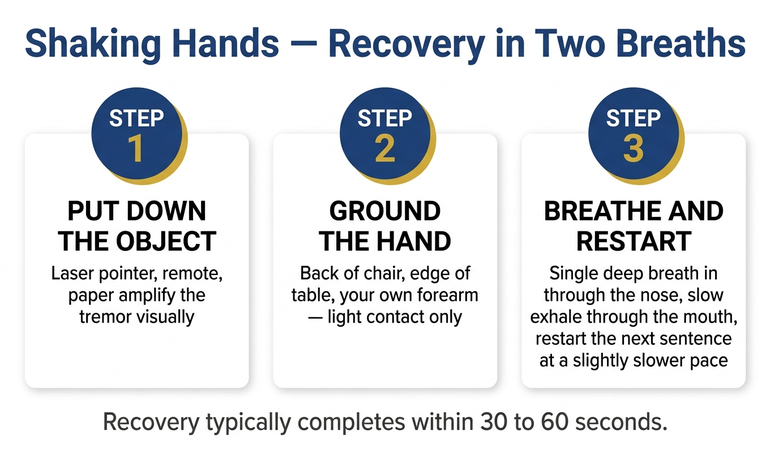
The reason this works is that the held object isolates and amplifies the tremor. A pen in a shaking hand telegraphs the tremor across the room. The same hand without the pen, resting lightly on something stable, looks composed. The breath helps because slow nasal inhalation activates the vagus nerve, which in turn reduces the adrenaline circulation. The shake usually starts to ease within fifteen to thirty seconds. By the time the presenter has restarted the next sentence at a slightly slower pace — pace recovery is part of the move — the shake has typically reduced to invisibility.
One important detail. Do not announce that your hands are shaking. The instinct can be to acknowledge it, to “be human”, to defuse the awkwardness. At the senior level this is the wrong move. The audience has often not noticed. Announcing it makes them notice and re-cast the rest of the presentation through that frame. The shake is something the presenter is aware of internally; it does not need to be made into a shared experience with the room. Recover quietly. Move on. For the closely related discipline of recovering from a physical symptom that starts before the presentation, see stomach churning before presentations and how to reset before walking in.
Stop being derailed by the physical symptoms of presentation anxiety.
Calm Under Pressure is a self-paced resource covering rapid-response techniques for shaking hands, racing heart, trembling voice, nausea — methods you can use in the room, in the moment, without anyone noticing. £19.99, instant access, no subscription.
- Rapid-response techniques for the physical symptoms that appear mid-presentation
- Methods designed to be used in the room without anyone noticing
- Covers shaking hands, racing heart, trembling voice, nausea
- Instant access on purchase, no subscription, no recurring billing
Wobbling voice — the deliberate slow re-entry
A wobbling voice — the slight tremor or break that appears when the vocal cords tighten under stress — is one of the most uncomfortable symptoms to experience because the presenter hears it from inside their own head. The internal volume is loud. The room often hears it as a much smaller wobble than the presenter does. But internal experience and external read aside, there is still a recovery move. The move has three parts. Stop the sentence at the next natural pause. Take a breath that is slightly longer than usual. Restart the next sentence at a deliberately slower pace and at a slightly lower pitch.
The reason this works has to do with vocal mechanics. The wobble is caused by laryngeal tension and shallow breathing. The breath drops the larynx into a lower position and refills the diaphragm. The slow re-entry on the next sentence prevents the wobble from compounding — most voice tremors get worse when the presenter pushes through them at the same pace. The slower restart breaks the cycle. The lower pitch is a small additional anchor. It signals to the laryngeal muscles to release rather than tighten. The combined move usually settles the voice within two to three sentences.
An additional detail: take a sip of water if water is available. The reflex of swallowing pulls the larynx through a small physical adjustment that often helps. The pause to drink also gives the breath time to do its work. None of this needs to be performed for the audience. A breath, a sip, a slower restart. The audience reads the sequence as a presenter taking their time to choose the next sentence carefully — which is largely true. For the closely related discipline of full vocal recovery during a more pronounced tremor episode, see voice tremor during presentations and the three-second reset.
Sweating through the shirt — what the room actually sees
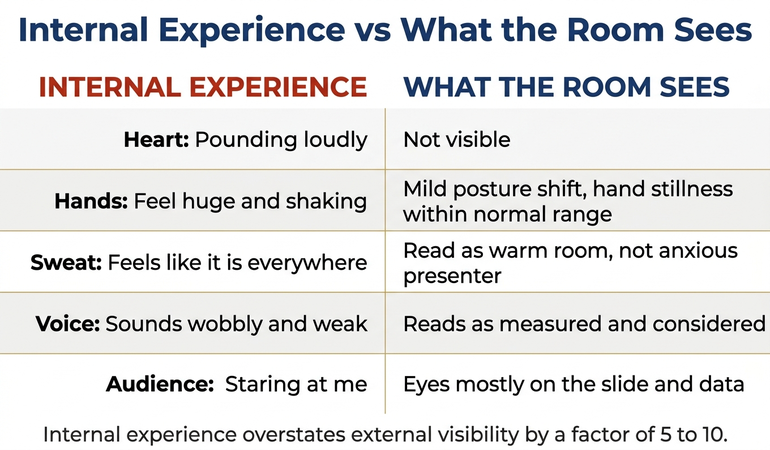
Sweating mid-presentation is the symptom that produces the most disproportionate distress relative to what the room actually perceives. The presenter feels the heat rising, feels the dampness on the back of the neck, feels the shirt going through, and the internal experience is overwhelming. The audience is typically watching the slide, the face, and the data. They are not auditing the shirt. Even when sweat is genuinely visible — which happens, particularly under stage lighting or in warm rooms — the audience reads it as “warm room” not as “anxious presenter” most of the time. Their default explanation is environmental, not psychological.
The in-the-moment work for sweating is part physical and part cognitive. The physical part is small. Adjust the posture slightly to allow air movement at the neck or chest — a half step back from the lectern, a slight loosening of a tightened tie, a hand placed briefly on the back of the chair to lift the shirt away from the back. None of this is performative. It is small. The cognitive part is the more important half. Reframe the internal experience from “the room can see this and is judging me” to “the room is paying attention to the data”. This reframe is harder than the physical move and more powerful. Anxious sweating is amplified by the belief that the room is watching the sweating. When the presenter mentally returns to the substance of the presentation, the body’s stress response often reduces, and the sweating reduces with it.
One physical preparation matters. Wear an undershirt. A simple base layer dramatically reduces visible shirt-through sweating because the outer shirt has a buffer. Choose shirt colours that do not telegraph wet patches — lighter blues, mid greys, and patterns are more forgiving than solid mid-blues or solid pastels. None of this is sophisticated wardrobe science. It is logistics. Senior presenters who have learned that they sweat under pressure prepare for it the way they prepare for any other variable. The garment is not a vanity choice. It is recovery infrastructure built before the meeting starts.
Want a complete reference for in-the-moment techniques across the full range of physical symptoms?
Calm Under Pressure covers rapid-response techniques for the physical symptoms of presentation anxiety, designed to use in the room without anyone noticing. £19.99, instant access.
Staying in the room after a physical symptom appears
The hardest part of recovering from a physical symptom mid-presentation is not the technique itself. It is staying mentally in the room afterwards. Once the symptom has appeared, the presenter’s attention can lock onto it for the rest of the presentation — wondering whether the audience saw it, whether it will return, whether the next slide is the slide where the voice will go again. This internal monitoring is where the second half of the presentation gets lost. The technique recovered the body within thirty seconds. The mental loop can derail the next twenty minutes.
The work to stay in the room is to make a deliberate cognitive return to the content. Look at the next slide. Read what is on it. Speak the next sentence. The mental act of re-engaging with the substance of the presentation is what pulls attention away from the body and back to the audience. This is not denial of what happened. It is choosing where the attention goes for the rest of the meeting. After a few presentations of practising this — coming back to the slide rather than monitoring the body — it becomes automatic. The post-symptom monitoring loop is itself a habit, and like all habits it can be replaced with a different one.
For presenters who experience these symptoms more intensely — full panic-attack-level responses rather than the smaller tremors and sweats discussed above — the underlying work is different in scale rather than in kind. The recovery moves still apply but the preparation work needs to extend to nervous-system regulation outside of presentation contexts. The companion discipline of pre-presentation panic recovery is covered in presentation panic attacks — what triggers them and how to regain control.
Frequently asked questions
Does the audience really not notice these symptoms?
The audience notices much less than the presenter believes. Internal experience overstates external visibility by a factor of roughly five to ten in most cases. A tremor that feels enormous to the presenter usually reads as a slight movement to the audience. A wobble that sounds catastrophic from inside the head usually reads as a small breath from the room. A sweat that feels universal usually reads as warm-room context. There are exceptions — heavy shaking, full vocal collapse, visible facial flushing — that the audience clearly perceives. But the everyday physical symptoms that distress senior presenters most are mostly invisible at the audience’s level of attention. This is not a comforting platitude. It is a calibration the body needs to learn through repeated exposure.
Should I acknowledge what is happening to defuse the awkwardness?
At a senior level, generally no. Acknowledgement creates an awkward moment that did not need to exist. The room had not registered the symptom; the acknowledgement makes them register it and re-cast the rest of the presentation through that frame. There is one exception. If the symptom is severe enough that the presenter genuinely cannot continue — voice fully gone, tremor preventing them from advancing slides, panic response acute — then a calm acknowledgement and a brief pause is better than struggling visibly. “Let me take a moment.” Step back. Drink water. Resume in two breaths. Most of the time it does not come to that. Recover quietly when you can; acknowledge briefly when you must.
Will these symptoms reduce with repeated exposure to senior presentations?
For most presenters, yes — but the pattern is uneven. The first ten or twenty senior presentations are typically the hardest. By presentation thirty or forty the body’s stress response has habituated to the context and the symptoms reduce in intensity, even if they do not fully disappear. Some presenters never fully lose the physical responses; they simply become better at recovering from them. The goal is not to eliminate the symptoms. The goal is to know what to do when they appear and to recover quickly. A senior presenter with thirty years of experience may still get a hand tremor in a particularly high-stakes meeting. They recover in fifteen seconds because they have done it a hundred times.
Is there preparation work that reduces the likelihood of symptoms appearing in the first place?
Yes — though it is upstream of the in-the-moment recovery. Sleep the night before. Hydration starting two hours before the meeting. A short walk in the thirty minutes before. Avoid heavy caffeine on the morning of a high-stakes presentation; it amplifies the autonomic response. Run through the deck once at speaking pace early in the morning, not in the hour immediately before — last-minute rehearsal often increases anxiety rather than reducing it. None of these completely prevent symptoms but the combination reduces their likelihood. The recovery techniques cover the cases where they appear despite the preparation. Both layers matter.
The Winning Edge — weekly newsletter
The Winning Edge is a weekly newsletter for senior professionals who present at the executive level. One short email a week, focused on the structural moves and recovery techniques that hold up under pressure. Subscribe to The Winning Edge →
Not ready for Calm Under Pressure? Start here instead: download the free Executive Presentation Checklist — a one-page reference for the structural moves senior leaders run before every committee deck.
About the author
Mary Beth Hazeldine is Owner & Managing Director of Winning Presentations Ltd. With 24 years of corporate banking experience at JPMorgan Chase, PwC, Royal Bank of Scotland, and Commerzbank, she advises executives across financial services, healthcare, technology, and government on structuring presentations for high-stakes funding rounds, board approvals, and strategic decisions.