

Quick answer: A 15-minute internal interview presentation should land on six slides: opening (the role and your read on it), context (what you have observed about the team or function from inside the organisation), a 90-day plan, a 12-month outlook, the operating model you would propose, and a clean ask plus open question. Aim for 11 minutes of speaking and 4 minutes of buffer for questions inside the slot. The mistake internal candidates make is treating the time as a presentation about themselves; the candidates who win treat it as a working session about the role.
JUMP TO:
Tomás had been with a Lisbon-based logistics technology company for nine years when the regional director role opened. He was one of two internal candidates being considered alongside three external ones. He had 15 minutes to present and 10 for Q&A. He spent two weeks preparing. He built 19 slides. He covered his career history, his understanding of the company strategy, his relationships across the business units, his proposed go-to-market plan, his 18-month vision, and a final slide thanking the panel for their time.
He ran 22 minutes. The panel cut him off mid-slide 16. The role went to one of the external candidates. The feedback he received afterwards was not that he lacked the experience or the knowledge — it was that “he treated it like an internal review, not an interview.” That is the trap internal candidates fall into more often than any other. They know too much, and they let that knowledge sprawl across the time slot.
The format that works is tight, structurally different from a typical promotion business case, and built around the discipline of saying less than you know. Six slides. Eleven minutes of speaking. Four minutes of internal buffer. The structure below is what experienced internal candidates use to win against external competition.
If you want a structural template, not just a framework:
The Executive Slide System gives you 26 templates and 93 AI prompts for senior decision presentations — including the structural patterns that work for 15-minute slots in front of a panel.
Why 15 minutes is the hardest slot
Fifteen minutes is the slot most internal candidates underestimate. It feels generous compared with the seven-minute pitch slot or the five-minute lightning round. In practice it is the most punishing length on the calendar.
The problem is calibration. Five-minute slots force absolute discipline; everyone overruns by ten seconds and the panel forgives. Thirty-minute slots have natural breathing room; pace can fluctuate. Fifteen minutes is precisely the window where candidates think they have time to be thorough — and then run over by three or four minutes, which feels intolerable to a panel running to schedule and signals, structurally, a lack of senior-level discipline.
The format below assumes you will speak for 11 minutes, leave 4 minutes of internal buffer, and finish before time. Finishing early in a 15-minute slot is rare enough to be remarkable, and it leaves the panel with more headspace for the Q&A — which is where most internal interview decisions are actually made.
The six-slide structure
Six slides, in this order:
Slide 1 — Opening: the role and your read on it (~90 seconds). Title the slide with the role, not your name. Two short paragraphs underneath: what the role is for in the business, and what you read as the two or three most important things the new person in seat will have to do in the first six months. This frames you immediately as someone who has thought about the role from the seat, not from outside it. Internal candidates who open with “I have been with the company for nine years…” waste the slot’s most valuable real estate.
Slide 2 — Context (~2 minutes). What you observe about the team, function, or business unit the role sits in. This is where internal knowledge becomes a structural advantage if used carefully. Two or three observations, each with the framing “what I see from inside that an external candidate would not see for six months.” Examples: a coordination problem between two teams that is not visible from the org chart, a specific commercial dynamic in the customer base, a capability gap inside the team that affects delivery. The point is not to demonstrate that you know things; it is to demonstrate that you have already done the diagnostic work the new person in seat would otherwise spend their first quarter doing.
Slide 3 — 90-day plan (~3 minutes). The most concrete slide in the deck. Three priorities for the first 90 days, each with a specific first move. Not “I would assess the team” — “In the first two weeks I would run individual sessions with each of the regional leads to confirm the picture I have from outside the seat.” The 90-day plan is what the panel uses to compare you against external candidates. Externals can present a polished generic 90-day plan; you can present one calibrated to the actual situation. Lean into that.
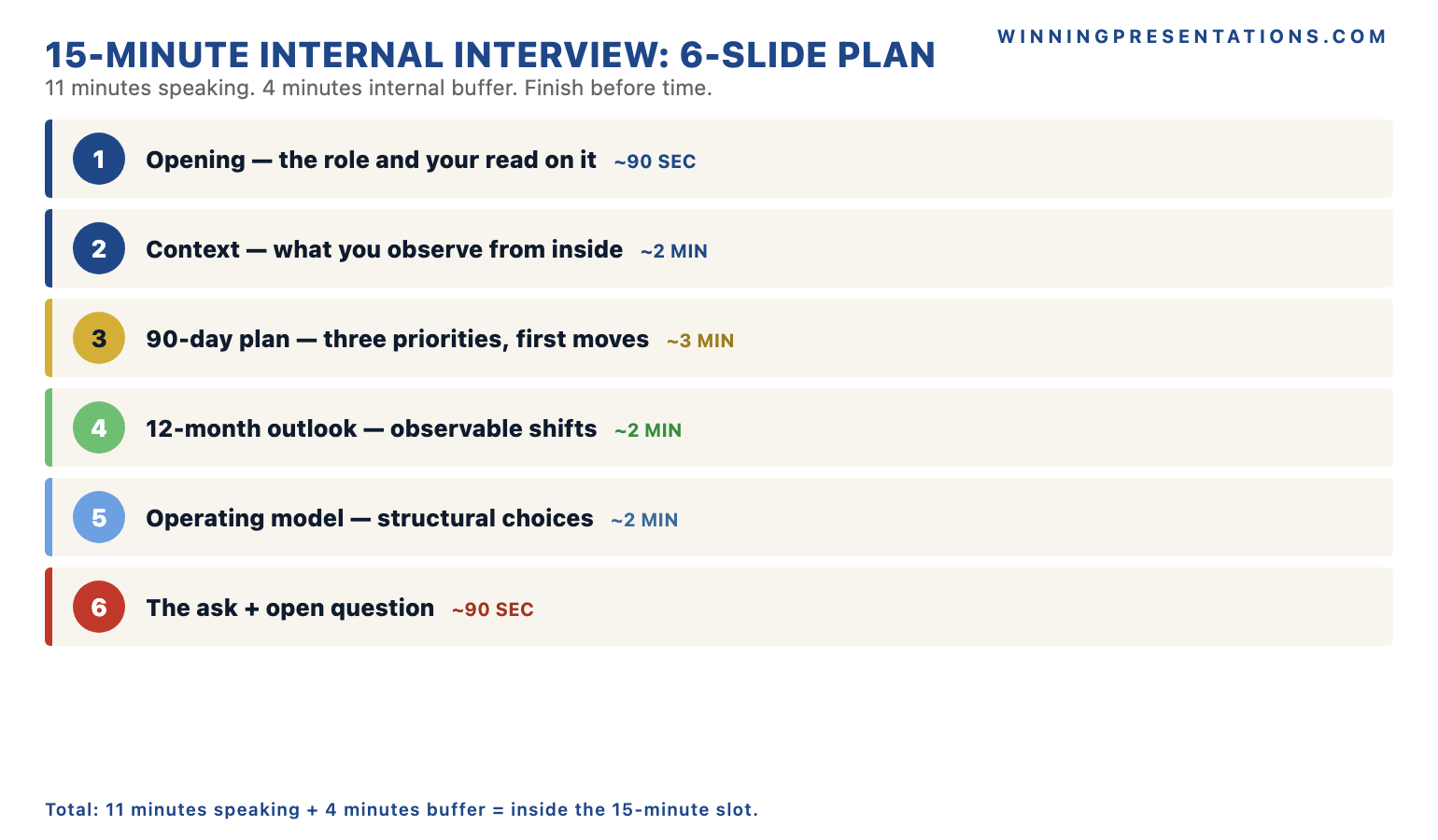
Slide 4 — 12-month outlook (~2 minutes). What you would expect the function to look like in 12 months — the two or three measurable shifts that would indicate the role is being executed well. Not vague aspirations (“a more aligned team”) — observable shifts (“decisions on cross-regional pricing taking under 10 working days, down from current 4–6 weeks”, or “a single source of truth on customer profitability across the three product lines”). The 12-month outlook is what convinces the panel you have a sense of where the role goes; the 90-day plan convinces them you can start.
Slide 5 — Operating model (~2 minutes). How you would propose to run the function. Not your management style — the structural choices: where the role spends its time, what gets delegated, how decisions get made, where the role interfaces with adjacent functions. This is the slide that separates senior candidates from middle-management ones. Senior candidates think structurally about how they spend their week; middle managers think about how busy they will be. Show the structural thinking.
Slide 6 — The ask and the open question (~90 seconds). Title: “What I am asking for, and the open question I would like to discuss.” Two lines: the role and the start date you would propose. Then one specific question you would like the panel to engage on — typically about the operating model or the 90-day plan. Just like a promotion business case (see the 5-slide promotion business case structure), giving the panel a specific question to discuss takes control of the Q&A and replaces evaluation of you with evaluation of the question you have framed.
Timing discipline: 11 minutes, not 14
Internal candidates who come in at 11 minutes signal something specific to the panel: that they understand executive discipline around time. Internal candidates who come in at 14 or 15 minutes signal the opposite, regardless of how good the content is.
The four-minute internal buffer matters because nobody, in practice, presents at exactly the pace they rehearsed. Nerves push pace up. Panel reactions slow it down. Technical glitches eat 30 seconds. A slide that needs an extra sentence of explanation eats another 30. If you have built a 15-minute deck, you will run 17. If you have built an 11-minute deck, you will run 13 — and finish, calmly, with two minutes still on the clock.
Build the deck with structure, not from a blank canvas.
The Executive Slide System gives you 26 templates designed for senior decision presentations — interview slots, board recommendations, executive committee proposals. 93 AI prompts to draft slide copy faster, 16 scenario playbooks for the situations that come up most often. £39, instant access, no subscription.
- 26 slide templates for senior decision presentations
- 93 AI prompts to build slides faster
- 16 scenario playbooks for high-stakes situations
- 7 checklists covering deck audit, rehearsal, and preparation
- Designed for senior professionals across financial services, healthcare, technology, and government
Get the Executive Slide System — £39 →
Instant download. No subscription.
Rehearsal is the only thing that produces 11 minutes. Two run-throughs the day before, both timed, both out loud. If your first run lands at 13, cut 90 seconds before the second run rather than tightening pace. Cutting content always works; speeding up never does.
The internal-knowledge trap
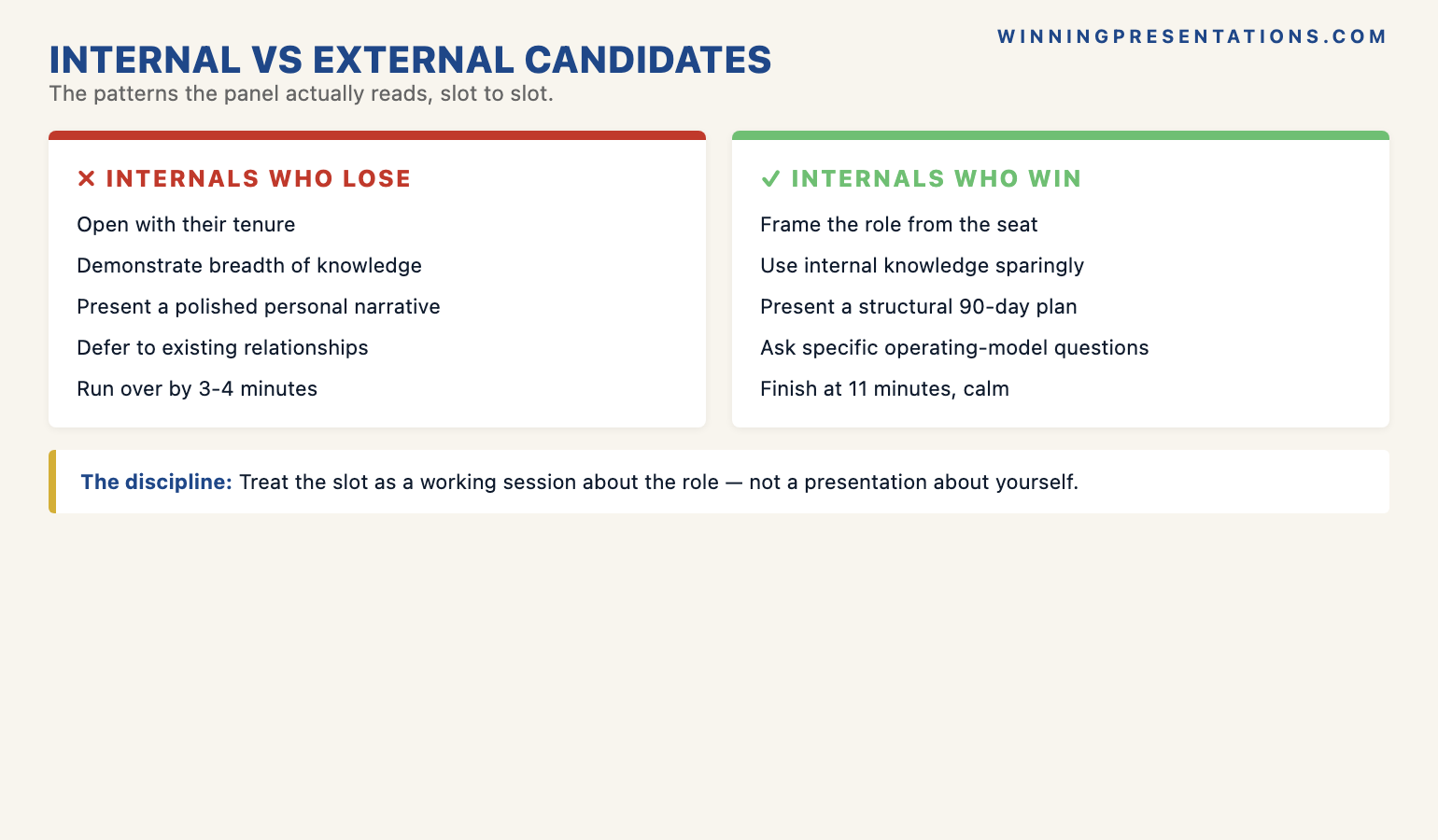
Internal candidates know too much. That sounds like an advantage and is, structurally, a liability if not managed carefully.
The trap looks like this. You know the regional commercial dynamics. You know the personalities on the executive team. You know the systems issues. You know the political tensions between two of the senior leaders. You know the budget context for the next financial year. The temptation is to demonstrate that knowledge across the slot — to signal to the panel that you bring all of it into the role on day one.
The problem is that demonstrating knowledge fragments the slot. Each piece of internal context invites a follow-up question; each follow-up eats time you needed for the 90-day plan. By the end, you have signalled that you know a lot and shown nothing about how you would operate at the next level. External candidates, who cannot signal the same knowledge, are forced into structural answers — and structural answers are what the panel actually weights.
The discipline is to use internal knowledge sparingly and structurally. Two specific observations on slide 2. One reference in the 90-day plan. One reference in the operating model. The rest of your internal knowledge stays in reserve for Q&A, where it is far more powerful because it answers a specific question rather than filling speaking time.
For senior leaders thinking about how they handle the room they will be presenting in if they win, the structural patterns in the 15-minute board presentation template apply directly — interview rooms and board rooms operate on the same constraints.
Handling the Q&A as an internal candidate
The Q&A is where internal interview decisions are usually made. The panel has spent 15 minutes hearing your structured pitch; the next 10 minutes are where they probe what is underneath it.
Three Q&A patterns are specific to internal candidates:
The “what would you change about the current approach?” question. This is the most dangerous question internal candidates face. Answer too sharply and you sound disloyal to the people you currently work with — including, often, the people on the panel. Answer too softly and you signal that you would not change anything, which contradicts the case for promoting you. The structural answer is to name a structural change (“the way decisions on cross-regional pricing currently flow”) rather than a personal critique (“the way X currently runs the team”), and to frame the change as evolution rather than correction.
The “how would you handle [a specific person] differently?” question. Panels ask this to test whether you have thought about the relational shifts the role would require. The temptation is to be diplomatic and vague. The better answer is specific and grounded: “I would expect to spend more time on [specific topic] with [role/function] in the first 90 days, because the picture I have from inside is that this is one of the under-engaged interfaces.” Stay structural; do not be drawn into personal critique.
The “why now?” question. Internal candidates are sometimes asked, gently, why they have not pushed for this role earlier. The honest answer is usually fine — timing, scope, organisational moment. The structural answer is better: “The role as it exists now requires [X] in a way that the previous version did not, and the case I am presenting today is built around that change.” Frame it as the role having grown into something you can take on, not as you having grown ready.
For the Q&A side specifically:
The Executive Q&A Handling System covers tough questions, calm authority, and decision-safe answers in 45 seconds — the structural framework for senior Q&A under pressure. £39, instant access. Pairs naturally with the 15-minute interview format when the Q&A slot is where the real decision happens.
Frequently asked questions
How many slides should I have for a 15-minute internal interview presentation?
Six. Each slide carries one job: opening, context, 90-day plan, 12-month outlook, operating model, and the ask. More than six and you fragment the slot. Fewer than six and you lose the structure that separates senior thinking from middle-management thinking. Six is the number that consistently lands the time, the message, and the discipline signal.
Should I show that I know more than the external candidates?
No. Use internal knowledge sparingly and structurally. Two observations on slide 2, one reference in the 90-day plan, one reference in the operating model. The rest stays in reserve for Q&A, where it answers specific questions far more powerfully than it would as part of your structured pitch.
What if the panel asks me about something not on my slides?
Answer it directly, then bridge back to the structural points the role requires. “That is a real question, and the way I would think about it is X. The reason I did not put it on the slides is that the more important shift in the first 90 days is Y, which is what slide 3 covers.” This handles the question and reinforces your structural priorities at the same time.
Should my opening slide thank the panel for the opportunity?
No. Opening with thanks is the most common space-waster in internal interview decks. It uses 30 seconds of your most attention-rich window to say something the panel already knows you feel. Open with the role and your read on it — that is what the slot is for. You can thank the panel briefly at the end if you want; not at the start.
Build the deck that wins the internal slot.
The Executive Slide System gives you 26 templates and 93 AI prompts designed for senior decision presentations — including the structural patterns for internal interviews. £39, instant access.
Get The Winning Edge newsletter
A weekly note from Mary Beth on the structure, psychology, and preparation that earns senior approval. One idea, one application, one specific scenario — every Thursday morning.
Not ready for the full system? Start here instead: download the free Executive Presentation Checklist — a single-page reference for what every senior presentation needs before it leaves your desk.
Next step: Block 90 minutes in your calendar this week. Open a blank document. Write the six slide titles. Write three sentences under each. If you can do that in 90 minutes, the slot is yours to lose; if you cannot, the case needs more thinking before any slide-building begins.
About the author
Mary Beth Hazeldine is Owner & Managing Director of Winning Presentations Ltd, founded in London in 1990. With 24 years of corporate banking experience at JPMorgan Chase, PwC, Royal Bank of Scotland, and Commerzbank, she advises executives across financial services, healthcare, technology, and government on structuring presentations for high-stakes funding rounds and board approvals.