

Quick Answer
A promotion presentation is not a request for recognition — it is a business case. Frame your advancement as the solution to a specific organisational problem, support it with quantified evidence from the past twelve months, anticipate the “not ready” objection with pre-emptive evidence, and deliver it in a format that mirrors the standards you apply to every other executive decision. Senior leaders approve promotions when they can see the business logic, not just the tenure.
In This Article
- Why most promotion pitches fail before they reach the decision-maker
- The business case framing: you are solving a problem, not asking a favour
- Building your evidence file: the twelve-month impact audit
- Translating your achievements into board-ready language
- Anticipating and answering the “not ready” objection
- The one-slide personal career brief
- Structuring the promotion conversation: timing, audience, format
- When the answer is “not yet”: using the conversation to create a pathway
- Frequently asked questions
Priya had been doing the CFO role in everything but title for fourteen months. She managed the treasury function, chaired the audit subcommittee, deputised for the outgoing CFO during his extended sick leave, and delivered the annual accounts presentation to the board — an event no other Finance Director in the business had ever been asked to lead. She had not been passed over; no formal process had started. She simply assumed that the evidence was visible and that the right conversation would happen when the time was right.
The time never quite arrived on its own. A restructure was announced. An external search was commissioned for a Group CFO. Priya’s name appeared on nobody’s shortlist because nobody had a structured record of what she had been doing. The hiring panel knew she was capable. They did not know how to articulate her case internally, because she had never given them the language to do it.
Priya was not passed over because she lacked the evidence. She was passed over because she had never organised that evidence into a format her organisation could act on. The business case for her promotion existed; it simply had not been presented.
The executives who consistently advance are not always the most accomplished. They are the ones who have learned to treat their own career advancement with the same analytical precision they apply to any other business decision they take to a senior committee.
Why Most Promotion Pitches Fail Before They Reach the Decision-Maker
The most common failure mode in promotion conversations is not rejection — it is deferral. “Let’s revisit this in six months” is almost always code for: the person making the case did not give us a clear enough reason to act now. Decision-makers rarely say that explicitly. They schedule another review instead.
Promotion pitches fail at three points. The first is framing: the candidate presents their tenure and competence rather than the business problem their advancement would solve. The second is evidence: achievements are described rather than quantified, making comparison with any external candidate impossible. The third is timing: the conversation is initiated before the candidate has built sufficient internal support, leaving the formal decision-maker without allies when the case is discussed.
Each of these failures is structural. They are not personality failures or confidence failures — they are presentation failures. The evidence may be solid; the problem is that it has not been organised into a format that a busy senior leader can process, evaluate, and act on under time pressure.
The solution is to treat your own promotion like any other business case you have presented: with a clear recommendation, supporting evidence, a response to the most predictable objections, and a specific ask.
The Business Case Framing: You Are Solving a Problem, Not Asking a Favour
The shift that changes everything in a promotion conversation is moving from a narrative about yourself to a narrative about the organisation. “I have been performing at this level for two years and I believe I deserve recognition” is a request. “The business has a gap at Group Finance leadership level, and my track record in the deputy role makes me the lowest-risk path to filling it” is a business case.
The distinction is not cosmetic. It changes the entire structure of the conversation. When you frame your promotion as a business problem — a capability gap, a succession risk, a transition challenge — you give the decision-maker something to agree with before they have to agree with you. They can support the idea of solving the problem without committing to you personally in the first instance. Your case then becomes the argument for why you, specifically, are the most efficient solution.
To build this frame, identify the specific business problems your promotion would solve. Is there a succession gap? A capability shortage? A risk created by the current structure? A growth objective that requires senior capacity at your level? Each of these is a legitimate business driver for promotion, and each is more persuasive than personal merit alone, because it gives your advocate something to present on your behalf when you are not in the room.
The question to answer in your framing is: “Why does the business need this to happen now?” The answer to that question is the foundation of your case.
Building Your Evidence File: The Twelve-Month Impact Audit
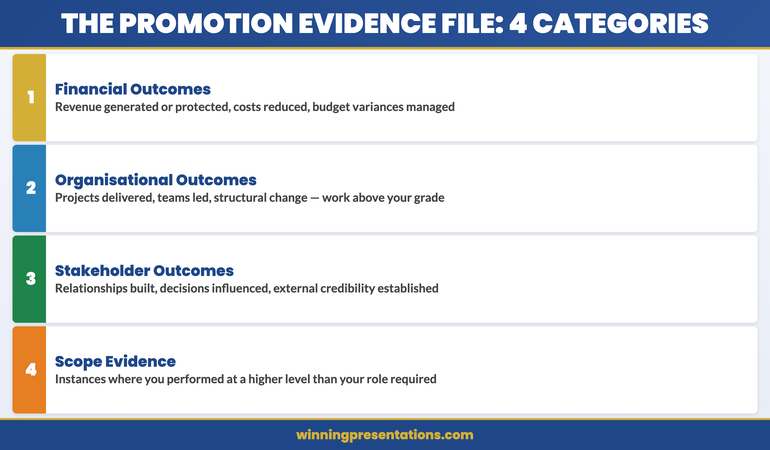
Before any promotion conversation, conduct a structured audit of your impact over the previous twelve months. Do not rely on memory and do not rely on your performance review documents, which tend to capture activity rather than impact. Instead, build a working document that contains four categories of evidence.
The first is financial outcomes: revenue generated or protected, costs reduced, budget variances managed, capital deployed. Any figure that appears in a management account or board report and that your decisions influenced belongs here. Quantify in absolute terms and as a percentage improvement where relevant.
The second is organisational outcomes: projects delivered, teams led, structural changes implemented, risks identified and resolved. These are the contributions that do not always appear in financial metrics but that senior leaders recognise as the work of someone operating above their grade.
The third is stakeholder outcomes: relationships built, decisions influenced, external credibility established, internal alignment achieved. If you have managed an external client relationship, led a major procurement, or been the internal face of a significant initiative, record it explicitly.
The fourth is scope evidence: instances where you performed at a higher level than your role required — covering a more senior colleague, leading a cross-functional workstream, representing the function at board or committee level. This is the category that most directly supports the case that your title has not kept pace with your actual level of operation.
Compile the audit before you begin structuring your promotion conversation. The material is unlikely to surprise you, but organising it systematically will reveal patterns of contribution that are not visible when the evidence is scattered across emails, project updates, and memory.
Translating Your Achievements Into Board-Ready Language
Senior decision-makers evaluate people using the same language they apply to any resource allocation decision: impact, risk, and return. Your evidence file needs to be translated from the language of individual performance into the language of organisational investment.
The translation rule is: every achievement should have a measurable outcome attached. “Led the supplier renegotiation” becomes “Led the supplier renegotiation, reducing annual category spend by 12% and extending contract terms by three years.” “Managed the team during the restructure” becomes “Maintained team retention at 94% through a six-month restructure period, against a sector average of 78%.”
When a direct financial metric is unavailable, use proxy metrics: time saved, risk reduced, scope managed, or scale of stakeholders involved. The goal is not to fabricate precision but to attach some external reference point that allows a decision-maker to calibrate the significance of what you did.
Avoid comparative language that positions you against your peers inside the organisation — this generates political risk without adding persuasive value. Instead, use external benchmarks where available: sector averages, industry norms, or publicly reported figures from comparable organisations. External comparisons strengthen the case without creating internal friction.
The Executive Slide System — Structure Every High-Stakes Deck
Your promotion case needs to be as sharply structured as any other business case you present. The Executive Slide System gives you the frameworks, templates, and slide structures to build a compelling, board-ready case for your own advancement — and every other high-stakes presentation you lead.
Anticipating and Answering the “Not Ready” Objection
The most common reason promotion conversations stall is the unspoken objection: “We’re not sure you’re ready for the full scope of the senior role.” This objection is rarely stated directly. It surfaces instead as a request for more time, a suggestion that you “continue to develop in the current role”, or a commitment to “revisit this in the next cycle.”
Because the objection is rarely explicit, most candidates never address it. The most effective approach is to surface it yourself and respond to it before it is raised. “I want to address directly the question of whether I am ready for the full scope of the role, because I know that is likely to be a concern given that I haven’t held the title formally.” Then answer it with the scope evidence from your audit: the specific instances where you have already been performing at the higher level.
The structure for this response is: acknowledge the concern, present the contrary evidence, and offer a specific reference. “My concern would be well-founded if I hadn’t been operating at this level for the past fourteen months. During that period I led [X], managed [Y] directly, and delivered [Z] in a context that was structurally equivalent to the senior role.” If a more senior colleague can attest to your performance at that level, reference them explicitly and ensure they have agreed to do so in advance.
Addressing the objection directly demonstrates the kind of confident self-awareness that senior leadership roles require. It also eliminates the gap that usually allows the objection to persist quietly beneath a polite deferral.
The One-Slide Personal Career Brief
In a formal promotion presentation, whether written or verbal, you need one slide — or one clearly delimited section — that summarises your entire case in ninety seconds. This is the component that your advocate will use when your case is discussed without you present, which is where most promotion decisions are actually made.
The one-slide brief has five components. The first is your current title and the level at which you have been operating in practice. The second is the business problem your promotion solves. The third is three to four headline impact metrics from your twelve-month audit, stated in board-ready language. The fourth is your response to the most predictable objection. The fifth is the specific ask: the title, the timing, and — if relevant — any structural change to your remit.
Keep the slide or section genuinely brief. The purpose is not to summarise your CV — it is to give a decision-maker a clear, memorable argument that they can repeat accurately to others. If someone who reads it once cannot reproduce the core logic five minutes later, it is too complex.
The discipline of constructing this brief will also help you identify the weakest element of your case. If any of the five components feels thin, that is where your preparation needs more work before the formal conversation begins.
Build a sharper promotion case with the Executive Slide System →
Structuring the Promotion Conversation: Timing, Audience, and Format
The most effective promotion conversations do not happen spontaneously. They are requested explicitly, prepared for in advance, and structured as a working meeting rather than an informal discussion. The distinction matters: an informal conversation gives the decision-maker permission to respond informally, which usually means no commitment and no timeline.
Request a dedicated meeting — thirty minutes, framed as a structured career conversation. Send a brief agenda in advance: three items, each stated as a business question rather than a personal request. This positions the meeting as a professional dialogue rather than a lobbying exercise.
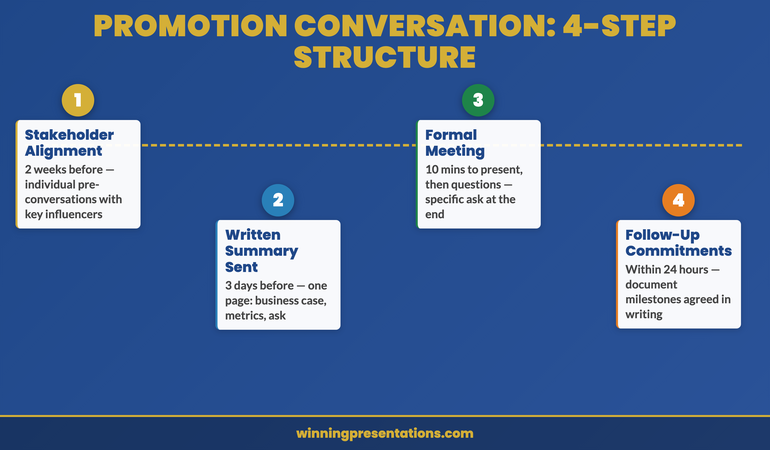
Before the formal conversation, apply the same pre-meeting approach you would use for any other high-stakes decision. Identify the two or three people whose informal support will influence the formal outcome. Meet them individually, understand their perspective, and address any concerns privately before the formal meeting. The principles of stakeholder alignment apply as directly to career conversations as they do to any other executive decision.
On the question of format: for a formal promotion into a senior leadership role, a written one-page summary sent in advance of the meeting is worth preparing. It signals seriousness of intent and gives the decision-maker time to formulate a considered response rather than an instinctive one. It also creates a record of the conversation’s basis, which is useful if the outcome is a conditional commitment with milestones attached.
When the Answer Is “Not Yet”: Using the Conversation to Create a Pathway
A “not yet” response is not the end of the conversation — it is the beginning of the next one. How you handle the deferral determines whether it becomes a genuine developmental pathway or a polite way of managing you out of the conversation indefinitely.
If the answer is “not yet”, ask three specific questions before you leave the room. The first: what specific evidence or capability would need to be demonstrated for the answer to change? The second: what is the realistic timeline, and what external factors — headcount, restructure, budget cycle — will influence it? The third: who else needs to be part of this conversation for a decision to be made, and is it appropriate for you to speak with them directly?
These questions serve two purposes. They convert a vague deferral into a structured commitment, and they reveal whether the deferral is genuine or indefinite. If the decision-maker cannot answer the first question with any specificity, the barrier to your promotion is probably not developmental — it is political, structural, or budgetary. Knowing that allows you to make an informed decision about whether to continue building your case internally or to consider whether the organisation has the capacity to advance you at all.
Document the conversation and any commitments made immediately afterwards. If milestones were agreed, write them up and share them with the decision-maker within 24 hours: “Following our conversation, I understood the next steps to be…” This is not aggressive — it is professional. It also prevents the well-intentioned deferral from quietly disappearing from the decision-maker’s priority list. If you are planning a different kind of career move — into a new organisation or a lateral transition — the principles of the career pivot presentation apply to structuring that case.
Rescue Block
If your promotion conversation is imminent and you haven’t had time to build the full business case, focus on one thing: the scope evidence. The single most persuasive argument for promotion is concrete evidence that you have already been performing at the higher level. Write down the five most significant things you have done in the past twelve months that were above your current grade. Lead with those. Everything else can be structured after the first conversation.
The Executive Slide System
Structure your promotion case — and every other high-stakes presentation — with the Executive Slide System. Slide frameworks, business case structures, and executive presentation templates used by senior leaders across finance, operations, and professional services.
Frequently Asked Questions
How long should a promotion presentation be?
For a formal promotion conversation at senior level, a written summary of one page and a thirty-minute meeting is the right format. The written document’s purpose is not to be exhaustive but to be clear: it should contain your business case framing, three to four headline impact metrics, your response to the most predictable objection, and a specific ask. The meeting itself should be structured as a working conversation rather than a monologue. Present your case in ten to twelve minutes, then invite questions. The quality of the questions tells you where the resistance lies and gives you the opportunity to address it directly in the room.
Should you share your promotion case in writing before the meeting?
Yes, for a formal senior promotion into a defined leadership role. Sharing a brief written summary two to three days before the meeting serves several functions: it signals that you are treating the conversation seriously, it gives the decision-maker time to prepare a considered response, and it creates a record of the basis on which the conversation was held. For more informal conversations — an annual review where promotion is one of several topics — a written document is unnecessary and may come across as disproportionately formal. Use your judgement about the register of the conversation before deciding.
What if you don’t have direct financial metrics to support your promotion case?
Most functional roles have significant indirect financial impact that can be quantified with some effort. If direct financial metrics are genuinely unavailable, use proxy metrics: team retention rates, project delivery rates, stakeholder satisfaction from formal feedback processes, scope of roles managed, or complexity of decisions taken. For roles in HR, legal, communications, or research, the relevant metrics might be response time, case volume, coverage scope, or error rate. The goal is not financial precision but external comparability — any figure that allows a decision-maker to calibrate the significance of your contribution against some reference point beyond your own assertion is worth including. If you are preparing for a first presentation in a new leadership role after your promotion, the same principle of evidence-first communication applies.
The Winning Edge — A Newsletter for Executives Who Present
Every Thursday: one structured technique for executive presentations, business cases, and high-stakes decision meetings. Practical and direct.
Free Resource
Download the Executive Presentation Checklist — the pre-flight audit used by senior leaders before every high-stakes presentation. Covers structure, evidence, stakeholder alignment, and delivery.
About the Author
Mary Beth Hazeldine has spent 25 years in banking and 16 years training executives to present with precision and authority. She works with senior leaders on high-stakes presentations, board communications, and career advancement conversations at the executive level.