

Quick answer: The best remote team leadership presentation in a quarterly townhall never opens with the numbers. The senior leaders who hold a distributed team across a fifty-minute virtual session open with three structural moves first — a named acknowledgement that recognises specific people in specific regions, a one-sentence framing of why this quarter is different from the last, and a deliberate pause that lets the team register the leader as a person before the deck takes over. The numbers come at minute four or five, after the team has already decided whether to lean in for the rest of the session. Junior remote leaders open with the headline number, expect the team to engage with it, and spend the next forty-five minutes presenting into a half-attentive distributed audience that politely waits for the slot to end. The opening moves decide the call, not the substance that follows.
JUMP TO:
- Why opening with the numbers fails on a remote townhall
- The named acknowledgement that converts tiles into people
- The one-sentence framing that earns the rest of the session
- The deliberate pause that registers the leader before the deck
- The fifteen-minute pre-townhall diagnostic
- One thing to do before the next remote townhall
- Frequently asked questions
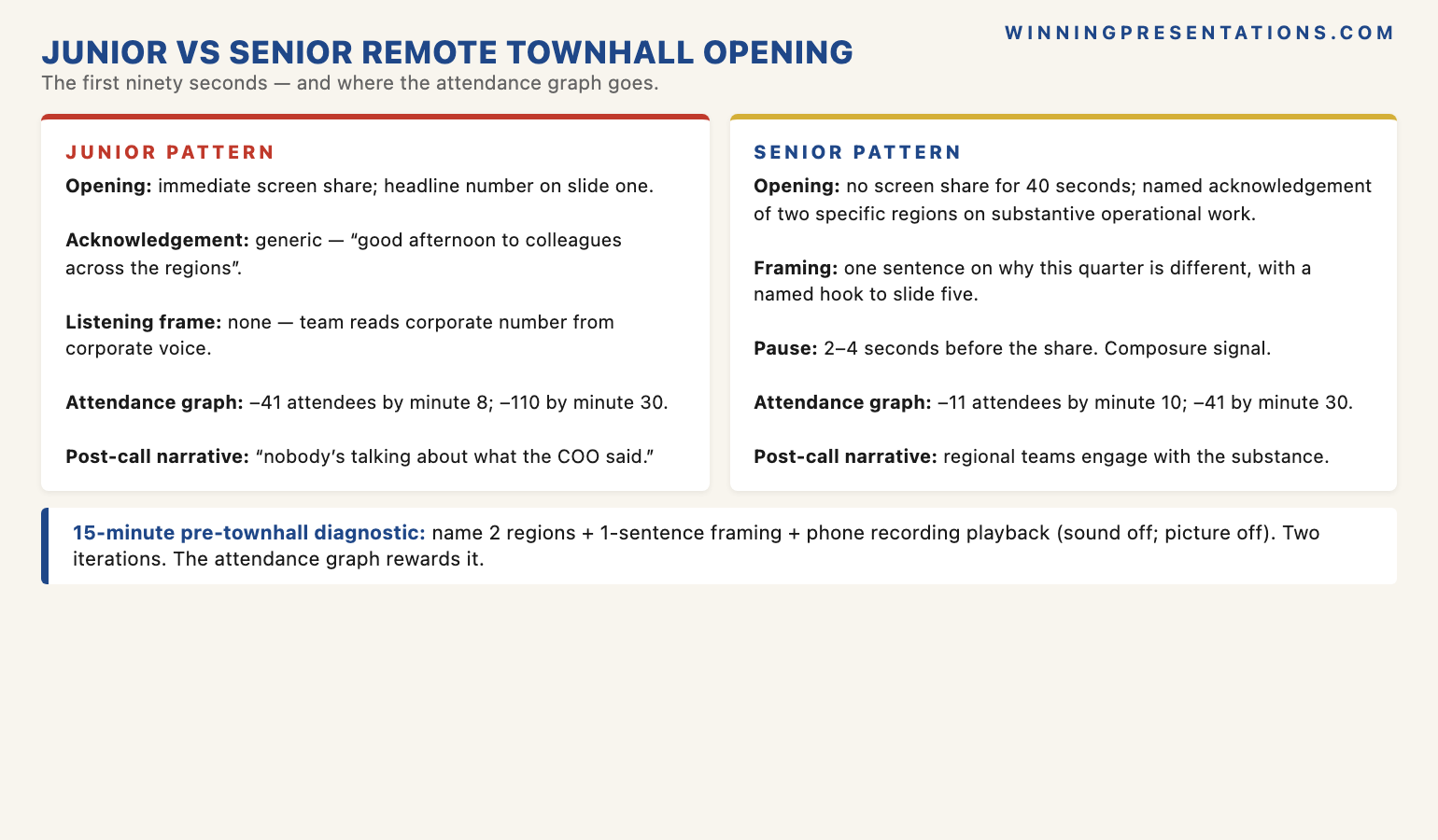
In September 2022 I was invited to observe a Q3 quarterly townhall at a mid-cap European logistics group that had moved its all-hands sessions fully remote after the pandemic and never returned. The format was a fifty-minute Zoom session with the group COO presenting to roughly four hundred and twenty employees distributed across the UK, Germany, the Netherlands, Italy, Poland, and two regional offices in the Nordics. The COO joined the call from his office in Rotterdam at 14:00 Central European Summer Time, the camera centred on him at his desk with a small company logo visible on the wall behind. The host opened the meeting, introduced him with a single sentence, and handed over. The COO shared his screen immediately. The first slide was the Q3 revenue headline. His opening words, before any other framing, were “So as you can see we’re sitting at €187 million for the quarter, which is six percent ahead of plan, and I want to walk you through what’s driving that.” The audience attendance in the Zoom panel showed three hundred and ninety-two attendees at minute one. By minute eight, when the COO moved off the financial summary and into the operational section, the attendance had dropped to three hundred and seventy-one. By minute thirty it was three hundred and twelve. The COO ended the session at minute fifty believing the townhall had landed well because he had delivered all the planned content. The chief of staff’s informal feedback the next morning, gathered from three regional MDs, was that nobody in their teams was talking about anything the COO had said.
(This article was created with AI assistance; all stories and insights are based on 35 years of real client work.)
This piece walks through why opening a remote team leadership presentation with the headline number is the structural pattern most likely to lose the room, and the three moves senior leaders make in the first ninety seconds instead. The moves are not communication softeners; they are perception architecture for a distributed audience that has fewer signals to read than an in-room audience and therefore decides much faster whether to engage. The remote townhall is a perception window before it is a content window. The numbers will land — or fail to land — inside whatever frame the first ninety seconds established. The framework the senior remote leaders apply is named, testable, and learnable, and it is almost entirely absent from the remote-leadership training most senior operators receive.
Before your next remote townhall, ninety seconds of structural rehearsal is worth running.
The Virtual Presentation Quick-Start Checklist walks through the named acknowledgement, the one-sentence framing, and the deliberate pause — the three structural moves senior remote leaders set before the numbers slide ever appears. Free download, no email gate.
Why opening with the numbers fails on a remote townhall
The number-first opening is the standard structural pattern most senior operators learned in the in-room townhall era because in a physical room the number works. The leader walks to the front, the room turns to face them, the slide goes up, and the number is the anchor everything else hangs from. The room’s presence does the relational work the leader does not have to do explicitly. People are already in the room; they have walked in, taken seats near colleagues, exchanged a brief greeting, signalled their presence. The leader stepping forward to the screen is itself a calibrating signal; the team has watched them enter the room and read the body language and adjusted their attention before the slide changes. The number opens the substantive content into an audience that has already engaged with the leader as a person.
The remote townhall strips out almost every one of those signals and leaves the leader with the headline number and nothing else. The team is distributed across regions and time zones. The Zoom tile shows the leader as a static face talking. Most attendees join on cameras off; the room is invisible to the leader and to itself. The headline-number opening lands into a perceptual void where the team has not yet decided whether the leader is worth attending to and has no relational signal pulling them toward attention. The headline number, presented without any preceding frame, reads as a corporate number being delivered by a corporate voice, and the team does what audiences do in front of any corporate number: they note it, file it, and move attention elsewhere. The attendance graph drops because the team is not engaged with the leader; the team is engaged with what they were doing before the call started.
The Rotterdam logistics COO in 2022 was a competent senior operator with a strong quarter to report. He had the substance. He had the data. He had a Q3 result six percent ahead of plan. What he did not have was a structural opening that converted four hundred and twenty distributed tiles into four hundred and twenty engaged people. The number-first opening assumed an audience that was already there; the remote format gave him an audience that had to be assembled. The energy signal a Zoom camera transmits covers the perception physics behind why the audience-assembly problem is so much more expensive in the remote format than in the room.
The named acknowledgement that converts tiles into people
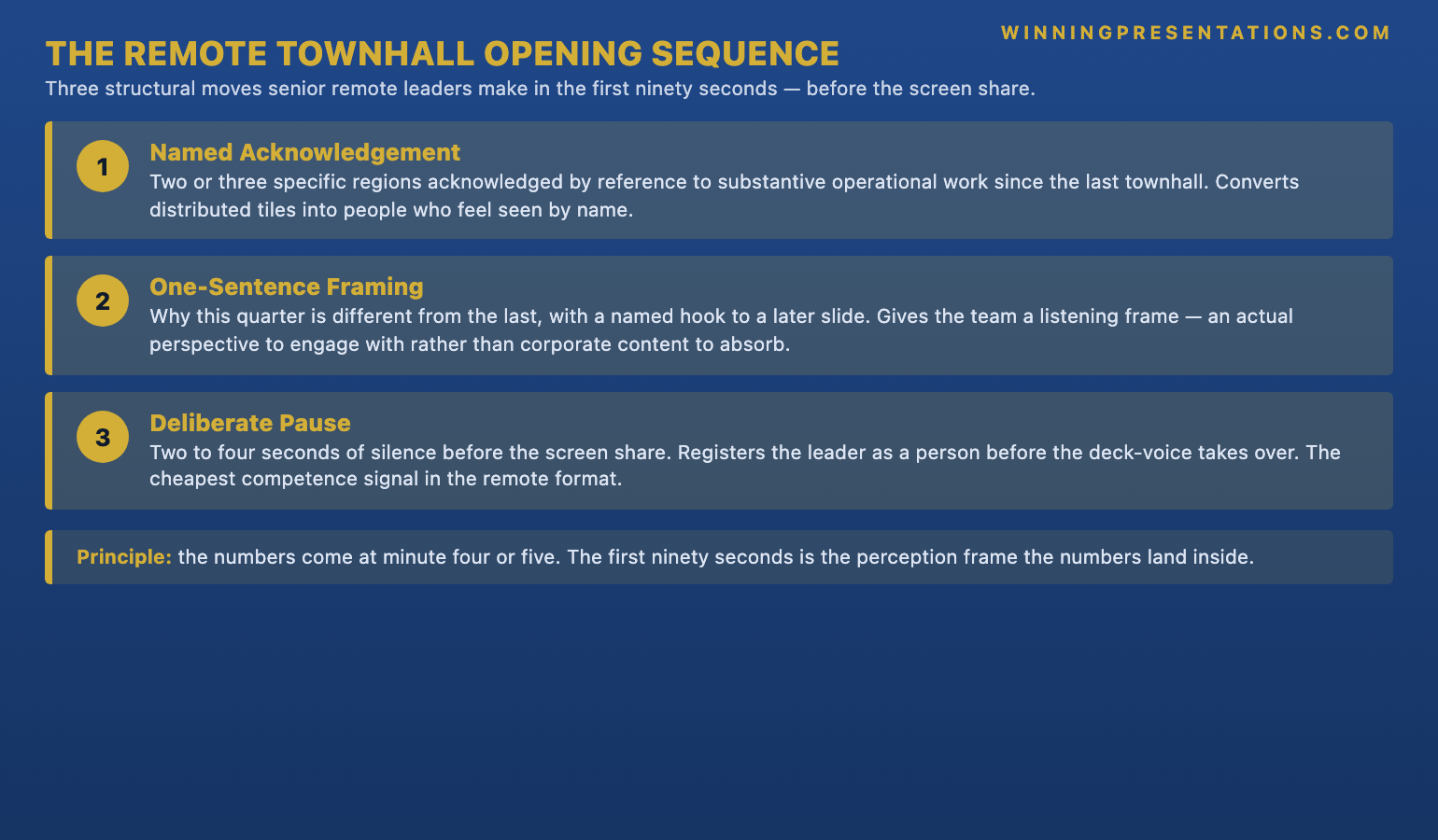
The first move senior remote leaders consistently make in a townhall opening is the named acknowledgement. It takes about twenty seconds. The leader, before sharing the screen, before any slide appears, addresses two or three named regions or named individuals by reference to something specific that has happened in their part of the business since the last townhall. The reference is short and accurate. It is not a generic “good afternoon to colleagues joining from across Europe” or “hello to everyone in the regions.” It is closer to: “Before I share the screen — I want to start by acknowledging the Hamburg team, who closed out the rail-freight transition project at the end of August three weeks ahead of plan. And to the Warsaw operations team, who took on the night-shift restructuring in July and have already moved the on-time performance numbers by four points. I’ll come back to both of those in the operational section.”
The named acknowledgement does three things in the same twenty seconds. It signals to the named regions that the leader knows what they are doing in specific operational terms, which converts the leader from a remote corporate voice into a leader who is paying attention. It signals to the un-named regions that the leader could have named them and chose two specific ones for substantive reasons rather than random selection — which keeps the un-named regions engaged because the leader has just demonstrated they read the regional updates. And it creates a named hook for later in the session: “I’ll come back to both of those in the operational section” gives the team a reason to stay for the operational section rather than treating the townhall as background while they triage email.
The named acknowledgement is harder than it sounds because it requires the leader to know specifically what has happened in two or three regions since the last townhall, in operational terms detailed enough to land as substantive rather than ceremonial. The fifteen-minute pre-townhall preparation that produces the named acknowledgement is the work most senior remote leaders skip because they assume the headline-number opening will do the engagement work. It will not. The named acknowledgement is the engagement work. The headline number is the substance the engagement work was set up to deliver.
The named acknowledgement works only when the deck behind it is built to support a leader-voice opening rather than competing with it.
The Executive Slide System is the slide library senior remote leaders use to build townhall and quarterly review decks that hold up at the Zoom-share scale and that support a leader-voice opening before the headline-number slide takes over. Layouts engineered for the camera tile, with the visual hierarchy that earns the audience’s attention rather than competing for it.
- 26 Executive Templates — including named-acknowledgement openers, regional-leader hooks, and section dividers that hold their structure when the deck is shared at 1080p across distributed screens
- 93 AI Prompts — rewrite the first three slides so the slide content frames the named acknowledgement rather than burying it
- 16 Scenario Playbooks — including the remote quarterly townhall, the distributed leadership update, and the multi-region all-hands
- 7 Checklists — the named-acknowledgement preparation list, the one-sentence framing rehearsal, and the post-share recovery routine
- Instant download, lifetime access — usable across every remote townhall cycle, not just the one in front of you now — £39
The one-sentence framing that earns the rest of the session
The second move senior remote leaders make is the one-sentence framing of why this quarter is different from the last. The sentence is short, specific, and operational. It tells the team what to listen for in the fifty minutes ahead. It is not a topic preview or an agenda walk-through. It is the leader’s actual perspective on the quarter, condensed to one sentence that the team will carry through the rest of the session as the listening frame.
The example that worked in the same European logistics group three quarters later, in Q2 2023, was the Hamburg-based head of operations delivering the same townhall format. The COO had stepped back from the quarterly format and a senior regional MD had stepped in for the rotating opening slot. She joined the call from her office in Hamburg at 14:00 Central European Summer Time. She did not share the screen. She delivered the named acknowledgement, paused for a second, and then said: “The thing I want to flag before we get into the numbers — this quarter looks better than the headline suggests, and the reason is something the regions have been quietly building over three quarters that’s now starting to show in the operational data. I’ll show you what I mean on slide five.” She paused another two seconds, said “Let me share the screen,” and then went into the deck. The attendance graph that quarter dropped by eleven attendees in the first ten minutes — not the forty-one of the Rotterdam session. By minute thirty the attendance was three hundred and seventy-nine, not three hundred and twelve.
The one-sentence framing works because it gives the team something to listen for. The team is not engaging with a corporate number; the team is engaging with a leader’s perspective on what the quarter actually means, with a named hook to slide five they want to see resolved. The framing converts the townhall from a passive reception of pre-prepared content into an active listening posture organised around the leader’s point of view. The numbers, when they appear, land inside that listening posture rather than into the void. The camera-angle decision senior leaders make before joining the board call covers the parallel dynamic in the smaller boardroom format, where the one-sentence framing carries comparable weight.
The deliberate pause that registers the leader before the deck
The third move is the deliberate pause — two to four seconds of silence between the one-sentence framing and the screen share. Junior remote leaders skip the pause because the silence feels uncomfortable in the Zoom format where dead air is more conspicuous than in a physical room. Senior remote leaders use the pause deliberately because they know what it does. The pause is the moment the team registers the leader as a person rather than as a delivery channel for the upcoming deck.
The pause works because of the perception physics of the Zoom tile. In a physical room a leader can hold the floor through posture, eye contact, and the deliberate movement to the screen; the team registers them as a presence over a span of ten or fifteen seconds without any verbal content. In a Zoom tile the only signals available are the face in the tile and the audio. If the leader collapses the moment between the framing sentence and the screen share into half a second, the team never gets to register the leader as a person between the framing and the deck-voice that takes over. The leader becomes the voice underneath the deck immediately, and the deck-voice carries lower authority than the person-voice it replaced. The pause holds the person-voice in the room for the two to four seconds it takes for the team to register them, and the deck-voice that follows is then anchored to the person-voice the team has already engaged with.
The pause is also a competence signal in its own right. Distributed teams have spent enough hours in Zoom townhalls to know that the leaders who can hold a deliberate pause are the leaders who are not rattled by the format. The pause reads as composure because that is what it is. The team’s engagement budget for the rest of the session is set in part by whether the leader looked like someone in command of the format in the first ninety seconds or someone trying to get through the content as fast as possible. The pause is the cheapest competence signal available, and almost nobody uses it deliberately on a remote townhall.
If the townhall is the warm-up to a buy-in moment the team needs to support, the structural method matters even more.
The Executive Buy-In Presentation System is the self-paced programme senior remote leaders use when the quarterly townhall is the prelude to a buy-in moment — a restructure announcement, a strategic pivot, a budget reallocation the team will have to absorb. Stop guessing what your stakeholders need to say yes. 7 modules, no deadlines, no mandatory session attendance. Optional live Q&A calls, fully recorded. Self-paced with monthly cohort enrolment. Lifetime access to materials. £499.
The fifteen-minute pre-townhall diagnostic
The fifteen-minute pre-townhall diagnostic is the closest available proxy for whether the opening ninety seconds will land. The procedure is mechanical. Open the calendar invite for the next townhall. Spend five minutes on the named acknowledgement: pick two regions, write down one specific operational thing each region has done since the last townhall in twelve to twenty words, and check the wording is accurate enough that the named regional team will recognise it as substantive rather than ceremonial. Spend five minutes on the one-sentence framing: write down the one thing you want the team to listen for in the rest of the session, in one sentence, with a named hook to a later slide. Spend five minutes rehearsing the opening forty seconds aloud, with a phone recording, paying attention to the pause between the framing sentence and the screen share.
Play the recording back twice. Once with the picture only and no sound — watch the face in the tile and ask whether it looks like a senior leader chairing the moment or someone working through a script. Once with the sound only and no picture — listen to the voice and ask whether the named acknowledgement sounds like the leader knows specifically what those regions have been doing, or whether it sounds like a generic acknowledgement that could apply to any quarter. If either answer is uncertain, the opening needs another iteration. Two iterations typically take ten to twelve minutes and are the difference between a townhall the team leans into and a townhall the attendance graph slowly drains. The diagnostic is mechanical for the same reason the verdict-first diagnostic on a board paper is mechanical: the leader is too close to their own delivery to read it as the team will read it, and the recording is the closest available external perspective.
Why the structural moves matter more for senior leaders than for junior ones
The structural moves matter more at senior level for the same compounding reason they matter on a Zoom board call. Junior team-leaders are forgiven the generic opening because the team’s expectation is calibrated downwards; the team reads the absence of a named acknowledgement as inexperience and engages with the substance anyway. Senior leaders are not forgiven the same pattern because the team’s expectation is calibrated to seniority. A COO who opens with the headline number reads as a COO who has not bothered to prepare a leader-voice opening; a regional MD who skips the named acknowledgement reads as a regional MD who is not paying attention to the regions; a head of operations who collapses the pause between the framing and the screen share reads as a leader who is not in command of the format. The same opening that a junior leader gets a generous read on costs a senior leader engagement for the rest of the session.
The compounding cost across four or five quarterly townhalls is significant. The team’s read of a senior remote leader is constructed quarter over quarter from the perception frame the first ninety seconds of each townhall establishes. A senior remote leader who runs four quarters of headline-number openings is building a perception frame where the team has learned that the townhall is a content delivery exercise rather than a leadership moment. The team disengages on schedule from minute five of every quarterly call. The regional MDs stop reading the leader as someone they want to align with on substantive operational work. The team’s informal narrative about the leader is set by the perception, not by the substance the leader was actually delivering. The cost is paid one quarter at a time, in attendance graph drops and in chief-of-staff feedback the leader rarely hears directly.
The opening moves are easier to apply when the deck is designed for a leader-voice opening in the first place.
Designed for senior remote leaders who run quarterly townhalls, distributed all-hands, and multi-region updates — the Executive Slide System gives you the named-acknowledgement openers, regional-leader hooks, and section dividers that hold their structure at the Zoom-share scale and let the leader-voice opening do its full work before the deck takes over. Built on 24 years in corporate banking and 16 years coaching senior professionals across financial services, insurance, consulting, and technology. 26 templates, 93 AI prompts, 16 scenario playbooks, 7 checklists. £39, instant download, lifetime access.
One thing to do before the next remote townhall
Fifteen minutes before the next quarterly townhall, write down two things. First, the two regions you will acknowledge by name, with one specific operational thing each region has done since the last townhall written in twelve to twenty accurate words. Second, the one-sentence framing of why this quarter is different, with a named hook to a later slide. Rehearse the opening forty seconds aloud once, with the phone recording. Play it back with the picture off and ask whether the named acknowledgement sounds substantive rather than ceremonial. If it does, the opening will land. Join the call when the host admits you, deliver the named acknowledgement before any screen share, deliver the one-sentence framing, and hold the deliberate pause for two to four seconds before you share the screen. The team will register you as a leader before the deck takes over. The numbers, when they land, will land into engagement rather than into the void.
Frequently asked questions
Isn’t the named acknowledgement going to feel awkward or favouritist to the regions I don’t name?
Not when it is done well. The named acknowledgement works because the two regions are picked for substantive operational reasons — visible accomplishments since the last townhall — and the un-named regions can see why those two were picked. The risk of favouritism is much higher when the leader picks the same two regions every quarter regardless of substance, or when the named acknowledgement is ceremonial rather than specific. Rotate the named regions quarter over quarter so that across a calendar year every region has been named at least once. Keep the operational reference specific enough that the un-named regions read it as a substantive choice rather than a personal preference. Done this way, the un-named regions stay engaged because they know they could be next quarter and they want their own operational work recognised when it lands at the same level.
What if I genuinely don’t know what specific regions have been doing operationally — my role is more strategic than operational?
Then the fifteen-minute pre-townhall preparation includes a five-minute call with the chief of staff or the regional MDs the day before. The leader does not need to know the operational details independently — the leader needs to be able to deliver the named acknowledgement in a way the regional teams will read as substantive. A short briefing from the chief of staff with two or three specific operational items per region is the structural input the named acknowledgement runs on. If the role is genuinely too strategic to be in operational detail, the leader can frame the acknowledgement differently: “I’ve been hearing from the regional MDs that the Warsaw team has shipped the night-shift restructuring three weeks ahead of plan — I want to acknowledge that before we get into anything else.” The leader is signalling that they pay attention to the operational signal coming up from the regions, even when their own role is set further up.
Does this work on smaller remote team meetings, or only on full quarterly townhalls?
It works on smaller remote team meetings, with the named acknowledgement scaled appropriately. On a fifteen-person remote leadership team call, the named acknowledgement might reference one specific colleague’s recent work rather than two regions. On a five-person remote project team, the named acknowledgement might be a single sentence recognising the previous sprint’s output. The principle is the same: open with a named, substantive signal that converts the tiles into people before the agenda content takes over. The scale of the acknowledgement should match the scale of the team. A twenty-second named acknowledgement on a five-person call would be overweight; a five-second one-line acknowledgement on a four-hundred-person townhall would be underweight. Calibrate accordingly.
What about the attendance graph — isn’t some drop-off inevitable on a long remote townhall?
Some drop-off is structural — people have other meetings, regional time zones make some attendees join late and leave early, the platform itself disconnects people periodically. The structural drop-off in a well-run remote townhall sits in the range of three to six percent over fifty minutes. What this article describes is the additional, avoidable drop-off that comes from a perception frame the leader did not establish in the opening ninety seconds. The Rotterdam session lost roughly twenty-seven percent of its audience between minute one and minute thirty; the Hamburg session three quarters later lost roughly ten percent across the same span. The seventeen-point difference is the engagement frame the opening moves established. Some drop-off is inevitable; this much drop-off is not.
The Winning Edge — weekly newsletter
The Winning Edge is a weekly (Thursday) newsletter for senior professionals who present at the executive level. One short email a week, focused on the structural moves that separate the remote townhalls and distributed leadership moments that earn engagement from the ones that quietly lose the room. Subscribe to The Winning Edge →
For the broader picture across slides, storytelling, confidence, and delivery, the seven-product Complete Presenter library is the bundle most senior professionals find useful as a single resource — £99 for everything, lifetime access.
About the author
Mary Beth Hazeldine is Owner & Managing Director of Winning Presentations Ltd. With 24 years of corporate banking experience at JPMorgan Chase, PwC, Royal Bank of Scotland, and Commerzbank, she advises senior professionals across financial services, insurance, consulting, and technology on the structural moves that separate the remote townhalls and quarterly reviews teams engage with from the ones they politely tolerate.