

Quick answer: Prompt engineering anxiety is the unspoken reason a generation of senior leaders quietly avoids Copilot and ChatGPT while their teams use both fluently. It has three flavours: blank-canvas freeze in front of an empty prompt box, judgement fear about how a prompt history will look to colleagues, and identity friction — the quiet sense that careful prompting is somehow below the level of the role. The anxiety is structural, not personal. The cultural cues for “good prompting” came from a younger cohort, and the missing scaffolding is what makes the prompt box feel hostile. The rebuild has four moves: start solo, start small, start by reading prompts before writing them, and start with a task the leader already does well so they can judge the output. Prompting is the same skill as briefing a junior analyst — applied to a new tool.
JUMP TO:
Sigrid, a director of operations at a logistics group, sat through a Tuesday planning meeting and watched two of her senior analysts run a Copilot session at the front of the room as casually as they might have used a spreadsheet five years earlier. They asked it to summarise three commercial proposals, then to draft a comparison table, then to flag the contractual asymmetries between the three. The room moved. A decision that would have taken an afternoon took eleven minutes. Sigrid nodded along, contributed two structural questions, and thought clearly to herself: I should be doing this.
That night she opened Copilot at her kitchen table, alone. The prompt box sat empty. She typed “draft a project plan”, waited, and read the generic, structureless output that came back. She closed the tab. The output had not given her what she wanted; worse, it had confirmed a private suspicion she had been carrying for months — that this tool was not actually useful at her level, and her team’s fluency must be either performance or a quieter form of avoidance she had not yet detected. She did not open Copilot again for three weeks.
What changed was a five-minute conversation with a colleague at a different firm, who mentioned in passing that she used Copilot for the first draft of her monthly board commentary. The colleague then walked Sigrid through a single specific prompt — what the commentary was for, who the audience was, the three signals that mattered, the two silences that mattered more, and the tone — and Sigrid recognised it instantly. It was the brief she had given to a junior analyst hundreds of times. The anxiety had not been about the technology. It was about the missing scaffolding. Two months later Sigrid was using it daily, quietly, on her own ground first.
If the anxiety pattern in this article feels familiar — the freezing, the avoidance, the private worry about competence:
Conquer Your Fear of Public Speaking is a self-study programme for senior professionals who are technically competent but freeze in moments that should be familiar. The mechanic — anxiety, competence, practice on safe ground — is the same one that rebuilds confidence in the prompt box.
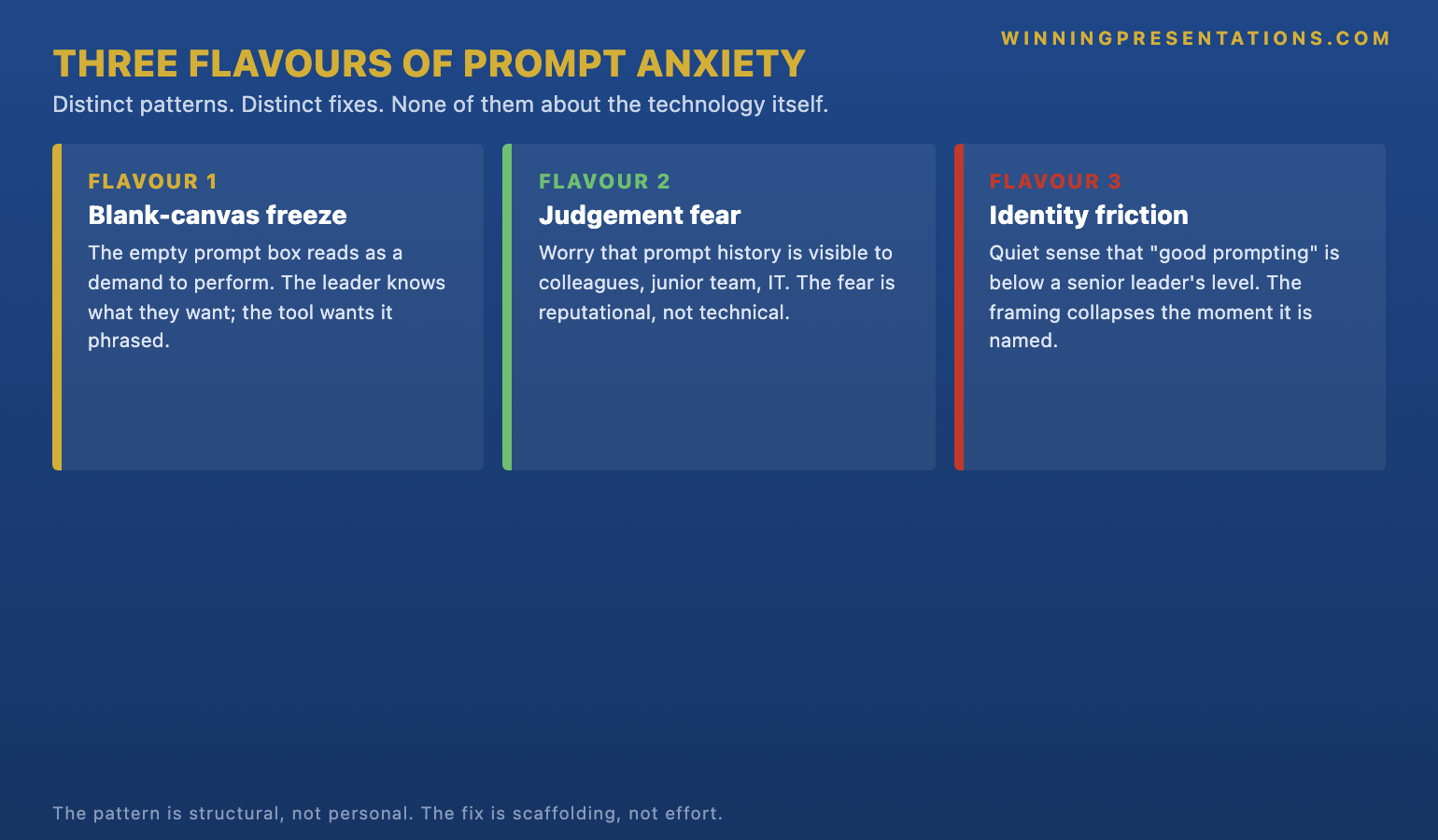
The three flavours of prompt engineering anxiety
The first flavour is blank-canvas freeze. The prompt box is empty. The cursor blinks. The leader knows roughly what they want, but the act of converting an internal sense of a question into a written brief — for an audience they cannot see, on a tool they have not yet calibrated — produces the same hesitation that a writer feels facing a blank page. For senior leaders, this hesitation has an edge that junior users do not feel, because the leader is used to being fluent. The blank page is not a familiar adversary. It feels like a small daily defeat.
The second flavour is judgement fear. Senior leaders are aware, sometimes more sharply than the rest of the organisation, that their prompt history is not entirely private. An IT colleague might see it during a support call. A coaching session might surface it. A team member who shares the workspace might glance at the recent activity. The fear is not really about the prompts themselves. It is about looking like a beginner in front of people who report to you, in a domain where the beginners are publicly competent. The leader’s professional identity has been built on knowing what to ask; being seen to fumble at the asking is a category of exposure most senior people are not used to.
The third flavour is identity friction — the quiet sense that careful, granular prompting is somehow below the level of the role. A director who briefs human teams in three sentences may feel awkward writing a four-paragraph prompt to a model. The internal voice asks: should I really be the one doing this? Shouldn’t I be making decisions, not crafting instructions? This friction is the most invisible of the three, because it does not present as anxiety. It presents as quiet, intermittent disengagement — opening the tool, getting a mediocre response, and walking away with the suspicion confirmed. For a closely related pattern, see our companion piece on AI anxiety in executive presentation work, which traces the same three flavours into the deck-writing context.
Why the anxiety is structural, not personal
The most useful single reframe a senior leader can hold about prompt engineering anxiety is that it is structural, not personal. The first generation of fluent AI users did not learn prompting from training programmes. They learned it from social media, from peer demonstrations, from late-evening experimentation with low-stakes tasks, and from a culture of “see what it does” that ran on platforms most senior leaders had already left. The cultural cues for what “good prompting” looks like came from a younger cohort, transmitted in formats — short videos, screen recordings, public threads — that senior leaders are less likely to have absorbed. The gap is not ability. It is exposure.
The second structural factor is that senior roles tend to compress the kind of low-stakes practice ground where new tools are usually learnt. A junior analyst can run a hundred Copilot prompts in a week, on tasks where a poor output costs nothing, and build calibration in the cracks of routine work. A senior leader’s day is denser, less forgiving of experimentation, and more likely to be spent on tasks where a mediocre output is genuinely a waste of time. The leader does not lack the capacity to learn the tool; the working day does not naturally provide the slack in which the learning happens.
The third structural factor, less often named, is that the leader’s existing competence works against them. Someone who briefs human teams effectively has a fluent, abbreviated, partially non-verbal style — a glance, a half-sentence, a shared context that makes a four-word brief sufficient. That fluency does not transfer to a model, which has none of the shared context. The leader’s instinct is to be terse; the tool rewards being structured. The mismatch is read by the leader as their own shortcoming, when it is actually the predictable cost of moving from a high-context to a low-context briefing channel. For a deeper treatment of this specific friction, our piece on imposter syndrome and AI in presentation work walks through the cognitive moves that re-stabilise senior identity in the new tool environment.
The freezing, the avoidance, the quiet sense that something familiar has become unfamiliar — these are the same patterns we work with in speaking anxiety. The mechanic transfers.
Conquer Your Fear of Public Speaking is a self-study programme for senior professionals who are technically capable but seize up in situations they used to handle without thinking. The work is the same: rebuilding the relationship between competence and comfort, on safe ground first, in private, before the stakes return.
- Self-study programme — practise alone, on your own schedule, before any audience is involved
- Built for senior professionals who are competent but freeze in specific situations
- The structural pattern that rebuilds confidence in speaking is the same pattern that rebuilds confidence in any high-stakes tool — including the prompt box
- Instant download on purchase, no subscription, lifetime access to the materials
The four-step rebuilding pattern
The rebuild has four moves and they run in order. The first is start solo. The second is start small. The third is start with reading prompts, not writing them. The fourth is start with a known task — something the leader already does well, where they can judge the output without external help. The four moves take pressure off the moment the leader sits down with the tool, because each one removes a different source of the original anxiety. Start solo removes the judgement-fear flavour. Start small removes the blank-canvas freeze. Start by reading neutralises the identity friction. Start with a known task gives the leader back the evaluation grip they had lost.
Start solo means: the first thirty hours with the tool happen on a personal device, in a private workspace, with no risk of a colleague seeing the history. The point is not secrecy. The point is removing one specific stressor while another is being worked on. A leader who is simultaneously learning the tool and managing the optics of being seen to learn the tool is doing two demanding things; they will do neither well. Strip the optics layer for the first month. Reattach it once the calibration is in place.
Start small means: the first prompts are about tiny, recoverable tasks. Reformat this paragraph. Summarise these three emails. Tighten this 200-word note. Translate this draft into something a senior audience would read. The task is small enough that the leader can hold the whole input and the whole output in their head, and judge the gap between the two. This is where calibration happens — not on a board commentary, where the leader is still reassembling their evaluation lens, but on a paragraph where the lens is already sharp.
The reframe: prompting is briefing, not coding
The single largest reframe — and the one that closes the loop on the identity friction flavour — is that prompting is not a separate skill from being a senior leader. It is the same skill, applied to a new tool. When a director briefs a junior analyst, they describe the decision, name the audience, set the time horizon, indicate the form of evidence that will land, and flag the things they do not want. The structural moves of a good prompt are identical: name the decision, name the audience, set the constraints, specify the output form, flag the failure modes. A senior leader who has spent fifteen years briefing teams is not a beginner at this. They are an expert at it. They have been routinely doing the underlying work the prompt is asking them to do.
The reason the reframe matters is that it changes what the leader is doing when they sit at the prompt box. They are not learning a new technical skill. They are translating an existing skill they already use fluently into a written form. That translation has a small learning curve — mostly about being more explicit than human briefing requires — but the substantive judgement, the bit that makes the brief work, is the bit the leader already owns. The fluency comes back quickly once the framing changes from “I am bad at this new thing” to “I am good at the underlying thing; I am still learning the surface.”
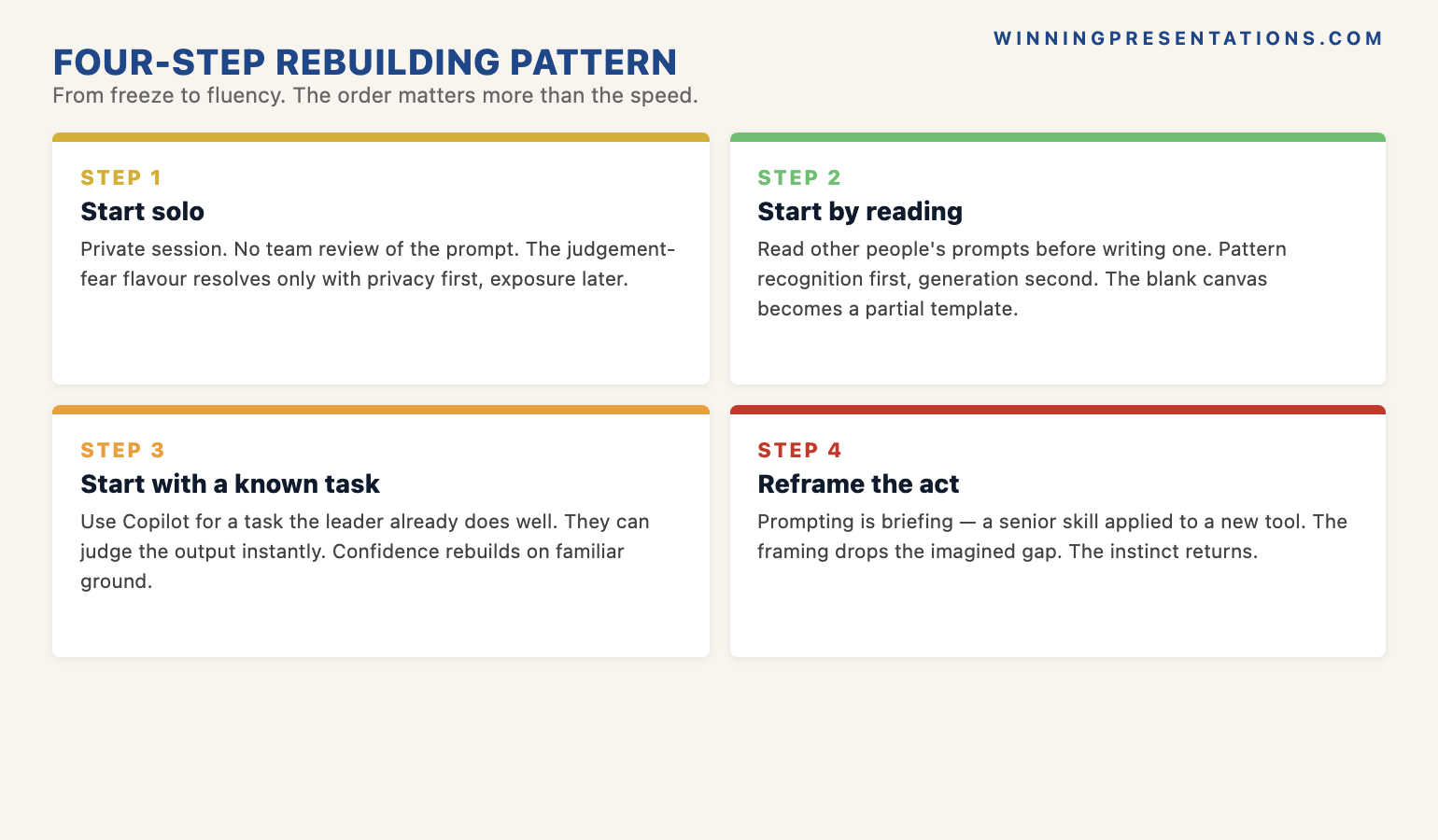
The reframe also closes the loop on the third anxiety flavour — identity friction. Once the leader sees prompting as briefing, the friction dissolves. Briefing is unambiguously senior work. It is one of the highest-leverage things a senior leader does. A director who writes a precise prompt is not stooping; they are doing exactly the work the role requires, with a different audience. The prompt box stops feeling like a place the leader is performing junior work, and becomes a place the leader is doing the senior work they were already good at — for a colleague who happens to be a model. For more on how this same shift plays out in the presentation context, see our companion piece on how senior leaders actually use AI in presentations.
If you want the structured framework for moving from prompt anxiety to AI-confident presentation work:
AI-Enhanced Presentation Mastery is a self-paced Maven programme — 8 modules, 83 lessons covering AI workflows for executive-grade presentation work, with monthly cohort enrolment. 2 optional live coaching sessions, fully recorded. £499, lifetime access to materials. Built for senior leaders who want a structured path through the territory rather than ad-hoc experimentation.
Why avoiding the tool is no longer neutral
For the last two years, a senior leader who quietly avoided AI tools could reasonably argue that the cost was zero. The team handled the AI-assisted parts of the workflow. The leader handled the parts that needed judgement. The output looked the same. That argument has stopped working. The team is no longer just using these tools for execution; they are using them upstream of judgement — for the synthesis, the contradiction-surfacing, the first-pass option mapping that used to happen in the leader’s head. A leader who is not in the same surface is, increasingly, working from a slower picture than the team is. The gap is widening rather than closing, and the longer the leader stays out, the more the team’s fluency becomes a quiet asymmetry inside the senior conversation.
The second cost is reputational, in a way that is almost never named directly. Junior colleagues notice which senior leaders use the tools and which do not. They do not say so. They adjust. Information flows differently to leaders who are not in the AI surface — slower, more pre-digested, with less contradiction-surfacing — because the team unconsciously protects them from the parts of the workflow that have moved into a tool the leader does not use. The leader experiences this as the team being “thoughtful”. It is also a quiet narrowing of the leader’s information channel, which over months matters more than any single missed prompt.
The third cost is the one the leader feels most directly: confidence. The longer avoidance runs, the more the prompt box accumulates symbolic weight, and the harder it becomes to start. Confidence does not return through reading articles about AI. It returns through low-stakes practice on safe ground, in private, on tasks the leader already evaluates well — the four-step rebuild this article has described. The pattern is structural, the rebuild is structural, and most leaders who run it find themselves through the gate within six to eight weeks. For a closely related practical guide, see our piece on teaching AI your presentation style, which extends the same scaffolding into the deck-writing context.
Frequently asked questions
Is prompt anxiety actually a thing, or am I just resistant to AI?
It is a real and patterned thing, and the distinction between anxiety and resistance is usually surfaced by one specific test: did you try the tool, dislike the early outputs, and quietly stop opening it — or did you decide on principle not to engage? If the first, the pattern is anxiety, and the rebuild is the four-step pattern in this article. If the second, the work is different and starts with examining the principle. Most senior leaders who think they are resistant are actually anxious; the resistance language is more dignified and less exposing, which is why the mind reaches for it first.
Should I admit to my team that I’m not using Copilot when they assume I am?
The answer most senior leaders find workable is partial honesty rather than full disclosure: acknowledge that you are still building your own pattern with the tool, ask one specific question about how a particular team member uses it for a specific task, and treat the conversation as peer learning rather than confession. The team almost always responds well to this — it is a lower-stakes admission than the leader fears, and it opens a useful information channel. Full silence, by contrast, tends to be read by the team eventually, and is harder to recover from than honest curiosity would have been.
Is there a “right” way to write prompts, or is it all just experimentation?
There are durable structural moves that lift prompt quality reliably — name the decision, name the audience, set the constraints, specify the output form, flag the failure modes — and these are stable across tools and across model generations. Beyond that, calibration is empirical: which models respond well to which kinds of framing, which tasks suit which surfaces, which constraints matter most for your specific workflow. Treat the structural moves as the rules and the calibration as the practice; both are needed, and the structural moves give the practice somewhere to stand.
How long does the rebuilding take in practice?
For most senior leaders who run the four-step pattern deliberately — solo, small, reading first, known-task before unknown-task — the move from avoidance to daily use takes six to eight weeks. The first two weeks feel awkward. Weeks three to five are when the calibration starts arriving, often unexpectedly, on a single task that suddenly works. Weeks six to eight are when the tool integrates into routine work without ceremony. Leaders who try to compress the rebuild into a single weekend usually find themselves back at avoidance within a month; the spaced practice is what makes the change durable.
The Winning Edge — weekly newsletter
The Winning Edge is a weekly newsletter for senior professionals who present at the executive level. One short email a week, focused on the structural moves that separate decks committees back from decks they defer. Subscribe to The Winning Edge →
Not ready for a full programme? Start here instead: download the free Executive Presentation Checklist — a one-page reference for the structural moves senior leaders run before every high-stakes presentation.
About the author
Mary Beth Hazeldine is Owner & Managing Director of Winning Presentations Ltd. With 24 years of corporate banking experience at JPMorgan Chase, PwC, Royal Bank of Scotland, and Commerzbank, she advises executives across financial services, healthcare, technology, and government on structuring presentations for high-stakes funding rounds, board approvals, and strategic decisions.