

In this article:
- What Executive Presence Actually Is
- What Online Presence Training Usually Gets Wrong
- The Structural Components That Actually Build Presence
- What to Look For in an Online Programme
- Self-Paced or Live? The Format Question
- How to Measure Whether Your Presence Is Actually Building
- Frequently Asked Questions
Tomás Alvarez, a divisional managing director in a European logistics group, had completed two executive presence courses in three years and paid for a third before he noticed the pattern. Each programme had produced a short-term lift in confidence and feedback. Each had receded within ninety days. His executive committee presentations were still landing as technically competent but not quite commanding. His chair had continued to say, in good faith, that he needed to “work on his presence.”
What each programme had taught him was surface technique. Where to stand. How to project. When to pause. When to make eye contact. He had absorbed all of it. None of it had changed the underlying experience of his presentations, because the issue was not his posture. The issue was that his thinking was not visible enough in the room for the committee to orient around it. He was reaching his conclusions in his head and presenting the conclusions. The structure that led to them was compressed inside him, invisible to the people he was trying to persuade.
The fourth programme Tomás chose was different. It spent the first three weeks on how executives structure arguments, how they sequence information for a senior audience, and how they make their thinking visible. Posture and voice were covered in a single module. By the end of the programme, Tomás was presenting to his committee at the same technical level — but his thinking was now visible in the sequence of the deck, in the pace of his narration, and in how he responded to questions. The chair stopped mentioning presence.
Tomás’s conclusion: the surface features of presence are real, but they are the symptom of the underlying discipline, not the cause. Training programmes that start with posture and voice are training symptoms. Programmes that start with thinking and structure are training the cause.
If you want structured, online executive presence training that works at the level of thinking, structure, and response — not just posture and voice — the AI-Enhanced Presentation Mastery programme on Maven covers the full architecture of how senior executives build and sustain room authority.
What Executive Presence Actually Is
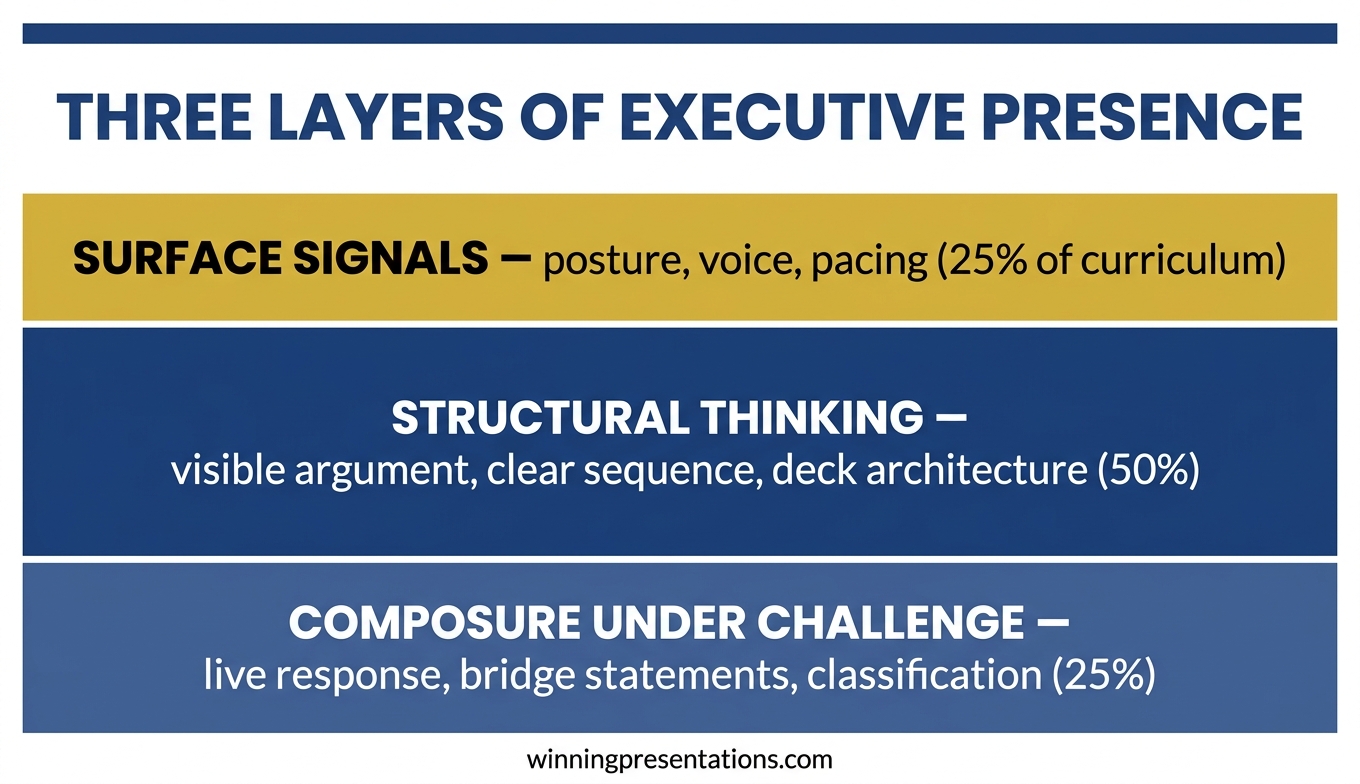
Executive presence is often described in terms of how someone carries themselves. That description is accurate but incomplete. Presence is a multi-layered phenomenon with three distinct components, and programmes that address only one layer produce partial results.
Layer one: surface signals. Posture, voice, eye contact, pacing, use of silence. These are the signals most directly observable, and they are what most coaching programmes focus on. They matter, but they are diagnostic, not causal. A senior executive with strong surface signals and weak underlying thinking reads as polished but not credible. A senior executive with imperfect surface signals and strong underlying thinking reads as credible despite the surface gaps.
Layer two: structural thinking visible in the room. How clearly the sequence of your argument can be traced by someone hearing it for the first time. How well the deck structure signals where the argument is going before it gets there. How concisely a complex idea can be expressed when asked to repeat it in a single sentence. This is the layer that most differentiates senior executives who hold the room from those who merely occupy it.
Layer three: composure under challenge. The specific ability to remain structured and non-defensive when a question lands unexpectedly, a data point is challenged, or a sceptical board member pushes back. This is the layer that separates presence in calm conditions from presence in adversarial ones. A senior executive whose presence collapses under pressure never holds the room beyond the introduction.
Executive Presence Training That Works at All Three Layers
AI-Enhanced Presentation Mastery is a self-paced executive programme covering structural thinking, slide architecture, composure under challenge, and the AI workflow that accelerates preparation. Eight modules, 83 lessons, two optional live coaching sessions — enrolment is open, join at your own pace.
£499 per seat. Designed for senior executives whose next presentation is to a board, committee, or investor audience.
What Online Presence Training Usually Gets Wrong
Most online executive presence training is built around video modules covering voice, body language, and communication style, followed by exercises and sometimes peer feedback. The format is not the problem. The problem is the curriculum design.
Over-indexing on surface technique. A programme that spends six modules on voice and body language and one module on structural thinking is teaching presence upside down. The surface components should occupy roughly a quarter of the curriculum, with the remaining three quarters on the structural and composure layers.
Generic scenarios. Training exercises that use generic business scenarios — “present a new product to your team” — do not transfer to the specific settings senior executives present in. A programme calibrated for senior audiences should use board meetings, audit committees, investor calls, capex committees, and strategic away-days as its scenario base.
Absence of live application. Passive video learning produces knowledge that does not transfer to live performance. The best online programmes build in live application — exercises the participant completes on a real upcoming presentation, or optional coaching sessions where a draft deck or Q&A scenario is stress-tested.
No connection to the tools the executive actually uses. Executives build decks in PowerPoint, increasingly with AI assistance. A presence programme that ignores the tooling executives use is asking them to mentally translate abstract principles into their actual working environment. Programmes that integrate the thinking discipline with the tools — including AI prompting for slide construction — deliver much higher transfer to live work.
The broader guide to building executive presence goes deeper into why structure precedes style.
The Structural Components That Actually Build Presence
Presence is built in four structural disciplines. Any serious online programme must cover each of them — not as a surface topic, but as a practiced skill.
Thinking architecture. How to structure an argument so that the conclusion is earned by the sequence of points that support it. The Pyramid Principle, SCQA, problem-solution-benefit, and similar frameworks are not stylistic — they are how senior executives make their thinking visible to audiences that need to be convinced efficiently. A presenter who has internalised these frameworks can construct a clear argument in fifteen minutes of preparation that a less-trained presenter would need three hours to draft.
Slide architecture. How the structure of the deck itself signals the argument. Headline-as-conclusion. One concept per slide. Jump-to structure. Appendix discipline. A deck whose architecture is clear does most of the work of establishing presence before the presenter has opened their mouth. The executive whose decks always look structured is read as structured by extension.
Live response under challenge. The capacity to handle an unexpected question, a challenged assumption, or a hostile frame without the structure of the presentation falling apart. This is a trainable skill — through rehearsed bridge statements, question classification disciplines, and structured response patterns. The presenter who handles challenge composedly is read as in command, regardless of whether they had the perfect answer.
Surface craft. Voice, pacing, silence, eye contact, posture. This layer is real and should be trained — but as the finishing polish on a structure that already works, not as a substitute for one.
What to Look For in an Online Programme
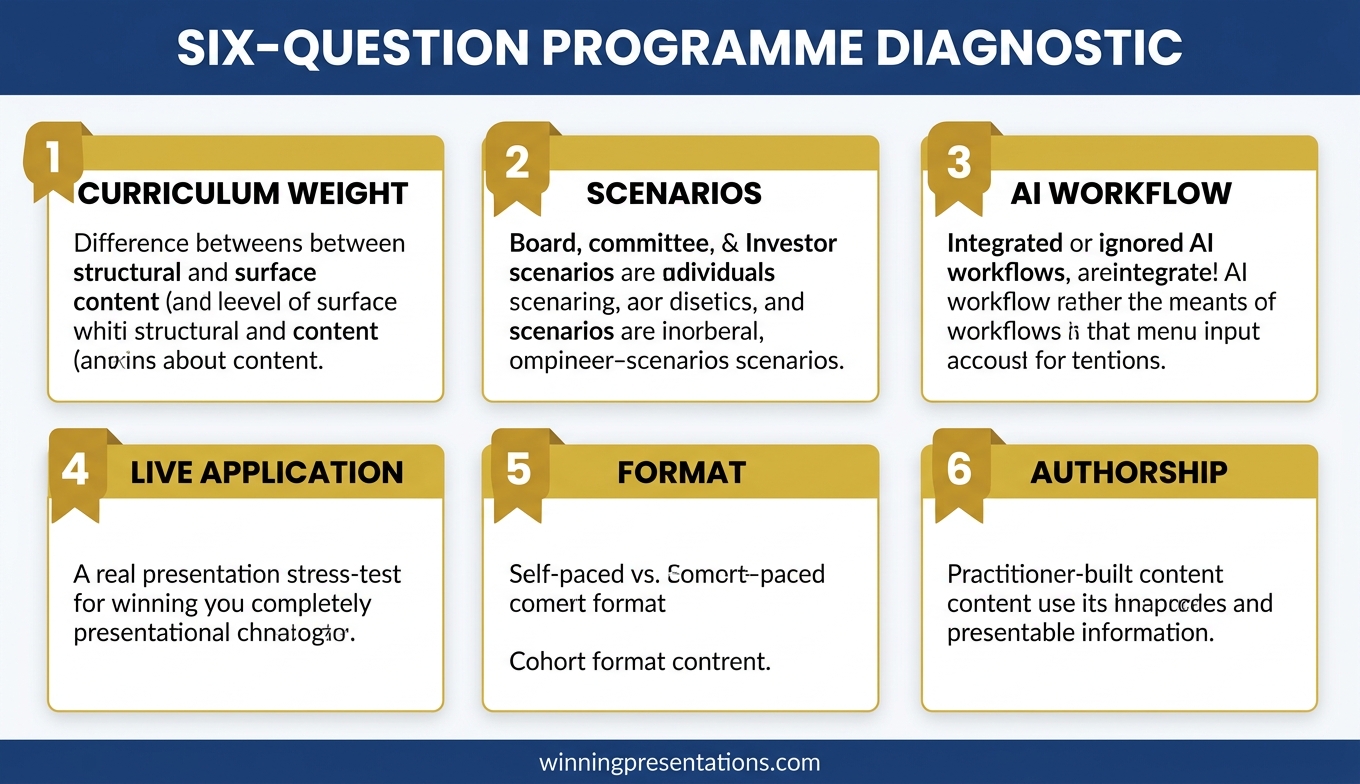
Six diagnostic questions before committing to any online executive presence programme:
1. What proportion of the curriculum is structural versus surface? If voice and posture modules outnumber structural and composure modules, the programme is surface-weighted. Look for programmes where structural thinking and live response together account for sixty per cent or more of the content.
2. What scenarios are used? Ask for an example of a module scenario. If the examples are generic, the programme is not calibrated for senior executive work. Look for board meetings, audit committees, capex committees, and executive team presentations in the core scenario base.
3. Is AI workflow integrated or ignored? Senior executives now build decks with AI assistance. A programme that treats AI as irrelevant is teaching presence for a working environment that no longer exists. Look for integrated prompt workflows that support structural discipline rather than undermine it.
4. Is there live application? Not just video modules and exercises. Does the programme include at least one opportunity to apply the learning to a real upcoming presentation — through coaching, critique, or structured feedback? Passive content alone does not transfer.
5. Is the format self-paced or time-bound? Both can work. Self-paced suits executives with unpredictable schedules who prefer to progress around live work. Time-bound suits executives who need the discipline of a cohort rhythm.
6. Who is the programme author? Presence is a practitioner discipline. Programmes built by practitioners who have presented at the level they are training — and who continue to advise senior executives — transfer better than programmes built primarily by academic or HR professionals.
A broader framework on the full set of capabilities that support senior-level speaking appears in executive communication skills.
If you want a programme that addresses all three presence layers with AI workflow integration, AI-Enhanced Presentation Mastery sequences structural thinking, slide architecture, and composure protocols across eight self-paced modules.
An Online Executive Presence Programme Built for Senior Work
AI-Enhanced Presentation Mastery on Maven covers thinking architecture, slide architecture, live response, and surface craft — integrated with the AI workflow executives actually use. Eight modules, 83 lessons, optional fully-recorded live coaching sessions.
£499 per seat. Enrolment is open — join at your own pace.
Self-Paced or Live? The Format Question
Online executive presence training comes in several formats. The choice matters less than the curriculum quality, but it is worth matching the format to how an executive actually works.
Self-paced with optional live sessions. The participant works through the modules on their own schedule. Optional live coaching or Q&A sessions are offered — attended live if possible, watched back on recording if not. This is the format that best fits the rhythm of most senior executives, whose diaries cannot support a fixed weekly time commitment over months. Ensure the live sessions are genuinely optional and fully recorded.
Cohort-based with fixed sessions. A group progresses through the material at a fixed pace, with live sessions at fixed times. This format suits participants who rely on the discipline of a schedule. The risk is that a missed live session leaves a gap that is harder to fill, particularly if recordings are not provided.
One-to-one coaching. The most intensive format and the most effective for individually tailored development. Also the most expensive. Most useful after a structural foundation has been built through a programme — coaching compounds on top of structure more than it substitutes for it.
For most senior executives balancing a demanding role, the self-paced programme with optional live coaching is the right choice. It provides structure without imposing rigid timing, and the live layer remains accessible when needed without penalising the weeks when it is not.
How to Measure Whether Your Presence Is Actually Building
Executive presence training is worth the investment only if it produces change in how the executive is received in their actual working environment. The measurement is not satisfaction with the programme. It is the shift in the room.
Observable shift 1: sharper questions from senior audiences. When your presence strengthens, senior audiences stop asking polite questions and start testing the thinking. The tone of the Q&A shifts from process to substance. This is the single most reliable signal. A chair who used to close with “thank you, very thorough” now closes with “that was a useful challenge to the committee.”
Observable shift 2: fewer requests to “take it offline.” A presentation that lands with presence produces decisions in the room, not deferrals. If the pattern of deferrals reduces over time on comparable material, the underlying presence has shifted.
Observable shift 3: shorter meetings, not longer. Strong presence compresses the meeting around the decision rather than expanding it through clarification. A presenter whose thinking is visible gets to the decision faster because the audience is not spending the first ten minutes reconstructing the argument in their heads.
Observable shift 4: invited to higher-stakes rooms. When presence consolidates, the executive is increasingly asked to present on strategic topics at the most senior level. The invitation is a downstream signal, not a direct measure, but over six to twelve months it is usually the clearest indicator that the room reads the executive differently. The deeper discussion of the measurement frame appears in senior leader presence.
Frequently Asked Questions
Is executive presence training online as effective as in-person?
Yes, if the programme is structurally weighted and includes live application. Online delivery allows far greater depth of curriculum — eighty-plus structured lessons is not feasible in an in-person format. The trade-off is the direct observation benefit of in-person coaching, which is why many senior executives combine a structured online programme with occasional one-to-one coaching sessions.
How long does online executive presence training take to show results?
Most participants see shifts in their next one or two presentations, particularly if they apply the structural modules to a live deck during the programme. Durable shift in how senior audiences receive them typically emerges over three to six months of repeated application. Programmes that promise transformation in weeks are usually selling surface technique, not building structural capability.
What is the right budget for online executive presence training?
Structured online programmes for senior executives typically sit in the £400–£1,500 range, with some premium offerings higher. Below £200 is usually surface-level content with limited application. Above £2,000 often carries bundled one-to-one coaching. For a senior executive whose next twelve months will include ten to twenty high-stakes presentations, the return on a well-calibrated programme is usually realised within one or two of those presentations.
Can you train executive presence without addressing posture and voice?
You can produce significant improvement without starting with posture and voice — but a complete programme should include them. The sequence matters: structure first, surface craft second. A curriculum that reverses the sequence produces a presenter who looks polished but whose thinking is still not making it into the room in a form the audience can follow.
Join The Winning Edge
Free weekly newsletter for senior executives working on presence, structural presentation, and the capacity to hold the room under challenge — delivered every Thursday.
Not ready for the full programme? Start here instead: download the free Executive Presentation Checklist — a quick-reference guide for structuring any high-stakes executive presentation at board and committee level.
Read next: If you are about to present a specific capital request to a finance committee and want to see structural presence applied concretely, see Capex Presentation Finance Committee: How to Structure the Request for Approval.
The next step is diagnostic. Look at the last presentation where a chair or senior colleague suggested you needed to work on your presence. Classify the gap: was it surface, structural, or composure? The classification determines which part of a programme will actually shift the outcome. Surface feedback asking for structural change — or vice versa — is the most common reason a previous programme did not land.
Mary Beth Hazeldine is the Owner & Managing Director of Winning Presentations. With 24 years of corporate banking experience at JPMorgan Chase, PwC, Royal Bank of Scotland, and Commerzbank, she advises executives across financial services, healthcare, technology, and government on structuring presentations, developing presence, and holding senior rooms under challenge.