

Quick answer: The leadership presentation coaching programme that works for senior leaders is structured around the constraint that almost defeats every other coaching format: senior leaders cannot reliably attend live sessions. The week ahead collapses in the diary repeatedly, regional travel cancels late, and a board meeting moves with two days’ notice. Any leadership presentation coaching programme that relies on mandatory live attendance is structurally incompatible with the working life of the audience it is trying to reach. The format that resolves this is self-paced course content with monthly cohort enrolment and optional, fully recorded Q&A sessions — the senior leader does the structured work privately on whatever days actually open up, joins the cohort enrolment that puts them alongside peers, and watches the optional Q&A calls back when their calendar permits. The format constraints are not concessions to busyness. They are the programme design.
JUMP TO:
- Why most leadership coaching programmes fail senior leaders on calendar grounds
- What a self-paced programme actually means at this seniority level
- The cohort enrolment that delivers peer benefit without live attendance
- The seven modules and what senior leaders actually build inside each
- Frequently asked questions
In 2022 I was approached by a chief operating officer of a UK-headquartered consulting firm who had been trying for eighteen months to find a leadership presentation coaching programme that her diary could absorb. She had enrolled in three programmes during that period, each marketed at senior leaders. The first was a four-week intensive with mandatory weekly live group calls. She made the first two and missed the last two because of unscheduled regional travel and a board paper that moved by a week. She fell behind, never caught up, and was refunded six weeks after the cohort ended. The second was a six-week programme with a shorter live commitment but a daily prompt-and-response cycle that assumed the leader could engage with the material in fifteen-to-twenty-minute increments each working day. She lasted eleven days; her diary then went sideways for three weeks and the prompts piled up unread. She abandoned the programme. The third tried to solve the engagement problem with a more flexible cadence but kept a mandatory two-hour live workshop at the start that she could not move and could not attend; she withdrew before the workshop because of a customer issue that ran late.
What she described, sitting across from me in the late autumn of that year, was the structural impossibility of any leadership presentation coaching programme that depends on the leader showing up at fixed times. The diary of a senior leader is not the diary of a mid-career manager. It does not collapse by half-hours; it collapses by whole days. It does not collapse predictably; it collapses on short notice and on the days the leader could not have anticipated. The leader is not unwilling. She is structurally unable to make commitments to live attendance that survive contact with her actual working life. Any leadership presentation coaching programme designed for this audience that does not start from this constraint is solving the wrong problem, regardless of how good the content is.
(This article was created with AI assistance; all stories and insights are based on 35 years of real client work.)
The structural design that resolves the constraint is a leadership presentation coaching programme built around three deliberate format choices: self-paced course content the leader works through privately whenever the diary actually opens up; monthly cohort enrolment that puts the leader alongside other senior peers working the same material on their own real decks; and optional Q&A or coaching sessions that are fully recorded so the leader can absorb them on a weekend morning, on a flight, or in the gap between two cancelled meetings. The format choices are not concessions to busy executives. They are the explicit programme architecture, because every other format I have observed designed for this audience — the four-week intensive, the six-week prompt cycle, the mandatory live workshop — produces the same predictable failure mode: high enthusiasm at enrolment, high attrition by week three, and refund requests by week six. The Executive Buy-In Presentation System is built end-to-end around the self-paced + cohort + optional-recorded design, because that is the design that survives a real senior diary.
If you have tried a leadership coaching programme and your diary has eaten it:
The Executive Buy-In Presentation System is the self-paced programme with monthly cohort enrolment built specifically for senior leaders whose calendar will not accommodate fixed live attendance. 7 modules, no deadlines, no mandatory live attendance, optional Q&A calls fully recorded — watch back anytime. Lifetime access to all course materials. £499.
Why most leadership coaching programmes fail senior leaders on calendar grounds
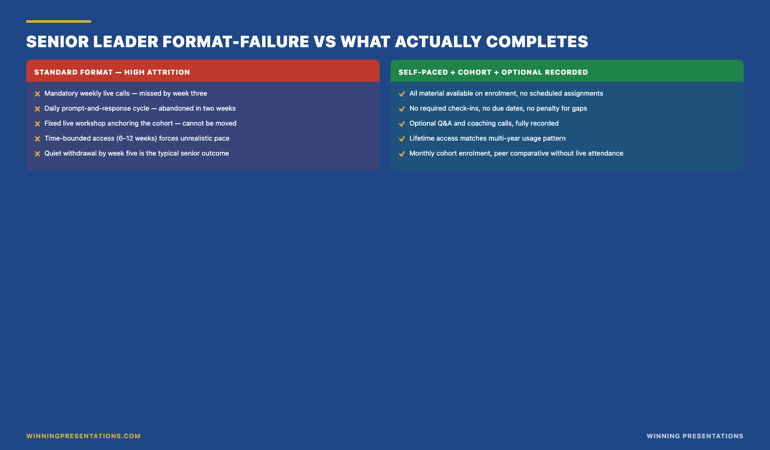
The standard architecture of a leadership coaching programme is built on assumptions inherited from the mid-career development market: predictable weekly availability, a shared cohort calendar everyone can sync to, a mandatory live workshop or two anchoring the structured engagement, and a delivery rhythm that assumes the leader can give the programme one to two hours per week on roughly the same days each week. Those assumptions are reasonable for a mid-career audience whose calendar is mostly under their own control. They break completely for a senior audience whose calendar is largely set by other people’s priorities — the chief executive’s diary, the board’s meeting cycle, the regulator’s timetable, the customer crisis, the late deal that needed a midnight phone call.
The result is a coaching market that nominally serves senior leaders but structurally serves mid-career managers, and that produces a particular failure pattern at the senior level. The senior leader enrols with genuine enthusiasm, makes the first one or two sessions, then runs into the first unmoveable diary conflict in week three. She misses one session. She tries to catch up via the recording. She does not, because the recording requires ninety uninterrupted minutes that her diary does not yield. The miss compounds. By week five she is two sessions behind, the cohort has moved on, and the live group conversations now reference material she has not absorbed. She quietly disengages. The programme’s enrolment metrics still count her; the programme’s completion rate at this seniority level is dramatically lower than the marketing implies. The pattern is so consistent that I now use “did you withdraw from a coaching programme in the last twelve months?” as a near-diagnostic question for whether the leader is fighting the format rather than the content.
The deeper structural problem is that the standard coaching market has assumed for years that the live element is what produces the value, and that programmes without live attendance are necessarily lower-quality. This assumption is roughly true for mid-career audiences, where the live group dynamic is itself a major part of the learning, but it is wrong for senior audiences, where the learning is primarily structural-and-private rather than social-and-live. A senior leader working through the structural elements of a board-level recommendation does most of the actual work alone with the deck, the brief, and the framework. The live element — if it adds anything — adds the comparative dimension of watching other senior leaders work through similar problems on different real decks. That comparative dimension is genuinely valuable, but it does not require live attendance. It requires recorded peer Q&A that the senior leader can absorb whenever the diary opens up.
What a self-paced programme actually means at this seniority level
“Self-paced” is a word that has been overloaded in the coaching market and now means different things in different programmes. In some programmes it means “you can complete the assignments on a flexible schedule but live calls are mandatory”. In others it means “the content is available all at once but there are weekly check-ins”. Neither of those is genuinely self-paced for a senior audience. A genuinely self-paced leadership presentation coaching programme means: all the material is available on enrolment, there are no scheduled assignments, there are no required check-ins, there are no due dates, and the leader works through the material whenever their actual diary permits — which for most senior leaders means three or four concentrated sessions over a three-to-six-month window, often on weekends or during long flights, interrupted by weeks where the programme goes untouched because the work itself has been overwhelming.
This is not a degraded version of a structured programme. It is the version that actually completes for this audience. The 7 modules of the Executive Buy-In Presentation System are designed to be worked through in any order the leader chooses, in any size of session their diary supports, with no penalty for gaps of weeks or months between sessions. The framework is the same; the cadence is the leader’s. A chief operating officer working on a real board paper might work through module 1 (stakeholder analysis) and module 3 (the opening) in two evening sessions, jump straight to module 6 (Q&A taxonomy) for the specific board paper, and return to modules 2, 4, 5, and 7 in the following quarter when the next board paper requires them. That sequence would be structurally chaotic in a fixed-cadence programme. It is exactly the design pattern self-paced enables, and it matches how senior leaders actually use the material.
The other element of self-paced that matters at this seniority level is lifetime access to materials. A senior leader will return to the framework repeatedly across multiple board papers over multiple years. A programme that restricts access to a six-week window forces the leader to consume the material on a schedule that does not match how they will actually use it. Lifetime access matches the multi-year usage pattern. The leader works through the framework once in the first six months, then returns to specific modules as specific situations arise over the following several years. The Executive Buy-In Presentation System is structured this way deliberately — the £499 buys lifetime access to all materials, not a six-week window. That is the structural fit for a senior audience, and it is the design senior leaders ask for when given the choice between time-bounded access and lifetime access at the same price.
The cohort enrolment that delivers peer benefit without live attendance
Senior leaders who hear “self-paced” sometimes infer “solitary”, and the inference is reasonable given how the term has been used elsewhere. The structural innovation of the Executive Buy-In Presentation System cohort enrolment is that it preserves the peer-comparative dimension — which is genuinely valuable for senior development work — without imposing the live-attendance constraint that breaks the format for this audience. New cohorts open every month. When a senior leader enrols, they join the next cohort whenever it suits them, and they are alongside a group of other senior peers who are working through the same modules on their own real decks at roughly the same time. The cohort structure provides the comparative dimension; the self-paced structure provides the format that the diary can absorb.
The optional Q&A and coaching sessions are the touchpoint where the cohort dimension becomes most visible. The sessions are scheduled at predictable times during each cohort cycle, are open to any leader in any current or past cohort, are not required, and are fully recorded so that any leader who cannot attend live can watch back. The content of the sessions is not the framework material — that lives in the self-paced modules — but the peer comparative dimension: another senior leader works through their specific board paper, asks the questions their situation surfaces, gets the structural response, and the rest of the cohort sees how the framework applies to a real case different from their own. A senior leader who watches the recording at 7am on a Saturday absorbs the same comparative learning as a leader who attended live. The format is genuinely structurally equivalent. The live attendance was never the load-bearing part.
This design also resolves the issue that defeats most senior leaders on coaching programmes: the moment they fall behind. In a fixed-cadence programme, falling behind compounds, because the live conversations reference material the leader has not yet absorbed. In the self-paced + cohort + optional-recorded design, there is no “behind”. A leader who has only worked through three modules can still attend or watch the Q&A session and benefit, because the Q&A is built around real cases rather than module-sequence dependencies. A leader who has worked through all seven modules but missed the last three Q&A sessions can catch up over a weekend without losing any structural value. The programme is genuinely robust to the senior diary, which is the design constraint the whole architecture is built around. For more on the structural framework, see the Executive Buy-In Masterclass overview and the broader presentation coaching services catalogue.
Work at your own pace. Keep the materials forever.
The Executive Buy-In Presentation System — 7 self-paced modules, monthly cohort enrolment, optional recorded Q&A calls. The format senior leaders use when live attendance is structurally not possible. Enrol with the next cohort whenever suits you; work through the material on whatever days actually open up. £499, lifetime access to materials, no deadlines, no mandatory attendance.
- 7 modules of self-paced course content covering stakeholder analysis, case construction, and presentation structure
- Optional live Q&A / coaching calls, fully recorded — watch back anytime on whatever schedule actually works
- Monthly cohort enrolment — join whenever suits you, no fixed start date
- Lifetime access to all course materials, no deadlines
The seven modules and what senior leaders actually build inside each
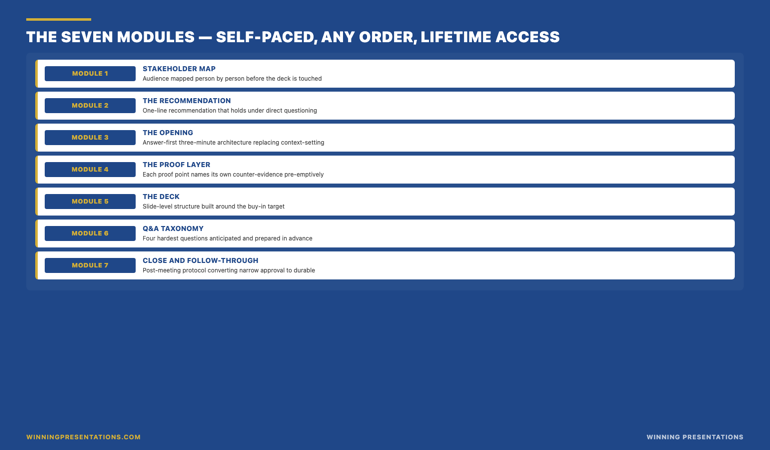
The leadership presentation coaching programme is organised across 7 modules covering stakeholder analysis, case construction, and the presentation structures that hold up at senior level. Module 1 builds the stakeholder map — the audience mapped person by person before the deck is touched. Module 2 builds the recommendation — the one-line recommendation that holds under direct questioning. Module 3 builds the opening — the answer-first three-minute architecture that replaces the standard context-setting approach. Module 4 builds the proof layer — each proof point names its own counter-evidence pre-emptively rather than waiting to be challenged. Module 5 builds the deck — the slide-level structure constructed around the buy-in target rather than around the available content.
Module 6 builds the Q&A taxonomy — the four hardest questions anticipated and prepared in advance, drawn from the stakeholder map and the case structure. Module 7 builds the close and follow-through — the post-meeting protocol that converts narrow approval into durable commitment. Each module is structured as a sequence of practical exercises against the leader’s own real upcoming presentation, not against case studies, because the framework is most useful when it is built against material the leader actually has to deliver. A senior leader who works through the modules in sequence on a real board paper typically produces a measurably restructured deck inside the first month, and a measurably different pre-meeting protocol inside the second. The cohort enrolment is what surrounds the private work with the peer comparative dimension; the optional recorded Q&A is where the dimension becomes most visible.
The price is £499 for lifetime access to all course materials. There are no deadlines, no mandatory attendance, no time-bounded restrictions, and no upgrade tiers. The optional live Q&A and coaching sessions are included; they are recorded; they are watchable anytime. Monthly cohort enrolment means the leader can enrol whenever suits them and start with the next cohort. The programme is built end-to-end on the assumption that the leader’s diary is the constraint, not the content, and that the design choices that resolve the diary constraint are what allow the programme to actually complete for the audience it is built for. The mid-career coaching market does not need this design. The senior leadership audience does.
For the slide-level structure that pairs with the framework — the actual templates the modules reference, the prompt library for AI-assisted drafting, the scenario playbooks for specific board situations — pair the coaching programme with the Executive Slide System (£39). It contains 26 executive templates, 93 AI prompts, and 16 scenario playbooks that the buy-in framework references throughout module five. Most senior leaders enrolled in the coaching programme who also own the slide system report the module five work goes about half the time it otherwise would.
Designed for senior professionals who present decisions to boards, investment committees, and executive sponsors.
The Executive Buy-In Presentation System — 7 self-paced modules covering the psychology and structure that earn serious approval, with monthly cohort enrolment and optional recorded Q&A sessions. £499, lifetime access to materials. The leadership presentation coaching programme architected around the constraint that defeats every other format at this seniority level.
Frequently asked questions
If the live calls are optional, do I miss anything by not attending them?
You do not, because the calls are fully recorded and are watchable on whatever schedule actually works for your diary. The structural value of the call is the peer comparative dimension — watching another senior leader work through their specific board paper and seeing how the framework applies to a real case different from your own. That comparative learning is preserved in the recording. The leaders who watch back on a weekend morning or in the gap between two cancelled meetings report the same value as the leaders who attend live. The recording is not a degraded substitute for the live session. It is the format that makes the programme actually work for an audience whose diary cannot reliably hold a fixed live time.
How long does the programme take to complete?
There is no fixed completion timeline because the programme is self-paced. Senior leaders typically work through the 7 modules over three to six months when they are using the framework against an active board paper, often in concentrated sessions on weekends or long flights interrupted by weeks where the work itself absorbs all available attention. Lifetime access to the materials means there is no penalty for taking longer or for returning to specific modules years later when a different situation requires them. The most common usage pattern is to work through all 7 modules in the first six months, then return to module 6 (Q&A taxonomy) or module 4 (proof layer) repeatedly over the following several years as new board papers require them. The programme is designed for that multi-year usage pattern, not for a fixed six-week sprint.
Is this appropriate for someone who already has a long-standing 1:1 coach?
Yes, and the leaders who already have a strong 1:1 relationship tend to get the most from it because they have already done the early framework-installation work the programme builds on top of. The cohort dimension adds the parallel-track exposure that 1:1 cannot produce — watching six other senior leaders work the same framework against six different decks. Most leaders who run both find their 1:1 conversations become sharper after the cohort, because they bring back specific structural questions surfaced by watching peers handle problems the leader had not yet encountered. Treat the formats as complementary rather than competing — 1:1 for the deep personal work, the programme for the structural framework and the peer comparative dimension.
What is the most common mistake senior leaders make when choosing a coaching programme?
Choosing the programme on content quality rather than on format fit. The content of most senior leadership coaching programmes is broadly similar — the underlying frameworks have been around long enough that the differences between programmes on content are relatively small. The differences on format are enormous, and the format determines whether the leader actually completes the programme or quietly withdraws. A programme with very good content and a format incompatible with senior diaries is worse than a programme with good content and a format the diary can absorb, because the second one actually gets used. Choose on format first, content second. For senior leaders specifically, the format constraint that matters most is the absence of mandatory live attendance — programmes that require it will not survive contact with the working life of the audience they are trying to reach.
The Winning Edge — weekly newsletter
The Winning Edge is a weekly newsletter for senior professionals who present at the executive level. One short email a week on the structural moves that separate decks committees back from decks they defer. Subscribe to The Winning Edge →
For the wider library of presentation assets that pair with the coaching programme — the slide system, the storytelling primer, the Q&A taxonomy, the delivery references — the Complete Presenter bundle (£99) collects them in one place.
About the author
Mary Beth Hazeldine is Owner & Managing Director of Winning Presentations Ltd. With 24 years of corporate banking experience at JPMorgan Chase, PwC, Royal Bank of Scotland, and Commerzbank, she advises executives across financial services, healthcare, technology, and government on structuring presentations for high-stakes funding rounds, board approvals, and strategic decisions.
The next time you weigh a leadership presentation coaching programme, do three things instead: check whether the format requires fixed live attendance and rule out anything that does; check whether the structured material is available all at once on enrolment or trickled out on a fixed cadence and rule out the latter; and check whether the access is lifetime or time-bounded and prefer lifetime. The senior leaders who complete a coaching programme are not the ones who happened to have the most spare time. They are the ones who chose a format that the diary could absorb, then worked through the material on whatever days actually opened up. The format is the work. The Executive Buy-In Presentation System is built around that recognition.