

A compliance presentation to your board isn’t about listing every control and audit trail. It’s about making the invisible visible—demonstrating that your organisation understands its risks, has addressed them thoughtfully, and remains operationally solid. The best compliance presentations satisfy governance requirements whilst keeping executives mentally engaged rather than overwhelmed by detail.
Need a structured approach to board presentations?
The Executive Slide System gives you proven frameworks, prompt cards, and slide templates for high-stakes governance meetings.
Jump to section:
A real moment: Kwame, the Chief Compliance Officer at a mid-market insurance broker, stood in front of his board with a 47-slide deck on regulatory obligations. Three minutes in, the Finance Director was checking emails. By slide twelve, the Chair asked him to “just tell us what we need to know.” He’d made a classic error: he’d built the presentation for the audit file, not for the boardroom. Six months later, after restructuring his approach around business impact rather than compliance tick-boxes, the same board gave his compliance update a standing question—because they understood not just what he was managing, but why it mattered to the organisation’s future. That shift—from “here are the rules” to “here’s how we’re protecting value”—is what separates compliance presentations that merely pass governance from those that actually persuade.
The Three-Act Structure That Works
A compliance presentation to a regulatory board or steering committee needs clear architecture. Executives are not processing compliance for the first time; they’re busy, they’re sceptical of jargon, and they’re thinking about what it costs the business. Your structure must answer three questions in sequence: What are we managing? How well are we managing it? What do we do next?
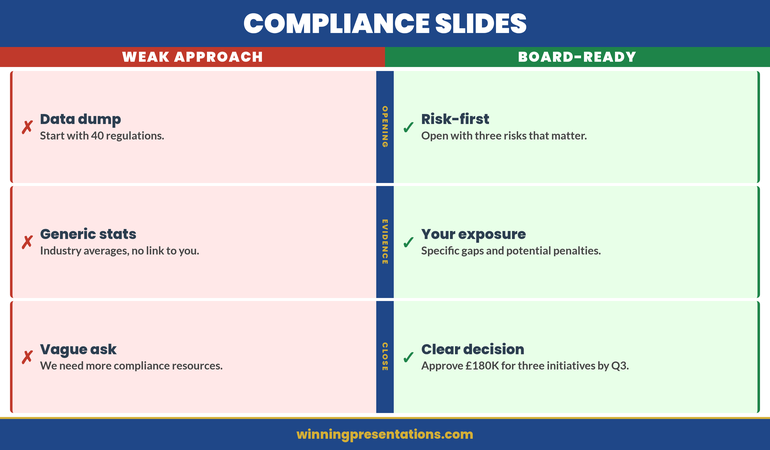
Act One: Context and Risk Landscape. Don’t open with a list of policies. Open with the risk picture. What regulatory environment is your organisation operating in? What has changed since the last update? What are the material compliance risks? This section should take 10–15 per cent of your time and establish why the board should pay attention. Use language like “our regulatory footprint has shifted” or “three new obligations take effect in the next quarter” rather than “we have implemented controls.”
Act Two: Control Posture and Assurance. This is where you demonstrate rigour. Show what you’re monitoring, how you’re testing, and where you’ve found gaps. The key is proportionality: don’t list every control. Show the control framework, then zoom into material areas. Use heat maps, trend lines, and open-item trackers so the board can see both your governance discipline and the reality of your risk management. This is also where you surface remediation activity—”we identified this gap in Q3, we’ve taken these steps, and here’s our timeline to close.” Boards respect transparency about gaps far more than a false appearance of perfection.
Act Three: Forward Look and Decisions. End with what you need from the board. Is it sign-off on a remediation plan? Approval of budget for a new control framework? Acknowledgement that you’re managing a residual risk? Make the ask clear and specific. Don’t end by summarising what you’ve just said.

Master Board Presentation Structure
The Executive Slide System includes frameworks for:
- Building credibility with governance committees in under 30 minutes
- Structuring complex risk narratives into clear, decision-ready slides
- Balancing regulatory detail with boardroom engagement
- Creating control heat maps and status dashboards executives actually read
- Crafting forward-looking recommendations boards will approve
Used by compliance, risk, and executive teams in regulated industries
Language That Board Members Respect
The way you talk about compliance in a boardroom sets the tone for how seriously they take it. Poor language signals either defensiveness (“we had to implement this”) or bureaucratic distance (“the control framework necessitates”). Strong language signals mastery and confidence.
Use outcomes, not activities. Instead of “we conducted 247 audit tests,” say “our testing validated that 96 per cent of high-risk transactions are operating within tolerance.” Instead of “we rolled out a new policy,” say “we’ve tightened approval authorities in the approval workflow to reduce settlement risk.” Boards care about what the activity achieved, not that you did it.
Connect to strategy and value. Compliance isn’t abstract governance. It’s about protecting shareholder value, maintaining customer trust, and operating with licence to trade. When you talk about regulatory obligations, immediately connect them to business impact. “The FCA’s new conduct rules affect how we price advisory services—we’ve redesigned our fee structure to ensure we remain competitive whilst maintaining margin.” That’s a language board members understand.
Be precise about timelines and ownership. Vague timelines erode credibility. Don’t say “we will enhance controls over the next period.” Say “we will implement the new segregation-of-duties control by end of Q2, with testing complete by end of Q3.” Name the owner. “Sarah Chen in Operations is leading this workstream.” This level of specificity signals that you have a real plan, not a hope.
When you’re discussing challenges or gaps, use language that frames them as managed risks rather than failures. “We identified a gap in our data retention protocol during the Q2 audit cycle. We’ve prioritised remediation and expect closure by April. The residual risk remains within our tolerance whilst controls are strengthened.” This is how senior executives talk to each other about problems.
Slide Design for Compliance Confidence
Compliance presentations often suffer from slide design that screams “I had to put this together quickly and I’m not sure what’s important.” Clean, intentional design signals that you’re on top of your brief.
One idea per slide. If your compliance slide has four separate concepts, your audience will remember none of them. A slide on risk landscape stays on risk landscape. Your next slide addresses controls. This discipline forces you to think clearly about sequence and meaning.
Use visuals that work. Heat maps showing risk ratings (green/amber/red) are far more useful than text lists. A simple bar chart showing the trend in audit findings over time tells a story in seconds. A control dashboard showing status, owners, and completion dates is infinitely more credible than a paragraph describing control assurance. Visuals aren’t decoration in a compliance presentation; they’re how you make complexity legible.
Label every number. A slide that says “247” with no context is useless. But “247 transactions tested with 237 passing tolerance, 10 requiring remediation” gives the board immediate insight. When you’re showing metrics, always include the denominator, the time period, and what “good” looks like.
As discussed in our technology evaluation presentation guide, even technical audiences respond to clarity and structure. The same principles apply to compliance: remove noise, highlight signal, make numbers speak.
Ready to redesign your compliance slides? The Executive Slide System includes templates for board-ready control dashboards, risk matrices, and assurance trackers.
Common Mistakes in Board Compliance Presentations
Knowing what to avoid is half the battle. Most compliance presentations stumble on a handful of predictable errors.
Mistake One: Leading with process instead of impact. Your first slide should not be your governance structure chart. It should be your risk landscape or your compliance evolution. Process details come later, if at all. The board doesn’t care about your committee hierarchy; they care about what risks you’re managing and how well you’re managing them.
Mistake Two: Presenting to the wrong audience layer. If your board has a dedicated Risk or Audit Committee, that committee’s appetite for detail is different from the full board’s. A Risk Committee might sit with a 40-slide deep-dive on control testing. The full board will mentally check out at slide 15 unless every slide answers “why does this matter to us?” Tailor your depth and terminology to the room.
Mistake Three: Hiding bad news. Boards have instincts for obfuscation. If you’ve found gaps or issues, surface them early and clearly. Explain what you’ve done about them. Then move on. A board’s confidence in your compliance posture depends less on the absence of problems than on your credibility in identifying and addressing them. As we explored in our article on restructuring presentations and team trust, transparency builds credibility more than spin.
Mistake Four: Forgetting that boards are busy. A 90-minute compliance presentation will lose your audience. Aim for 20–30 minutes of core content, with time for questions. Every slide should earn its place. If it doesn’t change the board’s understanding or decision, remove it.
Cut presentation time. Increase board confidence.
- AI prompt cards for rapid slide refinement
- Pre-built frameworks for risk narrative and assurance storytelling
Preparing for Questions and Challenges
Boards ask questions. The best compliance presentations anticipate them. If you’re presenting on a new regulatory requirement, be ready to explain: What does this mean for our business specifically? What’s our timeline? What resources do we need? Who bears accountability? What’s our competitive position?
Prepare for sceptical questions too. “Why do we need to spend £500k on this control framework?” “What happens if we don’t implement this?” “Are our competitors doing the same thing?” Having clear, business-focused answers ready signals that you’ve thought the matter through, not just accepted regulatory instruction at face value.
Keep your backup slides minimal but focused. One or two slides with detailed control matrices or policy excerpts can be useful if a director wants to dive deeper. But don’t rely on backup slides as a substitute for clear main-deck storytelling.
Building a Presentation Rhythm Across the Year
Most organisations give compliance updates to their boards quarterly or semi-annually. Use this rhythm strategically. Your Q1 update might focus on the regulatory landscape shift and annual compliance calendar. Q2 might dive into audit findings and remediation tracking. Q3 could focus on policy refresh and control enhancements. Q4 might be about compliance readiness for the next regulatory year and resource planning.
This prevents every update from feeling like a fire-hose of information. It also allows you to build narrative momentum. Boards remember a series of connected updates far better than a series of isolated reports. Your compliance presentation doesn’t stand alone; it’s part of your year-long conversation with the board about managing risk and protecting value.
Structure your compliance presentation like a strategic narrative, not a checklist. The Executive Slide System gives you frameworks for turning governance obligations into board-ready stories.
Is This Right For You?
This approach is for compliance officers, risk leaders, audit heads, and finance executives who need to communicate governance obligations to boards, steering committees, and regulatory oversight bodies. You’re looking to move beyond “here’s what the regulator said” towards “here’s what we’re managing and why it matters.” You want your board to understand not just that you’re compliant, but that you’re in control.
You’ll get the most from this if you’re working in a regulated industry (financial services, insurance, healthcare, utilities, major technology platforms), you’re responsible for enterprise risk or compliance reporting, and you want to tighten your boardroom communication around these high-stakes updates.
Turn Compliance Updates Into Board Confidence
The Executive Slide System gives you everything you need for high-confidence governance presentations:
- Frameworks for structuring risk narrative, control posture, and forward-looking recommendations
- Slide templates for compliance heat maps, audit dashboards, and regulatory tracking
- AI prompt cards for rapid iteration and refinement of your messaging
- Psychology-backed guidance on how boards process risk information and make decisions
- Real examples of compliance presentations that persuade rather than pacify
Join compliance leaders and risk officers who’ve transformed their board communication
Frequently Asked Questions
How long should a compliance presentation to a board take?
Aim for 20–30 minutes of core content, leaving 10–15 minutes for questions. Some boards will want more time; some will want less. The time should be proportional to the complexity of the compliance landscape and the materiality of recent findings. A board facing a new regulatory regime might give you 45 minutes. A routine quarterly update might be 15 minutes. Clarify expectations with your Board Chair or Audit Committee Chair before you begin building your deck.
What’s the best way to handle a board question you can’t answer in the moment?
Be direct. “That’s a great question. I don’t have the data to hand, but I’ll get you clarity by end of week.” Then actually do it. This builds credibility far more than trying to bluff your way through. Boards respect humility and follow-through more than the appearance of total omniscience. If it’s a question that might come up again, use it as a cue to improve your data and measurement going forward.
How do I talk about compliance costs without sounding defensive?
Frame compliance investment as risk management, not cost. “We’ve budgeted £300k for control enhancements this year. This addresses three high-priority regulatory obligations and reduces our settlement risk by an estimated 75 per cent. It also brings us in line with peer practices in the market.” You’re answering: What are we getting? Why does it matter? How does it compare? This is how boards think about investment decisions.
Join The Winning Edge
Weekly intelligence on presentation structure, boardroom psychology, and executive communication. Delivered to your inbox.
Get the Executive Presentation Checklist free—a step-by-step framework for structuring any board presentation.
Related: Learn how to structure difficult announcements to your board in our guide to redundancy announcement presentations.
Your board needs clarity, confidence, and momentum. The Executive Slide System → £39 gives you the frameworks and templates to deliver exactly that in your next compliance update.
Mary Beth Hazeldine is Owner & Managing Director of Winning Presentations. She advises thousands of executives across financial services, healthcare, technology, and government on how to structure presentations that persuade boards and stakeholders in high-stakes funding rounds and approvals. With 24 years of corporate banking experience at JPMorgan Chase, PwC, Royal Bank of Scotland, and Commerzbank, she knows what boards actually listen to—and why.