

Quick Answer
When someone in the room comments on the fact that you are shaking, the response that restores authority is not denial, not apology, and not over-explanation. It is four words: “Caffeine, not the room.” Said calmly, with eye contact, with no smile and no shrug. The line acknowledges what was observed, attributes it to a neutral cause, and closes the conversation in one breath. The room moves on. Your authority is intact. And you have not lied — caffeine is genuinely the cause for many senior professionals at midlife, even when the underlying anxiety is also a factor.
On this page
Magdalena had been chairing the European executive committee of a logistics group for two years when one of the divisional MDs interrupted her mid-recommendation: “Maggie — your hand is shaking. Are you all right?” The room looked at her. She had a half-second to respond. The recommendation she had been about to make involved a £14M restructuring. The wrong answer — any answer that broke the rhythm or invited a longer conversation about her wellbeing — would have made the next forty minutes about the wrong topic.
What Magdalena said was: “Caffeine, not the room.” She said it without smiling, without shrugging, with steady eye contact. The MD nodded. The room moved on. She finished the recommendation, the committee approved it, and the meeting ran another 35 minutes without anyone returning to the comment. Three weeks later she told me the line had felt like the most powerful thing she had said in a meeting that year, even though it was four words.
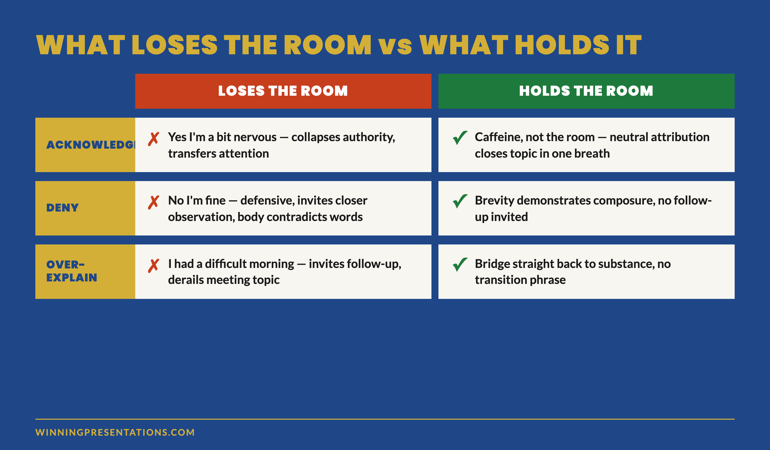
The rare moment when a senior colleague comments on a visible anxiety symptom — shaking, sweating, voice tremor — is one of the highest-stakes seconds in executive Q&A. The standard advice in older presentation training programmes is wrong for this moment. Acknowledging it (“yes, I’m a bit nervous”) collapses authority. Denying it (“no, I’m fine”) sounds defensive. Over-explaining it (“I had a difficult morning”) invites further conversation about something that is none of the room’s business. The structurally right response is the one that closes the topic in one breath without lying, without apologising, and without leaving the audience wondering.
If you want a structured library of executive Q&A responses
The four-word response is one specific case of a broader category — wellbeing-adjacent comments mid-meeting. The full system covers the calm-authority responses senior leaders need across the harder Q&A categories: hostile questions, technical curveballs, premature challenges, and the wellbeing-adjacent comments this article addresses.
Why comments about visible anxiety happen at senior level
Most senior professionals expect that comments about visible anxiety symptoms are vanishingly rare in executive environments. They mostly are. But the situations in which they do happen follow a pattern, and understanding the pattern reduces both the frequency and the impact.
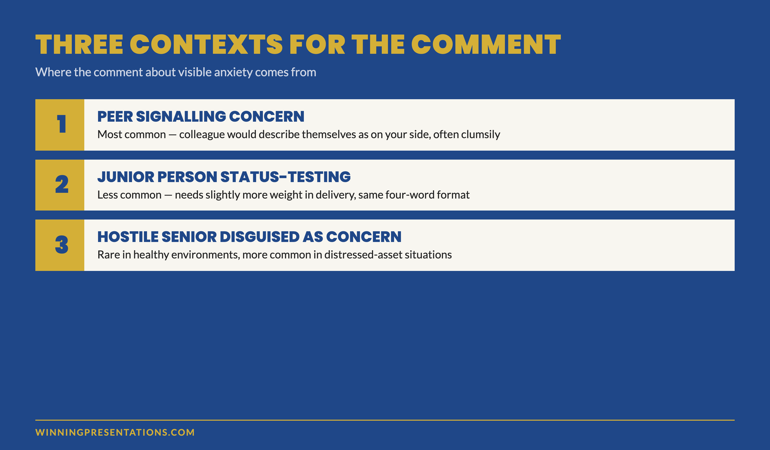
The first context is when the comment comes from a peer who knows you well. The MD who comments on Magdalena’s shaking is not being hostile — they are signalling concern, often clumsily. In peer-to-peer dynamics at the executive level, the comment is more likely from someone who would describe themselves as on your side. This matters because the response can read as either rebuffing concern (which damages the relationship) or accepting concern (which collapses authority in front of the rest of the room). The line needs to thread both — closing the topic without rejecting the colleague.
The second context is when the comment comes from a more junior person in the room — a board observer, a junior member of the executive team, an investor representative who is new to the dynamic. In this case the comment is sometimes status-testing rather than concern. The response needs to land with slightly more weight, but the four-word format still works because it produces enough closure to disincline a follow-up.
The third context is when the comment comes from a senior person who is hostile. This is rare in well-functioning executive environments and more common in turnaround or distressed-asset situations. The hostile version of the comment is usually disguised as concern but is structurally an attempt to undermine. The four-word response works here too, with one adjustment — the eye contact needs to be slightly more direct and the pause after slightly longer. The same line. Different delivery. Same closing effect.
What unites all three contexts is that the room is watching how you absorb the comment, not the content of the comment itself. The four-word format is calibrated for that observation — short enough to demonstrate composure, neutral enough to not invite follow-up, factual enough to not read as denial.
The 4-word response — and why it works
“Caffeine, not the room.” The line works at four levels simultaneously, which is why such a short response can do so much.
At the first level, it acknowledges what was observed. The colleague said they noticed shaking. The response confirms there is something to notice — no awkward denial. The room is not left wondering whether the senior leader saw what everyone else saw.
At the second level, it attributes the cause to something neutral and external. Caffeine is not embarrassing. It is not weakness. It is not a confession. It is the kind of thing that everyone in the room has experienced at some point, and the colleague who commented now has a frame that lets them move on without feeling they were rebuffed for caring.
At the third level, it explicitly excludes the most damaging interpretation. “Not the room” means: this is not about you, not about the meeting, not about the stakes, not about the recommendation. The phrase actively closes the door on the interpretation the room would otherwise be running silently.
At the fourth level, the brevity itself communicates composure. A senior leader with the calm to dispatch the comment in four words and return to the recommendation is not someone who is collapsing. The shortness of the response is the demonstration of authority.
The line is not a deflection or a lie. For most senior professionals at midlife, caffeine is genuinely a contributor to visible tremor — the body’s adrenaline response amplifies the slight muscular tremor that caffeine produces, and at 50+ the body’s caffeine clearance is slower than it was at 30, so the morning’s three coffees are more present in the system at the 11am board meeting than they used to be. Naming caffeine names a real contributor. The line is honest.
For senior professionals whose tremor is heavily anxiety-driven, the line still works because it is structurally true that the underlying activation is multifactorial. The body’s cooling channel, the caffeine in the system, the room temperature, the morning’s accumulated load — all of these contribute. Naming one accurate factor in a way that closes the room’s curiosity is the structural work the line is doing. It is not lying about anxiety. It is choosing which true thing to name.
For senior professionals who want to expand the response library beyond the wellbeing-adjacent category — into hostile questions, technical curveballs, and the harder Q&A scenarios — the Executive Q&A Handling System covers the full set of structures that hold authority under different kinds of pressure.
What loses the room — three common responses
The senior professional whose hand is shaking and who hears the comment is often, in the half-second of decision, drawn to one of three responses. All three are tempting because they are emotionally honest. All three damage authority. Knowing why is part of being able to override the impulse and reach for the four-word line instead.
Response 1 — The acknowledgement (“Yes, I’m a bit nervous”)
This response is the one that emotionally intelligent senior leaders are most drawn to. It feels honest, vulnerable, and humanising. In peer one-to-one settings it would be the right call. In a meeting where you are mid-recommendation and the room is watching, it is structurally damaging. The acknowledgement transfers the room’s attention from the recommendation to your emotional state. The next forty minutes will run with that frame. The committee will approve or reject the recommendation partly on whether they think you can manage the emotional load of the implementation. You have unintentionally introduced a different decision criterion.
Vulnerability has its place in executive leadership. The middle of a recommendation in front of an executive committee is not the place. The four-word line lets you save the vulnerability for a different conversation in a different setting.
Response 2 — The denial (“No, I’m fine”)
This response feels like the opposite of acknowledgement, but it has the same effect through a different mechanism. The denial is read by the room as defensive. The colleague who commented now feels rebuffed. The audience starts watching for confirmation of the symptom rather than letting it pass. The denial extends the moment by inviting closer observation, which is the opposite of what closure is supposed to do. The room’s attention stays on whether you are fine, not on the recommendation.
The denial also tends to be visibly false. The hand is still shaking. Saying “I’m fine” with a shaking hand reads as someone trying to control the narrative rather than someone with the calm to dispatch the comment. The audience trusts the body more than the words.
Response 3 — The over-explanation (“I had a difficult morning”)
This response feels like the diplomatic middle ground. It acknowledges that something is going on without confessing to anxiety. The damage here is that it invites a follow-up — colleagues who care will ask what happened, and the room is now committed to a conversation about your morning. The recommendation is still on hold. You are still talking about yourself rather than the £14M restructuring. The frame is still not back where it needs to be.
The over-explanation is also a category of response that, repeated over time, builds a reputation for being someone whose meetings get derailed by personal things. Not in any single instance, but in aggregate. Senior leaders who use this pattern frequently find their authority eroding without being able to identify why.
For the full executive Q&A response library
The Executive Q&A Handling System
- Structured response patterns for the hardest categories of executive Q&A — hostile questions, technical curveballs, premature challenges, wellbeing-adjacent comments
- Calm-authority frameworks designed for senior professionals who need to hold the room under genuine pressure
- Decision-safe answers in 45 seconds — the format the boardroom expects, not the over-long answers junior training teaches
- Built for board, executive committee, and investor presentation contexts
The Executive Q&A Handling System — £39, instant access, lifetime use.
Get the Executive Q&A Handling System →
For senior professionals presenting to boards, committees, and investor panels.
What to do in the next 60 seconds after the line lands
The four-word response closes the topic. The next 60 seconds reinforce the closure. The senior professional who delivers the line and then immediately returns to the recommendation reinforces the message that the comment was not significant. The senior professional who delivers the line and then pauses, smiles awkwardly, looks down, or says anything else — undoes the work the line just did.
The structure for the next 60 seconds is direct: bridge straight back to the substantive content with no transition phrase. Not “as I was saying” — that phrase signals that you registered a disruption. Not “where was I” — that phrase signals you lost your place. Just go to the next sentence of the recommendation as though no comment had been made. The room will follow your lead. The colleague who commented will let it go because you have signalled that you have.
It helps to have rehearsed the recommendation deeply enough that the next sentence is available without conscious effort. This is one specific reason structural preparation matters — the muscle memory of what comes next means the bridge back to substance is automatic, and the room reads the automaticity as composure.
If the colleague who commented is someone you would want to address one-to-one — a peer who has shown concern in good faith — the right time is after the meeting, in private. A short message: “Thanks for noticing — I appreciated it. All fine, just over-caffeinated.” This preserves the relationship without having spent the meeting itself on it.
Frequently asked questions
What if it really is the room and not caffeine?
The line still works because it is structurally true that the body’s response is multifactorial. The activation in your system right now is some combination of caffeine clearance, room temperature, accumulated load, and the meeting context — naming one accurate contributor in a way that closes the room’s attention is not lying. It is choosing which true thing to name. The honest part is that you are not denying anything; you are attributing to a contributor that does not invite further conversation. If caffeine is genuinely not in your system that morning, alternatives include “low blood sugar, not the room,” “morning workout, not the room,” or “cold hands, not the room” — pick the one that is also true for you.
What if my voice is shaking rather than my hand?
The same structural response works with a slight word change. “Cold tea, not the room” lands well for voice tremor because the room can pattern-match the explanation easily — a slightly warm-then-cold drink does affect vocal cords. “Allergies, not the room” works in spring or early autumn. The four-word format is the structure; the specific neutral attribution adapts to which symptom the colleague flagged.
What if the colleague follows up and asks if I’m sure I’m okay?
The follow-up is rare when the line is delivered with composure, but it does happen. The response is a single sentence with a redirect: “Honestly fine, thanks — let me come back to the customer concentration figure on slide nine.” The redirect to a specific later point in the deck signals confidence and gives the room a forward direction. The colleague almost always lets it go because the redirect demonstrates you are clearly tracking the substance of the meeting.
Does this work in virtual meetings as well as in-person?
Yes, with one adjustment. In a virtual meeting, the colleague’s comment usually arrives via chat or as a small spoken interruption between substantive contributions. The response is the same four words spoken with the same composure, but you can also use the chat to send a brief follow-up to the colleague directly: “Thanks — really fine, just morning caffeine. Will catch up after.” The dual-channel response works particularly well in virtual settings because it preserves the relationship while keeping the meeting on track.
Is this advice different for women in male-dominated executive environments?
The structural response is the same; the calibration is sometimes different. Women in heavily male-dominated executive teams sometimes find that even the brief four-word line gets followed by a more persistent follow-up, because the dynamic of the room treats the visible symptom as more remarkable than it would in a woman’s voice or hand. The response to the persistent follow-up is the same single-sentence redirect described above, with the same forward orientation. The structural work — close the topic, return to substance — does not change. The cultural environment may make the closure require slightly more weight in delivery; the words themselves are the same.
The Winning Edge — weekly newsletter for senior presenters
One framework, one micro-story, one slide pattern — every Thursday morning, ten minutes’ read. For senior professionals who want my best material before it appears anywhere else.
Not ready for the full system? Start here: download the free Executive Presentation Checklist — a one-page reference for the structural questions every executive deck must answer before the meeting.
For more on the in-the-moment physical reset that prevents these comments arising in the first place, see the 20-second physical reset for mid-presentation symptoms.
Mary Beth Hazeldine — Owner & Managing Director, Winning Presentations Ltd. After 24 years in corporate banking at JPMorgan Chase, PwC, Royal Bank of Scotland and Commerzbank, she advises senior professionals across financial services, healthcare, and technology on structuring presentations and Q&A responses for high-stakes funding rounds, board approvals, and committee decisions.